Bayesian analysis of the shear modulus in the neutron-star crust
Pith reviewed 2026-06-27 15:47 UTC · model grok-4.3
The pith
Bayesian analysis shows nuclear-physics priors reduce uncertainties in neutron-star crust shear modulus
A machine-rendered reading of the paper's core claim, the machinery that carries it, and where it could break.
Core claim
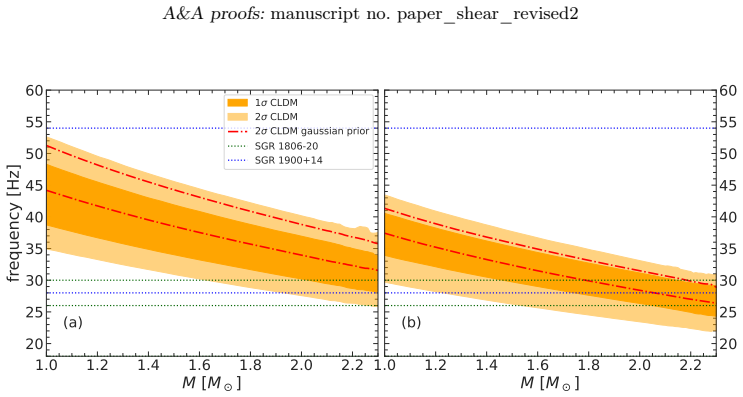
Using the one-component plasma approximation with a semi-classical treatment of the ions, the authors perform Bayesian inference on the shear properties starting from both a non-informative and a nuclear-physics-informed prior. They find that the two priors produce compatible central values for the shear modulus and speed, but the nuclear-informed prior considerably reduces the associated uncertainties. The fundamental torsional crustal mode frequencies obtained lie in the interval approximately 20-50 Hz, which overlaps the low-frequency range of observed quasi-periodic oscillations.
What carries the argument
Bayesian inference on shear modulus and speed with non-informative versus nuclear-informed priors inside the one-component plasma model of the crust
If this is right
- Fundamental torsional crustal mode frequencies lie between approximately 20 and 50 Hz.
- Nuclear-informed priors give results compatible with the non-informative case but with substantially smaller uncertainties.
- The reduced uncertainties can tighten predictions for the frequencies of crustal modes.
- Shear properties enter calculations of crustal modes that have been linked to quasi-periodic oscillations and possible gravitational-wave emission from crust deformations.
Where Pith is reading between the lines
- Additional nuclear scattering or binding-energy measurements could shrink the remaining uncertainty bands on shear speed even further.
- The same Bayesian setup could be applied to finite-temperature or multi-component plasma models to test robustness of the frequency range.
- If the narrower predictions hold, they would strengthen the use of observed quasi-periodic oscillation frequencies as direct probes of crust composition.
Load-bearing premise
The one-component plasma approximation with a semi-classical treatment of the ions is sufficient to model the inhomogeneous matter in the neutron-star crust at zero temperature.
What would settle it
A measured quasi-periodic oscillation frequency lying well outside the 20-50 Hz interval, or a laboratory constraint on nuclear parameters that produces shear-modulus posteriors inconsistent with the narrower band obtained from the informed prior.
Figures

read the original abstract
The elastic properties of the neutron-star crust are important for the calculations of crustal modes. In particular, the ability of the crust to support shear stresses has been connected to observations of quasi-periodic oscillations and to crust deformations potentially emitting gravitational waves. In this work, we assess the uncertainties in the shear modulus and shear speed in the neutron-star outer and inner crust. To this aim, we performed a Bayesian analysis of the shear properties of the neutron-star crust at zero temperature starting from both a non-informative and a nuclear-physics-informed prior. For the treatment of inhomogeneous matter in the crust, we relied on the one-component plasma approximation, with a (semi-)classical treatment of the ions. We show that the use of a nuclear-physics-informed prior has a non-negligible impact on the prediction of the elastic properties of the crust. The frequency of the fundamental torsional crustal modes we obtain is compatible with the low-frequency range of observed quasi-periodic oscillations, our estimates lying in the interval $\approx 20 - 50$~Hz. Although the different considered priors lead to compatible results, the inclusion of nuclear-physics experimental information in the prior considerably reduces the uncertainties in the prediction of the elastic properties of the crust, potentially constraining the predicted frequency of the crustal modes.
Editorial analysis
A structured set of objections, weighed in public.
Referee Report
Summary. The manuscript performs a Bayesian analysis of the shear modulus and shear speed throughout the neutron-star outer and inner crust at zero temperature, employing the one-component plasma approximation with a semi-classical treatment of the ions. It compares results obtained with a non-informative prior against those obtained with a nuclear-physics-informed prior, reports that the two sets of posteriors are compatible, and states that the informed prior substantially narrows the credible intervals on the elastic quantities; the resulting fundamental torsional mode frequencies lie in the interval ≈ 20–50 Hz and are therefore compatible with the low-frequency range of observed QPOs.
Significance. If the central numerical result holds, the work supplies a concrete, quantitative demonstration that the inclusion of external nuclear-physics constraints in the prior can materially tighten predictions for crustal elasticity and mode frequencies while leaving the central values unchanged. The internal consistency of the Bayesian update within a fixed microphysical model is a clear strength; the production of falsifiable frequency predictions (20–50 Hz) is also a positive feature.
major comments (1)
- [Abstract / Methods] The abstract (and, by the reader’s assessment, the methods section) provides no explicit statement of the likelihood function, the parameters that are varied, or the precise manner in which nuclear experimental information enters the informed prior. Because the central claim is precisely the reduction in posterior width that results from switching priors, this omission is load-bearing for evaluating whether the reported uncertainty reduction is robust.
minor comments (2)
- The one-component plasma plus semi-classical ion treatment is presented as a modeling choice rather than a claim of ultimate accuracy; the stress-test concern about this approximation therefore does not undermine the internal prior-comparison result.
- Notation for the shear modulus (and its relation to the Coulomb parameter) should be defined once at first use and used consistently thereafter.
Simulated Author's Rebuttal
We thank the referee for their careful reading of the manuscript and for the constructive comment. We address the point below and will revise the manuscript to improve clarity.
read point-by-point responses
-
Referee: [Abstract / Methods] The abstract (and, by the reader’s assessment, the methods section) provides no explicit statement of the likelihood function, the parameters that are varied, or the precise manner in which nuclear experimental information enters the informed prior. Because the central claim is precisely the reduction in posterior width that results from switching priors, this omission is load-bearing for evaluating whether the reported uncertainty reduction is robust.
Authors: We agree that the abstract and methods section would benefit from an explicit statement of the likelihood function, the parameters varied, and the precise manner in which nuclear experimental information enters the informed prior. This will allow readers to better evaluate the robustness of the reported uncertainty reduction. In the revised manuscript we will expand the methods section to provide these details (including the form of the likelihood, the parameter space sampled, and the construction of the informed prior from nuclear data) and will update the abstract to briefly reference the Bayesian setup. revision: yes
Circularity Check
No significant circularity
full rationale
The paper performs a standard Bayesian update on shear modulus and crustal mode frequencies inside a fixed one-component plasma model at T=0, comparing a non-informative prior to an externally supplied nuclear-physics-informed prior. The reported outcome (narrower credible intervals with the informed prior, frequencies in 20-50 Hz) is an internal statement about posterior contraction and does not reduce to any self-definition, fitted input renamed as prediction, or self-citation chain. The model assumptions are stated explicitly and are not derived from the results themselves.
Axiom & Free-Parameter Ledger
axioms (1)
- domain assumption One-component plasma approximation accurately describes the crust matter
Reference graph
Works this paper leans on
-
[1]
Relativistic mean-field theories for neutron-star physics based on chiral effective field theory , author =. Phys. Rev. C , volume =. 2022 , month =. doi:10.1103/PhysRevC.106.055804 , url =
-
[2]
The population of merging compact binaries inferred using gravitational waves through GWTC-3
Abbott, R. and others. Population of Merging Compact Binaries Inferred Using Gravitational Waves through GWTC-3. Phys. Rev. X. 2023. doi:10.1103/PhysRevX.13.011048. arXiv:2111.03634
work page internal anchor Pith review Pith/arXiv arXiv doi:10.1103/physrevx.13.011048 2023
-
[3]
Thermal properties of supernova matter: The bulk homogeneous phase
Constantinou, Constantinos and Muccioli, Brian and Prakash, Madappa and Lattimer, James M. Thermal properties of supernova matter: The bulk homogeneous phase. Phys. Rev. C. 2014. doi:10.1103/PhysRevC.89.065802. arXiv:1402.6348
work page internal anchor Pith review Pith/arXiv arXiv doi:10.1103/physrevc.89.065802 2014
-
[4]
, year = 1971, month = dec, volume =
The Ground State of Matter at High Densities: Equation of State and Stellar Models. , year = 1971, month = dec, volume =. doi:10.1086/151216 , adsurl =
-
[5]
Annals of Physics , year = 1971, month = jan, volume =
Neutron starquakes and pulsar speedup. Annals of Physics , year = 1971, month = jan, volume =. doi:10.1016/0003-4916(71)90084-4 , adsurl =
-
[6]
Neutron Stars 1: Equation of state and structure
-
[7]
Nuclear physics constraints from binary neutron star mergers in the Einstein Telescope era. Phys. Rev. D , keywords =. doi:10.1103/PhysRevD.108.122006 , archivePrefix =. 2308.12378 , primaryClass =
-
[8]
Reviews of Modern Physics , archivePrefix = "arXiv", eprint =
Equations of state for supernovae and compact stars. Reviews of Modern Physics , archivePrefix = "arXiv", eprint =. doi:10.1103/RevModPhys.89.015007 , adsurl =
-
[9]
Burgio, G. F. and Fantina, A. F. Nuclear Equation of State for Compact Stars and Supernovae. The Physics and Astrophysics of Neutron Stars. 2018. doi:10.1007/978-3-319-97616-7_6
-
[10]
Static Solutions of Einstein's Field Equations for Spheres of Fluid. Phys. Rev. , year = 1939, month = feb, volume =. doi:10.1103/PhysRev.55.364 , adsurl =
-
[11]
On Massive Neutron Cores. Phys. Rev. , year = 1939, month = feb, volume =. doi:10.1103/PhysRev.55.374 , adsurl =
-
[12]
Relativistic mean-field interaction with density-dependent meson-nucleon vertices based on microscopical calculations. Phys. Rev. C , archivePrefix = "arXiv", eprint =. doi:10.1103/PhysRevC.84.054309 , adsurl =
-
[13]
Unified equations of state for cold non-accreting neutron stars with Brussels-Montreal functionals - I. Role of symmetry energy. MNRAS , keywords =. doi:10.1093/mnras/sty2413 , archivePrefix =. 1903.04981 , primaryClass =
-
[14]
New relativistic mean-field interaction with density-dependent meson-nucleon couplings , author =. Phys. Rev. C , volume =. 2005 , month =. doi:10.1103/PhysRevC.71.024312 , url =
-
[15]
Equation of state and thickness of the inner crust of neutron stars , author =. Phys. Rev. C , volume =. 2014 , month =. doi:10.1103/PhysRevC.90.045803 , url =
-
[16]
Physics of Particles and Nuclei , year = 2015, month = jul, volume = 46, pages =
CompOSE CompStar online supernova equations of state harmonising the concert of nuclear physics and astrophysics compose.obspm.fr. Physics of Particles and Nuclei , year = 2015, month = jul, volume = 46, pages =. doi:10.1134/S1063779615040061 , adsurl =
-
[17]
CompOSE reference manual. Eur. Phys. J. A , year = 2022, month = nov, volume =. doi:10.1140/epja/s10050-022-00847-y , adsurl =
-
[18]
Erratum: Unified equations of state for cold non-accreting neutron stars with Brussels-Montreal functionals. I. Role of symmetry energy. MNRAS , keywords =. doi:10.1093/mnras/stz800 , adsurl =
-
[19]
Binary and ternary ionic compounds in the outer crust of a cold nonaccreting neutron star. , keywords =. doi:10.1103/PhysRevC.94.065802 , archivePrefix =. 2103.06073 , primaryClass =
-
[20]
A unified equation of state of dense matter and neutron star structure
A unified equation of state of dense matter and neutron star structure. , keywords =. doi:10.1051/0004-6361:20011402 , archivePrefix =. astro-ph/0111092 , primaryClass =
work page internal anchor Pith review Pith/arXiv arXiv doi:10.1051/0004-6361:20011402
-
[21]
Nonparametric inference of neutron star composition, equation of state, and maximum mass with GW170817. Phys. Rev. D , keywords =. doi:10.1103/PhysRevD.101.063007 , archivePrefix =. 1910.09740 , primaryClass =
-
[22]
Direct astrophysical tests of chiral effective field theory at supranuclear densities. Phys. Rev. C , keywords =. doi:10.1103/PhysRevC.102.055803 , archivePrefix =. 2004.07744 , primaryClass =
-
[23]
Detailed examination of astrophysical constraints on the symmetry energy and the neutron skin of ^ 208 Pb with minimal modeling assumptions. Phys. Rev. C , keywords =. doi:10.1103/PhysRevC.104.065804 , archivePrefix =. 2107.05528 , primaryClass =
-
[24]
Bayesian analysis of the crust-core transition with a compressible liquid-drop model. Eur. Phys. J. A , keywords =. doi:10.1140/epja/i2019-12884-1 , archivePrefix =. 1902.07032 , primaryClass =
-
[25]
General predictions for the neutron star crustal moment of inertia. Phys. Rev. C , keywords =. doi:10.1103/PhysRevC.100.055803 , archivePrefix =. 1810.00719 , primaryClass =
-
[26]
Slowly Rotating Relativistic Stars. I. Equations of Structure. , year = 1967, month = dec, volume =. doi:10.1086/149400 , adsurl =
-
[27]
Nuclear matter and its role in supernovae, neutron stars and compact object binary mergers. Phys. Rep. , keywords =. doi:10.1016/S0370-1573(00)00019-3 , archivePrefix =. astro-ph/0002203 , primaryClass =
work page internal anchor Pith review Pith/arXiv arXiv doi:10.1016/s0370-1573(00)00019-3
-
[28]
The AME 2020 atomic mass evaluation (II). Tables, graphs and references. Chinese Physics C , keywords =. doi:10.1088/1674-1137/abddaf , adsurl =
-
[29]
Bayesian inference of neutron star crust properties using an ab-initio─benchmarked metamodel. , keywords =. doi:10.1103/74qx-8ym8 , archivePrefix =. 2506.05603 , primaryClass =
-
[30]
Constraint on phase transition with the multimessenger data of neutron stars , author =. Phys. Rev. D , volume =. 2021 , month =. doi:10.1103/PhysRevD.103.063026 , url =
-
[31]
Tews, I. and Margueron, J. and Reddy, S. Critical examination of constraints on the equation of state of dense matter obtained from GW170817. Phys. Rev. C. 2018. doi:10.1103/PhysRevC.98.045804. arXiv:1804.02783
work page internal anchor Pith review Pith/arXiv arXiv doi:10.1103/physrevc.98.045804 2018
-
[32]
Neutron star radii and crusts: Uncertainties and unified equations of state. Phys. Rev. C , keywords =. doi:10.1103/PhysRevC.94.035804 , archivePrefix =. 1604.01944 , primaryClass =
work page internal anchor Pith review Pith/arXiv arXiv doi:10.1103/physrevc.94.035804
-
[33]
Universe , year = 2020, month = nov, volume =
Neutron Star Properties: Quantifying the Effect of the Crust-Core Matching Procedure. Universe , year = 2020, month = nov, volume =. doi:10.3390/universe6110220 , adsurl =
-
[34]
Influence of the crust on the neutron star macrophysical quantities and universal relations. Phys. Rev. C , keywords =. doi:10.1103/PhysRevC.104.015801 , archivePrefix =. 2106.12845 , primaryClass =
-
[35]
Polytropic fits of modern and unified equations of state (in review)
-
[36]
Astronomy & Astrophysics , keywords =
Uncertainties in the pasta-phase properties of catalysed neutron stars. Astronomy & Astrophysics , keywords =. 2021a , month = oct, volume =. doi:10.1051/0004-6361/202141192 , archivePrefix =. 2109.13638 , primaryClass =
-
[37]
The Nuclear Matter Density Functional under the Nucleonic Hypothesis. Universe , keywords =. 2021c , month = oct, volume =. doi:10.3390/universe7100373 , archivePrefix =. 2109.09675 , primaryClass =
-
[38]
Dinh Thi, H. and Fantina, A. F. and Gulminelli, F. The effect of the energy functional on the pasta-phase properties of catalysed neutron stars. Eur. Phys. J. A. 2021b. doi:10.1140/epja/s10050-021-00605-6. arXiv:2111.04374
-
[39]
The proto-neutron star inner crust in a multi-component plasma approach. , keywords =. doi:10.1051/0004-6361/202346606 , archivePrefix =. 2309.01527 , primaryClass =
-
[40]
Tidal Love numbers of neutron stars
Hinderer, T. Tidal Love numbers of neutron stars. 2008. doi:10.1086/533487. arXiv:0711.2420
work page internal anchor Pith review Pith/arXiv arXiv doi:10.1086/533487 2008
-
[41]
Hinderer, T. and Lackey, B. D. and Lang, R. N. and Read, J. S. Tidal deformability of neutron stars with realistic equations of state and their gravitational wave signatures in binary inspiral. Phys. Rev. D. 2010. doi:10.1103/PhysRevD.81.123016. arXiv:0911.3535
work page internal anchor Pith review Pith/arXiv arXiv doi:10.1103/physrevd.81.123016 2010
-
[42]
Nuclear Physics A , year = 1991, month = dec, volume = 535, pages =
A generalized equation of state for hot, dense matter. Nuclear Physics A , year = 1991, month = dec, volume = 535, pages =. doi:10.1016/0375-9474(91)90452-C , adsurl =
-
[43]
Direct URCA process in neutron stars , author =. Phys. Rev. Lett. , volume =. 1991 , month =. doi:10.1103/PhysRevLett.66.2701 , url =
-
[44]
Isospin Physics in Heavy-Ion Collisions at Intermediate Energies
Isospin Physics in Heavy-Ion Collisions at Intermediate Energies. International Journal of Modern Physics E , keywords =. doi:10.1142/S0218301398000087 , archivePrefix =. nucl-th/9707014 , primaryClass =
work page internal anchor Pith review Pith/arXiv arXiv doi:10.1142/s0218301398000087
-
[45]
Nuclear ``pasta'' structures and the charge screening effect. Phys. Rev. C , eprint =. doi:10.1103/PhysRevC.72.015802 , adsurl =
-
[46]
Newton, W. G. and Gearheart, M. and Li, Bao-An. A survey of the parameter space of the compressible liquid drop model as applied to the neutron star inner crust. ApJ Suppl. Ser. 2013. doi:10.1088/0067-0049/204/1/9. arXiv:1110.4043
work page internal anchor Pith review Pith/arXiv arXiv doi:10.1088/0067-0049/204/1/9 2013
-
[47]
Ravenhall, D. G. and Pethick, C. J. and Lattimer, J. M. NUCLEAR INTERFACE ENERGY AT FINITE TEMPERATURES. Nucl. Phys. A. 1983. doi:10.1016/0375-9474(83)90667-X
-
[48]
Equation of state and neutron star properties constrained by nuclear physics and observation
Hebeler, K. and Lattimer, J. M. and Pethick, C. J. and Schwenk, A. Equation of state and neutron star properties constrained by nuclear physics and observation. 2013. doi:10.1088/0004-637X/773/1/11. arXiv:1303.4662
work page internal anchor Pith review Pith/arXiv arXiv doi:10.1088/0004-637x/773/1/11 2013
-
[49]
Raithel, Carolyn A. and Most, Elias R. Degeneracy in the Inference of Phase Transitions in the Neutron Star Equation of State from Gravitational Wave Data. Phys. Rev. Lett. 2023. doi:10.1103/PhysRevLett.130.201403. arXiv:2208.04294
-
[50]
Tidal deformability doppelg \"a nger: Implications of a low-density phase transition in the neutron star equation of state. Phys. Rev. D , keywords =. 2023b. doi:10.1103/PhysRevD.108.023010 , archivePrefix =. 2208.04295 , primaryClass =
-
[51]
A NICER View of PSR J0030+0451: Millisecond Pulsar Parameter Estimation. , keywords =. doi:10.3847/2041-8213/ab481c , archivePrefix =. 1912.05702 , primaryClass =
-
[52]
A NICER View of the Massive Pulsar PSR J0740+6620 Informed by Radio Timing and XMM-Newton Spectroscopy. , keywords =. doi:10.3847/2041-8213/ac0a81 , archivePrefix =. 2105.06980 , primaryClass =
-
[53]
A Nicer View of PSR J0030+0451: Implications for the Dense Matter Equation of State. , keywords =. doi:10.3847/2041-8213/ab451a , archivePrefix =. 1912.05703 , primaryClass =
-
[54]
Densities and energies of nuclei in dilute matter
Densities and energies of nuclei in dilute matter at zero temperature. , keywords =. doi:10.1103/PhysRevC.88.045805 , archivePrefix =. 1305.0282 , primaryClass =
work page internal anchor Pith review Pith/arXiv arXiv doi:10.1103/physrevc.88.045805
-
[55]
, year = 2016, month = dec, volume =
Superfluid hydrodynamics in the inner crust of neutron stars. , year = 2016, month = dec, volume =. doi:10.1103/PhysRevC.94.065801 , adsurl =
-
[56]
A NICER View of the Nearest and Brightest Millisecond Pulsar: PSR J0437 4715. , keywords =. doi:10.3847/2041-8213/ad5a6f , archivePrefix =. 2407.06789 , primaryClass =
-
[57]
A NICER view of the 1.4 solar-mass edge-on pulsar PSR J0614--3329. , keywords =. doi:10.3847/1538-4357/ae145d , archivePrefix =. 2506.14883 , primaryClass =
-
[58]
A NICER view of the 1.4 solar-mass edge-on pulsar PSR J0614--3329. arXiv e-prints , keywords =. doi:10.48550/arXiv.2506.14883 , archivePrefix =. 2506.14883 , primaryClass =
-
[59]
Greif, S. K. and Raaijmakers, G. and Hebeler, K. and Schwenk, A. and Watts, A. L. Equation of state sensitivities when inferring neutron star and dense matter properties. 2019. doi:10.1093/mnras/stz654. arXiv:1812.08188
work page internal anchor Pith review Pith/arXiv arXiv doi:10.1093/mnras/stz654 2019
-
[60]
Constraining a relativistic mean field model using neutron star mass-radius measurements I: nucleonic models. MNRAS , keywords =. doi:10.1093/mnras/stae844 , archivePrefix =. 2303.17518 , primaryClass =
-
[61]
Science Case for the Einstein Telescope
Maggiore, Michele and others. Science Case for the Einstein Telescope. JCAP. 2020. doi:10.1088/1475-7516/2020/03/050. arXiv:1912.02622
work page internal anchor Pith review Pith/arXiv arXiv doi:10.1088/1475-7516/2020/03/050 2020
-
[62]
A Horizon Study for Cosmic Explorer: Science, Observatories, and Community
A Horizon Study for Cosmic Explorer: Science, Observatories, and Community. arXiv e-prints , keywords =. doi:10.48550/arXiv.2109.09882 , archivePrefix =. 2109.09882 , primaryClass =
work page internal anchor Pith review Pith/arXiv arXiv doi:10.48550/arxiv.2109.09882
-
[63]
Nonparametric inference of the neutron star equation of state from gravitational wave observations. Phys. Rev. D , keywords =. doi:10.1103/PhysRevD.99.084049 , archivePrefix =. 1811.12529 , primaryClass =
work page internal anchor Pith review Pith/arXiv arXiv doi:10.1103/physrevd.99.084049
-
[64]
A Massive Pulsar in a Compact Relativistic Binary
Antoniadis, John and others. A Massive Pulsar in a Compact Relativistic Binary. Science. 2013. doi:10.1126/science.1233232. arXiv:1304.6875
work page internal anchor Pith review Pith/arXiv arXiv doi:10.1126/science.1233232 2013
-
[65]
Shapiro delay measurement of a two solar mass neutron star
A two-solar-mass neutron star measured using Shapiro delay. Nature , keywords =. doi:10.1038/nature09466 , archivePrefix =. 1010.5788 , primaryClass =
work page internal anchor Pith review Pith/arXiv arXiv doi:10.1038/nature09466
-
[66]
Relativistic Shapiro delay measurements of an extremely massive millisecond pulsar. Nature Astronomy , keywords =. doi:10.1038/s41550-019-0880-2 , archivePrefix =. 1904.06759 , primaryClass =
-
[67]
The NANOGrav 11-year Data Set: High-precision timing of 45 Millisecond Pulsars
The NANOGrav 11-year Data Set: High-precision Timing of 45 Millisecond Pulsars. , keywords =. doi:10.3847/1538-4365/aab5b0 , archivePrefix =. 1801.01837 , primaryClass =
work page internal anchor Pith review Pith/arXiv arXiv doi:10.3847/1538-4365/aab5b0
-
[68]
GW170817: Observation of Gravitational Waves from a Binary Neutron Star Inspiral. Phys. Rev. Letters , archivePrefix = "arXiv", eprint =. doi:10.1103/PhysRevLett.119.161101 , adsurl =
-
[69]
, archivePrefix = "arXiv", eprint =
Gravitational Waves and Gamma-Rays from a Binary Neutron Star Merger: GW170817 and GRB 170817A. , archivePrefix = "arXiv", eprint =. doi:10.3847/2041-8213/aa920c , adsurl =
-
[70]
Abbott, B. P. and others. Multi-messenger Observations of a Binary Neutron Star Merger. 2017. doi:10.3847/2041-8213/aa91c9. arXiv:1710.05833
work page internal anchor Pith review Pith/arXiv arXiv doi:10.3847/2041-8213/aa91c9 2017
-
[71]
GW170817: Implications for the Stochastic Gravitational-Wave Background from Compact Binary Coalescences. Phys. Rev. Lett. , keywords =. doi:10.1103/PhysRevLett.120.091101 , archivePrefix =. 1710.05837 , primaryClass =
-
[72]
GW170817: Measurements of Neutron Star Radii and Equation of State. Phys. Rev. Lett. , keywords =. doi:10.1103/PhysRevLett.121.161101 , archivePrefix =. 1805.11581 , primaryClass =
work page internal anchor Pith review Pith/arXiv arXiv doi:10.1103/physrevlett.121.161101
-
[73]
Properties of the Binary Neutron Star Merger GW170817. Phys. Rev. X , keywords =. doi:10.1103/PhysRevX.9.011001 , archivePrefix =. 1805.11579 , primaryClass =
work page internal anchor Pith review Pith/arXiv arXiv doi:10.1103/physrevx.9.011001
-
[74]
Constraining the p -Mode-g -Mode Tidal Instability with GW170817. Phys. Rev. Lett. , keywords =. doi:10.1103/PhysRevLett.122.061104 , archivePrefix =. 1808.08676 , primaryClass =
work page internal anchor Pith review Pith/arXiv arXiv doi:10.1103/physrevlett.122.061104
-
[75]
Search for Gravitational Waves from a Long-lived Remnant of the Binary Neutron Star Merger GW170817. , keywords =. doi:10.3847/1538-4357/ab0f3d , archivePrefix =. 1810.02581 , primaryClass =
-
[76]
Tests of General Relativity with GW170817. Phys. Rev. Lett. , keywords =. doi:10.1103/PhysRevLett.123.011102 , archivePrefix =. 1811.00364 , primaryClass =
work page internal anchor Pith review Pith/arXiv arXiv doi:10.1103/physrevlett.123.011102
-
[77]
PSR J0030+0451 Mass and Radius from NICER Data and Implications for the Properties of Neutron Star Matter. , keywords =. doi:10.3847/2041-8213/ab50c5 , archivePrefix =. 1912.05705 , primaryClass =
work page internal anchor Pith review Pith/arXiv arXiv doi:10.3847/2041-8213/ab50c5 2041
-
[78]
The Radius of PSR J0740+6620 from NICER and XMM-Newton Data
The Radius of PSR J0740+6620 from NICER and XMM-Newton Data. , keywords =. doi:10.3847/2041-8213/ac089b , archivePrefix =. 2105.06979 , primaryClass =
work page internal anchor Pith review Pith/arXiv arXiv doi:10.3847/2041-8213/ac089b 2041
-
[79]
The Radius of PSR J0740+6620 from NICER with NICER Background Estimates. , keywords =. doi:10.3847/1538-4357/ac983d , archivePrefix =. 2209.12840 , primaryClass =
-
[80]
An Updated Mass-Radius Analysis of the 2017-2018 NICER Data Set of PSR J0030+0451. , keywords =. doi:10.3847/1538-4357/acfb83 , archivePrefix =. 2308.09469 , primaryClass =
discussion (0)
Sign in with ORCID, Apple, or X to comment. Anyone can read and Pith papers without signing in.