Declines in research funding and science ecosystem fragility
Pith reviewed 2026-06-27 14:16 UTC · model grok-4.3
The pith
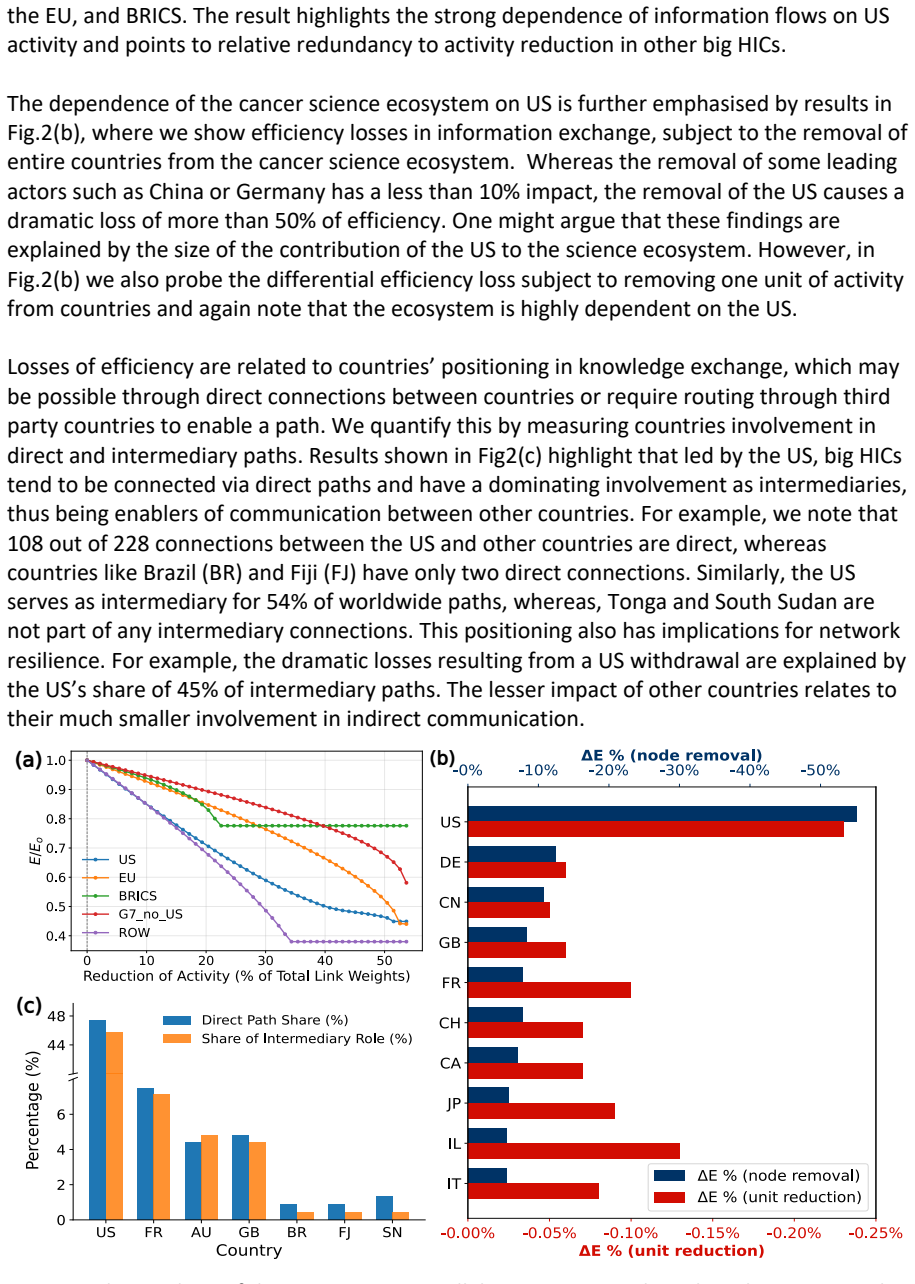
Sharp declines in US Federal funding degrade global information exchange in cancer science, burdening the EU and BRICS most.
A machine-rendered reading of the paper's core claim, the machinery that carries it, and where it could break.
Core claim
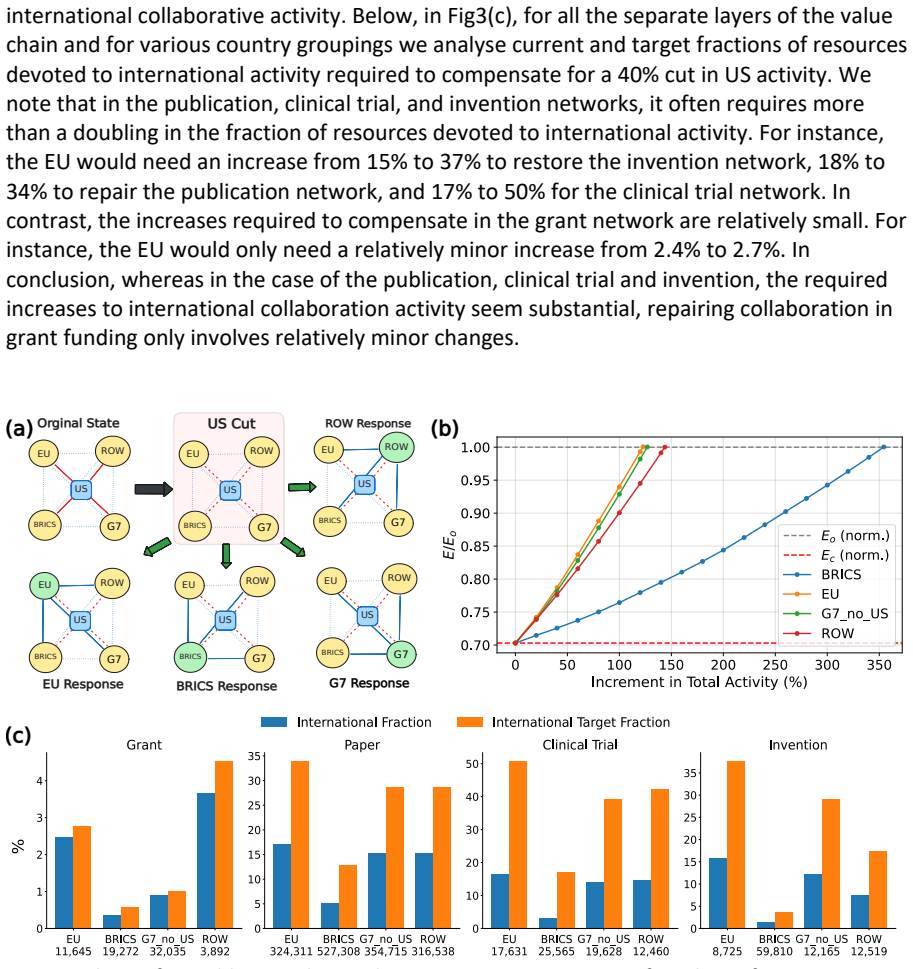
Sharp declines in US Federal funding for research degrade global information exchange in science, imposing outsized compensatory burdens on country groups such as the European Union (EU) and BRICS. However, if other countries provide more support for international collaborations, there is an opportunity to remodel the cancer science system to be more resilient to future shocks.
What carries the argument
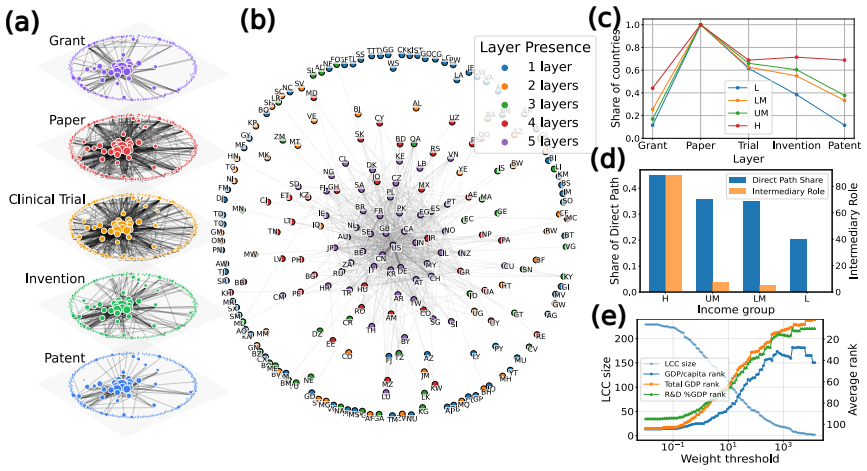
5-layer multiplex network of collaborative linkages between 233 countries and territories in grants, clinical trials, paper co-authorships, co-inventions and patent co-ownerships, quantified by network efficiency.
If this is right
- US funding declines lower network efficiency across the cancer science ecosystem.
- The EU and BRICS bear outsized compensatory burdens to preserve information flow.
- Increased international collaboration support from other countries can raise overall resilience.
- The cancer science network can be restructured to better withstand future funding shocks.
Where Pith is reading between the lines
- The same network compensation approach could be tested on non-cancer fields to check for similar patterns.
- Funding agencies outside the US could track multiplex efficiency metrics when setting cross-border grant priorities.
- Empirical follow-up studies could compare the model's efficiency predictions against observed changes in patent filings or trial registrations post-2025.
Load-bearing premise
Network efficiency in the multiplex model is a valid proxy for the real-world effects of funding declines on science.
What would settle it
Direct measurement of changes in collaboration rates, publication impact or knowledge transfer metrics in cancer science before and after the 2024-25 US funding declines.
Figures
read the original abstract
Scientific knowledge advances through within-country and cross-border scientific activities and collaborations, influenced by funding and strength of research enterprise. Sudden declines in research funding, for example from Federal sources in the United States (US) 2024-25, adversely impact on scientific collaboration. How rapid declines in funding affect the science enterprise and the magnitude of impact need to be analysed. Past studies have modelled the global scientific system as complex collaborative networks of entities and studied its topology and dynamics. However, these studies have not undertaken compensation analysis to real-world shocks that have produced rapid declines in scientific research funding. In this study we examine the effect of the sharp declines in the US Federal funding on cancer science research enterprise globally. We model the cancer science ecosystem as a 5-layer multiplex network of collaborative linkages between 233 countries and territories in grants and clinical trial co-investigations, paper co-authorships, co-inventions and patent co-ownerships. We quantify information flow in the multiplex system through network efficiency. Proposing a framework for compensation analysis, we show that sharp declines in US Federal funding for research degrade global information exchange in science, imposing outsized compensatory burdens on country groups such as the European Union (EU) and BRICS (Brazil, Russia, India, China and South Africa). However, we also show that if other countries provide more support for international collaborations, there is an opportunity to remodel the cancer science system to be more resilient to future shocks.
Editorial analysis
A structured set of objections, weighed in public.
Referee Report
Summary. The manuscript models the global cancer science ecosystem as a 5-layer multiplex network of collaborative linkages among 233 countries and territories in grants, clinical trials, papers, inventions, and patents. It quantifies information flow via network efficiency and proposes a compensation analysis framework to examine the effects of sharp 2024-25 declines in US Federal research funding, claiming these declines degrade global information exchange while imposing outsized compensatory burdens on the EU and BRICS; it further suggests that increased international support could enhance system resilience to future shocks.
Significance. If the network perturbation accurately operationalizes federal funding declines using real grant data shares and if multiplex efficiency serves as a validated proxy for information exchange impacts, the compensation analysis framework could offer a useful approach for assessing science ecosystem fragility and informing policies on cross-border collaborations. The work's emphasis on remodeling opportunities through additional international support adds a constructive policy angle, though its significance depends on addressing the modeling linkage to empirical funding data.
major comments (2)
- [Abstract] Abstract (modeling of funding decline): The central claim that US Federal funding declines produce measurable drops in network efficiency and outsized burdens on EU/BRICS requires that the simulation removes or down-weights edges in a manner corresponding to documented federal grant amounts rather than total US collaborations. The abstract provides no indication that the perturbation distinguishes federal from non-federal US support or scales to actual grant volumes, rendering the quantified compensation effects potentially an artifact of the chosen network modification.
- [Abstract] Abstract (compensation analysis framework): The proposed framework for compensation analysis is presented as a novel contribution, yet the abstract supplies no explicit definition, equations, or quantitative procedure for how compensatory burdens are calculated or how network efficiency changes are attributed to specific country groups, which is load-bearing for the reported degradation in global information exchange.
Simulated Author's Rebuttal
We thank the referee for their constructive comments, which highlight opportunities to strengthen the clarity of our abstract. We address each point below and have revised the abstract accordingly.
read point-by-point responses
-
Referee: [Abstract] Abstract (modeling of funding decline): The central claim that US Federal funding declines produce measurable drops in network efficiency and outsized burdens on EU/BRICS requires that the simulation removes or down-weights edges in a manner corresponding to documented federal grant amounts rather than total US collaborations. The abstract provides no indication that the perturbation distinguishes federal from non-federal US support or scales to actual grant volumes, rendering the quantified compensation effects potentially an artifact of the chosen network modification.
Authors: We agree the abstract should explicitly describe the perturbation. The full manuscript (Methods section) operationalizes the decline by down-weighting edges in the grants layer proportionally to documented federal grant shares drawn from NIH and other federal databases, distinguishing these from non-federal US collaborations and scaling to actual volumes. We have revised the abstract to state this linkage directly. revision: yes
-
Referee: [Abstract] Abstract (compensation analysis framework): The proposed framework for compensation analysis is presented as a novel contribution, yet the abstract supplies no explicit definition, equations, or quantitative procedure for how compensatory burdens are calculated or how network efficiency changes are attributed to specific country groups, which is load-bearing for the reported degradation in global information exchange.
Authors: We accept that the abstract requires a concise description of the framework. The Methods section defines compensatory burden as the attributed change in multiplex efficiency following targeted edge removal for each country group, computed via layer-wise efficiency deltas. We have added a brief outline of this quantitative procedure to the abstract. revision: yes
Circularity Check
No significant circularity detected in derivation chain
full rationale
The paper models the cancer science ecosystem as an empirical 5-layer multiplex network built from observed collaborative linkages (grants, trials, papers, inventions, patents) across 233 countries. Network efficiency is computed as a standard information-flow metric on this structure. A compensation framework is then applied by simulating US funding declines via edge perturbations and recomputing efficiency to quantify burdens on EU/BRICS groups. No equations, parameters, or results are shown to reduce to self-definition, fitted inputs renamed as predictions, or load-bearing self-citations; the simulation steps remain independent of the reported efficiency drops and compensation magnitudes. The derivation is therefore self-contained against external network data and metrics.
Axiom & Free-Parameter Ledger
axioms (1)
- domain assumption Cancer science collaborations can be represented as a 5-layer multiplex network whose efficiency quantifies information exchange relevant to the science enterprise.
invented entities (1)
-
Compensation analysis framework
no independent evidence
Reference graph
Works this paper leans on
-
[1]
Science159(3810), 56–63 (1968) https://doi
Merton RK. The Matthew Effect in Science: The reward and communication systems of science are considered. Science. 1968;159:56–63. doi:10.1126/science.159.3810.56 13. Olechnicka A, Ploszaj A, Celińska-Janowicz D. The Geography of Scientific Collaboration. London: Routledge; 2018. 236 p. doi:10.4324/9781315471938 14. Choi BY, Park H, Yang E, Lee SK, Lee Y,...
-
[2]
6794, 378–382, doi:10.1038/35019019
Albert R, Jeong H, Barabási AL. Error and attack tolerance of complex networks. Nature. 2000;406:378–82. doi:10.1038/35019019 26. European universalism : the rhetoric of power - London School of Economics [Internet]. [cited 2025 Dec 15]. Available from: https://librarysearch.lse.ac.uk/discovery/fulldisplay/alma99107970110302021/44LSE_INST:44LSE_VU1 27. Wa...
discussion (0)
Sign in with ORCID, Apple, or X to comment. Anyone can read and Pith papers without signing in.