Search for new physics using single-lepton events with high multiplicities of jets and b jets in proton-proton collisions at sqrt{s} = 13 TeV
Pith reviewed 2026-06-27 14:32 UTC · model grok-4.3
The pith
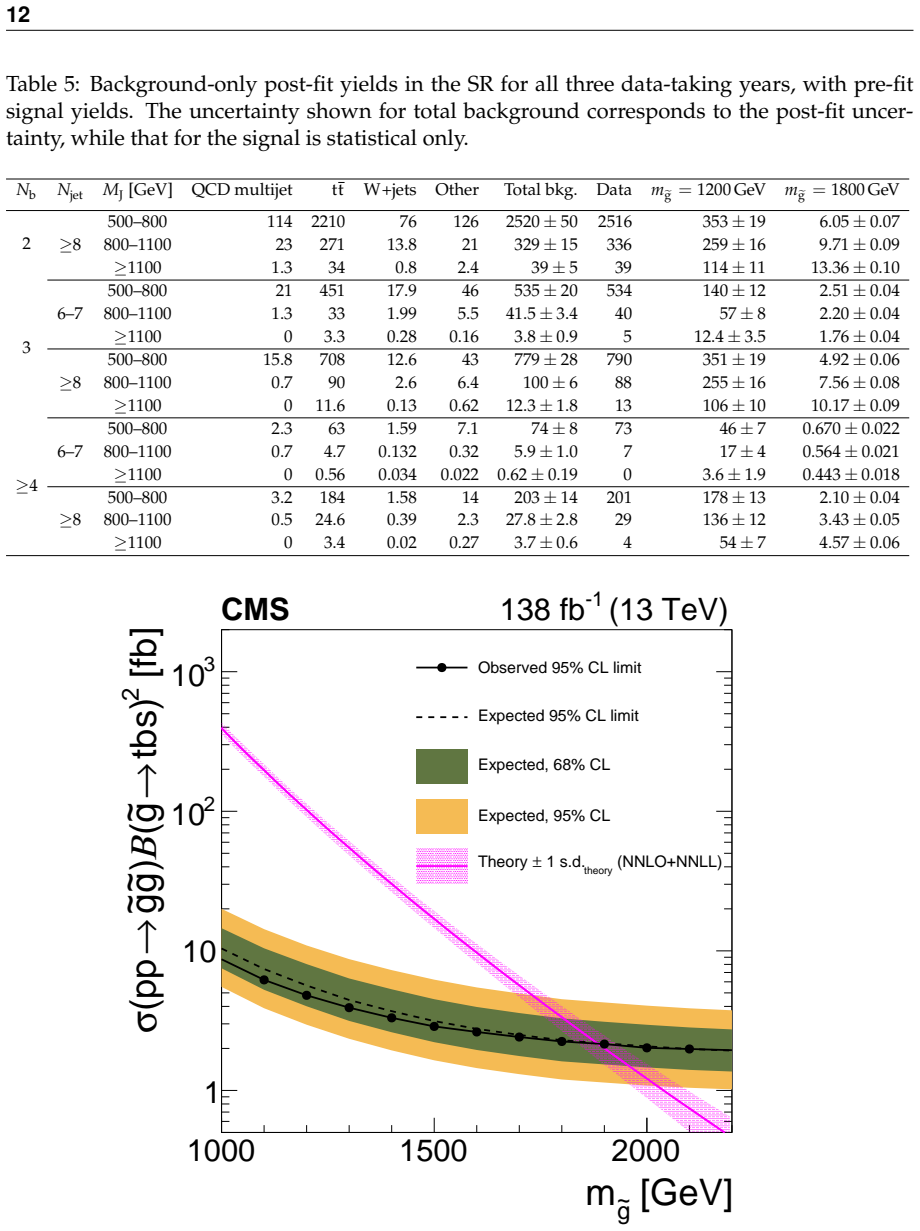
No excess observed in high-multiplicity jet events, excluding gluinos below 1890 GeV at 95% CL.
A machine-rendered reading of the paper's core claim, the machinery that carries it, and where it could break.
Core claim
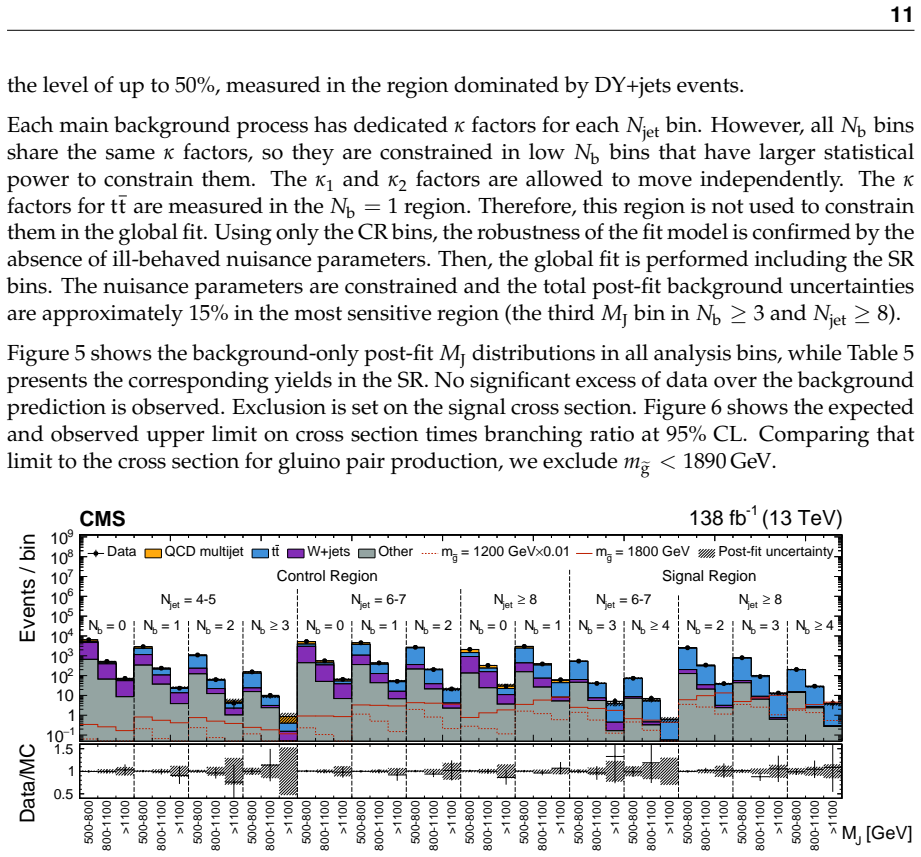
In 138 fb^{-1} of 13 TeV data, the observed event yields in the signal regions agree with background predictions within uncertainties. The search therefore excludes gluino masses below 1890 GeV at 95% confidence level for the specific decay mode in which each gluino produces one top, one bottom, and one strange quark.
What carries the argument
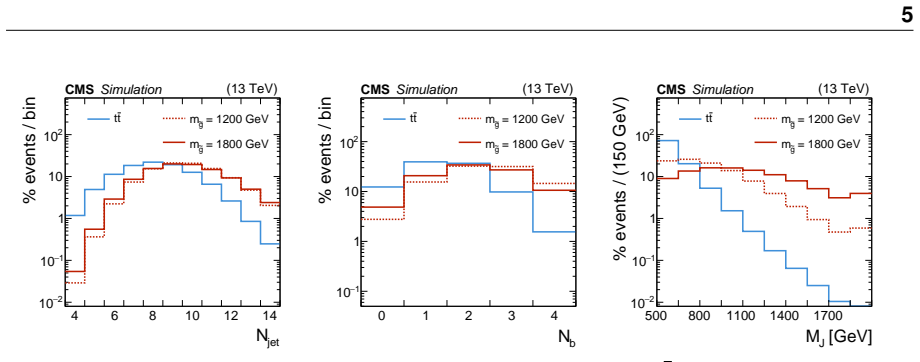
Sum of large-radius jet masses, used to capture the combined effect of high jet multiplicity and high interaction energy that distinguishes the signal from standard-model background.
If this is right
- Gluino pair production with this three-quark decay is ruled out up to 1890 GeV.
- The same data set and selection can be reinterpreted for other R-parity violating decay modes.
- Future runs with higher luminosity will extend the mass reach if background modeling remains stable.
Where Pith is reading between the lines
- The result tightens the parameter space available for baryon-number-violating supersymmetry that could be accessible at the LHC.
- Similar high-multiplicity searches without missing energy could be applied to other new-physics scenarios that produce many quarks.
Load-bearing premise
The background prediction from simulation and control regions accurately models the data in the high jet-multiplicity signal region without large unaccounted systematics.
What would settle it
A statistically significant excess in any of the high jet-multiplicity signal regions that persists after all background uncertainties are accounted for.
Figures

read the original abstract
This paper presents a search for beyond the standard model physics using single-lepton events with a high multiplicity of jets, including those identified as bottom quark jets, without a requirement on missing transverse momentum. The analysis is based on proton-proton collision data collected with the CMS detector at the CERN LHC at a center-of-mass energy of 13 TeV, corresponding to an integrated luminosity of 138 fb$^{-1}$. This search is sensitive to $R$-parity violating supersymmetry models, where supersymmetric particles can decay into standard-model particles through interactions that violate baryon number conservation. In particular, the signal model considered is gluino pair production, where each gluino decays into top, bottom, and strange quarks. The sum of large-radius jet masses is used to distinguish the signal from background, as it effectively captures the features of high jet multiplicity and high interaction energy. No significant excess of data over the background predictions is observed. Gluinos in this model have been excluded for masses below 1890 GeV at 95% confidence level.
Editorial analysis
A structured set of objections, weighed in public.
Referee Report
Summary. The manuscript presents a search for R-parity violating supersymmetry in 13 TeV proton-proton collisions recorded with the CMS detector, corresponding to 138 fb^{-1}. It targets single-lepton events with high jet and b-jet multiplicities (no missing transverse momentum requirement) in a gluino pair-production model where each gluino decays to top, bottom, and strange quarks. The sum of large-radius jet masses serves as the primary discriminant between signal and background. No significant excess over background predictions is observed, leading to a 95% CL exclusion of gluino masses below 1890 GeV.
Significance. If the background modeling and limit-setting procedure hold, the result supplies a competitive constraint on baryon-number-violating SUSY scenarios that is complementary to MET-based searches. The choice of the jet-mass-sum observable is well-motivated for high-multiplicity final states and represents a standard yet effective experimental technique. The analysis follows conventional CMS practices for simulation-based background estimation validated in control regions.
minor comments (3)
- The abstract states the exclusion limit but does not quote the exact signal cross-section assumption or the 95% CL construction method (e.g., asymptotic CLs or profile likelihood); a one-sentence clarification would improve standalone readability.
- Figure captions and text should explicitly define the large-radius jet algorithm (e.g., anti-kT radius) and the precise jet pT and |η| thresholds used in the multiplicity selection.
- A brief statement on the treatment of the dominant systematic uncertainties (jet energy scale, b-tagging, luminosity) in the limit-setting procedure would strengthen the methods section.
Simulated Author's Rebuttal
We thank the referee for the positive assessment of our manuscript, the accurate summary of the analysis, and the recommendation for minor revision. No major comments were raised.
Circularity Check
No significant circularity; standard experimental limit-setting
full rationale
The paper reports a null-result search for RPV gluino production using CMS data at 13 TeV. Background estimation combines simulation with control-region validation; the 95% CL mass limit follows directly from the observed data-to-background comparison in the signal region. No equations, self-citations, or ansatze reduce the quoted exclusion to a fitted parameter or prior result by construction. The derivation chain is externally falsifiable against the recorded dataset and is therefore self-contained.
Axiom & Free-Parameter Ledger
axioms (1)
- domain assumption Standard Model processes and detector effects are correctly simulated for background estimation
Reference graph
Works this paper leans on
-
[1]
Upper bounds on supersymmetric particle masses
R. Barbieri and G. F. Giudice, “Upper bounds on supersymmetric particle masses”,Nucl. Phys. B306(1988) 63,doi:10.1016/0550-3213(88)90171-X
-
[2]
Naturalness, chiral symmetry, and spontaneous chiral symmetry breaking
G. ’t Hooft, “Naturalness, chiral symmetry, and spontaneous chiral symmetry breaking”, NATO Sci. Ser. B59(1980) 135,doi:10.1007/978-1-4684-7571-5_9
-
[3]
Dynamical breaking of supersymmetry
E. Witten, “Dynamical breaking of supersymmetry”,Nucl. Phys. B188(1981) 513, doi:10.1016/0550-3213(81)90006-7. References 15
-
[4]
M. Dine, W. Fischler, and M. Srednicki, “Supersymmetric technicolor”,Nucl. Phys. B189 (1981) 575,doi:10.1016/0550-3213(81)90582-4
-
[5]
S. Dimopoulos and S. Raby, “Supercolor”,Nucl. Phys. B192(1981) 353, doi:10.1016/0550-3213(81)90430-2
-
[6]
Softly broken supersymmetry and SU(5)
S. Dimopoulos and H. Georgi, “Softly broken supersymmetry and SU(5)”,Nucl. Phys. B 193(1981) 150,doi:10.1016/0550-3213(81)90522-8
-
[7]
R. K. Kaul and P . Majumdar, “Cancellation of quadratically divergent mass corrections in globally supersymmetric spontaneously broken gauge theories”,Nucl. Phys. B199 (1982) 36,doi:10.1016/0550-3213(82)90565-X
-
[8]
Supersymmetry, supergravity and particle physics
H. P . Nilles, “Supersymmetry, supergravity and particle physics”,Phys. Rept.110(1984) 1,doi:10.1016/0370-1573(84)90008-5
-
[9]
The search for supersymmetry: probing physics beyond the standard model
H. E. Haber and G. L. Kane, “The search for supersymmetry: probing physics beyond the standard model”,Phys. Rept.117(1985) 75,doi:10.1016/0370-1573(85)90051-1
-
[10]
Supersymmetry and the scale of unification
S. Dimopoulos, S. Raby, and F. Wilczek, “Supersymmetry and the scale of unification”, Phys. Rev. D24(1981) 1681,doi:10.1103/PhysRevD.24.1681
-
[11]
Low-energy predictions in supersymmetric grand unified theories
L. E. Ib ´a˜nez and G. G. Ross, “Low-energy predictions in supersymmetric grand unified theories”,Phys. Lett. B105(1981) 439,doi:10.1016/0370-2693(81)91200-4
-
[12]
The weak mixing angle and unification mass in supersymmetric SU(5)
M. B. Einhorn and D. R. T. Jones, “The weak mixing angle and unification mass in supersymmetric SU(5)”,Nucl. Phys. B196(1982) 475, doi:10.1016/0550-3213(82)90502-8
-
[13]
Predictions of supersymmetric grand unified theories
W. J. Marciano and G. Senjanovi ´c, “Predictions of supersymmetric grand unified theories”,Phys. Rev. D25(1982) 3092,doi:10.1103/PhysRevD.25.3092
-
[14]
G. R. Farrar and P . Fayet, “Phenomenology of the production, decay, and detection of new hadronic states associated with supersymmetry”,Phys. Lett. B76(1978) 575, doi:10.1016/0370-2693(78)90858-4
-
[15]
R-parity-violating supersymmetry
R. Barbier et al., “R-parity-violating supersymmetry”,Phys. Rept.420(2005) 1, doi:10.1016/j.physrep.2005.08.006
-
[16]
MFV SUSY: A Natural Theory for R-Parity Violation
C. Cs ´aki, Y. Grossman, and B. Heidenreich, “Minimal flavor violation supersymmetry: a natural theory forR-parity violation”,Phys. Rev. D85(2012) 095009, doi:10.1103/PhysRevD.85.095009,arXiv:1111.1239
work page internal anchor Pith review Pith/arXiv arXiv doi:10.1103/physrevd.85.095009 2012
-
[17]
Neutron-antineutron oscillation search using a 0.37 megaton-years exposure of super-kamiokande
Super-Kamiokande Collaboration, “Neutron-antineutron oscillation search using a 0.37 megaton-years exposure of super-kamiokande”,Phys. Rev. D103(2021) 012008, doi:10.1103/PhysRevD.103.012008,arXiv:2012.02607
-
[18]
CMS Collaboration, “Search forR-parity violating supersymmetry in pp collisions at√s=13 TeV using b jets in a final state with a single lepton, many jets, and high sum of large-radius jet masses”,Phys. Lett. B783(2018) 114, doi:10.1016/j.physletb.2018.06.028,arXiv:1712.08920
work page internal anchor Pith review Pith/arXiv arXiv doi:10.1016/j.physletb.2018.06.028 2018
-
[19]
CMS Collaboration, “Searches forR-parity-violating supersymmetry in pp collisions at√s=8 TeV in final states with 0-4 leptons”,Phys. Rev. D94(2016) 112009, doi:10.1103/PhysRevD.94.112009,arXiv:1606.08076. 16
work page internal anchor Pith review Pith/arXiv arXiv doi:10.1103/physrevd.94.112009 2016
-
[20]
ATLAS Collaboration, “Search forR-parity-violating supersymmetry in a final state containing leptons and many jets with the ATLAS experiment using √s=13 TeV proton-proton collision data”,Eur. Phys. J. C81(2021) 1023, doi:10.1140/epjc/s10052-021-09761-x,arXiv:2106.09609
-
[21]
High Multiplicity Searches at the LHC Using Jet Masses
A. Hook, E. Izaguirre, M. Lisanti, and J. G. Wacker, “High multiplicity searches at the LHC using jet masses”,Phys. Rev. D85(2012) 055029, doi:10.1103/PhysRevD.85.055029,arXiv:1202.0558
work page internal anchor Pith review Pith/arXiv arXiv doi:10.1103/physrevd.85.055029 2012
-
[22]
T. Cohen, E. Izaguirre, M. Lisanti, and H. K. Lou, “Jet substructure by accident”,JHEP 03(2013) 161,doi:10.1007/JHEP03(2013)161,arXiv:1212.1456
work page internal anchor Pith review Pith/arXiv arXiv doi:10.1007/jhep03(2013)161 2013
-
[23]
Learning How to Count: A High Multiplicity Search for the LHC
S. El Hedri, A. Hook, M. Jankowiak, and J. G. Wacker, “Learning how to count: a high multiplicity search for the LHC”,JHEP08(2013) 136, doi:10.1007/JHEP08(2013)136,arXiv:1302.1870
work page internal anchor Pith review Pith/arXiv arXiv doi:10.1007/jhep08(2013)136 2013
-
[24]
ATLAS Collaboration, “Search for massive supersymmetric particles decaying to many jets using the ATLAS detector in pp collisions at √s=8 TeV”,Phys. Rev. D91(2015) 112016,doi:10.1103/PhysRevD.91.112016,arXiv:1502.05686
work page internal anchor Pith review Pith/arXiv arXiv doi:10.1103/physrevd.91.112016 2015
-
[25]
ATLAS Collaboration, “Search for new phenomena in final states with large jet multiplicities and missing transverse momentum at √s=8 TeV proton-proton collisions using the ATLAS experiment”,JHEP10(2013) 130,doi:10.1007/JHEP10(2013)130, arXiv:1308.1841. [Erratum:doi:10.1140/epjc/s10052-013-2501-z]
work page internal anchor Pith review Pith/arXiv arXiv doi:10.1007/jhep10(2013)130 2013
-
[26]
CMS Collaboration, “Search for supersymmetry in pp collisions at √s=13 TeV in the single-lepton final state using the sum of masses of large-radius jets”,JHEP08(2016) 122,doi:10.1007/JHEP08(2016)122,arXiv:1605.04608
work page internal anchor Pith review Pith/arXiv arXiv doi:10.1007/jhep08(2016)122 2016
-
[27]
CMS Collaboration, “Search for supersymmetry inppcollisions at √s=13 TeV in the single-lepton final state using the sum of masses of large-radius jets”,Phys. Rev. Lett.119 (2017) 151802,doi:10.1103/PhysRevLett.119.151802,arXiv:1705.04673
work page internal anchor Pith review Pith/arXiv arXiv doi:10.1103/physrevlett.119.151802 2017
-
[28]
HEPData record for this analysis, 2026.doi:10.17182/hepdata.172453
-
[29]
Precision luminosity measurement in proton-proton collisions at√s=13 TeV in 2015 and 2016 at CMS
CMS Collaboration, “Precision luminosity measurement in proton-proton collisions at√s=13 TeV in 2015 and 2016 at CMS”,Eur. Phys. J. C81(2021) 800, doi:10.1140/epjc/s10052-021-09538-2,arXiv:2104.01927
-
[30]
CMS luminosity measurement for the 2017 data-taking period at√s=13 TeV
CMS Collaboration, “CMS luminosity measurement for the 2017 data-taking period at√s=13 TeV”, CMS Physics Analysis Summary CMS-PAS-LUM-17-004, 2018
2017
-
[31]
CMS luminosity measurement for the 2018 data-taking period at√s=13 TeV
CMS Collaboration, “CMS luminosity measurement for the 2018 data-taking period at√s=13 TeV”, CMS Physics Analysis Summary CMS-PAS-LUM-18-002, 2018
2018
-
[32]
The CMS experiment at the CERN LHC
CMS Collaboration, “The CMS experiment at the CERN LHC”,JINST3(2008) S08004, doi:10.1088/1748-0221/3/08/S08004
-
[33]
Development of the CMS detector for the CERN LHC Run 3
CMS Collaboration, “Development of the CMS detector for the CERN LHC Run 3”, JINST19(2024) P05064,doi:10.1088/1748-0221/19/05/P05064, arXiv:2309.05466
-
[34]
Performance of the CMS Level-1 trigger in proton-proton collisions at √s=13 TeV
CMS Collaboration, “Performance of the CMS Level-1 trigger in proton-proton collisions at √s=13 TeV”,JINST15(2020) P10017, doi:10.1088/1748-0221/15/10/P10017,arXiv:2006.10165. References 17
-
[35]
CMS Collaboration, “The CMS trigger system”,JINST12(2017) P01020, doi:10.1088/1748-0221/12/01/P01020,arXiv:1609.02366
work page internal anchor Pith review Pith/arXiv arXiv doi:10.1088/1748-0221/12/01/p01020 2017
-
[36]
Performance of the CMS high-level trigger during LHC run 2
CMS Collaboration, “Performance of the CMS high-level trigger during LHC Run 2”, JINST19(2024) P11021,doi:10.1088/1748-0221/19/11/P11021, arXiv:2410.17038
-
[37]
Electron and photon reconstruction and identification with the CMS experiment at the CERN LHC
CMS Collaboration, “Electron and photon reconstruction and identification with the CMS experiment at the CERN LHC”,JINST16(2021) P05014, doi:10.1088/1748-0221/16/05/P05014,arXiv:2012.06888
-
[38]
CMS Collaboration, “Performance of the CMS muon detector and muon reconstruction with proton-proton collisions at √s=13 TeV”,JINST13(2018) P06015, doi:10.1088/1748-0221/13/06/P06015,arXiv:1804.04528
work page internal anchor Pith review Pith/arXiv arXiv doi:10.1088/1748-0221/13/06/p06015 2018
-
[39]
Description and performance of track and primary-vertex reconstruction with the CMS tracker
CMS Collaboration, “Description and performance of track and primary-vertex reconstruction with the CMS tracker”,JINST9(2014) P10009, doi:10.1088/1748-0221/9/10/P10009,arXiv:1405.6569
work page internal anchor Pith review Pith/arXiv arXiv doi:10.1088/1748-0221/9/10/p10009 2014
-
[40]
J. Alwall et al., “The automated computation of tree-level and next-to-leading order differential cross sections, and their matching to parton shower simulations”,JHEP07 (2014) 079,doi:10.1007/JHEP07(2014)079,arXiv:1405.0301
work page internal anchor Pith review Pith/arXiv arXiv doi:10.1007/jhep07(2014)079 2014
-
[41]
A New Method for Combining NLO QCD with Shower Monte Carlo Algorithms
P . Nason, “A new method for combining NLO QCD with shower Monte Carlo algorithms”,JHEP11(2004) 040,doi:10.1088/1126-6708/2004/11/040, arXiv:hep-ph/0409146
work page internal anchor Pith review Pith/arXiv arXiv doi:10.1088/1126-6708/2004/11/040 2004
-
[42]
Matching NLO QCD computations with Parton Shower simulations: the POWHEG method
S. Frixione, P . Nason, and C. Oleari, “Matching NLO QCD computations with parton shower simulations: the POWHEG method”,JHEP11(2007) 070, doi:10.1088/1126-6708/2007/11/070,arXiv:0709.2092
work page internal anchor Pith review Pith/arXiv arXiv doi:10.1088/1126-6708/2007/11/070 2007
-
[43]
A general framework for implementing NLO calculations in shower Monte Carlo programs: the POWHEG BOX
S. Alioli, P . Nason, C. Oleari, and E. Re, “A general framework for implementing NLO calculations in shower Monte Carlo programs: the POWHEG BOX”,JHEP06(2010) 043, doi:10.1007/JHEP06(2010)043,arXiv:1002.2581
work page internal anchor Pith review Pith/arXiv arXiv doi:10.1007/jhep06(2010)043 2010
-
[44]
T. Sj ¨ostrand et al., “An introduction to PYTHIA 8.2”,Comput. Phys. Commun.191(2015) 159,doi:10.1016/j.cpc.2015.01.024,arXiv:1410.3012
work page internal anchor Pith review Pith/arXiv arXiv doi:10.1016/j.cpc.2015.01.024 2015
-
[45]
A superspace module for the FeynRules package
C. Duhr and B. Fuks, “A superspace module for the feynrules package”,Comput. Phys. Commun.182(2011) 2404,doi:10.1016/j.cpc.2011.06.009,arXiv:1102.4191
work page internal anchor Pith review Pith/arXiv arXiv doi:10.1016/j.cpc.2011.06.009 2011
-
[46]
Ufo 2.0: the ‘universal feynman output’ format
L. Darm ´e et al., “Ufo 2.0: the ‘universal feynman output’ format”,Eur. Phys. J. C83 (2023) 631,doi:10.1140/epjc/s10052-023-11780-9,arXiv:2304.09883
-
[47]
NNLL-fast 2.0: coloured sparticle production at the LHC Run 3 with √s=13.6 TeV
W. Beenakker et al., “NNLL-fast 2.0: coloured sparticle production at the LHC Run 3 with √s=13.6 TeV”,SciPost Phys. Core7(2024) 072, doi:10.21468/SciPostPhysCore.7.4.072,arXiv:2404.18837
-
[48]
Parton distributions from high-precision collider data
R. D. Ball et al., “Parton distributions from high-precision collider data”,Eur. Phys. J. C 77(2017) 663,doi:10.1140/epjc/s10052-017-5199-5
work page internal anchor Pith review doi:10.1140/epjc/s10052-017-5199-5 2017
-
[49]
J. Alwall et al., “Comparative study of various algorithms for the merging of parton showers and matrix elements in hadronic collisions”,Eur. Phys. J. C53(2008) 473, doi:10.1140/epjc/s10052-007-0490-5,arXiv:0706.2569. 18
work page internal anchor Pith review Pith/arXiv arXiv doi:10.1140/epjc/s10052-007-0490-5 2008
-
[50]
Merging meets matching in MC@NLO
R. Frederix and S. Frixione, “Merging meets matching in MC@NLO”,JHEP12(2012) 061,doi:10.1007/JHEP12(2012)061,arXiv:1209.6215
work page internal anchor Pith review Pith/arXiv arXiv doi:10.1007/jhep12(2012)061 2012
-
[51]
Extraction and validation of a new set of CMSPYTHIA8 tunes from underlying-event measurements
CMS Collaboration, “Extraction and validation of a new set of CMS PYTHIA8 tunes from underlying-event measurements”,Eur. Phys. J. C80(2020) 4, doi:10.1140/epjc/s10052-019-7499-4,arXiv:1903.12179
-
[52]
GEANT4 Collaboration, “GEANT4—a simulation toolkit”,Nucl. Instrum. Meth. A506 (2003) 250,doi:10.1016/S0168-9002(03)01368-8
-
[53]
Particle-flow reconstruction and global event description with the CMS detector
CMS Collaboration, “Particle-flow reconstruction and global event description with the CMS detector”,JINST12(2017) P10003,doi:10.1088/1748-0221/12/10/P10003, arXiv:1706.04965
work page internal anchor Pith review Pith/arXiv arXiv doi:10.1088/1748-0221/12/10/p10003 2017
-
[54]
The anti-k_t jet clustering algorithm
M. Cacciari, G. P . Salam, and G. Soyez, “The anti-kT jet clustering algorithm”,JHEP04 (2008) 063,doi:10.1088/1126-6708/2008/04/063,arXiv:0802.1189
work page internal anchor Pith review Pith/arXiv arXiv doi:10.1088/1126-6708/2008/04/063 2008
-
[55]
M. Cacciari, G. P . Salam, and G. Soyez, “FastJet user manual”,Eur. Phys. J. C72(2012) 1896,doi:10.1140/epjc/s10052-012-1896-2,arXiv:1111.6097
work page internal anchor Pith review Pith/arXiv arXiv doi:10.1140/epjc/s10052-012-1896-2 2012
-
[56]
Pileup subtraction using jet areas
M. Cacciari and G. P . Salam, “Pileup subtraction using jet areas”,Phys. Lett. B659(2008) 119,doi:10.1016/j.physletb.2007.09.077,arXiv:0707.1378
work page internal anchor Pith review Pith/arXiv arXiv doi:10.1016/j.physletb.2007.09.077 2008
-
[57]
Jet algorithms performance in 13 TeV data
CMS Collaboration, “Jet algorithms performance in 13 TeV data”, technical report, 2017
2017
-
[58]
Identification of heavy-flavour jets with the CMS detector in pp collisions at 13 TeV
CMS Collaboration, “Identification of heavy-flavour jets with the CMS detector in pp collisions at 13 TeV”,JINST13(2018) P05011, doi:10.1088/1748-0221/13/05/P05011,arXiv:1712.07158
work page internal anchor Pith review Pith/arXiv arXiv doi:10.1088/1748-0221/13/05/p05011 2018
-
[59]
Efficient Identification of Boosted Semileptonic Top Quarks at the LHC
K. Rehermann and B. Tweedie, “Efficient identification of boosted semileptonic top quarks at the LHC”,JHEP03(2011) 059,doi:10.1007/JHEP03(2011)059, arXiv:1007.2221
work page internal anchor Pith review Pith/arXiv arXiv doi:10.1007/jhep03(2011)059 2011
-
[60]
CMS Collaboration, “Search for direct pair production of supersymmetric top quarks decaying to all-hadronic final states in pp collisions at √s=8 TeV”,Eur. Phys. J. C76 (2016) 460,doi:10.1140/epjc/s10052-016-4292-5,arXiv:1603.00765
work page internal anchor Pith review Pith/arXiv arXiv doi:10.1140/epjc/s10052-016-4292-5 2016
-
[61]
ATLAS Collaboration, “Search for direct pair production of the top squark in all-hadronic final states in proton-proton collisions at √s=8 TeV with the ATLAS detector”,JHEP 09(2014) 015,doi:10.1007/JHEP09(2014)015,arXiv:1406.1122
work page internal anchor Pith review Pith/arXiv arXiv doi:10.1007/jhep09(2014)015 2014
-
[62]
CMS Collaboration, “Measurement of the cross section for t ¯t production with additional jets and b jets in pp collisions at √s=13 TeV”,JHEP07(2020) 125, doi:10.1007/JHEP07(2020)125,arXiv:2003.06467
-
[63]
The CMS statistical analysis and combination tool: COMBINE
CMS Collaboration, “The CMS statistical analysis and combination tool: COMBINE”, Comput. Softw. Big Sci.8(2024) 19,doi:10.1007/s41781-024-00121-4, arXiv:2404.06614
-
[64]
Confidence Level Computation for Combining Searches with Small Statistics
T. Junk, “Confidence level computation for combining searches with small statistics”, Nucl. Instrum. Meth. A434(1999) 435,doi:10.1016/S0168-9002(99)00498-2, arXiv:hep-ex/9902006
work page internal anchor Pith review Pith/arXiv arXiv doi:10.1016/s0168-9002(99)00498-2 1999
-
[65]
Presentation of search results: The CL s technique
A. L. Read, “Presentation of search results: theCL s technique”,J. Phys. G28(2002) 2693, doi:10.1088/0954-3899/28/10/313. References 19
-
[66]
Asymptotic formulae for likelihood-based tests of new physics
G. Cowan, K. Cranmer, E. Gross, and O. Vitells, “Asymptotic formulae for likelihood-based tests of new physics”,Eur. Phys. J. C71(2011) 1554, doi:10.1140/epjc/s10052-011-1554-0,arXiv:1007.1727. 20 21 A The CMS Collaboration Yerevan Physics Institute, Yerevan, Armenia A. Hayrapetyan, V . Makarenko , A. Tumasyan1 Institut f ¨ ur Hochenergiephysik, Vienna, A...
work page internal anchor Pith review Pith/arXiv arXiv doi:10.1140/epjc/s10052-011-1554-0 2011
discussion (0)
Sign in with ORCID, Apple, or X to comment. Anyone can read and Pith papers without signing in.