Peristaltic Flow in Compressible, Ideal Magnetohydrodynamics: A Mechanism For Solar Spicules
Pith reviewed 2026-06-27 14:56 UTC · model grok-4.3
The pith
Peristaltic pumping by magnetosonic waves produces upward mass flux in solar spicules
A machine-rendered reading of the paper's core claim, the machinery that carries it, and where it could break.
Core claim
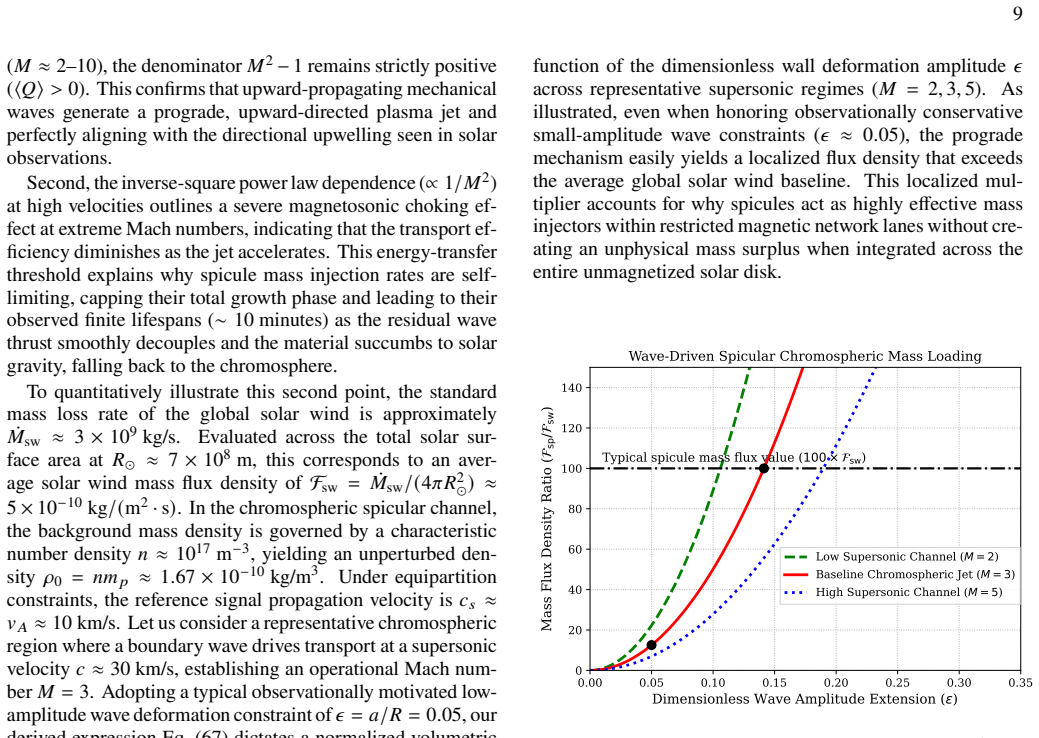
Under equipartition constraints where sound speed equals Alfvén speed, the net time-averaged volumetric flow rate is ⟨Q⟩ = 4ε²/(M²−1). Because the denominator stays positive across observed supersonic Mach numbers (M ≈ 2–10), upward-propagating disturbances drive a highly directional, collimated upward flow interpreted as a solar spicule, with a localized mass flux approximately 100 times that of the solar wind for observationally realistic amplitudes of order 10 percent.
What carries the argument
Net time-averaged volumetric flow rate ⟨Q⟩ obtained from small-amplitude perturbation expansion of the compressible ideal MHD equations under the thin-tube long-wavelength approximation
If this is right
- Upward-propagating mechanical disturbances produce a highly directional collimated upward flow
- The flow direction remains consistent for all supersonic Mach numbers between 2 and 10
- Magnetosonic waves with amplitudes of order 10 percent generate a localized mass flux roughly 100 times the solar-wind value
- The launch of each spicular jet is preceded by observable magnetosonic wave trains visible as intensity modulations
Where Pith is reading between the lines
- The same peristaltic mechanism could operate in stellar winds or the inner regions of magnetized accretion disks where traveling magnetic pinches occur
- Laboratory plasma devices containing traveling magnetic field pinches may exhibit analogous net mass transport
- High-resolution timing observations of wave trains and spicule onset would provide a direct test independent of the mass-flux estimate
Load-bearing premise
The thin-tube long-wavelength approximation together with a uniform axial background magnetic field and small-amplitude perturbation expansion
What would settle it
High-cadence chromospheric imaging that either detects or fails to detect localized intensity modulations from magnetosonic wave trains immediately preceding the launch of individual spicular jets
Figures

read the original abstract
We present analytical model for peristaltic transport within compressible, ideal magnetohydrodynamics (MHD). By employing small-amplitude perturbation expansion, under thin-tube long-wavelength approximation with a uniform axial background magnetic field, we study non-linear coupling between thermodynamic pressure variations and Maxwell's magnetic tension stresses. The resulting net time-averaged volumetric flow rate $\langle Q \rangle$ is calculated. When applied to solar chromospheric spicules under equipartition constraints ($\beta \sim 1$), where sound speed matches the Alfv{\'e}n speed, we find $\langle Q \rangle = 4\epsilon^2/(M^2-1)$. Because the denominator remains positive across all operational supersonic Mach numbers ($M \approx 2\text{--}10$), upward-propagating mechanical disturbances drive a highly directional, collimated upward flow which we interpret as a spicule. Estimates show that for observationally realistic magnetosonic waves with amplitudes of $\approx 10\%$, the peristaltic mechanism generates a localized mass flux $\approx 100$ times that of solar wind. We propose an explicit observational signature of this mechanism, wherein the launch of individual spicular jets is directly preceded by magnetosonic wave trains detectable as localized intensity modulations. Beyond solar chromospheric application, the model may be applicable to traveling magnetic field pinches in laboratory plasma devices and astrophysical mass-loading processes in stellar winds and inner regions of magnetized accretion disks.
Editorial analysis
A structured set of objections, weighed in public.
Referee Report
Summary. The manuscript presents an analytical model for peristaltic transport in compressible ideal MHD. Employing a small-amplitude perturbation expansion under the thin-tube long-wavelength approximation with uniform axial background magnetic field, it derives the time-averaged volumetric flow rate ⟨Q⟩ = 4ε²/(M²−1) when β ∼ 1. Applied to solar chromospheric spicules, the model claims this mechanism produces highly directional upward flows with localized mass flux ≈100 times the solar wind for observationally realistic ≈10% amplitudes, and proposes an observational signature of preceding magnetosonic wave trains.
Significance. If the central derivation holds under the stated approximations, the explicit algebraic result offers a potential MHD mechanism for the collimation and mass loading of spicules via nonlinear pressure-tension coupling. The formula's dependence on the free parameters ε and M, however, frames the 100× flux estimate as a scaling relation rather than a robust, parameter-free prediction. The model's possible extension to laboratory pinches and accretion disks is noted but undeveloped.
major comments (3)
- [Abstract and derivation section] Abstract and derivation section: The final expression ⟨Q⟩ = 4ε²/(M²−1) and the subsequent 100× solar-wind mass-flux claim are presented without the intermediate steps of the second-order perturbation expansion from the compressible ideal MHD equations; the full manuscript must display the complete calculation (including how the nonlinear terms close under the thin-tube ordering) to permit verification.
- [Application to spicules] Application to spicules: The mass-flux estimate of ≈100 times solar wind is obtained by selecting ε ≈ 0.1 as 'observationally realistic'; because ⟨Q⟩ scales explicitly with ε² and the denominator depends on the free parameter M, this numerical factor is not an independent prediction but a direct consequence of the chosen values.
- [Model assumptions] Model assumptions (thin-tube long-wavelength limit): The directional upward-flow interpretation and the algebraic simplicity of ⟨Q⟩ rest entirely on the thin-tube long-wavelength ordering together with uniform B₀; no quantitative check is supplied on whether this ordering remains valid for observed spicule aspect ratios and wavelengths, which is load-bearing for the claimed mechanism.
minor comments (2)
- [Abstract] Define the Mach number M and amplitude ε explicitly on first appearance and state the range of validity assumed for the perturbation expansion.
- [Throughout] Number all displayed equations and ensure every equation is referenced in the surrounding text.
Simulated Author's Rebuttal
We thank the referee for the constructive report and the recommendation for major revision. We address each major comment below, indicating where revisions will be made to improve clarity and completeness.
read point-by-point responses
-
Referee: [Abstract and derivation section] Abstract and derivation section: The final expression ⟨Q⟩ = 4ε²/(M²−1) and the subsequent 100× solar-wind mass-flux claim are presented without the intermediate steps of the second-order perturbation expansion from the compressible ideal MHD equations; the full manuscript must display the complete calculation (including how the nonlinear terms close under the thin-tube ordering) to permit verification.
Authors: We agree that the intermediate steps of the second-order expansion must be shown explicitly. The revised manuscript will include the full derivation from the compressible ideal MHD equations, detailing the thin-tube long-wavelength ordering, the form of the nonlinear terms, and how they close to yield the time-averaged ⟨Q⟩ = 4ε²/(M²−1) under β ∼ 1. revision: yes
-
Referee: [Application to spicules] Application to spicules: The mass-flux estimate of ≈100 times solar wind is obtained by selecting ε ≈ 0.1 as 'observationally realistic'; because ⟨Q⟩ scales explicitly with ε² and the denominator depends on the free parameter M, this numerical factor is not an independent prediction but a direct consequence of the chosen values.
Authors: The 100× figure is presented as an order-of-magnitude illustration obtained by substituting observationally reported wave amplitudes (ε ≈ 0.1) and typical chromospheric Mach numbers into the derived scaling. We will revise the text to state explicitly that the result is a scaling relation evaluated at realistic parameters rather than a parameter-free prediction, while retaining the demonstration that the mechanism can produce high localized flux. revision: yes
-
Referee: [Model assumptions] Model assumptions (thin-tube long-wavelength limit): The directional upward-flow interpretation and the algebraic simplicity of ⟨Q⟩ rest entirely on the thin-tube long-wavelength ordering together with uniform B₀; no quantitative check is supplied on whether this ordering remains valid for observed spicule aspect ratios and wavelengths, which is load-bearing for the claimed mechanism.
Authors: We will add a short quantitative paragraph in the revised manuscript comparing the thin-tube ordering (tube radius much smaller than wavelength) to observed spicule parameters (typical widths ∼0.5–1 Mm, lengths ∼5–10 Mm, and wave wavelengths inferred from periods of a few minutes), confirming that the approximation holds in the relevant regime. revision: yes
Circularity Check
No circularity: derivation proceeds from MHD equations via explicit approximations
full rationale
The paper performs a standard small-amplitude perturbation expansion under the thin-tube long-wavelength limit with uniform axial B0 to obtain the algebraic expression for net flow rate ⟨Q⟩ = 4ε²/(M²−1) from the compressible ideal MHD equations. This is a direct calculational result rather than a tautology or redefinition of inputs. The subsequent numerical estimate of mass flux (≈100× solar wind) for β∼1 and ε≈0.1 simply inserts observationally motivated parameter values into the derived formula; no fitting to data, self-citation load-bearing, or smuggling of ansatzes occurs. The central claim therefore remains independent of its own outputs.
Axiom & Free-Parameter Ledger
free parameters (2)
- ε
- M
axioms (3)
- domain assumption thin-tube long-wavelength approximation
- domain assumption uniform axial background magnetic field
- domain assumption small-amplitude perturbation expansion
Forward citations
Cited by 1 Pith paper
-
Unpinning of trapped oil droplets via non-resonant acoustic streaming in capillary tubes
Analytical model demonstrates unpinnning of trapped oil droplets in capillaries using non-resonant second-order acoustic streaming with an optimal absorption condition α = 1/2x0.
Reference graph
Works this paper leans on
-
[1]
Peristaltic Flow in Compressible, Ideal Magnetohydrodynamics: A Mechanism For Solar Spicules
were not the first to model peristaltic pumping, but they were the first to identify the profound role of fluid compress- ibility. The analytical framework derived in this manuscript arXiv:2606.09626v1 [astro-ph.SR] 8 Jun 2026 2 bridges these two milestones. By extending the compressible traveling wave paradigm into the idealmagnetohydrodynamic regime, th...
work page internal anchor Pith review Pith/arXiv arXiv 2026
-
[2]
Wave-Driven Ascent Phase
-
[3]
Supersonic Choking Transition
-
[4]
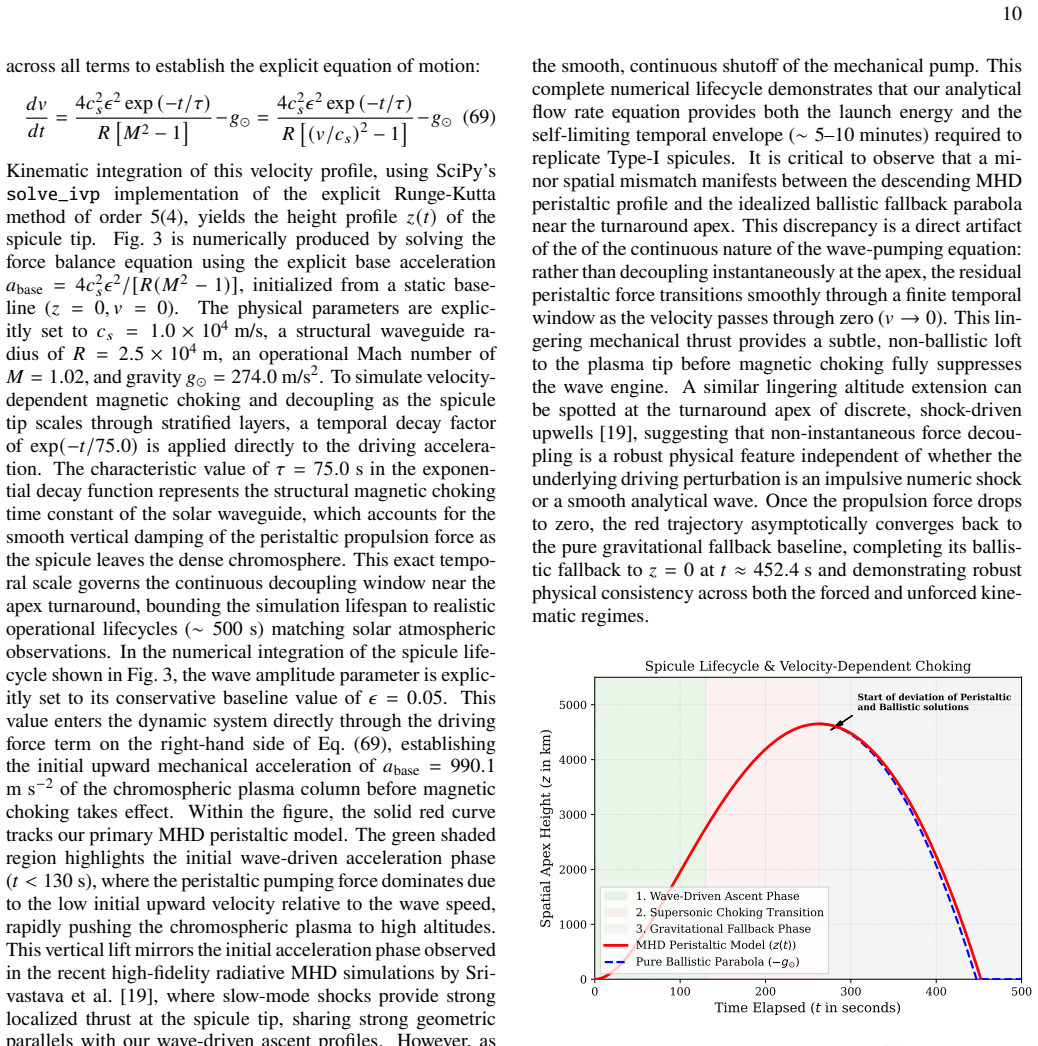
3: Time-dependent spatial height𝑧(𝑡)of a spicule column driven by the prograde equipartition net flow rate relation for𝜖=0.05
Gravitational Fallback Phase MHD Peristaltic Model (z(t)) Pure Ballistic Parabola ( g ) FIG. 3: Time-dependent spatial height𝑧(𝑡)of a spicule column driven by the prograde equipartition net flow rate relation for𝜖=0.05. The solid red curve represents the MHD peristaltic model, the green shaded area marks the initial acceleration phase (𝑡 <130s), and the p...
-
[5]
W.M.BaylissandE.H.Starling,TheJournalofPhysiology24, 99 (1899)
-
[6]
J.C.MisraandS.K.Pandey,MathematicalandComputerMod- elling45, 138 (2007)
2007
-
[7]
Hayat, M
T. Hayat, M. U. Qureshi, and Q. Hussain, International Journal of Heat and Mass Transfer55, 2856 (2012)
2012
-
[8]
A.C.T.AartsandG.Ooms,JournalofEngineeringMathemat- ics34, 435 (1998)
1998
-
[9]
Hayat, B
T. Hayat, B. Ahmed, and M. I. Khan, Journal of Porous Media 25, 45 (2022)
2022
-
[10]
A. H. Shapiro, M. Y. Jaffrin, and S. L. Weinberg, Journal of Fluid Mechanics37, 799 (1969)
1969
-
[11]
W.M.BaylissandE.H.Starling,TheJournalofPhysiology26, 125 (1901)
1901
-
[12]
A. H. Shapiro,The Dynamics and Thermodynamics of Com- pressible Fluid Flow, Vol. 1 and 2 (Ronald Press Company, New York, 1953)
1953
-
[13]
Tsiklauri and I
D. Tsiklauri and I. Beresnev, Physical Review E64, 036303 (2001), [Erratum: Phys. Rev. E73, 029901 (2006)]
2001
-
[14]
Tsiklauri and I
D. Tsiklauri and I. Beresnev, Physical Review E63, 046304 (2001)
2001
-
[15]
Tsiropoula, K
G. Tsiropoula, K. Tziotziou, I. Kontogiannis, M. S. Madjarska, J. G. Doyle, and Y. Suematsu, Space Science Reviews169, 181 (2012)
2012
-
[16]
De Pontieu, S
B. De Pontieu, S. McIntosh, V. H. Hansteen, M. Carlsson, C. J. Schrijver, T. D. Tarbell, A. M. Title, R. A. Shine, Y. Suematsu, S. Tsuneta,et al., Science318, 1574 (2007)
2007
-
[17]
A. K. Srivastava, A. Singh, B. Singh, K. Murawski, and B. N. Dwivedi, Philosophical Transactions of the Royal So- cietyA:Mathematical,PhysicalandEngineeringSciences382, 20230220 (2024)
2024
-
[18]
J. V. Hollweg, S. Jackson, and D. Galloway, The Astrophysical Journal252, 375 (1982)
1982
-
[19]
Carlsson, The Astrophysical Journal647, L73 (2006)
V.H.Hansteen,B.DePontieu,L.RouppevanderVoort,M.van 13 Noort, and M. Carlsson, The Astrophysical Journal647, L73 (2006)
2006
-
[20]
A. C. Sterling, Solar Physics196, 79 (2000)
2000
-
[21]
Oxley, J
W. Oxley, J. Scalisi, M. S. Ruderman, and R. Erdélyi, The Astrophysical Journal905, 168 (2020)
2020
-
[22]
Scalisi, W
J. Scalisi, W. Oxley, M. S. Ruderman, and R. Erdélyi, The Astrophysical Journal911, 39 (2021)
2021
-
[23]
Srivastava, P
S. Srivastava, P. Chatterjee, S. Dey, and R. Erdélyi, The Astro- physical Journal989, 39 (2025)
2025
-
[24]
S. I. Abdelsalam and K. Vafai, European Journal of Mechanics - B/Fluids65, 398 (2017)
2017
-
[25]
J.Lighthill,Waves in Fluids(CambridgeUniversityPress,Cam- bridge, UK, 1978)
1978
-
[26]
M.F.HamiltonandD.T.Blackstock,eds.,Nonlinear Acoustics (Academic Press, San Diego, CA, 1998)
1998
-
[27]
J. M. Beckers, Annual Review of Astronomy and Astrophysics 10, 73 (1972)
1972
-
[28]
G. W. Pneuman and R. A. Kopp, Solar Physics57, 49 (1978)
1978
-
[29]
De Pontieu, R
B. De Pontieu, R. Erdélyi, and S. P. James, Nature430, 536 (2004)
2004
-
[30]
J. I. Castor, D. C. Abbott, and R. I. Klein, The Astrophysical Journal195, 157 (1975)
1975
-
[31]
Velikovich, Physical Review E108, 035203 (2023)
C.Samulski,J.G.Wouchuk,R.Ramis,J.J.L.Huerta,andA.L. Velikovich, Physical Review E108, 035203 (2023)
2023
-
[32]
Yin and Y.-C
F. Yin and Y.-C. Fung, Journal of Applied Mechanics36, 579 (1969)
1969
-
[33]
Rev.190, 103 (2015)
D.B.Jess,R.Morton,G.Verth,V.Fedun,P.Antolin,andT.Van Doorsselaere, Space Sci. Rev.190, 103 (2015)
2015
-
[34]
P. H. Keys, A. Reid, M. Mathioudakis, S. Shelyag, V. M. J. Henriques, R. Erdélyi, and D. B. Jess, ApJ920, 102 (2021)
2021
-
[35]
M.P.Rast,L.R.BellotRubio,W.Cao,G.Cauzzi,B.DePontieu, et al., Solar Physics296, 70 (2021)
2021
-
[36]
S.K.Solanki,T.L.Riethmüller,A.Lagg,A.Feller,A.Gandor- fer,et al., Solar Physics296, 12 (2024)
2024
discussion (0)
Sign in with ORCID, Apple, or X to comment. Anyone can read and Pith papers without signing in.