Data-driven discovery of governing differential equations across physical systems
Pith reviewed 2026-06-27 17:11 UTC · model grok-4.3
The pith
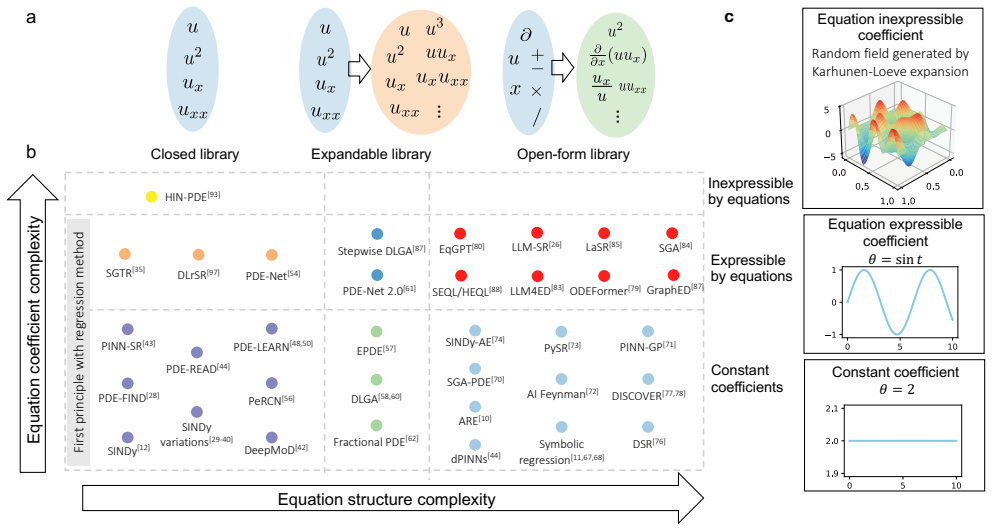
A phase diagram of structural and coefficient complexity plus the REO framework organizes data-driven differential equation discovery across methods.
A machine-rendered reading of the paper's core claim, the machinery that carries it, and where it could break.
Core claim
The authors claim that the two-dimensional phase diagram of equation discoverability, with axes of structural complexity and coefficient complexity, accounts for why different methodological families succeed or fail in different settings, while the representation-evaluation-optimization framework abstracts the discovery process into three persistent components that determine what equations can be found from data across physical systems.
What carries the argument
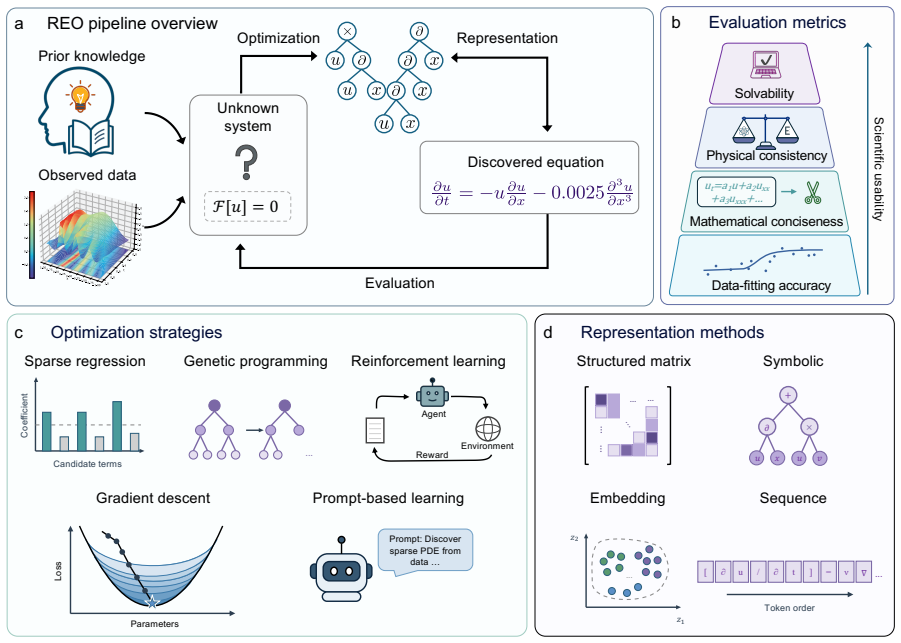
The representation-evaluation-optimization (REO) framework, which decomposes any discovery algorithm into choosing a representation for candidate equations, evaluating their fit to data, and optimizing over that representation.
If this is right
- Methods can be compared and improved by mapping them onto the regions of the phase diagram they can reliably address.
- Discovery algorithms will need to advance along both axes simultaneously to handle richer structures and more flexible coefficients.
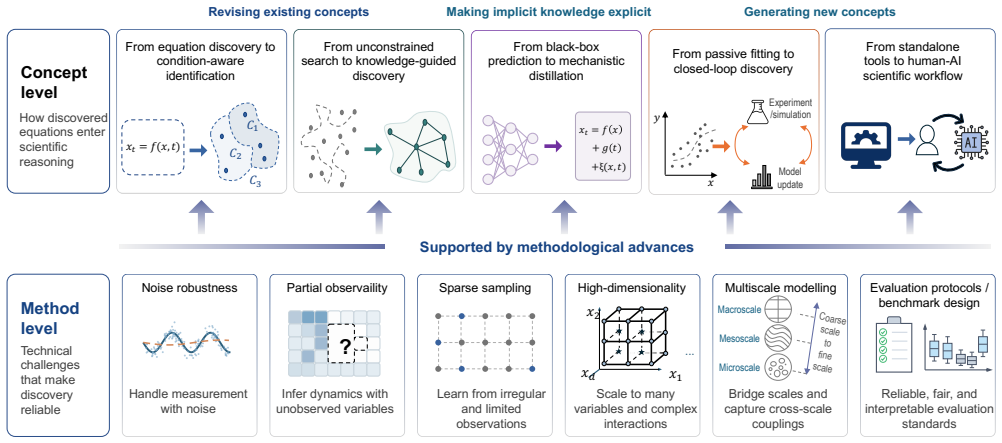
- Recovered equations become inputs for revising existing physical theories rather than end products.
Where Pith is reading between the lines
- The phase diagram could be used to design benchmark suites that systematically test coverage of complexity regions.
- REO might serve as a template for analyzing related inverse problems such as discovering discrete rules or stochastic dynamics.
Load-bearing premise
That the two axes of structural complexity and coefficient complexity are sufficient to organize discoverability problems and explain method success or failure.
What would settle it
A data set whose governing equation lies in one region of the proposed phase diagram yet is recovered by a method predicted to fail there, or fails to be recovered by a method predicted to succeed.
Figures

read the original abstract
Differential equations play a critical role in scientific discovery because they provide a mathematical framework to describe the behaviour of physical phenomena. As a promising alternative to traditional first principles, data-driven differential equation discovery has attracted increasing attention for its ability to infer governing laws directly from experimental or simulated data, especially when the underlying physics is unclear. However, the field has expanded rapidly along diverse methodological directions, particularly with the emergence of AI-based approaches, and still lacks a clear organizing perspective. In this Review, we propose a problem-oriented perspective on data-driven differential equation discovery. We first introduce a two-dimensional phase diagram of equation discoverability, where discovery problems are organized according to structural complexity and coefficient complexity. This phase diagram shows how the field has moved from the discovery of sparse equations with simple coefficients toward more complex governing laws with richer structures and more flexible parameterizations. It also clarifies why different methodological families succeed or fail in different problem settings. We then present the representation-evaluation-optimization (REO) framework as a fundamental abstraction of the discovery process. By identifying the core problems of equation discovery that persist across algorithmic variations, REO shifts the discussion from individual algorithms to the fundamental principles that determine discoverability. We connect these perspectives to applications across physics and adjacent sciences, and argue that the next challenge is not merely recovering equations, but using them to revise existing theories, distil mechanisms and form new scientific concepts.
Editorial analysis
A structured set of objections, weighed in public.
Referee Report
Summary. The paper is a review proposing a two-dimensional phase diagram that organizes data-driven differential equation discovery problems according to structural complexity and coefficient complexity. It introduces the representation-evaluation-optimization (REO) framework as a fundamental abstraction of the discovery process that persists across algorithmic variations. The review connects these ideas to applications in physics and adjacent sciences and argues that the next challenge is using discovered equations to revise theories and form new concepts.
Significance. If the proposed perspectives hold, the work offers a unifying problem-oriented view that synthesizes the rapidly expanding literature on data-driven equation discovery, shifting emphasis from individual algorithms to core principles of discoverability. This could help clarify why methodological families succeed or fail in different settings and guide future research toward mechanism distillation and theory revision.
major comments (1)
- [Phase diagram] Phase diagram (as described in the abstract): the axes of structural complexity and coefficient complexity are introduced conceptually but without operational definitions, scoring functions, or explicit procedures for mapping an arbitrary discovery task onto coordinates. This directly undermines the asserted explanatory power that the diagram clarifies method success/failure and enables prediction across the field.
Simulated Author's Rebuttal
We thank the referee for the constructive review and the recognition of the paper's potential to provide a unifying perspective. We address the single major comment below.
read point-by-point responses
-
Referee: [Phase diagram] Phase diagram (as described in the abstract): the axes of structural complexity and coefficient complexity are introduced conceptually but without operational definitions, scoring functions, or explicit procedures for mapping an arbitrary discovery task onto coordinates. This directly undermines the asserted explanatory power that the diagram clarifies method success/failure and enables prediction across the field.
Authors: We agree that the phase diagram is presented at a conceptual level in the current manuscript. Structural complexity is defined qualitatively as the syntactic form of the governing equation (e.g., number and type of terms, degree of nonlinearity), while coefficient complexity refers to the parameterization of those terms (e.g., constant scalars versus spatially or temporally varying functions). The manuscript illustrates these axes through multiple examples drawn from the literature, showing how different methodological families align with regions of the diagram. However, we acknowledge that formal scoring functions and a step-by-step mapping procedure for arbitrary tasks are not provided. In the revised manuscript we will add a new subsection that supplies (i) explicit, computable proxies for each axis based on equation structure and parameter type, (ii) worked examples that assign coordinates to published discovery problems, and (iii) a discussion of the diagram's intended use as an organizing heuristic rather than a quantitative predictor. This addition will preserve the high-level synthesis while addressing the concern about operational clarity. revision: yes
Circularity Check
No circularity: review organizes literature via conceptual axes without self-referential reductions
full rationale
This is a review paper that proposes a two-dimensional phase diagram (structural complexity vs. coefficient complexity) and the REO framework as organizing perspectives on existing equation-discovery methods. No derivation chain, quantitative predictions, or fitted parameters are introduced that reduce to inputs defined within the paper itself. The abstract and described content draw from cited prior work to classify problems and explain method performance, without any self-definitional, fitted-input, or uniqueness-imported steps. This matches the default expectation for non-circular reviews; the phase-diagram axes are presented conceptually rather than as outputs of an internal fit or self-citation chain.
Axiom & Free-Parameter Ledger
Reference graph
Works this paper leans on
-
[1]
& Ott, E
Pathak, J., Hunt, B., Girvan, M., Lu, Z. & Ott, E. Model-free prediction of large spatiotemporally chaotic systems from data: A reservoir computing approach.Phys. review letters120, 024102 (2018)
2018
-
[2]
& Karniadakis, G
Lu, L., Jin, P., Pang, G., Zhang, Z. & Karniadakis, G. E. Learning nonlinear operators via deeponet based on the universal approximation theorem of operators.Nat. machine intelligence3, 218–229 (2021)
2021
-
[3]
InInternational Conference on Learning Representations(2021)
Li, Z.et al.Fourier neural operator for parametric partial differential equations. InInternational Conference on Learning Representations(2021)
2021
-
[4]
& Lipson, H
Bongard, J. & Lipson, H. Automated reverse engineering of nonlinear dynamical systems.Proc. Natl. Acad. Sci.104, 9943–9948 (2007). 11.Schmidt, M. & Lipson, H. Distilling free-form natural laws from experimental data.science324, 81–85 (2009)
2007
-
[5]
L., Proctor, J
Brunton, S. L., Proctor, J. L. & Kutz, J. N. Discovering governing equations from data by sparse identification of nonlinear dynamical systems.Proc. national academy sciences113, 3932–3937 (2016). 21/35
2016
-
[6]
& Nair, P
Course, K. & Nair, P. B. State estimation of a physical system with unknown governing equations.Nature622, 261–267 (2023)
2023
-
[7]
Supekar, R.et al.Learning hydrodynamic equations for active matter from particle simulations and experiments.Proc. Natl. Acad. Sci.120, e2206994120 (2023)
2023
-
[8]
A., Kageorge, L
Reinbold, P. A., Kageorge, L. M., Schatz, M. F. & Grigoriev, R. O. Robust learning from noisy, incomplete, high- dimensional experimental data via physically constrained symbolic regression.Nat. communications12, 3219 (2021)
2021
-
[9]
Li, Z.et al.Bi-level identification of governing equations for nonlinear physical systems.Nat. Comput. Sci.5, 456–466 (2025)
2025
-
[10]
& Capecelatro, J
Beetham, S. & Capecelatro, J. Formulating turbulence closures using sparse regression with embedded form invariance. Phys. Rev. Fluids5, 084611 (2020)
2020
-
[11]
Beetham, S., Fox, R. O. & Capecelatro, J. Sparse identification of multiphase turbulence closures for coupled fluid–particle flows.J. Fluid Mech.914, A11 (2021)
2021
-
[12]
Water Resour
Song, W.et al.Deep learning identification of the governing equation for water flow in heterogeneous soils from data. Water Resour. Res.61, e2024WR037786 (2025)
2025
-
[13]
Zhan, Y .et al.Physics-informed identification of pdes with lasso regression, examples of groundwater-related equations. J. Hydrol.638, 131504 (2024)
2024
-
[14]
Xu, H., Wu, W., Chen, Y ., Zhang, D. & Mo, F. Explicit relation between thin film chromatography and column chromatography conditions from statistics and machine learning.Nat. Commun.16, 832 (2025). 22.Ying, J.et al.A neural symbolic model for space physics.Nat. Mach. Intell.1–16 (2025)
2025
-
[15]
S., Wikle, C
North, J. S., Wikle, C. K. & Schliep, E. M. A review of data-driven discovery for dynamic systems.Int. Stat. Rev.91, 464–492 (2023)
2023
-
[16]
Brunton, S. L. & Kutz, J. N. Promising directions of machine learning for partial differential equations.Nat. Comput. Sci. 4, 483–494 (2024)
2024
-
[17]
& Wedelin, D
Gennemark, P. & Wedelin, D. Benchmarks for identification of ordinary differential equations from time series data. Bioinformatics25, 780–786 (2009)
2009
-
[18]
Shojaee, P., Meidani, K., Gupta, S., Farimani, A. B. & Reddy, C. K. Llm-sr: Scientific equation discovery via programming with large language models. InThe Thirteenth International Conference on Learning Representations(2025)
2025
-
[19]
& Ahmed, S
Sanderse, B., Stinis, P., Maulik, R. & Ahmed, S. E. Scientific machine learning for closure models in multiscale problems: A review.Foundations Data Sci.7, 298–337 (2025)
2025
-
[20]
H., Brunton, S
Rudy, S. H., Brunton, S. L., Proctor, J. L. & Kutz, J. N. Data-driven discovery of partial differential equations.Sci. advances3, e1602614 (2017)
2017
-
[21]
Messenger, D. A. & Bortz, D. M. Weak sindy: Galerkin-based data-driven model selection.Multiscale Model. & Simul. 19, 1474–1497 (2021). 30.Messenger, D. A. & Bortz, D. M. Weak sindy for partial differential equations.J. Comput. Phys.443, 110525 (2021)
2021
-
[22]
& Garikipati, K
Wang, Z., Huan, X. & Garikipati, K. Variational system identification of the partial differential equations governing the physics of pattern-formation: Inference under varying fidelity and noise.Comput. Methods Appl. Mech. Eng.356, 44–74 (2019)
2019
-
[23]
& Garikipati, K
Wang, Z., Huan, X. & Garikipati, K. Variational system identification of the partial differential equations governing microstructure evolution in materials: Inference over sparse and spatially unrelated data.Comput. Methods Appl. Mech. Eng.377, 113706 (2021). 33.Loiseau, J.-C. & Brunton, S. L. Constrained sparse galerkin regression.J. Fluid Mech.838, 42–67 (2018)
2021
-
[24]
Kaiser, E., Kutz, J. N. & Brunton, S. L. Sparse identification of nonlinear dynamics for model predictive control in the low-data limit.Proc. Royal Soc. A474, 20180335 (2018)
2018
-
[25]
Rudy, S., Alla, A., Brunton, S. L. & Kutz, J. N. Data-driven identification of parametric partial differential equations. SIAM J. on Appl. Dyn. Syst.18, 643–660 (2019)
2019
-
[26]
N., Brunton, B
Fasel, U., Kutz, J. N., Brunton, B. W. & Brunton, S. L. Ensemble-sindy: Robust sparse model discovery in the low-data, high-noise limit, with active learning and control.Proc. Royal Soc. A478, 20210904 (2022). 22/35
2022
-
[27]
L., Sbalzarini, I
Maddu, S., Cheeseman, B. L., Sbalzarini, I. F. & Müller, C. L. Stability selection enables robust learning of differential equations from limited noisy data.Proc. Royal Soc. A478, 20210916 (2022)
2022
-
[28]
Learning partial differential equations via data discovery and sparse optimization.Proc
Schaeffer, H. Learning partial differential equations via data discovery and sparse optimization.Proc. Royal Soc. A: Math. Phys. Eng. Sci.473, 20160446 (2017)
2017
-
[29]
Kaheman, K., Kutz, J. N. & Brunton, S. L. Sindy-pi: a robust algorithm for parallel implicit sparse identification of nonlinear dynamics.Proc. Royal Soc. A476, 20200279 (2020)
2020
-
[30]
Open Source Softw.7, 3994 (2022)
Kaptanoglu, A.et al.Pysindy: A comprehensive python package for robust sparse system identification.J. Open Source Softw.7, 3994 (2022)
2022
-
[31]
& Brenner, M
Bar-Sinai, Y ., Hoyer, S., Hickey, J. & Brenner, M. P. Learning data-driven discretizations for partial differential equations. Proc. Natl. Acad. Sci.116, 15344–15349 (2019)
2019
-
[32]
& Kusters, R
Both, G.-J., Choudhury, S., Sens, P. & Kusters, R. Deepmod: Deep learning for model discovery in noisy data.J. Comput. Phys.428, 109985 (2021)
2021
-
[33]
& Sun, H
Chen, Z., Liu, Y . & Sun, H. Physics-informed learning of governing equations from scarce data.Nat. communications12, 6136 (2021)
2021
-
[34]
& Fukui, K.-i
Thanasutives, P., Morita, T., Numao, M. & Fukui, K.-i. Noise-aware physics-informed machine learning for robust pde discovery.Mach. Learn. Sci. Technol.4, 015009 (2023)
2023
-
[35]
Yuan, Y .et al.Machine discovery of partial differential equations from spatiotemporal data: A sparse bayesian learning framework.Chaos: An Interdiscip. J. Nonlinear Sci.33(2023)
2023
-
[36]
& Earls, C
Stephany, R. & Earls, C. Pde-read: Human-readable partial differential equation discovery using deep learning.Neural Networks154, 360–382 (2022)
2022
-
[37]
& Townsend, A
Boullé, N., Nakatsukasa, Y . & Townsend, A. Rational neural networks.Adv. neural information processing systems33, 14243–14253 (2020)
2020
-
[38]
& Earls, C
Stephany, R. & Earls, C. Pde-learn: Using deep learning to discover partial differential equations from noisy, limited data. Neural Networks174, 106242 (2024)
2024
-
[39]
& Yin, W
Chartrand, R. & Yin, W. Iteratively reweighted algorithms for compressive sensing. In2008 IEEE international conference on acoustics, speech and signal processing, 3869–3872 (IEEE, 2008)
2008
-
[40]
& Earls, C
Stephany, R. & Earls, C. Weak-pde-learn: A weak form based approach to discovering pdes from noisy, limited data.J. Comput. Phys.506, 112950 (2024)
2024
-
[41]
InInternational conference on learning representations, vol
Liu, Z.et al.Kan: Kolmogorov–arnold networks. InInternational conference on learning representations, vol. 2025, 70367–70413 (2025)
2025
-
[42]
C., Kim, S
Koenig, B. C., Kim, S. & Deng, S. Kan-odes: Kolmogorov–arnold network ordinary differential equations for learning dynamical systems and hidden physics.Comput. Methods Appl. Mech. Eng.432, 117397 (2024)
2024
-
[43]
Kantamneni, S., Liu, Z. & Tegmark, M. Optpde: Discovering novel integrable systems via ai-human collaboration.arXiv preprint arXiv:2405.04484(2024)
-
[44]
& Dong, B
Long, Z., Lu, Y ., Ma, X. & Dong, B. Pde-net: Learning pdes from data. InInternational conference on machine learning, 3208–3216 (PMLR, 2018). 55.So, C. C., Li, T. O., Wu, C. & Yung, S. P. Differential spectral normalization (dsn) for pde discovery. InProceedings of the AAAI Conference on Artificial Intelligence, vol. 35, 9675–9684 (2021)
2018
-
[45]
& Sun, H
Rao, C., Ren, P., Liu, Y . & Sun, H. Discovering nonlinear pdes from scarce data with physics-encoded learning.Int. Conf. on Learn. Represent.(2022)
2022
-
[46]
& Kalyuzhnaya, A
Maslyaev, M., Hvatov, A. & Kalyuzhnaya, A. Data-driven partial derivative equations discovery with evolutionary approach. InInternational Conference on Computational Science, 635–641 (Springer, 2019)
2019
-
[47]
& Zhang, D
Xu, H., Chang, H. & Zhang, D. Dlga-pde: Discovery of pdes with incomplete candidate library via combination of deep learning and genetic algorithm.J. Comput. Phys.418, 109584 (2020)
2020
-
[48]
& Karniadakis, G
Raissi, M., Perdikaris, P. & Karniadakis, G. E. Physics-informed neural networks: A deep learning framework for solving forward and inverse problems involving nonlinear partial differential equations.J. Comput. physics378, 686–707 (2019)
2019
-
[49]
& Zhang, D
Xu, H. & Zhang, D. Robust discovery of partial differential equations in complex situations.Phys. Rev. Res.3, 033270 (2021). 23/35
2021
-
[50]
& Dong, B
Long, Z., Lu, Y . & Dong, B. Pde-net 2.0: Learning pdes from data with a numeric-symbolic hybrid deep network.J. Comput. Phys.399, 108925 (2019)
2019
-
[51]
xiangnan et al.Nonlinear Dyn.1–21 (2025)
Yu, X.et al.A data-driven framework for discovering fractional differential equations in complex systems: Y . xiangnan et al.Nonlinear Dyn.1–21 (2025). 63.Virgolin, M. & Pissis, S. P. Symbolic regression is np-hard.Transactions on Mach. Learn. Res.(2022)
2025
-
[52]
& V oigt, H
Kahlmeyer, P., Giesen, J., Habeck, M. & V oigt, H. Scaling up unbiased search-based symbolic regression. InProceedings of the Thirty-Third International Joint Conference on Artificial Intelligence, 4264–4272 (2024)
2024
-
[53]
& Sun, H
Sun, F., Liu, Y ., Wang, J.-X. & Sun, H. Symbolic physics learner: Discovering governing equations via monte carlo tree search. InThe Eleventh International Conference on Learning Representations(2023). 66.Ruan, K.et al.Discovering physical laws with parallel symbolic enumeration.Nat. Comput. Sci.6, 53–66 (2026). 67.Dub ˇcáková, R. Eureqa: software review (2011)
2023
-
[54]
& Tonda, A
Gaucel, S., Keijzer, M., Lutton, E. & Tonda, A. Learning dynamical systems using standard symbolic regression. In European Conference on Genetic Programming, 25–36 (Springer, 2014)
2014
-
[55]
& Spector, L
La Cava, W., Danai, K. & Spector, L. Inference of compact nonlinear dynamic models by epigenetic local search.Eng. Appl. Artif. Intell.55, 292–306 (2016)
2016
-
[56]
& Zhang, D
Chen, Y ., Luo, Y ., Liu, Q., Xu, H. & Zhang, D. Symbolic genetic algorithm for discovering open-form partial differential equations (sga-pde).Phys. Rev. Res.4, 023174 (2022)
2022
-
[57]
G., Beykal, B
Cohen, B. G., Beykal, B. & Bollas, G. M. Physics-informed genetic programming for discovery of partial differential equations from scarce and noisy data.J. Comput. Phys.514, 113261 (2024)
2024
-
[58]
& Tegmark, M
Udrescu, S.-M. & Tegmark, M. Ai feynman: A physics-inspired method for symbolic regression.Sci. advances6, eaay2631 (2020)
2020
-
[59]
neural information processing systems33, 17429–17442 (2020)
Cranmer, M.et al.Discovering symbolic models from deep learning with inductive biases.Adv. neural information processing systems33, 17429–17442 (2020)
2020
-
[60]
Y ., Ariño Bernad, J
Lu, P. Y ., Ariño Bernad, J. & Soljaˇci´c, M. Discovering sparse interpretable dynamics from partial observations.Commun. Phys.5, 206 (2022)
2022
-
[61]
& Locatello, F
Pervez, A., Gavves, E. & Locatello, F. Mechanistic pde networks for discovery of governing equations. InForty-second International Conference on Machine Learning(2025)
2025
-
[62]
K.et al.Deep symbolic regression: Recovering mathematical expressions from data via risk-seeking policy gradients
Petersen, B. K.et al.Deep symbolic regression: Recovering mathematical expressions from data via risk-seeking policy gradients. InInternational Conference on Learning Representations(2021)
2021
-
[63]
& Zhang, D
Du, M., Chen, Y . & Zhang, D. Discover: Deep identification of symbolically concise open-form partial differential equations via enhanced reinforcement learning.Phys. Rev. Res.6, 013182 (2024)
2024
-
[64]
& Zhang, D
Du, M., Chen, Y ., Nie, L., Lou, S. & Zhang, D. Physics-constrained robust learning of open-form partial differential equations from limited and noisy data.Phys. Fluids36(2024)
2024
-
[65]
& Kilbertus, N
d’Ascoli, S., Becker, S., Schwaller, P., Mathis, A. & Kilbertus, N. Odeformer: Symbolic regression of dynamical systems with transformers. InInternational Conference on Learning Representations(2024)
2024
-
[66]
communications 16, 10255 (2025)
Xu, H.et al.Generative discovery of partial differential equations by learning from math handbooks.Nat. communications 16, 10255 (2025)
2025
-
[67]
Meidani, K., Shojaee, P., Reddy, C. K. & Farimani, A. B. Snip: Bridging mathematical symbolic and numeric realms with unified pre-training. InThe Twelfth International Conference on Learning Representations(2024)
2024
-
[68]
& Chen, Y
Li, Q., Hu, Y ., Liu, J. & Chen, Y . Gensr: Symbolic regression based in equation generative space. InInternational Conference on Learning Representations(2026)
2026
-
[69]
& Zhang, D
Du, M., Chen, Y ., Wang, Z., Nie, L. & Zhang, D. Large language models for automatic equation discovery of nonlinear dynamics.Phys. Fluids36(2024)
2024
-
[70]
In Proceedings of the 41st International Conference on Machine Learning, 33940–33962 (2024)
Ma, P.et al.Llm and simulation as bilevel optimizers: a new paradigm to advance physical scientific discovery. In Proceedings of the 41st International Conference on Machine Learning, 33940–33962 (2024)
2024
-
[71]
& Chaudhuri, S
Grayeli, A., Sehgal, A., Costilla Reyes, O., Cranmer, M. & Chaudhuri, S. Symbolic regression with a learned concept library.Adv. Neural Inf. Process. Syst.37, 44678–44709 (2024). 24/35
2024
-
[72]
& Lehman, L.-w
Li, J., Sun, G., Zhao, G. & Lehman, L.-w. H. Robust low-rank discovery of data-driven partial differential equations. In Proceedings of the AAAI Conference on Artificial Intelligence, vol. 34, 767–774 (2020)
2020
-
[73]
& Zeng, J
Xu, H., Zhang, D. & Zeng, J. Deep-learning of parametric partial differential equations from sparse and noisy data.Phys. Fluids33(2021)
2021
-
[74]
Zhang, M., Kim, S., Lu, P. Y . & Soljaˇci´c, M. Deep learning and symbolic regression for discovering parametric equations. IEEE Transactions on Neural Networks Learn. Syst.(2023)
2023
-
[75]
Xu, H., Chen, Y . & Zhang, D. Beyond empirical models: Discovering new constitutive laws in solids with graph-based equation discovery.arXiv preprint arXiv:2511.09906(2025)
-
[76]
& Phoon, K
Huang, S., Quek, S. & Phoon, K. Convergence study of the truncated karhunen–loeve expansion for simulation of stochastic processes.Int. journal for numerical methods engineering52, 1029–1043 (2001)
2001
-
[77]
Zhang, D. & Lu, Z. An efficient, high-order perturbation approach for flow in random porous media via karhunen–loeve and polynomial expansions.J. Comput. Phys.194, 773–794 (2004)
2004
-
[78]
C., Tripura, T., Nayek, R
Mathpati, Y . C., Tripura, T., Nayek, R. & Chakraborty, S. Discovering stochastic partial differential equations from limited data using variational bayes inference.Comput. Methods Appl. Mech. Eng.418, 116512 (2024)
2024
-
[79]
InProceedings of the 29th ACM SIGKDD Conference on Knowledge Discovery and Data Mining, 1595–1607 (2023)
Luo, Y .et al.Physics-guided discovery of highly nonlinear parametric partial differential equations. InProceedings of the 29th ACM SIGKDD Conference on Knowledge Discovery and Data Mining, 1595–1607 (2023)
2023
-
[80]
& Parascandolo, G
Biggio, L., Bendinelli, T., Lucchi, A. & Parascandolo, G. A seq2seq approach to symbolic regression. InLearning meets combinatorial algorithms at NeurIPS2020(2020)
2020
discussion (0)
Sign in with ORCID, Apple, or X to comment. Anyone can read and Pith papers without signing in.