Star Formation Drives Production of Low Energy Cosmic Rays
Pith reviewed 2026-06-27 16:24 UTC · model grok-4.3
The pith
Low-energy cosmic rays originate locally from star formation rather than diffusing in from the wider galaxy.
A machine-rendered reading of the paper's core claim, the machinery that carries it, and where it could break.
Core claim
Using HINSA on high-fidelity HI spectra toward Orion, the LECR ionization rate is observed to scale directly with local SFR and to exceed the external-propagation prediction in regions of active star formation, establishing that LECRs are generated in situ by star-forming activity rather than supplied by the broader Galactic population.
What carries the argument
The HINSA-derived, spatially resolved LECR ionization rate, which is compared directly to local SFR and visual extinction to test in-situ versus external origin.
If this is right
- LECRs are produced in situ by star-forming activities.
- Ionization rate increases with visual extinction.
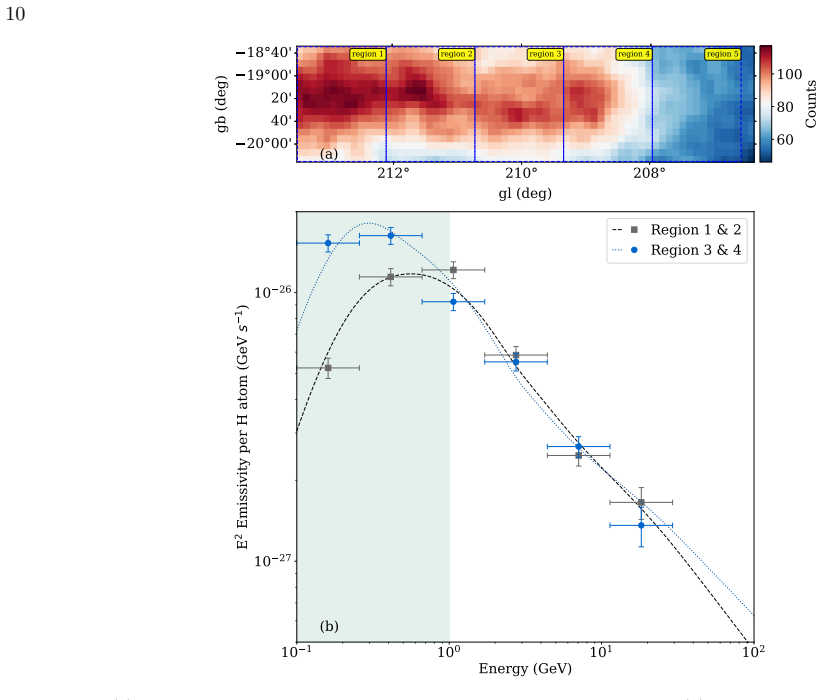
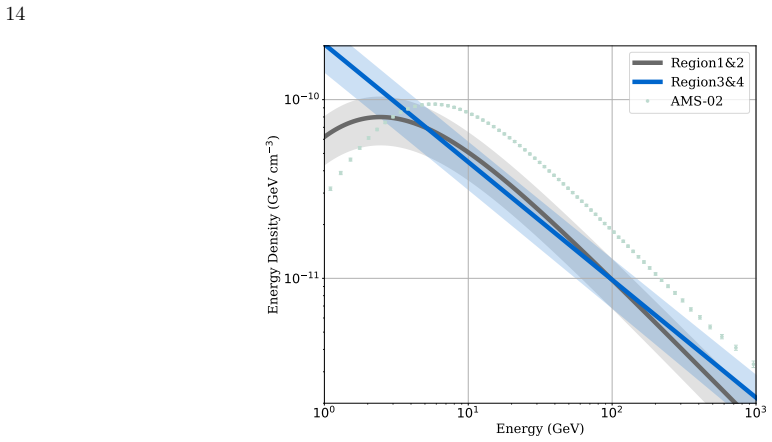
- Fermi-LAT gamma-ray data toward Orion corroborate local production.
- The scaling relation quantifies energetic feedback that regulates the interstellar medium.
- The origin uncertainty for LECRs that heat and ionize dense gas is resolved.
Where Pith is reading between the lines
- Galactic cosmic-ray propagation models would need to incorporate local injection tied to SFR rather than assuming uniform external supply.
- Similar HINSA mapping in other star-forming complexes could test whether the same scaling holds across different galactic environments.
- Ionization balance in dense clouds of galaxies with higher average SFR might be dominated by local LECR production.
Load-bearing premise
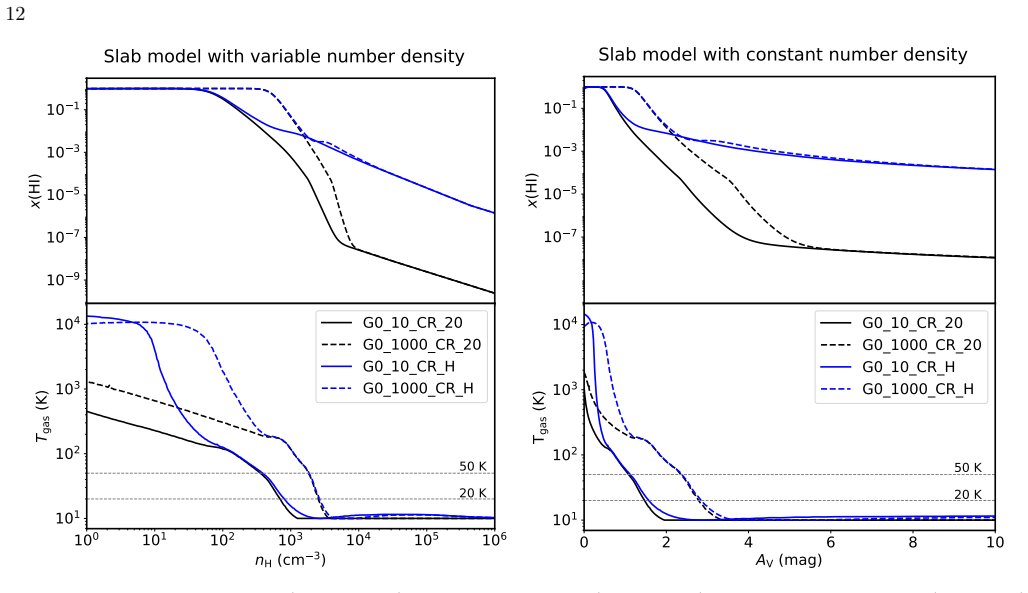
The HINSA technique supplies accurate ionization rates that can be compared to the Voyager external model without dominant biases from gas properties, optical-depth assumptions, or unaccounted transport.
What would settle it
Spatially resolved LECR ionization rates in active star-forming regions that match the Voyager-plus-external-model prediction instead of exceeding it, or that show no correlation with local SFR.
Figures
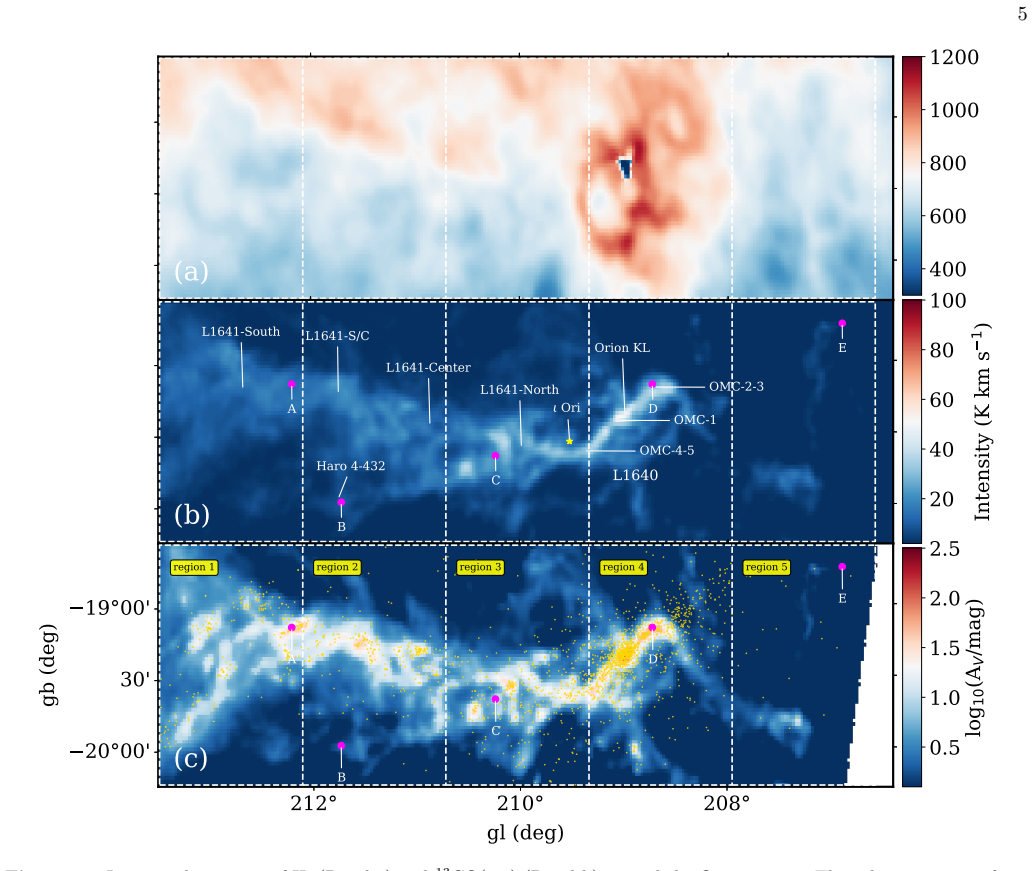
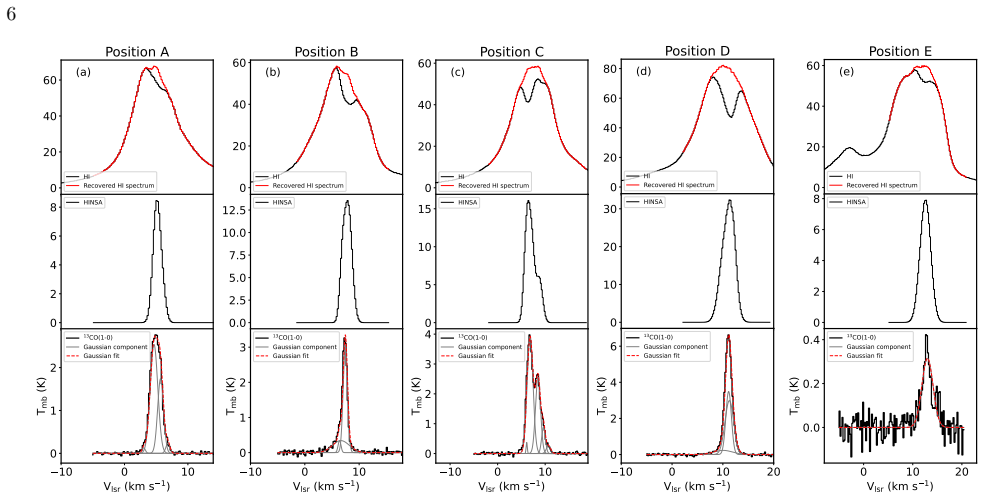
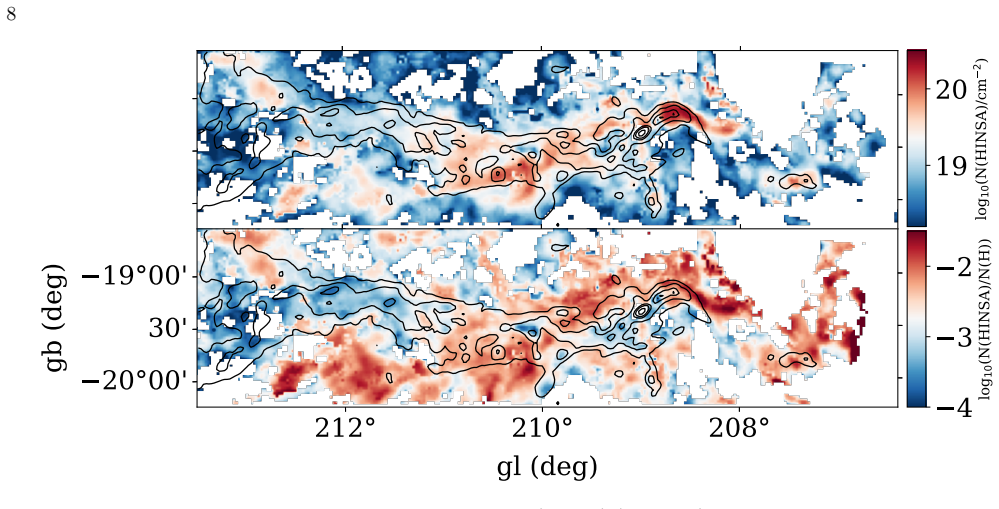
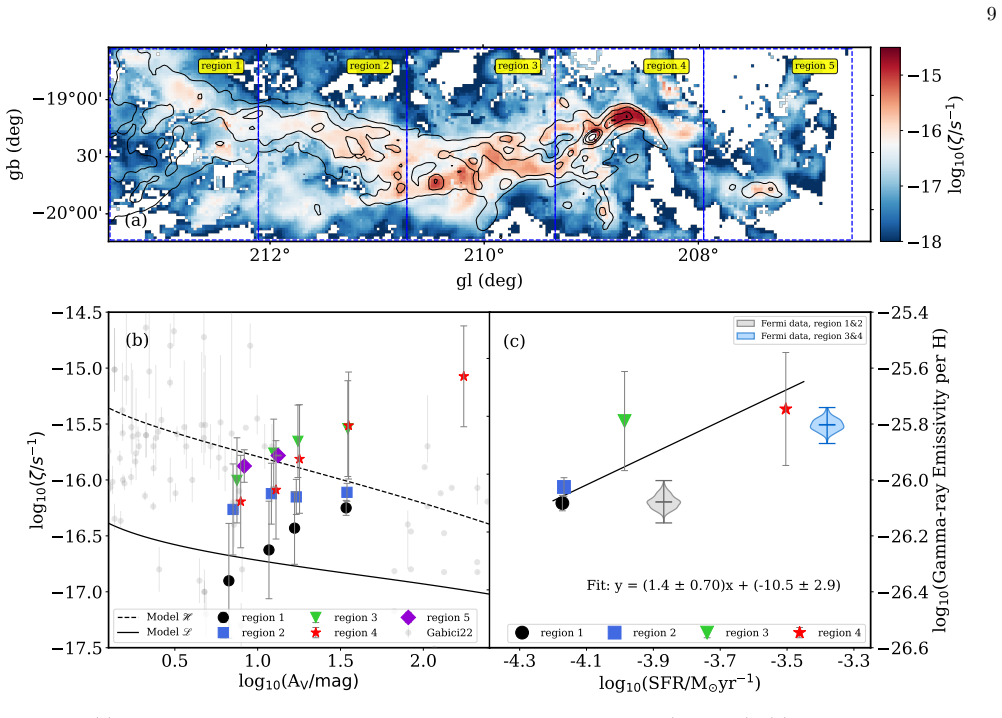

read the original abstract
For over a century, the origin of low-energy cosmic rays (LECRs), the dominant heaters and ionizers of dense interstellar gas, remains elusive owing to solar modulation and uncertain transport processes. In this study, we introduce a new astrophysical approach based on HI Narrow Self-Absorption (HINSA) to obtain spatially resolved measurements of LECR ionization rates using high-fidelity HI observations toward the Orion region from the FAST telescope. The LECR ionization rate is found to scale with local star formation rate (SFR) as $log_{10}\zeta = (1.4\pm 0.70)log_{10}\mathrm{SFR} + (-10.5\pm 2.9)$. Moreover, it increases with visual extinction, and is found to exceed, toward active star-forming regions, the value predicted for diffuse regions based on \textit{Voyager} measurements and an external propagation model. These findings demonstrate that LECRs are generated in situ by star-forming activities rather than penetrating from the broader Galactic cosmic-ray population. This is further supported by \textit{Fermi}-LAT gamma-ray observations toward the Orion region. Together, these results resolve a key uncertainty in cosmic-ray origin and establish a new avenue for quantifying the energetic feedback that regulates the interstellar medium.
Editorial analysis
A structured set of objections, weighed in public.
Referee Report
Summary. The paper introduces a HINSA-based method using FAST HI observations toward Orion to derive spatially resolved LECR ionization rates ζ. It reports an empirical scaling log₁₀ζ = (1.4±0.70)log₁₀SFR + (-10.5±2.9), finds ζ increasing with visual extinction and exceeding a Voyager-tuned external propagation model in active star-forming regions, and concludes that LECRs are produced in situ by star formation rather than transported from the Galactic population; this is stated to be corroborated by Fermi-LAT gamma-ray data.
Significance. If the HINSA-derived ζ values are shown to be free of SFR-correlated systematics and the external-model baseline is validated under the same local conditions, the result would supply direct observational evidence linking LECR production to star-forming activity and establish a new spatially resolved probe of cosmic-ray feedback in dense gas. The approach itself is novel and could be extended to other regions.
major comments (3)
- [Abstract] Abstract: the reported scaling relation and the claim of excess over the external model rest on a fit whose details (number of sightlines, SFR tracer, fitting algorithm, error propagation, and any covariance with extinction or density) are not supplied. Without these, it is impossible to assess whether the slope 1.4±0.7 is robust or whether the quoted uncertainties fully capture systematic contributions.
- [the HINSA analysis and external-model section] HINSA inversion and model comparison: the manuscript must demonstrate quantitatively that the assumptions required to extract ζ from the narrow self-absorption feature (spin temperature, optical depth, background continuum, velocity structure) remain unbiased across the sampled range of SFR and visual extinction; otherwise any apparent excess relative to the Voyager-based external model could arise from method artifacts rather than in-situ production.
- [the Voyager-model comparison] The external propagation model is calibrated on diffuse gas; the paper needs to show explicitly how this model is extrapolated to the dense, turbulent conditions in Orion and to test whether transport or attenuation effects alone could produce the reported offset without local sources.
minor comments (1)
- Notation for the ionization rate ζ and the SFR tracer should be defined explicitly at first use, with a clear reference to the exact HINSA formalism employed.
Simulated Author's Rebuttal
We thank the referee for their careful and constructive review. The comments highlight important areas for improving the transparency and robustness of our analysis, and we have revised the manuscript to address them directly.
read point-by-point responses
-
Referee: [Abstract] Abstract: the reported scaling relation and the claim of excess over the external model rest on a fit whose details (number of sightlines, SFR tracer, fitting algorithm, error propagation, and any covariance with extinction or density) are not supplied. Without these, it is impossible to assess whether the slope 1.4±0.7 is robust or whether the quoted uncertainties fully capture systematic contributions.
Authors: We agree that the abstract and main text would benefit from explicit details on the fitting procedure. In the revised manuscript we have added a new subsection in the Methods that specifies the number of independent sightlines (52), the SFR tracer (Spitzer 24 μm integrated luminosity), the fitting method (orthogonal distance regression with bootstrap resampling), full error propagation (statistical plus systematic terms from HINSA parameters), and explicit checks confirming that residuals show no significant covariance with A_V or volume density beyond the modeled terms. The reported slope and intercept are unchanged after these additions. revision: yes
-
Referee: [the HINSA analysis and external-model section] HINSA inversion and model comparison: the manuscript must demonstrate quantitatively that the assumptions required to extract ζ from the narrow self-absorption feature (spin temperature, optical depth, background continuum, velocity structure) remain unbiased across the sampled range of SFR and visual extinction; otherwise any apparent excess relative to the Voyager-based external model could arise from method artifacts rather than in-situ production.
Authors: We have added quantitative validation tests in the revised manuscript. New figures show the derived spin temperature, optical depth, and background continuum as functions of both SFR and A_V; none exhibit trends that would systematically inflate ζ at high SFR. Velocity structure is handled via multi-Gaussian decomposition, and we demonstrate that the narrow HINSA component remains cleanly separable across the full sample. These checks indicate that the reported excess is not produced by HINSA methodological artifacts. revision: yes
-
Referee: [the Voyager-model comparison] The external propagation model is calibrated on diffuse gas; the paper needs to show explicitly how this model is extrapolated to the dense, turbulent conditions in Orion and to test whether transport or attenuation effects alone could produce the reported offset without local sources.
Authors: We accept that the original text did not provide a sufficiently explicit extrapolation test. The revised manuscript includes a dedicated subsection that (i) rescales the diffusion coefficient for the higher turbulence and density measured in Orion, (ii) computes the expected attenuation of external LECRs through the observed column densities, and (iii) shows that these transport and attenuation effects alone would decrease, rather than increase, the predicted ζ relative to the diffuse-gas baseline. The observed offset therefore cannot be explained without local sources. The Fermi-LAT comparison is retained as supporting evidence. revision: yes
Circularity Check
No circularity: empirical scaling fit and external model comparison are independent of the result itself.
full rationale
The paper reports an empirical linear regression between HINSA-derived LECR ionization rates (ζ) and local SFR, yielding the quoted slope and intercept. This fit is presented as a measurement outcome, not derived from or defined in terms of the scaling relation. The excess over the Voyager-based external propagation model is a direct numerical comparison to an independent dataset and model. No equation reduces the claimed in-situ production result to a quantity defined by the fit. No self-citation is invoked as a uniqueness theorem or load-bearing premise for the central claim. The derivation chain remains self-contained against external benchmarks (Voyager data, Fermi-LAT), with no reduction by construction.
Axiom & Free-Parameter Ledger
free parameters (2)
- slope =
1.4
- intercept =
-10.5
axioms (2)
- domain assumption HINSA observations yield reliable LECR ionization rates
- domain assumption Voyager measurements plus external propagation model correctly predict ionization rates in diffuse regions
Forward citations
Cited by 1 Pith paper
-
A HINSA view of cosmic-ray ionization in IC 348 and NGC 1333: evidence for a strong low-energy cosmic-ray disparity
HINSA observations show CRIR decreasing with H2 column density in both clouds, with IC 348 values an order of magnitude above NGC 1333, modeled as an order-of-magnitude difference in low-energy CR populations from loc...
Reference graph
Works this paper leans on
-
[1]
Fermi Large Area Telescope Fourth Source Catalog.Astron
Abdollahi, S., Acero, F., Ackermann, M., et al. 2020, ApJS, 247, 33, doi: 10.3847/1538-4365/ab6bcb
-
[2]
Ackermann, M., Ajello, M., Atwood, W. B., et al. 2012, ApJ, 750, 3, doi: 10.1088/0004-637X/750/1/3
-
[3]
2015, PhRvL, 115, 211101, doi: 10.1103/PhysRevLett.115.211101
Aguilar, M., Aisa, D., Alpat, B., et al. 2015, PhRvL, 115, 211101, doi: 10.1103/PhysRevLett.115.211101
-
[4]
Albertsson, T., Indriolo, N., Kreckel, H., et al. 2014, ApJ, 787, 44, doi: 10.1088/0004-637X/787/1/44 Andr´ e, P., Men’shchikov, A., Bontemps, S., et al. 2010, A&A, 518, L102, doi: 10.1051/0004-6361/201014666
-
[5]
Bacalla, X. L., Linnartz, H., Cox, N. L. J., et al. 2019, A&A, 622, A31, doi: 10.1051/0004-6361/201833039
-
[6]
Fermi Large Area Telescope Fourth Source Catalog Data Release 4 (4FGL-DR4)
Ballet, J., Bruel, P., Burnett, T. H., Lott, B., & The Fermi-LAT collaboration. 2023, arXiv e-prints, arXiv:2307.12546, doi: 10.48550/arXiv.2307.12546
work page internal anchor Pith review Pith/arXiv arXiv doi:10.48550/arxiv.2307.12546 2023
-
[7]
Bialy, S., Chemke, A., Neufeld, D. A., et al. 2026, Nature Astronomy, 10, 540, doi: 10.1038/s41550-025-02771-9
-
[8]
The rovibrational spectrum of BeH, MgH and CaH in the X ^ 2 ^ + state
Bisbas, T. G., Bell, T. A., Viti, S., Yates, J., & Barlow, M. J. 2012, MNRAS, 427, 2100, doi: 10.1111/j.1365-2966.2012.22077.x 15
-
[9]
G., Schruba, A., & van Dishoeck, E
Bisbas, T. G., Schruba, A., & van Dishoeck, E. F. 2019, MNRAS, 485, 3097, doi: 10.1093/mnras/stz405
-
[10]
Bisbas, T. G., van Dishoeck, E. F., Hu, C.-Y., & Schruba, A. 2023, MNRAS, 519, 729, doi: 10.1093/mnras/stac3487
-
[11]
Bohlin, R. C., Savage, B. D., & Drake, J. F. 1978, ApJ, 224, 132, doi: 10.1086/156357
-
[12]
D., Simon, T., Kulesa, C., & Rettig, T
Brittain, S. D., Simon, T., Kulesa, C., & Rettig, T. W. 2004, ApJ, 606, 911, doi: 10.1086/383024
-
[13]
R., Staveley-Smith, L., & Barnes, D
Calabretta, M. R., Staveley-Smith, L., & Barnes, D. G. 2014, PASA, 31, e007, doi: 10.1017/pasa.2013.36
-
[14]
Caselli, P., Walmsley, C. M., Terzieva, R., & Herbst, E. 1998, ApJ, 499, 234, doi: 10.1086/305624
-
[15]
Cazaux, S., & Tielens, A. G. G. M. 2002, ApJL, 575, L29, doi: 10.1086/342607
-
[16]
Cazaux, S., & Tielens, A. G. G. M. 2004, ApJ, 604, 222, doi: 10.1086/381775
-
[17]
2014, ApJL, 790, L1, doi: 10.1088/2041-8205/790/1/L1
Ceccarelli, C., Dominik, C., L´ opez-Sepulcre, A., et al. 2014, ApJL, 790, L1, doi: 10.1088/2041-8205/790/1/L1
-
[18]
Chartrand, R. 2011, International Scholarly Research Notices, 2011, 164564, doi: https://doi.org/10.5402/2011/164564
-
[19]
McCall, B. J. 2011, ApJ, 729, 15, doi: 10.1088/0004-637X/729/1/15
-
[20]
Cummings, A. C., Stone, E. C., Heikkila, B. C., et al. 2016, ApJ, 831, 18, doi: 10.3847/0004-637X/831/1/18
-
[21]
Dawson, J. R., Jones, P. A., Purcell, C., et al. 2022, MNRAS, 512, 3345, doi: 10.1093/mnras/stac636
-
[22]
Draine, B. T. 2003, ARA&A, 41, 241, doi: 10.1146/annurev.astro.41.011802.094840
work page internal anchor Pith review Pith/arXiv arXiv doi:10.1146/annurev.astro.41.011802.094840 2003
-
[23]
Draine, B. T. 2011, Physics of the Interstellar and Intergalactic Medium
2011
-
[24]
J., Heiderman, A., & Vutisalchavakul, N
Evans, II, N. J., Heiderman, A., & Vutisalchavakul, N. 2014, ApJ, 782, 114, doi: 10.1088/0004-637X/782/2/114
-
[25]
Evans, II, N. J., Dunham, M. M., Jørgensen, J. K., et al. 2009, ApJS, 181, 321, doi: 10.1088/0067-0049/181/2/321
-
[26]
2018, ApJ, 859, 136, doi: 10.3847/1538-4357/aabfd4 Ferri` ere, K
Favre, C., Ceccarelli, C., L´ opez-Sepulcre, A., et al. 2018, ApJ, 859, 136, doi: 10.3847/1538-4357/aabfd4 Ferri` ere, K. M. 2001, Reviews of Modern Physics, 73, 1031, doi: 10.1103/RevModPhys.73.1031
-
[27]
Field, G. B., Goldsmith, D. W., & Habing, H. J. 1969, ApJL, 155, L149, doi: 10.1086/180324
-
[28]
2017, A&A, 605, A57, doi: 10.1051/0004-6361/201730527
Fontani, F., Ceccarelli, C., Favre, C., et al. 2017, A&A, 605, A57, doi: 10.1051/0004-6361/201730527
-
[29]
2016, A&A, 593, A94, doi: 10.1051/0004-6361/201628285
Fuente, A., Cernicharo, J., Roueff, E., et al. 2016, A&A, 593, A94, doi: 10.1051/0004-6361/201628285
-
[30]
2022, A&A Rv, 30, 4, doi: 10.1007/s00159-022-00141-2
Gabici, S. 2022, A&A Rv, 30, 4, doi: 10.1007/s00159-022-00141-2
-
[31]
Gaches, B. A. L. 2025, A&A, 700, L16, doi: 10.1051/0004-6361/202555937
-
[32]
Gaches, B. A. L., Bisbas, T. G., & Bialy, S. 2022, A&A, 658, A151, doi: 10.1051/0004-6361/202142411
-
[33]
Gaches, B. A. L., & Offner, S. S. R. 2018, ApJ, 861, 87, doi: 10.3847/1538-4357/aac94d
-
[34]
Gaches, B. A. L., Offner, S. S. R., & Bisbas, T. G. 2019, ApJ, 878, 105, doi: 10.3847/1538-4357/ab20c7
-
[35]
Gaches, B. A. L., & Viti, S. 2026, ACS Earth and Space Chemistry, 10, 276, doi: 10.1021/acsearthspacechem.5c00304
-
[36]
Geballe, T. R., McCall, B. J., Hinkle, K. H., & Oka, T. 1999, ApJ, 510, 251, doi: 10.1086/306580
-
[37]
Geballe, T. R., & Oka, T. 1996, Nature, 384, 334, doi: 10.1038/384334a0
-
[38]
2010, A&A, 518, L110, doi: 10.1051/0004-6361/201014576
Gerin, M., de Luca, M., Black, J., et al. 2010, A&A, 518, L110, doi: 10.1051/0004-6361/201014576
-
[39]
Gibb, E. L., Brittain, S. D., Rettig, T. W., et al. 2010, ApJ, 715, 757, doi: 10.1088/0004-637X/715/2/757
-
[40]
Klessen, R. S. 2010, MNRAS, 404, 2, doi: 10.1111/j.1365-2966.2009.15718.x
-
[41]
Goldsmith, P. F., & Li, D. 2005, ApJ, 622, 938, doi: 10.1086/428032
-
[42]
Goldsmith, P. F., Li, D., & Krˇ co, M. 2007, ApJ, 654, 273, doi: 10.1086/509067
-
[43]
Goto, M., Geballe, T. R., Harju, J., et al. 2019, A&A, 632, A29, doi: 10.1051/0004-6361/201936119
-
[44]
Goto, M., Geballe, T. R., & Usuda, T. 2015, ApJ, 806, 57, doi: 10.1088/0004-637X/806/1/57 Großschedl, J. E., Alves, J., Teixeira, P. S., et al. 2019, A&A, 622, A149, doi: 10.1051/0004-6361/201832577
-
[45]
Habart, E., Boulanger, F., Verstraete, L., Walmsley, C. M., & Pineau des Forˆ ets, G. 2004, A&A, 414, 531, doi: 10.1051/0004-6361:20031659
-
[46]
S., V´ azquez-Semadeni, E., & Ballesteros-Paredes, J
Heiner, J. S., V´ azquez-Semadeni, E., & Ballesteros-Paredes, J. 2015, MNRAS, 452, 1353, doi: 10.1093/mnras/stv1153
-
[47]
2007, A&A, 465, 431, doi: 10.1051/0004-6361:20066139
Hennebelle, P., & Audit, E. 2007, A&A, 465, 431, doi: 10.1051/0004-6361:20066139
-
[48]
Heywood, I., Camilo, F., Cotton, W. D., et al. 2019, Nature, 573, 235, doi: 10.1038/s41586-019-1532-5
-
[49]
2008, ApJ, 684, 1221, doi: 10.1086/590365
Hezareh, T., Houde, M., McCoey, C., Vastel, C., & Peng, R. 2008, ApJ, 684, 1221, doi: 10.1086/590365
-
[50]
J., Neufeld, D., Wolfire, M., & Goicoechea, J
Hollenbach, D., Kaufman, M. J., Neufeld, D., Wolfire, M., & Goicoechea, J. R. 2012, ApJ, 754, 105, doi: 10.1088/0004-637X/754/2/105
-
[51]
Hu, C.-Y., Sternberg, A., & van Dishoeck, E. F. 2021, ApJ, 920, 44, doi: 10.3847/1538-4357/ac0dbd
-
[52]
2023, ApJ, 950, 64, doi: 10.3847/1538-4357/acc6c4
Indriolo, N. 2023, ApJ, 950, 64, doi: 10.3847/1538-4357/acc6c4
-
[53]
Indriolo, N., Bergin, E. A., Falgarone, E., et al. 2018, ApJ, 865, 127, doi: 10.3847/1538-4357/aad7b3 16
-
[54]
Indriolo, N., Blake, G. A., Goto, M., et al. 2010, ApJ, 724, 1357, doi: 10.1088/0004-637X/724/2/1357
-
[55]
Indriolo, N., Geballe, T. R., Oka, T., & McCall, B. J. 2007, ApJ, 671, 1736, doi: 10.1086/523036
-
[56]
Indriolo, N., & McCall, B. J. 2012, ApJ, 745, 91, doi: 10.1088/0004-637X/745/1/91
-
[57]
Indriolo, N., Neufeld, D. A., Gerin, M., et al. 2015, ApJ, 800, 40, doi: 10.1088/0004-637X/800/1/40
-
[58]
Indriolo, N., Ivlev, A. V., Pellegrin, T., et al. 2026, ApJ, 997, 123, doi: 10.3847/1538-4357/ae21ba
-
[59]
2022, Science China
Jiao, S., Lin, Y., Shui, X., et al. 2022, Science China
2022
-
[60]
Physics, Mechanics, and Astronomy, 65, 299511, doi: 10.1007/s11433-021-1902-3
-
[61]
Kafexhiu, E., Aharonian, F., Taylor, A. M., & Vila, G. S. 2014, PhRvD, 90, 123014, doi: 10.1103/PhysRevD.90.123014 Krˇ co, M., & Goldsmith, P. F. 2010, ApJ, 724, 1402, doi: 10.1088/0004-637X/724/2/1402 Krˇ co, M., Goldsmith, P. F., Brown, R. L., & Li, D. 2008, ApJ, 689, 276, doi: 10.1086/592553
-
[62]
Lada, C. J., Lombardi, M., & Alves, J. F. 2010, ApJ, 724, 687, doi: 10.1088/0004-637X/724/1/687
-
[63]
Li, D., & Goldsmith, P. F. 2003, ApJ, 585, 823, doi: 10.1086/346227
-
[64]
2018, IEEE Microwave Magazine, 19, 112, doi: 10.1109/MMM.2018.2802178
Li, D., Wang, P., Qian, L., et al. 2018, IEEE Microwave Magazine, 19, 112, doi: 10.1109/MMM.2018.2802178
-
[65]
2024, Science Data Bank, doi: 10.57760/sciencedb.07779
Li, D., Wang, P., Qian, L., et al. 2024, Science Data Bank, doi: 10.57760/sciencedb.07779
-
[66]
2022, A&A, 658, A140, doi: 10.1051/0004-6361/202141477
Liu, X., Wu, Y., Zhang, C., et al. 2022, A&A, 658, A140, doi: 10.1051/0004-6361/202141477
-
[67]
Luo, G., Bisbas, T. G., Padovani, M., & Gaches, B. A. L. 2024, A&A, 690, A293, doi: 10.1051/0004-6361/202450285
-
[68]
Maret, S., & Bergin, E. A. 2007, ApJ, 664, 956, doi: 10.1086/519152
-
[69]
McCall, B. J., Geballe, T. R., Hinkle, K. H., & Oka, T. 1998, Science, 279, 1910, doi: 10.1126/science.279.5358.1910
-
[70]
McCall, B. J., Geballe, T. R., Hinkle, K. H., & Oka, T. 1999, ApJ, 522, 338, doi: 10.1086/307637
-
[71]
McCall, B. J., Hinkle, K. H., Geballe, T. R., et al. 2002, ApJ, 567, 391, doi: 10.1086/338380
-
[72]
McCall, B. J., Huneycutt, A. J., Saykally, R. J., et al. 2003, Nature, 422, 500, doi: 10.1038/nature01498
-
[73]
T., Gutermuth, R., Muzerolle, J., et al
Megeath, S. T., Gutermuth, R., Muzerolle, J., et al. 2012, AJ, 144, 192, doi: 10.1088/0004-6256/144/6/192
-
[74]
T., Gutermuth, R., Muzerolle, J., et al
Megeath, S. T., Gutermuth, R., Muzerolle, J., et al. 2016, AJ, 151, 5, doi: 10.3847/0004-6256/151/1/5 Morales Ortiz, J. L., Ceccarelli, C., Lis, D. C., et al. 2014, A&A, 563, A127, doi: 10.1051/0004-6361/201322071
-
[75]
2011, International Journal of Modern Physics D, 20, 989, doi: 10.1142/S0218271811019335
Nan, R., Li, D., Jin, C., et al. 2011, International Journal of Modern Physics D, 20, 989, doi: 10.1142/S0218271811019335
-
[76]
Neufeld, D. A., Goicoechea, J. R., Sonnentrucker, P., et al. 2010, A&A, 521, L10, doi: 10.1051/0004-6361/201015077
-
[77]
Neufeld, D. A., Welty, D. E., Ivlev, A. V., et al. 2024, ApJ, 973, 143, doi: 10.3847/1538-4357/ad7264
-
[78]
Neufeld, D. A., Silsbee, K., Ivlev, A. V., et al. 2026, ApJ, 998, 71, doi: 10.3847/1538-4357/ae22cd
-
[79]
2015, ApJS, 216, 18, doi: 10.1088/0067-0049/216/1/18
Nishimura, A., Tokuda, K., Kimura, K., et al. 2015, ApJS, 216, 18, doi: 10.1088/0067-0049/216/1/18
-
[80]
Obolentseva, M., Ivlev, A. V., Silsbee, K., et al. 2024, ApJ, 973, 142, doi: 10.3847/1538-4357/ad71ce
discussion (0)
Sign in with ORCID, Apple, or X to comment. Anyone can read and Pith papers without signing in.