NEXUS: Abundance, Environments, and Spectral Diversity of Little Red Dots from the NIRSpec MSA Sample
Pith reviewed 2026-06-27 16:18 UTC · model grok-4.3
The pith
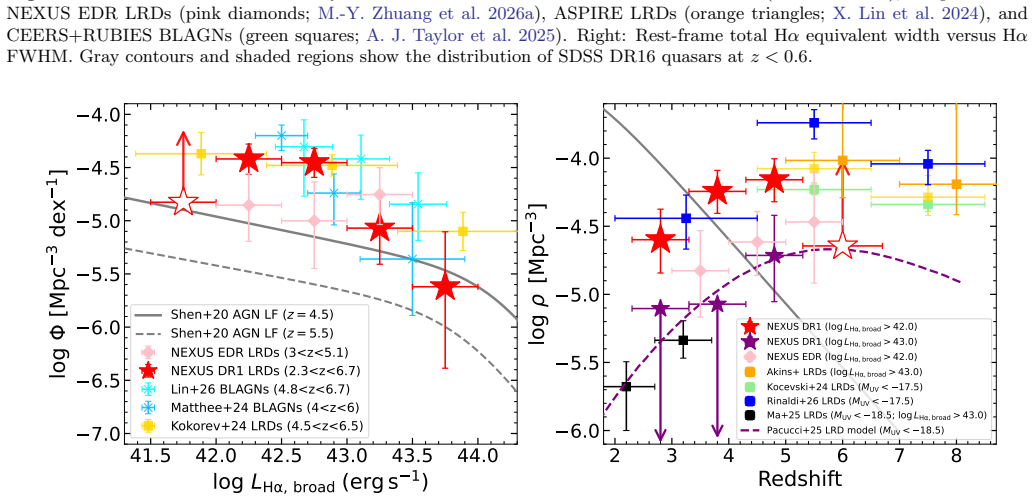
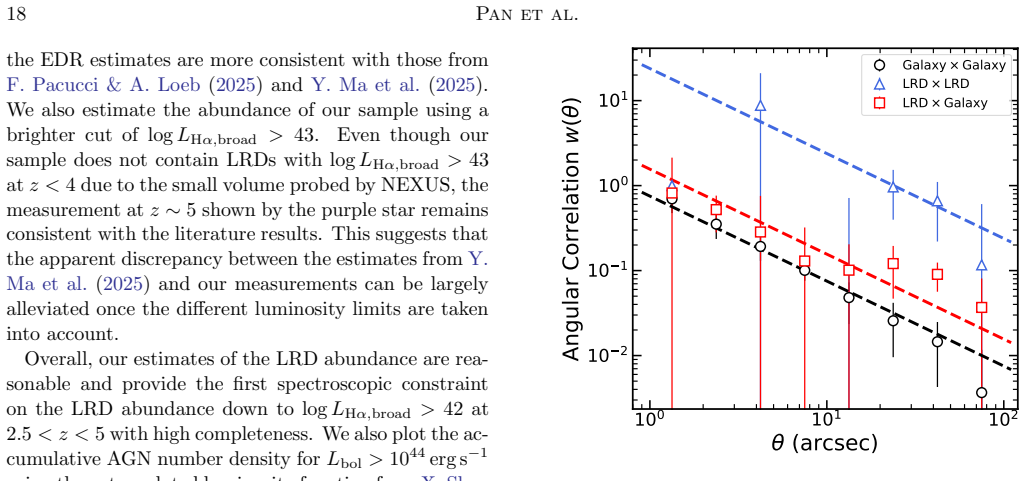
Little Red Dots show declining space density toward z=2 opposite normal AGNs and inhabit dark matter halos of several times 10^11 solar masses
A machine-rendered reading of the paper's core claim, the machinery that carries it, and where it could break.
Core claim
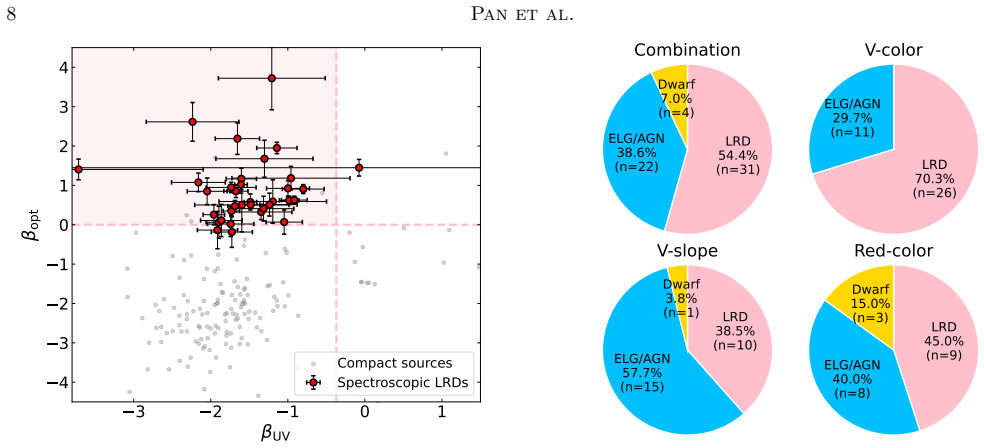
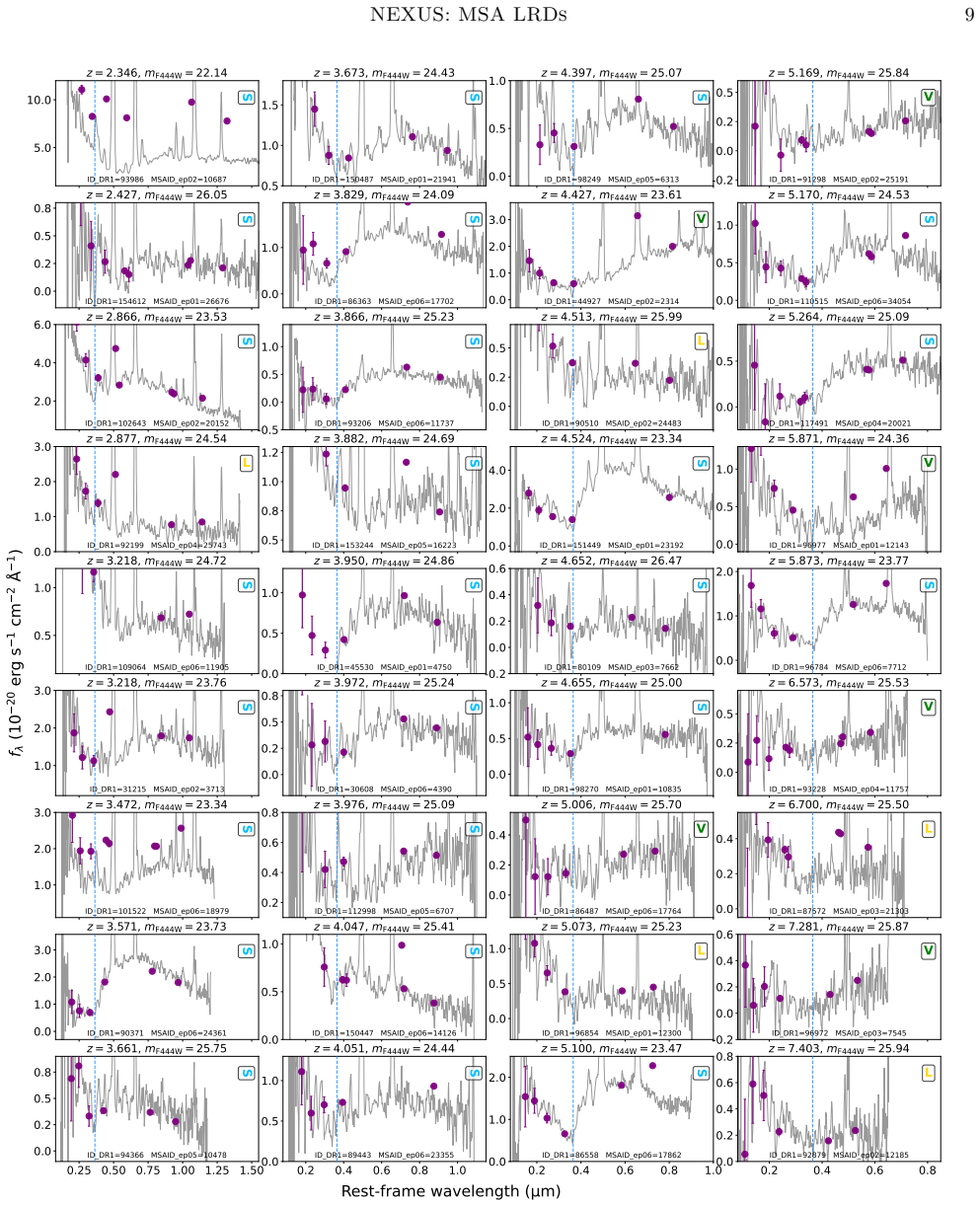
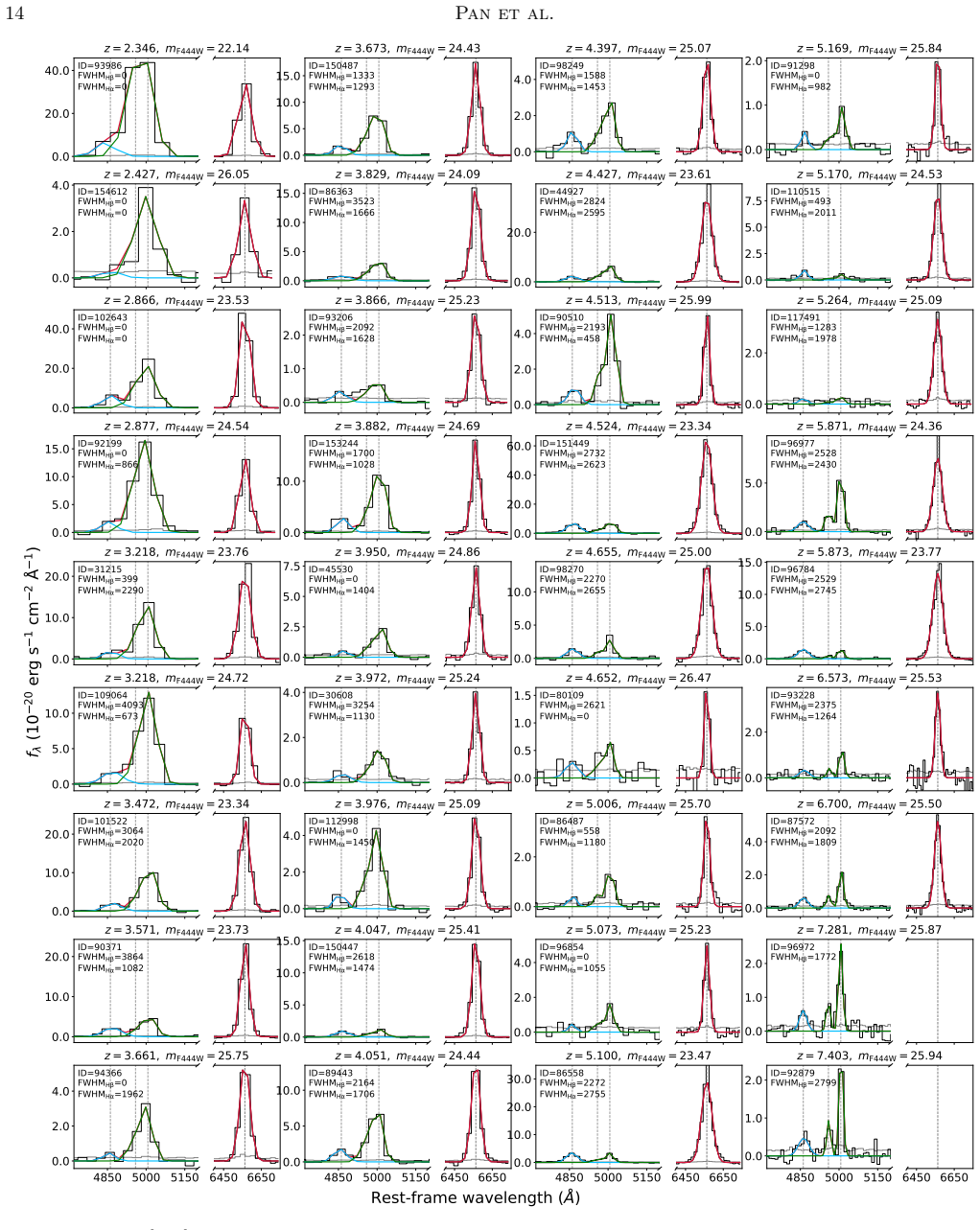
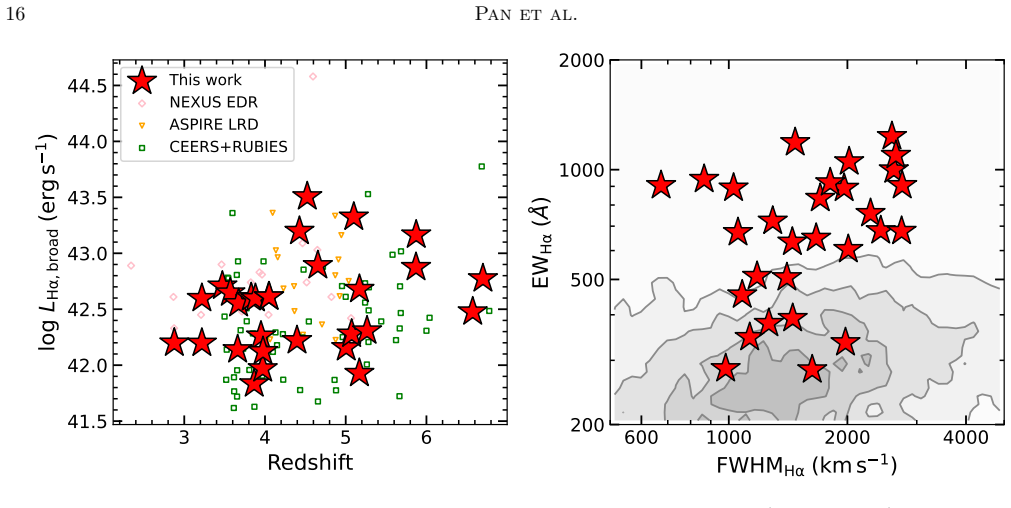
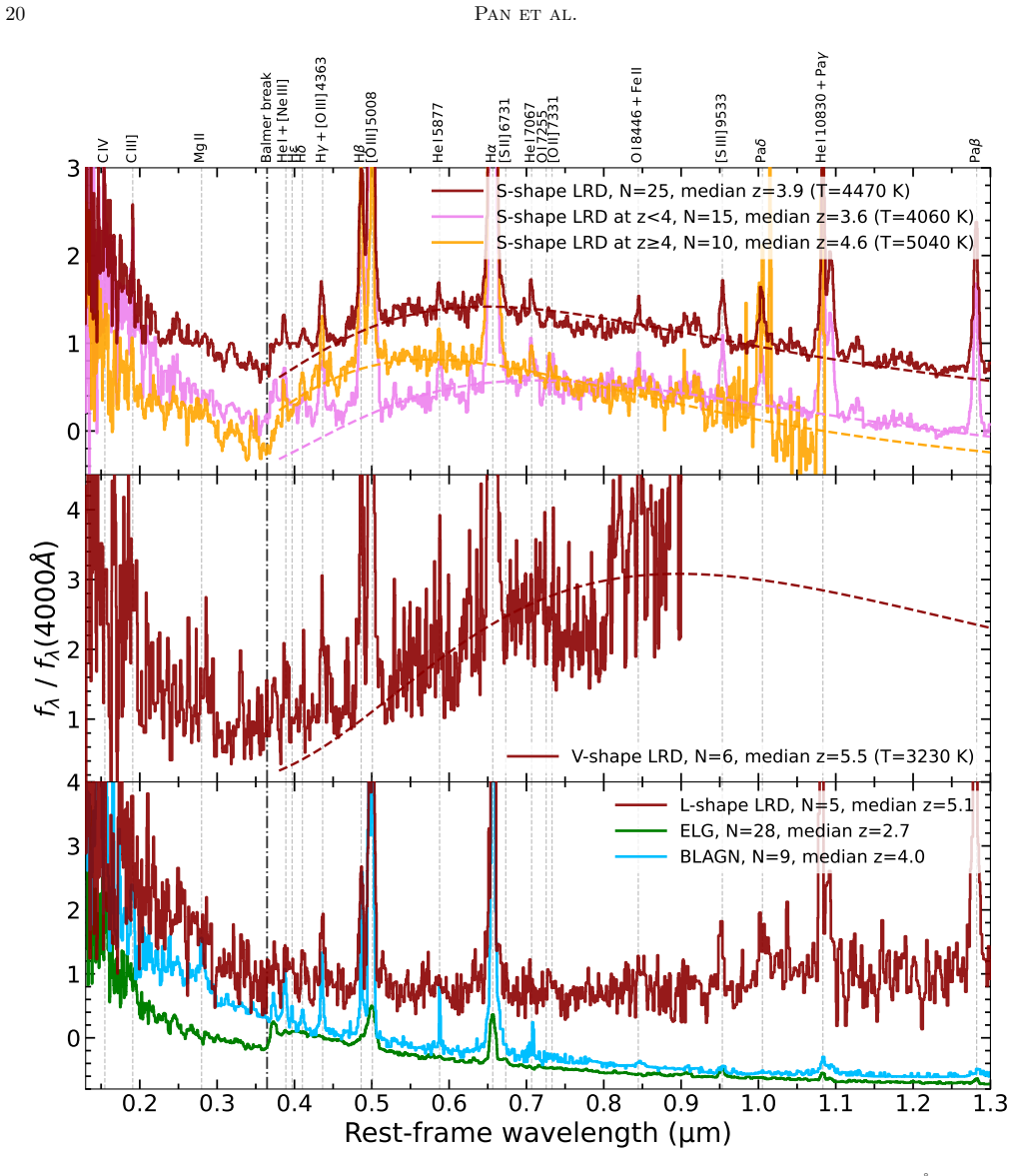
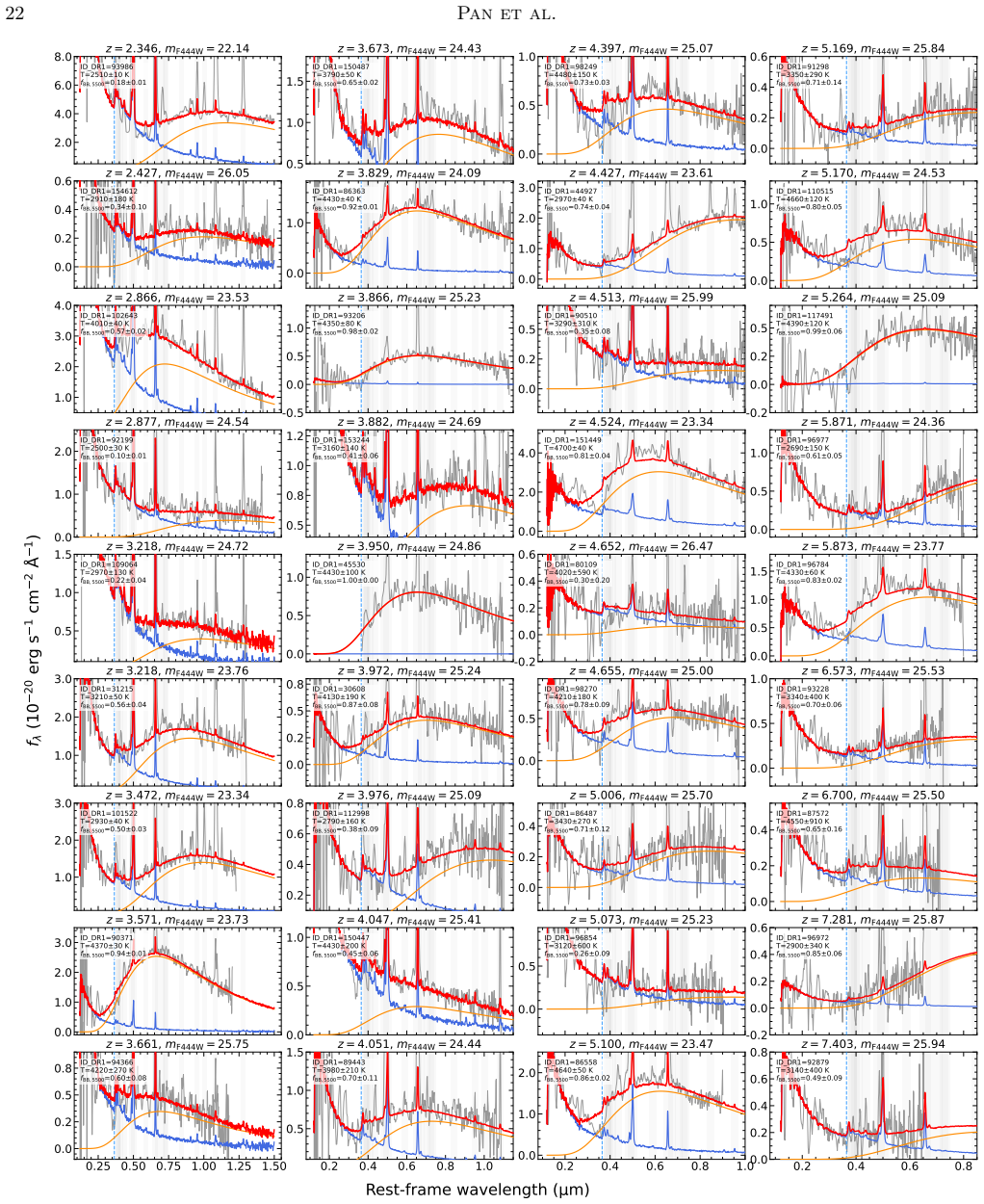
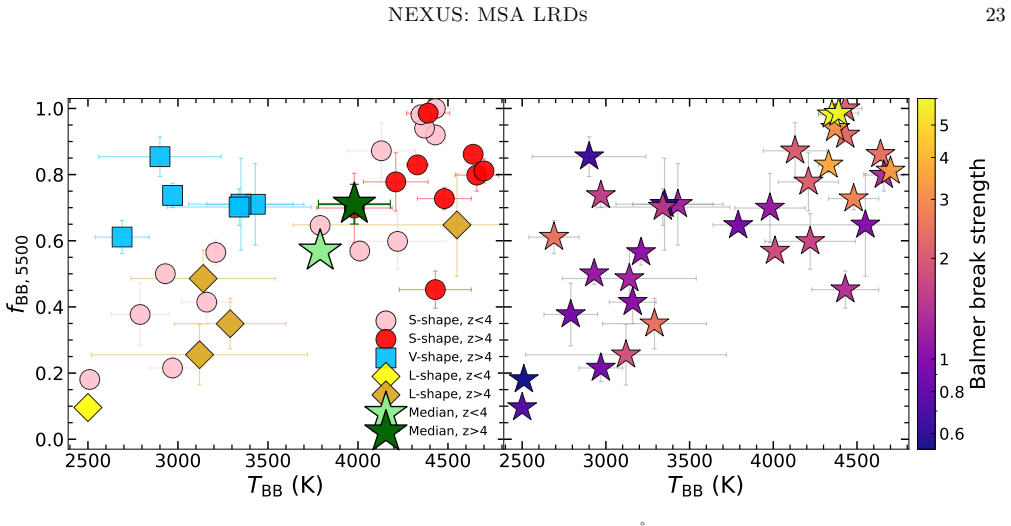
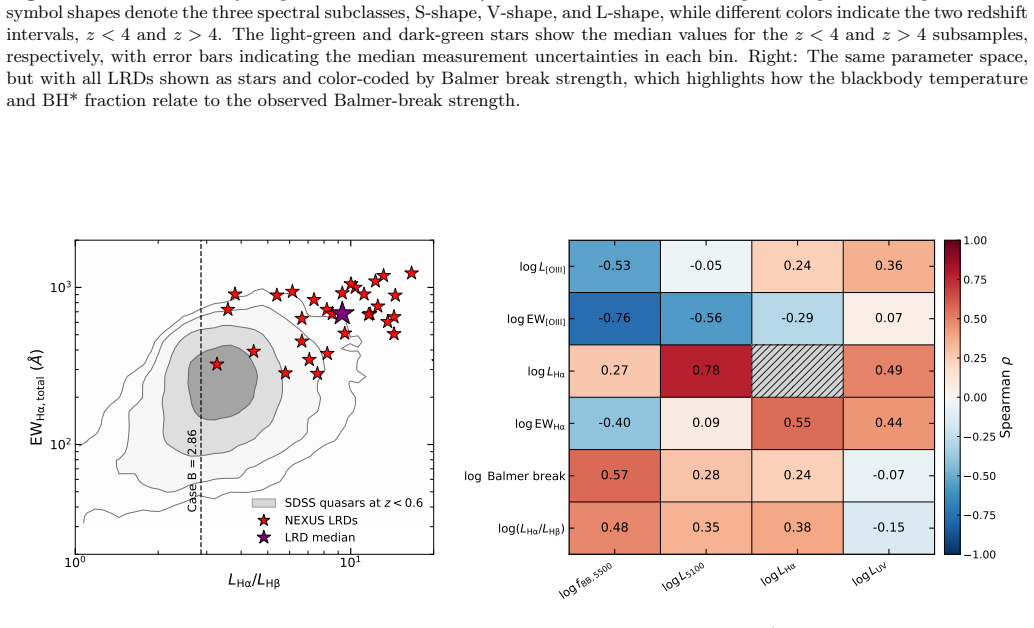
The spectroscopic sample of 36 LRDs spans the full observed spectral range, including objects with extreme Balmer breaks and moderately reddened continua fittable by blackbody components. Broad H-alpha emission correlates with the 5100 Angstrom continuum while narrow [O III] does not, and none of these spectral traits evolve with redshift. Space density declines toward z approximately 2, opposite the rise seen for normal AGNs, though low-luminosity examples at z 2-4 may exceed current ground-based limits. Clustering measurements imply LRDs occupy dark matter halos of several times 10^11 h^{-1} solar masses, consistent with accreting supermassive black holes enshrouded in dense gas.
What carries the argument
Photometric selection of LRDs followed by NIRSpec MSA/PRISM spectra to quantify space densities, clustering signals, and emission-line properties across the redshift range.
If this is right
- Space density of LRDs decreases toward z about 2 in contrast to the increase for normal AGNs.
- Low-luminosity LRDs at z 2-4 may exceed abundances measured by existing ground-based searches.
- LRDs reside in dark matter halos of several times 10^11 h^{-1} solar masses.
- Spectral features including Balmer breaks and line-continuum correlations show no redshift evolution.
- The population is consistent with accreting supermassive black holes inside dense gas envelopes.
Where Pith is reading between the lines
- Larger samples with improved purity could tighten halo mass constraints and connect LRDs to specific phases of early black hole assembly.
- If the density decline holds, it may indicate a redshift-dependent transition in the fraction of black holes that remain enshrouded.
- The lack of spectral evolution suggests the physical conditions around these black holes stabilize early and persist across several billion years.
Load-bearing premise
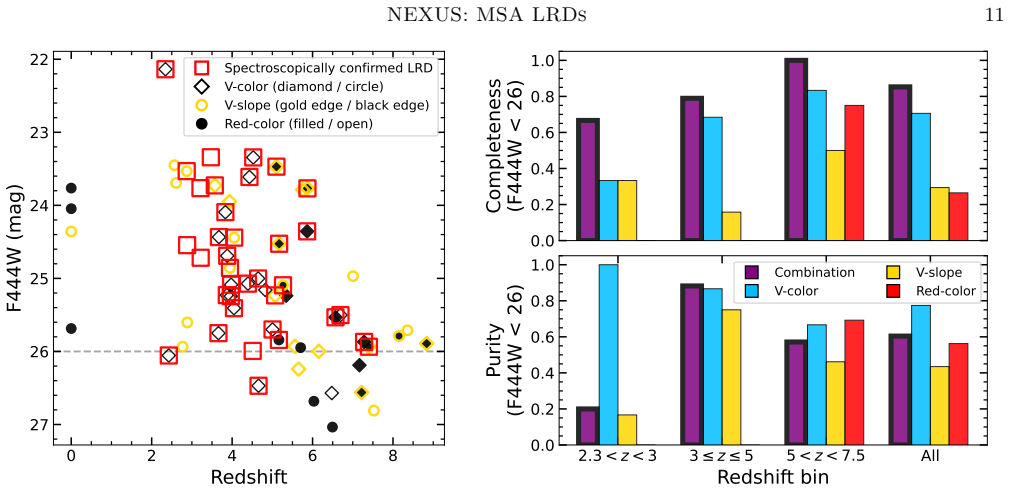
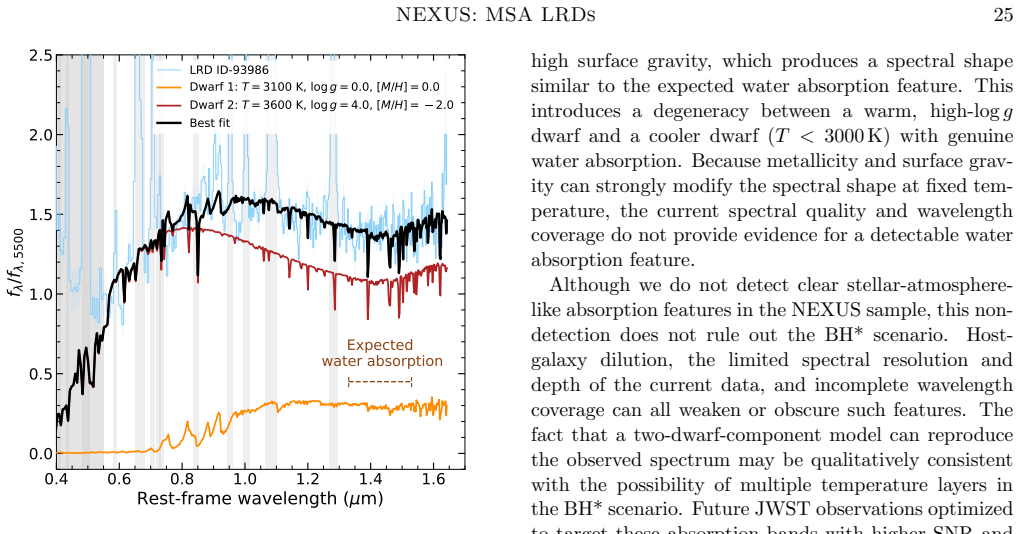
The photometric selection yields a representative LRD sample despite 60 percent purity and contamination from emission-line galaxies, normal AGNs, and dwarf stars.
What would settle it
A deeper survey at z approximately 2 that measures a space density for LRDs equal to or higher than the extrapolated high-redshift value would contradict the reported decline.
Figures
read the original abstract
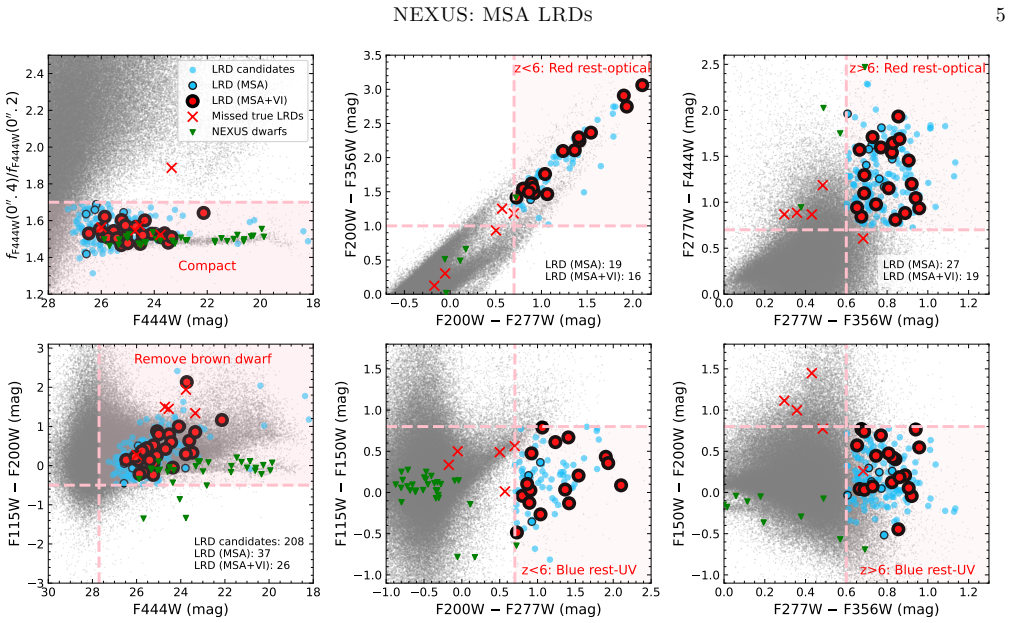
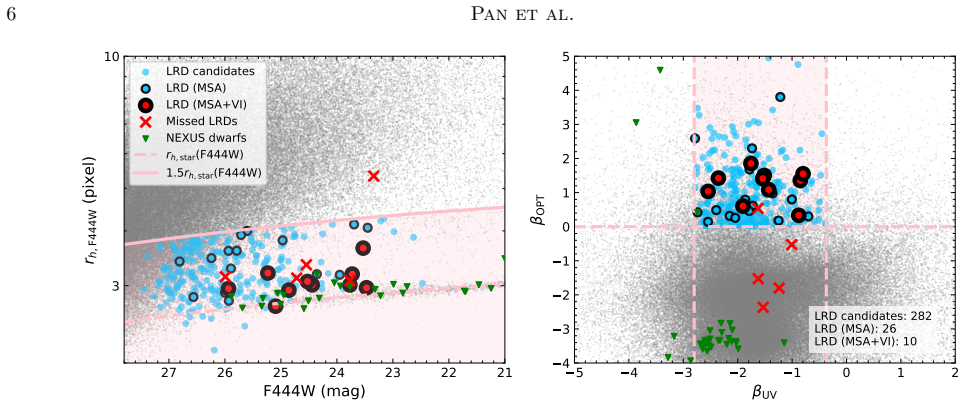
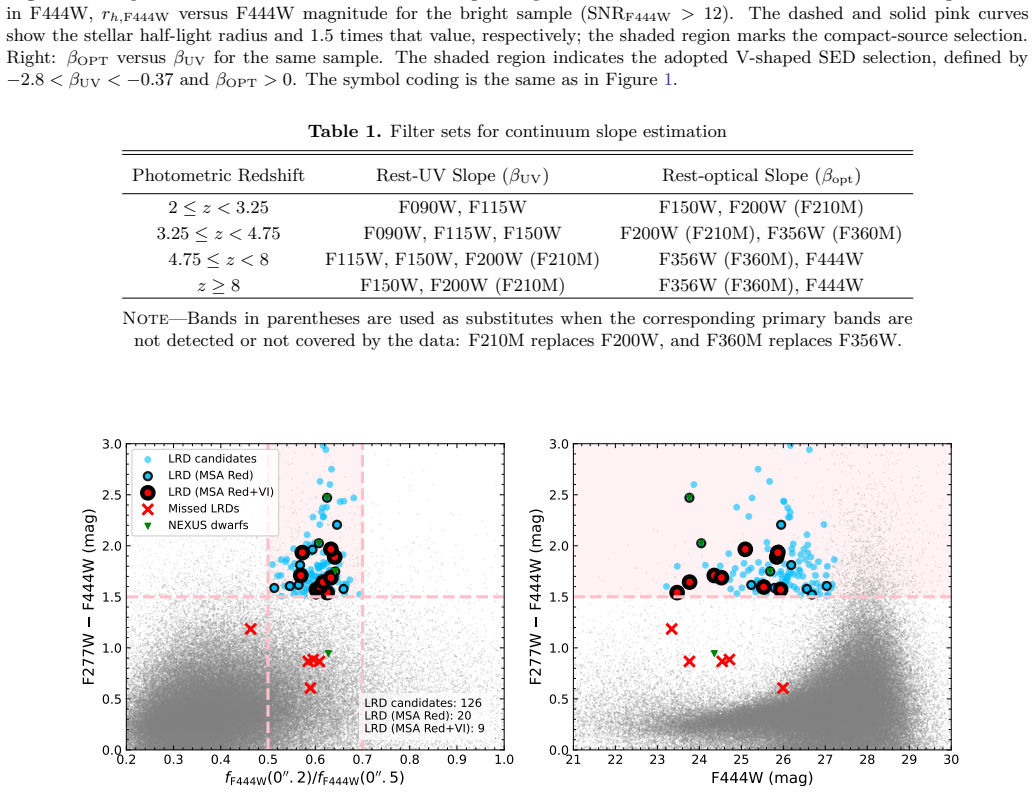
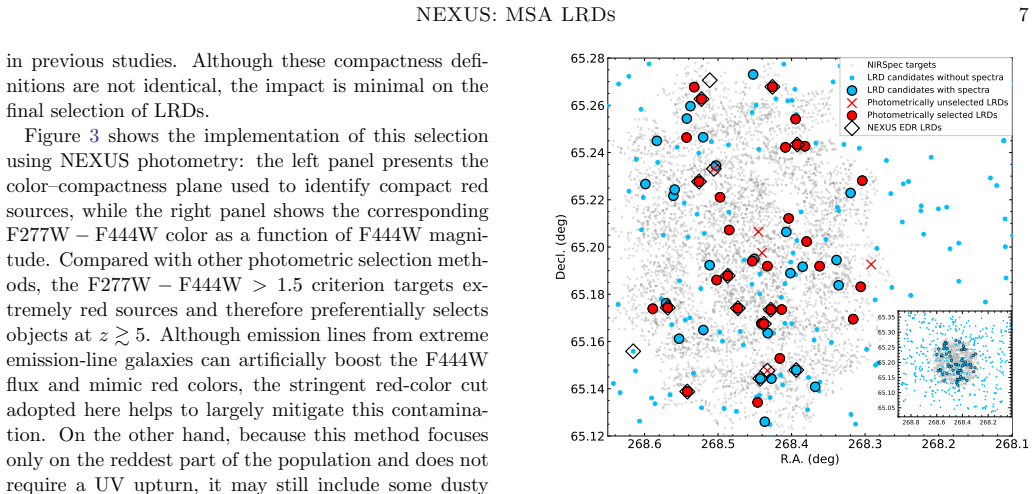
We present a comprehensive study of Little Red Dots (LRDs) at 2.3 < z < 7.4 using NIRCam photometry and NIRSpec MSA/PRISM spectra from the ongoing NEXUS program. Photometric selection combining several commonly adopted methods yields a high completeness of about 85% for LRD selection over this redshift range and for a flux limit of F444W < 26. The overall purity is about 60%, with contamination from emission-line galaxies and normal active galactic nuclei (AGNs), as well as dwarf stars. Most (>90%) of the spectroscopically confirmed LRDs have robust broad-line detection. Our spectroscopic sample of 36 LRDs displays the full range of spectral diversity of LRDs. It includes objects with extreme Balmer breaks similar to the LRD "Cliff", as well as objects with moderately reddened rest-optical continua that can be fit with low-temperature blackbody components in the recent BH* model framework. The broad H$\alpha$ emission is correlated with the continuum emission at 5100 Angstrom, suggesting common origins for these emission components; the narrow [O III] emission, however, is poorly correlated with the optical continuum. We do not find evidence of redshift evolution in these spectral properties. The space density of LRDs declines toward z about 2, opposite to the trend for normal AGNs, although low-luminosity LRDs at z about 2-4 may be more abundant than currently probed by ground-based searches. The clustering of LRDs suggests that they live in dark matter halos of several times $10^{11}\ h^{-1}$ solar masses, albeit with large uncertainties. Overall, these results are consistent with recent observations of LRDs and with the emerging picture of accreting SMBHs enshrouded in dense gas envelopes as the origin of LRDs.
Editorial analysis
A structured set of objections, weighed in public.
Referee Report
Summary. The manuscript presents a study of Little Red Dots (LRDs) at 2.3 < z < 7.4 using NIRCam photometry and NIRSpec MSA/PRISM spectra from the NEXUS program. Photometric selection combining multiple methods yields ~85% completeness but ~60% purity (contaminants: emission-line galaxies, normal AGNs, dwarf stars). A spectroscopic subsample of 36 LRDs shows spectral diversity (extreme Balmer breaks, reddened continua fit by low-T blackbodies), with broad Hα correlated to 5100Å continuum but narrow [O III] not; no redshift evolution is found in spectral properties. Central claims are a declining LRD space density toward z~2 (opposite normal AGNs) and clustering implying dark matter halos of several ×10^{11} h^{-1} M_⊙.
Significance. If the 60% purity and associated contamination are shown to be correctly subtracted in a redshift- and luminosity-dependent way, the work would supply useful observational constraints on LRD demographics, spectral diversity, and environments, reinforcing distinctions from standard AGNs and supporting dense-gas-envelope models for accreting SMBHs.
major comments (3)
- [Abstract] Abstract: the space-density decline toward z~2 and the clustering-derived halo masses are obtained from the photometrically selected parent sample. With only 60% purity, a redshift- and luminosity-dependent correction for the 40% contaminants (ELGs, normal AGNs, dwarf stars) is required; the manuscript must demonstrate that this correction has been applied and quantify residual bias, otherwise both the reported density trend and the two-point correlation function (hence halo mass) can shift systematically.
- [Abstract] Abstract: the >90% broad-line confirmation rate applies only to the 36 spectroscopically confirmed objects; the statistical claims on abundance and clustering use the full photometric sample, so the purity and confirmation fraction for that parent sample must be stated explicitly.
- [Abstract] Abstract: no uncertainties or error bars are reported on the space densities or clustering measurements; without them the significance of the claimed decline relative to normal AGNs and the halo-mass estimate cannot be assessed.
minor comments (1)
- Additional details on the spectral fitting procedures, continuum modeling (including the BH* blackbody components), and any data-exclusion criteria would improve reproducibility.
Simulated Author's Rebuttal
We thank the referee for their careful and constructive comments. We address each major point below and will revise the manuscript accordingly to improve clarity on the photometric sample properties.
read point-by-point responses
-
Referee: [Abstract] Abstract: the space-density decline toward z~2 and the clustering-derived halo masses are obtained from the photometrically selected parent sample. With only 60% purity, a redshift- and luminosity-dependent correction for the 40% contaminants (ELGs, normal AGNs, dwarf stars) is required; the manuscript must demonstrate that this correction has been applied and quantify residual bias, otherwise both the reported density trend and the two-point correlation function (hence halo mass) can shift systematically.
Authors: We agree that a redshift- and luminosity-dependent correction for the 40% contaminants must be demonstrated explicitly for the photometric sample results. We will revise the methods and results sections to detail how this correction was applied and to quantify any residual bias after subtraction. revision: yes
-
Referee: [Abstract] Abstract: the >90% broad-line confirmation rate applies only to the 36 spectroscopically confirmed objects; the statistical claims on abundance and clustering use the full photometric sample, so the purity and confirmation fraction for that parent sample must be stated explicitly.
Authors: The abstract already states both the 60% purity of the photometric selection and that the >90% broad-line rate applies specifically to the spectroscopically confirmed objects. We will revise the abstract to state the confirmation fraction and purity applicable to the photometric parent sample even more explicitly. revision: partial
-
Referee: [Abstract] Abstract: no uncertainties or error bars are reported on the space densities or clustering measurements; without them the significance of the claimed decline relative to normal AGNs and the halo-mass estimate cannot be assessed.
Authors: We will add explicit error bars to the space density measurements and quantitative uncertainties to the clustering and halo-mass results in the revised manuscript and figures. revision: yes
Circularity Check
No circularity; results are direct observational counts and correlations
full rationale
The paper computes space densities from photometric selection (with stated 85% completeness and 60% purity corrections) followed by spectroscopic confirmation of 36 objects, and infers halo masses from measured clustering via standard bias-to-halo-mass mapping. No equations or steps reduce by construction to fitted inputs, self-definitions, or self-citation chains; all load-bearing quantities are measured quantities from the NIRCam/NIRSpec data. The purity caveat is a systematic uncertainty, not a circularity mechanism.
Axiom & Free-Parameter Ledger
axioms (2)
- domain assumption Standard photometric selection criteria for LRDs achieve the stated 85% completeness over 2.3 < z < 7.4
- standard math Clustering statistics can be translated to halo mass using standard cosmology and bias models
Reference graph
Works this paper leans on
-
[1]
2016, JWST User Documentation (JDox),, JWST User Documentation Website
2016
-
[2]
Akins, H. B., Casey, C. M., Lambrides, E., et al. 2024, arXiv e-prints, arXiv:2406.10341, doi: 10.48550/arXiv.2406.10341
-
[3]
Akins, H. B., Casey, C. M., Lambrides, E., et al. 2025, ApJ, 991, 37, doi: 10.3847/1538-4357/ade984
-
[4]
Allard, F., Homeier, D., & Freytag, B. 2012, Philosophical Transactions of the Royal Society of London Series A, 370, 2765, doi: 10.1098/rsta.2011.0269
-
[5]
Ananna, T. T., Bogd´ an,´A., Kov´ acs, O. E., Natarajan, P., & Hickox, R. C. 2024, ApJL, 969, L18, doi: 10.3847/2041-8213/ad5669
-
[6]
2025, MNRAS, 536, 3677, doi: 10.1093/mnras/stae2765 Astropy Collaboration, Robitaille, T
Arita, J., Kashikawa, N., Onoue, M., et al. 2025, MNRAS, 536, 3677, doi: 10.1093/mnras/stae2765 Astropy Collaboration, Robitaille, T. P., Tollerud, E. J., et al. 2013, A&A, 558, A33, doi: 10.1051/0004-6361/201322068 Astropy Collaboration, Price-Whelan, A. M., Sip˝ ocz, B. M., et al. 2018, AJ, 156, 123, doi: 10.3847/1538-3881/aabc4f Astropy Collaboration, ...
-
[7]
Baggen, J. F. W., van Dokkum, P., Labb´ e, I., et al. 2023, ApJL, 955, L12, doi: 10.3847/2041-8213/acf5ef
-
[8]
Barro, G., P´ erez-Gonz´ alez, P. G., Kocevski, D. D., et al. 2024, ApJ, 963, 128, doi: 10.3847/1538-4357/ad167e
-
[9]
2025, astropy/photutils: 2.2.0, 2.2.0 Zenodo, doi: 10.5281/zenodo.14889440
Bradley, L., Sip˝ ocz, B., Robitaille, T., et al. 2025, astropy/photutils: 2.2.0, 2.2.0 Zenodo, doi: 10.5281/zenodo.14889440
-
[10]
Brammer, G. B., van Dokkum, P. G., & Coppi, P. 2008, ApJ, 686, 1503, doi: 10.1086/591786
work page internal anchor Pith review doi:10.1086/591786 2008
-
[11]
Carnall, A. C. 2017, arXiv e-prints, arXiv:1705.05165, doi: 10.48550/arXiv.1705.05165
work page internal anchor Pith review Pith/arXiv arXiv doi:10.48550/arxiv.1705.05165 2017
-
[12]
2026, MNRAS, 545, staf2131, doi: 10.1093/mnras/staf2131
Chang, S.-J., Gronke, M., Matthee, J., & Mason, C. 2026, MNRAS, 545, staf2131, doi: 10.1093/mnras/staf2131 NEXUS: MSA LRDs27 de Graaff, A., Rix, H.-W., Carniani, S., et al. 2024, A&A, 684, A87, doi: 10.1051/0004-6361/202347755 de Graaff, A., Rix, H.-W., Naidu, R. P., et al. 2025a, A&A, 701, A168, doi: 10.1051/0004-6361/202554681 de Graaff, A., Hviding, R....
-
[13]
2026, arXiv e-prints, arXiv:2602.12325, doi: 10.48550/arXiv.2602.12325
Fei, Q., Fujimoto, S., Brammer, G., et al. 2026, arXiv e-prints, arXiv:2602.12325, doi: 10.48550/arXiv.2602.12325
-
[14]
2025, arXiv e-prints, arXiv:2512.02096, doi: 10.48550/arXiv.2512.02096
Fu, S., Zhang, Z., Jiang, D., et al. 2025, arXiv e-prints, arXiv:2512.02096, doi: 10.48550/arXiv.2512.02096
-
[15]
J., Zitrin, A., Plat, A., et al
Furtak, L. J., Zitrin, A., Plat, A., et al. 2023, ApJ, 952, 142, doi: 10.3847/1538-4357/acdc9d
-
[16]
J., Labb´ e, I., Zitrin, A., et al
Furtak, L. J., Labb´ e, I., Zitrin, A., et al. 2024, Nature, 628, 57, doi: 10.1038/s41586-024-07184-8
-
[17]
1986, ApJ, 303, 336, doi: 10.1086/164079
Gehrels, N. 1986, ApJ, 303, 336, doi: 10.1086/164079
-
[18]
Gloudemans, A. J., Duncan, K. J., Eilers, A.-C., et al. 2025, ApJ, 986, 130, doi: 10.3847/1538-4357/adddb9 G´ orski, K. M., Hivon, E., Banday, A. J., et al. 2005, ApJ, 622, 759, doi: 10.1086/427976
-
[19]
Greene, J. E., Labbe, I., Goulding, A. D., et al. 2024, ApJ, 964, 39, doi: 10.3847/1538-4357/ad1e5f
-
[20]
Greene, J. E., Setton, D. J., Furtak, L. J., et al. 2026, ApJ, 996, 129, doi: 10.3847/1538-4357/ae1836
-
[21]
A., Pacucci, F., & Kocevski, D
Guia, C. A., Pacucci, F., & Kocevski, D. D. 2024, Research Notes of the American Astronomical Society, 8, 207, doi: 10.3847/2515-5172/ad7262
-
[22]
2023, ApJ, 959, 39, doi: 10.3847/1538-4357/ad029e
Harikane, Y., Zhang, Y., Nakajima, K., et al. 2023, ApJ, 959, 39, doi: 10.3847/1538-4357/ad029e
-
[23]
Harris, C. R., Millman, K. J., van der Walt, S. J., et al. 2020, Nature, 585, 357, doi: 10.1038/s41586-020-2649-2
-
[24]
Hunter, J. D. 2007, Computing in Science & Engineering, 9, 90, doi: 10.1109/MCSE.2007.55
-
[25]
Hviding, R. E., de Graaff, A., Miller, T. B., et al. 2025, A&A, 702, A57, doi: 10.1051/0004-6361/202555816
-
[26]
Inayoshi, K., Kimura, S. S., & Noda, H. 2025, PASJ, 77, 811, doi: 10.1093/pasj/psaf050
-
[27]
2025, ApJL, 980, L27, doi: 10.3847/2041-8213/adaebd
Inayoshi, K., & Maiolino, R. 2025, ApJL, 980, L27, doi: 10.3847/2041-8213/adaebd
-
[28]
2025, MNRAS, 544, 3900, doi: 10.1093/mnras/staf1867
Ji, X., Maiolino, R., ¨Ubler, H., et al. 2025, MNRAS, 544, 3900, doi: 10.1093/mnras/staf1867
-
[29]
2025, Nature Astronomy, 9, 1890, doi: 10.1038/s41550-025-02676-7
Jiang, D., Jiang, L., Sun, S., Liu, W., & Fu, S. 2025, Nature Astronomy, 9, 1890, doi: 10.1038/s41550-025-02676-7
-
[30]
2024, A&A, 691, A52, doi: 10.1051/0004-6361/202348857
Killi, M., Watson, D., Brammer, G., et al. 2024, A&A, 691, A52, doi: 10.1051/0004-6361/202348857
-
[31]
Kocevski, D. D., Finkelstein, S. L., Barro, G., et al. 2024, arXiv e-prints, arXiv:2404.03576, doi: 10.48550/arXiv.2404.03576
-
[32]
Kocevski, D. D., Finkelstein, S. L., Barro, G., et al. 2025, ApJ, 986, 126, doi: 10.3847/1538-4357/adbc7d
-
[34]
2024b, ApJ, 975, 178, doi: 10.3847/1538-4357/ad7d03
Kokorev, V., Chisholm, J., Endsley, R., et al. 2024b, ApJ, 975, 178, doi: 10.3847/1538-4357/ad7d03
-
[35]
Kokorev, V., Caputi, K. I., Greene, J. E., et al. 2024c, ApJ, 968, 38, doi: 10.3847/1538-4357/ad4265
-
[36]
2025, ApJ, 995, 24, doi: 10.3847/1538-4357/ae119e
Kokubo, M., & Harikane, Y. 2025, ApJ, 995, 24, doi: 10.3847/1538-4357/ae119e
-
[37]
Kormendy, J., & Ho, L. C. 2013, ARA&A, 51, 511, doi: 10.1146/annurev-astro-082708-101811 Labb´ e, I., van Dokkum, P., Nelson, E., et al. 2023, Nature, 616, 266, doi: 10.1038/s41586-023-05786-2
work page internal anchor Pith review doi:10.1146/annurev-astro-082708-101811 2013
-
[38]
Labbe, I., Greene, J. E., Bezanson, R., et al. 2025, ApJ, 978, 92, doi: 10.3847/1538-4357/ad3551
-
[39]
Landy, S. D., & Szalay, A. S. 1993, ApJ, 412, 64, doi: 10.1086/172900
-
[40]
Latif, M. A., Aftab, A., Whalen, D. J., & Mezcua, M. 2025, A&A, 694, L14, doi: 10.1051/0004-6361/202453194
-
[41]
Leung, G. C. K., Finkelstein, S. L., P´ erez-Gonz´ alez, P. G., et al. 2025, ApJ, 992, 26, doi: 10.3847/1538-4357/adfcce
-
[42]
Li, Z., Inayoshi, K., Chen, K., Ichikawa, K., & Ho, L. C. 2025, ApJ, 980, 36, doi: 10.3847/1538-4357/ada5fb
-
[43]
2024, ApJ, 974, 147, doi: 10.3847/1538-4357/ad6565
Lin, X., Wang, F., Fan, X., et al. 2024, ApJ, 974, 147, doi: 10.3847/1538-4357/ad6565
-
[44]
2026a, ApJ, 996, 93, doi: 10.3847/1538-4357/ae1b9b
Lin, X., Fan, X., Wang, F., et al. 2026a, ApJ, 996, 93, doi: 10.3847/1538-4357/ae1b9b
-
[45]
2026b, ApJ, 997, 61, doi: 10.3847/1538-4357/ae1eef
Lin, X., Fan, X., Sun, F., et al. 2026b, ApJ, 997, 61, doi: 10.3847/1538-4357/ae1eef
-
[46]
2026c, ApJ, 997, 364, doi: 10.3847/1538-4357/ae2bdf
Lin, X., Fan, X., Cai, Z., et al. 2026c, ApJ, 997, 364, doi: 10.3847/1538-4357/ae2bdf
-
[47]
How I Wonder What You Are -- JWST's Little Red Dots do not TWINKLE
Liu, Z., Naidu, R. P., Secunda, A., et al. 2026, arXiv e-prints, arXiv:2604.13000, doi: 10.48550/arXiv.2604.13000
work page internal anchor Pith review Pith/arXiv arXiv doi:10.48550/arxiv.2604.13000 2026
-
[48]
Ma, Y., Greene, J. E., Setton, D. J., et al. 2025, arXiv e-prints, arXiv:2504.08032, doi: 10.48550/arXiv.2504.08032
-
[49]
2024, ApJL, 976, L24, doi: 10.3847/2041-8213/ad90e1
Madau, P., & Haardt, F. 2024, ApJL, 976, L24, doi: 10.3847/2041-8213/ad90e1
-
[50]
2024, Astronomy and Astrophysics, 691, A145, doi: 10.1051/0004-6361/202347640
Maiolino, R., Scholtz, J., Curtis-Lake, E., et al. 2024, A&A, 691, A145, doi: 10.1051/0004-6361/202347640
-
[51]
2025, MNRAS, 538, 1921, doi: 10.1093/mnras/staf359
Maiolino, R., Risaliti, G., Signorini, M., et al. 2025, MNRAS, 538, 1921, doi: 10.1093/mnras/staf359
-
[52]
Matthee, J., Naidu, R. P., Brammer, G., et al. 2024, ApJ, 963, 129, doi: 10.3847/1538-4357/ad2345
-
[53]
2026, arXiv e-prints, arXiv:2603.17667, doi: 10.48550/arXiv.2603.17667
Matthee, J., Torralba, A., Pezzulli, G., et al. 2026, arXiv e-prints, arXiv:2603.17667, doi: 10.48550/arXiv.2603.17667 28Pan et al
-
[54]
2026, A&A, 706, A372, doi: 10.1051/0004-6361/202453317
Mazzolari, G., Gilli, R., Maiolino, R., et al. 2026, A&A, 706, A372, doi: 10.1051/0004-6361/202453317
-
[55]
A "Black Hole Star" Reveals the Remarkable Gas-Enshrouded Hearts of the Little Red Dots
Naidu, R. P., Matthee, J., Katz, H., et al. 2025, arXiv e-prints, arXiv:2503.16596, doi: 10.48550/arXiv.2503.16596
work page internal anchor Pith review Pith/arXiv arXiv doi:10.48550/arxiv.2503.16596 2025
-
[56]
2025, ApJL, 989, L19, doi: 10.3847/2041-8213/ade871
Pacucci, F., & Loeb, A. 2025, ApJL, 989, L19, doi: 10.3847/2041-8213/ade871
-
[57]
Pang, Y., Wang, X., Cheng, C., et al. 2026, arXiv e-prints, arXiv:2602.12548, doi: 10.48550/arXiv.2602.12548 P´ erez-Gonz´ alez, P. G., Barro, G., Rieke, G. H., et al. 2024, ApJ, 968, 4, doi: 10.3847/1538-4357/ad38bb
work page internal anchor Pith review Pith/arXiv arXiv doi:10.48550/arxiv.2602.12548 2026
-
[58]
Reines, A. E., Greene, J. E., & Geha, M. 2013, ApJ, 775, 116, doi: 10.1088/0004-637X/775/2/116
work page internal anchor Pith review doi:10.1088/0004-637x/775/2/116 2013
-
[59]
Rinaldi, P., Hainline, K., D’Eugenio, F., et al. 2026, arXiv e-prints, arXiv:2604.07138, doi: 10.48550/arXiv.2604.07138
work page internal anchor Pith review Pith/arXiv arXiv doi:10.48550/arxiv.2604.07138 2026
-
[60]
Rusakov, V., Watson, D., Nikopoulos, G. P., et al. 2026, Nature, 649, 574, doi: 10.1038/s41586-025-09900-4
-
[61]
Setton, D. J., Greene, J. E., Spilker, J. S., et al. 2025, ApJL, 991, L10, doi: 10.3847/2041-8213/ade78b
-
[62]
F., Faucher-Gigu` ere, C.-A., et al
Shen, X., Hopkins, P. F., Faucher-Gigu` ere, C.-A., et al. 2020, MNRAS, 495, 3252, doi: 10.1093/mnras/staa1381
-
[63]
Shen, Y., Strauss, M. A., Oguri, M., et al. 2007, AJ, 133, 2222, doi: 10.1086/513517
-
[64]
Shen, Y., Richards, G. T., Strauss, M. A., et al. 2011, ApJS, 194, 45, doi: 10.1088/0067-0049/194/2/45
-
[65]
2024, arXiv e-prints, arXiv:2408.12713, doi: 10.48550/arXiv.2408.12713
Shen, Y., Zhuang, M.-Y., Li, J., et al. 2024, arXiv e-prints, arXiv:2408.12713, doi: 10.48550/arXiv.2408.12713
-
[66]
Song, M., Finkelstein, S. L., Ashby, M. L. N., et al. 2016, ApJ, 825, 5, doi: 10.3847/0004-637X/825/1/5
-
[67]
Stern, J., & Laor, A. 2012, MNRAS, 423, 600, doi: 10.1111/j.1365-2966.2012.20901.x
-
[68]
2025, arXiv e-prints, arXiv:2509.19585, doi: 10.48550/arXiv.2509.19585
Stone, Z., Shen, Y., Zhuang, M.-Y., et al. 2025, arXiv e-prints, arXiv:2509.19585, doi: 10.48550/arXiv.2509.19585
-
[69]
Sun, W. Q., Naidu, R. P., Matthee, J., et al. 2026, arXiv e-prints, arXiv:2601.20929, doi: 10.48550/arXiv.2601.20929
work page internal anchor Pith review Pith/arXiv arXiv doi:10.48550/arxiv.2601.20929 2026
-
[70]
Taylor, A. J., Barger, A. J., Cowie, L. L., et al. 2023, ApJS, 266, 24, doi: 10.3847/1538-4365/accd70
-
[71]
Taylor, A. J., Finkelstein, S. L., Kocevski, D. D., et al. 2025, ApJ, 986, 165, doi: 10.3847/1538-4357/add15b
-
[72]
L., Fan, X., Wang, F., & Yang, J
Tee, W. L., Fan, X., Wang, F., & Yang, J. 2025, ApJL, 983, L26, doi: 10.3847/2041-8213/adc5e3
-
[73]
2026a, A&A, 707, A75, doi: 10.1051/0004-6361/202557537
Torralba, A., Matthee, J., Pezzulli, G., et al. 2026, A&A, 707, A75, doi: 10.1051/0004-6361/202557537
-
[74]
2025, ApJL, 994, L6, doi: 10.3847/2041-8213/ae13a9
Tripodi, R., Bradaˇ c, M., D’Eugenio, F., et al. 2025, ApJL, 994, L6, doi: 10.3847/2041-8213/ae13a9
-
[75]
2026, ApJ, 999, 183, doi: 10.3847/1538-4357/ae4101
Umeda, H., Inayoshi, K., Harikane, Y., & Murase, K. 2026, ApJ, 999, 183, doi: 10.3847/1538-4357/ae4101
-
[76]
Vestergaard, M., & Peterson, B. M. 2006, ApJ, 641, 689, doi: 10.1086/500572
work page internal anchor Pith review doi:10.1086/500572 2006
-
[77]
Virtanen, P., Gommers, R., Oliphant, T. E., et al. 2020, Nature Methods, 17, 261, doi: 10.1038/s41592-019-0686-2
-
[78]
2024, ApJL, 969, L13, doi: 10.3847/2041-8213/ad55f7
Wang, B., Leja, J., de Graaff, A., et al. 2024, ApJL, 969, L13, doi: 10.3847/2041-8213/ad55f7
-
[79]
Wang, B., de Graaff, A., Davies, R. L., et al. 2025, ApJ, 984, 121, doi: 10.3847/1538-4357/adc1ca
-
[80]
2026, arXiv e-prints, arXiv:2602.06024, doi: 10.48550/arXiv.2602.06024
Wang, B., Leja, J., Labbe, I., et al. 2026, arXiv e-prints, arXiv:2602.06024, doi: 10.48550/arXiv.2602.06024
-
[81]
C., Alberts, S., Ji, Z., et al
Williams, C. C., Alberts, S., Ji, Z., et al. 2024, ApJ, 968, 34, doi: 10.3847/1538-4357/ad3f17
discussion (0)
Sign in with ORCID, Apple, or X to comment. Anyone can read and Pith papers without signing in.