A Multi-Wavelength View of the First Type Ic-BL Supernova with an Einstein Probe X-ray Shock Breakout
Pith reviewed 2026-06-27 15:21 UTC · model grok-4.3
The pith
The first X-ray shock breakout from a Type Ic-BL supernova indicates most such events produce weaker signals.
A machine-rendered reading of the paper's core claim, the machinery that carries it, and where it could break.
Core claim
EP260321a is the first EP FXT with a strong match to X-ray shock-breakout emission and is linked to SN 2026gzf, the first Type Ic-BL supernova with a definitive X-ray SBO. Its radio follow-up rules out on-axis jets of E_K > 10^49 erg for n > 10^{-2} cm^{-3} and limits synchrotron emission from the fastest ejecta. The supernova's optical properties lie inside the 90 percent interval of other Ic-BL events. Its light curve is best reproduced by combined CSM interaction and radioactive decay. Assuming every Ic-BL supernova produces an EP260321a-like FXT, the ZTF-derived rate implies 4.4-16 EP detections per year, inconsistent at 90 percent with observed rates and therefore indicating that most I
What carries the argument
The rate scaling from the ZTF Bright Transient Survey Ic-BL supernova rate to Einstein Probe FXT detections under the uniform-luminosity assumption for X-ray shock breakouts.
If this is right
- Radio limits exclude bright on-axis jets and bound the fastest SN ejecta velocity and density.
- SN 2026gzf's optical and host properties are statistically typical of the Ic-BL population.
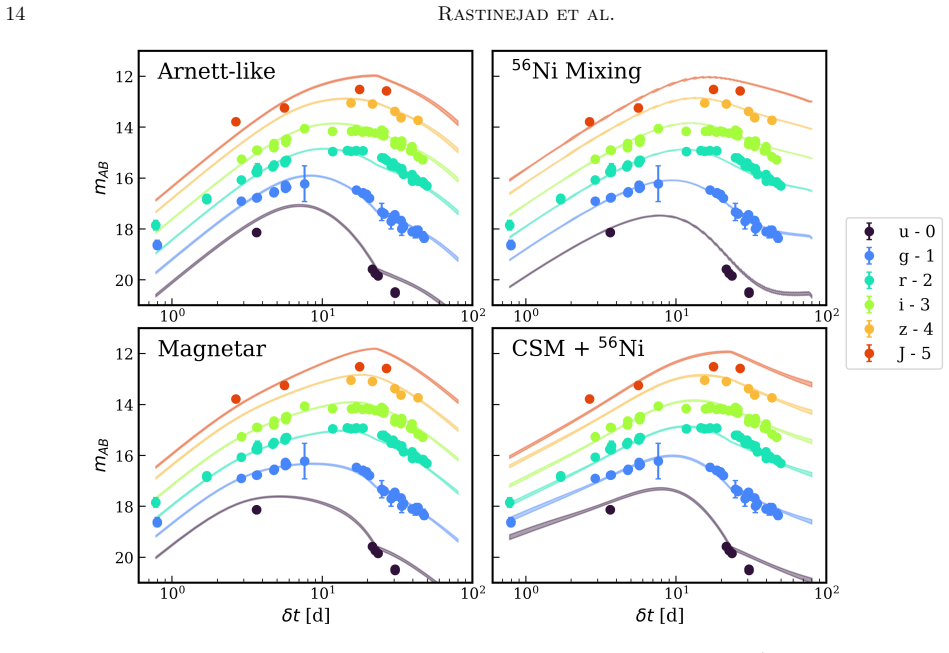
- Combined circumstellar interaction plus 56Ni decay reproduces the optical light curve with plausible parameters.
- Most Type Ic-BL supernovae must produce X-ray SBOs fainter than EP260321a to reconcile ZTF rates with current EP detections.
Where Pith is reading between the lines
- Diversity in progenitor mass-loss history or envelope structure could explain why only a minority of Ic-BL events yield bright X-ray SBOs.
- Targeted X-ray monitoring of future Ic-BL discoveries could directly measure the fraction that produce detectable SBOs.
- The result constrains the typical shock-breakout luminosity distribution rather than the mere existence of the mechanism.
Load-bearing premise
Every Type Ic-BL supernova produces an X-ray shock breakout with luminosity and duration comparable to EP260321a.
What would settle it
A measured Einstein Probe FXT rate matching the predicted 4.4-16 per year, or a volume-limited search showing that most Ic-BL supernovae lack X-ray SBOs at the EP260321a luminosity level.
Figures





read the original abstract
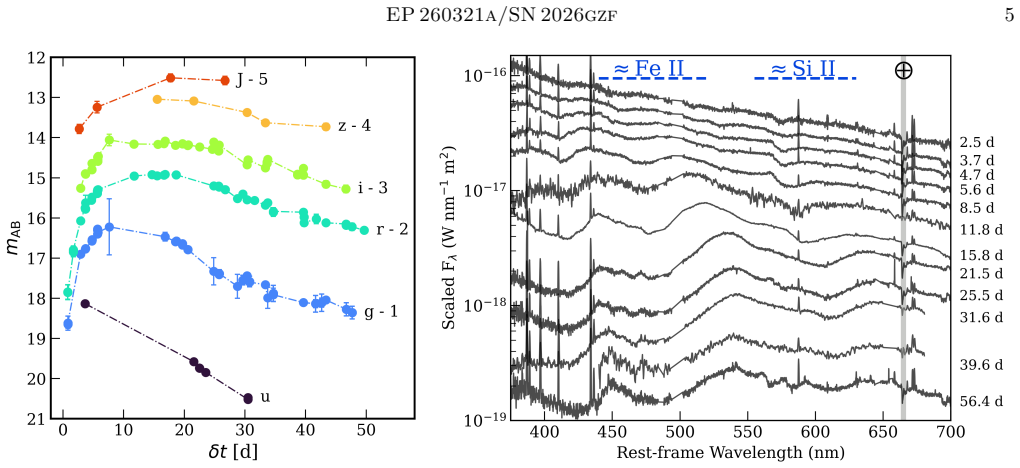
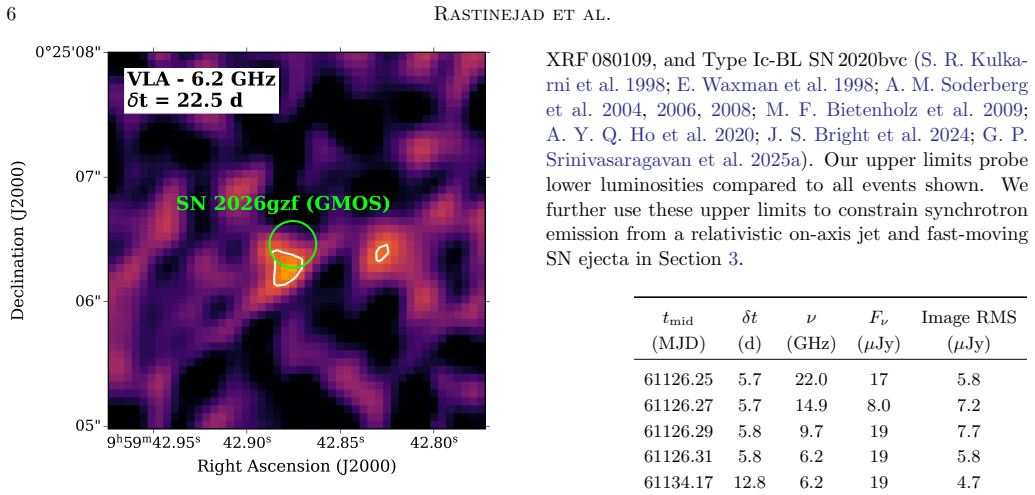
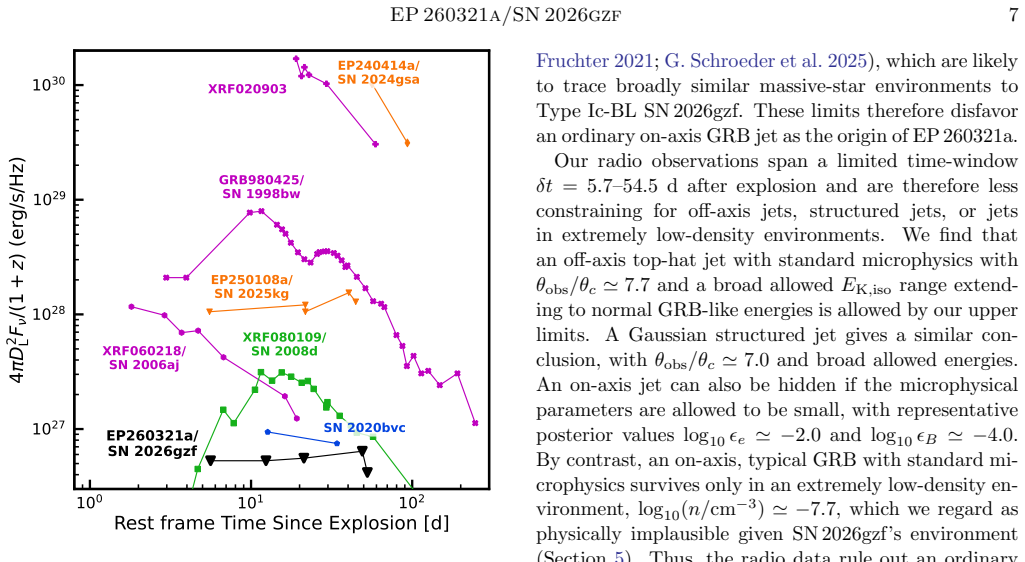
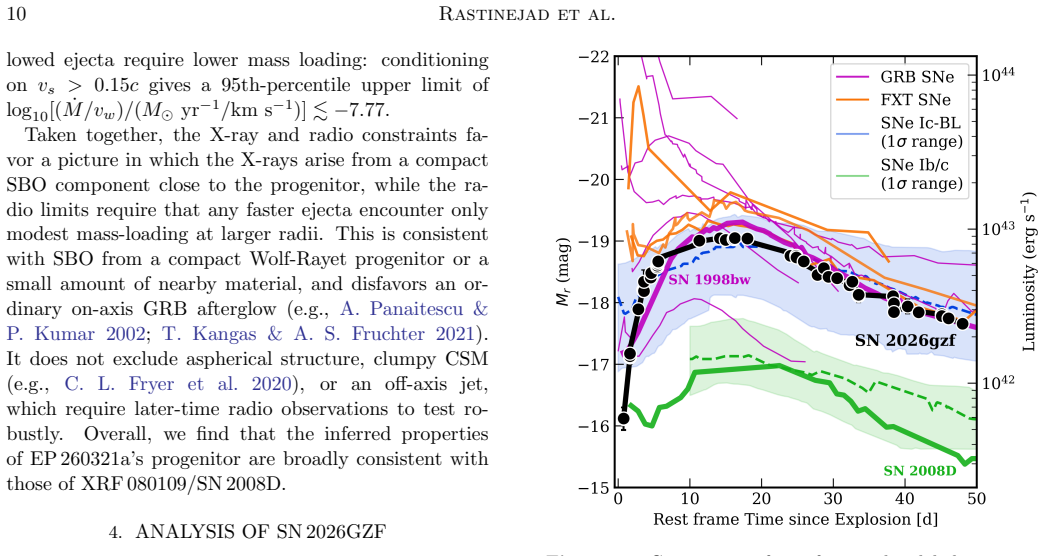
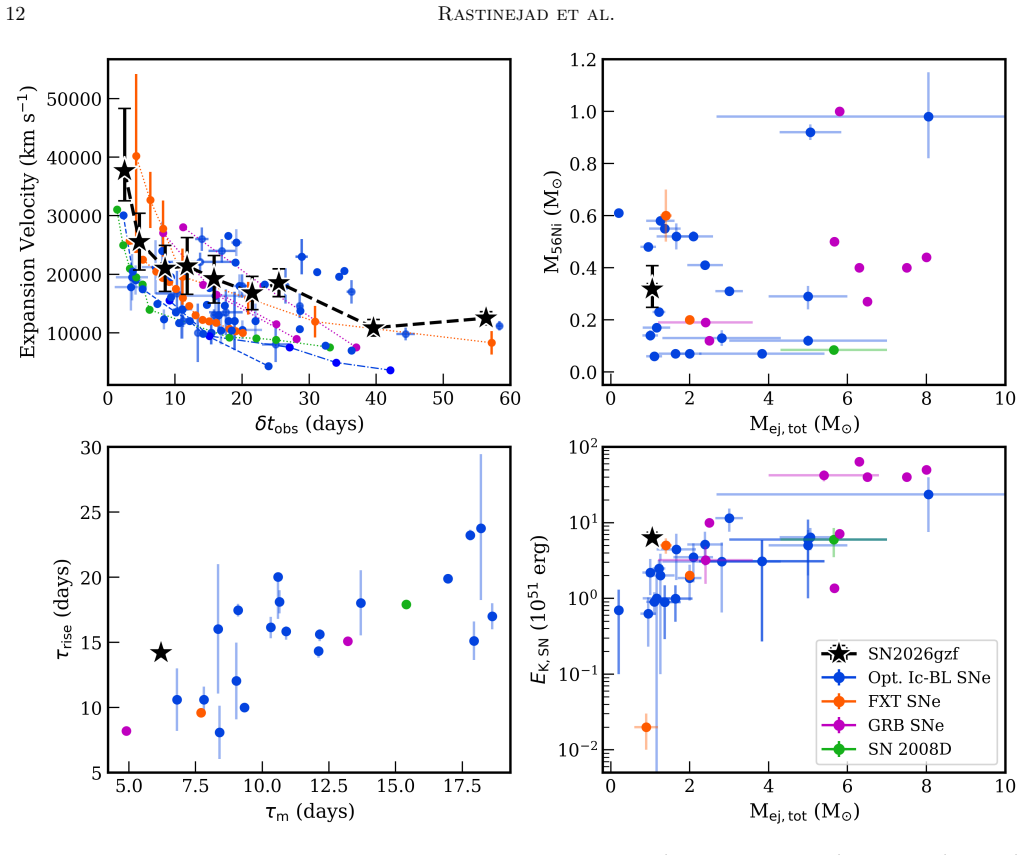
In March 2026, the Einstein Probe (EP) discovered its most nearby (z = 0.0343) Fast X-ray Transient (FXT), EP260321a, the first EP FXT to provide a strong match to expectations for X-ray ''shock breakout'' (SBO) emission. Here, we present our multi-wavelength follow-up campaign of EP260321a and its broad-line Type Ic (Ic-BL) supernova (SN) counterpart, SN 2026gzf, the first Type Ic-BL SN with a definitive X-ray SBO. We show that our radio follow-up extending over 5.8 - 54.5 days post-FXT rules out an on-axis jet counterpart of isotropic-equivalent kinetic energy $E_{K} > 10^{49}$ erg for circumburst densities $n > 10^{-2}~{\rm cm}^{-3}$ and constrains radio synchrotron emission from the fastest-moving SN ejecta. In addition, we derive the properties of SN 2026gzf and its host galaxy from our well-sampled optical data and compare them with those of optically discovered Type Ic-BL SNe, finding that SN2026gzf is well within the 90% confidence interval across all properties. We further fit SN 2026gzf's light curve with five different physical models, and determine that combined emission from both interaction with circumstellar material (CSM) and $^{56}$Ni radioactive decay provides the best fit with plausible model parameters. Finally, using the rate of Ic-BL SNe from the ZTF Bright Transient Survey and assuming all Type Ic-BL SNe produce EP260321a-like FXTs, we infer an expected rate of EP-detected SBOs of 4.4 - 16 year$^{-1}$. This is inconsistent at the 90% confidence level with current EP detection rates, potentially indicating that most Type Ic-BL SNe produce less luminous X-ray SBO signals compared to EP 260321a.
Editorial analysis
A structured set of objections, weighed in public.
Referee Report
Summary. The manuscript presents multi-wavelength follow-up of EP260321a, the nearest EP FXT at z=0.0343, and its Ic-BL SN counterpart SN 2026gzf, claimed as the first definitive X-ray shock-breakout association with a Type Ic-BL event. Radio observations (5.8–54.5 days) rule out an on-axis jet with E_K > 10^49 erg for n > 10^{-2} cm^{-3}; optical data show SN 2026gzf lies within the 90% interval of other Ic-BL events; a two-component (CSM + 56Ni) model is preferred over five alternatives; scaling the ZTF Ic-BL rate under the assumption that all such SNe produce EP260321a-like FXTs yields an expected EP rate of 4.4–16 yr^{-1}, inconsistent at 90% CL with current EP detections and implying most Ic-BL events have fainter SBOs.
Significance. If the rate scaling and statistical comparison hold, the result supplies the first direct multi-wavelength anchor for X-ray SBO emission in Ic-BL SNe, together with jet-energy upper limits from radio and a quantitative suggestion of SBO luminosity diversity. The radio constraints and well-sampled optical photometry are concrete additions that can be used by future progenitor and explosion models.
major comments (3)
- [Abstract (rate paragraph)] Abstract (final paragraph): The quoted EP detection rate range 4.4–16 yr^{-1} and the 90% CL inconsistency are presented without the numerical ZTF rate adopted, its uncertainty, the EP detection efficiency or luminosity threshold applied, or the statistical procedure (e.g., Poisson or binomial) used to obtain the 90% interval. These details are required to assess whether the inference that most Ic-BL SNe produce fainter SBOs is robust.
- [Optical properties comparison] Optical comparison paragraph: The claim that SN 2026gzf lies “well within the 90% confidence interval across all properties” does not report the size of the comparison Ic-BL sample or the precise list of properties; without these, the strength of the “typical” conclusion cannot be evaluated.
- [Light-curve fitting] Light-curve modeling section: The statement that the combined CSM + 56Ni model “provides the best fit” is given without quantitative metrics (reduced χ², AIC, or BIC) for the five models or discussion of parameter covariances, making the model-selection step difficult to reproduce or assess for post-hoc bias.
minor comments (1)
- [Radio analysis] The radio non-detection limits would benefit from an explicit statement of the assumed microphysical parameters (ε_e, ε_B) used to translate flux limits into E_K bounds.
Simulated Author's Rebuttal
We thank the referee for their constructive and detailed comments, which have identified several areas where additional clarity will strengthen the manuscript. We address each major comment below and will incorporate revisions as indicated.
read point-by-point responses
-
Referee: [Abstract (rate paragraph)] Abstract (final paragraph): The quoted EP detection rate range 4.4–16 yr^{-1} and the 90% CL inconsistency are presented without the numerical ZTF rate adopted, its uncertainty, the EP detection efficiency or luminosity threshold applied, or the statistical procedure (e.g., Poisson or binomial) used to obtain the 90% interval. These details are required to assess whether the inference that most Ic-BL SNe produce fainter SBOs is robust.
Authors: We agree that the abstract would benefit from greater self-containment on this point. The ZTF rate (with uncertainty), EP detection efficiency, luminosity threshold, and Poisson-based statistical procedure used to derive the 90% CL inconsistency are all provided in Section 5 of the main text. We will revise the final paragraph of the abstract to include the numerical ZTF rate and a brief note on the statistical method, while keeping the abstract concise. revision: yes
-
Referee: [Optical properties comparison] Optical comparison paragraph: The claim that SN 2026gzf lies “well within the 90% confidence interval across all properties” does not report the size of the comparison Ic-BL sample or the precise list of properties; without these, the strength of the “typical” conclusion cannot be evaluated.
Authors: We thank the referee for this observation. The comparison uses a sample of optically discovered Type Ic-BL supernovae drawn from the literature, and the properties considered are peak absolute magnitude, rise time, decline rate, and photospheric velocity. We will revise the relevant paragraph (and associated figure caption) to explicitly state the sample size and enumerate the properties, thereby allowing readers to directly assess the strength of the conclusion that SN 2026gzf is typical. revision: yes
-
Referee: [Light-curve fitting] Light-curve modeling section: The statement that the combined CSM + 56Ni model “provides the best fit” is given without quantitative metrics (reduced χ², AIC, or BIC) for the five models or discussion of parameter covariances, making the model-selection step difficult to reproduce or assess for post-hoc bias.
Authors: We accept that quantitative model-selection statistics are necessary for reproducibility. In the revised manuscript we will add a table listing reduced χ², AIC, and BIC values for all five models and will include a short discussion of the parameter covariances returned by the fitting routine. This will make the preference for the combined CSM + 56Ni model fully transparent and allow independent evaluation of possible post-hoc bias. revision: yes
Circularity Check
No significant circularity
full rationale
The paper's rate calculation takes the external ZTF Bright Transient Survey Ic-BL rate, applies an explicit all-produce-EP260321a-like assumption, and computes an expected EP detection rate (4.4-16 yr^{-1}) for direct comparison against observed EP rates. This step is a straightforward scaling under a stated null hypothesis; no fitted parameters, light-curve models, or radio constraints from the present data are inserted into the rate formula. No self-citations, uniqueness theorems, or ansatzes appear in the provided derivation chain. The logic is therefore self-contained against external benchmarks.
Axiom & Free-Parameter Ledger
free parameters (1)
- luminosity threshold for EP260321a-like FXT
axioms (1)
- domain assumption All Type Ic-BL supernovae produce X-ray shock breakouts of comparable luminosity and duration to EP260321a
Forward citations
Cited by 2 Pith papers
-
Pinning Down the Geometry of the Type Ic Broad-Line Supernova 2026gzf
Spectropolarimetry of SN 2026gzf indicates mostly spherical ejecta with axisymmetric Ca distribution viewed at ~40° from symmetry axis.
-
Discovery of a Supernova Following the Einstein Probe Transient EP250302a at z = 1.131
The paper identifies supernova emission matching a scaled SN 1998bw template in the late-time light curve of EP250302a at z=1.131, with early data constraining the jet Lorentz factor above 25.
Reference graph
Works this paper leans on
-
[1]
The Journal of Open Source Software , keywords =
scarlet2: Astronomical scene modeling in JAX. The Journal of Open Source Software , keywords =. doi:10.21105/joss.09646 , adsurl =
-
[2]
Astronomy and Computing , keywords =
Disentangling transients and their host galaxies with scarlet2: A framework to forward model multi-epoch imaging. Astronomy and Computing , keywords =. doi:10.1016/j.ascom.2025.100930 , archivePrefix =. 2409.15427 , primaryClass =
-
[3]
Characterizing Supernova Host Galaxies with FrankenBlast: A Scalable Tool for Transient Host Galaxy Association, Photometry, and Stellar Population Modeling. , keywords =. doi:10.3847/1538-4357/ae247b , archivePrefix =. 2509.08874 , primaryClass =
-
[4]
Blast: a Web Application for Characterizing the Host Galaxies of Astrophysical Transients. arXiv e-prints , keywords =. doi:10.48550/arXiv.2410.17322 , archivePrefix =. 2410.17322 , primaryClass =
-
[5]
The Pan-STARRS1 Surveys. arXiv e-prints , keywords =. doi:10.48550/arXiv.1612.05560 , archivePrefix =. 1612.05560 , primaryClass =
-
[6]
The Two Micron All Sky Survey (2MASS). , keywords =. doi:10.1086/498708 , adsurl =
-
[7]
Studying the Power Sources behind Type Ic Supernovae. , keywords =. doi:10.3847/1538-4357/ae1582 , archivePrefix =. 2501.15702 , primaryClass =
-
[8]
The GALEX/S ^ 4 G Surface Brightness and Color Profiles Catalog. I. Surface Photometry and Color Gradients of Galaxies. , keywords =. doi:10.3847/1538-4365/aaa384 , archivePrefix =. 1710.00955 , primaryClass =
-
[9]
The Wide-field Infrared Survey Explorer (WISE): Mission Description and Initial On-orbit Performance. , keywords =. doi:10.1088/0004-6256/140/6/1868 , archivePrefix =. 1008.0031 , primaryClass =
-
[10]
Overview of the DESI Legacy Imaging Surveys. , keywords =. doi:10.3847/1538-3881/ab089d , archivePrefix =. 1804.08657 , primaryClass =
-
[11]
The Automatic Learning for the Rapid Classification of Events (ALeRCE) Alert Broker. , keywords =. doi:10.3847/1538-3881/abe9bc , archivePrefix =. 2008.03303 , primaryClass =
-
[12]
LSST: From Science Drivers to Reference Design and Anticipated Data Products. , keywords =. doi:10.3847/1538-4357/ab042c , archivePrefix =. 0805.2366 , primaryClass =
-
[13]
Extragalactic High-energy Transients: Event Rate Densities and Luminosity Functions. , keywords =. doi:10.1088/0004-637X/812/1/33 , archivePrefix =. 1509.01592 , primaryClass =
-
[14]
The SED Machine: A Robotic Spectrograph for Fast Transient Classification. , keywords =. doi:10.1088/1538-3873/aaa53f , archivePrefix =. 1710.02917 , primaryClass =
-
[15]
EP 250108a/SN 2025kg: Observations of the Most Nearby Broad-line Type Ic Supernova Following an Einstein Probe Fast X-Ray Transient. , keywords =. doi:10.3847/2041-8213/ade7f9 , archivePrefix =. 2504.08889 , primaryClass =
-
[16]
Handbook of Supernovae , year = 2017, editor =
Shock Breakout Theory. Handbook of Supernovae , year = 2017, editor =. doi:10.1007/978-3-319-21846-5_33 , adsurl =
-
[17]
Two short lived X-ray transients at high galactic latitude. , keywords =. doi:10.1038/261564a0 , adsurl =
-
[18]
Probabilistic Association of Transients to their Hosts (PATH). , keywords =. doi:10.3847/1538-4357/abe8d2 , archivePrefix =. 2102.10627 , primaryClass =
-
[19]
The Elixir System: Data Characterization and Calibration at the Canada-France-Hawaii Telescope. , keywords =. doi:10.1086/420756 , adsurl =
-
[20]
The Automated Photometry of Transients pipeline (AUTOPHOT). , keywords =. doi:10.1051/0004-6361/202243067 , archivePrefix =. 2201.02635 , primaryClass =
-
[21]
The Dynamics and Light Curves of Beamed Gamma-Ray Burst Afterglows. , keywords =. doi:10.1086/307907 , archivePrefix =. astro-ph/9903399 , primaryClass =
-
[22]
The Cow: Discovery of a Luminous, Hot, and Rapidly Evolving Transient. , keywords =. doi:10.3847/2041-8213/aadd90 , archivePrefix =. 1807.05965 , primaryClass =
-
[23]
, year = 1974, month = jan, volume =
Early Gamma Rays from Supernovae. , year = 1974, month = jan, volume =. doi:10.1086/152632 , adsurl =
doi:10.1086/152632 1974
-
[24]
Shock steepening and prompt thermal emission in supernovae. , keywords =. doi:10.1086/182810 , adsurl =
-
[25]
X-ray bursts from type II supernovae. , keywords =. doi:10.1086/182740 , adsurl =
-
[26]
A Dynamical Model of Type-I Supernova Atmosphere with the Velocity Gradient. , keywords =. doi:10.1007/BF00654026 , adsurl =
-
[27]
Shock Breakout in SN 1987A. , keywords =. doi:10.1086/171542 , adsurl =
-
[28]
The Expulsion of Stellar Envelopes in Core-Collapse Supernovae. , keywords =. doi:10.1086/306571 , archivePrefix =. astro-ph/9807046 , primaryClass =
-
[29]
The Early Asymmetries of Supernova 2008D/XRF 080109. , keywords =. doi:10.1088/0004-637X/705/2/1139 , archivePrefix =. 0908.2841 , primaryClass =
-
[30]
Early Supernovae Light Curves Following the Shock Breakout. , keywords =. doi:10.1088/0004-637X/725/1/904 , archivePrefix =. 1004.2496 , primaryClass =
-
[31]
Shock Breakout in Dense Circumstellar Material with Application to PS1-13arp. , keywords =. doi:10.3847/1538-4357/abe938 , archivePrefix =. 2011.01937 , primaryClass =
-
[32]
Setting the Stage for Circumstellar Interaction in Core-Collapse Supernovae. II. Wave-driven Mass Loss in Supernova Progenitors. , keywords =. doi:10.1088/0004-637X/780/1/96 , archivePrefix =. 1308.5978 , primaryClass =
-
[33]
How Massive Single Stars End Their Life. , keywords =. doi:10.1086/375341 , archivePrefix =. astro-ph/0212469 , primaryClass =
-
[34]
RTN-114: Alert Production with the Vera C. Rubin Observatory. doi:10.71929/RUBIN/3019817 , adsurl =
-
[35]
BOOM and Babamul: a real-time, multi-survey, optical alert broker system operating at scale. arXiv e-prints , keywords =. doi:10.48550/arXiv.2511.00164 , archivePrefix =. 2511.00164 , primaryClass =
-
[36]
Ground-based and Airborne Instrumentation for Astronomy VII , year = 2018, editor =
The preliminary design of the next generation Palomar spectrograph for 200-inch Hale telescope. Ground-based and Airborne Instrumentation for Astronomy VII , year = 2018, editor =. doi:10.1117/12.2312550 , adsurl =
-
[37]
A generalized semi-analytic model for magnetar-driven supernovae. , keywords =. doi:10.1093/mnras/stad3645 , archivePrefix =. 2308.12997 , primaryClass =
-
[38]
On the diversity of magnetar-driven kilonovae. , keywords =. doi:10.1093/mnras/stac2609 , archivePrefix =. 2205.14159 , primaryClass =
-
[39]
Two-dimensional Radiation-hydrodynamic Simulations of Supernova Ejecta with a Central Power Source. , keywords =. doi:10.3847/1538-4357/abd54c , archivePrefix =. 2012.10057 , primaryClass =
-
[40]
Research Notes of the American Astronomical Society , keywords =
Extended Self-similar Solution for Circumstellar Material-supernova Ejecta Interaction. Research Notes of the American Astronomical Society , keywords =. doi:10.3847/2515-5172/ab7128 , archivePrefix =. 2008.10397 , primaryClass =
-
[41]
The chemical signature of jet-driven hypernovae. , keywords =. doi:10.1093/mnras/staa3819 , archivePrefix =. 2010.06766 , primaryClass =
-
[42]
American Astronomical Society Meeting Abstracts \#221 , year = 2013, series =
Superluminous Supernovae from Pair Instability and from SN ejecta - Circumstellar Matter Interaction: Insights from Light Curve Fits and Simulations. American Astronomical Society Meeting Abstracts \#221 , year = 2013, series =
2013
-
[43]
On the Nature of Pulsars. I. Theory. , year = 1969, month = sep, volume =. doi:10.1086/150160 , adsurl =
doi:10.1086/150160 1969
-
[44]
The Physics of Type IA Supernova Light Curves. II. Opacity and Diffusion. , keywords =. doi:10.1086/308380 , adsurl =
-
[45]
EP250827b/SN 2025wkm: An X-ray Flash-Supernova Powered by a Central Engine and Circumstellar Interaction. arXiv e-prints , keywords =. doi:10.48550/arXiv.2512.10239 , archivePrefix =. 2512.10239 , primaryClass =
-
[46]
GRB Coordinates Network , year = 2026, month = mar, volume =
EP260321a: refined analysis of the EP-WXT and EP-FXT observations, implying a possible supernova shock breakout candidate. GRB Coordinates Network , year = 2026, month = mar, volume =
2026
-
[47]
GRB Coordinates Network , year = 2026, month = mar, volume =
EP260321a: Einstein Probe detection of an X-ray transient. GRB Coordinates Network , year = 2026, month = mar, volume =
2026
-
[48]
EP241021a: A Months-duration X-Ray Transient with Luminous Optical and Radio Emission. , keywords =. doi:10.3847/2041-8213/adf4cd , archivePrefix =. 2505.07665 , primaryClass =
-
[49]
Analyzing the Largest Spectroscopic Data Set of Stripped Supernovae to Improve Their Identifications and Constrain Their Progenitors. , keywords =. doi:10.3847/0004-637X/827/2/90 , archivePrefix =. 1510.08049 , primaryClass =
-
[50]
The soft X-ray transient EP241021a: a cosmic explosion with a complex off-axis jet and cocoon from a massive progenitor. arXiv e-prints , keywords =. doi:10.48550/arXiv.2505.05444 , archivePrefix =. 2505.05444 , primaryClass =
-
[51]
EP240801a/XRF 240801B: An X-ray Flash Detected by the Einstein Probe and Implications of its Multiband Afterglow. arXiv e-prints , keywords =. doi:10.48550/arXiv.2503.04306 , archivePrefix =. 2503.04306 , primaryClass =
-
[52]
The Luminosity Phase Space of Galactic and Extragalactic X-Ray Transients Out to Intermediate Redshifts. , keywords =. doi:10.3847/1538-4357/acf765 , archivePrefix =. 2211.01232 , primaryClass =
-
[53]
New JWST redshifts for the host galaxies of CDF-S XT1 and XT2: Understanding their nature. , keywords =. doi:10.1051/0004-6361/202451825 , archivePrefix =. 2410.10015 , primaryClass =
-
[54]
The MAXI Mission on the ISS: Science and Instruments for Monitoring All-Sky X-Ray Images. , keywords =. doi:10.1093/pasj/61.5.999 , archivePrefix =. 0906.0631 , primaryClass =
-
[55]
Science China Physics, Mechanics, and Astronomy , keywords =
Science objectives of the Einstein Probe mission. Science China Physics, Mechanics, and Astronomy , keywords =. doi:10.1007/s11433-024-2600-3 , archivePrefix =. 2501.07362 , primaryClass =
-
[56]
Optical and Radio Analysis of Systematically Classified Broad-lined Type Ic Supernovae from the Zwicky Transient Facility. , keywords =. doi:10.3847/1538-4357/ad7fde , archivePrefix =. 2408.14586 , primaryClass =
-
[57]
, year = 1997, month = jan, volume =
Optical Spectra of Supernovae. , year = 1997, month = jan, volume =. doi:10.1146/annurev.astro.35.1.309 , adsurl =
-
[58]
Shock Breakout Emission from a Type Ib/c Supernova: XRT 080109/SN 2008D. , keywords =. doi:10.1086/591522 , archivePrefix =. 0806.0371 , primaryClass =
-
[59]
The Metamorphosis of Supernova SN 2008D/XRF 080109: A Link Between Supernovae and GRBs/Hypernovae. Science , keywords =. doi:10.1126/science.1158088 , archivePrefix =. 0807.1695 , primaryClass =
-
[60]
Early Spectroscopic Identification of SN 2008D. , keywords =. doi:10.1088/0004-637X/692/2/L84 , archivePrefix =. 0805.1188 , primaryClass =
-
[61]
The Palomar Transient Factory: System Overview, Performance, and First Results. , keywords =. doi:10.1086/648598 , archivePrefix =. 0906.5350 , primaryClass =
-
[62]
The All-Sky Automated Survey for Supernovae (ASAS-SN) Light Curve Server v1.0. , keywords =. doi:10.1088/1538-3873/aa80d9 , archivePrefix =. 1706.07060 , primaryClass =
-
[63]
The Progenitor Stars of Gamma-Ray Bursts. , keywords =. doi:10.1086/498500 , archivePrefix =. astro-ph/0508175 , primaryClass =
-
[64]
The Luminosity and Stellar Mass Functions of GRB Host Galaxies: Insight Into the Metallicity Bias. , keywords =. doi:10.1088/0004-637X/802/2/103 , archivePrefix =. 1406.1503 , primaryClass =
-
[65]
The Peculiar Transient AT2018cow: A Possible Origin of a Type Ibn/IIn Supernova. , keywords =. doi:10.3847/1538-4357/abdeba , archivePrefix =. 2101.08009 , primaryClass =
-
[66]
GRB Coordinates Network , year = 2024, month = dec, volume =
EP241217a: Gemini-North spectroscopic redshift z = 4.59. GRB Coordinates Network , year = 2024, month = dec, volume =
2024
-
[67]
Handbook of X-ray and Gamma-ray Astrophysics , year = 2022, editor =
The Einstein Probe Mission. Handbook of X-ray and Gamma-ray Astrophysics , year = 2022, editor =. doi:10.1007/978-981-16-4544-0_151-1 , adsurl =
-
[68]
Discovery of Three Candidate Magnetar-powered Fast X-Ray Transients from Chandra Archival Data. , keywords =. doi:10.3847/1538-4357/ac4fc6 , archivePrefix =. 2201.06754 , primaryClass =
-
[69]
A new, faint population of X-ray transients. , keywords =. doi:10.1093/mnras/stx417 , archivePrefix =. 1702.04422 , primaryClass =
-
[70]
Discovery of a New Kind of Explosive X-Ray Transient near M86. , keywords =. doi:10.1088/0004-637X/779/1/14 , archivePrefix =. 1310.7238 , primaryClass =
-
[71]
Two fast X-ray transients in archival Chandra data. , keywords =. doi:10.1093/mnras/stv801 , archivePrefix =. 1504.03720 , primaryClass =
-
[72]
GRB 060218/SN 2006aj: A Gamma-Ray Burst and Prompt Supernova at z = 0.0335. , keywords =. doi:10.1086/505177 , archivePrefix =. astro-ph/0603686 , primaryClass =
-
[73]
Early-Time Photometry and Spectroscopy of the Fast Evolving SN 2006aj Associated with GRB 060218. , keywords =. doi:10.1086/505906 , archivePrefix =. astro-ph/0603377 , primaryClass =
-
[74]
The Metamorphosis of SN 1998bw. , keywords =. doi:10.1086/321526 , archivePrefix =. astro-ph/0103111 , primaryClass =
-
[75]
Characterization of a Peculiar Einstein Probe Transient EP240408a: An Exotic Gamma-Ray Burst or an Abnormal Jetted Tidal Disruption Event?. , keywords =. doi:10.3847/2041-8213/ada7f5 , archivePrefix =. 2410.21622 , primaryClass =
-
[76]
Long-term Radio Monitoring of the Fast X-Ray Transient EP 240315a: Evidence for a Relativistic Jet. , keywords =. doi:10.3847/2041-8213/ad8b3f , archivePrefix =. 2407.18311 , primaryClass =
-
[77]
Extragalactic fast X-ray transient candidates discovered by Chandra (2000-2014). , keywords =. doi:10.1051/0004-6361/202243047 , archivePrefix =. 2201.07773 , primaryClass =
-
[78]
Extragalactic fast X-ray transient candidates discovered by Chandra (2014-2022). , keywords =. doi:10.1051/0004-6361/202345912 , archivePrefix =. 2304.13795 , primaryClass =
-
[79]
Blasts from the Past: Supernova Shock Breakouts among X-Ray Transients in the XMM-Newton Archive. , keywords =. doi:10.3847/1538-4357/ab91ba , archivePrefix =. 2004.09519 , primaryClass =
-
[80]
Keck Infrared Transient Survey. I. Survey Description and Data Release 1. , keywords =. doi:10.1088/1538-3873/ad1b39 , archivePrefix =. 2309.07102 , primaryClass =
discussion (0)
Sign in with ORCID, Apple, or X to comment. Anyone can read and Pith papers without signing in.