Collective drift and pinning in active rotator networks with Kuramoto coupling and mixed-sign feedback disorder
Pith reviewed 2026-06-27 13:51 UTC · model grok-4.3
The pith
Mixed-sign local feedback alone can tip active rotator networks between pinned and drifting states even with uniform intrinsic drive.
A machine-rendered reading of the paper's core claim, the machinery that carries it, and where it could break.
Core claim
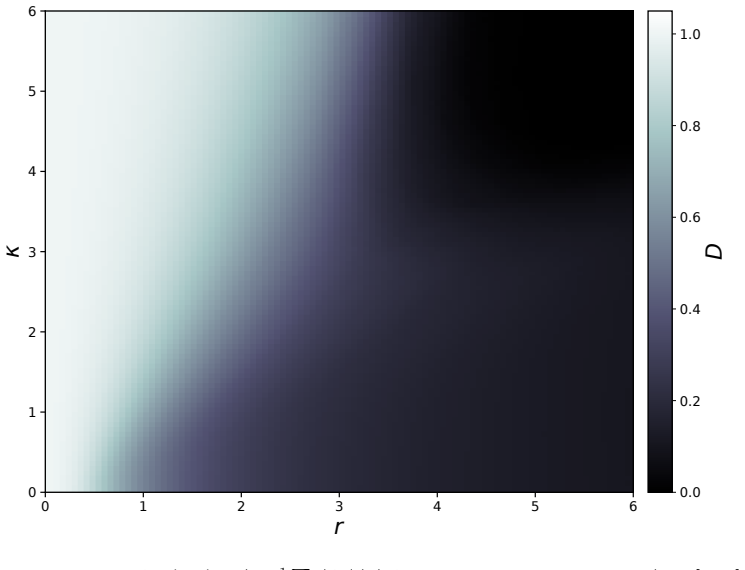
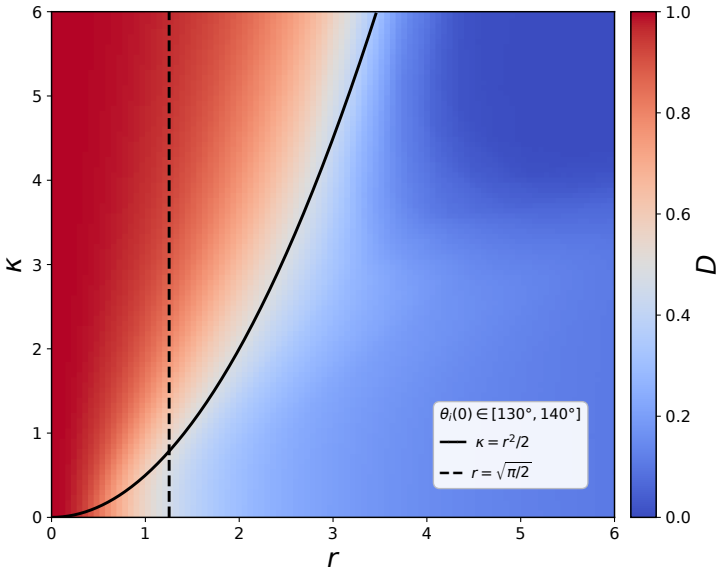
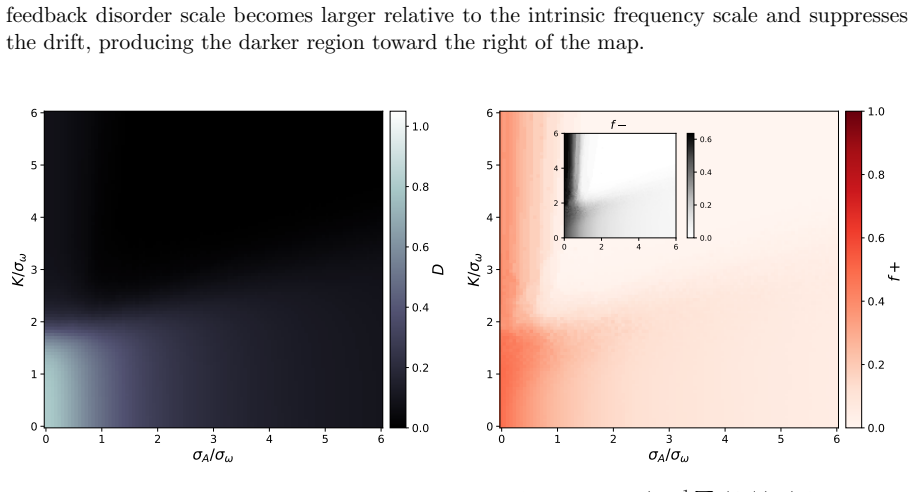
In active rotator networks with Kuramoto coupling, feedback amplitudes drawn from a zero-mean Gaussian produce a competition between local pinning and collective phase alignment. At weak coupling, increasing feedback disorder strength suppresses late-time drift; stronger coupling restores positive drift when disorder is not too large. These regime boundaries are mapped using mean absolute late-time drift and the fractions of positive and negative drifting oscillators, and the results persist for homogeneous intrinsic drive.
What carries the argument
Competition between local pinning from mixed-sign Gaussian feedback and collective phase alignment from Kuramoto coupling, quantified by mean absolute late-time drift and fractions of drifting oscillators.
If this is right
- Weak coupling combined with large feedback disorder suppresses collective drift.
- Increasing coupling strength can overcome moderate feedback disorder and restore net positive drift.
- The same transitions occur when intrinsic frequencies are replaced by a zero-mean distribution.
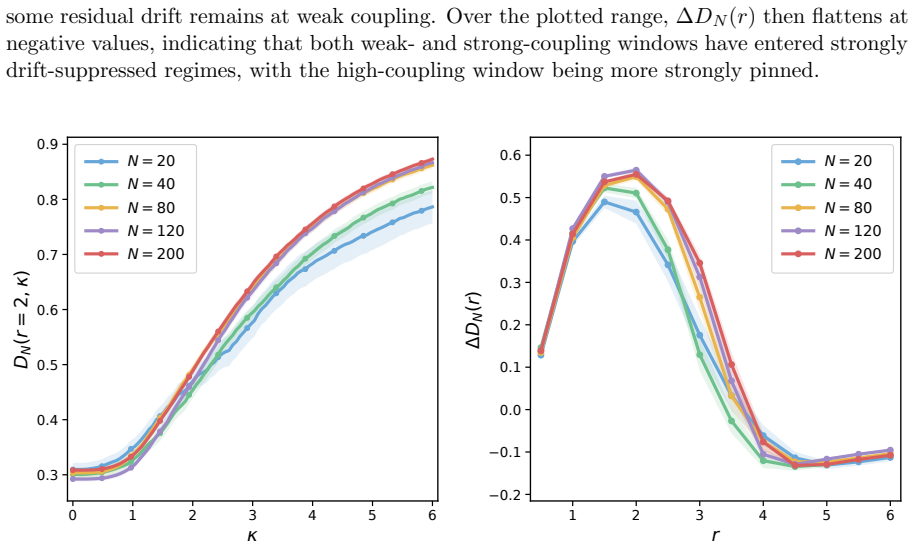
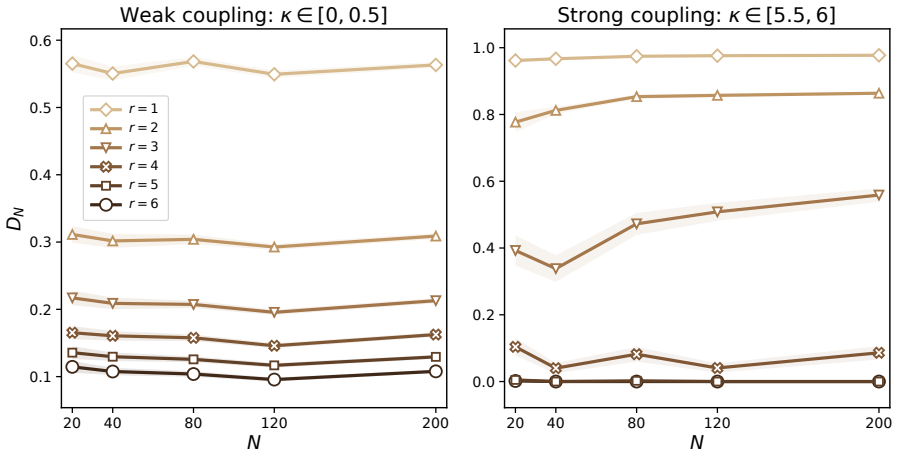
- Finite-size effects do not eliminate the identified regimes.
Where Pith is reading between the lines
- Local feedback sign disorder may serve as a tunable control parameter in other oscillator networks whose connectivity is not all-to-all.
- The same mechanism could appear in excitable-media models if feedback terms are allowed to take both signs.
- Testing whether the reported boundaries survive when the feedback distribution is changed from Gaussian would directly test the role of the zero-mean assumption.
Load-bearing premise
Feedback amplitudes are drawn from a zero-mean Gaussian distribution on a fully connected network.
What would settle it
Simulations on a non-fully-connected network or with a non-zero-mean feedback distribution that produce unchanged regime boundaries would show the reported control by mixed-sign disorder does not hold.
Figures


read the original abstract
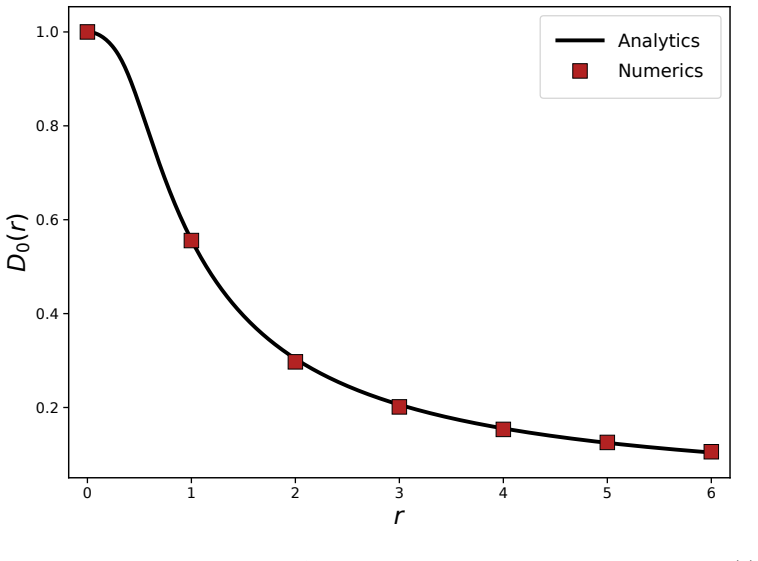
Active rotator models provide a minimal phase description of excitable and oscillatory systems, and have long been used to study mutual entrainment, synchronization, and collective transitions. Here, we investigate fully connected active rotator networks with Kuramoto coupling, where a common intrinsic drive competes with local feedback amplitudes drawn from a zero-mean Gaussian distribution. This produces a competition between local pinning and collective phase alignment. Using mean absolute late-time drift and the fractions of positive and negative drifting oscillators, we construct numerical regime maps in the feedback-disorder-coupling plane. At weak coupling, increasing the feedback disorder strength suppresses drift, while stronger coupling can restore positive late-time drift when feedback disorder is not too strong. We interpret these regimes using analytical limits for the uncoupled and coherent strong-coupling cases. We also examine finite-size effects and zero-mean distributed intrinsic frequencies. Together, these results show that mixed-sign local feedback alone can reshape the balance between pinning and drifting in coupled active rotator networks, even when the intrinsic drive is homogeneous.
Editorial analysis
A structured set of objections, weighed in public.
Referee Report
Summary. The manuscript examines fully connected active rotator networks with Kuramoto coupling where a homogeneous intrinsic drive competes with local feedback amplitudes drawn from a zero-mean Gaussian distribution. Numerical regime maps are constructed in the feedback-disorder-coupling plane using observables such as mean absolute late-time drift and fractions of drifting oscillators. At weak coupling, feedback disorder suppresses drift; stronger coupling can restore positive drift when disorder is moderate. Analytical limits for uncoupled and coherent strong-coupling cases are used for interpretation, along with checks on finite-size effects and zero-mean distributed intrinsic frequencies. The central claim is that mixed-sign local feedback alone can reshape the pinning-drifting balance even with homogeneous drive.
Significance. If the numerical results hold, the work demonstrates a concrete mechanism by which local feedback disorder alters collective phase dynamics in active rotator networks, extending beyond standard Kuramoto entrainment. The explicit use of analytical limits for boundary cases and examination of finite-size effects provide a solid foundation for the regime maps. This could inform studies of excitable media and synchronization with heterogeneous feedback.
major comments (2)
- [Numerical Methods] Numerical Methods section (or equivalent): The construction of regime maps relies on direct numerical integration, yet no details are provided on the integration scheme (e.g., Euler vs. Runge-Kutta), time step, total integration time, ensemble size over disorder realizations, or convergence diagnostics. These omissions make it impossible to assess the robustness of the reported boundaries between pinning and drifting regimes.
- [Results] Results, regime-map figures: The observables (mean absolute late-time drift and drifting fractions) are well-defined, but without error bars, standard deviations across realizations, or explicit thresholds used to classify 'drifting' vs. 'pinned' oscillators, the sharpness of the reported transitions cannot be evaluated.
minor comments (2)
- [Abstract] Abstract and introduction: The phrase 'mixed-sign local feedback alone' is clear in context but could be rephrased for precision to emphasize that the disorder is zero-mean Gaussian and the network is all-to-all.
- [Analytical limits] Analytical limits: The strong-coupling coherent state analysis is useful, but a brief derivation sketch or reference to the exact reduction would aid readers.
Simulated Author's Rebuttal
We thank the referee for the positive assessment and constructive feedback. We will revise the manuscript to address the concerns regarding numerical methods and results presentation.
read point-by-point responses
-
Referee: [Numerical Methods] Numerical Methods section (or equivalent): The construction of regime maps relies on direct numerical integration, yet no details are provided on the integration scheme (e.g., Euler vs. Runge-Kutta), time step, total integration time, ensemble size over disorder realizations, or convergence diagnostics. These omissions make it impossible to assess the robustness of the reported boundaries between pinning and drifting regimes.
Authors: We agree with this assessment. The original manuscript omitted these details. In the revised version, we will include a new subsection in the Methods describing the numerical integration scheme (we use a fourth-order Runge-Kutta method with fixed time step of 0.01), total integration time (up to t=1000 after transients), ensemble size (100 disorder realizations), and convergence diagnostics based on the stabilization of the mean drift observable. revision: yes
-
Referee: [Results] Results, regime-map figures: The observables (mean absolute late-time drift and drifting fractions) are well-defined, but without error bars, standard deviations across realizations, or explicit thresholds used to classify 'drifting' vs 'pinned' oscillators, the sharpness of the reported transitions cannot be evaluated.
Authors: We concur that error bars and classification thresholds should be provided for clarity. We will add error bars (standard deviation over realizations) to the regime map figures and explicitly state the threshold for classifying an oscillator as drifting (absolute drift velocity exceeding 0.05 in our units). This will allow better evaluation of the transition sharpness. revision: yes
Circularity Check
No circularity: derivation rests on explicit numerical construction and independent analytical limits
full rationale
The paper constructs regime maps from direct numerical integration of the model equations using well-defined observables (mean absolute late-time drift, fractions of drifting oscillators). Analytical limits are derived for the uncoupled case and the strong-coupling coherent state; these limits follow from the governing ODEs without parameter fitting or self-referential definitions. No step reduces a claimed prediction to a fitted input by construction, and no load-bearing claim depends on a self-citation chain. The zero-mean Gaussian feedback and all-to-all connectivity are stated as modeling choices, not derived results. This is the standard non-circular case of simulation plus limiting analysis.
Axiom & Free-Parameter Ledger
Reference graph
Works this paper leans on
-
[1]
J. A. Acebr´ on, L. L. Bonilla, C. J. P´ erez Vicente, F. Ritort, and R. Spigler, “The Kuramoto model: A simple paradigm for synchronization phenomena,”Reviews of Modern Physics 77, 137–185 (2005).https://doi.org/10.1103/RevModPhys.77.137
-
[2]
Phase Transitions in Active Rotator Systems,
S. Shinomoto and Y. Kuramoto, “Phase Transitions in Active Rotator Systems,”Progress of Theoretical Physics75, 1105–1110 (1986).https://doi.org/10.1143/PTP.75.1105
-
[3]
Progress of Theoretical Physics 76, 576–581
H. Sakaguchi and Y. Kuramoto, “A Soluble Active Rotator Model Showing Phase Tran- sitions via Mutual Entrainment,”Progress of Theoretical Physics76, 576–581 (1986). https://doi.org/10.1143/PTP.76.576
-
[4]
H. Sakaguchi, S. Shinomoto, and Y. Kuramoto, “Phase transitions and their bifurcation analysis in a large population of active rotators with mean-field coupling,”Progress of Theoretical Physics79, 600–607 (1988).https://doi.org/10.1143/PTP.79.600
-
[5]
Collective dynamics of coupled oscillators with random pinning,
S. H. Strogatz, C. M. Marcus, R. M. Westervelt, and R. E. Mirollo, “Collective dynamics of coupled oscillators with random pinning,”Physica D: Nonlinear Phenomena36, 23–50 (1989).https://doi.org/10.1016/0167-2789(89)90246-7
-
[6]
Synchronization in the random-field Kuramoto model on complex networks,
M. A. Lopes, E. M. Lopes, S. Yoon, J. F. F. Mendes, and A. V. Goltsev, “Synchronization in the random-field Kuramoto model on complex networks,”Physical Review E94, 012308 (2016).https://doi.org/10.1103/PhysRevE.94.012308
-
[7]
N. Komin and R. Toral, “Order parameter expansion and finite-size scaling study of co- herent dynamics induced by quenched noise in the active rotator model,”Physical Review E82, 051127 (2010).https://doi.org/10.1103/PhysRevE.82.051127
-
[8]
V. Klinshov and I. Franovi´ c, “Two scenarios for the onset and suppression of collective os- cillations in heterogeneous populations of active rotators,”Physical Review E100, 062211 (2019).https://doi.org/10.1103/PhysRevE.100.062211 18
-
[9]
The Kuramoto model in complex networks,
F. A. Rodrigues, T. K. D. M. Peron, P. Ji, and J. Kurths, “The Kuramoto model in complex networks,”Physics Reports610, 1–98 (2016).https://doi.org/10.1016/j.physrep.20 15.10.008
-
[10]
B. Sonnenschein, T. K. D. M. Peron, F. A. Rodrigues, J. Kurths, and L. Schimansky- Geier, “Cooperative behavior between oscillatory and excitable units: the peculiar role of positive coupling-frequency correlations,”European Physical Journal B87, 182 (2014). https://doi.org/10.1140/epjb/e2014-50274-2
-
[11]
E. Ott and T. M. Antonsen, “Low dimensional behavior of large systems of globally coupled oscillators,”Chaos18, 037113 (2008).https://doi.org/10.1063/1.2930766
-
[12]
Biological rhythms and the behavior of populations of coupled oscillators,
A. T. Winfree, “Biological rhythms and the behavior of populations of coupled oscillators,” Journal of Theoretical Biology16, 15–42 (1967).https://doi.org/10.1016/0022-519 3(67)90051-3
-
[13]
S. H. Strogatz, “From Kuramoto to Crawford: exploring the onset of synchronization in populations of coupled oscillators,”Physica D: Nonlinear Phenomena143, 1–20 (2000). https://doi.org/10.1016/S0167-2789(00)00094-4 19
discussion (0)
Sign in with ORCID, Apple, or X to comment. Anyone can read and Pith papers without signing in.