Learning the Universe with the 2nd Generation of CAMELS: Varying 35 parameters of the IllustrisTNG model in (50Mpc/h)³ boxes
Pith reviewed 2026-06-27 15:11 UTC · model grok-4.3
The pith
Larger (50 Mpc/h)^3 simulation volumes produce tighter marginal constraints on 35 parameters via neural networks than smaller boxes.
A machine-rendered reading of the paper's core claim, the machinery that carries it, and where it could break.
Core claim
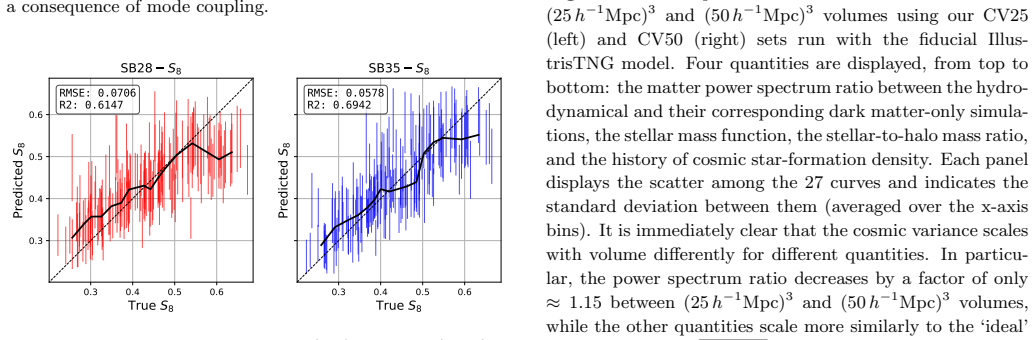
Increasing simulation volume from (25 Mpc/h)^3 to (50 Mpc/h)^3 generally produces tighter marginal constraints on the 35 parameters, with the size of the improvement depending on the data representation fed to the neural networks.
What carries the argument
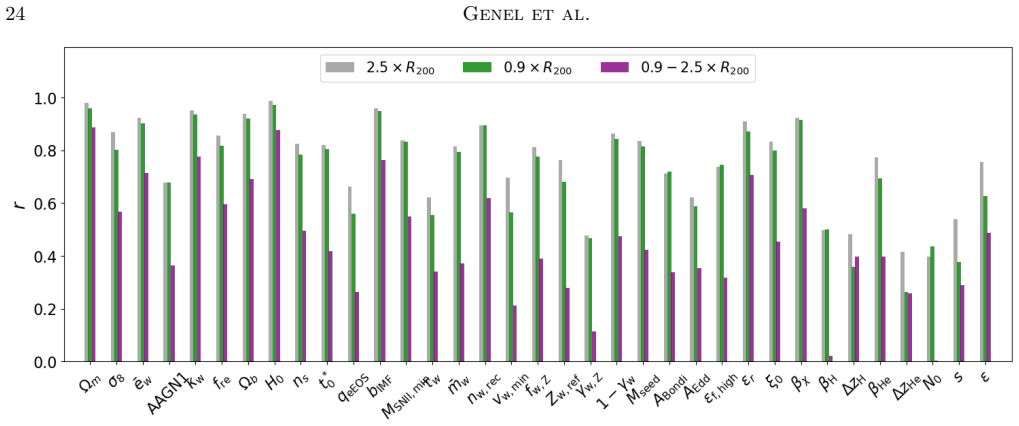
Neural-network inference of the 35 parameters from four distinct data representations extracted from the simulations, tested across two different volume sizes.
If this is right
- Larger volumes deliver tighter constraints on the full set of 35 parameters.
- The amount of improvement differs across power spectra, maps, graphs, and halo properties.
- Constraint tightening scales more weakly than the square root of volume growth, consistent with mode coupling or degeneracies.
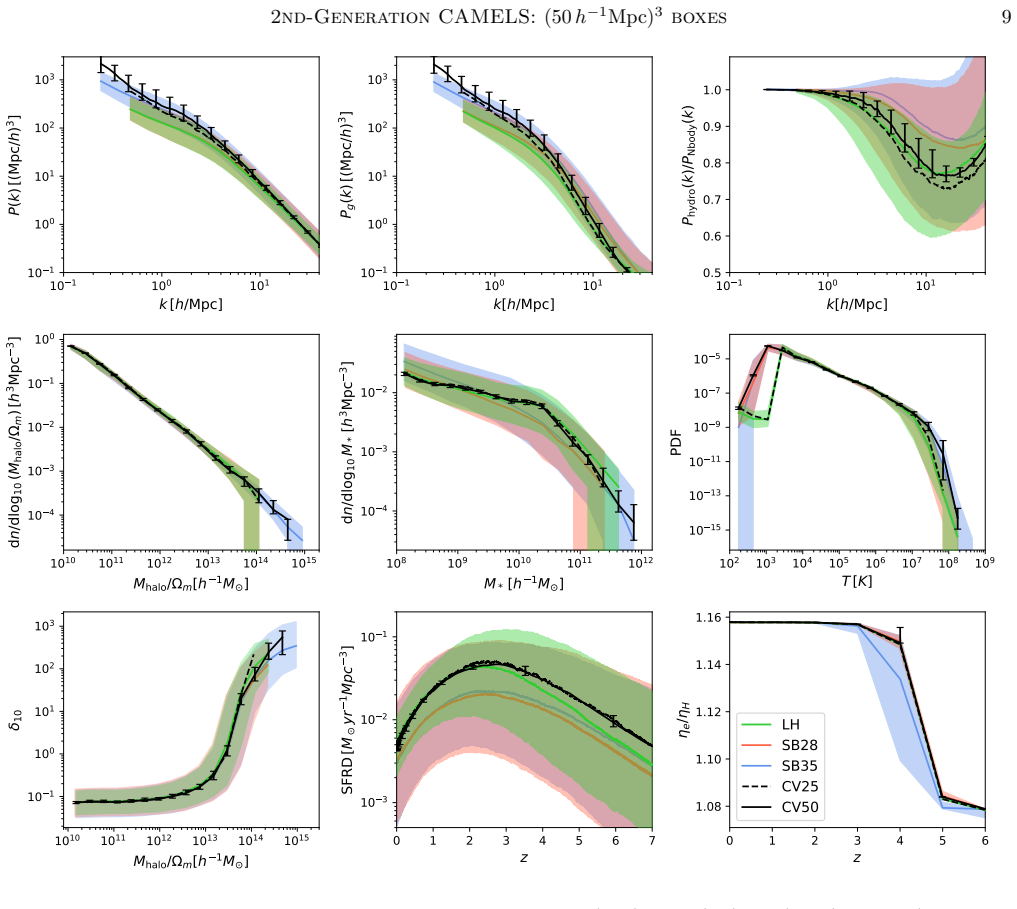
- The four new ionizing-background parameters measurably alter intergalactic medium temperature statistics.
Where Pith is reading between the lines
- Even larger volumes could be tested to determine whether further gains continue or saturate.
- Joint use of multiple input representations might produce additional constraint improvements beyond any single channel.
- The released simulation outputs allow other inference methods to be benchmarked against the neural-network results reported here.
Load-bearing premise
The observed tightening of constraints arises primarily from the increase in physical volume rather than from shifts in parameter sampling density or neural-network settings between the two simulation generations.
What would settle it
A side-by-side run that holds parameter sampling density and network hyperparameters fixed while changing only the box volume, then measures whether the constraint widths improve exactly in proportion to the volume ratio.
Figures









read the original abstract
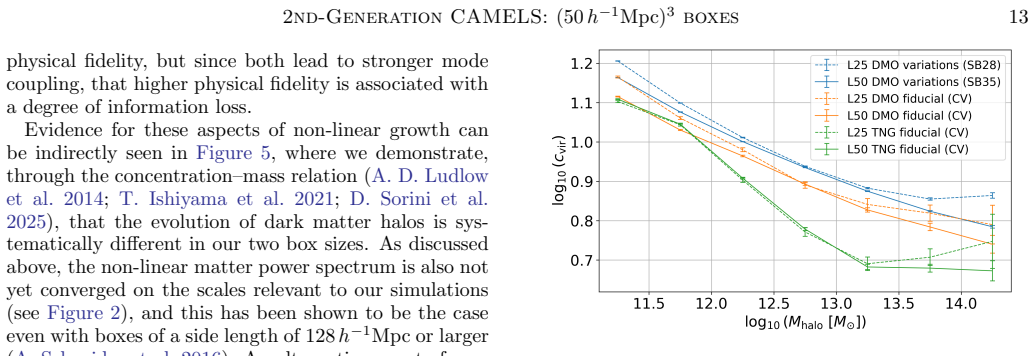
We present a new set of 1,192 cosmological simulations as part of the CAMELS project, in which a space of 35 cosmological, astrophysical, and numerical parameters is explored around the fiducial IllustrisTNG model. The volume of each of these simulations is (50Mpc/h)^3, eight times larger than that of previous CAMELS simulations. This provides lower sample variance as well as access to more massive halos and more diverse environments. We focus this work on exploring the advantages these differences provide for parameter inference powered by neural networks. We generate training sets based on the matter power spectra, projected maps of the volumes, graphs representing galaxy spatial distributions, and thermodynamical properties of massive halos. We employ multilayer perceptrons, convolutional neural networks, graph neural networks, and Gaussian processes, respectively, to extract information on the simulation parameters from these inputs while comparing systematically to analogous results from our previous generation of (25Mpc/h)^3 simulations. We generally find that the new, larger volumes produce tighter marginal constraints on the parameters, to degrees that vary between the different inputs. The improvements, however, scale more weakly than with the square root of the increase in the amount of data (i.e., physical volume). We interpret this as originating either from information loss due to mode coupling or from complex degeneracies in parameter space. We also discuss the effects on statistics of the intergalactic medium temperature from four new parameters that are varied in these simulations, which control the amplitude and timing of the ionizing background radiation. We publicly release the simulation outputs and ancillary data at https://camels.readthedocs.io.
Editorial analysis
A structured set of objections, weighed in public.
Referee Report
Summary. The manuscript presents 1,192 new CAMELS simulations exploring a 35-parameter space (cosmological, astrophysical, and numerical) around the IllustrisTNG model in (50 Mpc/h)^3 volumes. Training sets are generated from matter power spectra, projected maps, galaxy graphs, and halo thermodynamical properties; multilayer perceptrons, CNNs, graph neural networks, and Gaussian processes are used to infer parameters. Results are compared systematically to the prior (25 Mpc/h)^3 generation, with the central finding that larger volumes yield tighter marginal constraints whose improvement scales more weakly than √8.
Significance. If the attribution to volume holds after controls, the work would help quantify how simulation volume affects ML-based cosmological parameter inference and inform the design of future large-volume campaigns. The public data release strengthens the contribution.
major comments (2)
- [Abstract] Abstract: the claim that larger volumes produce tighter marginal constraints is presented without any quantitative metrics, improvement factors, error bars, or tables summarizing the degree of tightening for each input type (power spectra, maps, graphs, halos).
- [Results and Methods (comparison)] Comparison to prior generation (throughout results sections): the manuscript states the comparison is 'systematic' but does not report whether the number of training realizations, exact parameter ranges and sampling density (Latin-hypercube/Sobol), neural-network hyperparameters/architectures, or preprocessing pipelines were held identical between the two generations; without this isolation, the weaker-than-√8 scaling cannot be unambiguously attributed to mode coupling or degeneracies rather than uncontrolled differences in sampling or training.
minor comments (1)
- [Abstract] Abstract: the data-release URL is provided and the description of the four new ionizing-background parameters is clear.
Simulated Author's Rebuttal
We thank the referee for their constructive comments, which highlight opportunities to improve the clarity and rigor of our presentation. We address each major comment below and will incorporate revisions to strengthen the manuscript.
read point-by-point responses
-
Referee: [Abstract] Abstract: the claim that larger volumes produce tighter marginal constraints is presented without any quantitative metrics, improvement factors, error bars, or tables summarizing the degree of tightening for each input type (power spectra, maps, graphs, halos).
Authors: We agree that the abstract would benefit from quantitative detail on the reported improvements. In the revised manuscript we will insert specific tightening factors (with uncertainties) for the marginal constraints obtained from each input type, drawn from the results sections. revision: yes
-
Referee: [Results and Methods (comparison)] Comparison to prior generation (throughout results sections): the manuscript states the comparison is 'systematic' but does not report whether the number of training realizations, exact parameter ranges and sampling density (Latin-hypercube/Sobol), neural-network hyperparameters/architectures, or preprocessing pipelines were held identical between the two generations; without this isolation, the weaker-than-√8 scaling cannot be unambiguously attributed to mode coupling or degeneracies rather than uncontrolled differences in sampling or training.
Authors: The comparisons were performed with matched training-set sizes, identical parameter ranges and Latin-hypercube sampling, the same network architectures and hyperparameters, and the same preprocessing pipelines as the prior generation. We acknowledge that these controls were not documented in a single dedicated location. We will add an explicit subsection (or table) in the Methods that tabulates the matching choices, thereby making the systematic nature of the comparison fully transparent and allowing readers to evaluate the attribution to volume. revision: yes
Circularity Check
No circularity: empirical comparison of new independent simulations to prior generation
full rationale
The paper generates a fresh set of 1,192 simulations in (50 Mpc/h)^3 volumes, trains separate neural networks (MLPs, CNNs, GNNs, GPs) on power spectra, maps, graphs and halo properties, and reports observed tighter marginal constraints relative to the earlier (25 Mpc/h)^3 CAMELS generation. No equation, ansatz or self-citation reduces the reported constraints to quantities fitted from the same data; the comparison is presented as an external empirical result. The prior generation constitutes independent evidence, and the central claim does not rely on any load-bearing self-citation or definitional identity.
Axiom & Free-Parameter Ledger
axioms (1)
- domain assumption Fiducial IllustrisTNG model provides a sufficiently accurate representation of galaxy formation physics for the purpose of parameter inference training
Reference graph
Works this paper leans on
-
[1]
Abbott , T. M. C., Aguena , M., Alarcon , A., et al. 2022, title Dark Energy Survey Year 3 results: Cosmological constraints from galaxy clustering and weak lensing , , 105, 023520, 10.1103/PhysRevD.105.023520
-
[2]
Akiba, T., Sano, S., Yanase, T., Ohta, T., & Koyama, M. 2019, in The 25th ACM SIGKDD International Conference on Knowledge Discovery & Data Mining (New York, NY, USA: Association for Computing Machinery), 2623--2631, 10.1145/3292500.3330701
-
[3]
Alam , S., Aubert , M., Avila , S., et al. 2021, title Completed SDSS-IV extended Baryon Oscillation Spectroscopic Survey: Cosmological implications from two decades of spectroscopic surveys at the Apache Point Observatory , , 103, 083533, 10.1103/PhysRevD.103.083533
-
[4]
Anderson , L., Aubourg , \'E ., Bailey , S., et al. 2014, title The clustering of galaxies in the SDSS-III Baryon Oscillation Spectroscopic Survey: baryon acoustic oscillations in the Data Releases 10 and 11 Galaxy samples , , 441, 24, 10.1093/mnras/stu523
-
[5]
2026, title Claude (Opus-4.7), , https://www.anthropic.com
Anthropic . 2026, title Claude (Opus-4.7), , https://www.anthropic.com
2026
-
[6]
Bairagi , A., Wandelt , B., & Villaescusa-Navarro , F. 2025, title The BIG SOBOL SEQUENCE: How many simulations do we need for simulation-based inference in cosmology? , , 703, A301, 10.1051/0004-6361/202554602
-
[7]
Balla , J., Mishra-Sharma , S., Cuesta-Lazaro , C., Jaakkola , T., & Smidt , T. 2024, title A Cosmic-Scale Benchmark for Symmetry-Preserving Data Processing , arXiv e-prints, arXiv:2410.20516, 10.48550/arXiv.2410.20516
-
[8]
Behroozi , P. S., Wechsler , R. H., & Wu , H.-Y. 2013 a , title The ROCKSTAR Phase-space Temporal Halo Finder and the Velocity Offsets of Cluster Cores , , 762, 109, 10.1088/0004-637X/762/2/109
work page internal anchor Pith review doi:10.1088/0004-637x/762/2/109 2013
-
[9]
Behroozi , P. S., Wechsler , R. H., Wu , H.-Y., et al. 2013 b , title Gravitationally Consistent Halo Catalogs and Merger Trees for Precision Cosmology , , 763, 18, 10.1088/0004-637X/763/1/18
work page internal anchor Pith review doi:10.1088/0004-637x/763/1/18 2013
-
[10]
Bird , S., Ni , Y., Di Matteo , T., et al. 2022, title The ASTRID simulation: galaxy formation and reionization , , 512, 3703, 10.1093/mnras/stac648
-
[11]
Crain , R. A., Schaye , J., Bower , R. G., et al. 2015, title The EAGLE simulations of galaxy formation: calibration of subgrid physics and model variations , , 450, 1937, 10.1093/mnras/stv725
-
[12]
Crocce , M., Pueblas , S., & Scoccimarro , R. 2006, title Transients from initial conditions in cosmological simulations , , 373, 369, 10.1111/j.1365-2966.2006.11040.x
-
[13]
Dav \'e , R., Angl \'e s-Alc \'a zar , D., Narayanan , D., et al. 2019, title SIMBA: Cosmological simulations with black hole growth and feedback , , 486, 2827, 10.1093/mnras/stz937
work page internal anchor Pith review doi:10.1093/mnras/stz937 2019
-
[14]
Davis , M., Efstathiou , G., Frenk , C. S., & White , S. D. M. 1985, title The evolution of large-scale structure in a universe dominated by cold dark matter , , 292, 371, 10.1086/163168
-
[15]
de Santi , N. S. M., Shao , H., Villaescusa-Navarro , F., et al. 2023, title Robust Field-level Likelihood-free Inference with Galaxies , , 952, 69, 10.3847/1538-4357/acd1e2
-
[16]
M., Angl \'e s-Alc \'a zar , D., Thiele , L., et al
Delgado , A. M., Angl \'e s-Alc \'a zar , D., Thiele , L., et al. 2023, title Predicting the impact of feedback on matter clustering with machine learning in CAMELS , , 526, 5306, 10.1093/mnras/stad2992
-
[17]
Duan , K., Liu , Z., Wang , P., et al. 2022, title A Comprehensive Study on Large-Scale Graph Training: Benchmarking and Rethinking , arXiv e-prints, arXiv:2210.07494, 10.48550/arXiv.2210.07494
-
[18]
P., Ramp \'a s ek , L., Galkin , M., et al
Dwivedi , V. P., Ramp \'a s ek , L., Galkin , M., et al. 2022, title Long Range Graph Benchmark , arXiv e-prints, arXiv:2206.08164, 10.48550/arXiv.2206.08164
-
[19]
Overview of the Euclid mission
Euclid Collaboration , Mellier , Y., Abdurro'uf , et al. 2025, title Euclid: I. Overview of the Euclid mission , , 697, A1, 10.1051/0004-6361/202450810
-
[20]
Faucher-Gigu \`e re , C., Lidz , A., Zaldarriaga , M., & Hernquist , L. 2009, title A New Calculation of the Ionizing Background Spectrum and the Effects of He II Reionization , , 703, 1416, 10.1088/0004-637X/703/2/1416
-
[21]
Gebhardt , M., Angl \'e s-Alc \'a zar , D., Borrow , J., et al. 2024, title Cosmological baryon spread and impact on matter clustering in CAMELS , , 529, 4896, 10.1093/mnras/stae817
-
[22]
Gebhardt , M., Angl \'e s-Alc \'a zar , D., Genel , S., et al. 2026, title Cosmological back-reaction of baryons on dark matter in the CAMELS simulations , , 547, stag525, 10.1093/mnras/stag525
-
[23]
Genel , S., Vogelsberger , M., Springel , V., et al. 2014, title Introducing the Illustris project: the evolution of galaxy populations across cosmic time , , 445, 175, 10.1093/mnras/stu1654
-
[24]
Gnedin , N. Y., & Madau , P. 2022, title Modeling cosmic reionization , Living Reviews in Computational Astrophysics, 8, 3, 10.1007/s41115-022-00015-5
-
[25]
2022, in Proceedings of Machine Learning Research, Vol
Guan, C., Wang, X., Chen, H., Zhang, Z., & Zhu, W. 2022, in Proceedings of Machine Learning Research, Vol. 162, Proceedings of the 39th International Conference on Machine Learning, ed. K. Chaudhuri, S. Jegelka, L. Song, C. Szepesvari, G. Niu, & S. Sabato (PMLR), 7968--7981. https://proceedings.mlr.press/v162/guan22d.html
2022
-
[26]
Hahn , C., Lemos , P., Parker , L., et al. 2024, title Cosmological constraints from non-Gaussian and nonlinear galaxy clustering using the SIMBIG inference framework , Nature Astronomy, 8, 1457, 10.1038/s41550-024-02344-2
-
[27]
Hern \'a ndez-Mart \' nez , E., Genel , S., Villaescusa-Navarro , F., et al. 2025, title Cosmological and Astrophysical Parameter Inference from Stacked Galaxy Cluster Profiles Using CAMELS-zoomGZ , , 981, 170, 10.3847/1538-4357/ada9e9
-
[28]
Hinshaw , G., Larson , D., Komatsu , E., et al. 2013, title Nine-year Wilkinson Microwave Anisotropy Probe (WMAP) Observations: Cosmological Parameter Results , , 208, 19, 10.1088/0067-0049/208/2/19
work page internal anchor Pith review doi:10.1088/0067-0049/208/2/19 2013
-
[29]
Ho , M., Bartlett , D. J., Chartier , N., et al. 2024, title LtU-ILI: An All-in-One Framework for Implicit Inference in Astrophysics and Cosmology , The Open Journal of Astrophysics, 7, 54, 10.33232/001c.120559
-
[30]
Huang , N., Stiskalek , R., Lee , J.-Y., et al. 2025, title CosmoBench: A Multiscale, Multiview, Multitask Cosmology Benchmark for Geometric Deep Learning , arXiv e-prints, arXiv:2507.03707, 10.48550/arXiv.2507.03707
-
[31]
Ishiyama , T., Prada , F., Klypin , A. A., et al. 2021, title The Uchuu simulations: Data Release 1 and dark matter halo concentrations , , 506, 4210, 10.1093/mnras/stab1755
-
[32]
Jeffrey , N., & Wandelt , B. D. 2020, title Solving high-dimensional parameter inference: marginal posterior densities & Moment Networks , arXiv e-prints, arXiv:2011.05991, 10.48550/arXiv.2011.05991
-
[33]
Jo , Y., Genel , S., Sengupta , A., et al. 2025, title Towards Robustness Across Cosmological Simulation Models TNG, SIMBA, ASTRID, and EAGLE , arXiv e-prints, arXiv:2502.13239, 10.48550/arXiv.2502.13239
-
[34]
Adam: A Method for Stochastic Optimization
Kingma , D. P., & Ba , J. 2014, title Adam: A Method for Stochastic Optimization , arXiv e-prints, arXiv:1412.6980, 10.48550/arXiv.1412.6980
work page internal anchor Pith review Pith/arXiv arXiv doi:10.48550/arxiv.1412.6980 2014
-
[35]
A., Trujillo-Gomez , S., & Primack , J
Klypin , A. A., Trujillo-Gomez , S., & Primack , J. 2011, title Dark Matter Halos in the Standard Cosmological Model: Results from the Bolshoi Simulation , , 740, 102, 10.1088/0004-637X/740/2/102
-
[36]
Kugel , R., Schaye , J., Schaller , M., Forouhar Moreno , V. J., & McGibbon , R. J. 2025, title The FLAMINGO Project: An assessment of the systematic errors in the predictions of models for galaxy cluster counts used to infer cosmological parameters , , 537, 2179, 10.1093/mnras/staf111
-
[37]
Kugel , R., Schaye , J., Schaller , M., et al. 2023, title FLAMINGO: calibrating large cosmological hydrodynamical simulations with machine learning , , 526, 6103, 10.1093/mnras/stad2540
-
[38]
2025, title ethlau/CAMELS\_emulator: v1.0.0, , v1.0.0 Zenodo, 10.5281/zenodo.14714183
Lau, E. 2025, title ethlau/CAMELS\_emulator: v1.0.0, , v1.0.0 Zenodo, 10.5281/zenodo.14714183
-
[39]
T., Nagai , D., Farahi , A., et al
Lau , E. T., Nagai , D., Farahi , A., et al. 2025 a , title Baryon Pasting the Uchuu Light-cone Simulation , , 980, 122, 10.3847/1538-4357/ada940
-
[40]
T., Nagai , D., Bogd \'a n , \'A ., et al
Lau , E. T., Nagai , D., Bogd \'a n , \'A ., et al. 2025 b , title X-Raying CAMELS: Constraining Baryonic Feedback in the Circumgalactic Medium with the CAMELS Simulations and eRASS X-Ray Observations , , 984, 190, 10.3847/1538-4357/adc450
-
[41]
Lee, J.-Y., & Villaescusa-Navarro, F. 2025, title Cosmology with Topological Deep Learning, The Astrophysical Journal, 989, 47, 10.3847/1538-4357/ade806
-
[42]
Lee , M. E., Genel , S., Wandelt , B. D., et al. 2024, title Zooming by in the CARPoolGP Lane: New CAMELS-TNG Simulations of Zoomed-in Massive Halos , , 968, 11, 10.3847/1538-4357/ad3d4a
-
[43]
Li , X., Zhou , Z., Yao , J., et al. 2023, title Neural Atoms: Propagating Long-range Interaction in Molecular Graphs through Efficient Communication Channel , arXiv e-prints, arXiv:2311.01276, 10.48550/arXiv.2311.01276
-
[44]
Lin , S., Li , Y., Genel , S., et al. 2026, title One Latent to Fit Them All: A Unified Representation of Baryonic Feedback on Matter Distribution , , 996, L41, 10.3847/2041-8213/ae3084
-
[45]
LSST Science Book, Version 2.0
LSST Science Collaboration , Abell , P. A., Allison , J., et al. 2009, title LSST Science Book, Version 2.0 , arXiv e-prints, arXiv:0912.0201, 10.48550/arXiv.0912.0201
work page internal anchor Pith review Pith/arXiv arXiv doi:10.48550/arxiv.0912.0201 2009
-
[46]
Ludlow , A. D., Navarro , J. F., Angulo , R. E., et al. 2014, title The mass-concentration-redshift relation of cold dark matter haloes , , 441, 378, 10.1093/mnras/stu483
-
[47]
First results from the IllustrisTNG simulations: radio haloes and magnetic fields
Marinacci , F., Vogelsberger , M., Pakmor , R., et al. 2018, title First results from the IllustrisTNG simulations: radio haloes and magnetic fields , , 480, 5113, 10.1093/mnras/sty2206
work page internal anchor Pith review doi:10.1093/mnras/sty2206 2018
-
[48]
P., Pillepich , A., Springel , V., et al
Naiman , J. P., Pillepich , A., Springel , V., et al. 2018, title First results from the IllustrisTNG simulations: a tale of two elements - chemical evolution of magnesium and europium , , 477, 1206, 10.1093/mnras/sty618
work page internal anchor Pith review doi:10.1093/mnras/sty618 2018
-
[49]
Nelson , D., Pillepich , A., Springel , V., et al. 2018, title First results from the IllustrisTNG simulations: the galaxy colour bimodality , , 475, 624, 10.1093/mnras/stx3040
work page internal anchor Pith review doi:10.1093/mnras/stx3040 2018
-
[50]
Nelson , D., Springel , V., Pillepich , A., et al. 2019, title The IllustrisTNG simulations: public data release , Computational Astrophysics and Cosmology, 6, 2, 10.1186/s40668-019-0028-x
-
[51]
Ni , Y., Di Matteo , T., Bird , S., et al. 2022, title The ASTRID simulation: the evolution of supermassive black holes , , 513, 670, 10.1093/mnras/stac351
-
[52]
Ni , Y., Genel , S., Angl \'e s-Alc \'a zar , D., et al. 2023, title The CAMELS Project: Expanding the Galaxy Formation Model Space with New ASTRID and 28-parameter TNG and SIMBA Suites , , 959, 136, 10.3847/1538-4357/ad022a
-
[53]
Nicola , A., Villaescusa-Navarro , F., Spergel , D. N., et al. 2022, title Breaking baryon-cosmology degeneracy with the electron density power spectrum , , 2022, 046, 10.1088/1475-7516/2022/04/046
-
[54]
2025, title ChatGPT (GPT-4.5), , https://openai.com
OpenAI . 2025, title ChatGPT (GPT-4.5), , https://openai.com
2025
-
[55]
Pakmor , R., Springel , V., Coles , J. P., et al. 2023, title The MillenniumTNG Project: the hydrodynamical full physics simulation and a first look at its galaxy clusters , , 524, 2539, 10.1093/mnras/stac3620
-
[56]
A., Genel , S., Villaescusa-Navarro , F., et al
Perez , L. A., Genel , S., Villaescusa-Navarro , F., et al. 2023, title Constraining Cosmology with Machine Learning and Galaxy Clustering: The CAMELS-SAM Suite , , 954, 11, 10.3847/1538-4357/accd52
-
[57]
Pillepich , A., Nelson , D., Hernquist , L., et al. 2018 a , title First results from the IllustrisTNG simulations: the stellar mass content of groups and clusters of galaxies , , 475, 648, 10.1093/mnras/stx3112
work page internal anchor Pith review doi:10.1093/mnras/stx3112 2018
-
[58]
Simulating Galaxy Formation with the IllustrisTNG Model
Pillepich , A., Springel , V., Nelson , D., et al. 2018 b , title Simulating galaxy formation with the IllustrisTNG model , , 473, 4077, 10.1093/mnras/stx2656
work page internal anchor Pith review doi:10.1093/mnras/stx2656 2018
-
[59]
Planck Collaboration , Aghanim , N., Akrami , Y., et al. 2020, title Planck 2018 results. VI. Cosmological parameters , , 641, A6, 10.1051/0004-6361/201833910
-
[60]
Power , C., & Knebe , A. 2006, title The impact of box size on the properties of dark matter haloes in cosmological simulations , , 370, 691, 10.1111/j.1365-2966.2006.10562.x
-
[61]
Puchwein , E., Haardt , F., Haehnelt , M. G., & Madau , P. 2019, title Consistent modelling of the meta-galactic UV background and the thermal/ionization history of the intergalactic medium , , 485, 47, 10.1093/mnras/stz222
-
[62]
H., Rai c evi \'c , M., & Schaye , J
Rahmati , A., Pawlik , A. H., Rai c evi \'c , M., & Schaye , J. 2013, title On the evolution of the H I column density distribution in cosmological simulations , , 430, 2427, 10.1093/mnras/stt066
-
[63]
Rodriguez-Gomez , V., Genel , S., Vogelsberger , M., et al. 2015, title The merger rate of galaxies in the Illustris simulation: a comparison with observations and semi-empirical models , , 449, 49, 10.1093/mnras/stv264
work page internal anchor Pith review doi:10.1093/mnras/stv264 2015
-
[64]
G., Kwan , J., Upadhye , A., & Font , A
Salcido , J., McCarthy , I. G., Kwan , J., Upadhye , A., & Font , A. S. 2023, title SP(k) - a hydrodynamical simulation-based model for the impact of baryon physics on the non-linear matter power spectrum , , 523, 2247, 10.1093/mnras/stad1474
-
[65]
, archivePrefix = "arXiv", eprint =
Schaye , J., Dalla Vecchia , C., Booth , C. M., et al. 2010, title The physics driving the cosmic star formation history , , 402, 1536, 10.1111/j.1365-2966.2009.16029.x
-
[66]
, archivePrefix = "arXiv", eprint =
Schaye , J., Crain , R. A., Bower , R. G., et al. 2015, title The EAGLE project: simulating the evolution and assembly of galaxies and their environments , , 446, 521, 10.1093/mnras/stu2058
-
[67]
Schaye , J., Kugel , R., Schaller , M., et al. 2023, title The FLAMINGO project: cosmological hydrodynamical simulations for large-scale structure and galaxy cluster surveys , , 526, 4978, 10.1093/mnras/stad2419
-
[68]
Schneider , A., Teyssier , R., Potter , D., et al. 2016, title Matter power spectrum and the challenge of percent accuracy , , 2016, 047, 10.1088/1475-7516/2016/04/047
-
[69]
Scoccimarro , R. 1998, title Transients from initial conditions: a perturbative analysis , , 299, 1097, 10.1046/j.1365-8711.1998.01845.x
-
[70]
Shao , H., Villaescusa-Navarro , F., Villanueva-Domingo , P., et al. 2023, title Robust Field-level Inference of Cosmological Parameters with Dark Matter Halos , , 944, 27, 10.3847/1538-4357/acac7a
-
[71]
Sims , X., Angl \'e s-Alc \'a zar , D., Oh , B.-K., et al. 2026, title CAMELS Environments: The Impact of Local Neighbours on Galaxy Evolution across the SIMBA, IllustrisTNG, ASTRID, and Swift-EAGLE Simulations , arXiv e-prints, arXiv:2601.06290, 10.48550/arXiv.2601.06290
-
[72]
Smith , L. N. 2015, title Cyclical Learning Rates for Training Neural Networks , arXiv e-prints, arXiv:1506.01186, 10.48550/arXiv.1506.01186
work page internal anchor Pith review Pith/arXiv arXiv doi:10.48550/arxiv.1506.01186 2015
-
[73]
and Sarajedini, Ata and Geisler, Doug and Bica, Eduardo and Claria, Juan J
Sokasian , A., Abel , T., & Hernquist , L. 2002, title The epoch of helium reionization , , 332, 601, 10.1046/j.1365-8711.2002.05291.x
-
[74]
Sorini , D., Bose , S., Pakmor , R., et al. 2025, title The impact of baryons on the internal structure of dark matter haloes from dwarf galaxies to superclusters in the redshift range 0 < z < 7 , , 536, 728, 10.1093/mnras/stae2613
-
[75]
, archivePrefix = "arXiv", eprint =
Springel , V. 2010, title E pur si muove: Galilean-invariant cosmological hydrodynamical simulations on a moving mesh , , 401, 791, 10.1111/j.1365-2966.2009.15715.x
-
[76]
Springel , V., Frenk , C. S., & White , S. D. M. 2006, title The large-scale structure of the Universe , , 440, 1137, 10.1038/nature04805
-
[77]
The stellar population synthesis models
Springel , V., & Hernquist , L. 2003, title Cosmological smoothed particle hydrodynamics simulations: a hybrid multiphase model for star formation , , 339, 289, 10.1046/j.1365-8711.2003.06206.x
-
[78]
Springel , V., White , S. D. M., Tormen , G., & Kauffmann , G. 2001, title Populating a cluster of galaxies - I. Results at [formmu2]z=0 , , 328, 726, 10.1046/j.1365-8711.2001.04912.x
-
[79]
Springel , V., White , S. D. M., Jenkins , A., et al. 2005, title Simulations of the formation, evolution and clustering of galaxies and quasars , , 435, 629, 10.1038/nature03597
-
[80]
Springel , V., Pakmor , R., Pillepich , A., et al. 2018, title First results from the IllustrisTNG simulations: matter and galaxy clustering , , 475, 676, 10.1093/mnras/stx3304
discussion (0)
Sign in with ORCID, Apple, or X to comment. Anyone can read and Pith papers without signing in.