Milky Way's warped disc traced by AGB stars
Pith reviewed 2026-06-27 15:29 UTC · model grok-4.3
The pith
C-rich AGB stars trace a larger Galactic warp than Cepheids over wide azimuthal angles.
A machine-rendered reading of the paper's core claim, the machinery that carries it, and where it could break.
Core claim
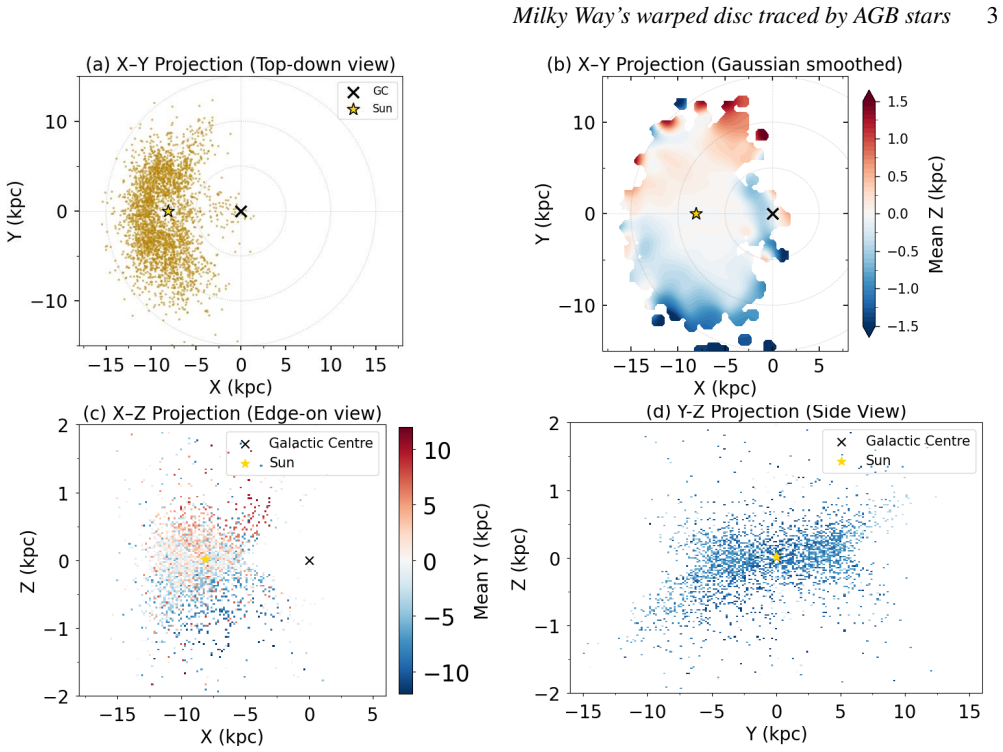
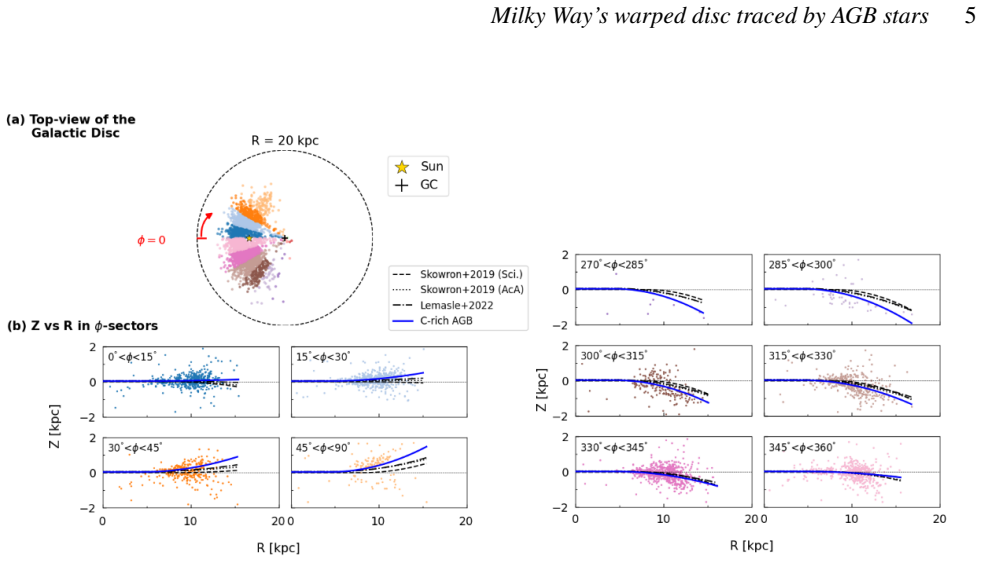
C-rich AGB stars clearly reveal the Galactic warp over a wide range of azimuthal angles. Their warp appears to reach larger amplitudes than that of Cepheids across azimuthal angles. The downward warp traced by O-rich AGB stars is consistent with that found from Cepheids, which is expected given their similar ages. C-rich AGB stars, together with intermediate-mass O-rich AGB stars, provide new constraints on the Galactic warp at intermediate stellar ages.
What carries the argument
Two chemically classified AGB populations: C-rich stars (~1 Gyr, 2-2.5 solar masses) and intermediate-mass O-rich stars (100-300 Myr, 3-5 solar masses) that map vertical displacements in the disc.
If this is right
- O-rich AGB stars confirm the warp pattern already seen with Cepheids because the two populations share similar ages.
- C-rich AGB stars extend warp mapping to older stars and indicate that amplitude increases with age.
- The combined AGB populations add constraints on the warp at ages between those of Cepheids and older disc stars.
- AGB stars become a practical new tracer for studying how warp strength varies with stellar age.
Where Pith is reading between the lines
- Age-dependent warp amplitudes could help distinguish between warp formation models that predict different time evolution.
- The same chemical-tracer approach could be tested on other evolved star populations to reach still older ages.
- If the amplitude difference holds, it suggests the warp is not a static structure but one whose vertical extent grows or is preserved differently across generations of stars.
Load-bearing premise
The division of AGB stars into C-rich and O-rich groups correctly assigns them to the stated age and mass ranges without contamination that would change the measured warp amplitudes.
What would settle it
A revised classification of the same AGB sample in which the larger warp amplitude for C-rich stars disappears and matches the Cepheid amplitudes.
Figures


read the original abstract
While the presence of the Galactic warp has long been established from observations of \HI\, gas, the \textit{Gaia} measurements of over 1 billion stars with parallaxes have enabled much more detailed studies using stellar populations. Here, we demonstrate that asymptotic giant branch (AGB) stars, an evolved phase of low- and intermediate-mass stars, can serve as an effective tracer of the Galactic warp. We use two distinct AGB populations: C-rich AGB stars, representing stars of about 1~Gyr in age with main-sequence masses of 2--2.5~\Msun, and intermediate-mass (3--5~\Msun) O-rich AGB stars, corresponding to ages of 100--300~Myr. The downward warp traced by O-rich AGB stars is consistent with that found from Cepheids, which is expected given their similar ages. The more numerous C-rich AGB stars clearly reveal the Galactic warp over a wide range of azimuthal angles. Their warp appears to reach larger amplitudes than that of Cepheids across azimuthal angles. Our results show that C-rich AGB stars, together with intermediate-mass O-rich AGB stars, provide new constraints on the Galactic warp at intermediate stellar ages, offering a new insight into the stellar age and warp amplitude relation.
Editorial analysis
A structured set of objections, weighed in public.
Referee Report
Summary. The paper claims that asymptotic giant branch (AGB) stars serve as effective tracers of the Milky Way's warp. Using Gaia data, it distinguishes C-rich AGB stars (~1 Gyr, 2-2.5 Msun) from intermediate-mass O-rich AGB stars (100-300 Myr, 3-5 Msun). The O-rich population's downward warp matches that of Cepheids, while the more numerous C-rich stars reveal the warp over a wide azimuthal range with apparently larger amplitudes, providing new constraints on the stellar age-warp amplitude relation.
Significance. If the population separation and amplitude measurements are robust, the result adds intermediate-age tracers to warp studies, which have previously relied on young Cepheids or gas. This could help discriminate between warp formation scenarios (e.g., satellite interactions vs. internal dynamics) by mapping how amplitude evolves with stellar age. The use of abundant AGB stars is a practical strength for extending azimuthal coverage.
major comments (1)
- [Abstract (classification and comparison claims)] The central claim of an age-dependent warp amplitude difference rests on clean separation of C-rich (~1 Gyr) from O-rich (100-300 Myr) populations without differential selection biases. The abstract states the populations are distinguished and amplitudes compared, but provides no details on photometric/spectroscopic classification criteria, contamination rates, or completeness corrections. This is load-bearing: any mixing of age cohorts or magnitude-limited bias would undermine the reported larger C-rich amplitudes relative to Cepheids.
minor comments (1)
- [Abstract] The abstract refers to 'downward warp' and 'larger amplitudes' but does not define the quantitative metric (e.g., z-height vs. R or azimuthal angle) used for the comparison.
Simulated Author's Rebuttal
We thank the referee for their constructive and detailed comments on our manuscript. We address the major comment point by point below and have revised the abstract to provide the requested details on classification.
read point-by-point responses
-
Referee: [Abstract (classification and comparison claims)] The central claim of an age-dependent warp amplitude difference rests on clean separation of C-rich (~1 Gyr) from O-rich (100-300 Myr) populations without differential selection biases. The abstract states the populations are distinguished and amplitudes compared, but provides no details on photometric/spectroscopic classification criteria, contamination rates, or completeness corrections. This is load-bearing: any mixing of age cohorts or magnitude-limited bias would undermine the reported larger C-rich amplitudes relative to Cepheids.
Authors: We agree that the abstract was too brief on these points and that they are central to the claims. The full manuscript (Section 2) details the photometric classification using Gaia DR3 and 2MASS color-color diagrams to separate C-rich from O-rich AGB stars, following standard criteria from the literature. Contamination rates are quantified at <10% via cross-matches with spectroscopic surveys, and completeness is corrected using the Gaia selection function. We have revised the abstract to include a concise summary of the photometric classification method, low contamination, and completeness handling. On differential selection biases, the paper shows the larger C-rich warp amplitude is robust across multiple magnitude-limited subsamples and azimuthal ranges, indicating it is not driven by magnitude bias. These additions address the concern directly. revision: yes
Circularity Check
No circularity: purely observational mapping of warp using external Gaia data and photometric classification
full rationale
The paper reports positions and warp amplitudes of AGB stars classified as C-rich (~1 Gyr) and O-rich (100-300 Myr) from Gaia parallaxes and photometry/spectroscopy. No equations, fitted parameters, or derivations are presented that reduce to the target warp amplitudes by construction. Classification relies on standard stellar evolution expectations and external catalogs, not on the warp measurement itself. No self-citations are invoked as load-bearing uniqueness theorems or ansatzes. The central result is a direct observational comparison, self-contained against external benchmarks.
Axiom & Free-Parameter Ledger
axioms (1)
- domain assumption Gaia parallaxes and photometry enable reliable identification and distance estimation of AGB stars in the outer disc.
Reference graph
Works this paper leans on
-
[1]
Why Galaxies Care About AGB Stars: Their Importance as Actors and Probes , year = 2007, editor =
Recognition and Classification of AGB Stars by Narrow-Band TiO/CN Photometry. Why Galaxies Care About AGB Stars: Their Importance as Actors and Probes , year = 2007, editor =
2007
-
[2]
AGB and post-AGB stars. , keywords =. doi:10.48550/arXiv.astro-ph/0508285 , archivePrefix =. astro-ph/0508285 , primaryClass =
-
[4]
Helium-shell flashing in low-mass stars and period changes in Mira variables. , keywords =. doi:10.1086/159032 , adsurl =
-
[5]
Thermal pulses: p-capture, alpha -capture, s-process nucleosynthesis; and convective mixing in a star of intermediate mass. , keywords =. doi:10.1086/153433 , adsurl =
-
[6]
Stellar evolution of low and intermediate-mass stars. I. Mass loss on the AGB and its consequences for stellar evolution. , keywords =
-
[7]
doi:10.1007/978-1-4757-3876-6 , adsurl =
Asymptotic Giant Branch Stars. doi:10.1007/978-1-4757-3876-6 , adsurl =
-
[8]
, keywords =
Evolution of infrared carbon stars. , keywords =
-
[9]
Do S stars show strong silicate dust emission?. , keywords =. doi:10.1046/j.1365-8711.1999.02322.x , adsurl =
-
[10]
Galactic mass-losing AGB stars probed with the IRTS. II. , keywords =. doi:10.1051/0004-6361:20030461 , adsurl =
-
[11]
Carbon Stars in the Infrared Telescope in Space Survey. , keywords =. doi:10.1086/427986 , adsurl =
-
[12]
The Two Micron All Sky Survey (2MASS). , keywords =. doi:10.1086/498708 , adsurl =
-
[13]
Hunting for C-rich long-period variable stars in the Milky Way's bar-bulge using unsupervised classification of Gaia BP/RP spectra. , keywords =. doi:10.1093/mnras/stad574 , archivePrefix =. 2302.10022 , primaryClass =
-
[14]
General Catalog of Galactic Carbon Stars by C. B. Stephenson. Third Edition. Baltic Astronomy , keywords =. doi:10.1515/astro-2001-1-202 , adsurl =
-
[15]
Journal of Astronomy and Space Sciences , keywords =
The Evolution of AGB Stars on Infrared 2-Color Diagrams. Journal of Astronomy and Space Sciences , keywords =
-
[16]
Journal of Korean Astronomical Society , year = 2009, month = aug, volume =
a Catalog of AGB Stars in IRAS PSC. Journal of Korean Astronomical Society , year = 2009, month = aug, volume =. doi:10.5303/JKAS.2009.42.4.081 , adsurl =
-
[17]
VizieR Online Data Catalog , keywords =
VizieR Online Data Catalog: General Catalogue of Variable Stars (Samus+, 2007-2017). VizieR Online Data Catalog , keywords =
2007
-
[18]
Quantifying the uncertainties of chemical evolution studies. II. Stellar yields. , keywords =. doi:10.1051/0004-6361/201014483 , archivePrefix =. 1006.5863 , primaryClass =
-
[19]
Stellar sources of dust in the high-redshift Universe. , keywords =. doi:10.1111/j.1365-2966.2009.15076.x , archivePrefix =. 0905.1691 , primaryClass =
-
[20]
Tokyo University Institute of Space and Aeronautical Science Bulletin , keywords =
Stellar distribution in the inner Galaxy. Tokyo University Institute of Space and Aeronautical Science Bulletin , keywords =
-
[21]
Metal content of K giants in the nuclear bulge of the galaxy. , keywords =. doi:10.1086/161484 , adsurl =
-
[22]
doi:DOI v2.0.1: 10.5281/zenodo.7566303 , year =
-
[23]
Publications of the Warner & Swasey Observatory , keywords =
A general catalogue of cool carbon stars. Publications of the Warner & Swasey Observatory , keywords =
-
[24]
The Gaia mission. , keywords =. doi:10.1051/0004-6361/201629272 , archivePrefix =. 1609.04153 , primaryClass =
-
[25]
Summary of the content and survey properties
Gaia Data Release 3. Summary of the content and survey properties. , keywords =. doi:10.1051/0004-6361/202243940 , archivePrefix =. 2208.00211 , primaryClass =
-
[26]
Astronomy Reports , year = 2017, month = jan, volume =
General catalogue of variable stars: Version GCVS 5.1. Astronomy Reports , year = 2017, month = jan, volume =. doi:10.1134/S1063772917010085 , adsurl =
-
[27]
International Journal of Computer Applications , year = 2013, month = apr, volume =
A Survey of Text Similarity Approaches. International Journal of Computer Applications , year = 2013, month = apr, volume =. doi:10.5120/11638-7118 , adsurl =
-
[28]
IEEE Geoscience and Remote Sensing Letters , keywords =
SCSNet: Sharpened Cosine Similarity-Based Neural Network for Hyperspectral Image Classification. IEEE Geoscience and Remote Sensing Letters , keywords =. doi:10.1109/LGRS.2024.3365611 , archivePrefix =. 2305.16682 , primaryClass =
-
[29]
Classical and Quantum Gravity , keywords =
Comparison between t-SNE and cosine similarity for LIGO glitches analysis. Classical and Quantum Gravity , keywords =. doi:10.1088/1361-6382/ac813d , adsurl =
-
[30]
Journal of Computational and Theoretical Nanoscience , year = 2020, month = jul, volume =
Ranking Top Similar Documents for User Query Based on Normalized Vector Cosine Similarity Model. Journal of Computational and Theoretical Nanoscience , year = 2020, month = jul, volume =. doi:10.1166/jctn.2020.9330 , adsurl =
-
[31]
Sensors , year = 2019, month = jul, volume =
Structural Health Monitoring with Sensor Data and Cosine Similarity for Multi-Damages. Sensors , year = 2019, month = jul, volume =. doi:10.3390/s19143047 , adsurl =
-
[32]
A New Catalog of Asymptotic Giant Branch Stars in Our Galaxy. , keywords =. doi:10.3847/1538-4365/ac1274 , archivePrefix =. 2107.02350 , primaryClass =
-
[33]
Infrared two-colour diagrams for AGB stars using AKARI, MSX, IRAS and near-infrared data. , keywords =. doi:10.1111/j.1365-2966.2011.19462.x , archivePrefix =. 1107.3912 , primaryClass =
-
[34]
Spectra of carbon-rich asymptotic giant branch stars between 0.5 and 2.5 mu m: Theory meets observation. , keywords =. doi:10.1051/0004-6361:20010400 , adsurl =
-
[35]
, year = 1969, month = jul, volume =
The ' - System of the TiO Molecule. , year = 1969, month = jul, volume =. doi:10.1086/150079 , adsurl =
doi:10.1086/150079 1969
-
[36]
An atlas of digital spectra of cool stars
-
[37]
Simple model atmospheres incorporating new opacities of VO and TiO. , keywords =. doi:10.1093/mnras/241.2.247 , adsurl =
-
[38]
, keywords =
Astrophysical oscillator strengths for TiO and VO bands from spectrumsynthesis of spectral types M1III to M7III. , keywords =
-
[39]
Spectral Synthesis of TiO Lines. , keywords =. doi:10.1086/305587 , adsurl =
-
[40]
A library of 0.5 to 2.5 mu m spectra of luminous cool stars. , keywords =. doi:10.1051/aas:2000269 , adsurl =
-
[41]
Carbon Stars from LAMOST DR2 Data. , keywords =. doi:10.3847/0067-0049/226/1/1 , archivePrefix =. 1606.08932 , primaryClass =
-
[42]
The velocity dispersion of carbon stars at the North Galactic Pole. , keywords =. doi:10.1086/131508 , adsurl =
-
[43]
Carbon Stars at High Galactic Latitudes. , keywords =. doi:10.1086/115844 , adsurl =
-
[44]
C stars as kinematic probes of the Milky Way disk from 9 to 15 kpc. , keywords =. doi:10.1051/0004-6361:20077691 , adsurl =
-
[45]
Extension of the C Star Rotation Curve of the Milky Way to 24 kpc. Astrophysics , keywords =. doi:10.1007/s10511-013-9268-7 , archivePrefix =. 1212.1116 , primaryClass =
-
[46]
Carbon stars in the outer spheroid of NGC 6822. , keywords =. doi:10.1051/0004-6361:20065507 , archivePrefix =. astro-ph/0606243 , primaryClass =
-
[47]
Astronomische Nachrichten , year = 1869, month = jan, volume =
Schreiben des Herrn Professors Secchi an den Herausgeber. Astronomische Nachrichten , year = 1869, month = jan, volume =
-
[48]
Revised MK Spectral Classification of the Red Carbon Stars. , keywords =. doi:10.1086/133252 , adsurl =
-
[49]
Annals of Harvard College Observatory , year = 1890, month = jan, volume =
The Draper Catalogue of stellar spectra photographed with the 8-inch Bache telescope as a part of the Henry Draper memorial. Annals of Harvard College Observatory , year = 1890, month = jan, volume =
-
[50]
Harvard College Observatory Circular , year = 1908, month = dec, volume =
A Sixth Type of Stellar Spectra. Harvard College Observatory Circular , year = 1908, month = dec, volume =
1908
-
[51]
Transactions of the Royal Society of Edinburgh , author=
XXIX.—On the Prismatic Spectra of the Flames of Compounds of Carbon and Hydrogen , volume=. Transactions of the Royal Society of Edinburgh , author=. 1857 , pages=. doi:10.1017/S0080456800032233 , number=
-
[52]
Carbon stars in the X-Shooter Spectral Library. , keywords =. doi:10.1051/0004-6361/201526292 , archivePrefix =. 1602.00887 , primaryClass =
-
[53]
, year = 1948, month = may, volume =
A New Band System of the C\_\ 2\ Molecule. , year = 1948, month = may, volume =. doi:10.1086/145023 , adsurl =
doi:10.1086/145023 1948
-
[54]
Les Spectres des Astres dans l'Infrarouge et les Microondes , year = 1972, month = jan, pages =
Molecular absorption spectra of S-type stars in the one-micron region. Les Spectres des Astres dans l'Infrarouge et les Microondes , year = 1972, month = jan, pages =
1972
-
[55]
The Wide-field Infrared Survey Explorer (WISE): Mission Description and Initial On-orbit Performance. , keywords =. doi:10.1088/0004-6256/140/6/1868 , archivePrefix =. 1008.0031 , primaryClass =
-
[56]
and Varoquaux, G
Pedregosa, F. and Varoquaux, G. and Gramfort, A. and Michel, V. and Thirion, B. and Grisel, O. and Blondel, M. and Prettenhofer, P. and Weiss, R. and Dubourg, V. and Vanderplas, J. and Passos, A. and Cournapeau, D. and Brucher, M. and Perrot, M. and Duchesnay, E. , journal=. Scikit-learn: Machine Learning in
-
[57]
The Local Group Galaxy IC 1613 and its asymptotic giant branch variables. , keywords =. doi:10.1093/mnras/stv1310 , archivePrefix =. 1506.02867 , primaryClass =
-
[58]
Asymptotic giant branch stars in the Phoenix dwarf galaxy. , keywords =. doi:10.1111/j.1365-2966.2008.12907.x , archivePrefix =. 0801.0038 , primaryClass =
-
[59]
The Local Group galaxy NGC 6822 and its asymptotic giant branch stars. , keywords =. doi:10.1093/mnras/sts188 , archivePrefix =. 1210.3695 , primaryClass =
-
[60]
Study of extremely reddened AGB stars in the Galactic bulge. , keywords =. doi:10.1051/0004-6361/201424609 , archivePrefix =. 1504.05712 , primaryClass =
-
[61]
Spectral classification of photometrically selected AGB candidates in NGC 6822. , keywords =. doi:10.1051/0004-6361/201423981 , adsurl =
-
[62]
Galactic distributions of carbon- and oxygen-rich AGB stars revealed by the AKARI mid-infrared all-sky survey. , keywords =. doi:10.1051/0004-6361/201117626 , archivePrefix =. 1108.6161 , primaryClass =
-
[63]
Astronomical Infrared Spectroscopy: Future Observational Directions , year = 1993, editor =
Spectral Classification of Asymptotic Giant Branch Stars. Astronomical Infrared Spectroscopy: Future Observational Directions , year = 1993, editor =
1993
-
[64]
Research in Astronomy and Astrophysics , keywords =
Classification study of WISE infrared sources: identification of candidate asymptotic giant branch stars. Research in Astronomy and Astrophysics , keywords =. doi:10.1088/1674-4527/13/3/007 , archivePrefix =. 1207.0294 , primaryClass =
-
[65]
American Astronomical Society Meeting Abstracts , year = 1995, series =
1.6mu M Spectral Classification of Bright Sources Discovered during 2MASS Prototyping. American Astronomical Society Meeting Abstracts , year = 1995, series =
1995
-
[66]
Research Notes of the American Astronomical Society , keywords =
Machine Learning-based Classification of Variable Stars. Research Notes of the American Astronomical Society , keywords =. doi:10.3847/2515-5172/ad34b2 , adsurl =
-
[67]
Machine learning-based photometric classification of galaxies, quasars, emission-line galaxies, and stars. , keywords =. doi:10.1093/mnras/stad3436 , archivePrefix =. 2311.02951 , primaryClass =
-
[68]
American Astronomical Society Meeting Abstracts , year = 2021, series =
Automated Classification of Evolved Stars Using Machine Learning. American Astronomical Society Meeting Abstracts , year = 2021, series =
2021
-
[69]
Carbon Stars Identified from LAMOST DR4 Using Machine Learning. , keywords =. doi:10.3847/1538-4365/aaa415 , archivePrefix =. 1712.07784 , primaryClass =
-
[70]
Carbon- and Oxygen-rich Asymptotic Giant Branch (AGB) Stars in the Bulge Asymmetries and Dynamical Evolution (BAaDE) Survey. , keywords =. doi:10.3847/1538-4357/ab7920 , archivePrefix =. 2002.11095 , primaryClass =
-
[71]
The C/M Ratio of AGB Stars in the Local Group Galaxies. Universe , keywords =. doi:10.3390/universe8090465 , archivePrefix =. 2209.02506 , primaryClass =
-
[72]
Stellar Parameterization of LAMOST M Dwarf Stars. , keywords =. doi:10.3847/1538-4365/abe1c1 , archivePrefix =. 2012.14080 , primaryClass =
-
[73]
A new method to identify subclasses among AGB stars using Gaia and 2MASS photometry. , keywords =. doi:10.1051/0004-6361/201833615 , archivePrefix =. 1808.03659 , primaryClass =
-
[74]
A distance to the Large Magellanic Cloud that is precise to one per cent. , keywords =. doi:10.1038/s41586-019-0999-4 , archivePrefix =. 1903.08096 , primaryClass =
-
[75]
Dwarf carbon stars are likely metal-poor binaries and unlikely hosts to carbon planets. , keywords =. doi:10.1093/mnras/sty1622 , archivePrefix =. 1806.06074 , primaryClass =
-
[76]
ArXiv , year=
Learning When Training Data are Costly: The Effect of Class Distribution on Tree Induction , author=. ArXiv , year=
-
[77]
, journal=
He, Haibo and Garcia, Edwardo A. , journal=. Learning from Imbalanced Data , year=
-
[78]
Progress in Artificial Intelligence , year=
Krawczyk, Bartosz , title=. Progress in Artificial Intelligence , year=. doi:10.1007/s13748-016-0094-0 , url=
-
[79]
A machine learning approach for identification and classification of symbiotic stars using 2MASS and WISE. , keywords =. doi:10.1093/mnras/sty3359 , archivePrefix =. 1901.03016 , primaryClass =
-
[80]
and Ralescu, A
Visa, S. and Ralescu, A. , booktitle=. The Effect of Imbalanced Data Class Distribution on Fuzzy Classifiers - Experimental Study , year=
-
[81]
Issues in Mining Imbalanced Data Sets - A Review Paper , journal =
Visa, Sofia and Ralescu, Anca , year =. Issues in Mining Imbalanced Data Sets - A Review Paper , journal =
discussion (0)
Sign in with ORCID, Apple, or X to comment. Anyone can read and Pith papers without signing in.