Atomic Intent Reasoning: Bringing LLM Semantics to Industrial Cross-Domain Recommendations
Pith reviewed 2026-06-27 11:57 UTC · model grok-4.3
The pith
Atomic Intent Reasoning precomputes LLM semantics offline for 400x faster cross-domain recommendations that still deliver real GMV gains.
A machine-rendered reading of the paper's core claim, the machinery that carries it, and where it could break.
Core claim
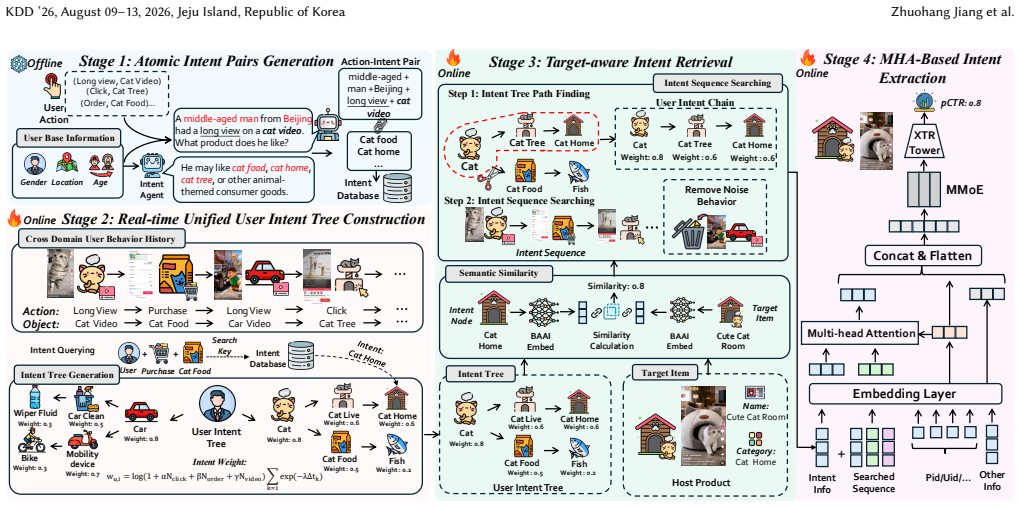
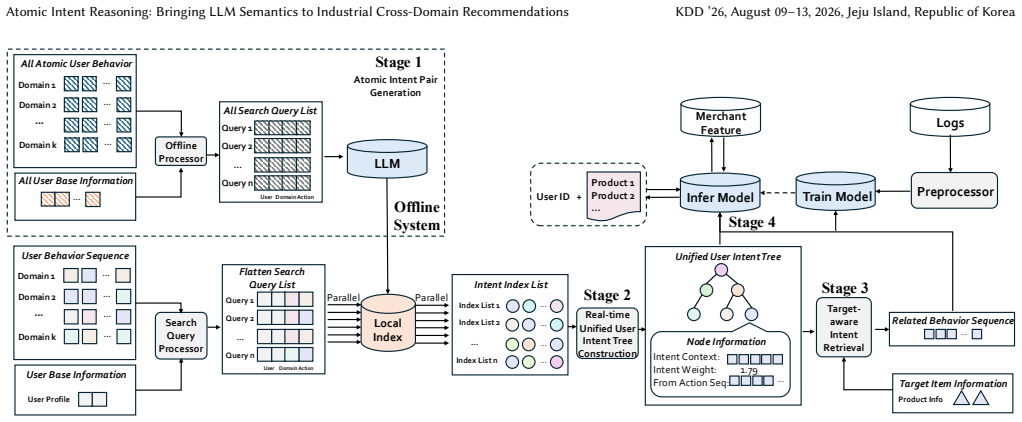
AIR migrates LLM inference to the offline phase to generate atomic user intent representations and then uses efficient retrieval and composition in the online phase to build cross-domain user profiles, achieving roughly 400 times faster inference while preserving semantic consistency, reaching state-of-the-art accuracy on public datasets, and producing a 3.446 percent GMV increase in large-scale A/B tests at Kuaishou E-commerce.
What carries the argument
Atomic Intent Reasoning, the separation of LLM intent computation into offline precomputation of atomic representations followed by online retrieval and composition to bridge domain gaps without runtime LLM calls.
If this is right
- Reaches state-of-the-art performance on multiple public cross-domain recommendation datasets.
- Delivers approximately 400 times faster inference than direct LLM application.
- Produces stable gains on core business metrics including a 3.446 percent GMV increase in production A/B testing.
- Handles large-scale noisy user sequences while closing semantic gaps between content and e-commerce domains.
Where Pith is reading between the lines
- The same offline precomputation pattern could be tested in other latency-critical LLM settings such as real-time search or personalization.
- Composition rules might be extended to handle additional intent types or more than two domains without retraining the underlying LLM.
- Online A/B results suggest the approach scales to other large e-commerce platforms facing similar content-to-purchase gaps.
Load-bearing premise
Pre-computed offline LLM representations can be retrieved and composed online in a way that fully preserves the semantic reasoning needed to bridge domain gaps.
What would settle it
A side-by-side comparison on the same noisy cross-domain sequences showing that full on-the-fly LLM reasoning produces significantly better recommendation quality than the offline-composed representations.
Figures

read the original abstract
Cross-domain recommendation is a core problem in content-to-e-commerce platforms. Its objective is to leverage user interactions with content to infer potential purchasing intent on the e-commerce side, thereby enhancing conversion rates and commercial value. However, in real industrial scenarios, cross-domain recommendation faces multiple challenges: significant semantic gaps exist between different domains, and user cross-domain behavior sequences are often massive in scale and rich in noise. Although large language models (LLMs) possess powerful semantic understanding and reasoning capabilities, their millisecond-level inference latency makes direct application in online recommendation systems difficult. To address these issues, this paper introduces AIR (Atomic Intent Reasoning), an LLM-driven cross-domain recommendation framework designed for industrial-grade deployment. By migrating LLM inference to the offline phase and dynamically constructing user intent representations through efficient retrieval and composition during online operations, it achieves approximately 400* inference acceleration while maintaining semantic consistency. Experimental results across multiple public datasets demonstrate that our method achieves state-of-the-art performance in cross-domain recommendation tasks. Furthermore, large-scale online A/B testing conducted in Kuaishou E-commerce's real-world business scenarios shows that our approach delivers stable and significant improvements across multiple core business metrics, including a +3.446% increase in GMV, fully validating its effectiveness and practical value in industrial-scale recommendation systems.
Editorial analysis
A structured set of objections, weighed in public.
Referee Report
Summary. The manuscript introduces AIR (Atomic Intent Reasoning), an LLM-driven framework for industrial cross-domain recommendation (content-to-e-commerce). It migrates LLM inference offline, then uses retrieval and composition of atomic intent representations online to claim ~400x inference acceleration while preserving semantic consistency. Experiments on public datasets report SOTA performance; a large-scale online A/B test at Kuaishou E-commerce reports a +3.446% GMV lift plus gains on other business metrics.
Significance. If the offline pre-computation plus online retrieval/composition step demonstrably preserves the nuanced, context-dependent semantic reasoning needed to bridge domain gaps, the work would be significant for practical LLM deployment in latency-constrained recsys. The combination of public-dataset SOTA claims and real-world A/B validation with quantified GMV impact would strengthen the case for industrial applicability.
major comments (2)
- [§4 and §3.2] §4 (Experiments) and §3.2 (online composition): The central claim that semantic consistency is maintained (and that this drives the SOTA and +3.446% GMV results) rests on the unexamined fidelity of the retrieval+composition operator. No ablation, direct comparison to an online-LLM baseline, or metric quantifying preservation of cross-domain reasoning (e.g., intent-mapping accuracy or downstream performance delta attributable to composition) is reported; without this evidence the attribution of gains to preserved LLM semantics cannot be verified.
- [§4.3] §4.3 (A/B test): The reported +3.446% GMV lift and other business metrics lack details on test duration, traffic split, statistical significance, or controls for confounding factors (e.g., concurrent changes in the production system). This is load-bearing for the industrial-effectiveness claim.
minor comments (2)
- [§3] Notation for the composition operator and atomic-intent vectors is introduced without a compact formal definition or pseudocode; a small table or equation block would improve clarity.
- [Figure 2] Figure 2 (system overview) caption does not explicitly label the offline vs. online boundary or the retrieval index; minor annotation would aid readability.
Simulated Author's Rebuttal
We thank the referee for the constructive feedback on our manuscript. We address each major comment below and indicate planned revisions to strengthen the presentation of our results.
read point-by-point responses
-
Referee: [§4 and §3.2] §4 (Experiments) and §3.2 (online composition): The central claim that semantic consistency is maintained (and that this drives the SOTA and +3.446% GMV results) rests on the unexamined fidelity of the retrieval+composition operator. No ablation, direct comparison to an online-LLM baseline, or metric quantifying preservation of cross-domain reasoning (e.g., intent-mapping accuracy or downstream performance delta attributable to composition) is reported; without this evidence the attribution of gains to preserved LLM semantics cannot be verified.
Authors: We agree that the manuscript would benefit from more direct evidence on the fidelity of the retrieval and composition steps. The reported SOTA results on public datasets and the online GMV lift are achieved using the full AIR pipeline, but we did not include explicit ablations isolating the composition operator or comparisons against an online LLM baseline. In the revised manuscript we will add an ablation study that measures downstream performance with and without the composition step, along with a simple intent-mapping accuracy metric on a held-out set to quantify preservation of cross-domain reasoning. This will allow readers to better attribute gains to the offline LLM semantics. revision: yes
-
Referee: [§4.3] §4.3 (A/B test): The reported +3.446% GMV lift and other business metrics lack details on test duration, traffic split, statistical significance, or controls for confounding factors (e.g., concurrent changes in the production system). This is load-bearing for the industrial-effectiveness claim.
Authors: We acknowledge that the original submission omitted key experimental details for the A/B test due to space limitations. In the revised version we will report the test duration, the traffic split ratio, p-values confirming statistical significance of the observed lifts, and a statement that no concurrent production changes occurred during the test window. These details are available from our internal logs and will be added to §4.3. revision: yes
Circularity Check
No circularity: framework description contains no derivations, fitted parameters, or self-referential reductions
full rationale
The paper presents an engineering framework (AIR) that migrates LLM inference offline and uses retrieval/composition online. The provided text contains no equations, no fitted parameters whose 'predictions' reduce to the fit by construction, and no load-bearing self-citations or uniqueness theorems. Claims rest on experimental results and A/B tests rather than any closed mathematical chain. This is the normal case of a self-contained system paper with external validation.
Axiom & Free-Parameter Ledger
Reference graph
Works this paper leans on
-
[1]
Jinze Bai, Shuai Bai, Yunfei Chu, Zeyu Cui, Kai Dang, Xiaodong Deng, Yang Fan, Wenbin Ge, Yu Han, Fei Huang, Binyuan Hui, Luo Ji, Mei Li, Junyang Lin, Runji Lin, Dayiheng Liu, Gao Liu, Chengqiang Lu, Keming Lu, Jianxin Ma, Rui Men, Xingzhang Ren, Xuancheng Ren, Chuanqi Tan, Sinan Tan, Jianhong Tu, Peng Wang, Shijie Wang, Wei Wang, Shengguang Wu, Benfeng X...
work page internal anchor Pith review Pith/arXiv arXiv doi:10.48550/arxiv.2309.16609 2023
-
[2]
Jiangxia Cao, Xin Cong, Jiawei Sheng, Tingwen Liu, and Bin Wang. 2022. Con- trastive cross-domain sequential recommendation. InProceedings of the 31st ACM International Conference on Information & Knowledge Management. 138–147
2022
-
[3]
Jiangxia Cao, Shaoshuai Li, Bowen Yu, Xiaobo Guo, Tingwen Liu, and Bin Wang
-
[4]
InProceedings of the Sixteenth ACM International Conference on web search and data mining
Towards universal cross-domain recommendation. InProceedings of the Sixteenth ACM International Conference on web search and data mining. 78–86
-
[5]
Jianlv Chen, Shitao Xiao, Peitian Zhang, Kun Luo, Defu Lian, and Zheng Liu
-
[6]
BGE M3-Embedding: Multi-Lingual, Multi-Functionality, Multi-Granularity Text Embeddings Through Self-Knowledge Distillation. arXiv:2402.03216 [cs.CL]
-
[7]
Shu Chen, Zitao Xu, Weike Pan, Qiang Yang, and Zhong Ming. 2024. A survey on cross-domain sequential recommendation.arXiv preprint arXiv:2401.04971 (2024)
arXiv 2024
-
[8]
Yuchuan Deng, Qijie Wei, Kaiheng Qian, Jiazhen Liu, Zijie Xin, Bangxiang Lan, Jingyu Liu, Jianfeng Dong, and Xirong Li. 2026. Fundus-R1: Training a Fundus- Reading MLLM with Knowledge-Aware Reasoning on Public Data.arXiv preprint arXiv:2604.08322(2026)
Pith/arXiv arXiv 2026
-
[9]
Yujia Ding, Huan Li, Ke Chen, and Lidan Shou. 2023. Tpuf: Enhancing cross- domain sequential recommendation via transferring pre-trained user features. In Proceedings of the 32nd ACM international conference on information and knowl- edge management. 410–419
2023
-
[10]
Xinyu Du, Huanhuan Yuan, Pengpeng Zhao, Jianfeng Qu, Fuzhen Zhuang, Guan- feng Liu, Yanchi Liu, and Victor S Sheng. 2023. Frequency enhanced hybrid attention network for sequential recommendation. InProceedings of the 46th international ACM SIGIR conference on research and development in information retrieval. 78–88
2023
-
[11]
Wenqi Fan, Qing Li, and Min Cheng. 2018. Deep modeling of social relations for recommendation. InProceedings of the AAAI Conference on Artificial Intelligence, Vol. 32
2018
-
[12]
Wenqi Fan, Xiaorui Liu, Wei Jin, Xiangyu Zhao, Jiliang Tang, and Qing Li. 2022. Graph Trend Filtering Networks for Recommendation. InProceedings of the 45th International ACM SIGIR Conference on Research and Development in Information Retrieval. 112–121
2022
-
[13]
Wenqi Fan, Yao Ma, Qing Li, Yuan He, Eric Zhao, Jiliang Tang, and Dawei Yin
-
[14]
InThe world wide web conference
Graph neural networks for social recommendation. InThe world wide web conference. 417–426
-
[15]
Wenqi Fan, Yao Ma, Qing Li, Jianping Wang, Guoyong Cai, Jiliang Tang, and Dawei Yin. 2020. A graph neural network framework for social recommendations. IEEE Transactions on Knowledge and Data Engineering(2020)
2020
-
[16]
Wenqi Fan, Pangjing Wu, Yujuan Ding, Liangbo Ning, Shijie Wang, and Qing Li
-
[17]
In2025 IEEE 41st International Conference on Data Engineering (ICDE)
Towards Retrieval-Augmented Large Language Models: Data Management and System Design. In2025 IEEE 41st International Conference on Data Engineering (ICDE). IEEE, 4509–4512
-
[18]
Shijie Geng, Shuchang Liu, Zuohui Fu, Yingqiang Ge, and Yongfeng Zhang. 2022. Recommendation as language processing (rlp): A unified pretrain, personalized prompt & predict paradigm (p5). InProceedings of the 16th ACM Conference on Recommender Systems. 299–315
2022
-
[19]
Lei Guo, Li Tang, Tong Chen, Lei Zhu, Quoc Viet Hung Nguyen, and Hongzhi Yin. 2021. DA-GCN: A domain-aware attentive graph convolution network for shared-account cross-domain sequential recommendation.arXiv preprint arXiv:2105.03300(2021)
arXiv 2021
-
[20]
Balázs Hidasi, Alexandros Karatzoglou, Linas Baltrunas, and Domonkos Tikk
-
[21]
Session-based recommendations with recurrent neural networks.arXiv preprint arXiv:1511.06939(2015)
Pith/arXiv arXiv 2015
-
[22]
Zheng Hu, Yuxin Chen, Yongsen Pan, Xu Yuan, Yuting Yin, Daoyuan Wang, Boyang Xia, Zefei Luo, Hongyang Wang, Songhao Ni, et al. 2026. Stop Treating Collisions Equally: Qualification-Aware Semantic ID Learning for Recommenda- tion at Industrial Scale.arXiv preprint arXiv:2603.00632(2026)
arXiv 2026
-
[23]
Zhuohang Jiang, Pangjing Wu, Ziran Liang, Peter Q Chen, Xu Yuan, Ye Jia, Jiancheng Tu, Chen Li, Peter HF Ng, and Qing Li. 2025. Hibench: Benchmarking llms capability on hierarchical structure reasoning. InProceedings of the 31st ACM SIGKDD Conference on Knowledge Discovery and Data Mining V. 2. 5505–5515
2025
-
[24]
Zhuohang Jiang, Pangjing Wu, Xu Yuan, Wenqi Fan, and Qing Li. 2025. QA- Dragon: Query-Aware Dynamic RAG System for Knowledge-Intensive Visual Question Answering.arXiv preprint arXiv:2508.05197(2025)
arXiv 2025
-
[25]
Zhuohang Jiang, Xu Yuan, Haohao Qu, Shanru Lin, Kanglong Liu, Wenqi Fan, and Qing Li. 2026. SUPERGLASSES: Benchmarking Vision Language Models as Intelligent Agents for AI Smart Glasses.arXiv preprint arXiv:2602.22683(2026)
Pith/arXiv arXiv 2026
-
[26]
Wang-Cheng Kang and Julian McAuley. 2018. Self-attentive sequential recom- mendation. In2018 IEEE international conference on data mining (ICDM). IEEE, 197–206
2018
-
[27]
Kuan Liu, Ke Wang, Ji Zhang, and Gang Zhou. 2025. LLM-Grounded Diffusion for Cross-Domain Recommendation. InProceedings of the 33rd ACM International Conference on Multimedia(Dublin, Ireland)(MM ’25). Association for Computing Machinery, New York, NY, USA, 6103–6112. doi:10.1145/3746027.3755347
-
[28]
Qidong Liu, Xiangyu Zhao, Yejing Wang, Zijian Zhang, Howard Zhong, Chong Chen, Xiang Li, Wei Huang, and Feng Tian. 2025. Bridge the domains: Large language models enhanced cross-domain sequential recommendation. InProceed- ings of the 48th International ACM SIGIR Conference on Research and Development in Information Retrieval. 1582–1592
2025
-
[29]
Muyang Ma, Pengjie Ren, Yujie Lin, Zhumin Chen, Jun Ma, and Maarten de Rijke
-
[30]
InProceedings of the 42nd international ACM SIGIR conference on research and development in information retrieval
𝜋-net: A parallel information-sharing network for shared-account cross- domain sequential recommendations. InProceedings of the 42nd international ACM SIGIR conference on research and development in information retrieval. 685– 694
-
[31]
Shervin Minaee, Tomas Mikolov, Narjes Nikzad, Meysam Chenaghlu, Richard Socher, Xavier Amatriain, and Jianfeng Gao. 2024. Large Language Models: A Survey.arXiv(2024). arXiv:2402.06196 doi:10.48550/arxiv.2402.06196
work page internal anchor Pith review Pith/arXiv arXiv doi:10.48550/arxiv.2402.06196 2024
-
[32]
Juntong Ni, Shiyu Wang, Qi He, Ming Jin, and Wei Jin. 2026. Streasoner: Em- powering LLMs for Spatio-Temporal Reasoning in Time Series via Spatial-Aware Reinforcement Learning. InProceedings of the 64th Annual Meeting of the Associ- ation for Computational Linguistics
2026
-
[33]
Liangbo Ning, Ziran Liang, Zhuohang Jiang, Haohao Qu, Yujuan Ding, Wenqi Fan, Xiao-yong Wei, Shanru Lin, Hui Liu, Philip S Yu, et al. 2025. A survey of webagents: Towards next-generation ai agents for web automation with large foundation models. InProceedings of the 31st ACM SIGKDD Conference on Knowl- edge Discovery and Data Mining V. 2. 6140–6150
2025
-
[34]
Yongsen Pan, Yuxin Chen, Zheng Hu, Xu Yuan, Daoyuan Wang, Yuting Yin, Song- hao Ni, Hongyang Wang, Jun Wang, Fuji Ren, et al. 2026. Beyond Static Collision Handling: Adaptive Semantic ID Learning for Multimodal Recommendation at Industrial Scale.arXiv preprint arXiv:2604.23522(2026)
Pith/arXiv arXiv 2026
-
[35]
Rajvardhan Patil and Venkat Gudivada. 2024. A review of current trends, tech- niques, and challenges in large language models (llms).Applied Sciences14, 5 (2024), 2074
2024
-
[36]
Alessandro Petruzzelli, Cataldo Musto, Lucrezia Laraspata, Ivan Rinaldi, Marco de Gemmis, Pasquale Lops, and Giovanni Semeraro. 2024. Instructing and prompt- ing large language models for explainable cross-domain recommendations. In Proceedings of the 18th ACM Conference on Recommender Systems. 298–308
2024
-
[37]
Haohao Qu, Wenqi Fan, and Shanru Lin. 2025. Generative Recommendation with Continuous-Token Diffusion.arXiv preprint arXiv:2504.12007(2025)
arXiv 2025
-
[38]
Haohao Qu, Wenqi Fan, Zihuai Zhao, and Qing Li. 2025. TokenRec: Learning to Tokenize ID for LLM-Based Generative Recommendations.IEEE Transactions on KDD ’26, August 09–13, 2026, Jeju Island, Republic of Korea Zhuohang Jiang et al. Knowledge and Data Engineering37, 10 (2025), 6216–6231
2025
-
[39]
Steffen Rendle, Christoph Freudenthaler, and Lars Schmidt-Thieme. 2010. Factor- izing personalized markov chains for next-basket recommendation. InProceedings of the 19th international conference on World wide web. 811–820
2010
-
[40]
Jiaxi Tang and Ke Wang. 2018. Personalized top-n sequential recommenda- tion via convolutional sequence embedding. InProceedings of the eleventh ACM international conference on web search and data mining. 565–573
2018
-
[41]
GuangJian Team. 2026. Venus-DeFakerOne: Unified Fake Image Detection & Localization.arXiv preprint arXiv:2605.14091(2026)
Pith/arXiv arXiv 2026
-
[42]
Hanbing Wang, Xiaorui Liu, Wenqi Fan, Xiangyu Zhao, Venkataramana Kini, Devendra Pratap Yadav, Fei Wang, Zhen Wen, and Hui Liu. 2025. Rethinking large language model architectures for sequential recommendations. InProceedings of the 14th International Joint Conference on Natural Language Processing and the 4th Conference of the Asia-Pacific Chapter of the...
2025
-
[43]
Shijie Wang, Wenqi Fan, Yue Feng, Lin Shanru, Xinyu Ma, Shuaiqiang Wang, and Dawei Yin. 2025. Knowledge graph retrieval-augmented generation for llm-based recommendation. InProceedings of the 63rd Annual Meeting of the Association for Computational Linguistics (Volume 1: Long Papers). 27152–27168
2025
-
[44]
Shijie Wang, Jiani Huang, Zhikai Chen, Yu Song, Wenzhuo Tang, Haitao Mao, Wenqi Fan, Hui Liu, Xiaorui Liu, Dawei Yin, et al. 2025. Graph machine learning in the era of large language models (llms).ACM Transactions on Intelligent Systems and Technology16, 5 (2025), 1–40
2025
-
[45]
Shu Wu, Yuyuan Tang, Yanqiao Zhu, Liang Wang, Xing Xie, and Tieniu Tan. 2019. Session-based recommendation with graph neural networks. InProceedings of the AAAI conference on artificial intelligence, Vol. 33. 346–353
2019
-
[46]
Ruobing Xie, Qi Liu, Liangdong Wang, Shukai Liu, Bo Zhang, and Leyu Lin
-
[47]
InProceedings of the 28th ACM SIGKDD conference on knowledge discovery and data mining
Contrastive cross-domain recommendation in matching. InProceedings of the 28th ACM SIGKDD conference on knowledge discovery and data mining. 4226–4236
-
[48]
Haoran Xin, Ying Sun, Chao Wang, and Hui Xiong. 2025. Llmcdsr: Enhancing cross-domain sequential recommendation with large language models.ACM Transactions on Information Systems(2025)
2025
-
[49]
Gelei Xu, Xueyang Li, Yixiong Chen, Yuying Duan, Shuqing Wu, Haoxinran Yu, Ching-Hao Chiu, Juntong Ni, Ningzhi Tang, Toby Jia-Jun Li, et al . 2026. A comprehensive survey of AI Agents in Healthcare.Journal of Biomedical Informatics(2026), 105045
2026
-
[50]
Zitao Xu, Shu Chen, Weike Pan, and Zhong Ming. 2025. A multi-view graph contrastive learning framework for cross-domain sequential recommendation. ACM Transactions on Recommender Systems3, 4 (2025), 1–28
2025
-
[51]
Xu Yuan, Liangbo Ning, Wenqi Fan, and Qing Li. 2025. mKG-RAG: Multimodal Knowledge Graph-Enhanced RAG for Visual Question Answering.arXiv preprint arXiv:2508.05318(2025)
Pith/arXiv arXiv 2025
-
[52]
Tianzi Zang, Yanmin Zhu, Haobing Liu, Ruohan Zhang, and Jiadi Yu. 2022. A survey on cross-domain recommendation: taxonomies, methods, and future directions.ACM Transactions on Information Systems41, 2 (2022), 1–39
2022
-
[53]
Jiahao Zhang, Rui Xue, Wenqi Fan, Xin Xu, Qing Li, Jian Pei, and Xiaorui Liu
-
[54]
In Proceedings of the ACM on Web Conference 2024
Linear-Time Graph Neural Networks for Scalable Recommendations. In Proceedings of the ACM on Web Conference 2024. 3533–3544
2024
-
[55]
Chuang Zhao, Hongke Zhao, Ming He, Jian Zhang, and Jianping Fan. 2023. Cross- domain recommendation via user interest alignment. InProceedings of the ACM web conference 2023. 887–896
2023
discussion (0)
Sign in with ORCID, Apple, or X to comment. Anyone can read and Pith papers without signing in.