Rogue Ones: Orbital census of Galactic Cepheids and their Anomalies
Pith reviewed 2026-06-27 12:57 UTC · model grok-4.3
The pith
A 6D kinematic census of Milky Way Cepheids reveals 18 stars on highly inclined and retrograde orbits whose light curves still match classical Cepheids.
A machine-rendered reading of the paper's core claim, the machinery that carries it, and where it could break.
Core claim
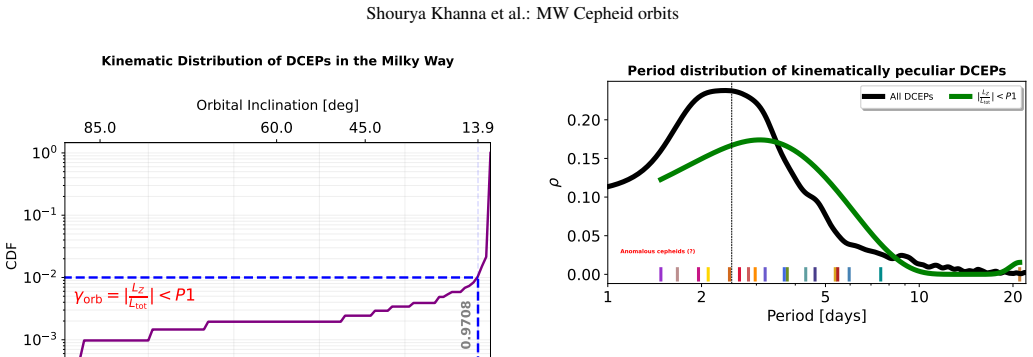
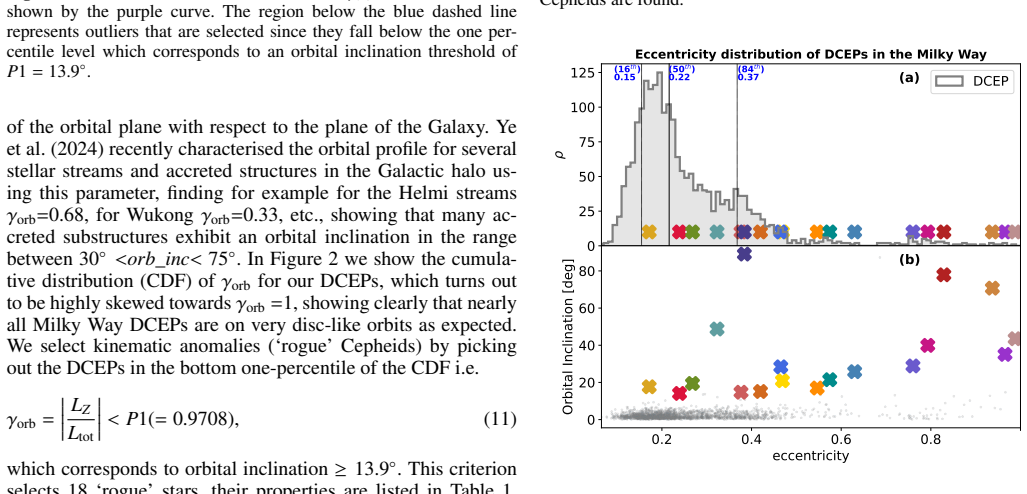
Using precise mid-infrared distances together with Gaia-DR3 astrometry and velocities, the authors map the 6D distribution of Galactic classical Cepheids and isolate 18 kinematically anomalous objects on highly inclined orbits, including two retrograde cases and one with total velocity of approximately 480 km/s. Optical light curves remain consistent with classical Cepheid classifications, and distances recomputed under a Type II Cepheid hypothesis do not bring the kinematics into line with the expected older population. Dynamical comparison with globular clusters indicates that at least one anomaly (OGLE-GD-CEP-0507) could have been scattered by an encounter with cluster E3; under a runaway
What carries the argument
The 6D phase-space census that merges mid-infrared period-luminosity distances with Gaia proper motions and radial velocities to isolate kinematic outliers among classical Cepheids.
If this is right
- The rogue Cepheids trace dynamical heating or ejection channels that operate inside the young disc population.
- At least one object is consistent with having been scattered by a globular cluster, implying that such encounters can inject young stars onto halo-like orbits.
- Dynamical ages derived from the runaway hypothesis agree with independent Cepheid ages, supporting the physical origin of the anomalies.
- The same photometric-plus-kinematic filter can be applied to other variable-star classes to refine membership in Galactic components.
Where Pith is reading between the lines
- If the light-curve classifications hold, the metallicity range tolerated by classical Cepheids must extend lower than usually assumed.
- Future Gaia data releases with improved radial velocities could increase the number of detected rogue Cepheids and allow statistical study of their origin channels.
- These stars may serve as test particles for models of disc-halo interaction and the survival of young populations on high-energy orbits.
Load-bearing premise
That the optical light-curve shapes continue to confirm classical Cepheid status even for stars whose trajectories are extreme enough to suggest they might be older Type II objects.
What would settle it
A spectroscopic metallicity measurement for the most metal-poor candidate that places it firmly outside the range observed for classical Cepheids or, conversely, a new distance that brings all 18 objects inside the angular-momentum distribution of known Type II Cepheids.
Figures



read the original abstract
Classical Cepheids (DCEPs) are excellent standard candles expected to trace the spatial and kinematic distribution of the Galaxy's young and dynamically cold stellar disc. Using the most precise mid-infrared DCEP distances to date combined with Gaia-DR3 astrometry & line-of-sight velocities, we perform a comprehensive 6D dynamical census of the Milky Way's DCEP population. While the vast majority exhibit the expected disc-like kinematics, we identify 18 kinematically anomalous Cepheids. These `rogue' stars reside on highly inclined orbits, including two in retrograde motion and one with a total velocity of ~480 km/s. Despite their extreme trajectories, their optical light curves are consistent with DCEP classifications. We explore whether these anomalies originate from classification systematics or physical processes. Re-deriving distances under the assumption that these are misclassified older Type II Cepheids (T2C) fails to reconcile their extreme kinematics, placing them at the tail of the T2C angular momentum distribution. Dynamical comparison with Galactic Globular Clusters (GC) suggests that at least one anomaly (OGLE-GD-CEP-0507) was possibly scattered into its current orbit via an interaction with the GC E3. Assuming a runaway scenario we derive dynamical ages for the kinematic anomalies, which we find highly consistent with their Cepheid ages. Spectroscopic follow-up would be insightful as one source in particular is exceptionally metal poor ([Fe/H] ~-1.6 dex), which is highly atypical for a DCEP. Integrating photometric classification with 6D kinematics will help fully characterise the Galaxy's variable star populations.
Editorial analysis
A structured set of objections, weighed in public.
Referee Report
Summary. The manuscript conducts a 6D kinematic census of Galactic classical Cepheids (DCEPs) combining precise mid-infrared distances with Gaia DR3 astrometry and line-of-sight velocities. While most DCEPs show expected thin-disc kinematics, the authors identify 18 kinematically anomalous 'rogue' objects on highly inclined orbits (including two retrograde and one reaching ~480 km/s total velocity). Optical light curves remain consistent with DCEP classification; re-deriving distances under a Type II Cepheid (T2C) hypothesis leaves the stars as kinematic outliers relative to the T2C population. One object (OGLE-GD-CEP-0507) is suggested to have been scattered by interaction with globular cluster E3, and dynamical ages derived under a runaway scenario are reported to be consistent with the stars' Cepheid ages. Spectroscopic follow-up is recommended, particularly for an exceptionally metal-poor source.
Significance. If the identifications and classifications hold, the result demonstrates that a non-negligible fraction of young, standard-candle tracers can occupy extreme orbits, implying dynamical scattering or other processes can displace disc stars. The explicit test ruling out T2C misclassification and the reported consistency between dynamical and stellar ages constitute concrete strengths. The work illustrates the value of combining photometric classification with full 6D kinematics for characterizing variable-star populations and may motivate targeted searches for similar anomalies in other tracers.
minor comments (3)
- [Abstract] Abstract: quantitative details such as the total number of DCEPs examined, the precise kinematic thresholds used to flag the 18 anomalies, and any reported uncertainties on velocities or ages are absent; adding these would strengthen the summary without altering the central claims.
- The manuscript would benefit from an explicit table or section listing the 18 rogue Cepheids with their key observables (positions, velocities, distances, light-curve parameters) to allow direct reproducibility of the anomaly selection.
- The dynamical-age calculation under the runaway scenario is described only qualitatively; a brief methods paragraph or appendix outlining the orbit-integration assumptions and age-estimation procedure would improve clarity.
Simulated Author's Rebuttal
We thank the referee for their positive and constructive report, which highlights the strengths of the 6D kinematic analysis and the consistency checks performed. The recommendation for minor revision is noted; we address the single explicit suggestion below and confirm that no major concerns were raised that require substantive changes to the core results.
read point-by-point responses
-
Referee: Spectroscopic follow-up is recommended, particularly for an exceptionally metal-poor source.
Authors: We fully agree that spectroscopic follow-up would provide valuable confirmation, especially for the source with [Fe/H] ~ -1.6 dex. In the revised manuscript we have expanded the discussion section to explicitly recommend targeted spectroscopy for this object and the broader rogue sample, including suggested instruments and the scientific motivation. revision: yes
Circularity Check
No significant circularity
full rationale
The paper performs a 6D kinematic census using external Gaia-DR3 astrometry, line-of-sight velocities, and independent mid-infrared distance catalogs. Anomalies are identified by direct comparison to expected disc kinematics; alternative classifications (T2C hypothesis) are tested by re-deriving distances and comparing to the T2C angular-momentum distribution, which is an external benchmark. Dynamical-age estimates under a runaway scenario are compared to standard Cepheid period-age relations without any parameter fitted to the anomalies themselves. No equations, self-citations, or ansatzes reduce the reported results to the input data by construction; the derivation chain remains independent of the target anomalies.
Axiom & Free-Parameter Ledger
axioms (1)
- domain assumption Classical Cepheids trace the spatial and kinematic distribution of the Galaxy's young and dynamically cold stellar disc
Reference graph
Works this paper leans on
-
[1]
Galactic runaway O and Be stars found using Gaia DR3. , keywords =. doi:10.1051/0004-6361/202346613 , archivePrefix =. 2311.01827 , primaryClass =
-
[2]
Gvaramadze, Vasilii V. and Gualandris, Alessia and Zwart, Simon Portegies , title =. Monthly Notices of the Royal Astronomical Society , volume =. 2009 , month =. doi:10.1111/j.1365-2966.2009.14809.x , url =
-
[3]
Monthly Notices of the Royal Astronomical Society , volume =
Evans, F A and Renzo, M and Rossi, E M , title =. Monthly Notices of the Royal Astronomical Society , volume =. 2020 , month =. doi:10.1093/mnras/staa2334 , url =
-
[4]
Improving the open cluster census. III. Using cluster masses, radii, and dynamics to create a cleaned open cluster catalogue. , keywords =. doi:10.1051/0004-6361/202348662 , archivePrefix =. 2403.05143 , primaryClass =
-
[5]
doi:10.5281/zenodo.3509134 , url =
The pandas development team , title =. doi:10.5281/zenodo.3509134 , url =
-
[6]
arXiv e-prints , keywords =
IRS 9: The Case for a Dynamically-Ejected Star from the Galactic Center. arXiv e-prints , keywords =
-
[7]
The Milky Way as Seen by Classical Cepheids. I. Distances Based on Mid-infrared Photometry. , keywords =. doi:10.3847/1538-4365/adc3f3 , archivePrefix =. 2406.09113 , primaryClass =
-
[8]
A classifier for spurious astrometric solutions in Gaia eDR3. , keywords =. doi:10.1093/mnras/stab3588 , archivePrefix =. 2101.11641 , primaryClass =
-
[9]
New evidence of binarity in young -rich turn-off and subgiant stars: fast rotation and strong magnetic activity. , keywords =. doi:10.1093/mnras/stae1091 , archivePrefix =. 2404.13562 , primaryClass =
-
[10]
K2 results for ``young'' -rich stars in the Galaxy. , keywords =. doi:10.1051/0004-6361/202347440 , archivePrefix =. 2312.07091 , primaryClass =
-
[11]
Vaex: Big Data exploration in the era of Gaia
Vaex: big data exploration in the era of Gaia. , keywords =. doi:10.1051/0004-6361/201732493 , archivePrefix =. 1801.02638 , primaryClass =
work page internal anchor Pith review Pith/arXiv arXiv doi:10.1051/0004-6361/201732493
-
[12]
Charles R. Harris and K. Jarrod Millman and St. Array programming with. 2020 , month = sep, journal =. doi:10.1038/s41586-020-2649-2 , publisher =
-
[13]
The Astropy Project: Building an inclusive, open-science project and status of the v2.0 core package
The Astropy Project: Building an Open-science Project and Status of the v2.0 Core Package. , keywords =. doi:10.3847/1538-3881/aabc4f , archivePrefix =. 1801.02634 , primaryClass =
work page internal anchor Pith review Pith/arXiv arXiv doi:10.3847/1538-3881/aabc4f
-
[14]
Hunter, J. D. , Title =. Computing in Science & Engineering , Volume =
-
[15]
Exploring the Galactic Warp through Asymmetries in the Kinematics of the Galactic Disk. , keywords =. doi:10.3847/1538-4357/abc3c2 , archivePrefix =. 2010.10398 , primaryClass =
-
[16]
Classical Cepheids in the Milky Way. , keywords =. doi:10.32023/0001-5237/71.3.2 , archivePrefix =. 2112.03284 , primaryClass =
-
[17]
Mapping the Northern Galactic Disk Warp with Classical Cepheids. , keywords =. doi:10.32023/0001-5237/69.4.1 , archivePrefix =. 1912.11142 , primaryClass =
-
[18]
An intuitive 3D map of the Galactic warp's precession traced by classical Cepheids
An intuitive 3D map of the Galactic warp's precession traced by classical Cepheids. Nature Astronomy , keywords =. doi:10.1038/s41550-018-0686-7 , archivePrefix =. 1902.00998 , primaryClass =
work page internal anchor Pith review Pith/arXiv arXiv doi:10.1038/s41550-018-0686-7 1902
-
[19]
Mapping luminous hot stars in the Galaxy. , keywords =. doi:10.1051/0004-6361/202039726 , archivePrefix =. 2102.08684 , primaryClass =
-
[20]
The Apache Point Observatory Galactic Evolution Experiment (APOGEE)
The Apache Point Observatory Galactic Evolution Experiment (APOGEE). , keywords =. doi:10.3847/1538-3881/aa784d , archivePrefix =. 1509.05420 , primaryClass =
work page internal anchor Pith review Pith/arXiv arXiv doi:10.3847/1538-3881/aa784d
-
[21]
The Messenger , year = 2013, month = dec, volume = 154, pages =
The Gaia-ESO Large Public Spectroscopic Survey. The Messenger , year = 2013, month = dec, volume = 154, pages =
2013
-
[22]
Structure, kinematics, and time evolution of the Galactic warp from Classical Cepheids. , keywords =. doi:10.1093/mnras/stae308 , archivePrefix =. 2401.13736 , primaryClass =
-
[23]
The Galaxy in Context: Structural, Kinematic and Integrated Properties
The Galaxy in Context: Structural, Kinematic, and Integrated Properties. , keywords =. doi:10.1146/annurev-astro-081915-023441 , archivePrefix =. 1602.07702 , primaryClass =
work page internal anchor Pith review Pith/arXiv arXiv doi:10.1146/annurev-astro-081915-023441
-
[24]
The Size and Shape of the Milky Way Disk and Halo from M-type Brown Dwarfs in the BoRG Survey
The size and shape of the Milky Way disc and halo from M-type brown dwarfs in the BoRG survey. , keywords =. doi:10.1093/mnras/stw258 , archivePrefix =. 1603.05287 , primaryClass =
work page internal anchor Pith review Pith/arXiv arXiv doi:10.1093/mnras/stw258
-
[25]
Keeping It Cool: Much Orbit Migration, yet Little Heating, in the Galactic Disk. , keywords =. doi:10.3847/1538-4357/ab910c , archivePrefix =. 2002.04622 , primaryClass =
-
[26]
The Milky Way's stellar disk. Mapping and modeling the Galactic disk. , keywords =. doi:10.1007/s00159-013-0061-8 , archivePrefix =. 1301.3168 , primaryClass =
work page internal anchor Pith review Pith/arXiv arXiv doi:10.1007/s00159-013-0061-8
-
[27]
The Sixth Data Release of the Radial Velocity Experiment (RAVE). I. Survey Description, Spectra, and Radial Velocities. , keywords =. doi:10.3847/1538-3881/ab9ab9 , archivePrefix =. 2002.04377 , primaryClass =
-
[28]
LAMOST Experiment for Galactic Understanding and Exploration (LEGUE) The survey science plan
LAMOST Experiment for Galactic Understanding and Exploration (LEGUE) The survey's science plan. Research in Astronomy and Astrophysics , keywords =. doi:10.1088/1674-4527/12/7/003 , archivePrefix =. 1206.3578 , primaryClass =
work page internal anchor Pith review Pith/arXiv arXiv doi:10.1088/1674-4527/12/7/003
-
[29]
The GALAH Survey: Scientific Motivation
The GALAH survey: scientific motivation. , keywords =. doi:10.1093/mnras/stv327 , archivePrefix =. 1502.04767 , primaryClass =
work page internal anchor Pith review Pith/arXiv arXiv doi:10.1093/mnras/stv327
-
[30]
Astronomical Data Analysis Software and Systems XIV , year = 2005, editor =
TOPCAT & STIL: Starlink Table/VOTable Processing Software. Astronomical Data Analysis Software and Systems XIV , year = 2005, editor =
2005
-
[31]
P\'erez, Fernando and Granger, Brian E. , Title =. Computing in Science and Engineering , Volume =. doi:10.1109/MCSE.2007.53 , publisher =
-
[32]
The Wide-field Infrared Survey Explorer (WISE): Mission Description and Initial On-orbit Performance
The Wide-field Infrared Survey Explorer (WISE): Mission Description and Initial On-orbit Performance. , keywords =. doi:10.1088/0004-6256/140/6/1868 , archivePrefix =. 1008.0031 , primaryClass =
work page internal anchor Pith review Pith/arXiv arXiv doi:10.1088/0004-6256/140/6/1868
-
[33]
Gaia Data Release 2. Cross-match with external catalogues - Algorithms and results
Gaia Data Release 2. Cross-match with external catalogues: algorithms and results. , keywords =. doi:10.1051/0004-6361/201834142 , archivePrefix =. 1808.09151 , primaryClass =
work page internal anchor Pith review Pith/arXiv arXiv doi:10.1051/0004-6361/201834142
-
[34]
Gaia DR3 documentation Chapter 15: Cross-match with external catalogues
-
[35]
Gaia Data Release 3: Summary of the content and survey properties. arXiv e-prints , keywords =. doi:10.48550/arXiv.2208.00211 , archivePrefix =. 2208.00211 , primaryClass =
-
[36]
Summary of the contents and survey properties
Gaia Early Data Release 3. Summary of the contents and survey properties. , keywords =. doi:10.1051/0004-6361/202039657 , archivePrefix =. 2012.01533 , primaryClass =
-
[37]
Photometric content and validation
Gaia Early Data Release 3. Photometric content and validation. , keywords =. doi:10.1051/0004-6361/202039587 , archivePrefix =. 2012.01916 , primaryClass =
-
[38]
A new resonance-like feature in the outer disc of the Milky Way , DOI= "10.1051/0004-6361/202244605", url= "https://doi.org/10.1051/0004-6361/202244605", journal =
-
[39]
Galaxia: a code to generate a synthetic survey of the Milky Way
Galaxia: A Code to Generate a Synthetic Survey of the Milky Way. , keywords =. doi:10.1088/0004-637X/730/1/3 , archivePrefix =. 1101.3561 , primaryClass =
work page internal anchor Pith review Pith/arXiv arXiv doi:10.1088/0004-637x/730/1/3
-
[40]
A synthetic view on structure and evolution of the Milky Way. , keywords =. doi:10.1051/0004-6361:20031117 , adsurl =
-
[41]
arXiv e-prints , keywords =
The Physical Thickness of Stellar Disks to z -0.5ex 2. arXiv e-prints , keywords =
-
[42]
AGAMA: Action-based galaxy modelling architecture
AGAMA: action-based galaxy modelling architecture. , keywords =. doi:10.1093/mnras/sty2672 , archivePrefix =. 1802.08239 , primaryClass =
work page internal anchor Pith review Pith/arXiv arXiv doi:10.1093/mnras/sty2672
-
[43]
Mapping the asymmetric disc of the Milky Way
Gaia Data Release 3. Mapping the asymmetric disc of the Milky Way. , keywords =. doi:10.1051/0004-6361/202243797 , archivePrefix =. 2206.06207 , primaryClass =
-
[44]
The Astrophysical Journal , author =
Maps of Dust Infrared Emission for Use in Estimation of Reddening and Cosmic Microwave Background Radiation Foregrounds. , keywords =. doi:10.1086/305772 , archivePrefix =. astro-ph/9710327 , primaryClass =
work page internal anchor Pith review Pith/arXiv arXiv doi:10.1086/305772
-
[45]
Measuring Reddening with SDSS Stellar Spectra and Recalibrating SFD
Measuring Reddening with Sloan Digital Sky Survey Stellar Spectra and Recalibrating SFD. , keywords =. doi:10.1088/0004-637X/737/2/103 , archivePrefix =. 1012.4804 , primaryClass =
work page internal anchor Pith review Pith/arXiv arXiv doi:10.1088/0004-637x/737/2/103
-
[46]
The Relationship between Infrared, Optical, and Ultraviolet Extinction. , keywords =. doi:10.1086/167900 , adsurl =
-
[47]
Three Dimensional Structure of the Milky Way Disk
Three-dimensional Structure of the Milky Way Disk: The Distribution of Stars and Dust beyond 0.35 R _ solar. , keywords =. doi:10.1086/321556 , archivePrefix =. astro-ph/0101259 , primaryClass =
work page internal anchor Pith review Pith/arXiv arXiv doi:10.1086/321556
-
[48]
Estimating Distances from Parallaxes. V. Geometric and Photogeometric Distances to 1.47 Billion Stars in Gaia Early Data Release 3. , keywords =. doi:10.3847/1538-3881/abd806 , archivePrefix =. 2012.05220 , primaryClass =
work page internal anchor Pith review Pith/arXiv arXiv doi:10.3847/1538-3881/abd806 2012
-
[49]
Gaia Data Release 2: using Gaia parallaxes
Gaia Data Release 2. Using Gaia parallaxes. , keywords =. doi:10.1051/0004-6361/201832964 , archivePrefix =. 1804.09376 , primaryClass =
work page internal anchor Pith review Pith/arXiv arXiv doi:10.1051/0004-6361/201832964
-
[50]
Gaia-2MASS 3D maps of Galactic interstellar dust within 3 kpc
Gaia-2MASS 3D maps of Galactic interstellar dust within 3 kpc. , keywords =. doi:10.1051/0004-6361/201834695 , archivePrefix =. 1902.04116 , primaryClass =
work page internal anchor Pith review Pith/arXiv arXiv doi:10.1051/0004-6361/201834695 1902
-
[51]
A 3D Dust Map Based on Gaia, Pan-STARRS 1 and 2MASS
A 3D Dust Map Based on Gaia, Pan-STARRS 1, and 2MASS. , keywords =. doi:10.3847/1538-4357/ab5362 , archivePrefix =. 1905.02734 , primaryClass =
work page internal anchor Pith review Pith/arXiv arXiv doi:10.3847/1538-4357/ab5362 1905
-
[52]
Improved GRAVITY astrometric accuracy from modeling optical aberrations. , keywords =. doi:10.1051/0004-6361/202040208 , archivePrefix =. 2101.12098 , primaryClass =
-
[53]
The reduced proper motion selected halo: Methods and description of the catalogue. , keywords =. doi:10.1051/0004-6361/202038178 , archivePrefix =. 2004.07328 , primaryClass =
-
[54]
A Gaia Early DR3 Mock Stellar Catalog: Galactic Prior and Selection Function. , keywords =. doi:10.1088/1538-3873/ab8cb0 , archivePrefix =. 2004.09991 , primaryClass =
-
[55]
Estimating distances from parallaxes
Estimating Distances from Parallaxes. , keywords =. doi:10.1086/683116 , archivePrefix =. 1507.02105 , primaryClass =
work page internal anchor Pith review Pith/arXiv arXiv doi:10.1086/683116
-
[56]
Red clump stars and Gaia: calibration of the standard candle using a hierarchical probabilistic model. , keywords =. doi:10.1093/mnras/stx1655 , archivePrefix =. 1705.08988 , primaryClass =
work page internal anchor Pith review Pith/arXiv arXiv doi:10.1093/mnras/stx1655
-
[57]
On the use of Gaia magnitudes and new tables of bolometric corrections
On the use of Gaia magnitudes and new tables of bolometric corrections. , keywords =. doi:10.1093/mnrasl/sly104 , archivePrefix =. 1806.01953 , primaryClass =
work page internal anchor Pith review Pith/arXiv arXiv doi:10.1093/mnrasl/sly104
-
[58]
A distance to the Large Magellanic Cloud that is precise to one per cent
A distance to the Large Magellanic Cloud that is precise to one per cent. , keywords =. doi:10.1038/s41586-019-0999-4 , archivePrefix =. 1903.08096 , primaryClass =
work page internal anchor Pith review Pith/arXiv arXiv doi:10.1038/s41586-019-0999-4 1903
-
[59]
Structure and properties of the Magellanic Clouds
Gaia Early Data Release 3. Structure and properties of the Magellanic Clouds. , keywords =. doi:10.1051/0004-6361/202039588 , archivePrefix =. 2012.01771 , primaryClass =
-
[60]
, year = 2016, month = sep, volume =
Red Clump Stars. , year = 2016, month = sep, volume =. doi:10.1146/annurev-astro-081915-023354 , adsurl =
-
[61]
The GALAH+ survey: Third data release. , keywords =. doi:10.1093/mnras/stab1242 , archivePrefix =. 2011.02505 , primaryClass =
-
[62]
The GALAH survey and Gaia DR2: dissecting the stellar disc's phase space by age, action, chemistry, and location. , keywords =. doi:10.1093/mnras/stz217 , archivePrefix =. 1809.02658 , primaryClass =
work page internal anchor Pith review Pith/arXiv arXiv doi:10.1093/mnras/stz217
-
[63]
The Seventeenth Data Release of the Sloan Digital Sky Surveys: Complete Release of MaNGA, MaStar, and APOGEE-2 Data. , keywords =. doi:10.3847/1538-4365/ac4414 , archivePrefix =. 2112.02026 , primaryClass =
-
[64]
Monthly Notices of the Royal Astronomical Society , volume =
Khanna, Shourya and Sharma, Sanjib and Bland-Hawthorn, Joss and Hayden, Michael and Nataf, David M and Ting, Yuan-Sen and Kos, Janez and Martell, Sarah and Zwitter, Tomaž and De Silva, Gayandhi and Asplund, Martin and Buder, Sven and Duong, Ly and Lin, Jane and Simpson, Jeffrey D and Anguiano, Borja and Horner, Jonathan and Kafle, Prajwal R and Lewis, Ger...
-
[65]
Asteroseismology of 16000 Kepler Red Giants: Global Oscillation Parameters, Masses, and Radii
Asteroseismology of 16,000 Kepler Red Giants: Global Oscillation Parameters, Masses, and Radii. , keywords =. doi:10.3847/1538-4365/aaaf74 , archivePrefix =. 1802.04455 , primaryClass =
work page internal anchor Pith review Pith/arXiv arXiv doi:10.3847/1538-4365/aaaf74
-
[66]
Gravity modes as a way to distinguish between hydrogen- and helium-burning red giant stars
Gravity modes as a way to distinguish between hydrogen- and helium-burning red giant stars. , keywords =. doi:10.1038/nature09935 , archivePrefix =. 1103.5805 , primaryClass =
work page internal anchor Pith review Pith/arXiv arXiv doi:10.1038/nature09935
-
[67]
A Large and Pristine Sample of Standard Candles across the Milky Way: 100,000 Red Clump Stars with 3\. , keywords =. doi:10.3847/2041-8213/aabf8e , archivePrefix =. 1803.06650 , primaryClass =
work page internal anchor Pith review Pith/arXiv arXiv doi:10.3847/2041-8213/aabf8e 2041
-
[68]
Giant star seismology. , keywords =. doi:10.1007/s00159-017-0101-x , archivePrefix =. 1609.07487 , primaryClass =
work page internal anchor Pith review Pith/arXiv arXiv doi:10.1007/s00159-017-0101-x
-
[69]
Hypervelocity star candidates from Gaia DR2 and DR3 proper motions and parallaxes. , keywords =. doi:10.1051/0004-6361/202348430 , archivePrefix =. 2402.10714 , primaryClass =
-
[70]
Searching for new hypervelocity stars with Gaia DR3 and VLT/FORS2 spectroscopy. , keywords =. doi:10.1051/0004-6361/202554784 , archivePrefix =. 2507.00150 , primaryClass =
-
[71]
Kepler Planet-Detection Mission: Introduction and First Results. Science , keywords =. doi:10.1126/science.1185402 , adsurl =
-
[72]
Kepler Mission Design, Realized Photometric Performance, and Early Science
Kepler Mission Design, Realized Photometric Performance, and Early Science. , keywords =. doi:10.1088/2041-8205/713/2/L79 , archivePrefix =. 1001.0268 , primaryClass =
work page internal anchor Pith review Pith/arXiv arXiv doi:10.1088/2041-8205/713/2/l79 2041
-
[73]
Insights from the APOKASC determination of the evolutionary state of red-giant stars by consolidation of different methods. , keywords =. doi:10.1093/mnras/stz2356 , archivePrefix =. 1909.06266 , primaryClass =
-
[74]
From the inner to outer Milky Way: a photometric sample of 2.6 million red clump stars. , keywords =. doi:10.1093/mnras/staa1226 , archivePrefix =. 2002.02961 , primaryClass =
-
[75]
Robust Data-driven Metallicities for 175 Million Stars from Gaia XP Spectra. , keywords =. doi:10.3847/1538-4365/acd53e , archivePrefix =. 2302.02611 , primaryClass =
-
[76]
An empirical model of the Gaia DR3 selection function. , keywords =. doi:10.1051/0004-6361/202244784 , archivePrefix =. 2208.09335 , primaryClass =
-
[77]
Estimating the selection function of Gaia DR3 subsamples. , keywords =. doi:10.1051/0004-6361/202346547 , archivePrefix =. 2303.17738 , primaryClass =
-
[78]
Uniting Gaia and APOGEE to unveil the cosmic chemistry of the Milky Way disc. arXiv e-prints , keywords =. doi:10.48550/arXiv.2401.05023 , archivePrefix =. 2401.05023 , primaryClass =
-
[79]
Multivariate Density Estimation
-
[80]
The Proper Motion of Sagittarius A*. III. The Case for a Supermassive Black Hole. , keywords =. doi:10.3847/1538-4357/ab76cd , archivePrefix =. 2001.04386 , primaryClass =
discussion (0)
Sign in with ORCID, Apple, or X to comment. Anyone can read and Pith papers without signing in.