Full one-fluid dusty gas with multiple grain species in SPH
Pith reviewed 2026-06-27 11:55 UTC · model grok-4.3
The pith
A new SPH implementation evolves multiple dust species under arbitrary drag while conserving mass, momentum, angular momentum and energy by construction.
A machine-rendered reading of the paper's core claim, the machinery that carries it, and where it could break.
Core claim
We present a Smoothed Particle Hydrodynamics implementation of the full one-fluid dusty gas algorithm for multiple dust species, generalising our previous terminal velocity approach to handle arbitrary drag regimes. By construction, mass, momentum, angular momentum, and energy are all conserved.
What carries the argument
The full one-fluid dusty gas algorithm for multiple dust species that evolves differential velocities explicitly and solves drag terms implicitly.
If this is right
- The method recovers analytic solutions in drag regimes where the terminal velocity approximation fails.
- Errors from the terminal velocity approximation can accumulate and affect other dust phases.
- Disabling the stopping-time limiter changes outcomes for large grains but the discrepancy with the full solution remains comparable.
- The formulation is required when coagulation or fragmentation must be included because large grains then dominate the dynamics.
- Orbit-crossing trajectories cannot be captured and remain the main limitation of the approach.
Where Pith is reading between the lines
- Adding an effective dust pressure term, as done for velocity dispersion in gases, could allow the one-fluid model to approximate orbit-crossing effects.
- The method may enable more accurate long-term simulations of grain growth in protoplanetary disks where Stokes numbers exceed unity.
- The five-to-ten times higher cost is acceptable only when the terminal velocity approximation demonstrably alters the science outcome.
- Extension to three dimensions with self-gravity would test whether the conservation properties survive in more complex orbital dynamics.
Load-bearing premise
The one-fluid formalism remains valid and sufficient when differential velocities are evolved explicitly for multiple species without requiring explicit treatment of orbit-crossing trajectories.
What would settle it
A direct numerical comparison in a regime containing orbit-crossing dust trajectories that produces different macroscopic evolution from the one-fluid solution would show the formalism is insufficient.
Figures



read the original abstract
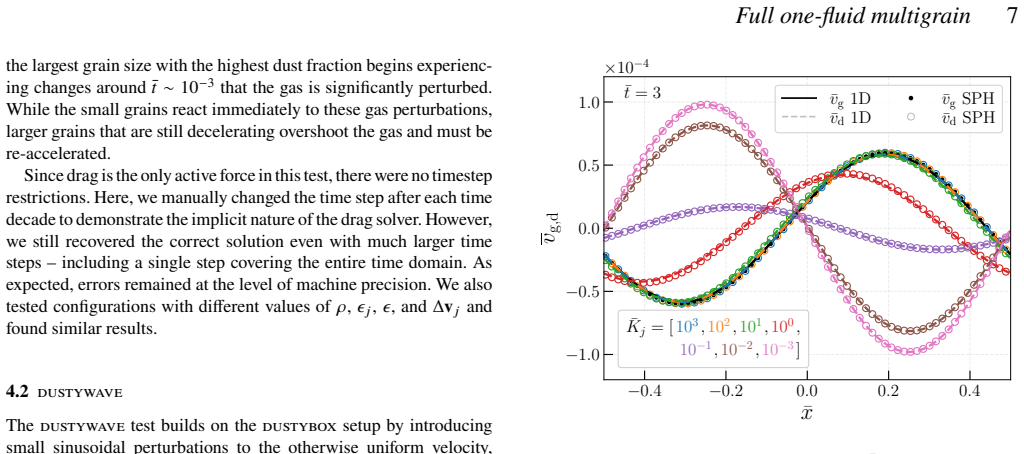
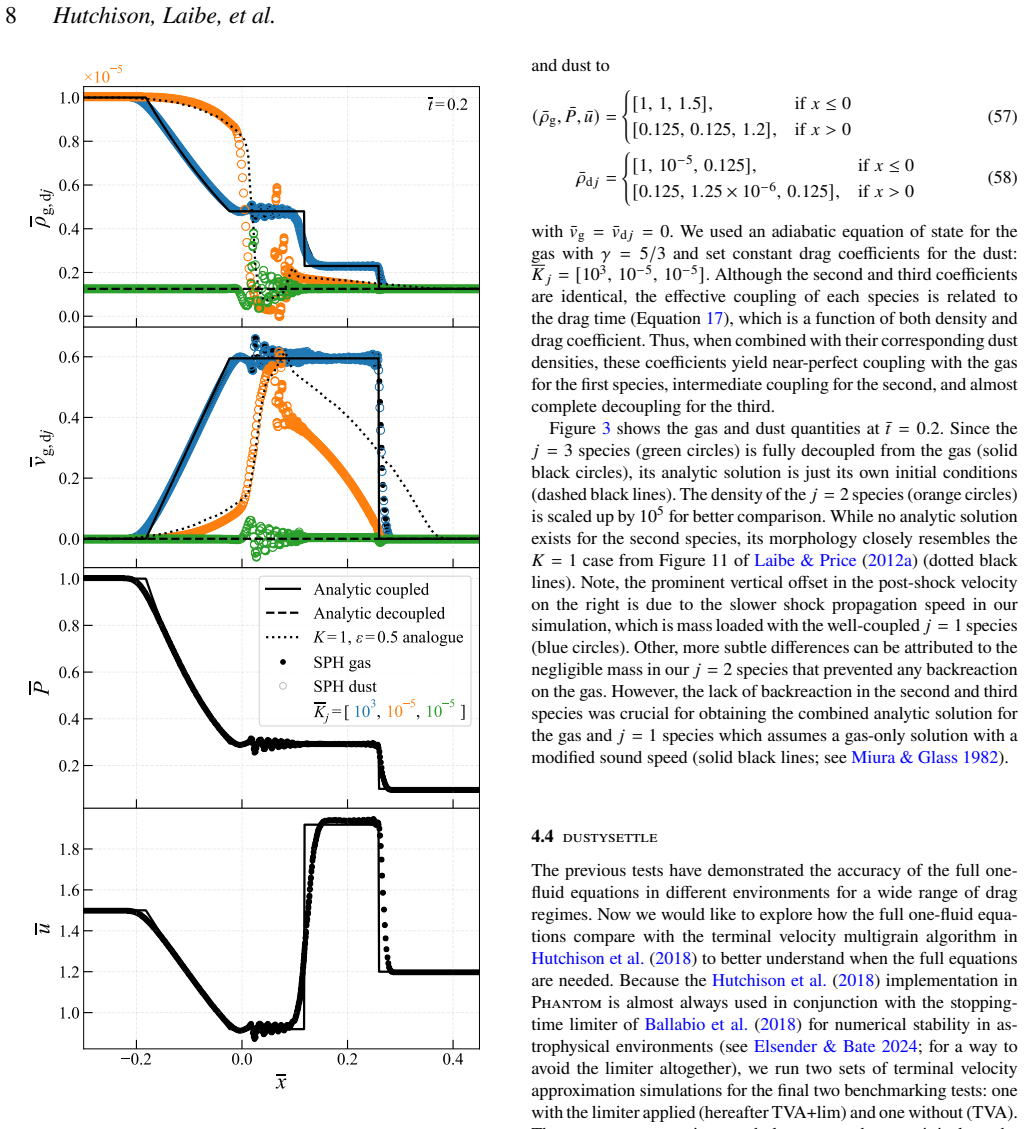
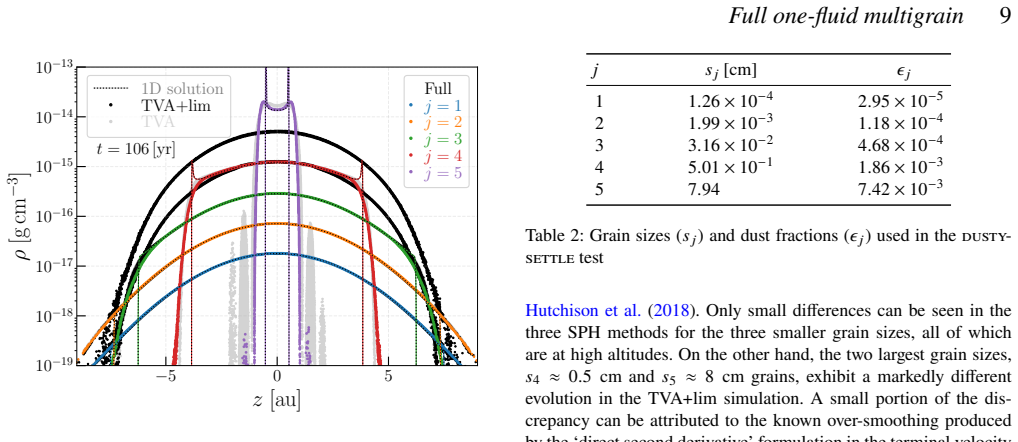
We present a Smoothed Particle Hydrodynamics (SPH) implementation of the full one-fluid dusty gas algorithm for multiple dust species, generalising our previous terminal velocity approach to handle arbitrary drag regimes. By construction, mass, momentum, angular momentum, and energy are all conserved. We benchmark our method against a suite of tests -- DUSTYBOX, DUSTYWAVE, DUSTYSHOCK, DUSTYSETTLE, and DUSTYDISC -- each probing different aspects of the algorithm. Compared to the terminal velocity approximation, the full one-fluid approach incurs a computational cost increase of a factor of five to ten due to the added overhead of evolving the differential velocities and solving the drag terms implicitly. However, it accurately recovers analytic behaviour in regimes where the terminal velocity approximation fails. In such cases, errors from the terminal velocity approximation accumulate and propagate to other dust phases. We show that the stopping-time limiter commonly used in the terminal velocity approximation for numerical stability can substantially affect simulations containing large grains (Stokes numbers $\gtrsim 1$). While disabling the limiter leads to different outcomes, the discrepancy with the full one-fluid solution remains comparable, underscoring the importance of using a more general formulation for large grains. The full one-fluid formalism may be useful when including processes such as coagulation and fragmentation, where accurate treatment of large grains becomes essential. While the inability to model orbit-crossing dust trajectories remains a key limitation of the one-fluid formalism, this may eventually be addressed through the introduction of an effective dust pressure, mirroring how fluid models encapsulate microscopic velocity dispersion in gases.
Editorial analysis
A structured set of objections, weighed in public.
Referee Report
Summary. The paper presents an SPH implementation of the full one-fluid dusty gas algorithm extended to multiple grain species. It generalizes the authors' prior terminal-velocity approximation to arbitrary drag regimes, asserting that mass, momentum, angular momentum, and energy are conserved by construction. The implementation is benchmarked on the standard DUSTYBOX, DUSTYWAVE, DUSTYSHOCK, DUSTYSETTLE, and DUSTYDISC tests, recovering analytic solutions in regimes where the terminal-velocity approximation fails, at a computational cost increase of a factor of five to ten due to evolving differential velocities and implicit drag solves. The work discusses the impact of the stopping-time limiter on large grains (St ≳ 1) and notes the one-fluid formalism's inability to model orbit-crossing trajectories as a key limitation.
Significance. If the implementation and conservation properties hold, the method supplies a more general tool for multi-species dusty gas simulations in astrophysical contexts, particularly where terminal-velocity assumptions break down or where coagulation/fragmentation processes require accurate treatment of large grains. The benchmarks are standard and independent, and the explicit discussion of the orbit-crossing limitation and limiter effects provides useful guidance for users.
minor comments (2)
- [Abstract] Abstract: the description of the implicit drag solver implementation is limited and no quantitative error metrics (e.g., L1 or L2 norms) from the benchmarks are supplied; adding these would improve clarity on the method's accuracy.
- The discussion of the stopping-time limiter's effect on large grains is noted, but the manuscript would benefit from explicit comparison of limiter-on vs. limiter-off results against the full one-fluid solution in at least one benchmark (e.g., DUSTYSETTLE or DUSTYDISC) to quantify the discrepancy.
Simulated Author's Rebuttal
We thank the referee for their positive summary of the manuscript and for recommending minor revision. No major comments were listed in the report.
Circularity Check
Minor self-citation to prior terminal-velocity work; central implementation claims remain independent
full rationale
The paper describes a new SPH implementation of the full one-fluid dusty-gas scheme for multiple grain species, generalizing the authors' earlier terminal-velocity approximation. Conservation of mass/momentum/angular-momentum/energy is stated to hold by construction of the numerical scheme (standard for conservative SPH discretizations) rather than derived from data or prior results. Benchmarks use standard test problems (DUSTYBOX, DUSTYWAVE, etc.) whose analytic solutions are external to the paper. Self-citations appear only to motivate the generalization and are not load-bearing for the new algorithm's validity or the reported accuracy gains in non-terminal regimes. No self-definitional loops, fitted inputs renamed as predictions, or uniqueness theorems imported from the same authors are present.
Axiom & Free-Parameter Ledger
axioms (2)
- standard math Standard conservation laws of mass, momentum, angular momentum and energy apply to the coupled gas-dust system.
- domain assumption The one-fluid description remains adequate for the benchmark regimes even when differential velocities are non-zero.
Reference graph
Works this paper leans on
-
[1]
arXiv , arxivurl =:1111.3083 , journal =
-
[2]
Safronov, V. S. , title =
-
[3]
arXiv , author =:2508.19127 , journal =
doi:10.1051/0004-6361/202554662 , eid =. arXiv , author =:2508.19127 , journal =
-
[4]
arXiv , author =:2601.07088 , journal =
doi:10.1051/0004-6361/202557277 , eid =. arXiv , author =:2601.07088 , journal =
-
[5]
arXiv , author =:2509.25347 , journal =
doi:10.1051/0004-6361/202556530 , eid =. arXiv , author =:2509.25347 , journal =
-
[6]
doi:10.1093/mnras/stae722 , eprint =
, keywords =. doi:10.1093/mnras/stae722 , eprint =
-
[7]
arXiv , author =:2512.06409 , journal =
doi:10.1093/mnras/stag078 , eid =. arXiv , author =:2512.06409 , journal =
-
[8]
arXiv , arxivurl =:1005.4982 , journal =
-
[9]
arXiv , author =:2511.00631 , journal =
doi:10.48550/arXiv.2511.00631 , eid =. arXiv , author =:2511.00631 , journal =
-
[10]
arXiv , author =:2310.04435 , journal =
doi:10.3847/1538-4365/ad14f9 , eid =. arXiv , author =:2310.04435 , journal =
-
[11]
arXiv , author =:2206.01023 , journal =
doi:10.3847/1538-4365/ac76cb , eid =. arXiv , author =:2206.01023 , journal =
-
[12]
doi:10.3847/2515-5172/abc7be , eid =
Research Notes of the American Astronomical Society , keywords =. doi:10.3847/2515-5172/abc7be , eid =
-
[13]
doi:10.1093/mnras/staa3162 , eprint =
, keywords =. doi:10.1093/mnras/staa3162 , eprint =
-
[14]
Streaming Instability for Particle-Size Distributions
doi:10.3847/2041-8213/ab2596 , eid =. arXiv , author =:1905.13139 , journal =
work page internal anchor Pith review Pith/arXiv arXiv doi:10.3847/2041-8213/ab2596 2041
-
[15]
doi:10.1093/mnras/staf444 , eprint =
, keywords =. doi:10.1093/mnras/staf444 , eprint =
-
[16]
doi:10.1093/mnras/stad2471 , eprint =
, keywords =. doi:10.1093/mnras/stad2471 , eprint =
-
[17]
arXiv , author =:2011.07849 , journal =
doi:10.3847/1538-4357/abca9b , eid =. arXiv , author =:2011.07849 , journal =
-
[18]
doi:10.1093/mnrasl/slae011 , eprint =
, keywords =. doi:10.1093/mnrasl/slae011 , eprint =
-
[19]
doi:10.1146/annurev-astro-071221-052705 , eprint =
, keywords =. doi:10.1146/annurev-astro-071221-052705 , eprint =
-
[20]
Wojciech W. Grabowski , keywords =. Chapter 3 - Rainfall modeling , editor =. Rainfall: Modeling, Measurement and Applications , publisher =. 2022 , isbn =. doi:https://doi.org/10.1016/B978-0-12-822544-8.00010-X , url =
-
[21]
doi:10.1093/mnras/sty1701 , eprint =
, keywords =. doi:10.1093/mnras/sty1701 , eprint =
-
[22]
doi:10.1093/mnras/stae2039 , eprint =
, keywords =. doi:10.1093/mnras/stae2039 , eprint =
-
[23]
doi:10.1093/mnras/staa3682 , eprint =
, keywords =. doi:10.1093/mnras/staa3682 , eprint =
-
[24]
doi:10.1093/mnras/stac2232 , eprint =
, keywords =. doi:10.1093/mnras/stac2232 , eprint =
-
[25]
doi:10.3847/2041-8213/aaf741 , eid =. arXiv , author =:1812.04040 , journal =
work page internal anchor Pith review Pith/arXiv arXiv doi:10.3847/2041-8213/aaf741 2041
-
[26]
doi:10.1093/mnras/stv246 , eprint =
, keywords =. doi:10.1093/mnras/stv246 , eprint =
-
[27]
arXiv , author =:2407.09343 , journal =
doi:10.3847/1538-4357/ad8087 , eid =. arXiv , author =:2407.09343 , journal =
-
[28]
arXiv , author =:2310.09132 , journal =
doi:10.1051/0004-6361/202346767 , eid =. arXiv , author =:2310.09132 , journal =
-
[29]
arXiv , author =:2303.13172 , journal =
doi:10.1051/0004-6361/202346167 , eid =. arXiv , author =:2303.13172 , journal =
-
[30]
doi:10.1051/0004-6361/201116950 , eid =. arXiv , author =:1106.0498 , journal =
work page internal anchor Pith review Pith/arXiv arXiv doi:10.1051/0004-6361/201116950
-
[31]
doi:10.1051/0004-6361/202349015 , eid =. arXiv , author =:2404.10821 , journal =
-
[32]
arXiv , author =:2009.02321 , journal =
doi:10.1088/1674-4527/20/10/164 , eid =. arXiv , author =:2009.02321 , journal =
-
[33]
arXiv , author =:2005.14097 , journal =
doi:10.1051/0004-6361/201936576 , eid =. arXiv , author =:2005.14097 , journal =
-
[34]
Protostars and Planets VII , date-added =
-
[35]
doi:10.1093/mnras/stad2460 , eprint =
, keywords =. doi:10.1093/mnras/stad2460 , eprint =
-
[36]
Dust as interstellar catalyst I. Quantifying the chemical desorption process
doi:10.1051/0004-6361/201525981 , eid =. arXiv , author =:1510.03218 , journal =
work page internal anchor Pith review Pith/arXiv arXiv doi:10.1051/0004-6361/201525981
-
[37]
doi:10.1038/s41550-024-02454-x , eprint =
Nature Astronomy , keywords =. doi:10.1038/s41550-024-02454-x , eprint =
-
[38]
, keywords =. doi:10.1093/mnras/staf2028 , eprint =
-
[39]
doi:10.1093/mnras/stac3044 , eprint =
, keywords =. doi:10.1093/mnras/stac3044 , eprint =
-
[40]
doi:10.1016/j.icarus.2024.116452 , eid =
, keywords =. doi:10.1016/j.icarus.2024.116452 , eid =
-
[41]
arXiv , author =:2412.09426 , journal =
doi:10.48550/arXiv.2412.09426 , eid =. arXiv , author =:2412.09426 , journal =
-
[42]
doi:10.1016/j.pss.2021.105357 , eid =
, keywords =. doi:10.1016/j.pss.2021.105357 , eid =
-
[43]
doi:10.1175/1520-0469(1972)029<0400:TEODOT>2.0.CO;2 , journal =
-
[44]
Insights from Synthetic Star-forming Regions: I. Reliable Mock Observations from SPH Simulations
doi:10.3847/1538-4365/233/1/1 , eid =. arXiv , author =:1603.02270 , journal =
work page internal anchor Pith review Pith/arXiv arXiv doi:10.3847/1538-4365/233/1/1
-
[45]
Royal Society of London Proceedings Series A , keywords =
-
[46]
Journal of Computational Physics , keywords =
-
[47]
astro-ph/0310790 , journal =
-
[48]
arXiv , arxivurl =:1111.3090 , journal =
-
[49]
arXiv , arxivurl =:1106.1736 , journal =
-
[50]
arXiv , arxivurl =:0709.2772 , journal =
-
[51]
arXiv , arxivurl =:1006.1524 , journal =
-
[52]
Journal of Computational Physics , month = sep, pages =
-
[53]
doi:10.1093/mnras/sty642 , eprint =
, keywords =. doi:10.1093/mnras/sty642 , eprint =
-
[54]
arXiv , arxivurl =:1702.03930 , journal =
-
[55]
arXiv , arxivurl =:1002.0335 , journal =
-
[56]
doi:10.1093/mnras/stac765 , eprint =
, keywords =. doi:10.1093/mnras/stac765 , eprint =
-
[57]
doi:10.1093/mnras/staa1366 , eprint =
, keywords =. doi:10.1093/mnras/staa1366 , eprint =
-
[58]
doi:10.1093/mnras/staa3171 , eprint =
, keywords =. doi:10.1093/mnras/staa3171 , eprint =
-
[59]
2016 , bdsk-file-1 =
On dust entrainment in photoevaporative winds , volume =. 2016 , bdsk-file-1 =. http://mnras.oxfordjournals.org/content/461/1/742.full.pdf+html , journal =
2016
-
[60]
doi:10.3847/1538-4365/ab0a0e , eid =. arXiv , author =:1811.07925 , journal =
work page internal anchor Pith review Pith/arXiv arXiv doi:10.3847/1538-4365/ab0a0e
-
[61]
arXiv , author =:2104.02356 , journal =
doi:10.1016/j.jcp.2020.110035 , eid =. arXiv , author =:2104.02356 , journal =
-
[62]
doi:10.1093/mnras/stac2625 , eprint =
, keywords =. doi:10.1093/mnras/stac2625 , eprint =
-
[63]
doi:10.1093/mnras/stz2035 , eprint =
, keywords =. doi:10.1093/mnras/stz2035 , eprint =
-
[64]
Small dust grain dynamics on adaptive mesh-refinement grids. I. Methods
doi:10.1051/0004-6361/201834147 , eid =. arXiv , author =:1905.01948 , journal =
work page internal anchor Pith review Pith/arXiv arXiv doi:10.1051/0004-6361/201834147 1905
-
[65]
astro-ph/0409263 , journal =
-
[66]
arXiv , arxivurl =:1505.00969 , journal =
-
[67]
arXiv , arxivurl =:1407.3569 , journal =
-
[68]
arXiv , arxivurl =:1402.5248 , journal =
-
[69]
arXiv , arxivurl =:1402.5249 , journal =
-
[70]
doi:10.1088/0305-4470/23/7/028 , journal =
-
[71]
doi:10.1088/0305-4470/33/6/309 , journal =
-
[72]
Zeitschrift fur Physik , month = jan, pages =
-
[73]
arXiv , arxivurl =:1706.05107 , journal =
-
[74]
Transactions of the Cambridge Philosophical Society , month = jan, pages =
-
[75]
Physical Review , month = jun, pages =
-
[76]
arXiv , arxivurl =:1111.3089 , journal =
-
[77]
arXiv , arxivurl =:1802.03213 , journal =
-
[78]
arXiv , arxivurl =:1012.1885 , journal =
-
[79]
astro-ph/0610872 , journal =
discussion (0)
Sign in with ORCID, Apple, or X to comment. Anyone can read and Pith papers without signing in.