FairWave : A Fairness-Aware Asynchronous DAG-BFT Consensus
Pith reviewed 2026-06-29 02:15 UTC · model grok-4.3
The pith
FairWave separates anchor selection from reward distribution in PoS DAG-BFT to cut centralization while keeping Sybil resistance.
A machine-rendered reading of the paper's core claim, the machinery that carries it, and where it could break.
Core claim
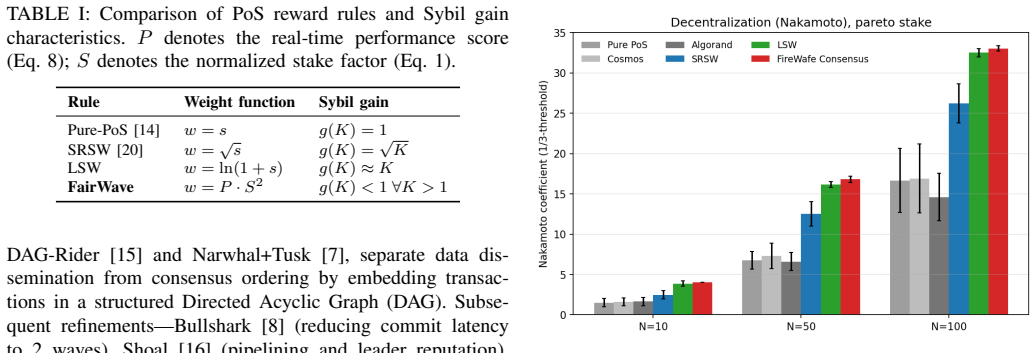
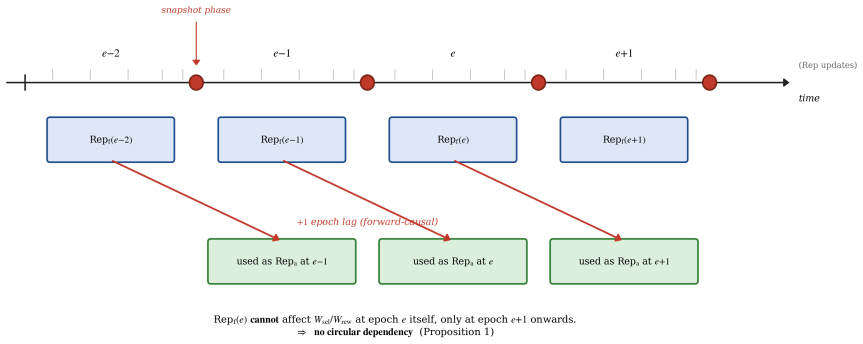
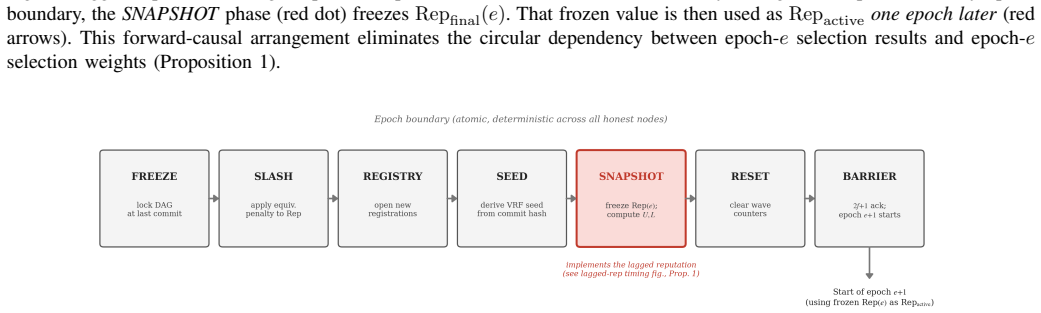
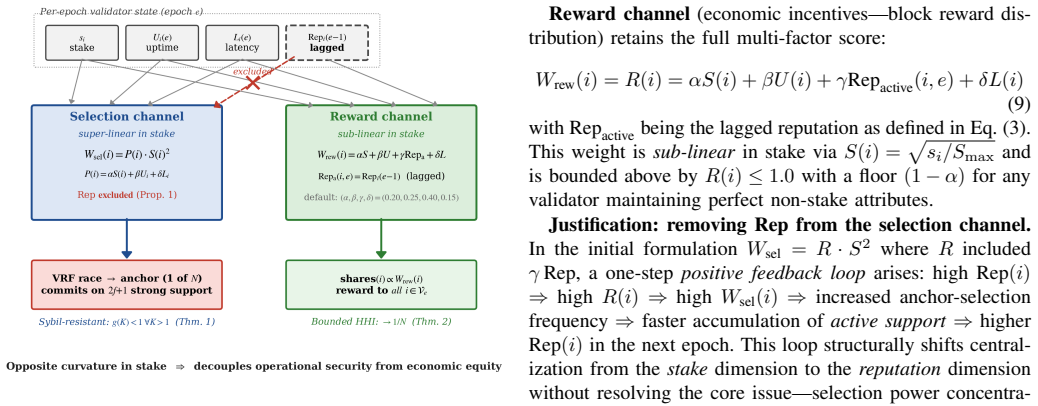
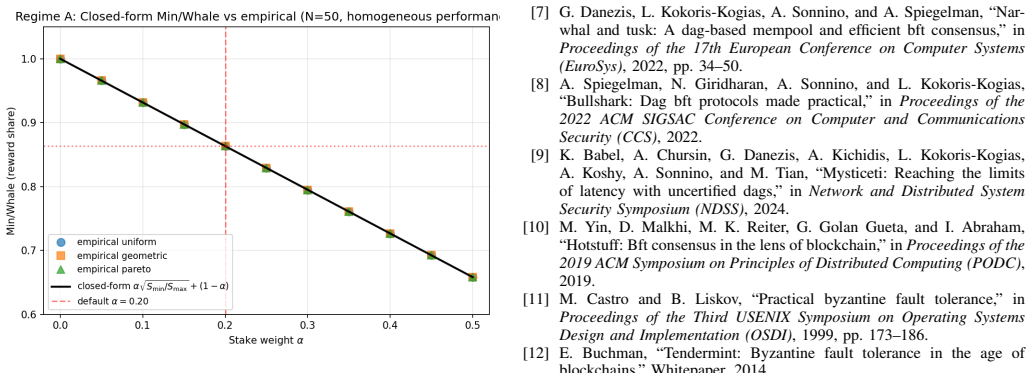
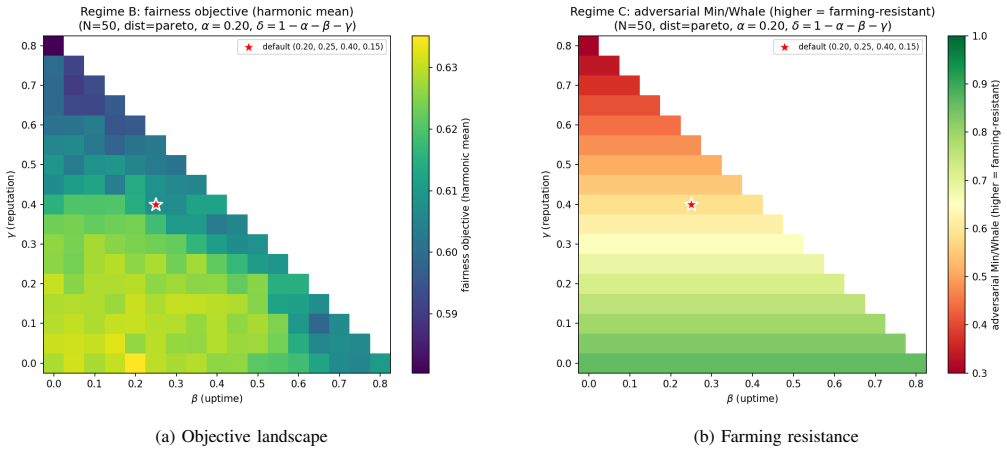
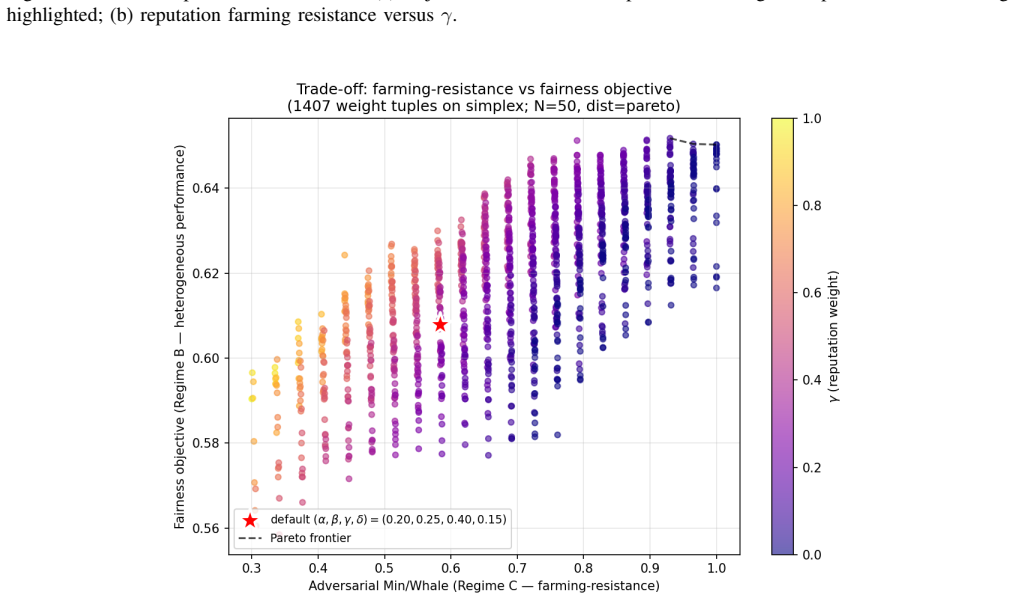
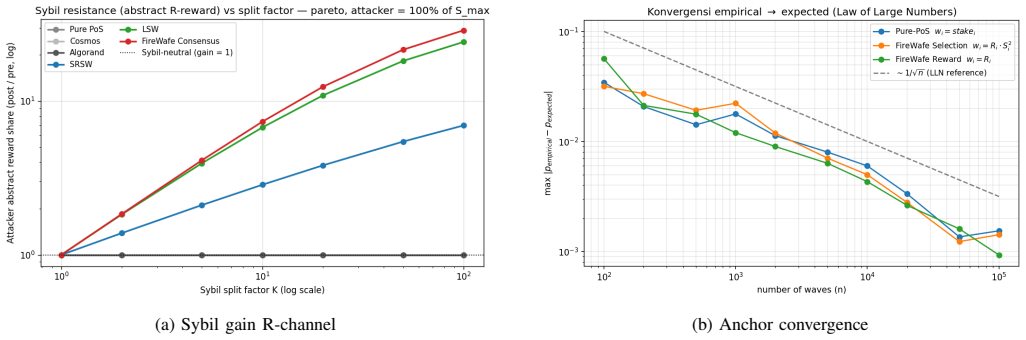
FairWave is a dual-channel DAG-BFT protocol that separates anchor selection from reward distribution. The selection channel is super-linear in stake, guaranteeing Sybil gain less than 1 for K greater than 1; the reward channel is sub-linear via square-root stake normalization. DAG-derived uptime and latency metrics eliminate external oracles, and lagged reputation breaks the circular dependency between selection outcomes and weights.
What carries the argument
Dual-channel separation of super-linear stake-based anchor selection from sub-linear square-root reward distribution.
If this is right
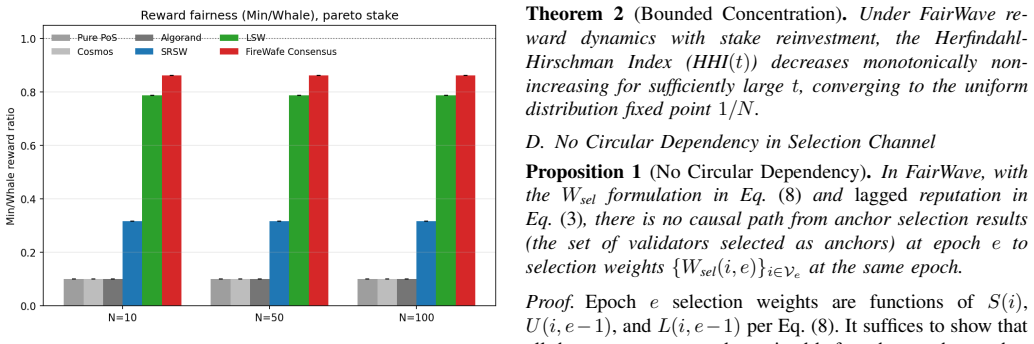
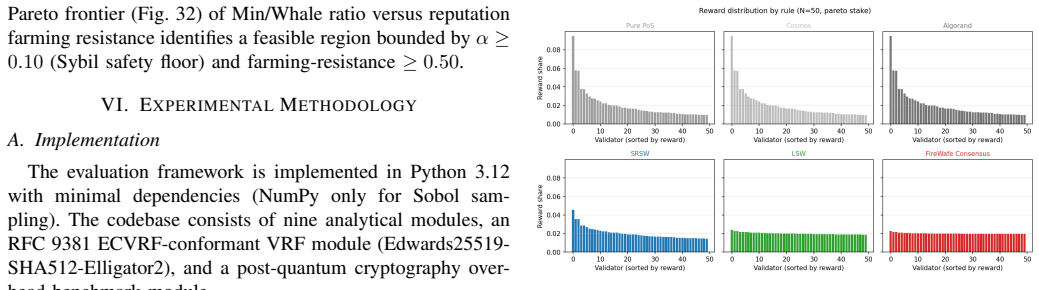
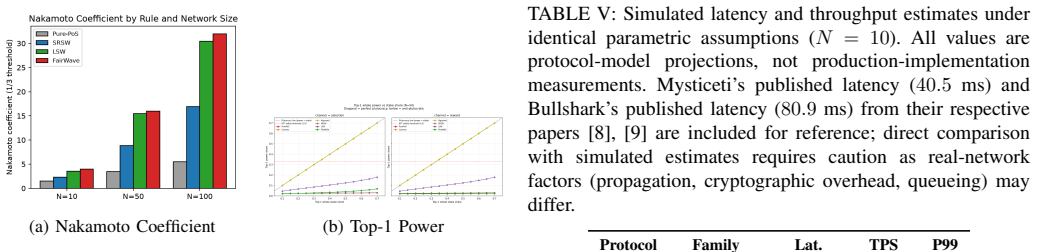
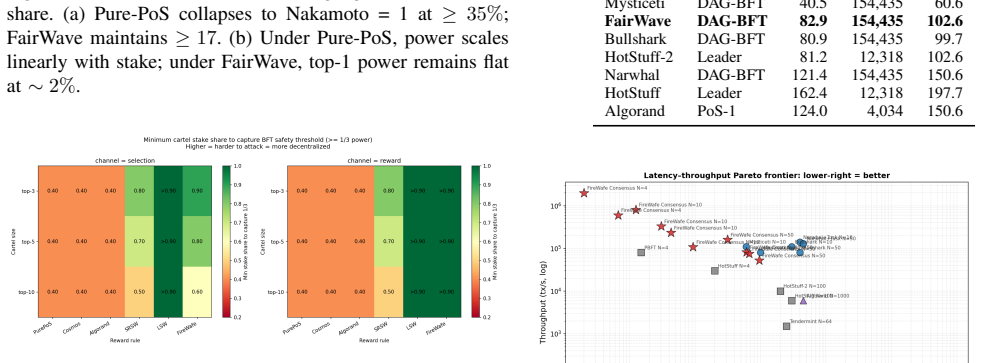
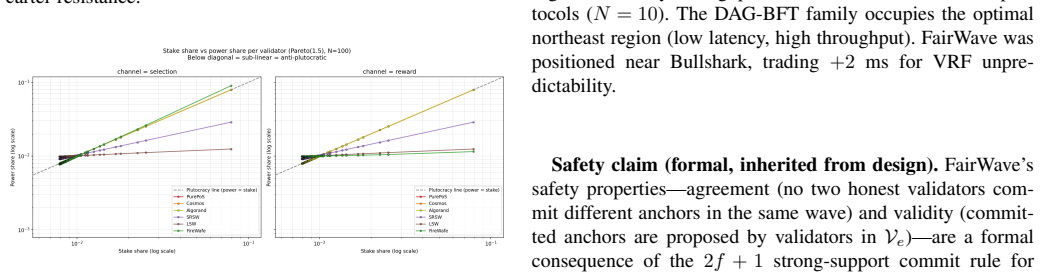
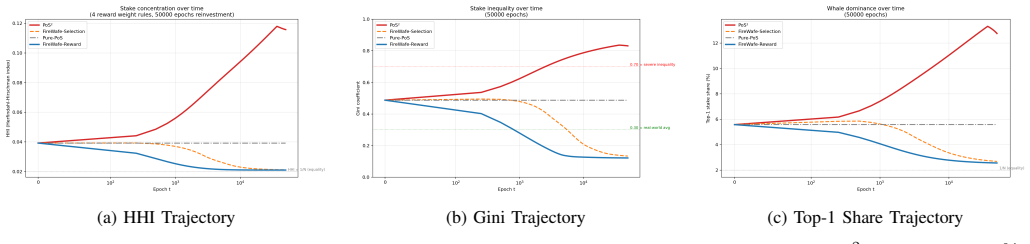
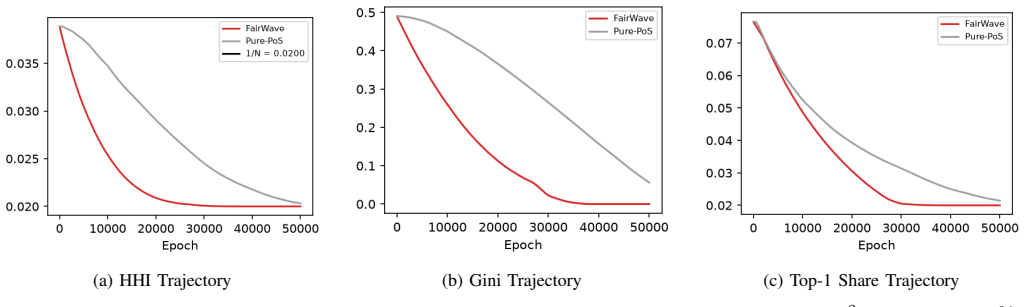
- Gini coefficient falls to 0.140 versus 0.490 under pure Proof-of-Stake.
- Herfindahl-Hirschman Index declines monotonically from 0.039 to 0.020 across 50,000 epochs.
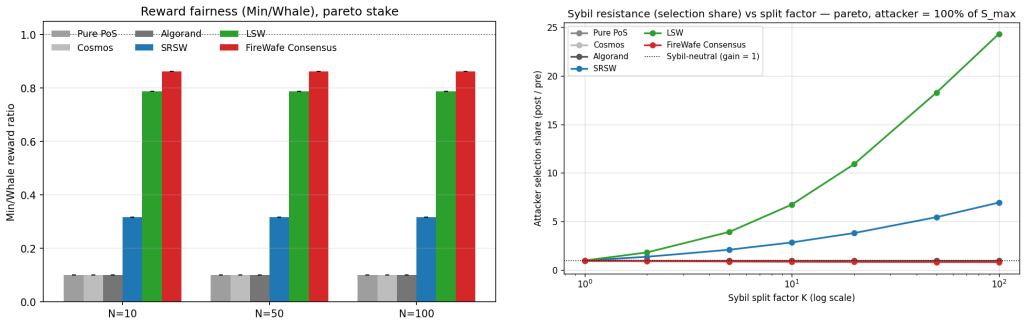
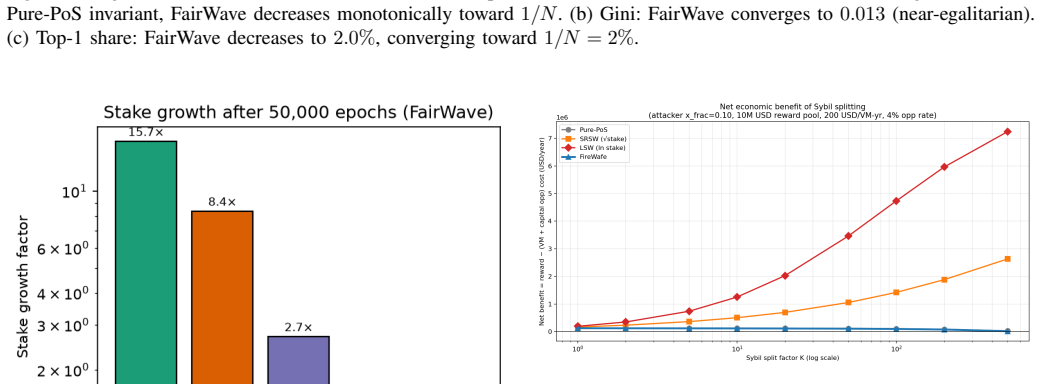
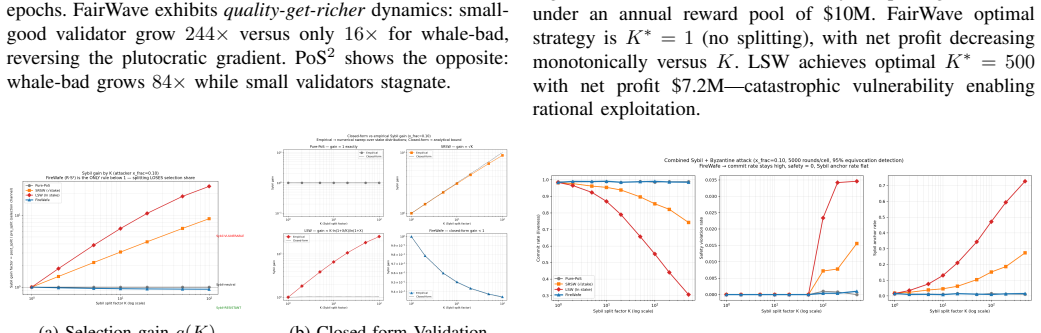
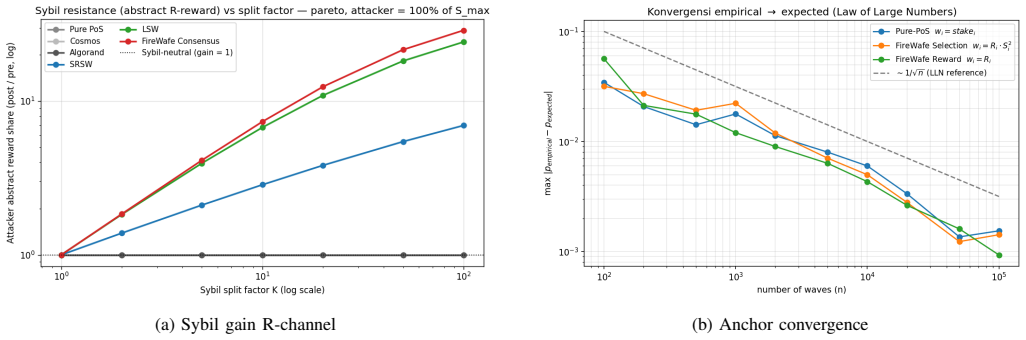
- Optimal Sybil strategy is a single identity (K*=1).
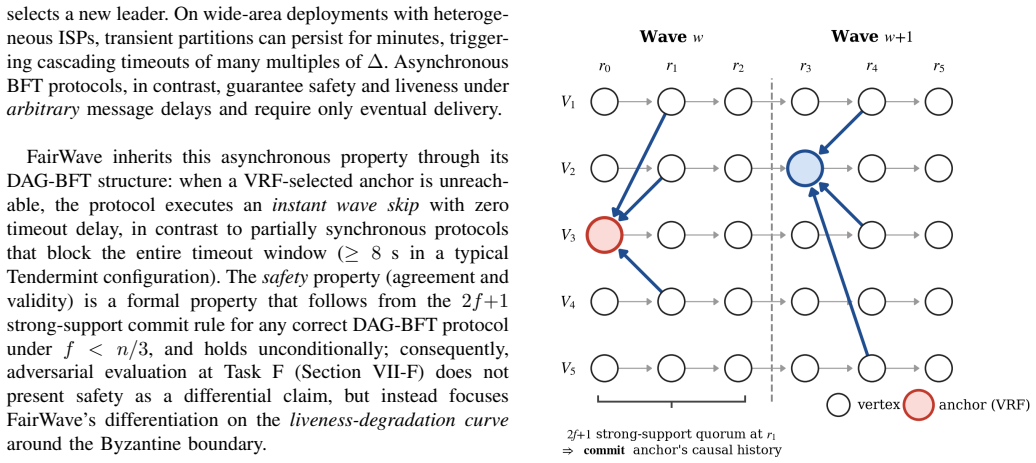
- Safety holds unconditionally from the 2f+1 commit rule.
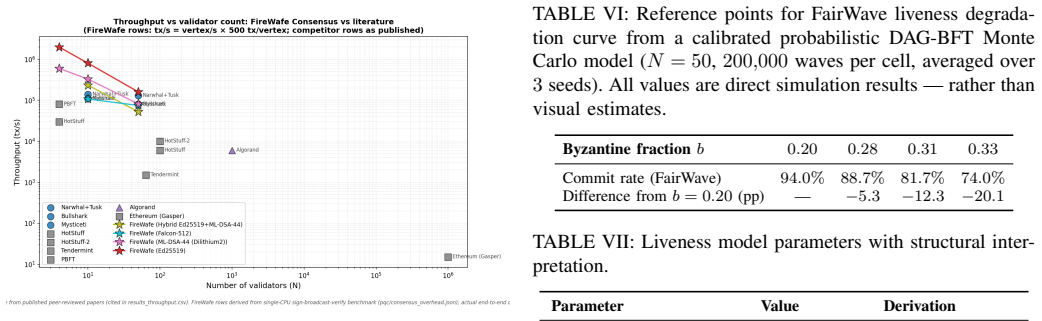
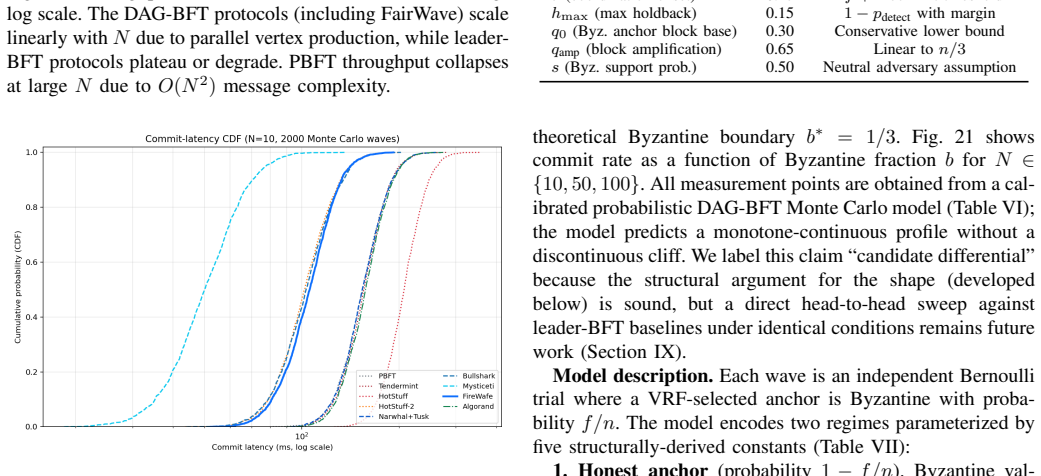
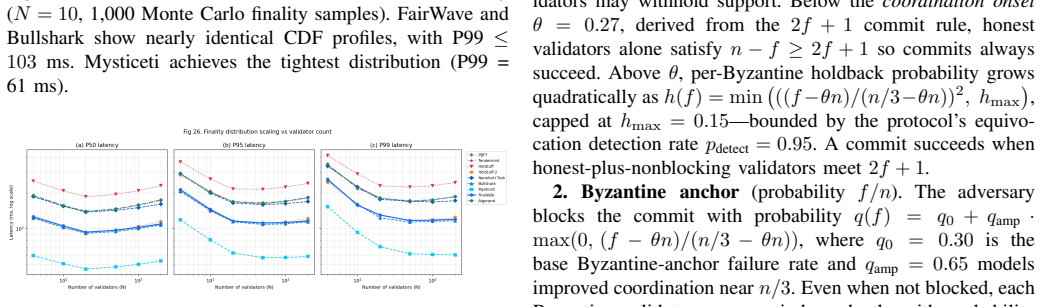
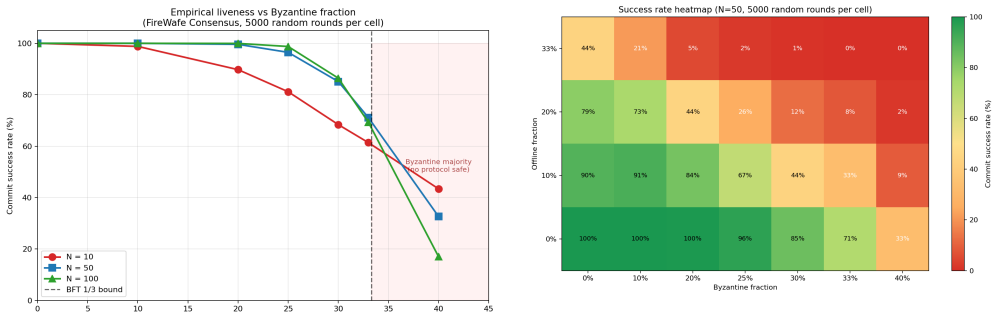
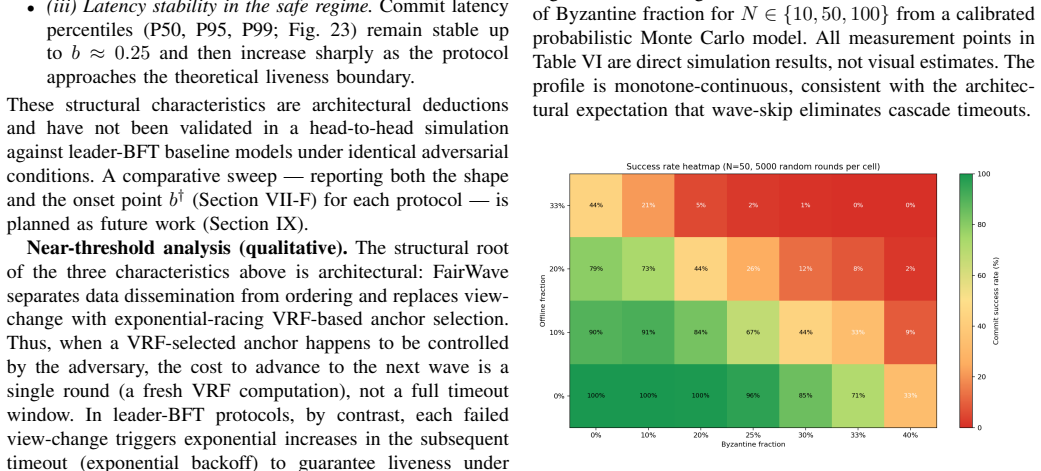
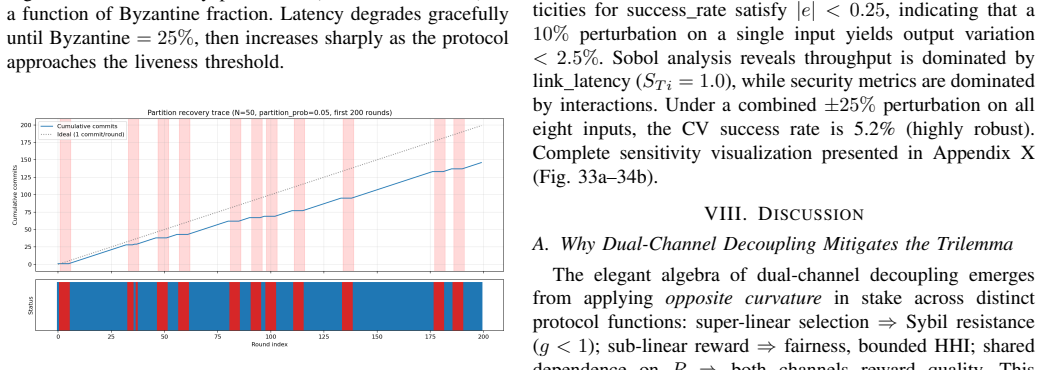
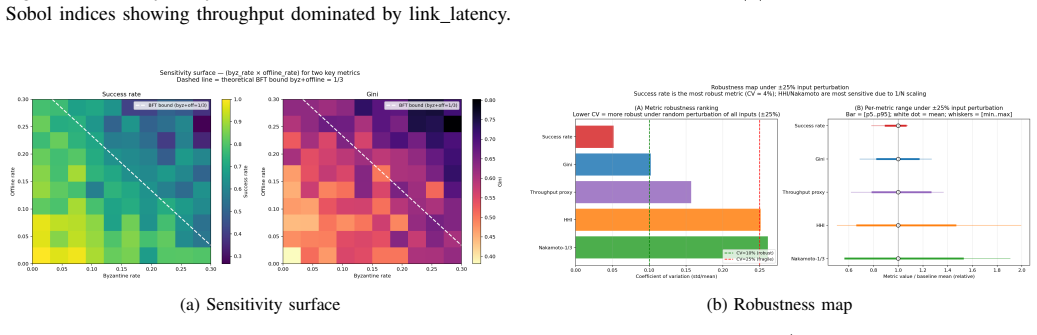
- Liveness falls monotonically from 94 percent at 20 percent faults to 74 percent at one-third faults.
Where Pith is reading between the lines
- The fairness gains may shrink if real message delays deviate from the Monte Carlo delay model.
- The same channel separation could be tested in partially synchronous DAG protocols that already use similar commit rules.
- Longer simulation horizons beyond 50,000 epochs would reveal whether the HHI reduction continues or plateaus.
Load-bearing premise
The 550,000 Monte Carlo rounds and the lagged reputation mechanism accurately capture real asynchronous network behavior and break the circular dependency between selection outcomes and weights without introducing new biases.
What would settle it
Deploy the protocol on a live asynchronous network and check whether the Gini coefficient remains near 0.140 and whether any safety violation occurs outside the 2f+1 commit threshold.
Figures

















read the original abstract
Proof-of-Stake DAG-BFT consensus faces a trilemma between sybil resistance, reward fairness, and plutocracy. Existing protocols prioritize liveness over fair stake-based selection, driving longitudinal centralization. FairWave is a dual-channel DAG-BFT protocol that separates anchor selection from reward distribution. The selection channel is super-linear in stake, guaranteeing Sybil gain < 1 for K > 1; the reward channel is sub-linear via square-root stake normalization. DAG-derived uptime and latency metrics eliminate external oracles,and lagged reputation breaks circular dependency between selection outcomes and weights. Evaluated through approximately 550,000 Monte Carlo rounds against eight baselines, FairWave shows Gini 0.140 (vs. Pure-PoS 0.490, monotone HHI reduction from 0.039 to 0.020 over 50,000 epochs, and optimal Sybil split K * = 1. Safety follows unconditionally from the 2f + 1 commit rule; the liveness model predicts monotone degradation from 94.0% at b = 0.20 to 74.0% at b = 1/3, consistent with the architectural expectation of no discontinuous cliff.
Editorial analysis
A structured set of objections, weighed in public.
Referee Report
Summary. The paper proposes FairWave, a dual-channel asynchronous DAG-BFT consensus protocol that separates super-linear stake-based anchor selection (to guarantee Sybil gain <1 for K>1) from sub-linear square-root stake-normalized reward distribution. It derives reputation from DAG uptime and latency metrics without external oracles and uses lagged reputation to break the circular dependency between selection outcomes and weights. Through ~550,000 Monte Carlo rounds against eight baselines, it reports Gini coefficient 0.140 (vs. Pure-PoS 0.490), monotone HHI reduction from 0.039 to 0.020 over 50,000 epochs, optimal Sybil split K*=1, unconditional safety from the 2f+1 commit rule, and liveness degrading monotonically from 94.0% at b=0.20 to 74.0% at b=1/3.
Significance. If the Monte Carlo assumptions hold and the lagged reputation mechanism demonstrably decouples selection from weights without introducing new biases, the protocol would offer a concrete mechanism to address the Sybil-resistance/fairness/plutocracy trilemma in PoS DAG-BFT systems. The extensive simulation campaign against multiple baselines and the explicit modeling of liveness degradation are strengths that could inform practical deployments.
major comments (2)
- [Abstract] Abstract: The central claims of Gini 0.140, HHI reduction 0.039→0.020, and K*=1 rest on the assertion that lagged reputation breaks the circular dependency between selection outcomes and weights without new biases. No formal argument, sensitivity analysis on the lag parameter, or explicit delay/failure model is supplied; the 550,000 Monte Carlo rounds are presented without reported assumptions, error bars, or implementation details of the baselines, which is load-bearing for the fairness and longitudinal centralization results.
- [Abstract] Abstract: The liveness model is stated to predict monotone degradation from 94.0% at b=0.20 to 74.0% at b=1/3 and to be 'consistent with the architectural expectation of no discontinuous cliff,' yet no equations, derivation, or parameter values for the model (including how the dual-channel architecture and asynchrony enter) are provided, preventing verification that the prediction follows from the protocol rather than simulation artifacts.
minor comments (2)
- [Abstract] The abstract refers to 'free_parameters' (super-linear stake factor and square-root normalization constant) but does not state their concrete values or whether results are sensitive to them; adding this would improve reproducibility.
- Consider reporting the exact number of nodes, stake distributions, and network delay distributions used in the Monte Carlo setup to allow independent reproduction of the Gini/HHI figures.
Simulated Author's Rebuttal
We appreciate the referee's thorough review and constructive feedback on our manuscript. We address each major comment point by point below, providing clarifications and committing to revisions where the manuscript can be strengthened.
read point-by-point responses
-
Referee: [Abstract] Abstract: The central claims of Gini 0.140, HHI reduction 0.039→0.020, and K*=1 rest on the assertion that lagged reputation breaks the circular dependency between selection outcomes and weights without new biases. No formal argument, sensitivity analysis on the lag parameter, or explicit delay/failure model is supplied; the 550,000 Monte Carlo rounds are presented without reported assumptions, error bars, or implementation details of the baselines, which is load-bearing for the fairness and longitudinal centralization results.
Authors: We agree that additional formalization and details would enhance the presentation. The lagged reputation mechanism uses reputation from the previous epoch to determine selection weights in the current epoch, thereby breaking the circular dependency. We will add a formal argument in a new subsection demonstrating that this lag introduces no new biases under the assumed failure model. Additionally, we will include a sensitivity analysis on the lag parameter (e.g., lag=1 vs. lag=2 epochs) and report the Monte Carlo assumptions, including the random seed, number of runs per configuration, error bars (standard deviation across runs), and detailed implementation of the eight baselines. These changes will be incorporated in the revised manuscript. revision: yes
-
Referee: [Abstract] Abstract: The liveness model is stated to predict monotone degradation from 94.0% at b=0.20 to 74.0% at b=1/3 and to be 'consistent with the architectural expectation of no discontinuous cliff,' yet no equations, derivation, or parameter values for the model (including how the dual-channel architecture and asynchrony enter) are provided, preventing verification that the prediction follows from the protocol rather than simulation artifacts.
Authors: The liveness prediction is based on a probabilistic model incorporating the dual-channel separation and asynchronous message delivery. We will expand the manuscript to include the full set of equations for the liveness model, the derivation steps, and the specific parameter values used (such as the Byzantine fraction b and asynchrony bounds). This will clarify how the architecture ensures monotone degradation without cliffs, distinguishing it from simulation results. revision: yes
Circularity Check
No significant circularity in derivation chain
full rationale
The paper defines a protocol design choice (lagged reputation using DAG-derived metrics) to address an acknowledged circular dependency between selection and weights, then evaluates the resulting fairness metrics via Monte Carlo simulation. No equations or derivations are exhibited that reduce the central claims (Gini, HHI, K*) to the inputs by construction, nor is any fitted parameter renamed as a prediction. Safety follows from the standard 2f+1 rule and liveness from an explicit degradation model; both are independent of the fairness mechanism. The simulation results are empirical outputs under the stated design rather than tautological. This is the common case of a self-contained empirical protocol paper.
Axiom & Free-Parameter Ledger
free parameters (2)
- super-linear stake factor
- square-root normalization constant
axioms (2)
- standard math Safety follows unconditionally from the 2f+1 commit rule
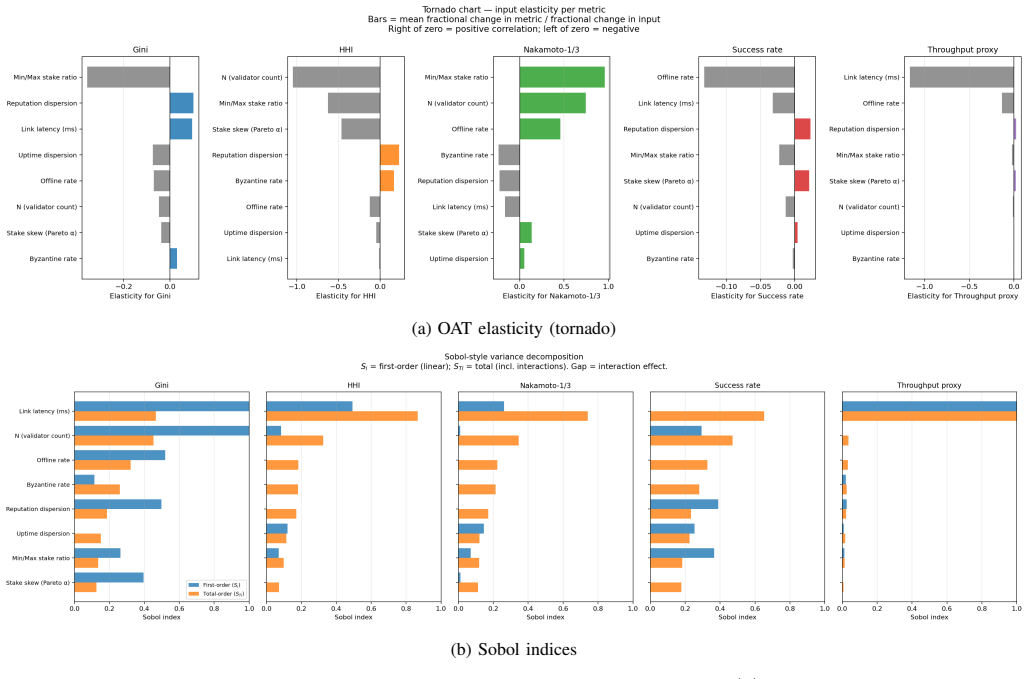
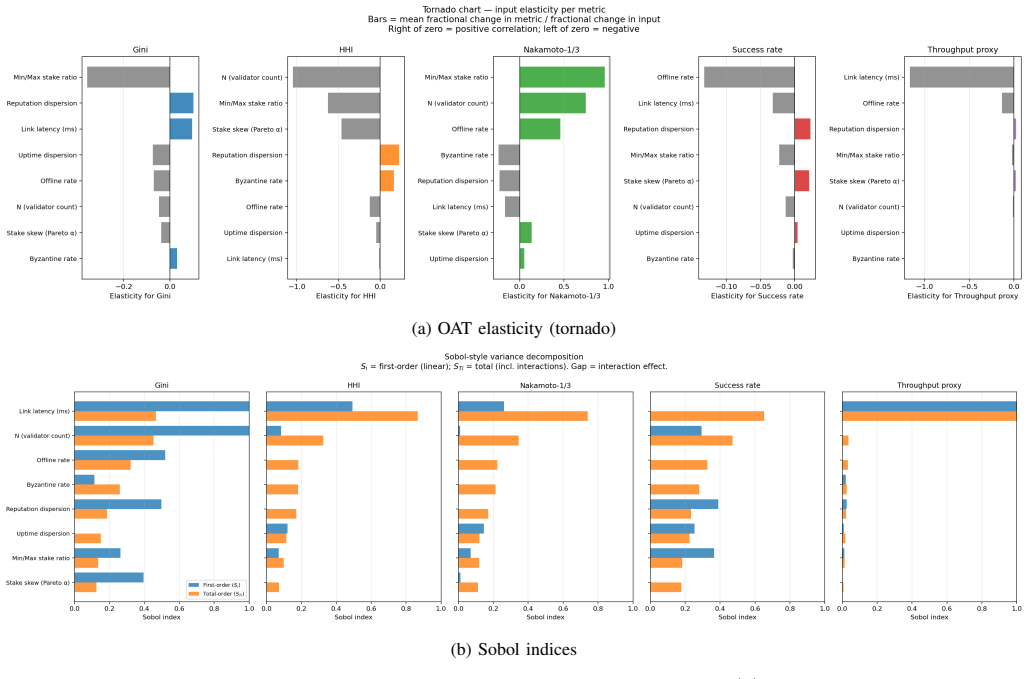
- domain assumption DAG-derived uptime and latency metrics are reliable substitutes for external oracles
Reference graph
Works this paper leans on
-
[1]
Proof-of-stake centralization: A longi- tudinal study,
S. Motepalli and M. Jacobson, “Proof-of-stake centralization: A longi- tudinal study,”IEEE Transactions on Blockchain and Cryptocurrency, 2024
2024
-
[2]
Centralization in proof-of-stake blockchains: A game-theoretic analysis of bootstrapping protocols,
V . Srivastava, S. Damle, and S. Gujar, “Centralization in proof-of-stake blockchains: A game-theoretic analysis of bootstrapping protocols,” arXiv preprint arXiv:2404.09627, 2024
-
[3]
Ethereum proof-of-stake under the microscope,
V . Buterin, D. Herman, D. Reijsbergen, and S. Leonardos, “Ethereum proof-of-stake under the microscope,”arXiv preprint arXiv:2005.09817, 2020
-
[4]
How centralized is decentralized? com- parison of wealth distribution in coins and tokens,
B. Ku ´smierz and R. Overko, “How centralized is decentralized? com- parison of wealth distribution in coins and tokens,”arXiv preprint arXiv:2207.01340, 2022
-
[5]
Ethereum proof- of-stake consensus layer: Participation and decentralization,
D. Grandjean, L. Heimbach, and R. Wattenhofer, “Ethereum proof-of- stake consensus layer: Participation and decentralization,”arXiv preprint arXiv:2306.10777, 2023
-
[6]
Flash boys 2.0: Frontrunning in decentralized exchanges, miner extractable value, and consensus instability,
P. Daian, S. Goldfeder, T. Kell, Y . Li, X. Zhao, I. Bentov, L. Breidenbach, and A. Juels, “Flash boys 2.0: Frontrunning in decentralized exchanges, miner extractable value, and consensus instability,” in2020 IEEE Symposium on Security and Privacy (SP), 2020, pp. 910–927
2020
-
[7]
Nar- whal and tusk: A dag-based mempool and efficient bft consensus,
G. Danezis, L. Kokoris-Kogias, A. Sonnino, and A. Spiegelman, “Nar- whal and tusk: A dag-based mempool and efficient bft consensus,” in Proceedings of the 17th European Conference on Computer Systems (EuroSys), 2022, pp. 34–50
2022
-
[8]
Bullshark: Dag bft protocols made practical,
A. Spiegelman, N. Giridharan, A. Sonnino, and L. Kokoris-Kogias, “Bullshark: Dag bft protocols made practical,” inProceedings of the 2022 ACM SIGSAC Conference on Computer and Communications Security (CCS), 2022
2022
-
[9]
Mysticeti: Reaching the limits of latency with uncertified dags,
K. Babel, A. Chursin, G. Danezis, A. Kichidis, L. Kokoris-Kogias, A. Koshy, A. Sonnino, and M. Tian, “Mysticeti: Reaching the limits of latency with uncertified dags,” inNetwork and Distributed System Security Symposium (NDSS), 2024
2024
-
[10]
Hotstuff: Bft consensus in the lens of blockchain,
M. Yin, D. Malkhi, M. K. Reiter, G. Golan-Gueta, and I. Abraham, “Hotstuff: Bft consensus in the lens of blockchain,” inProceedings of the 2019 ACM Symposium on Principles of Distributed Computing (PODC), 2019
2019
-
[11]
Hotstuff-2: Optimal two-phase responsive bft,
D. Malkhi and K. Nayak, “Hotstuff-2: Optimal two-phase responsive bft,”Cryptology ePrint Archive, Report 2023/397, 2023
2023
-
[12]
Practical byzantine fault tolerance,
M. Castro and B. Liskov, “Practical byzantine fault tolerance,” in Proceedings of the Third USENIX Symposium on Operating Systems Design and Implementation (OSDI), 1999, pp. 173–186
1999
-
[13]
Tendermint: Byzantine fault tolerance in the age of blockchains,
E. Buchman, “Tendermint: Byzantine fault tolerance in the age of blockchains,” Whitepaper, 2014
2014
-
[14]
Algorand: Scaling byzantine agreements for cryptocurrencies,
Y . Gilad, R. Hemo, S. Micali, G. Vlachos, and N. Zeldovich, “Algorand: Scaling byzantine agreements for cryptocurrencies,” inProceedings of the 26th Symposium on Operating Systems Principles, 2017, pp. 51–68
2017
-
[15]
All you need is dag,
I. Keidar, L. Kokoris-Kogias, O. Naor, and A. Spiegelman, “All you need is dag,” inProceedings of the 2022 ACM Symposium on Principles of Distributed Computing (PODC), 2022, pp. 165–175
2022
-
[16]
Shoal: Improving DAG- BFT latency and robustness.CoRR, abs/2306.03058,
A. Spiegelman, B. Arun, R. Gelashvili, and Z. Li, “Shoal: Improving dag-bft latency and robustness,”arXiv preprint arXiv:2306.03058, 2023
-
[17]
Shoal++: High throughput dag bft can be fast!ArXiv, abs/2405.20488,
B. Arun, Z. Li, F. Suri-Payer, S. Das, and A. Spiegelman, “Shoal++: High throughput dag bft can be fast!”arXiv preprint arXiv:2405.20488, 2024
-
[18]
The honey badger of bft protocols,
A. Miller, Y . Xia, K. Croman, E. Shi, and D. Song, “The honey badger of bft protocols,” inProceedings of the 2016 ACM SIGSAC Conference on Computer and Communications Security (CCS), 2016, pp. 31–42
2016
-
[19]
Another advantage of free choice: Completely asyn- chronous agreement protocols,
M. Ben-Or, “Another advantage of free choice: Completely asyn- chronous agreement protocols,” inProceedings of the Second Annual ACM Symposium on Principles of Distributed Computing (PODC), 1983, pp. 27–30
1983
-
[20]
Cosmos governance framework,
J. Kwon, “Cosmos governance framework,” Cosmos Network Documen- tation, 2019
2019
-
[21]
Ouroboros: A provably secure proof-of-stake blockchain protocol,
A. Kiayias, A. Russell, B. David, and R. Oliynykov, “Ouroboros: A provably secure proof-of-stake blockchain protocol,” inAdvances in Cryptology – CRYPTO 2017, 2017, pp. 357–388
2017
-
[22]
Ethereum proof-of-stake consensus specification (casper ffg + lmd ghost),
V . Buterin, D. Herman, and D. Reijsbergen, “Ethereum proof-of-stake consensus specification (casper ffg + lmd ghost),” Ethereum Foundation, Tech. Rep., 2022
2022
-
[23]
Approach to allevi- ate wealth compounding in proof-of-stake cryptocurrencies,
Z. Naderi, S. P. Shariatpanahi, and B. Bahrak, “Approach to alleviate wealth compounding in proof-of-stake cryptocurrencies,”arXiv preprint arXiv:2207.11714, 2022
-
[24]
Reward schemes and committee sizes in proof of stake governance,
G. Birmpas, P. Lazos, E. Markakis, and P. Penna, “Reward schemes and committee sizes in proof of stake governance,”arXiv preprint arXiv:2406.10525, 2024
-
[25]
Stability of shares in the proof of stake protocol – concen- tration and phase transitions,
W. Tang, “Stability of shares in the proof of stake protocol – concen- tration and phase transitions,”arXiv preprint arXiv:2206.02227, 2022
-
[26]
Measurement of inequality of incomes,
C. Gini, “Measurement of inequality of incomes,”The Economic Jour- nal, vol. 31, no. 121, pp. 124–126, 1921
1921
-
[27]
Study of the sensitivity of coupled reaction systems to uncertainties in rate coefficients. i. theory,
R. I. Cukier, C. M. Fortuin, K. E. Shuler, A. G. Petschek, and J. H. Schaibly, “Study of the sensitivity of coupled reaction systems to uncertainties in rate coefficients. i. theory,”Journal of Chemical Physics, vol. 59, no. 8, pp. 3873–3878, 1973
1973
-
[28]
Saltelli, M
A. Saltelli, M. Ratto, T. Andres, F. Campolongo, J. Cariboni, D. Gatelli, M. Saisana, and S. Tarantola,Global Sensitivity Analysis: The Primer. Wiley, 2010
2010
-
[29]
Global sensitivity indices for nonlinear mathematical models and their monte carlo estimates,
I. M. Sobol’, “Global sensitivity indices for nonlinear mathematical models and their monte carlo estimates,”Mathematics and Computers in Simulation, vol. 55, no. 1–3, pp. 271–280, 2001
2001
-
[30]
Cachin, R
C. Cachin, R. Guerraoui, and L. Rodrigues,Introduction to Reliable and Secure Distributed Programming, 2nd ed. Springer, 2011
2011
-
[31]
Consensus in the presence of partial synchrony,
C. Dwork, N. Lynch, and L. Stockmeyer, “Consensus in the presence of partial synchrony,”Journal of the ACM, vol. 35, no. 2, pp. 288–323, 1988
1988
-
[32]
The sybil attack,
J. R. Douceur, “The sybil attack,” inProceedings of the First Interna- tional Workshop on Peer-to-Peer Systems (IPTPS), 2002, pp. 251–260
2002
-
[33]
Polkadot: Vision for a heterogeneous multi-chain frame- work,
G. Wood, “Polkadot: Vision for a heterogeneous multi-chain frame- work,” Whitepaper, 2020
2020
-
[34]
Hedera: A public hashgraph network for fair ordering of transactions,
L. Baird, M. Harmon, and P. Madsen, “Hedera: A public hashgraph network for fair ordering of transactions,” Technical Report, 2016
2016
-
[35]
Solana: A new architecture for a high performance blockchain,
A. Yakovenko, “Solana: A new architecture for a high performance blockchain,” Whitepaper, 2020
2020
-
[36]
Who wins ethereum block building auctions and why?
B. ¨Oz, D. Sui, T. Thiery, and F. Matthes, “Who wins ethereum block building auctions and why?” inAdvances in Financial Technologies (AFT 2024), 2024. APPENDIX Heterogeneous Validator Profiles Table XI lists the five validator profile types used in the fairness evaluation (Section VII) and their non-stake quality parameters. These profiles model heterogen...
2024
discussion (0)
Sign in with ORCID, Apple, or X to comment. Anyone can read and Pith papers without signing in.