SN 1006: A Cosmic Laboratory for Investigating Shock Acceleration Physics
Pith reviewed 2026-06-27 08:42 UTC · model grok-4.3
The pith
SN 1006 accelerates cosmic rays at 20 percent efficiency only in quasi-parallel shocks and emits gamma rays mostly from electrons.
A machine-rendered reading of the paper's core claim, the machinery that carries it, and where it could break.
Core claim
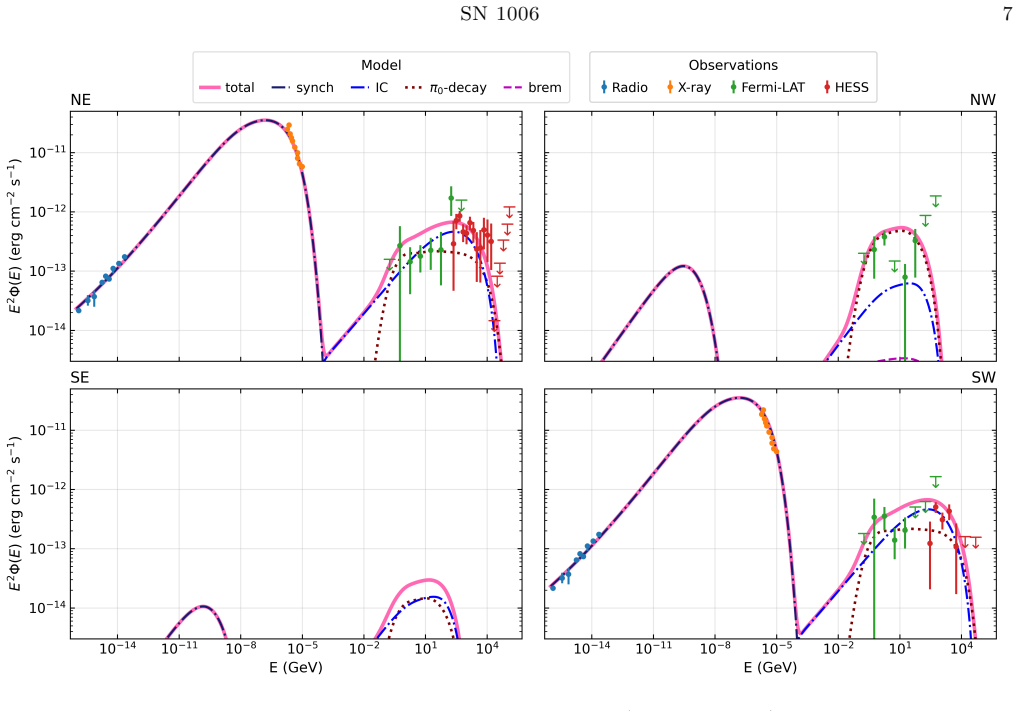
Using a self-consistent multi-zone kinetic model that incorporates CR-driven shock modification, magnetic field amplification, drift in magnetic fluctuations, and temporal dynamics including adiabatic and synchrotron losses, the authors reproduce the observed spectral and spatial properties of SN 1006. Quasi-parallel regions exhibit very prominent CR acceleration with approximately 20 percent efficiency, while quasi-perpendicular regions exhibit efficiencies below 1 percent. Electrons are responsible for the majority of the gamma-ray emission, making SN 1006 a leptonic source, with the exception of the northwest region due to an encounter with a dense cloud.
What carries the argument
The self-consistent multi-zone kinetic model of particle acceleration that accounts for CR-driven shock modification, magnetic field amplification, drift in magnetic fluctuations, and temporal dynamics including adiabatic and synchrotron losses.
If this is right
- Quasi-parallel shocks are the dominant sites of efficient cosmic ray acceleration in supernova remnants.
- The gamma-ray emission from SN 1006 is primarily leptonic except where the remnant interacts with a dense cloud.
- The radio profile of SN 1006 requires three-dimensional hydrodynamic effects beyond the two-dimensional model.
- The obliquity dependence of acceleration efficiency matches predictions from kinetic simulations.
Where Pith is reading between the lines
- The same obliquity dependence could explain differences in gamma-ray brightness among other supernova remnants.
- Three-dimensional modeling of SN 1006 would likely resolve remaining mismatches in the radio data.
- Application of similar models to other remnants could test whether the 20 percent versus sub-1 percent efficiency split is general.
Load-bearing premise
The 2D multi-zone kinetic model with assumed ambient magnetic field orientation and cloud interaction in the northwest is sufficient to determine the hadronic versus leptonic nature of the gamma-ray emission and the obliquity-dependent efficiencies.
What would settle it
Gamma-ray observations that resolve the northwest region and show no hadronic component, or that detect high acceleration efficiency in a clearly quasi-perpendicular shock region, would contradict the model's conclusions.
Figures

read the original abstract
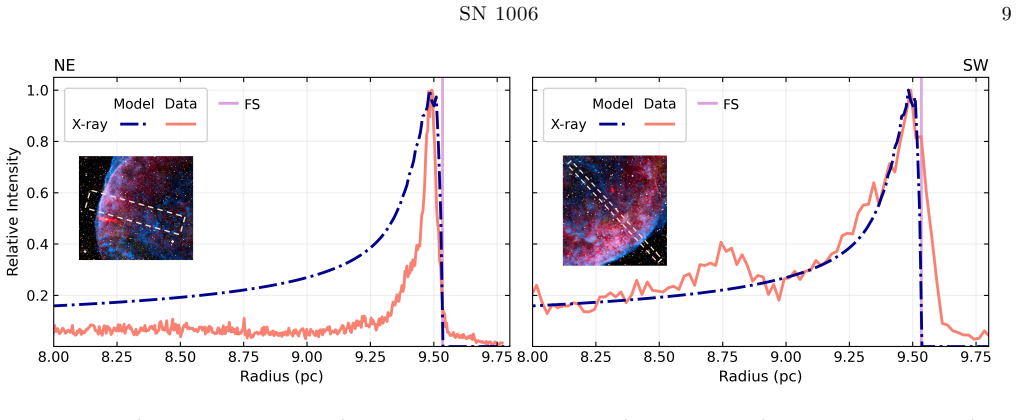
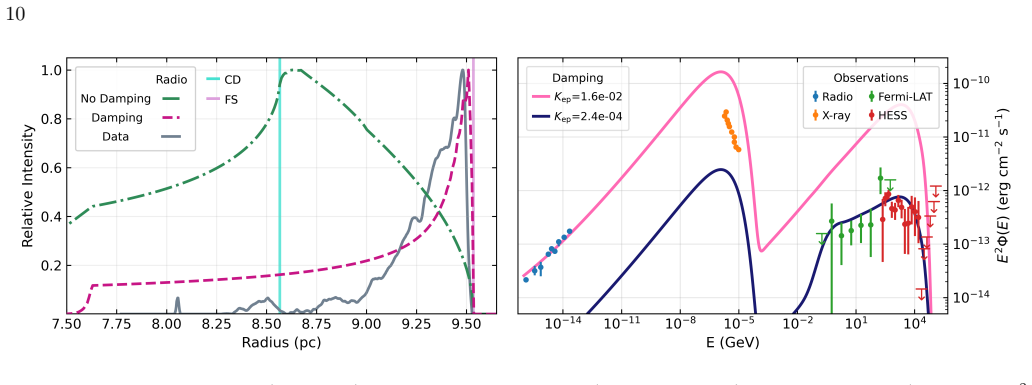
SN 1006 is a historical Type Ia supernova remnant that exhibits non-thermal emission ranging from radio to multi-TeV $\gamma$-rays. Most of this emission (particularly X-rays and $\gamma$-rays) is concentrated in polar caps aligned with the ambient magnetic field, which makes it an ideal laboratory for studying cosmic ray (CR) acceleration at different shock obliquities and the hadronic/leptonic nature of the $\gamma$-ray emission. We model SN 1006's morphology, multi-wavelength spectrum, and radial profile using a self-consistent multi-zone kinetic model of particle acceleration that accounts for: CR-driven shock modification, magnetic field amplification, drift in magnetic fluctuations, and temporal dynamics including adiabatic and synchrotron losses. Our model can reproduce both the observed spectral and spatial properties, with the exception of the radio profile that we argue requires 3D hydrodynamic effects to replicate. We find that quasi-parallel regions (where the shock normal aligns with the ambient magnetic field) exhibit very prominent CR acceleration ($\sim$20% efficiency), while quasi-perpendicular regions exhibit efficiencies below 1%, consistent with the results of kinetic simulations. We also find that electrons are responsible for the majority of the $\gamma$-ray emission from SN 1006 (i.e., it is a leptonic source), with the exception of the northwest region due to an encounter with a dense cloud.
Editorial analysis
A structured set of objections, weighed in public.
Referee Report
Summary. The manuscript presents a 2D multi-zone kinetic model of particle acceleration in SN 1006 that incorporates CR-driven shock modification, magnetic field amplification, and particle losses. The model reproduces the observed multi-wavelength spectrum and spatial morphology (except the radio radial profile, which is attributed to 3D hydrodynamic effects). It concludes that CR acceleration efficiency reaches ~20% in quasi-parallel regions and falls below 1% in quasi-perpendicular regions, and that the gamma-ray emission is predominantly leptonic except in the northwest where a dense cloud interaction occurs.
Significance. If robust, the results would provide direct observational constraints on obliquity-dependent CR acceleration efficiencies in supernova remnants, consistent with kinetic simulations, and clarify the leptonic versus hadronic origin of gamma-ray emission in SN 1006. The self-consistent inclusion of shock modification and field amplification adds strength to the modeling approach.
major comments (2)
- [Abstract] Abstract: The central claims on the ~20% versus <1% efficiency contrast and the leptonic nature of the gamma-ray emission (except NW) are obtained by fitting a 2D model whose free parameters include the ambient magnetic-field orientation and the presence/density of the NW cloud. The manuscript states that the same model cannot reproduce the radio radial profile without 3D hydrodynamic effects; because gamma-ray morphology is shaped by the same transport and loss physics, an untested 3D correction or modest change in assumed B-field angle could alter the required proton versus electron contributions and the derived efficiencies.
- [Model description] Model description (final paragraph of abstract): No section demonstrates that the leptonic/hadronic partition or the efficiency values remain stable under plausible variations of the two key inputs (B-field angle and cloud parameters). Because the efficiencies are among the fitted free parameters, the specific numerical contrast may reflect the chosen assumptions rather than a unique determination from the data.
minor comments (1)
- The abstract notes the radio-profile discrepancy but does not quantify how the 3D effects invoked for radio might (or might not) propagate to the gamma-ray band; a brief statement on this point would improve clarity.
Simulated Author's Rebuttal
We thank the referee for the constructive comments on our modeling of SN 1006. We address the two major comments below, clarifying the constraints from the data and indicating where we will strengthen the manuscript.
read point-by-point responses
-
Referee: [Abstract] Abstract: The central claims on the ~20% versus <1% efficiency contrast and the leptonic nature of the gamma-ray emission (except NW) are obtained by fitting a 2D model whose free parameters include the ambient magnetic-field orientation and the presence/density of the NW cloud. The manuscript states that the same model cannot reproduce the radio radial profile without 3D hydrodynamic effects; because gamma-ray morphology is shaped by the same transport and loss physics, an untested 3D correction or modest change in assumed B-field angle could alter the required proton versus electron contributions and the derived efficiencies.
Authors: We agree that the model is two-dimensional and that three-dimensional hydrodynamic effects are required to reproduce the radio radial profile. The gamma-ray morphology, however, is reproduced to good accuracy in the 2D calculation, and this observable directly informs the leptonic versus hadronic partition. The self-consistent inclusion of shock modification, magnetic-field amplification, and particle losses ties the efficiencies and emission mechanisms to the multi-wavelength data. We will add a paragraph in the discussion section that explicitly addresses the possible impact of 3D geometry on the gamma-ray morphology and derived efficiencies, while emphasizing that the present 2D model already provides a consistent description of the observed gamma-ray and X-ray maps. revision: partial
-
Referee: [Model description] Model description (final paragraph of abstract): No section demonstrates that the leptonic/hadronic partition or the efficiency values remain stable under plausible variations of the two key inputs (B-field angle and cloud parameters). Because the efficiencies are among the fitted free parameters, the specific numerical contrast may reflect the chosen assumptions rather than a unique determination from the data.
Authors: The ambient magnetic-field orientation is not a completely free parameter; it is fixed by the requirement that the model reproduce the observed bilateral synchrotron morphology. The northwest cloud density is likewise guided by independent X-ray and infrared observations of the cloud interaction. Although the original manuscript did not contain an explicit sensitivity study, the best-fit solution is stable within the observationally allowed ranges. We will insert a new subsection in the results section that varies the magnetic-field angle by ±10° around the best-fit value and the cloud density within the range permitted by the data, showing that the ~20 % versus <1 % efficiency contrast and the predominantly leptonic character of the gamma-ray emission are preserved. revision: yes
Circularity Check
No circularity: model outputs derived from independent physical assumptions and data fits
full rationale
The paper constructs a multi-zone kinetic model incorporating CR-driven shock modification, magnetic amplification, drift, and losses, then adjusts parameters to reproduce observed spectra, morphology, and profiles. The reported efficiencies (~20% quasi-parallel, <1% quasi-perpendicular) and leptonic/hadronic partition emerge as outputs of this fit, cross-checked against external kinetic simulations. No quoted equation or self-citation reduces these results to inputs by construction; the derivation remains self-contained against the data and prior independent simulations. Standard modeling practice, not circular.
Axiom & Free-Parameter Ledger
free parameters (2)
- CR acceleration efficiency (quasi-parallel)
- CR acceleration efficiency (quasi-perpendicular)
axioms (1)
- domain assumption CR-driven shock modification, magnetic field amplification, and particle drift in fluctuations are the dominant processes controlling acceleration at different obliquities
Reference graph
Works this paper leans on
-
[1]
The ``toothbrush-relic'': evidence for a coherent linear 2-Mpc scale shock wave in a massive merging galaxy cluster?. , keywords =. doi:10.1051/0004-6361/201219000 , archivePrefix =. 1209.2196 , primaryClass =
work page internal anchor Pith review Pith/arXiv arXiv doi:10.1051/0004-6361/201219000
-
[2]
Constraining the efficiency of cosmic ray acceleration by cluster shocks
Constraining the efficiency of cosmic ray acceleration by cluster shocks. , keywords =. doi:10.1093/mnras/stw584 , archivePrefix =. 1603.02688 , primaryClass =
work page internal anchor Pith review Pith/arXiv arXiv doi:10.1093/mnras/stw584
-
[3]
Ion Weibel Instability in the hybrid framework: the optimal resolution
Ion Weibel Instability in the hybrid framework: the optimal resolution. arXiv e-prints , keywords =. doi:10.48550/arXiv.2604.05021 , archivePrefix =. 2604.05021 , primaryClass =
work page internal anchor Pith review Pith/arXiv arXiv doi:10.48550/arxiv.2604.05021
-
[4]
A., Schnurr O., Hirschi R., Yusof N., Parker R
Simulating the -ray emission from galaxy clusters: a universal cosmic ray spectrum and spatial distribution. , keywords =. doi:10.1111/j.1365-2966.2010.17328.x , archivePrefix =. 1001.5023 , primaryClass =
-
[5]
On the mediation of a shock front by Fermi-accelerated cosmic rays. , keywords =. doi:10.1086/157998 , adsurl =
-
[6]
Cluster magnetic fields from large-scale-structure and galaxy-cluster shocks
Cluster Magnetic Fields from Large-Scale Structure and Galaxy Cluster Shocks. , keywords =. doi:10.1086/504470 , archivePrefix =. astro-ph/0512079 , primaryClass =
work page internal anchor Pith review Pith/arXiv arXiv doi:10.1086/504470
-
[7]
Generation of Magnetic Fields in the Relativistic Shock of Gamma-Ray-Burst Sources
Generation of Magnetic Fields in the Relativistic Shock of Gamma-Ray Burst Sources. , keywords =. doi:10.1086/308038 , archivePrefix =. astro-ph/9904363 , primaryClass =
work page internal anchor Pith review Pith/arXiv arXiv doi:10.1086/308038
-
[8]
Gamma-Ray Burst Afterglow: Polarization and Analytic Light Curves
Gamma-Ray Burst Afterglow: Polarization and Analytic Light Curves. , keywords =. doi:10.1086/306720 , archivePrefix =. astro-ph/9807111 , primaryClass =
work page internal anchor Pith review Pith/arXiv arXiv doi:10.1086/306720
-
[9]
Particle transport in tangled magnetic fields and Fermi acceleration at relativistic shocks
Particle Transport in Tangled Magnetic Fields and Fermi Acceleration at Relativistic Shocks. , keywords =. doi:10.1086/376353 , archivePrefix =. astro-ph/0304058 , primaryClass =
work page internal anchor Pith review Pith/arXiv arXiv doi:10.1086/376353
-
[10]
Acceleration time scale for the first-order Fermi acceleration in relativistic shock waves
The acceleration time-scale for first-order Fermi acceleration in relativistic shock waves. , keywords =. doi:10.1093/mnras/283.2.447 , archivePrefix =. astro-ph/9608078 , primaryClass =
work page internal anchor Pith review Pith/arXiv arXiv doi:10.1093/mnras/283.2.447
-
[11]
Fermi acceleration by relativistic shock waves. , keywords =. doi:10.1093/mnras/196.2.135 , adsurl =
-
[12]
Microphysics of Particle Reflection in Weibel-mediated Shocks. , keywords =. doi:10.3847/1538-4357/ad527d , archivePrefix =. 2310.12950 , primaryClass =
-
[13]
Electron-Ion Temperature Ratio in Astrophysical Shocks. , keywords =. doi:10.3847/1538-4357/acc528 , archivePrefix =. 2303.08849 , primaryClass =
-
[14]
doi:10.1051/0004-6361/201527761 , Eid =. arXiv , Author =:1511.05343 , Journal =
work page internal anchor Pith review Pith/arXiv arXiv doi:10.1051/0004-6361/201527761
-
[15]
Collisionless Shocks in a Partially Ionized Medium. II. Balmer Emission , Volume =. doi:10.1088/0004-637X/760/2/137 , Eid =. arXiv , Author =:1210.4296 , Journal =
work page internal anchor Pith review Pith/arXiv arXiv doi:10.1088/0004-637x/760/2/137
-
[16]
European Physical Journal Web of Conferences , Doi =. 2019 , Bdsk-Url-1 =. arXiv , Author =:1902.08124 , Keywords =
Pith/arXiv arXiv 2019
-
[17]
Adriani, O. and Akaike, Y. and Asano, K. and Asaoka, Y. and Bagliesi, M. G. and Berti, E. and Bigongiari, G. and Binns, W. R. and Bonechi, S. and Bongi, M. and Brogi, P. and Bruno, A. and Buckley, J. H. and Cannady, N. and Castellini, G. and Checchia, C. and Cherry, M. L. and Collazuol, G. and Di Felice, V. and Ebisawa, K. and Fuke, H. and Guzik, T. G. an...
-
[18]
Manconi and M
S. Manconi and M. Di Mauro and F. Donato , Doi =. Multi-messenger constraints to the local emission of cosmic-ray electrons , Url =. Journal of Cosmology and Astroparticle Physics , Month =
-
[19]
The origin of the spectral intensities of cosmic-ray positrons
2014 , Bdsk-Url-1 =. doi:10.1088/0004-637X/786/2/124 , Eid =. arXiv , Author =:1305.1242 , Journal =
work page internal anchor Pith review Pith/arXiv arXiv doi:10.1088/0004-637x/786/2/124 2014
-
[20]
Reviews of Modern Physics , author =
Reviews of Modern Physics , Keywords =. 2001 , Bdsk-Url-1 =. doi:10.1103/RevModPhys.73.1031 , Eprint =
-
[21]
Cowsik and T
R. Cowsik and T. Madziwa-Nussinov , Doi =. The Astrophysical Journal , Month =
-
[22]
2016 , Bdsk-Url-1 =. doi:10.1017/S0022377816000660 , Eid =. arXiv , Author =:1601.01570 , Journal =
work page internal anchor Pith review Pith/arXiv arXiv doi:10.1017/s0022377816000660 2016
-
[23]
Lowe, R. E. and Burgess, D. , Doi =. The properties and causes of rippling in quasi-perpendicular collisionless shock fronts , Url =. Annales Geophysicae , Number =. 2003 , Bdsk-Url-1 =
2003
-
[24]
Shock ripples observed by the
Andreas Johlander and Andris Vaivads and Yuri V Khotyaintsev and Imogen Gingell and Steven J Schwartz and Barbara L Giles and Roy B Torbert and Christopher T Russell , Doi =. Shock ripples observed by the. Plasma Physics and Controlled Fusion , Month =
-
[25]
and Schwartz, S
Johlander, A. and Schwartz, S. J. and Vaivads, A. and Khotyaintsev, Y. V. and Gingell, I. and Peng, I. B. and Markidis, S. and Lindqvist, P.-A. and Ergun, R. E. and Marklund, G. T. and Plaschke, F. and Magnes, W. and Strangeway, R. J. and Russell, C. T. and Wei, H. and Torbert, R. B. and Paterson, W. R. and Gershman, D. J. and Dorelli, J. C. and Avanov, L...
2016
-
[26]
Johlander, A. and Vaivads, A. and Khotyaintsev, Y. V. and Retin. Ion injection at Quasi-parallel Shocks Seen by the Cluster Spacecraft , Url =. , Keywords =. 2016 , Bdsk-Url-1 =. doi:10.3847/2041-8205/817/1/L4 , Eid =
-
[27]
Kinetic simulations of mildly relativistic shocks: Particle acceleration in high Mach number shocks , Url =. , Keywords =. 2019 , Bdsk-Url-1 =. doi:10.1093/mnras/stz232 , Eprint =
-
[28]
Weidl and Dan Winske and Christoph Niemann , Doi =
Martin S. Weidl and Dan Winske and Christoph Niemann , Doi =. On the Background-gyroresonant Character of Bell's Instability in the Large-current Regime , Url =. The Astrophysical Journal , Month =
-
[29]
Jokipii, J. R. , Doi =. Propagation of cosmic rays in the solar wind , Url =. 1971 , Bdsk-Url-1 =. https://agupubs.onlinelibrary.wiley.com/doi/pdf/10.1029/RG009i001p00027 , Journal =
-
[30]
The Astrophysical Journal , Month = apr, Title =
Mignone, A and Bodo, G and Vaidya, B and Mattia, G , Doi =. The Astrophysical Journal , Month = apr, Title =. 2018 , Bdsk-Url-1 =
2018
-
[31]
Blazars as Ultra-High-Energy Cosmic-Ray Sources: Implications for TeV Gamma-Ray Observations
2012 , Bdsk-Url-1 =. doi:10.1088/0004-637X/749/1/63 , Eid =. arXiv , Author =:1107.5576 , Journal =
work page internal anchor Pith review Pith/arXiv arXiv doi:10.1088/0004-637x/749/1/63 2012
-
[32]
MNRAS , Keywords =. doi:10.1111/j.1365-2966.2009.15428.x , Eprint =
-
[33]
arXiv , Author =:1407.5223 , Journal =
-
[34]
, Keywords =
Cambridge and New York, Cambridge University Press, 1990, 292 p. , Keywords =
1990
-
[35]
doi:10.1088/1742-6596/409/1/012008 , Eid =
Journal of Physics Conference Series , Month = feb, Number = 1, Pages =. doi:10.1088/1742-6596/409/1/012008 , Eid =
-
[36]
astro-ph/9803299 , Journal =
-
[37]
MNRAS , Keywords =. 2000 , Bdsk-Url-1 =. doi:10.1046/j.1365-8711.2000.03146.x , Eprint =
-
[38]
doi:10.1016/j.astropartphys.2010.12.008 , Eprint =
, Month = mar, Pages =. doi:10.1016/j.astropartphys.2010.12.008 , Eprint =
-
[39]
Phys. Rep. , Month = sep, Pages =. doi:10.1016/j.physrep.2008.05.004 , Eprint =
-
[40]
ApJ Lett. , Keywords =. doi:10.1088/2041-8205/790/2/L21 , Eid =
-
[41]
doi:10.1016/j.astropartphys.2010.08.010 , Eprint =
, Pages =. doi:10.1016/j.astropartphys.2010.08.010 , Eprint =
-
[42]
doi:10.1016/j.nuclphysbps.2009.03.069 , Eprint =
Nuclear Physics B Proceedings Supplements , Month = may, Pages =. doi:10.1016/j.nuclphysbps.2009.03.069 , Eprint =
-
[43]
ApJ Lett. , Keywords =. doi:10.1088/2041-8205/720/2/L155 , Eprint =
-
[44]
MNRAS , Keywords =. 2010 , Bdsk-Url-1 =. doi:10.1111/j.1365-2966.2009.15784.x , Eprint =
-
[45]
doi:10.4236/ijaa.2014.43046 , Journal =
2014 , Bdsk-Url-1 =. doi:10.4236/ijaa.2014.43046 , Journal =
-
[46]
MNRAS , Keywords =. 2001 , Bdsk-Url-1 =. doi:10.1046/j.1365-8711.2001.04851.x , Eprint =
-
[47]
doi:10.1088/1367-2630/6/1/140 , Journal =
-
[48]
Physical Review Letters , Month = jul, Pages =. 1995 , Bdsk-Url-1 =. doi:10.1103/PhysRevLett.75.386 , Eprint =
-
[49]
Astroparticle Physics , Month = may, Pages =. 2012 , Bdsk-Url-1 =. doi:10.1016/j.astropartphys.2012.02.004 , Eprint =
-
[50]
arXiv , Author =:1310.5477 , Journal =
Probing the origin of cosmic-rays with extremely high energy neutrinos using the IceCube Observatory , Volume =. arXiv , Author =:1310.5477 , Journal =
-
[51]
Cosmic ray composition and energy spectrum from 1-30 PeV using the 40-string configuration of IceTop and IceCube. Astroparticle Physics , keywords =. doi:10.1016/j.astropartphys.2012.11.003 , archivePrefix =. 1207.3455 , primaryClass =
work page internal anchor Pith review Pith/arXiv arXiv doi:10.1016/j.astropartphys.2012.11.003 2012
-
[52]
, Keywords =. doi:10.1086/510831 , Eprint =
-
[53]
arXiv , Author =:1311.0287 , Journal =
-
[54]
and Trivelpiece, A.W
Krall, N.A. and Trivelpiece, A.W. , Date-Added =. Principles of plasma physics , Url =. 1973 , Bdsk-Url-1 =
1973
-
[55]
, Keywords =. doi:10.1086/309533 , Eprint =
-
[56]
doi:10.1038/nphys2541 , Eprint =
Nature Physics , Month = mar, Pages =. doi:10.1038/nphys2541 , Eprint =
-
[57]
doi:10.3847/1538-4357/aa76ea , Eid =. arXiv , Author =:1705.11096 , Journal =
work page internal anchor Pith review Pith/arXiv arXiv doi:10.3847/1538-4357/aa76ea
-
[58]
A. Masters and A. H. Sulaiman and N. Sergis and L. Stawarz and M. Fujimoto and A. J. Coates and M. K. Dougherty , title =. The Astrophysical Journal , abstract =. 2016 , month =. doi:10.3847/0004-637X/826/1/48 , url =
-
[59]
doi:10.1063/1.866765 , Journal =
-
[60]
doi:10.1093/mnras/stt100 , Eprint =
, Keywords =. doi:10.1093/mnras/stt100 , Eprint =
-
[61]
doi:10.1088/0004-637X/721/1/828 , Eprint =
, Keywords =. doi:10.1088/0004-637X/721/1/828 , Eprint =
-
[62]
doi:10.1093/mnras/stt179 , Eprint =
MNRAS , Keywords =. doi:10.1093/mnras/stt179 , Eprint =
-
[63]
MNRAS , Month = jan, Pages =
-
[64]
MNRAS , Month = feb, Pages =
-
[65]
2001 , Bdsk-Url-1 =
MNRAS , Month = mar, Pages =. 2001 , Bdsk-Url-1 =
2001
-
[66]
Bell, A. R. , Date-Added =. doi:10.1111/j.1365-2966.2004.08097.x , Journal =
-
[67]
, Keywords =. doi:10.1086/591308 , Eprint =
-
[68]
astro-ph/0104064 , Journal =
-
[69]
doi:10.1051/0004-6361:20042015 , Eprint =
A&A , Month = apr, Pages =. doi:10.1051/0004-6361:20042015 , Eprint =
-
[70]
Akademiia Nauk SSSR Doklady , Month = jun, Pages =
-
[71]
doi:10.1086/182658 , Journal =
1978 , Bdsk-Url-1 =. doi:10.1086/182658 , Journal =
-
[72]
doi:10.1142/S0217732305019213 , Eprint =
Modern Physics Letters A , Pages =. doi:10.1142/S0217732305019213 , Eprint =
-
[73]
The origin of the positron excess in cosmic rays
2009 , Bdsk-Url-1 =. doi:10.1103/PhysRevLett.103.051104 , Eid =. arXiv , Author =:0903.2794 , Journal =
work page internal anchor Pith review Pith/arXiv arXiv doi:10.1103/physrevlett.103.051104 2009
-
[74]
Fast electron transport in laser-produced plasmas and the
A R Bell and A P L Robinson and M Sherlock and R J Kingham and W Rozmus , Doi =. Fast electron transport in laser-produced plasmas and the. Plasma Physics and Controlled Fusion , Month =
-
[75]
doi:10.1016/0021-9991(86)90076-8 , Journal =
1986 , Bdsk-Url-1 =. doi:10.1016/0021-9991(86)90076-8 , Journal =
-
[76]
2000 , Bdsk-Url-1 =
MNRAS , Month = may, Pages =. 2000 , Bdsk-Url-1 =
2000
-
[77]
doi:10.1007/BF00642346 , Journal =
-
[78]
MNRAS , Month = sep, Pages =. doi:10.1111/j.1365-2966.2006.10739.x , Eprint =
-
[79]
1982 , Bdsk-Url-1 =
A&A , Month = dec, Pages =. 1982 , Bdsk-Url-1 =
1982
-
[80]
Solar Physics , Pages =
discussion (0)
Sign in with ORCID, Apple, or X to comment. Anyone can read and Pith papers without signing in.