Shaping the horizontal branch: The role of envelope mass in the evolution of stripped core-helium-burning stars
Pith reviewed 2026-06-27 08:12 UTC · model grok-4.3
The pith
The residual hydrogen envelope mass after stripping on the first giant branch sets the horizontal branch position of core-helium-burning stars and the maximum mass that still avoids later thermally pulsing asymptotic giant branch evolution.
A machine-rendered reading of the paper's core claim, the machinery that carries it, and where it could break.
Core claim
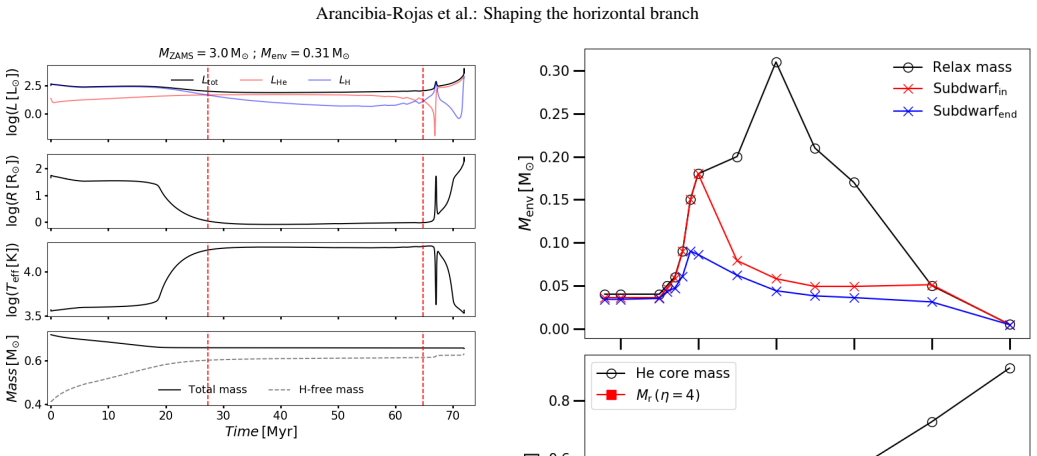
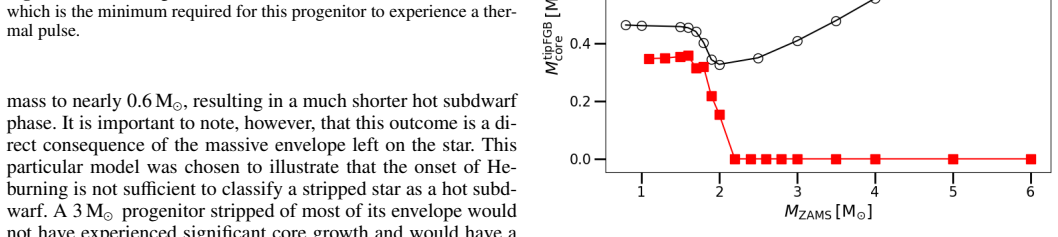
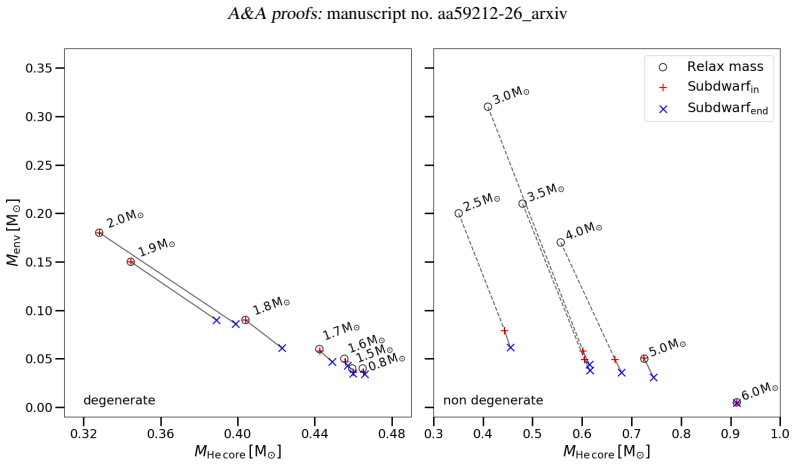
We computed evolutionary sequences for stripped stars with initial masses below about 6 solar masses at two metallicities, removing the envelope at the minimum and maximum core masses for helium ignition and varying the remaining envelope mass. As envelope mass rises, stars sit at cooler temperatures on the horizontal branch. The upper limit on envelope mass to skip the thermally pulsing asymptotic giant branch is 0.05 solar masses for low-mass progenitors and 0.30 solar masses for intermediate-mass ones. Early envelope loss in low-mass cases triggers a late hot flash that reproduces the properties of the hottest blue hook stars, while intermediate-mass cases with partial stripping match ext
What carries the argument
Residual hydrogen-envelope mass after stripping on the first giant branch, which controls effective temperature on the horizontal branch and the path of subsequent evolution.
If this is right
- Effective temperature along the horizontal branch decreases with increasing residual envelope mass.
- Maximum residual envelope mass to avoid the thermally pulsing asymptotic giant branch is approximately 0.05 solar masses for low-mass progenitors and 0.30 solar masses for intermediate-mass progenitors.
- Early envelope removal in low-mass progenitors induces a late hot flash that explains the hottest blue hook stars.
- Partial envelope stripping in intermediate-mass systems produces extended pre-horizontal-branch configurations observed in binaries with Be companions.
- Post-stripping evolutionary tracks are made available for use in binary population synthesis.
Where Pith is reading between the lines
- These envelope mass thresholds may help predict the fraction of horizontal branch stars versus asymptotic giant branch stars in stellar populations.
- The models could be tested against observed horizontal branch morphologies in globular clusters at different metallicities.
- The late hot flash mechanism might apply to other stripping scenarios such as those in close binaries.
- Extending the grid to higher masses or different stripping timings could reveal additional pathways for blue hook star formation.
Load-bearing premise
Envelope removal is assumed to occur on the first giant branch at the two extreme core masses that allow helium ignition.
What would settle it
A direct count of whether stars with measured envelope masses above 0.30 solar masses for intermediate-mass progenitors proceed to the thermally pulsing asymptotic giant branch or remain on the horizontal branch.
Figures




read the original abstract
The location of a star along the horizontal branch (HB) during core-helium burning is primarily determined by the amount of mass lost by its progenitor. We investigate the formation and properties of stripped core-helium-burning stars, focusing on how the residual hydrogen-envelope mass ($M_{\mathrm{env}}$) and the timing of envelope removal shape their properties. We used the MESA stellar evolution code to model stars that lose their hydrogen envelopes on the first giant branch. We explored two limiting cases for the timing of stripping, corresponding to the minimum and maximum core masses for helium ignition, for progenitors with initial masses below $\sim$6 $M_{\odot}$ at two metallicities ($Z=0.02$ and $Z=0.004$), while systematically varying $M_{\mathrm{env}}$. As expected, the effective temperature along the HB decreases as $M_{\mathrm{env}}$ increases. We determined the maximum $M_{\mathrm{env}}$ required to avoid subsequent evolution through the thermally pulsing asymptotic giant branch, which ranges from $\sim0.05$ $M_{\odot}$, for low-mass progenitors to $\sim0.30$ $M_{\odot}$ for intermediate-mass progenitors. In low-mass progenitors, early envelope removal triggers a late hot flash, naturally explaining the hottest blue hook stars. In intermediate-mass systems, partial envelope stripping can produce extended pre-HB configurations consistent with puffed-up stripped stars observed in binaries with Be companions. Our post-stripping evolutionary tracks are publicly available for use in binary evolution and population synthesis studies.
Editorial analysis
A structured set of objections, weighed in public.
Referee Report
Summary. The paper uses MESA to model stars that lose their hydrogen envelopes on the first giant branch, exploring two limiting cases for the timing of stripping (minimum and maximum core masses for helium ignition) for progenitors below ~6 Msun at Z=0.02 and Z=0.004 while varying residual envelope mass M_env. It reports that effective temperature on the HB decreases with increasing M_env, determines the maximum M_env to avoid TP-AGB evolution (~0.05 Msun for low-mass to ~0.30 Msun for intermediate-mass progenitors), and notes that early stripping in low-mass stars triggers a late hot flash while partial stripping in intermediate-mass systems can produce extended pre-HB phases. Post-stripping tracks are made public.
Significance. If the numerical results hold, the work supplies publicly available evolutionary tracks useful for binary population synthesis and offers a natural explanation for the hottest blue hook stars via late hot flashes in low-mass stripped stars. The systematic parameter variation over progenitor mass and metallicity strengthens the mapping from M_env to HB location and TP-AGB avoidance.
major comments (1)
- [Abstract and methods description] Abstract and methods description: the reported maximum M_env thresholds (0.05–0.30 Msun) are obtained exclusively from instantaneous envelope removal at the two limiting core masses for He ignition. No sequences with finite-rate removal (e.g., over 10^4–10^6 yr) or continuous mass-loss histories are described; because core growth and thermal relaxation during stripping depend on the adopted timescale, the critical M_env values could shift by an amount comparable to the quoted range itself.
Simulated Author's Rebuttal
We thank the referee for their careful reading of the manuscript and for identifying this methodological point. We address the comment below.
read point-by-point responses
-
Referee: [Abstract and methods description] Abstract and methods description: the reported maximum M_env thresholds (0.05–0.30 Msun) are obtained exclusively from instantaneous envelope removal at the two limiting core masses for He ignition. No sequences with finite-rate removal (e.g., over 10^4–10^6 yr) or continuous mass-loss histories are described; because core growth and thermal relaxation during stripping depend on the adopted timescale, the critical M_env values could shift by an amount comparable to the quoted range itself.
Authors: We thank the referee for this observation. Our calculations deliberately employ instantaneous envelope removal at the two limiting core masses for helium ignition precisely to bracket the range of possible stripping outcomes while isolating the dependence on residual envelope mass M_env. These two cases correspond to the earliest and latest plausible moments of envelope loss on the first giant branch. We acknowledge that a finite-duration mass-loss episode would permit some core growth and thermal readjustment during the stripping phase itself, and that the precise critical M_env values separating HB from TP-AGB evolution could therefore differ from the instantaneous limits we report. In the revised manuscript we will (i) state explicitly in the methods section that envelope removal is modeled as instantaneous, (ii) add a brief discussion of how continuous mass-loss histories would be expected to produce results intermediate between our two limiting cases, and (iii) note this modeling choice as a limitation when interpreting the quoted M_env thresholds. We believe these additions will clarify the scope of the reported thresholds without altering the main conclusions of the work. revision: yes
Circularity Check
No circularity: numerical forward modeling with M_env varied as explicit input
full rationale
The paper runs MESA simulations that take initial mass, metallicity, stripping timing (two fixed RGB core-mass limits), and residual M_env as independent inputs, then reports the resulting HB properties and the M_env threshold that avoids TP-AGB evolution. These thresholds are direct simulation outputs, not quantities obtained by fitting to data and then relabeled as predictions, nor derived from self-citations whose content reduces to the present work. No self-definitional loops, ansatz smuggling, or renaming of known results appear in the derivation chain. The work is self-contained against external stellar-evolution benchmarks.
Axiom & Free-Parameter Ledger
free parameters (1)
- M_env
axioms (2)
- domain assumption MESA code accurately captures core helium burning, envelope stripping, and subsequent evolution for stars below 6 solar masses at the stated metallicities.
- domain assumption Envelope removal occurs on the first giant branch in the two limiting core-mass cases for helium ignition.
Reference graph
Works this paper leans on
-
[1]
, year = 1954, month = jan, volume = 119, pages =
On the Indentification of Radio Sources. , year = 1954, month = jan, volume = 119, pages =
1954
-
[2]
Lithium and mass loss in massive AGB stars in the Large Magellanic Clouds
Lithium and mass loss in massive AGB stars in the Large Magellanic Cloud. , keywords =. doi:10.48550/arXiv.astro-ph/0101374 , archivePrefix =. astro-ph/0101374 , primaryClass =
work page internal anchor Pith review Pith/arXiv arXiv doi:10.48550/arxiv.astro-ph/0101374
-
[3]
The Origin of Hot Subluminous Horizontal-Branch Stars in Omega Centauri and NGC 2808
The Origin of Hot Subluminous Horizontal-Branch Stars in Centauri and NGC 2808. Omega Centauri, A Unique Window into Astrophysics , year = 2002, editor =. doi:10.48550/arXiv.astro-ph/0203063 , archivePrefix =. astro-ph/0203063 , primaryClass =
work page internal anchor Pith review Pith/arXiv arXiv doi:10.48550/arxiv.astro-ph/0203063 2002
-
[4]
Mass Loss in Globular Cluster Red Giants: an Evolutionary Investigation. , keywords =. doi:10.1086/172547 , adsurl =
-
[5]
Stellar evolution of low and intermediate-mass stars. I. Mass loss on the AGB and its consequences for stellar evolution. , keywords =
-
[6]
RR Lyrae from binary evolution: abundant, young, and metal-rich. , keywords =. doi:10.1093/mnras/stad3996 , archivePrefix =. 2208.04332 , primaryClass =
-
[7]
Alone but not lonely: Observational evidence that binary interaction is always required to form hot subdwarf stars. , keywords =. doi:10.1051/0004-6361/202038473 , archivePrefix =. 2008.07522 , primaryClass =
-
[8]
Horizontal-branch morphology and multiple stellar populations in the anomalous globular cluster M22
Horizontal Branch Morphology and Multiple Stellar Populations in the Anomalous Globular Cluster M 22. , keywords =. doi:10.1088/0004-637X/768/1/27 , archivePrefix =. 1302.5870 , primaryClass =
work page internal anchor Pith review Pith/arXiv arXiv doi:10.1088/0004-637x/768/1/27
-
[9]
, year = 1976, month = mar, volume =
Gaps in the blue horizontal branch. , year = 1976, month = mar, volume =. doi:10.1086/154228 , adsurl =
-
[10]
Multiple Populations on the Horizontal Branch. I. Observations in the (log g, log T eff)--Diagram. , keywords =. doi:10.1086/166648 , adsurl =
-
[11]
A stripped-companion origin for Be stars: clues from the putative black holes HR 6819 and LB-1. , keywords =. doi:10.1093/mnras/stab285 , archivePrefix =. 2006.11974 , primaryClass =
-
[12]
Evolutionary nature of puffed-up stripped star binaries and their occurrence in stellar populations. , keywords =. doi:10.1051/0004-6361/202349065 , archivePrefix =. 2312.12658 , primaryClass =
-
[13]
A self-synthesized origin for heavy metals in hot subdwarf stars. , keywords =. doi:10.1051/0004-6361/202348157 , archivePrefix =. 2311.04700 , primaryClass =
-
[14]
Bimodality and Gaps on Globular Cluster Horizontal Branches. II. The Cases of NGC 6229, NGC 1851, and NGC 2808. , keywords =. doi:10.1086/305200 , archivePrefix =. astro-ph/9708096 , primaryClass =
work page internal anchor Pith review Pith/arXiv arXiv doi:10.1086/305200
-
[15]
The sdA problem I: Physical Properties
The sdA problem - I. Physical properties. , keywords =. doi:10.1093/mnras/sty011 , archivePrefix =. 1801.00495 , primaryClass =
work page internal anchor Pith review Pith/arXiv arXiv doi:10.1093/mnras/sty011
-
[16]
Are sdAs helium core stars?. Open Astronomy , keywords =. doi:10.1515/astro-2017-0433 , archivePrefix =. 1710.09882 , primaryClass =
work page internal anchor Pith review Pith/arXiv arXiv doi:10.1515/astro-2017-0433 2017
-
[17]
New white dwarf and subdwarf stars in the Sloan Digital Sky Survey Data Release 12
New white dwarf and subdwarf stars in the Sloan Digital Sky Survey Data Release 12. , keywords =. doi:10.1093/mnras/stv2526 , archivePrefix =. 1510.08409 , primaryClass =
work page internal anchor Pith review Pith/arXiv arXiv doi:10.1093/mnras/stv2526
-
[18]
The Nature of Faint Blue Stars in the Halo. II. , year = 1974, month = nov, volume =. doi:10.1086/190315 , adsurl =
-
[19]
IAU Colloq
Quantitative spectroscopy of HBB stars and sdB stars. IAU Colloq. 95: Second Conference on Faint Blue Stars , year = 1987, editor =
1987
-
[20]
Ultraviolet Radiation from Evolved Stellar Populations. I. Models. , keywords =. doi:10.1086/173511 , archivePrefix =. astro-ph/9311022 , primaryClass =
work page internal anchor Pith review Pith/arXiv arXiv doi:10.1086/173511
-
[21]
Synthetic Colors and the Chemical Evolution of Elliptical Galaxies. , keywords =. doi:10.1086/168330 , adsurl =
-
[22]
Analysis of the Hot Stellar Population of the Globular Cluster Centauri. , keywords =. doi:10.1086/305288 , adsurl =
-
[23]
, year = 2016, month = sep, volume =
Red Clump Stars. , year = 2016, month = sep, volume =. doi:10.1146/annurev-astro-081915-023354 , adsurl =
-
[24]
HST Observations of New Horizontal Branch Structures in the Globular Cluster omega Centauri
Hubble Space Telescope Observations of New Horizontal Branch Structures in the Globular Cluster omega Centauri. , keywords =. doi:10.1086/308375 , archivePrefix =. astro-ph/9909371 , primaryClass =
work page internal anchor Pith review Pith/arXiv arXiv doi:10.1086/308375
-
[25]
The elusive chase for the first RR Lyr star in a binary system: the case of KIC 2831097. , keywords =. doi:10.1051/0004-6361/202556279 , archivePrefix =. 2509.20473 , primaryClass =
-
[26]
VFTS 291: a stripped star from a recent mass transfer phase
The B-type Binaries Characterisation Programme - II. VFTS 291: a stripped star from a recent mass transfer phase. , keywords =. doi:10.1093/mnras/stad2533 , archivePrefix =. 2307.07766 , primaryClass =
-
[27]
HR6819: a puffed-up stripped star system challenging stable mass transfer theory. , keywords =. doi:10.1051/0004-6361/202556556 , archivePrefix =. 2509.21521 , primaryClass =
-
[28]
The binary fraction of extreme horizontal branch stars. , keywords =. doi:10.1111/j.1365-2966.2001.04714.x , archivePrefix =. astro-ph/0103342 , primaryClass =
-
[29]
The binary fraction of blue horizontal branch stars. , keywords =. doi:10.1051/0004-6361/202555002 , archivePrefix =. 2508.02790 , primaryClass =
-
[30]
New RR Lyrae variables in binary systems
New RR Lyrae variables in binary systems. , keywords =. doi:10.1093/mnrasl/slv024 , archivePrefix =. 1502.01318 , primaryClass =
work page internal anchor Pith review Pith/arXiv arXiv doi:10.1093/mnrasl/slv024
-
[31]
Studies of RR Lyrae Variables in Binary Systems. I. Evidence of a Trimodal Companion Mass Distribution. , keywords =. doi:10.3847/1538-4357/abff4b , archivePrefix =. 2105.03750 , primaryClass =
-
[32]
A Radial-velocity Search for Binary RR Lyrae Variables. , keywords =. doi:10.3847/1538-3881/ac09f2 , archivePrefix =. 2106.05208 , primaryClass =
-
[33]
The Hubble Space Telescope UV Legacy Survey of Galactic Globular Clusters. VII. Implications from the Nearly Universal Nature of Horizontal Branch Discontinuities. , keywords =. doi:10.3847/0004-637X/822/1/44 , archivePrefix =. 1603.07651 , primaryClass =
work page internal anchor Pith review Pith/arXiv arXiv doi:10.3847/0004-637x/822/1/44
-
[34]
The atmosphere of subluminous B stars. II. Analysis of 10 helium poor subdwarfs and the birthrate of sdB stars. , keywords =
-
[35]
The Origin of Extreme Horizontal Branch Stars
The Origin of Extreme Horizontal Branch Stars. , keywords =. doi:10.1086/177515 , archivePrefix =. astro-ph/9511017 , primaryClass =
work page internal anchor Pith review Pith/arXiv arXiv doi:10.1086/177515
-
[36]
First full evolutionary computation of the He-flash induced mixing in Population II stars
First Full Evolutionary Computation of the Helium Flash-induced Mixing in Population II Stars. , keywords =. doi:10.1086/346200 , archivePrefix =. astro-ph/0211498 , primaryClass =
work page internal anchor Pith review Pith/arXiv arXiv doi:10.1086/346200
-
[37]
Helium Mixing in Globular Cluster Stars
Helium Mixing in Globular Cluster Stars. The Third Conference on Faint Blue Stars , year = 1997, editor =. doi:10.48550/arXiv.astro-ph/9708164 , archivePrefix =. astro-ph/9708164 , primaryClass =
work page internal anchor Pith review Pith/arXiv arXiv doi:10.48550/arxiv.astro-ph/9708164 1997
-
[38]
Spectroscopic analyses of the ``blue hook'' stars in omega Centauri: A test of the late hot flasher scenario. , keywords =. doi:10.1051/0004-6361:20021248 , archivePrefix =. astro-ph/0209028 , primaryClass =
work page internal anchor Pith review Pith/arXiv arXiv doi:10.1051/0004-6361:20021248
-
[39]
Spectroscopic analyses of the blue hook stars in NGC 2808: A more stringent test of the late hot flasher scenario. , keywords =. doi:10.1051/0004-6361:20034505 , archivePrefix =. astro-ph/0311215 , primaryClass =
work page internal anchor Pith review Pith/arXiv arXiv doi:10.1051/0004-6361:20034505
-
[40]
The Blue Hook Populations of Massive Globular Clusters
The Blue Hook Populations of Massive Globular Clusters. , keywords =. doi:10.1088/0004-637X/718/2/1332 , archivePrefix =. 1006.1591 , primaryClass =
work page internal anchor Pith review Pith/arXiv arXiv doi:10.1088/0004-637x/718/2/1332
-
[41]
Effects of Helium Mixing on the Evolution of Globular Cluster Stars. , keywords =. doi:10.1086/310414 , adsurl =
-
[42]
The mass range of hot subdwarf B stars from MESA simulations. , keywords =. doi:10.1093/mnras/stad3891 , archivePrefix =. 2312.09920 , primaryClass =
-
[43]
Modules for Experiments in Stellar Astrophysics (MESA): Time-dependent Convection, Energy Conservation, Automatic Differentiation, and Infrastructure. , keywords =. doi:10.3847/1538-4365/acae8d , archivePrefix =. 2208.03651 , primaryClass =
-
[44]
Explaining the orbital period-mass ratio relation in wide hot subdwarf binaries
Observed binary populations reflect the Galactic history. Explaining the orbital period-mass ratio relation in wide hot subdwarf binaries. , keywords =. doi:10.1051/0004-6361/201937195 , archivePrefix =. 2003.05665 , primaryClass =
-
[45]
The effects of diffusion in hot subdwarf progenitors from the common envelope channel
The effects of diffusion in hot subdwarf progenitors from the common envelope channel. , keywords =. doi:10.1093/mnras/sty158 , archivePrefix =. 1802.00436 , primaryClass =
work page internal anchor Pith review Pith/arXiv arXiv doi:10.1093/mnras/sty158
-
[46]
Formation and evolution of hybrid He-CO white dwarfs and their properties
Formation and evolution of hybrid He-CO white dwarfs and their properties. , keywords =. doi:10.1093/mnras/sty2723 , archivePrefix =. 1803.04444 , primaryClass =
work page internal anchor Pith review Pith/arXiv arXiv doi:10.1093/mnras/sty2723
-
[47]
The formation of bipolar planetary nebulae and close white dwarf binaries. , keywords =. doi:10.1093/mnras/272.4.800 , adsurl =
-
[48]
A critical test of stellar evolution and convective core `overshooting' by means of zeta Aurigae systems. , keywords =. doi:10.1093/mnras/285.4.696 , adsurl =
-
[49]
Further critical tests of stellar evolution by means of double-lined eclipsing binaries. , keywords =. doi:10.1093/mnras/289.4.869 , adsurl =
-
[50]
, year = 1971, month = jan, volume =
The evolution of low mass stars. , year = 1971, month = jan, volume =. doi:10.1093/mnras/151.3.351 , adsurl =
-
[51]
, year = 1972, month = jan, volume =
Composition changes during stellar evolution. , year = 1972, month = jan, volume =. doi:10.1093/mnras/156.3.361 , adsurl =
-
[52]
, year = 1973, month = jan, volume =
A numerical treatment of double shell source stars. , year = 1973, month = jan, volume =. doi:10.1093/mnras/163.3.279 , adsurl =
-
[53]
The origin of subdwarf B stars - I. The formation channels. , keywords =. doi:10.1046/j.1365-8711.2002.05752.x , archivePrefix =. astro-ph/0206130 , primaryClass =
-
[54]
Measurements of general relativistic effects in the binary pulsar PSR1913 + 16. , keywords =. doi:10.1038/277437a0 , adsurl =
-
[55]
2013, ApJS, 208, 4, doi: 10.1088/0067-0049/208/1/4
Modules for Experiments in Stellar Astrophysics (MESA): Planets, Oscillations, Rotation, and Massive Stars. , keywords =. doi:10.1088/0067-0049/208/1/4 , archivePrefix =. 1301.0319 , primaryClass =
work page internal anchor Pith review Pith/arXiv arXiv doi:10.1088/0067-0049/208/1/4
-
[56]
2015, ApJS, 220, 15, doi: 10.1088/0067-0049/220/1/15
Modules for Experiments in Stellar Astrophysics (MESA): Binaries, Pulsations, and Explosions. , keywords =. doi:10.1088/0067-0049/220/1/15 , archivePrefix =. 1506.03146 , primaryClass =
work page internal anchor Pith review Pith/arXiv arXiv doi:10.1088/0067-0049/220/1/15
-
[57]
Modules for Experiments in Stellar Astrophysics (MESA): Convective Boundaries, Element Diffusion, and Massive Star Explosions. , keywords =. doi:10.3847/1538-4365/aaa5a8 , archivePrefix =. 1710.08424 , primaryClass =
work page internal anchor Pith review Pith/arXiv arXiv doi:10.3847/1538-4365/aaa5a8
-
[58]
Modules for Experiments in Stellar Astrophysics (MESA): Pulsating Variable Stars, Rotation, Convective Boundaries, and Energy Conservation. , keywords =. doi:10.3847/1538-4365/ab2241 , archivePrefix =. 1903.01426 , primaryClass =
work page internal anchor Pith review Pith/arXiv arXiv doi:10.3847/1538-4365/ab2241 1903
-
[59]
Stellar evolution models for Z = 0.0001 to 0.03. , keywords =. doi:10.1046/j.1365-8711.1998.01658.x , adsurl =
-
[60]
The shape of convective core overshooting from gravity-mode period spacings
The shape of convective core overshooting from gravity-mode period spacings. , keywords =. doi:10.1051/0004-6361/201732317 , archivePrefix =. 1802.02051 , primaryClass =
work page internal anchor Pith review Pith/arXiv arXiv doi:10.1051/0004-6361/201732317
-
[61]
, keywords =
New Grids of Stellar Models from 0.8-SOLAR-MASS to 120-SOLAR-MASSES at Z=0.020 and Z=0.001. , keywords =
-
[62]
Subdwarf B stars from the common envelope ejection channel
Subdwarf B stars from the common envelope ejection channel. , keywords =. doi:10.1051/0004-6361/201629622 , archivePrefix =. 1608.08739 , primaryClass =
work page internal anchor Pith review Pith/arXiv arXiv doi:10.1051/0004-6361/201629622
-
[63]
Stellar wind models of subluminous hot stars
Stellar wind models of subluminous hot stars. , keywords =. doi:10.1051/0004-6361/201628433 , archivePrefix =. 1607.04445 , primaryClass =
work page internal anchor Pith review Pith/arXiv arXiv doi:10.1051/0004-6361/201628433
-
[64]
doi:10.1046/j.1365-8711.2000.03050.x , eprint =
Comprehensive analytic formulae for stellar evolution as a function of mass and metallicity. , keywords =. doi:10.1046/j.1365-8711.2000.03426.x , archivePrefix =. astro-ph/0001295 , primaryClass =
-
[65]
, year = 2009, month = sep, volume =
Hot Subdwarf Stars. , year = 2009, month = sep, volume =. doi:10.1146/annurev-astro-082708-101836 , adsurl =
-
[66]
The role of an outer tertiary on formation channels
Forming hot subluminous stars from hierarchical triples - I. The role of an outer tertiary on formation channels. , keywords =. doi:10.1093/mnras/stac2798 , archivePrefix =. 2209.11327 , primaryClass =
-
[67]
An atlas of stellar spectra, with an outline of spectral classification
-
[68]
, year = 1939, month = may, volume =
Two New White Dwarfs; Notes on Proper Motion Stars. , year = 1939, month = may, volume =. doi:10.1086/144075 , adsurl =
-
[69]
A Survey of Stellar Families: Multiplicity of Solar-Type Stars
A Survey of Stellar Families: Multiplicity of Solar-type Stars. , keywords =. doi:10.1088/0067-0049/190/1/1 , archivePrefix =. 1007.0414 , primaryClass =
work page internal anchor Pith review Pith/arXiv arXiv doi:10.1088/0067-0049/190/1/1
-
[70]
On the variation of the initial mass function. , keywords =. doi:10.1046/j.1365-8711.2001.04022.x , archivePrefix =. astro-ph/0009005 , primaryClass =
-
[71]
Evolutionary modelling of subdwarf B stars using MESA with the predictive mixing and convective pre-mixing schemes. , keywords =. doi:10.1093/mnras/staa3751 , archivePrefix =. 2011.14621 , primaryClass =
-
[72]
White dwarf binaries suggest a common envelope efficiency 1/3. , keywords =. doi:10.1093/mnras/stac3313 , archivePrefix =. 2211.02036 , primaryClass =
-
[73]
On the Number-Mass Distribution of Degenerate Dwarfs Produced by the Interacting Binaries and Evidence for Mergers of Low-Mass Helium Dwarfs. , keywords =. doi:10.1086/164813 , adsurl =
-
[74]
On the evolution of close binaries with components of initial mass between 3 M and 12 M. , keywords =. doi:10.1086/191054 , adsurl =
-
[75]
Exploring stellar evolution models of sdB stars using MESA
Exploring Stellar Evolution Models of sdB Stars using MESA. , keywords =. doi:10.1088/0004-637X/806/2/178 , archivePrefix =. 1410.8204 , primaryClass =
work page internal anchor Pith review Pith/arXiv arXiv doi:10.1088/0004-637x/806/2/178
-
[76]
Normal type Ia supernovae from disruptions of hybrid He-CO white-dwarfs by CO white-dwarfs. arXiv e-prints , keywords =. doi:10.48550/arXiv.1910.07532 , archivePrefix =. 1910.07532 , primaryClass =
-
[77]
Evolution of Low-Mass Helium Stars in Semidetached Binaries
Evolution of low-mass helium stars in semidetached binaries. Astronomy Letters , keywords =. doi:10.1134/S1063773708090053 , archivePrefix =. 0804.2780 , primaryClass =
work page internal anchor Pith review Pith/arXiv arXiv doi:10.1134/s1063773708090053
-
[78]
, year = 1984, month = feb, volume = 277, pages =
Double white dwarfs as progenitors of R Coronae Borealis stars and Type I supernovae. , year = 1984, month = feb, volume = 277, pages =. doi:10.1086/161701 , adsurl =
-
[79]
, year = 1958, month = may, volume =
Study of the Hydrogen and Helium II Lines in a High-Temperature Subdwarf. , year = 1958, month = may, volume =. doi:10.1086/146496 , adsurl =
-
[80]
, year = 1947, month = jan, volume =
A Search for Faint Blue Stars. , year = 1947, month = jan, volume =. doi:10.1086/144884 , adsurl =
discussion (0)
Sign in with ORCID, Apple, or X to comment. Anyone can read and Pith papers without signing in.