An iterative Ising decoder for quantum error correction codes
Pith reviewed 2026-06-27 09:15 UTC · model grok-4.3
The pith
An iterative algorithm approximates joint X-Z decoding in Ising models for quantum error correction by alternating sub-Hamiltonians with Bayesian priors.
A machine-rendered reading of the paper's core claim, the machinery that carries it, and where it could break.
Core claim
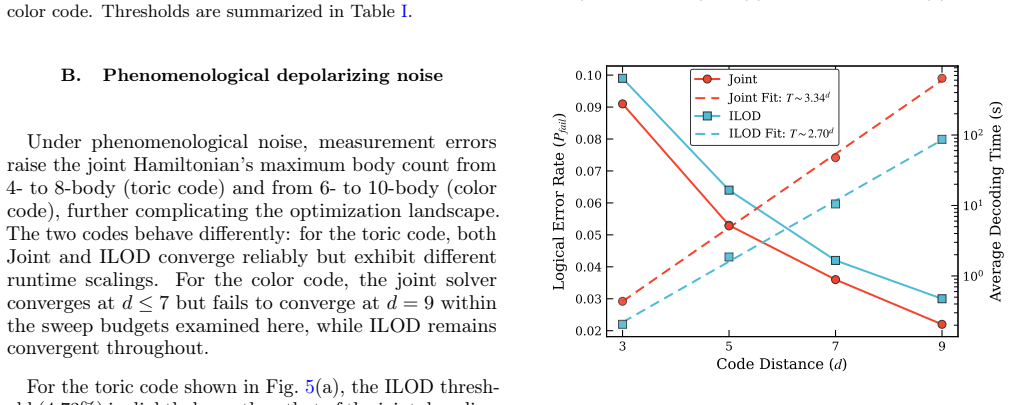
The ILOD algorithm alternates between X-type and Z-type sub-Hamiltonians for toric and 6.6.6 color codes, approximating cross-type error correlations through Bayesian priors that reweight couplings based on the other type's inferred configuration. This halves the maximum interaction order, restores convergence at larger distances, and yields a threshold of 4.73% for the toric code compared to 4.83% for the joint formulation, with runtime scaling as (0.81)^d.
What carries the argument
The iterative low-order decoding (ILOD) procedure that alternates X and Z sub-Hamiltonians and reweights couplings via Bayesian priors derived from the alternate error type's configuration.
Load-bearing premise
Bayesian priors derived from one error type's inferred configuration can reweight the couplings of the other type sufficiently accurately that the iterative procedure preserves near-optimal decoding performance without reintroducing the high-order terms.
What would settle it
A significant drop in threshold or loss of convergence at code distances where the joint formulation succeeds would falsify the claim that the approximation maintains near-optimal performance.
Figures


read the original abstract
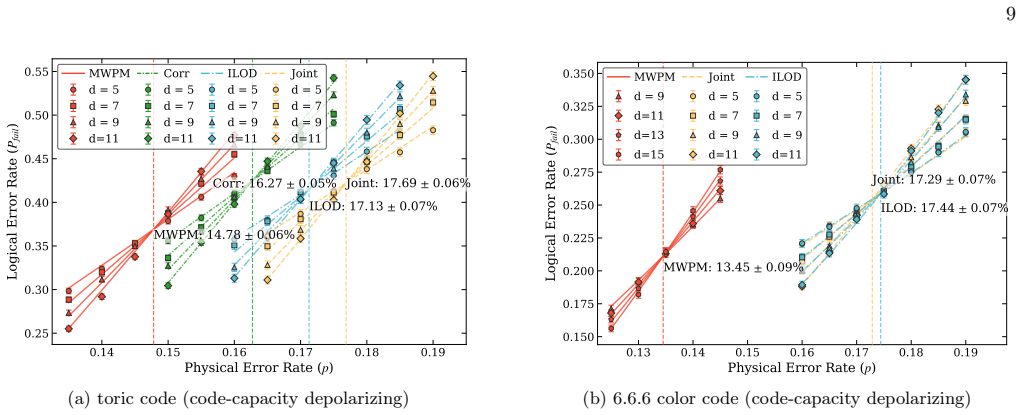
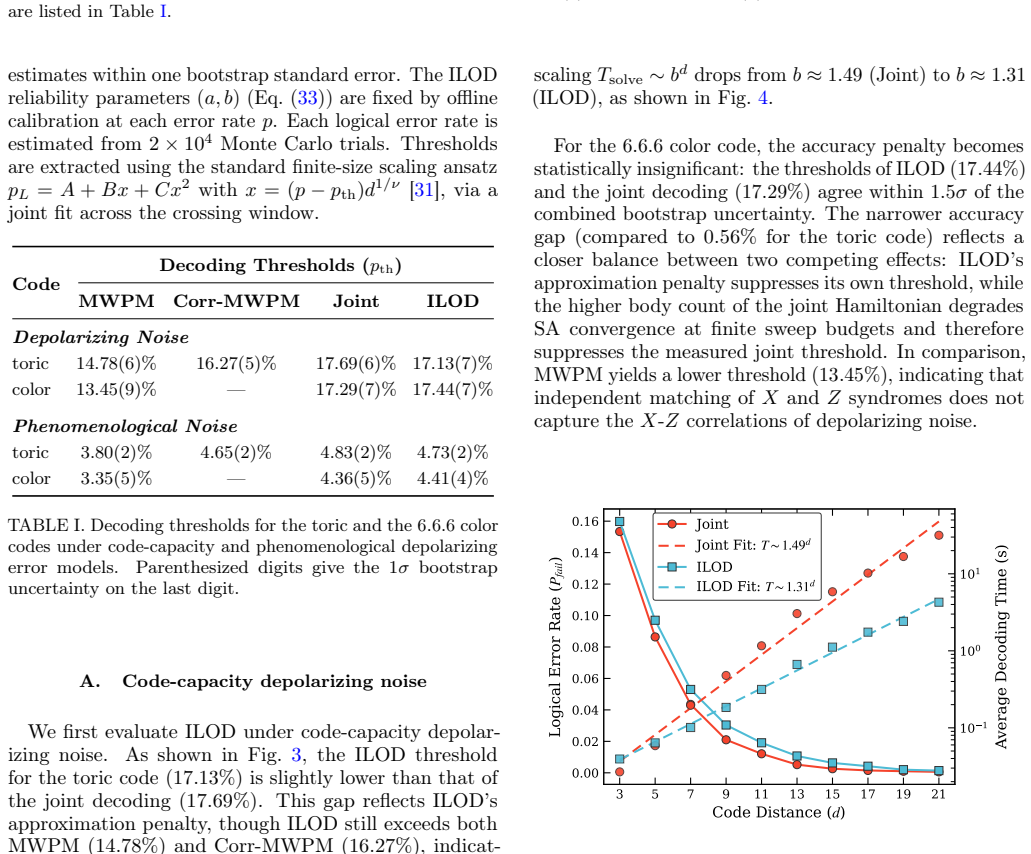
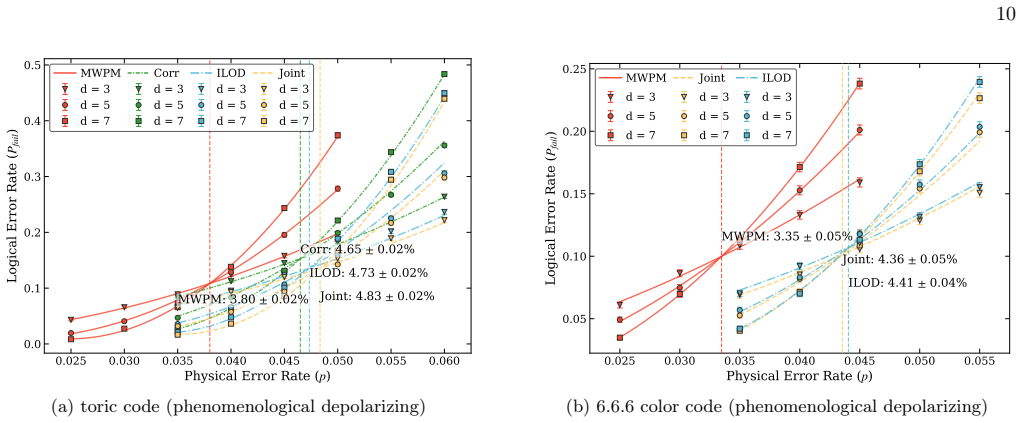
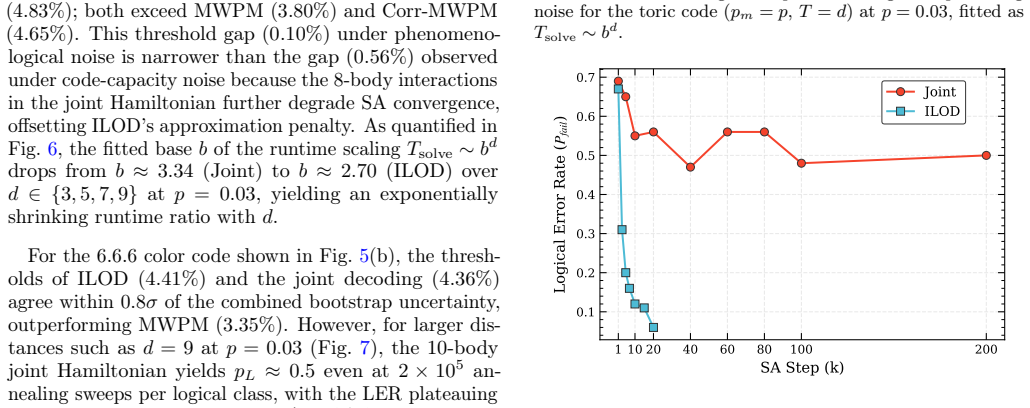
The Ising framework maps the decoding problem in quantum error correction onto ground-state optimization of a classical Hamiltonian, in which $X$-$Z$ error correlations enter as cross terms. Under phenomenological depolarizing noise, the exact joint formulation contains up to 8-body interactions for the toric code and 10-body for the $6.6.6$ color code. These high-order terms degrade solver convergence, inflate runtime, and raise the auxiliary spin overhead when embedding into native 2-body Ising hardware. In this work, we propose the iterative low-order decoding (ILOD) algorithm, which alternates between $X$- and $Z$-type sub-Hamiltonians, approximating cross-type correlations through Bayesian priors that reweight each type's couplings using the other type's inferred error configuration. This halves the maximum body count of interaction terms in the Hamiltonian, accelerating the solver, restoring convergence at larger code distances, and reducing the total spin count for 2-body embedding by a factor of $2.5$. For the toric code, ILOD attains a threshold of $4.73%$ versus $4.83%$ for the joint formulation, with the empirical runtime ratio scaling as $(0.81)^d$. For the $6.6.6$ color code, their thresholds agree within statistical uncertainty for small code distances, and ILOD remains convergent for larger distances where the joint formulation fails to converge despite a larger annealing budget.
Editorial analysis
A structured set of objections, weighed in public.
Referee Report
Summary. The paper proposes the iterative low-order decoding (ILOD) algorithm for Ising-based decoding of quantum error correction codes under phenomenological depolarizing noise. ILOD alternates between separate X- and Z-type sub-Hamiltonians, using Bayesian priors derived from one error type's configuration to reweight the couplings of the other and thereby approximate the high-order (up to 8- or 10-body) X-Z cross terms present in the joint formulation. This reduces maximum interaction order, spin overhead for 2-body embedding, and solver runtime while restoring convergence at large distances. Empirical results are reported for the toric code (thresholds 4.73% vs. 4.83%, runtime ratio scaling as (0.81)^d) and the 6.6.6 color code (threshold agreement at small distances, continued convergence where the joint solver fails).
Significance. If the Bayesian reweighting approximation is shown to be sufficiently faithful, the work supplies a concrete route to lower-order Ising Hamiltonians that retain near-optimal decoding performance, halve interaction body count, cut embedding overhead by a factor of 2.5, and improve both runtime and convergence range. The reported empirical runtime scaling law and the restoration of convergence at distances where the joint solver fails are concrete strengths that would be useful for hardware implementations.
major comments (2)
- [Abstract] Abstract and results section: the central claim that ILOD attains thresholds within 0.1% of the joint formulation (4.73% vs. 4.83% for the toric code) rests on empirical simulation, yet no error bars, number of Monte Carlo samples, or convergence diagnostics are supplied; without these the statistical significance of the small difference cannot be assessed and the performance-equivalence conclusion remains provisional.
- [ILOD algorithm] ILOD algorithm description: the performance equivalence between the iterative procedure and the joint 8-/10-body Hamiltonian is asserted to follow from Bayesian prior reweighting of cross-type couplings, but no quantitative metric (overlap of inferred error configurations, residual correlation error, or per-instance decoder disagreement rate) is reported to verify how faithfully the omitted high-order terms are recovered; this validation is load-bearing for the claim that near-optimal decoding is preserved.
minor comments (2)
- Clarify the precise functional form of the Bayesian update rule, including any hyperparameters or annealing schedule used to generate the priors.
- Specify the exact solver parameters, embedding overhead calculation, and code-distance range over which the (0.81)^d runtime scaling was fitted.
Simulated Author's Rebuttal
We thank the referee for the constructive and detailed review. We address each major comment below and commit to revisions that strengthen the statistical reporting and validation of the approximation.
read point-by-point responses
-
Referee: [Abstract] Abstract and results section: the central claim that ILOD attains thresholds within 0.1% of the joint formulation (4.73% vs. 4.83% for the toric code) rests on empirical simulation, yet no error bars, number of Monte Carlo samples, or convergence diagnostics are supplied; without these the statistical significance of the small difference cannot be assessed and the performance-equivalence conclusion remains provisional.
Authors: We agree that the absence of error bars, sample counts, and convergence diagnostics limits assessment of the reported threshold difference. In the revised manuscript we will expand the results section to include, for each code distance and noise rate: the number of Monte Carlo trials, standard-error estimates on the logical error rate, and a brief statement of the convergence criterion used for the annealing schedule. These additions will allow direct evaluation of whether the 0.1% gap is statistically meaningful. revision: yes
-
Referee: [ILOD algorithm] ILOD algorithm description: the performance equivalence between the iterative procedure and the joint 8-/10-body Hamiltonian is asserted to follow from Bayesian prior reweighting of cross-type couplings, but no quantitative metric (overlap of inferred error configurations, residual correlation error, or per-instance decoder disagreement rate) is reported to verify how faithfully the omitted high-order terms are recovered; this validation is load-bearing for the claim that near-optimal decoding is preserved.
Authors: The referee is correct that a direct quantitative check on the fidelity of the Bayesian reweighting would make the performance-equivalence claim more robust. While threshold agreement supplies indirect support, we will add, in a new subsection of the results, two explicit metrics computed on a representative set of instances for small distances: (i) the fraction of instances on which ILOD and the joint decoder return identical error configurations, and (ii) the average overlap between the two inferred error vectors. These numbers will be reported alongside the threshold data. revision: yes
Circularity Check
No significant circularity; central claims rest on empirical simulation results.
full rationale
The paper introduces the ILOD algorithm as an iterative approximation that alternates X/Z sub-Hamiltonians with Bayesian reweighting of couplings. All reported performance figures (thresholds 4.73% vs 4.83%, runtime ratio scaling as (0.81)^d, convergence restoration for the 6.6.6 color code) are obtained from direct Monte Carlo or annealing simulations on finite-distance codes. No equation in the manuscript reduces a derived quantity to a fitted parameter or self-citation by algebraic identity, and no uniqueness theorem or ansatz is imported from prior self-work to force the result. The approximation quality of the priors is treated as an empirical question validated by the same simulations, not as a definitional tautology.
Axiom & Free-Parameter Ledger
axioms (1)
- domain assumption Bayesian priors from one error type's configuration can reweight the other type's couplings without materially degrading threshold performance
Reference graph
Works this paper leans on
-
[1]
It encodes k = 2logical qubits into n = 2L2 physical qubits with code distanced=L
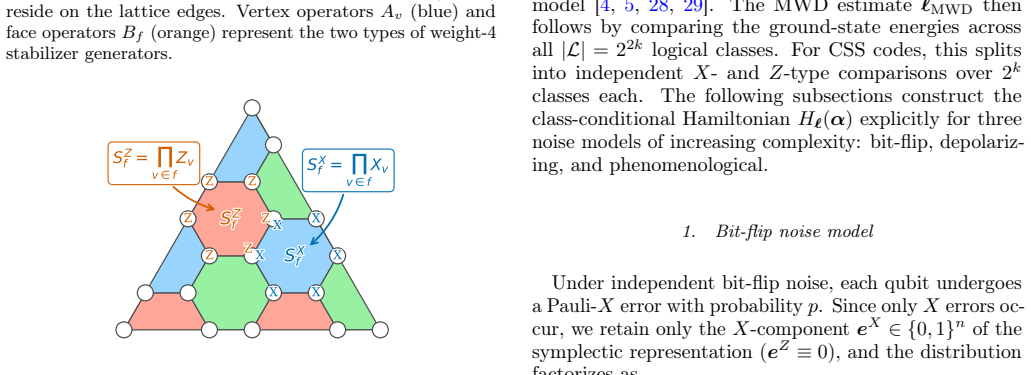
Toric codes The toric code [5, 26] is a topological stabilizer code defined on anL×L square lattice with periodic boundary conditions. It encodes k = 2logical qubits into n = 2L2 physical qubits with code distanced=L. As illustrated in Fig. 1, data qubits reside on the lat- tice edges. The stabilizer group is generated by vertex operators (Av) and face op...
-
[2]
Color codes The color code is a family of topological stabilizer codes defined on trivalent, three-face-colorable lattices. An example is the6.6.6hexagonal lattice with a triangular boundary [27], encoding k = 1logical qubit into n = (3d2 + 1)/4physical qubits for odd d, where d equals the boundary side length. As illustrated in Fig. 2, data qubits are lo...
-
[3]
Bit-flip noise model Under independent bit-flip noise, each qubit undergoes a Pauli-X error with probabilityp. Since onlyX errors oc- cur, we retain only theX-component eX ∈ {0, 1}n of the symplectic representation (eZ ≡ 0), and the distribution factorizes as P(e X) = nY q=1 peX q (1−p) 1−eX q ,(7) which takes the Boltzmann formP (τ) ∝e −βH0(τ) of a non-i...
-
[4]
Depolarizing noise model For depolarizing noise, each qubit independently un- dergoes an X, Y, or Z error with probabilityp/3each (and no error with probability1−p). Because depolariz- ing noise produces bothX and Z error components, the mapping now requires two sets of gauge spins,σj for the X-stabilizers and µl for the Z-stabilizers, with Y errors enter...
-
[5]
In practice, syndrome extraction is itself faulty, and the phenomenological noise model therefore requires T consecutive rounds to separate data and mea- surement errors [3, 5, 31]
Phenomenological noise model The bit-flip and depolarizing formulations above cap- ture spatial error configurations under perfect syndrome 5 measurements. In practice, syndrome extraction is itself faulty, and the phenomenological noise model therefore requires T consecutive rounds to separate data and mea- surement errors [3, 5, 31]. Denoting the set of...
-
[6]
B. M. Terhal, Quantum error correction for quantum memories, Rev. Mod. Phys.87, 307 (2015)
2015
-
[7]
Battistel, C
F. Battistel, C. Chamberland, K. Johar, R. W. Overwa- ter, F. Sebastiano, L. Skoric, Y. Ueno, and M. Usman, Real-time decoding for fault-tolerant quantum computing: Progress, challenges and outlook, Nano Futures7, 032003 (2023)
2023
-
[8]
A. G. Fowler, M. Mariantoni, J. M. Martinis, and A. N. Cleland, Surface codes: Towards practical large-scale quantum computation, Phys. Rev. A86, 032324 (2012)
2012
-
[9]
Sourlas, Spin-glass models as error-correcting codes, Nature339, 693 (1989)
N. Sourlas, Spin-glass models as error-correcting codes, Nature339, 693 (1989)
1989
-
[10]
Dennis, A
E. Dennis, A. Kitaev, A. Landahl, and J. Preskill, Topo- logical quantum memory, J. Math. Phys.43, 4452 (2002)
2002
-
[11]
H. G. Katzgraber, H. Bombin, and M. A. Martin-Delgado, Error threshold for color codes and random three-body Ising models, Phys. Rev. Lett.103, 090501 (2009)
2009
-
[12]
Bombin, R
H. Bombin, R. S. Andrist, M. Ohzeki, H. G. Katzgraber, and M. A. Martin-Delgado, Strong resilience of topological codes to depolarization, Phys. Rev. X2, 021004 (2012). 12
2012
-
[13]
Marandi, Z
A. Marandi, Z. Wang, K. Takata, R. L. Byer, and Y. Ya- mamoto, Network of time-multiplexed optical parametric oscillators as a coherent Ising machine, Nat. Photonics8, 937 (2014)
2014
-
[14]
Inagaki, Y
T. Inagaki, Y. Haribara, K. Igarashi, T. Sonobe, S. Ta- mate, T. Honjo, A. Marandi, P. L. McMahon, T. Umeki, K. Enbutsu,et al., A coherent Ising machine for 2000-node optimization problems, Science354, 603 (2016)
2000
-
[15]
M. W. Johnsonet al., Quantum annealing with manufac- tured spins, Nature473, 194 (2011)
2011
-
[16]
A. D. Kinget al., Quantum critical dynamics in a 5,000- qubit programmable spin glass, Nature617, 61 (2023)
2023
-
[17]
Aramon, G
M. Aramon, G. Rosenberg, E. Valiante, T. Miyazawa, H. Tamura, and H. G. Katzgraber, Physics-inspired op- timization for quadratic unconstrained problems using a digital annealer, Front. Phys.7, 48 (2019)
2019
-
[18]
Honjo, T
T. Honjo, T. Sonobe, K. Inaba, T. Inagaki, T. Ikuta, Y. Yamada, T. Kazama, K. Enbutsu, T. Umeki, R. Kasa- hara, K.-i. Kawarabayashi, and H. Takesue, 100,000-spin coherent Ising machine, Sci. Adv.7, eabh0952 (2021)
2021
-
[19]
Y. Takeuchi, Y. Takada, T. Sakashita, J. Fujisaki, H. Os- hima, S. Sato, and K. Fujii, Comparative study of de- coding the surface code using simulated annealing under depolarizing noise (2023), arXiv:2311.07973 [quant-ph]
arXiv 2023
-
[20]
Takada, Y
Y. Takada, Y. Takeuchi, and K. Fujii, Ising model formu- lation for highly accurate topological color codes decoding, Phys. Rev. Res.6, 013092 (2024)
2024
-
[21]
Derrida, Random-energy model: An exactly solvable model of disordered systems, Phys
B. Derrida, Random-energy model: An exactly solvable model of disordered systems, Phys. Rev. B24, 2613 (1981)
1981
-
[22]
D. J. Gross and M. Mézard, The simplest spin glass, Nucl. Phys. B240, 431 (1984)
1984
-
[23]
I. G. Rosenberg, Reduction of bivalent maximization to the quadratic case, Cah. Cent. Étud. Rech. Opér.17, 71 (1975)
1975
-
[24]
Boros and P
E. Boros and P. L. Hammer, Pseudo-boolean optimization, Discrete Appl. Math.123, 155 (2002)
2002
-
[25]
N. Dattani, Quadratization in discrete optimization and quantum mechanics (2019), arXiv:1901.04405 [quant-ph]
arXiv 2019
-
[26]
Poulin, Optimal and efficient decoding of concatenated quantum block codes, Phys
D. Poulin, Optimal and efficient decoding of concatenated quantum block codes, Phys. Rev. A74, 052333 (2006)
2006
-
[27]
Gottesman,Stabilizer Codes and Quantum Error Cor- rection, Ph.D
D. Gottesman,Stabilizer Codes and Quantum Error Cor- rection, Ph.D. thesis, California Institute of Technology (1997), arXiv:quant-ph/9705052 [quant-ph]
Pith/arXiv arXiv 1997
-
[28]
Aaronson and D
S. Aaronson and D. Gottesman, Improved simulation of stabilizer circuits, Phys. Rev. A70, 052328 (2004)
2004
-
[29]
A. R. Calderbank and P. W. Shor, Good quantum error- correcting codes exist, Phys. Rev. A54, 1098 (1996)
1996
-
[30]
A. M. Steane, Error correcting codes in quantum theory, Phys. Rev. Lett.77, 793 (1996)
1996
-
[31]
A. Y. Kitaev, Fault-tolerant quantum computation by anyons, Ann. Phys.303, 2 (2003)
2003
-
[32]
Bombin and M
H. Bombin and M. A. Martin-Delgado, Topological quan- tum distillation, Phys. Rev. Lett.97, 180501 (2006)
2006
-
[33]
Nishimori, Internal energy, specific heat and correlation function of the bond-random Ising model, Prog
H. Nishimori, Internal energy, specific heat and correlation function of the bond-random Ising model, Prog. Theor. Phys.66, 1169 (1981)
1981
-
[34]
A. A. Kovalev and L. P. Pryadko, Spin glass reflection of the decoding transition for quantum error correcting codes (2013), arXiv:1311.7688 [quant-ph]
Pith/arXiv arXiv 2013
-
[35]
C. T. Chubb and S. T. Flammia, Statistical mechanical models for quantum codes with correlated noise, Ann. Inst. Henri Poincaré D8, 269 (2021)
2021
-
[36]
C. Wang, J. Harrington, and J. Preskill, Confinement- higgs transition in a disordered gauge theory and the accuracy threshold for quantum memory, Ann. Phys.303, 31 (2003)
2003
-
[37]
Ohzeki, Accuracy thresholds of topological color codes on the hexagonal and square-octagonal lattices, Phys
M. Ohzeki, Accuracy thresholds of topological color codes on the hexagonal and square-octagonal lattices, Phys. Rev. E80, 011141 (2009)
2009
-
[38]
Saad,Iterative Methods for Sparse Linear Systems, 2nd ed
Y. Saad,Iterative Methods for Sparse Linear Systems, 2nd ed. (SIAM, 2003)
2003
-
[39]
Criger and I
B. Criger and I. Ashraf, Multi-path Summation for De- coding 2D Topological Codes, Quantum2, 102 (2018)
2018
-
[40]
Higgott and C
O. Higgott and C. Gidney, Sparse blossom: correcting a million errors per core second with minimum-weight matching, Quantum9, 1600 (2025)
2025
-
[41]
A. G. Fowler, Optimal complexity correction of correlated errors in the surface code (2013), arXiv:1310.0863 [quant- ph]
Pith/arXiv arXiv 2013
-
[42]
C. Gidney and C. Jones, New circuits and an open source decoder for the color code (2023), arXiv:2312.08813 [quant-ph]
arXiv 2023
-
[43]
OpenJij Team, OpenJij: An open-source library for Ising models and QUBOs, https://github.com/OpenJij/ OpenJij(2023)
2023
-
[44]
N. P. Breuckmann and J. N. Eberhardt, Quantum low- density parity-check codes, PRX Quantum2, 040101 (2021)
2021
-
[45]
Panteleev and G
P. Panteleev and G. Kalachev, Degenerate quantum LDPC codes with good parameters, Quantum5, 585 (2021)
2021
-
[46]
Panteleev and G
P. Panteleev and G. Kalachev, Asymptotically good quantum and locally testable classical LDPC codes, in Proc. 54th Annu. ACM SIGACT Symp. Theory Comput. (STOC)(ACM, 2022) pp. 375–388
2022
-
[47]
Bravyi, A
S. Bravyi, A. W. Cross, J. M. Gambetta, D. Maslov, P. Rall, and T. J. Yoder, High-threshold and low-overhead fault-tolerant quantum memory, Nature627, 778 (2024)
2024
discussion (0)
Sign in with ORCID, Apple, or X to comment. Anyone can read and Pith papers without signing in.