Resolving the Schwartz Quadratic Meander Number Conjecture
Pith reviewed 2026-06-27 08:55 UTC · model grok-4.3
The pith
The maximum meander number over cyclic permutations on n letters is bounded above and below by quadratic functions of n.
A machine-rendered reading of the paper's core claim, the machinery that carries it, and where it could break.
Core claim
The principal result shows that the maximum of the meander number over all cyclic permutations on n letters is bounded above and below quadratically in n. This resolves the Schwartz conjecture. The paper also constructs families of cyclic permutations on n letters whose meander numbers realize a continuum of growth rates between linear and quadratic.
What carries the argument
The meander number of a cyclic permutation, the smallest number of extra transverse intersection points needed to realize the permutation by an embedded oriented loop crossing a fixed line.
Load-bearing premise
The meander number is exactly the smallest number of extra crossings that must be added to embed the given cyclic permutation as the crossing sequence of a single oriented loop.
What would settle it
A cyclic permutation on n letters whose minimal number of extra crossings is either o(n squared) or omega(n squared) for infinitely many n.
Figures
read the original abstract
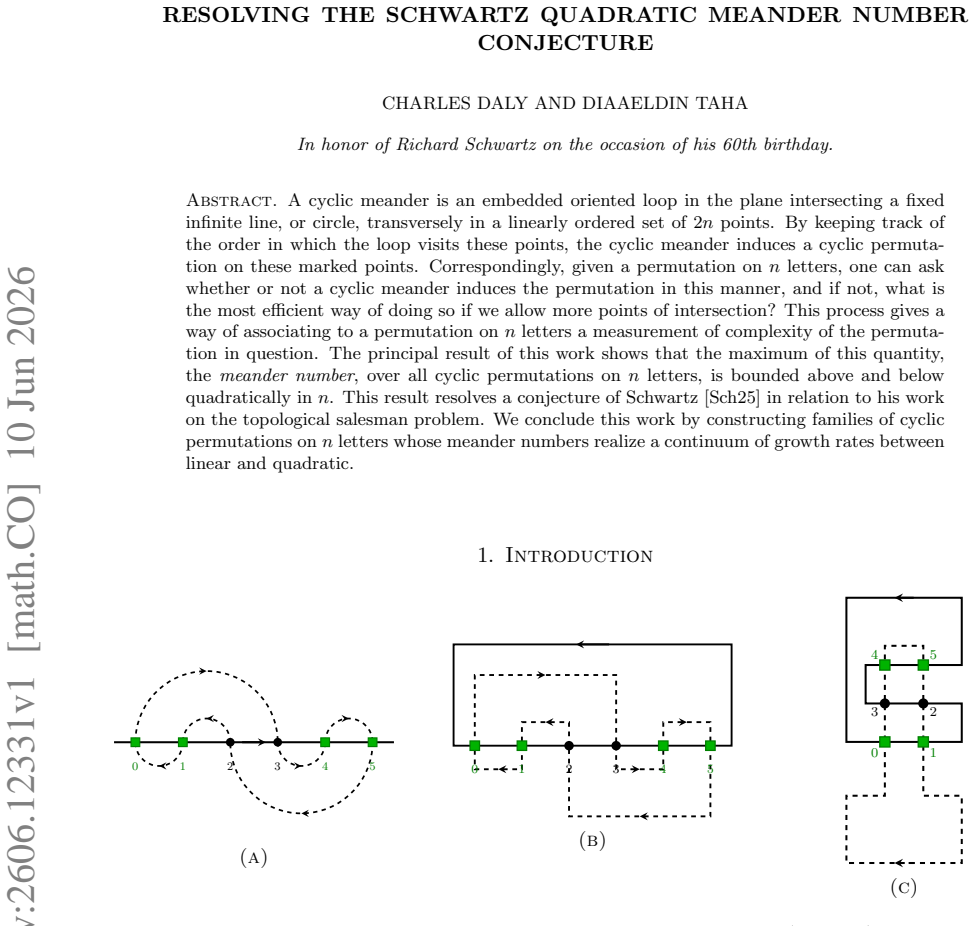
A cyclic meander is an embedded oriented loop in the plane intersecting a fixed infinite line, or circle, transversely in a linearly ordered set of $2n$ points. By keeping track of the order in which the loop visits these points, the cyclic meander induces a cyclic permutation on these marked points. Correspondingly, given a permutation on $n$ letters, one can ask whether or not a cyclic meander induces the permutation in this manner, and if not, what is the most efficient way of doing so if we allow more points of intersection? This process gives a way of associating to a permutation on $n$ letters a measurement of complexity of the permutation in question. The principal result of this work shows that the maximum of this quantity, the \emph{meander number}, over all cyclic permutations on $n$ letters, is bounded above and below quadratically in $n$. This result resolves a conjecture of Schwartz~\cite{richtpss} in relation to his work on the topological salesman problem. We conclude this work by constructing families of cyclic permutations on $n$ letters whose meander numbers realize a continuum of growth rates between linear and quadratic.
Editorial analysis
A structured set of objections, weighed in public.
Referee Report
Summary. The manuscript defines the meander number of a cyclic permutation on n letters as the minimal number of extra transverse intersection points needed for an embedded oriented loop to realize the permutation when intersecting a fixed line or circle. It proves that the maximum of this quantity over all cyclic permutations on n letters is bounded above and below by quadratic functions of n, thereby resolving Schwartz's conjecture on the topological salesman problem. The paper also constructs explicit families of permutations whose meander numbers realize every growth rate between linear and quadratic.
Significance. If the central bounds hold, the result supplies the first quadratic resolution of the meander-number conjecture and supplies a continuum of intermediate growth rates via explicit constructions. These features directly advance the topological combinatorics of permutations and the salesman problem; the constructive component is a particular strength.
major comments (1)
- [Abstract, paragraph 2] Abstract, paragraph 2: the shift from a cyclic meander on 2n marked points (inducing a permutation on those 2n points) to the meander number of an arbitrary permutation on n letters is stated without an explicit bijection, reduction, or pairing rule. Because the quadratic upper and lower bounds are claimed for the maximum over all cyclic permutations on [n], any many-to-one, incomplete, or auxiliary-pairing mapping would change the extremal scaling; this definitional step is therefore load-bearing for the principal theorem.
Simulated Author's Rebuttal
We thank the referee for their careful reading of the manuscript and for identifying a point of potential ambiguity in the abstract. We address the major comment below.
read point-by-point responses
-
Referee: [Abstract, paragraph 2] Abstract, paragraph 2: the shift from a cyclic meander on 2n marked points (inducing a permutation on those 2n points) to the meander number of an arbitrary permutation on n letters is stated without an explicit bijection, reduction, or pairing rule. Because the quadratic upper and lower bounds are claimed for the maximum over all cyclic permutations on [n], any many-to-one, incomplete, or auxiliary-pairing mapping would change the extremal scaling; this definitional step is therefore load-bearing for the principal theorem.
Authors: We agree that the abstract's brevity leaves the precise reduction implicit. The full manuscript (Section 2) defines the meander number of a cyclic permutation σ on [n] via the canonical doubling map that sends each letter i to the ordered pair of consecutive intersection points (2i-1, 2i) while preserving the cyclic order induced by σ; this yields a bijection between the set of cyclic permutations on [n] and the subset of cyclic permutations on [2n] that respect the fixed pairing of consecutive points. The meander number is then the minimal number of additional transverse intersections needed to realize this doubled permutation. Because the map is bijective on the relevant class and the extra intersections are counted uniformly, the quadratic upper and lower bounds transfer directly without altering the extremal scaling. To eliminate any ambiguity we will insert a single clarifying sentence in the abstract describing this doubling construction. revision: yes
Circularity Check
No circularity: independent proof of quadratic bounds on meander number
full rationale
The paper defines the meander number for a cyclic permutation on n letters as the minimal additional transverse intersections needed to realize it via an embedded loop on a line/circle. It then proves that the maximum of this quantity over all such permutations is bounded above and below by quadratic functions of n, resolving an external conjecture. No equations, fitted parameters, or self-citations are shown reducing the claimed bounds to the inputs by construction. The constructions for intermediate growth rates are presented as explicit families, and the central result is framed as a proof rather than a renaming or self-referential fit. The derivation chain is self-contained against the stated definitions and external conjecture.
Axiom & Free-Parameter Ledger
axioms (1)
- standard math Standard definitions and basic properties of cyclic meanders, transverse intersections, and induced cyclic permutations on 2n points
Reference graph
Works this paper leans on
-
[1]
2025 , month=
The Topological Traveling Salesman Problem , author=. 2025 , month=
2025
-
[2]
Siberian Mathematical Journal , volume=
A branched covering of CP2→ S 4, hyperbolicity and projectivity topology , author=. Siberian Mathematical Journal , volume=. 1988 , publisher=
1988
-
[3]
Theoretical Computer Science , volume=
Plane and projective meanders , author=. Theoretical Computer Science , volume=. 1993 , publisher=
1993
-
[4]
2004 , publisher=
Graphs on surfaces and their applications , author=. 2004 , publisher=
2004
-
[5]
Mathematical and Computer Modelling , volume=
Meander, folding, and arch statistics , author=. Mathematical and Computer Modelling , volume=. 1997 , publisher=
1997
-
[6]
Forum of Mathematics, Pi , volume=
Enumeration of meanders and Masur--Veech volumes , author=. Forum of Mathematics, Pi , volume=. 2020 , organization=
2020
-
[7]
arXiv preprint arXiv:2506.13131 , year=
Alphaevolve: A coding agent for scientific and algorithmic discovery , author=. arXiv preprint arXiv:2506.13131 , year=
-
[8]
arXiv preprint arXiv:2511.02864 , year=
Mathematical exploration and discovery at scale , author=. arXiv preprint arXiv:2511.02864 , year=
-
[9]
SIAM Journal on Applied Mathematics , volume=
A separator theorem for planar graphs , author=. SIAM Journal on Applied Mathematics , volume=. 1979 , publisher=
1979
-
[10]
1983 , publisher=
Complexity issues in VLSI: optimal layouts for the shuffle-exchange graph and other networks , author=. 1983 , publisher=
1983
-
[11]
International Symposium on Graph Drawing , pages=
An improved lower bound for crossing numbers , author=. International Symposium on Graph Drawing , pages=. 2001 , organization=
2001
-
[12]
Proceedings of the tenth annual symposium on Computational geometry , pages=
Applications of the crossing number , author=. Proceedings of the tenth annual symposium on Computational geometry , pages=
-
[13]
Journal of Graph Algorithms and Applications , volume=
Crossing numbers and cutwidths , author=. Journal of Graph Algorithms and Applications , volume=
-
[14]
AlphaEvolve: A coding agent for scientific and algorithmic discovery
Alexander Novikov and Ng. AlphaEvolve:. CoRR , volume =. 2025 , url =. doi:10.48550/ARXIV.2506.13131 , eprinttype =. 2506.13131 , timestamp =
work page internal anchor Pith review Pith/arXiv arXiv doi:10.48550/arxiv.2506.13131 2025
-
[15]
Sur un th
Poincar. Sur un th. Rendiconti del Circolo Matematico di Palermo , number =. 1912 , month =
1912
-
[16]
Meander, folding, and arch statistics , journal =
P. Meander, folding, and arch statistics , journal =. 1997 , issn =. doi:https://doi.org/10.1016/S0895-7177(97)00202-1 , url =
-
[17]
2025 , howpublished =
Schwartz, Richard , title =. 2025 , howpublished =
2025
discussion (0)
Sign in with ORCID, Apple, or X to comment. Anyone can read and Pith papers without signing in.