Between Degeneracy and Evolution: UV-to-optical Insights into the BH^* Model in Little Red Dots
Pith reviewed 2026-06-27 09:19 UTC · model grok-4.3
The pith
Only about 6% of Little Red Dots are best fit by the BH* model in the optical with a host galaxy in the UV.
A machine-rendered reading of the paper's core claim, the machinery that carries it, and where it could break.
Core claim
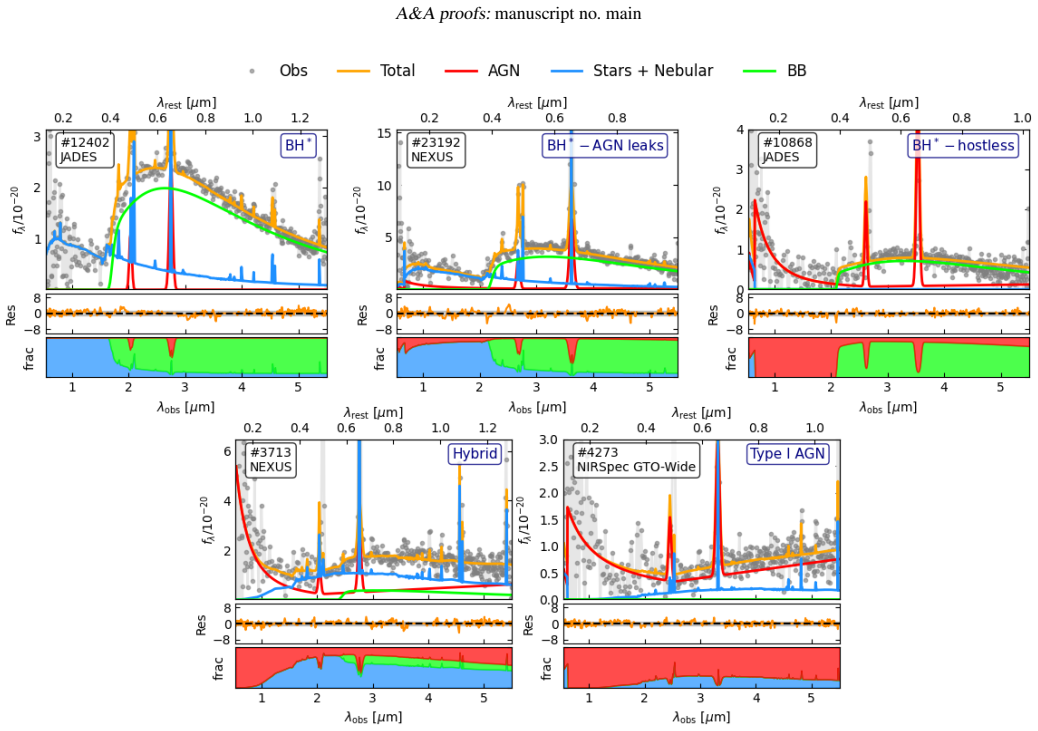
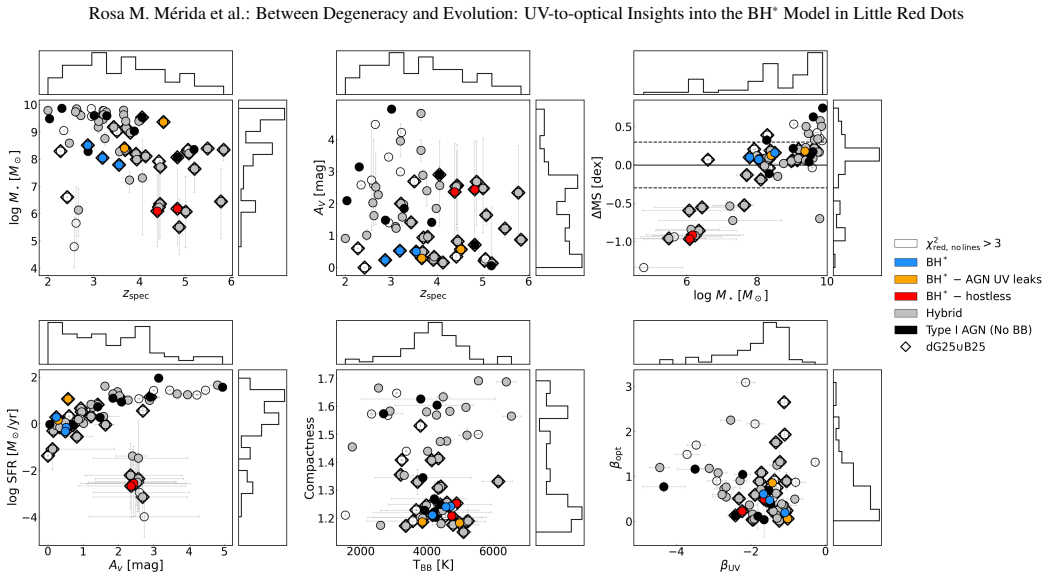
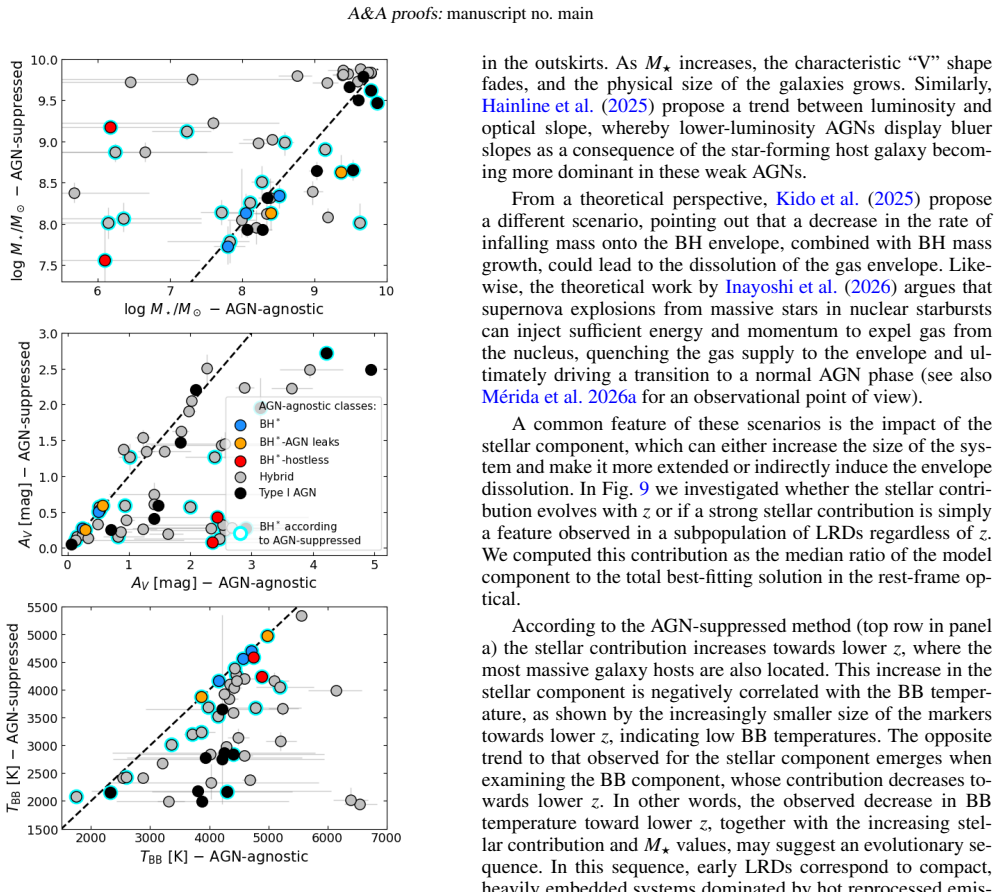
The BH* model provides the best fit for only about 6 percent of Little Red Dots when using broad priors on the modified Bagpipes models, with most objects instead dominated by stellar and AGN emission in the optical. Even when priors are adjusted to favor BH*-like solutions by disfavoring AGN continua, the fraction reaches only 40 percent, and many require additional stellar contributions. This indicates significant degeneracy between the BH* scenario and alternatives, possibly hinting at an evolutionary sequence in which the blackbody contribution decreases at lower redshifts as stellar mass increases.
What carries the argument
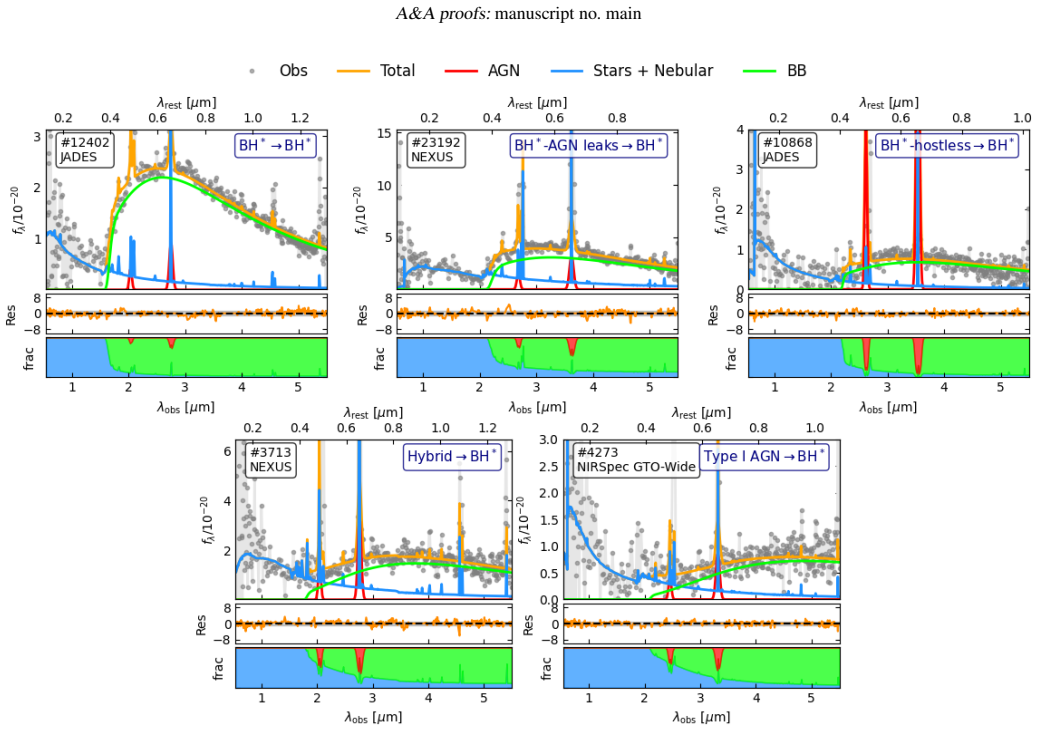
Modified Bagpipes spectral fitting that combines blackbody emission with Balmer absorption for the BH* component, dust-attenuated stellar and nebular emission, and an AGN continuum component to decompose the UV-to-optical spectra and determine dominant sources.
If this is right
- Approximately 8% of LRDs show blackbody-dominated optical continua but lack a stellar component or exhibit AGN UV leakage.
- The majority of LRDs have optical continua primarily from stellar and/or AGN emission with only minor blackbody contribution.
- Even when priors enforce BH*-like solutions, many LRDs still require a stellar-dominated optical continuum.
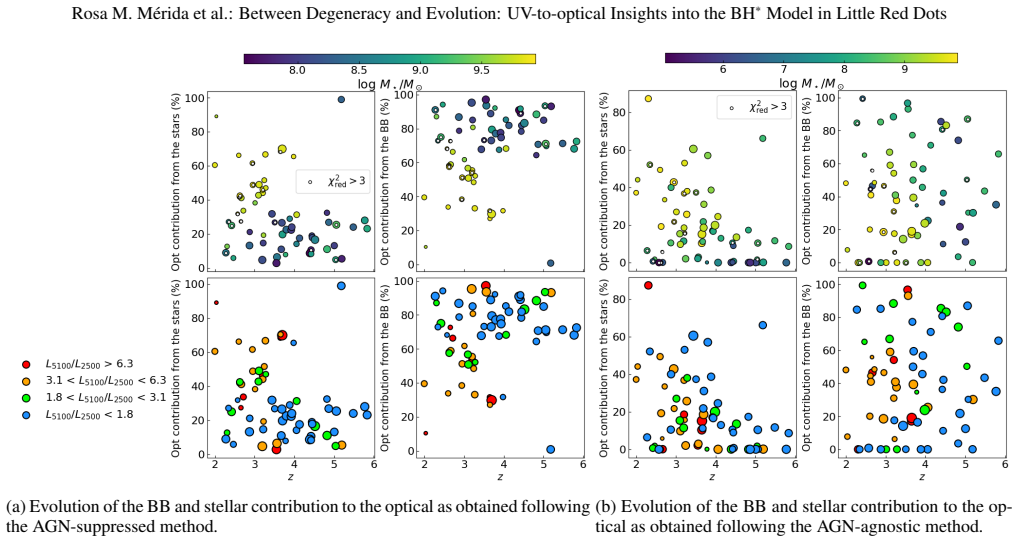
- An evolutionary sequence may exist in which blackbody contribution decreases with falling redshift, producing lower temperatures and higher stellar masses.
Where Pith is reading between the lines
- Higher-resolution spectra targeting specific absorption or emission lines could break the reported degeneracy between BH* and AGN/stellar models.
- If the evolutionary picture holds, LRD samples at higher redshifts should display more pronounced V-shaped spectral energy distributions.
- The persistent need for stellar light even in forced BH* fits suggests the model may need to allow mixed contributions from multiple components.
Load-bearing premise
The modified Bagpipes models accurately represent the physical contributions from blackbody, stellar, nebular, and AGN components without significant missing elements or flawed assumptions about dust attenuation and absorption.
What would settle it
A spectral analysis of a larger LRD sample or with higher-resolution data that shows systematic mismatches in the predicted Balmer absorption depth or continuum shape for the BH* blackbody component would falsify its broad applicability.
Figures


read the original abstract
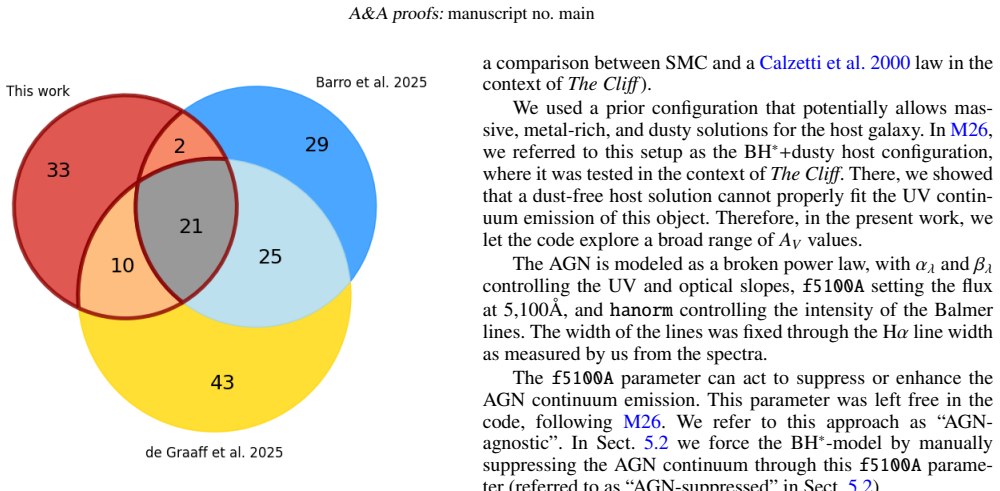
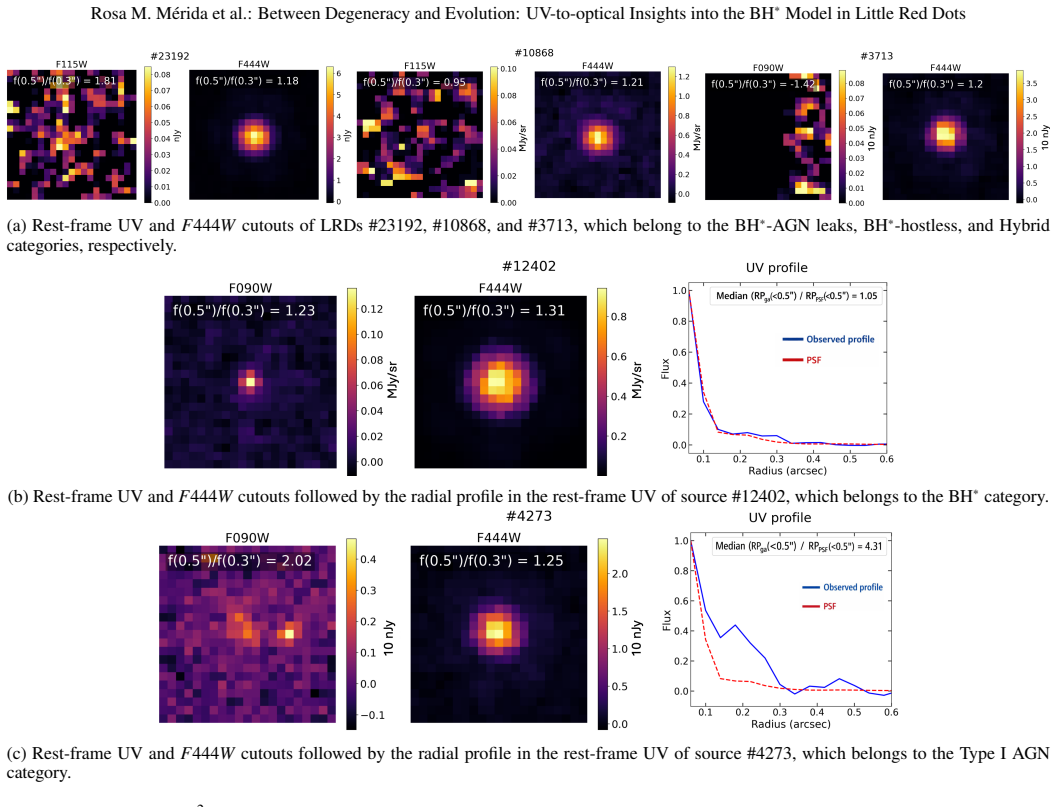
Little Red Dots (LRDs) are a heterogeneous class of objects, with several proposed scenarios for their physical nature and evolution. While these theories have been tested on individual LRDs using limited spectral features, a systematic Bayesian analysis of the LRD population incorporating the different models across a broad wavelength range is still lacking. In this study, we conduct a consistent ultraviolet (UV)-to-optical continuum fitting analysis of 66 LRDs at 2<z<6 using JWST/NIRSpec PRISM spectroscopy. Employing a modified version of Bagpipes--including blackbody (BB) emission affected by Balmer absorption, stellar and nebular emission attenuated by dust, and an active galactic nucleus (AGN) component--we assess the performance of the black hole star (BH*) model in describing the LRD population. We adopt broad priors and therefore do not impose any specific physical scenario. Our results show that only ~6% of LRDs with statistically robust solutions (52 objects in total) are best-fit by a BH* in the optical and a host galaxy in the UV. ~8% of LRDs show BB-dominated optical continua but lack a stellar component or exhibit AGN UV leakage. Most LRDs are dominated by stellar and/or AGN emission in the optical, with minor BB contribution. When we adopt a prior that disfavors a strong AGN continuum to enforce BH*-like solutions, the percentage of BH$^*$ systems increases to ~40%, highlighting the strong degeneracy between a BH* solution and alternative scenarios. Even when BH*-like solutions are enforced, many LRDs still require a stellar-dominated optical continuum. This may reveal limitations of the BH* model or point to an evolutionary sequence in which the BB contribution decreases as the host grows, leading to lower BB temperatures and higher stellar masses at lower z. In this scenario, more pronounced ''V'' shapes would correspond to later stages in LRD evolution.
Editorial analysis
A structured set of objections, weighed in public.
Referee Report
Summary. The paper performs a uniform Bayesian UV-to-optical continuum fit to 66 Little Red Dots at 2<z<6 using JWST/NIRSpec PRISM spectra and a modified Bagpipes code that includes a blackbody+Balmer-absorption component (for the proposed BH* optical continuum), a dust-attenuated stellar+nebular component, and an AGN continuum. With broad priors the authors report that only ~6% of the 52 objects yielding statistically robust solutions are best described by a BH* optical + host-galaxy UV solution; this fraction rises to ~40% when a prior that disfavors a strong AGN continuum is imposed. The work concludes that most LRDs are instead dominated by stellar and/or AGN emission and discusses possible evolutionary implications of the remaining degeneracy.
Significance. If the adopted spectral components are shown to be adequate, the analysis supplies the first population-level, prior-sensitivity-controlled assessment of how often the BH* scenario is statistically preferred over stellar/AGN alternatives across the LRD sample. The explicit demonstration that the headline fractions shift sharply with prior choice is a useful cautionary result for the field.
major comments (3)
- [Abstract / Methods] Abstract and Methods description: the headline ~6% and ~40% fractions are obtained by Bayesian model comparison among the three specific functional forms (blackbody+Balmer absorption, stellar+nebular with dust attenuation, AGN continuum) implemented in the modified Bagpipes code. No external validation of these forms (e.g., against higher-resolution spectra, alternative extinction curves, or additional line/continuum components) is described, yet the classification of objects as “BH* in optical + host in UV” versus alternatives rests directly on the completeness and correctness of these parametrizations.
- [Abstract] Abstract: the reported percentages are given without uncertainties, without the precise definition of “statistically robust solutions,” and without summary statistics on the posterior distributions or evidence ratios that underlie the 52-object subsample. This makes it impossible to judge how sensitive the 6%/40% numbers are to small changes in the fitting procedure or to the exact threshold used for robustness.
- [Results] Results (implied by the prior-sensitivity test): while the paper correctly shows that relaxing the AGN-disfavoring prior drops the BH*-like fraction from ~40% to ~6%, it does not explore the effect of other modeling choices (different dust-law parametrizations, Balmer-absorption profile details, or AGN-slope priors) that are equally load-bearing for the flux attribution and therefore for the final percentages.
minor comments (1)
- [Abstract] The abstract states that 66 objects were fitted but only 52 yielded robust solutions; a brief statement of the rejection criteria (e.g., evidence threshold or convergence diagnostics) would improve clarity.
Simulated Author's Rebuttal
We thank the referee for their careful reading and constructive comments, which highlight important aspects of model assumptions and reporting. We address each major comment below with specific revisions where appropriate.
read point-by-point responses
-
Referee: [Abstract / Methods] Abstract and Methods description: the headline ~6% and ~40% fractions are obtained by Bayesian model comparison among the three specific functional forms (blackbody+Balmer absorption, stellar+nebular with dust attenuation, AGN continuum) implemented in the modified Bagpipes code. No external validation of these forms (e.g., against higher-resolution spectra, alternative extinction curves, or additional line/continuum components) is described, yet the classification of objects as “BH* in optical + host in UV” versus alternatives rests directly on the completeness and correctness of these parametrizations.
Authors: The three functional forms were selected to directly represent the competing physical scenarios proposed for LRDs in the literature (BH* continuum, stellar+nebular, and AGN power-law). These are implemented within the established Bagpipes framework to enable consistent Bayesian evidence comparison. We agree that external validation against higher-resolution spectra or alternative parametrizations would strengthen the analysis; however, the moderate resolution of the PRISM spectra precludes detailed line-profile or extinction-curve tests at present. In the revised Methods section we have expanded the justification for each component, added explicit caveats on their limitations, and noted that the reported fractions reflect relative preference among these three models rather than absolute physical truth. revision: partial
-
Referee: [Abstract] Abstract: the reported percentages are given without uncertainties, without the precise definition of “statistically robust solutions,” and without summary statistics on the posterior distributions or evidence ratios that underlie the 52-object subsample. This makes it impossible to judge how sensitive the 6%/40% numbers are to small changes in the fitting procedure or to the exact threshold used for robustness.
Authors: We accept this criticism. The revised manuscript now defines “statistically robust solutions” explicitly as those objects for which the log-evidence difference between the highest-evidence model and the next-best model exceeds 5 (strong evidence on the Jeffreys scale). We report the 6% and 40% fractions with binomial uncertainties derived from the 52-object subsample and include a supplementary table summarizing the median evidence ratios, posterior parameter ranges, and convergence diagnostics for the full sample. These additions allow readers to assess sensitivity to the robustness threshold. revision: yes
-
Referee: [Results] Results (implied by the prior-sensitivity test): while the paper correctly shows that relaxing the AGN-disfavoring prior drops the BH*-like fraction from ~40% to ~6%, it does not explore the effect of other modeling choices (different dust-law parametrizations, Balmer-absorption profile details, or AGN-slope priors) that are equally load-bearing for the flux attribution and therefore for the final percentages.
Authors: The AGN-prior test was performed because the AGN continuum is the dominant degeneracy with the BH* component. We acknowledge that other modeling choices are also important. In the revised Discussion we now report a limited sensitivity test on a representative subset of 15 objects using an alternative SMC extinction curve and a narrower Balmer-absorption profile; the BH*-preferred fraction changes by less than 8 percentage points. A comprehensive grid over all possible dust laws, line profiles, and AGN slopes is computationally prohibitive for the full sample but is flagged as a clear avenue for future work. revision: partial
Circularity Check
Spectral fitting analysis shows no circularity in reported fractions
full rationale
The paper performs Bayesian continuum fitting of JWST PRISM spectra for 66 LRDs using a modified Bagpipes code that includes three explicit components (blackbody + Balmer absorption, stellar+nebular with dust, AGN continuum). The headline percentages (~6% and ~40%) are direct outputs of model comparison and prior choice applied to the observed data; they are not predictions that reduce to fitted inputs by construction, nor do they rely on self-citation chains or uniqueness theorems imported from the authors' prior work. The model functional forms are stated as adopted assumptions, and the paper explicitly discusses degeneracy and prior sensitivity, but this is a standard modeling choice rather than a circular reduction. The classification is externally falsifiable against the spectra themselves and does not rename known results or smuggle ansatzes via self-citation.
Axiom & Free-Parameter Ledger
free parameters (3)
- dust attenuation parameters
- blackbody temperature and normalization
- AGN continuum strength
axioms (2)
- domain assumption The modified Bagpipes models correctly capture the emission mechanisms without missing physics
- standard math Bayesian evidence comparison with broad priors yields reliable model preference
Reference graph
Works this paper leans on
-
[1]
AGN Dusty Tori. II. Observational Implications of Clumpiness. , keywords =. doi:10.1086/590483 , archivePrefix =. 0806.0512 , primaryClass =
work page internal anchor Pith review Pith/arXiv arXiv doi:10.1086/590483
-
[2]
The X-Ray Dot: Exotic Dust or a Late-stage Little Red Dot?. , keywords =. doi:10.3847/2041-8213/ae4c88 , archivePrefix =. 2601.09778 , primaryClass =
-
[3]
Little Red Dots as Globular Clusters in Formation. arXiv e-prints , keywords =. doi:10.48550/arXiv.2602.15935 , archivePrefix =. 2602.15935 , primaryClass =
-
[4]
The UV continuum slopes of early star-forming galaxies in JADES. , keywords =. doi:10.1093/mnras/stae800 , archivePrefix =. 2307.08835 , primaryClass =
-
[5]
Efficient Ionizers with Low H + [O III] Equivalent Widths: JADES Spectroscopy of a Peculiar High-redshift Population. , keywords =. doi:10.3847/1538-4357/adddb5 , archivePrefix =. 2412.04542 , primaryClass =
-
[6]
A JWST/NIRSpec First Census of Broad-line AGNs at z = 4-7: Detection of 10 Faint AGNs with M _ BH 10 ^ 6 - 10 ^ 8 M _ and Their Host Galaxy Properties. , keywords =. doi:10.3847/1538-4357/ad029e , archivePrefix =. 2303.11946 , primaryClass =
-
[7]
RUBIES: A spectroscopic census of little red dots: All point sources with v-shaped continua have broad lines. , keywords =. doi:10.1051/0004-6361/202555816 , archivePrefix =. 2506.05459 , primaryClass =
-
[8]
Dwarf Galaxies with Optical Signatures of Active Massive Black Holes
Dwarf Galaxies with Optical Signatures of Active Massive Black Holes. , keywords =. doi:10.1088/0004-637X/775/2/116 , archivePrefix =. 1308.0328 , primaryClass =
work page internal anchor Pith review Pith/arXiv arXiv doi:10.1088/0004-637x/775/2/116
-
[9]
Dynamical delays between starburst and AGN activity in galaxy nuclei. , keywords =. doi:10.1111/j.1745-3933.2011.01179.x , archivePrefix =. 1101.4230 , primaryClass =
-
[10]
The effects of super-Eddington accretion and feedback on the growth of early supermassive black holes and galaxies. , keywords =. doi:10.1093/mnras/staf146 , archivePrefix =. 2410.09450 , primaryClass =
-
[11]
Super-Eddington accretion in high-redshift black holes and the emergence of jetted AGN. , keywords =. doi:10.1093/mnras/stae851 , archivePrefix =. 2403.15106 , primaryClass =
-
[12]
The bolometric luminosity of type 2 AGN from extinction-corrected [OIII]. No evidence of Eddington-limited sources. , keywords =. doi:10.1051/0004-6361/200912023 , archivePrefix =. 0905.4439 , primaryClass =
work page internal anchor Pith review Pith/arXiv arXiv doi:10.1051/0004-6361/200912023
-
[13]
Estimating Black Hole Masses in Active Galaxies Using the Halpha Emission Line
Estimating Black Hole Masses in Active Galaxies Using the H Emission Line. , keywords =. doi:10.1086/431897 , archivePrefix =. astro-ph/0508335 , primaryClass =
work page internal anchor Pith review Pith/arXiv arXiv doi:10.1086/431897
-
[14]
Spectral Energy Distributions and Multiwavelength Selection of Type 1 Quasars
Spectral Energy Distributions and Multiwavelength Selection of Type 1 Quasars. , keywords =. doi:10.1086/506525 , archivePrefix =. astro-ph/0601558 , primaryClass =
work page internal anchor Pith review Pith/arXiv arXiv doi:10.1086/506525
-
[15]
Bolometric correction factors for active galactic nuclei. , keywords =. doi:10.1093/mnras/stz2016 , archivePrefix =. 1907.09534 , primaryClass =
-
[16]
Present-Day Growth of Black Holes and Bulges: the SDSS Perspective
Present-Day Growth of Black Holes and Bulges: The Sloan Digital Sky Survey Perspective. , keywords =. doi:10.1086/422872 , archivePrefix =. astro-ph/0406218 , primaryClass =
work page internal anchor Pith review Pith/arXiv arXiv doi:10.1086/422872
-
[17]
doi:10.5281/zenodo.7299501 , version =
gbrammer/msaexp: Full working version with 2d drizzling and extraction. doi:10.5281/zenodo.7299501 , version =
-
[18]
Possible environmental quenching in an interacting little red dot pair at z 7. , keywords =. doi:10.1051/0004-6361/202553943 , archivePrefix =. 2501.17925 , primaryClass =
-
[19]
Photometry of a complete sample of faint galaxies. , keywords =. doi:10.1086/190669 , adsurl =
-
[20]
Strong Rest-UV Emission Lines in a ``Little Red Dot'' Active Galactic Nucleus at z = 7: Early Supermassive Black Hole Growth alongside Compact Massive Star Formation?. , keywords =. doi:10.3847/2041-8213/adab76 , archivePrefix =. 2410.00949 , primaryClass =
-
[21]
Nonparametric Star Formation History Reconstruction with Gaussian Processes. I. Counting Major Episodes of Star Formation. , keywords =. doi:10.3847/1538-4357/ab2052 , archivePrefix =. 1901.02877 , primaryClass =
work page internal anchor Pith review Pith/arXiv arXiv doi:10.3847/1538-4357/ab2052 1901
-
[22]
The Near-Infrared Spectrograph (NIRSpec) on the James Webb Space Telescope. I. Overview of the instrument and its capabilities. , keywords =. doi:10.1051/0004-6361/202142663 , archivePrefix =. 2202.03305 , primaryClass =
work page internal anchor Pith review Pith/arXiv arXiv doi:10.1051/0004-6361/202142663
-
[23]
Galaxy mergers can initiate quenching by unlocking an AGN-driven transformation of the baryon cycle. , keywords =. doi:10.1093/mnras/stac1742 , archivePrefix =. 2203.08157 , primaryClass =
-
[24]
Growing supermassive black holes in the late stages of galaxy mergers are heavily obscured
Growing supermassive black holes in the late stages of galaxy mergers are heavily obscured. , keywords =. doi:10.1093/mnras/stx173 , archivePrefix =. 1701.04825 , primaryClass =
work page internal anchor Pith review Pith/arXiv arXiv doi:10.1093/mnras/stx173
-
[25]
Hidden Little Monsters: Spectroscopic Identification of Low-mass, Broad-line AGNs at z > 5 with CEERS. , keywords =. doi:10.3847/2041-8213/ace5a0 , archivePrefix =. 2302.00012 , primaryClass =
-
[26]
UNCOVER Spectroscopy Confirms the Surprising Ubiquity of Active Galactic Nuclei in Red Sources at z > 5. , keywords =. doi:10.3847/1538-4357/ad1e5f , archivePrefix =. 2309.05714 , primaryClass =
-
[27]
Spectral Templates Optimal for Selecting Galaxies at z > 8 with the JWST. , keywords =. doi:10.3847/1538-4357/acfed4 , archivePrefix =. 2211.10035 , primaryClass =
-
[28]
The Galaxies Missed by Hubble and ALMA: The Contribution of Extremely Red Galaxies to the Cosmic Census at 3 < z < 8. , keywords =. doi:10.3847/1538-4357/ad3f17 , archivePrefix =. 2311.07483 , primaryClass =
-
[29]
Outshining by Recent Star Formation Prevents the Accurate Measurement of High-z Galaxy Stellar Masses. , keywords =. doi:10.3847/1538-4357/ad0966 , archivePrefix =. 2306.10118 , primaryClass =
-
[30]
Star formation histories of UV-luminous galaxies at z ≃ 6.8: implications for stellar mass assembly at early cosmic times. , keywords =. doi:10.1093/mnras/stad004 , archivePrefix =. 2206.05315 , primaryClass =
-
[31]
A population of red candidate massive galaxies 600 Myr after the Big Bang. , keywords =. doi:10.1038/s41586-023-05786-2 , archivePrefix =. 2207.12446 , primaryClass =
-
[32]
UNCOVER: Candidate Red Active Galactic Nuclei at 3 < z < 7 with JWST and ALMA. , keywords =. doi:10.3847/1538-4357/ad3551 , archivePrefix =. 2306.07320 , primaryClass =
-
[33]
Not Just a Dot: The Complex UV Morphology and Underlying Properties of Little Red Dots. , keywords =. doi:10.3847/1538-4357/adfa10 , archivePrefix =. 2411.14383 , primaryClass =
-
[34]
JADES: The diverse population of infant black holes at 4 < z < 11: Merging, tiny, poor, but mighty. , keywords =. doi:10.1051/0004-6361/202347640 , archivePrefix =. 2308.01230 , primaryClass =
-
[35]
An unambiguous AGN and a Balmer break in an Ultraluminous Little Red Dot at z=4.47 from Ultradeep UNCOVER and All the Little Things Spectroscopy. arXiv e-prints , keywords =. doi:10.48550/arXiv.2412.04557 , archivePrefix =. 2412.04557 , primaryClass =
-
[36]
doi:10.1093/mnras/stac3044 , eprint =
Radiation pressure-driven outflows from dusty AGN. , keywords =. doi:10.1093/mnras/stac3044 , archivePrefix =. 2210.10598 , primaryClass =
-
[37]
Effect of molecules and grains on Rosseland mean opacities. , keywords =. doi:10.1086/161339 , adsurl =
-
[38]
EAZY: A Fast, Public Photometric Redshift Code
EAZY: A Fast, Public Photometric Redshift Code. , keywords =. doi:10.1086/591786 , archivePrefix =. 0807.1533 , primaryClass =
work page internal anchor Pith review Pith/arXiv arXiv doi:10.1086/591786
-
[39]
Galaxy Mergers in the Epoch of Reionization I: A JWST Study of Pair Fractions, Merger Rates, and Stellar Mass Accretion Rates at z = 4.5 - 11.5. , keywords =. doi:10.1093/mnras/staf638 , archivePrefix =. 2407.09472 , primaryClass =
-
[40]
Secondary standard stars for absolute spectrophotometry. , keywords =. doi:10.1086/160817 , adsurl =
-
[41]
Galactic Stellar and Substellar Initial Mass Function
Galactic Stellar and Substellar Initial Mass Function. , keywords =. doi:10.1086/376392 , archivePrefix =. astro-ph/0304382 , primaryClass =
work page internal anchor Pith review Pith/arXiv arXiv doi:10.1086/376392
-
[42]
arXiv e-prints , keywords =
An unambiguous AGN and a Balmer break in an Ultraluminous Little Red Dot at z=4.47 from Ultradeep UNCOVER and All the Little Things Spectroscopy. arXiv e-prints , keywords =
-
[43]
On the stunning abundance of super-early, luminous galaxies revealed by JWST. , keywords =. doi:10.1093/mnras/stad1095 , archivePrefix =. 2208.00720 , primaryClass =
-
[44]
Research Notes of the American Astronomical Society , keywords =
Sizes and Stellar Masses of the Little Red Dots Imply Immense Stellar Densities. Research Notes of the American Astronomical Society , keywords =. doi:10.3847/2515-5172/ad7262 , archivePrefix =. 2408.11890 , primaryClass =
-
[45]
ASTRAEUS: X. Indications of a top-heavy initial mass function in highly star-forming galaxies from JWST observations at z > 10. , keywords =. doi:10.1051/0004-6361/202452460 , archivePrefix =. 2410.00730 , primaryClass =
-
[46]
Hubble Space Telescope Observations of the Lensing Cluster Abell 2218
Hubble Space Telescope Observations of the Lensing Cluster Abell 2218. , keywords =. doi:10.1086/177995 , archivePrefix =. astro-ph/9511015 , primaryClass =
work page internal anchor Pith review Pith/arXiv arXiv doi:10.1086/177995
-
[47]
Constraining the mass distribution of galaxies using galaxy-galaxy lensing in clusters and in the field. , keywords =. doi:10.1111/j.1365-2966.2004.08449.x , archivePrefix =. astro-ph/0405607 , primaryClass =
-
[48]
Where is the matter in the Merging Cluster Abell 2218?
Where is the matter in the Merging Cluster Abell 2218?. arXiv e-prints , keywords =. doi:10.48550/arXiv.0710.5636 , archivePrefix =. 0710.5636 , primaryClass =
work page internal anchor Pith review Pith/arXiv arXiv doi:10.48550/arxiv.0710.5636
-
[49]
Parametrising Star Formation Histories
Parametrising Star Formation Histories. arXiv e-prints , keywords =. doi:10.48550/arXiv.1404.0402 , archivePrefix =. 1404.0402 , primaryClass =
work page internal anchor Pith review Pith/arXiv arXiv doi:10.48550/arxiv.1404.0402
-
[50]
How to Measure Galaxy Star Formation Histories. II. Nonparametric Models. , keywords =. doi:10.3847/1538-4357/ab133c , archivePrefix =. 1811.03637 , primaryClass =
work page internal anchor Pith review Pith/arXiv arXiv doi:10.3847/1538-4357/ab133c
-
[51]
Synthetic Properties of Starburst Galaxies. , keywords =. doi:10.1086/192112 , adsurl =
-
[52]
A Bayesian approach to strong lensing modelling of galaxy clusters
A Bayesian approach to strong lensing modelling of galaxy clusters. New Journal of Physics , keywords =. doi:10.1088/1367-2630/9/12/447 , archivePrefix =. 0706.0048 , primaryClass =
work page internal anchor Pith review Pith/arXiv arXiv doi:10.1088/1367-2630/9/12/447
-
[53]
Galaxy-galaxy lensing in the outskirts of CLASH clusters: constraints on local shear and testing mass-luminosity scaling relation. , keywords =. doi:10.1093/mnras/sty1666 , archivePrefix =. 1806.08120 , primaryClass =
work page internal anchor Pith review Pith/arXiv arXiv doi:10.1093/mnras/sty1666
-
[54]
The BUFFALO HST Survey. , keywords =. doi:10.3847/1538-4365/ab75ed , archivePrefix =. 2001.09999 , primaryClass =
-
[55]
COSMOS-Web: An Overview of the JWST Cosmic Origins Survey. , keywords =. doi:10.3847/1538-4357/acc2bc , archivePrefix =. 2211.07865 , primaryClass =
-
[56]
An Upper Limit of 10 ^ 6 M _ in Dust from ALMA Observations in 60 Little Red Dots. , keywords =. doi:10.3847/2041-8213/adfa91 , archivePrefix =. 2505.18873 , primaryClass =
-
[57]
Dust in Little Red Dots. , keywords =. doi:10.3847/2041-8213/ad7ba7 , archivePrefix =. 2407.05094 , primaryClass =
-
[58]
Discovery of dual ``little red dots'' indicates excess clustering on kilo-parsec scales. arXiv e-prints , keywords =. doi:10.48550/arXiv.2412.14246 , archivePrefix =. 2412.14246 , primaryClass =
work page internal anchor Pith review Pith/arXiv arXiv doi:10.48550/arxiv.2412.14246
-
[59]
Balancing the efficiency and stochasticity of star formation with dust extinction in z 10 galaxies observed by JWST. , keywords =. doi:10.1093/mnras/stac3578 , archivePrefix =. 2208.12826 , primaryClass =
-
[60]
Stochastic star formation in early galaxies: Implications for the James Webb Space Telescope. , keywords =. doi:10.1051/0004-6361/202347384 , archivePrefix =. 2307.03219 , primaryClass =
-
[61]
Feedback-free starbursts at cosmic dawn: Observable predictions for JWST. , keywords =. doi:10.1051/0004-6361/202348727 , archivePrefix =. 2311.14662 , primaryClass =
-
[62]
Efficient formation of massive galaxies at cosmic dawn by feedback-free starbursts. , keywords =. doi:10.1093/mnras/stad1557 , archivePrefix =. 2303.04827 , primaryClass =
-
[63]
Size matters: are we witnessing super-Eddington accretion in high-redshift black holes from JWST?. , keywords =. doi:10.1051/0004-6361/202451249 , archivePrefix =. 2406.17847 , primaryClass =
-
[64]
Super-Eddington accretion in high-redshift quasar hosts: Black-hole-driven outflows, galaxy quenching, and the nature of little red dots. , keywords =. doi:10.1051/0004-6361/202555423 , archivePrefix =. 2505.05556 , primaryClass =
-
[65]
Why are JWST super-early, massive galaxies so blue?
Blue monsters. Why are JWST super-early, massive galaxies so blue?. , keywords =. doi:10.1093/mnras/stad125 , archivePrefix =. 2209.06840 , primaryClass =
-
[66]
The eventful life of GS-z14-0, the most distant galaxy at redshift z = 14.32. , keywords =. doi:10.1051/0004-6361/202450944 , archivePrefix =. 2405.20370 , primaryClass =
-
[67]
Super-early JWST galaxies, outflows, and Ly visibility in the Epoch of Reionization. , keywords =. doi:10.1051/0004-6361/202348321 , archivePrefix =. 2310.12197 , primaryClass =
-
[68]
Inferring the star formation histories of massive quiescent galaxies with BAGPIPES: evidence for multiple quenching mechanisms. , keywords =. doi:10.1093/mnras/sty2169 , archivePrefix =. 1712.04452 , primaryClass =
work page internal anchor Pith review Pith/arXiv arXiv doi:10.1093/mnras/sty2169
-
[69]
Two Massive, Compact, and Dust-obscured Candidate z ≃ 8 Galaxies Discovered by JWST. , keywords =. doi:10.3847/1538-4357/acef21 , archivePrefix =. 2304.12347 , primaryClass =
-
[70]
RUBIES: Evolved Stellar Populations with Extended Formation Histories at z 7 8 in Candidate Massive Galaxies Identified with JWST/NIRSpec. , keywords =. doi:10.3847/2041-8213/ad55f7 , archivePrefix =. 2405.01473 , primaryClass =
-
[71]
CDM not dead yet: massive high-z Balmer break galaxies are less common than previously reported. , keywords =. doi:10.1093/mnras/stae1084 , archivePrefix =. 2310.03063 , primaryClass =
-
[72]
Performance of NIRCam on JWST in Flight. , keywords =. doi:10.1088/1538-3873/acac53 , archivePrefix =. 2212.12069 , primaryClass =
-
[73]
A Confirmed Deficit of Hot and Cold Dust Emission in the Most Luminous Little Red Dots. , keywords =. doi:10.3847/2041-8213/ade78b , adsurl =
-
[74]
The Little Blue and Red Dots Rosetta Stones: Non-Gaussian broad lines, hot dust, and X-ray weakness. arXiv e-prints , keywords =. doi:10.48550/arXiv.2601.22214 , archivePrefix =. 2601.22214 , primaryClass =
-
[75]
Photutils: Photometry tools
-
[76]
Little Red Dots at an Inflection Point: Ubiquitous V-shaped Turnover Consistently Occurs at the Balmer Limit. , keywords =. doi:10.3847/1538-4357/ae1500 , archivePrefix =. 2411.03424 , primaryClass =
-
[77]
The Rise of Faint, Red Active Galactic Nuclei at z > 4: A Sample of Little Red Dots in the JWST Extragalactic Legacy Fields. , keywords =. doi:10.3847/1538-4357/adbc7d , archivePrefix =. 2404.03576 , primaryClass =
-
[78]
An updated analytic model for the attenuation by the intergalactic medium
An updated analytic model for attenuation by the intergalactic medium. , keywords =. doi:10.1093/mnras/stu936 , archivePrefix =. 1402.0677 , primaryClass =
work page internal anchor Pith review Pith/arXiv arXiv doi:10.1093/mnras/stu936
-
[79]
A Deep Dive down the Broad-line Region: Permitted O I, Ca II, and Fe II Emission in an Active Galactic Nucleus Little Red Dot at z = 5.3. , keywords =. doi:10.3847/2041-8213/ae13a9 , archivePrefix =. 2507.20684 , primaryClass =
-
[80]
Nature Communications , keywords =
Extreme properties of a compact and massive accreting black hole host in the first 500 Myr. Nature Communications , keywords =. doi:10.1038/s41467-025-65070-x , archivePrefix =. 2412.04983 , primaryClass =
discussion (0)
Sign in with ORCID, Apple, or X to comment. Anyone can read and Pith papers without signing in.