Will AI Agents Free Us From Meaningless Work? A Human-Centered Analysis
Pith reviewed 2026-06-30 19:20 UTC · model grok-4.3
The pith
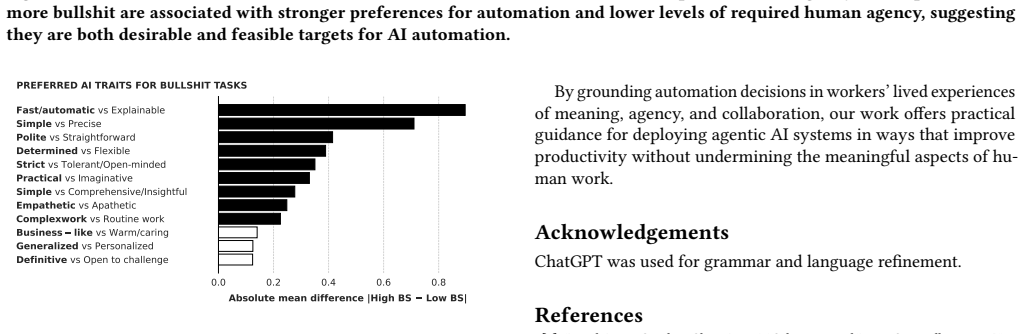
Workers want AI agents to take over tasks they rate as bullshit, which they also see as needing little oversight.
A machine-rendered reading of the paper's core claim, the machinery that carries it, and where it could break.
Core claim
Tasks perceived as bullshit are natural candidates for AI delegation, aligning worker preferences with perceived feasibility.
What carries the argument
Five-item scale of perceived bullshitness at the task level, which predicts desire for AI delegation and low oversight needs.
If this is right
- Perceived bullshitness can serve as a practical signal for choosing which tasks to automate first.
- Task-level variation in meaning within the same job becomes visible and actionable for AI design.
- Delegation decisions can be guided by worker input rather than top-down occupation lists.
- Tasks rated high on bullshitness are expected to need less ongoing human monitoring once automated.
Where Pith is reading between the lines
- AI tools aimed at high-bullshit tasks may see faster acceptance because they match what workers already want removed.
- Job redesign efforts could use the scale to protect high-meaning tasks while automating the rest.
- Long-term studies could test whether removing these tasks raises overall job satisfaction or shifts what counts as meaningful work.
Load-bearing premise
The five-item scale validly measures Graeber's bullshit-jobs idea at the level of single tasks and that workers' self-reported desire to delegate reflects real feasibility without response bias.
What would settle it
A workplace study that tracks actual AI task delegation and finds no correlation between bullshitness ratings and delegation rates.
Figures

read the original abstract
Some claim that AI agents will free workers from the boring parts of their jobs, yet little is known about how workers themselves identify which tasks should be automated. Prior research focuses on occupations, overlooking that workers experience varying levels of meaning across tasks within the same role. We address this gap with a task-level analysis grounded in Graeber's theory of bullshit jobs. Using ratings from 202 workers on 171 workplace tasks, we (1) validate a five-item scale of perceived bullshitness, (2) show that perceived bullshitness strongly predicts desire for AI delegation, and (3) find that such tasks are also seen as requiring less human oversight. Together, these findings suggest that tasks perceived as bullshit are natural candidates for AI delegation, aligning worker preferences with perceived feasibility.
Editorial analysis
A structured set of objections, weighed in public.
Referee Report
Summary. The manuscript reports results from 202 workers rating 171 workplace tasks. It validates a five-item scale of perceived bullshitness grounded in Graeber's theory, shows that bullshitness strongly predicts desire for AI delegation, and finds that such tasks are perceived to require less human oversight. The central claim is that tasks perceived as bullshit are natural candidates for AI delegation, aligning worker preferences with perceived feasibility.
Significance. If the scale validly operationalizes the construct at the task level and self-reported delegation preferences reflect genuine feasibility without bias, the work supplies task-level empirical evidence extending Graeber's framework to AI contexts and identifies a potential alignment between perceived meaninglessness and automation suitability. The direct collection of worker ratings on concrete tasks is a clear methodological asset.
major comments (2)
- [Methods] Methods (scale validation subsection): the five-item bullshitness scale is load-bearing for the prediction and oversight claims, yet the abstract and reported results give no indication of convergent validity against Graeber-derived items, discriminant validity from mere task unpleasantness, or controls for social-desirability bias in delegation preferences. Without these, the observed correlations do not establish that the scale specifically captures societal pointlessness rather than personal dislike.
- [Abstract/Results] Abstract and Results: the abstract states scale validation, a strong predictor relationship, and an oversight finding but supplies no error bars, per-task sample sizes, or data exclusion rules. This prevents assessment of whether post-hoc analytic choices affect the central correlations between bullshitness and delegation desire.
minor comments (1)
- [Abstract] Abstract: the opening sentence could explicitly note the sample (202 workers, 171 tasks) to give immediate context for the scale-validation claim.
Simulated Author's Rebuttal
Thank you for the referee's constructive comments on our manuscript. We address each major point below with the strongest honest defense possible, indicating where revisions are warranted.
read point-by-point responses
-
Referee: [Methods] Methods (scale validation subsection): the five-item bullshitness scale is load-bearing for the prediction and oversight claims, yet the abstract and reported results give no indication of convergent validity against Graeber-derived items, discriminant validity from mere task unpleasantness, or controls for social-desirability bias in delegation preferences. Without these, the observed correlations do not establish that the scale specifically captures societal pointlessness rather than personal dislike.
Authors: The five-item scale was constructed with items directly derived from Graeber's definition of bullshit jobs to ensure content validity by design, and the manuscript reports reliability and factor-analytic validation of its internal structure. We acknowledge that separate convergent validity tests against additional Graeber-derived items, explicit discriminant validity checks against unpleasantness measures, and social-desirability controls were not included in the survey design or reported results. The survey was anonymous, which mitigates some response bias, but we agree this leaves open the possibility that ratings partly reflect personal dislike. We will revise the methods and limitations sections to clarify the theoretical grounding and explicitly discuss these gaps. revision: partial
-
Referee: [Abstract/Results] Abstract and Results: the abstract states scale validation, a strong predictor relationship, and an oversight finding but supplies no error bars, per-task sample sizes, or data exclusion rules. This prevents assessment of whether post-hoc analytic choices affect the central correlations between bullshitness and delegation desire.
Authors: The abstract is space-constrained, but the full results section reports the overall sample (202 workers, 171 tasks) and the key correlations. We will revise the abstract to include the primary correlation coefficients with 95% confidence intervals. In the results, we will add the mean and range of per-task ratings (each task was rated by a subset of participants), along with explicit data exclusion rules such as removal of incomplete responses. These changes will improve transparency regarding analytic choices and robustness. revision: yes
Circularity Check
Empirical survey study with no mathematical derivation or self-referential loops
full rationale
The paper is a human-subjects survey collecting ratings on 171 tasks from 202 workers. It validates a five-item bullshitness scale via standard psychometric methods on the collected data, then reports correlations between bullshitness ratings and delegation desire/oversight needs. No equations, fitted parameters, or predictions are defined in terms of themselves; the central claims rest directly on the external survey responses rather than any self-citation chain or definitional reduction. This matches the default case of a self-contained empirical study.
Axiom & Free-Parameter Ledger
axioms (1)
- domain assumption Graeber's theory of bullshit jobs applies directly to granular workplace tasks and can be measured with a short self-report scale.
Reference graph
Works this paper leans on
-
[1]
2022.New Frontiers: The Origins and Content of New Work, 1940–2018
David Autor, Caroline Chin, Anna M Salomons, and Bryan Seegmiller. 2022.New Frontiers: The Origins and Content of New Work, 1940–2018. Working Paper 30389. National Bureau of Economic Research. doi:10.3386/w30389
-
[2]
Catherine Bailey, Ruth Yeoman, Adrian Madden, Marc Thompson, and Gary Kerridge. 2019. A Review of the Empirical Literature on Meaningful Work: Progress and Research Agenda.Human Resource Development Review18, 1 (2019), 83–113. doi:10.1177/1534484318804653
-
[3]
Butler, S
J. Butler, S. Jaffe, R. Janßen, N. Baym, B. Hecht, J. Hofman, S. Rintel, B. Sarrafzadeh, A. Sellen, M. Vorvoreanu, and J. Teevan. 2025.Microsoft New Future of Work Report 2025. Technical Report MSR-TR-2025-58. Microsoft Research. https: //aka.ms/nfw2025
2025
-
[4]
M. Dong, J. R. Conway, J.-F. Bonnefon, A. Shariff, and I. Rahwan. 2024. Fears about Artificial Intelligence across 20 Countries and Six Domains of Application. American Psychologist(2024)
2024
- [5]
-
[6]
Erik Engberg, Michael Koch, Magnus Lodefalk, and Sarah Schroeder. 2025. Arti- ficial intelligence, tasks, skills, and wages: Worker-level evidence from Germany. Research Policy54, 8 (2025), 105285. doi:10.1016/j.respol.2025.105285
-
[7]
David Graeber. 2013. On the Phenomenon of Bullshit Jobs: A Work Rant.Strike Magazine3, 1 (2013), 2
2013
-
[8]
2018.Bullshit Jobs: A Theory
David Graeber. 2018.Bullshit Jobs: A Theory. Simon & Schuster, New York, NY, USA
2018
-
[9]
Abraham H. Maslow. 1943. A Theory of Human Motivation.Psychological Review 50, 4 (1943), 370–396. doi:10.1037/h0054346
-
[10]
Mariano Méndez-Suárez, Maja Ćukušić, and Ivana Ninčević-Pašalić. 2026. AI FoMO (fear of missing out) in the workplace.Technology in Society84 (2026), 103052. doi:10.1016/j.techsoc.2025.103052
-
[11]
National Center for O*NET Development. 2025. O*NET OnLine. https://www. onetonline.org/ Will AI Agents Free Us From Meaningless Work? A Human-Centered Analysis Conference’17, July 2017, Washington, DC, USA
2025
-
[12]
Jaspreet Ranjit, Ke Zhou, Swabha Swayamdipta, and Daniele Quercia. 2026. Are We Automating the Joy Out of Work? Designing AI to Augment Work, Not Meaning. InProceedings of the 2026 CHI Conference on Human Factors in Computing Systems. 1–46
2026
-
[13]
Ali Akbar Septiandri, Marios Constantinides, and Daniele Quercia. 2024. The potential impact of AI innovations on US occupations.PNAS Nexus3, 9 (09 2024), pgae320. doi:10.1093/pnasnexus/pgae320
-
[14]
Y. Shao, H. Zope, Y. Jiang, J. Pei, D. Nguyen, Erik Brynjolfsson, and D. Yang
-
[15]
Future of Work with AI Agents: Auditing Automation and Augmentation Potential across the U.S. Workforce.arXiv(2025). arXiv:2506.06576 https: //arxiv.org/abs/2506.06576
-
[16]
The training process of many deep networks explores the same low-dimensional manifold
Tyler J. VanderWeele. 2017. On the Promotion of Human Flourishing.Proceedings of the National Academy of Sciences114, 31 (2017), 8148–8156. doi:10.1073/pnas. 1702996114
-
[17]
Monika Westphal, Patrick Hemmer, Michael Vössing, Max Schemmer, Sebastian Vetter, and Gerhard Satzger. 2025. Towards Understanding AI Delegation: The Role of Self-Efficacy and Visual Processing Ability.ACM Trans. Interact. Intell. Syst.15, 1, Article 5 (Feb. 2025), 24 pages. doi:10.1145/3696423
discussion (0)
Sign in with ORCID, Apple, or X to comment. Anyone can read and Pith papers without signing in.