TESS detection of periodic brightness variations during the rise of classical nova PGIR22akgylf
Pith reviewed 2026-06-27 08:05 UTC · model grok-4.3
The pith
Periodic brightness variations detected by TESS in PGIR22akgylf arise from binary orbital motion distorting the nova envelope.
A machine-rendered reading of the paper's core claim, the machinery that carries it, and where it could break.
Core claim
The detected 0.1802 d periodic brightness modulation in PGIR22akgylf, observed 3 to 16 days after discovery when the nova was still rising, originates from the orbital motion of the binary system distorting the nova envelope. This points to common-envelope interaction contributing to the shell ejection mechanism, demonstrating that slow rises can occur in systems with dwarf donors.
What carries the argument
The 0.1802-day periodic signal from TESS photometry, interpreted as orbital distortion of the nova envelope by the binary motion.
If this is right
- The nova's light at the time of observation is dominated by the expanding photosphere rather than accretion or other sources.
- The period corresponds to the full or half orbital period of a dwarf donor companion.
- Common-envelope interaction contributes to shell ejection in PGIR22akgylf.
- The slow-rise phenomenon occurs outside of symbiotic binaries with large orbital separations.
Where Pith is reading between the lines
- If similar periodic signals are found in other slow-rising novae, it would support a general role for envelope distortion in rise times.
- Models of nova ejection could incorporate common-envelope effects even for close binaries with dwarf donors.
- Follow-up spectroscopy might confirm the orbital period by measuring radial velocities of the companion.
Load-bearing premise
That the observed light comes primarily from the expanding photosphere and that the detected period directly reflects the binary orbital period or its half.
What would settle it
Detection of a changing period over time or spectroscopic evidence that the light source is not the photosphere would undermine the orbital distortion interpretation.
Figures

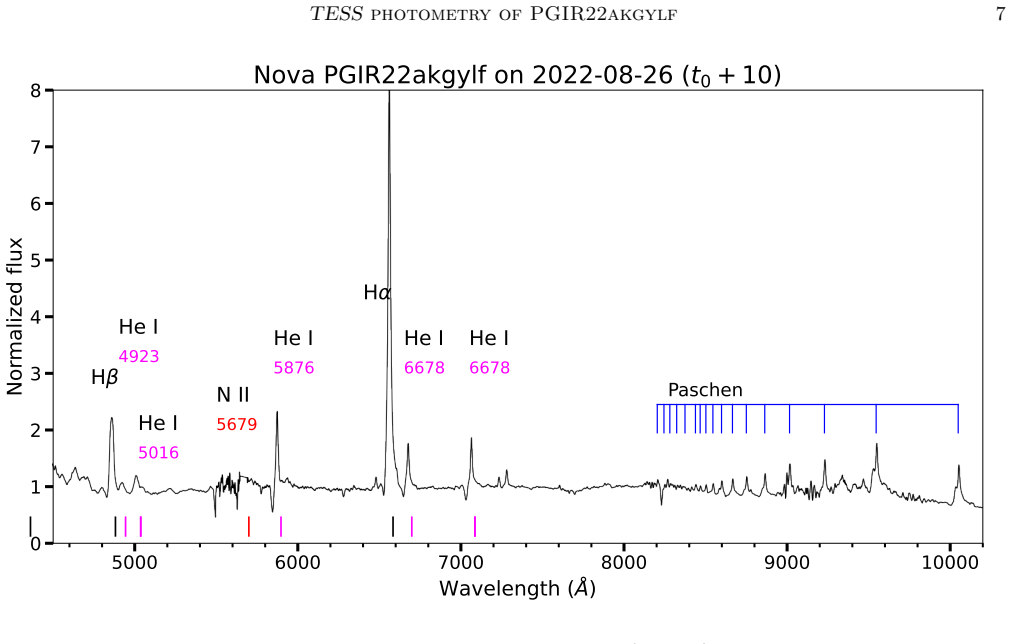


read the original abstract
Classical novae are transient events powered by thermonuclear burning in a layer of hydrogen-rich material accreted by a white dwarf from its binary companion. Most classical novae reach optical maximum within ~1 d, but a rare few rise far more slowly. We probe the envelope structure and ejection mechanism of the slowly-rising nova PGIR22akgylf with TESS photometry spanning 3 to 16 d after the nova discovery, supplemented by ground-based observations that cover its full ~133 d ascent to maximum. We detect a 0.1802 +/-0.0012 d periodic brightness modulation with a peak-to-peak amplitude of ~0.02 mag, identified with PGIR22akgylf via temporal and spatial coincidence. The period is stable over the two weeks of TESS coverage, suggesting an orbital origin. Whether this period corresponds to the full or half orbital period, it implies a dwarf donor companion. At the time of the TESS observations the nova was >~6 mag above quiescence (but still 4 mag below peak), so its light should be dominated by the expanding photosphere. We interpret the periodic signal as arising from the binary orbital motion distorting the nova envelope while its size remains comparable to the binary separation. This interpretation points to common-envelope interaction as a contributor to shell ejection in PGIR22akgylf and demonstrates that the slow-rise phenomenon is not exclusive to thermonuclear eruptions in symbiotic binaries, where the large orbital separation of the giant companion inhibits such interaction.
Editorial analysis
A structured set of objections, weighed in public.
Referee Report
Summary. The paper reports TESS photometry of the slowly-rising classical nova PGIR22akgylf spanning 3–16 days post-discovery (supplemented by ground-based data covering the full ~133 d rise), detecting a stable periodic brightness modulation of period 0.1802 ± 0.0012 d and ~0.02 mag amplitude. The authors identify the signal with the nova via coincidence and interpret it as orbital modulation from binary distortion of the envelope while its size remains comparable to the binary separation, implying a dwarf donor and common-envelope interaction as a contributor to shell ejection (distinct from symbiotic systems).
Significance. If the interpretation holds, the result supplies an observational constraint on envelope structure and binary interaction during the early rise of a classical nova with a dwarf companion, supporting the idea that common-envelope effects can influence ejection even outside symbiotic systems. The period detection itself rests on standard time-series methods with a stability check.
major comments (1)
- [Abstract] Abstract and interpretation section: the central claim that the TESS-epoch light is photosphere-dominated and that R_phot remains comparable to a_bin (required for the distortion interpretation and common-envelope conclusion) is asserted without any quantitative estimate; no expansion velocity, blackbody radius, or model-based R_phot at 3–16 d is supplied, and the 133 d rise time alone does not constrain R_phot ~ a_bin rather than >> a_bin.
minor comments (2)
- The period uncertainty derivation and any alias checks should be stated explicitly in the methods or results section.
- Figure captions for the light curve and periodogram should include the exact time baseline and any detrending details applied to the TESS data.
Simulated Author's Rebuttal
We thank the referee for the careful reading and for identifying the need for quantitative support of the photospheric radius claim. We address the point below and will revise the manuscript to incorporate an explicit estimate.
read point-by-point responses
-
Referee: [Abstract] Abstract and interpretation section: the central claim that the TESS-epoch light is photosphere-dominated and that R_phot remains comparable to a_bin (required for the distortion interpretation and common-envelope conclusion) is asserted without any quantitative estimate; no expansion velocity, blackbody radius, or model-based R_phot at 3–16 d is supplied, and the 133 d rise time alone does not constrain R_phot ~ a_bin rather than >> a_bin.
Authors: We agree that an explicit quantitative estimate strengthens the interpretation and that the 133-day rise time by itself is insufficient. In the revised manuscript we will add a calculation of R_phot at the TESS epoch (3–16 d post-discovery). Using the observed magnitude (~6 mag above quiescence, 4 mag below peak), a conservative distance, and a blackbody temperature of ~8000–12000 K appropriate for early nova phases, we obtain R_phot ~ few × 10^11 cm. For a 0.18 d orbital period with a dwarf donor this is comparable to a_bin, supporting the distortion interpretation. We will also cite typical nova expansion velocities (~100–300 km/s at early times) to show that the photosphere has not yet expanded far beyond binary scales. This addresses the referee’s concern directly. revision: yes
Circularity Check
No circularity: observational detection plus standard interpretation
full rationale
The paper reports a TESS-detected 0.1802 d periodic signal in PGIR22akgylf, notes its stability and coincidence with the nova, and interprets it as orbital distortion of the envelope under the assumption that the photosphere dominates the light and remains comparable in size to the binary separation. No equations, fitted parameters, or self-citations are presented that reduce this interpretation to a tautology or force the result by construction. The central claim rests on direct photometry and conventional astrophysical reasoning rather than any of the enumerated circular patterns.
Axiom & Free-Parameter Ledger
axioms (2)
- domain assumption Nova light during the rise phase is dominated by emission from the expanding photosphere rather than residual accretion or other components.
- domain assumption The measured 0.18 d period corresponds to the orbital period or half-period of a dwarf donor binary.
Reference graph
Works this paper leans on
-
[1]
A., Ackermann, M., Ajello, M., et al
Abdo, A. A., Ackermann, M., Ajello, M., et al. 2010, Science, 329, 817, doi: 10.1126/science.1192537
-
[2]
2025, A&A, 695, A152, doi: 10.1051/0004-6361/202452447 18 Sokolovsky et al
Abe, K., Abe, S., Abhishek, A., et al. 2025, A&A, 695, A152, doi: 10.1051/0004-6361/202452447 18 Sokolovsky et al
-
[3]
Acciari, V. A., Ansoldi, S., Antonelli, L. A., et al. 2022, Nature Astronomy, 6, 689, doi: 10.1038/s41550-022-01640-z
-
[4]
2014, Science, 345, 554, doi: 10.1126/science.1253947 Astropy Collaboration, Robitaille, T
Ackermann, M., Ajello, M., Albert, A., et al. 2014, Science, 345, 554, doi: 10.1126/science.1253947 Astropy Collaboration, Robitaille, T. P., Tollerud, E. J., et al. 2013, A&A, 558, A33, doi: 10.1051/0004-6361/201322068 Astropy Collaboration, Price-Whelan, A. M., Sipőcz, B. M., et al. 2018, AJ, 156, 123, doi: 10.3847/1538-3881/aabc4f Astropy Collaboration...
-
[5]
2018, Phd thesis, University of Cape Town, Cape
Aydi, E. 2018, Phd thesis, University of Cape Town, Cape
2018
-
[6]
Aydi, E., Sokolovsky, K. V., Chomiuk, L., et al. 2020a, Nature Astronomy, 4, 776, doi: 10.1038/s41550-020-1070-y
-
[7]
2020b, ApJ, 905, 62, doi: 10.3847/1538-4357/abc3bb
Aydi, E., Chomiuk, L., Izzo, L., et al. 2020b, ApJ, 905, 62, doi: 10.3847/1538-4357/abc3bb
-
[8]
2023, MNRAS, 524, 1946, doi: 10.1093/mnras/stad1914
Aydi, E., Chomiuk, L., Mikołajewska, J., et al. 2023, MNRAS, 524, 1946, doi: 10.1093/mnras/stad1914
-
[9]
2024, MNRAS, 527, 9303, doi: 10.1093/mnras/stad3342
Aydi, E., Chomiuk, L., Strader, J., et al. 2024, MNRAS, 527, 9303, doi: 10.1093/mnras/stad3342
-
[10]
Aydi, E., Monnier, J. D., Mérand, A., et al. 2026, Nature Astronomy, 10, 271, doi: 10.1038/s41550-025-02725-1
-
[11]
Barnes, T. G., & Evans, N. R. 1970, PASP, 82, 889, doi: 10.1086/128978
-
[12]
Bath, G. T., & Shaviv, G. 1976, MNRAS, 175, 305, doi: 10.1093/mnras/175.2.305
-
[13]
Bellm, E. C., Kulkarni, S. R., Graham, M. J., et al. 2019, PASP, 131, 018002, doi: 10.1088/1538-3873/aaecbe
-
[14]
W., et al
Blank, R., Anglin, S., Beletic, J. W., et al. 2011, in Astronomical Society of the Pacific Conference Series, Vol. 437, Solar Polarization 6, ed. J. R. Kuhn, D. M
2011
-
[15]
2016, Photutils: Photometry tools, Astrophysics Source Code Library, record ascl:1609.011
Bradley, L., Sipocz, B., Robitaille, T., et al. 2016, Photutils: Photometry tools, Astrophysics Source Code Library, record ascl:1609.011. http://ascl.net/1609.011
2016
-
[16]
E., Phillip, C., Fleming, S
Brasseur, C. E., Phillip, C., Fleming, S. W., Mullally, S. E., & White, R. L. 2019, Astrocut: Tools for creating cutouts of TESS images. http://ascl.net/1905.007
2019
-
[17]
2023a, MNRAS, 519, 352, doi: 10.1093/mnras/stac3493 —
Bruch, A. 2023a, MNRAS, 519, 352, doi: 10.1093/mnras/stac3493 —. 2023b, MNRAS, 525, 1953, doi: 10.1093/mnras/stad2089
-
[18]
Chambers, K. C., Magnier, E. A., Metcalfe, N., et al. 2016, arXiv e-prints, arXiv:1612.05560, doi: 10.48550/arXiv.1612.05560
work page internal anchor Pith review Pith/arXiv arXiv doi:10.48550/arxiv.1612.05560 2016
-
[19]
2020, ApJS, 249, 18, doi: 10.3847/1538-4365/ab9cae
Chen, X., Wang, S., Deng, L., et al. 2020, ApJS, 249, 18, doi: 10.3847/1538-4365/ab9cae
-
[20]
Cheung, C. C., Johnson, T. J., Jean, P., et al. 2022, ApJ, 935, 44, doi: 10.3847/1538-4357/ac7eb7
-
[21]
1997, Contributions of the Astronomical Observatory Skalnate Pleso, 27, 53
Chochol, D., & Pribulla, T. 1997, Contributions of the Astronomical Observatory Skalnate Pleso, 27, 53
1997
-
[22]
Chomiuk, L., Metzger, B. D., & Shen, K. J. 2021a, ARA&A, 59, 391, doi: 10.1146/annurev-astro-112420-114502
-
[23]
Chomiuk, L., Linford, J. D., Yang, J., et al. 2014, Nature, 514, 339, doi: 10.1038/nature13773
-
[24]
Chomiuk, L., Linford, J. D., Aydi, E., et al. 2021b, ApJS, 257, 49, doi: 10.3847/1538-4365/ac24ab
-
[25]
2025, ApJ, 981, 198, doi: 10.3847/1538-4357/adb628
Cohen, A., Guetta, D., Hillman, Y., et al. 2025, ApJ, 981, 198, doi: 10.3847/1538-4357/adb628
-
[26]
Condon, J. J. 1974, ApJ, 188, 279, doi: 10.1086/152714
-
[27]
2026, MNRAS, 546, staf2270, doi: 10.1093/mnras/staf2270
Craig, P., Aydi, E., Chomiuk, L., et al. 2026, MNRAS, 546, staf2270, doi: 10.1093/mnras/staf2270
-
[28]
Cushing, M. C., Vacca, W. D., & Rayner, J. T. 2004, PASP, 116, 362, doi: 10.1086/382907
-
[29]
De, K., Hankins, M. J., Kasliwal, M. M., et al. 2020, PASP, 132, 025001, doi: 10.1088/1538-3873/ab6069
-
[30]
De, K., Kasliwal, M. M., Hankins, M. J., et al. 2021, ApJ, 912, 19, doi: 10.3847/1538-4357/abeb75
-
[31]
B., et al
De, K., Soria, R., Agusti, M. B., et al. 2022, The Astronomer’s Telegram, 15587, 1
2022
-
[32]
Deeming, T. J. 1975, Ap&SS, 36, 137, doi: 10.1007/BF00681947 Dubovský, P. A., Petrík, K., & Breus, V. 2024, Contributions of the Astronomical Observatory Skalnate Pleso, 54, 128, doi: 10.31577/caosp.2024.54.2.128
-
[33]
Eyres, S. P. S., Bewsher, D., Hillman, Y., et al. 2017, MNRAS, 467, 2684, doi: 10.1093/mnras/stx298
-
[34]
Fabian, A. C., & Pringle, J. E. 1977, MNRAS, 180, 749, doi: 10.1093/mnras/180.4.749
-
[35]
2018, A&A, 609, A120, doi: 10.1051/0004-6361/201731516
Buson, S. 2018, A&A, 609, A120, doi: 10.1051/0004-6361/201731516
-
[36]
Friedjung, M. 1990, in IAU Colloq. 122: Physics of Classical Novae, ed. A. Cassatella & R. Viotti, Vol. 369, 244, doi: 10.1007/3-540-53500-4_132 —. 2004, Baltic Astronomy, 13, 116 González-Bolívar, M., De Marco, O., Lau, M. Y. M., Hirai, R., & Price, D. J. 2022, MNRAS, 517, 3181, doi: 10.1093/mnras/stac2301
-
[37]
Goranskij, V. P., Katysheva, N. A., Kusakin, A. V., et al. 2007, Astrophysical Bulletin, 62, 125, doi: 10.1134/S1990341307020046
-
[38]
Gordon, A. C., Aydi, E., Page, K. L., et al. 2021, ApJ, 910, 134, doi: 10.3847/1538-4357/abe547 TESS photometry of PGIR22akgylf 19
-
[39]
Graham, M. J., Kulkarni, S. R., Bellm, E. C., et al. 2019, PASP, 131, 078001, doi: 10.1088/1538-3873/ab006c H. E. S. S. Collaboration, Aharonian, F., Ait Benkhali, F., et al. 2022, Science, 376, 77, doi: 10.1126/science.abn0567
-
[40]
2004, ApJL, 612, L57, doi: 10.1086/424595
Hachisu, I., & Kato, M. 2004, ApJL, 612, L57, doi: 10.1086/424595
-
[41]
Harrison, T. E., & Campbell, R. K. 2016, MNRAS, 459, 4161, doi: 10.1093/mnras/stw961
-
[42]
Heinze, A. N., Tonry, J. L., Denneau, L., et al. 2018, AJ, 156, 241, doi: 10.3847/1538-3881/aae47f
-
[43]
Herter, T. L., Henderson, C. P., Wilson, J. C., et al. 2008, in Society of Photo-Optical Instrumentation Engineers (SPIE) Conference Series, Vol. 7014, Ground-based and Airborne Instrumentation for Astronomy II, ed. I. S. McLean & M. M. Casali, 70140X, doi: 10.1117/12.789660
-
[44]
2022, MNRAS, 515, 1404, doi: 10.1093/mnras/stac1688
Hillman, Y. 2022, MNRAS, 515, 1404, doi: 10.1093/mnras/stac1688
-
[45]
Neill, J. D. 2014, MNRAS, 437, 1962, doi: 10.1093/mnras/stt2027
-
[46]
Hogg, D. W. 2001, AJ, 121, 1207, doi: 10.1086/318736
-
[47]
Holdsworth, D. L., Rushton, M. T., Bewsher, D., et al. 2014, MNRAS, 438, 3483, doi: 10.1093/mnras/stt2455
-
[48]
Hounsell, R., Darnley, M. J., Bode, M. F., et al. 2016, ApJ, 820, 104, doi: 10.3847/0004-637X/820/2/104
-
[49]
2003, in Astronomical Society of the Pacific Conference Series, Vol
Iben, Jr., I. 2003, in Astronomical Society of the Pacific Conference Series, Vol. 303, Symbiotic Stars Probing Stellar Evolution, ed. R. L. M. Corradi, J. Mikolajewska, & T. J. Mahoney, 177
2003
-
[50]
Ivanov, L. N. 1978, Soviet Astronomy Letters, 4, 141
1978
-
[51]
Lombardi, J. C. 2013, Science, 339, 433, doi: 10.1126/science.1225540
-
[52]
Kahabka, P., & van den Heuvel, E. P. J. 1997, ARA&A, 35, 69, doi: 10.1146/annurev.astro.35.1.69
-
[53]
1994, ApJ, 437, 802, doi: 10.1086/175041 —
Kato, M., & Hachisu, I. 1994, ApJ, 437, 802, doi: 10.1086/175041 —. 2009, ApJ, 699, 1293, doi: 10.1088/0004-637X/699/2/1293 —. 2011, ApJ, 743, 157, doi: 10.1088/0004-637X/743/2/157
-
[54]
Kato, M., & Hachisu, I. 2015, in The Golden Age of Cataclysmic Variables and Related Objects - III (Golden2015), 52, doi: 10.22323/1.255.0052
-
[55]
2021, ApJ, 910, 120, doi: 10.3847/1538-4357/abe53d —
Kawash, A., Chomiuk, L., Strader, J., et al. 2021, ApJ, 910, 120, doi: 10.3847/1538-4357/abe53d —. 2022, ApJ, 937, 64, doi: 10.3847/1538-4357/ac8d5e
-
[56]
Kenyon, S. J., & Truran, J. W. 1983, ApJ, 273, 280, doi: 10.1086/161367
-
[57]
Kloppenborg, B. K. 2025, Observations from the AA VSO International Database, https://www.aavso.org König, O., Wilms, J., Arcodia, R., et al. 2022, Nature, 605, 248, doi: 10.1038/s41586-022-04635-y
-
[58]
Kornilov, V. G., Lipunov, V. M., Gorbovskoy, E. S., et al. 2012, Experimental Astronomy, 33, 173, doi: 10.1007/s10686-011-9280-z
-
[59]
2019, Acta Astronautica, 160, 46, doi: 10.1016/j.actaastro.2019.04.016
Vanderspek, R. 2019, Acta Astronautica, 160, 46, doi: 10.1016/j.actaastro.2019.04.016
-
[60]
Kuiper, G. P. 1941, ApJ, 93, 133, doi: 10.1086/144252
-
[61]
Lamb, F. K., Aly, J.-J., Cook, M. C., & Lamb, D. Q. 1983, ApJL, 274, L71, doi: 10.1086/184153
-
[62]
Li, K.-L., Metzger, B. D., Chomiuk, L., et al. 2017, Nature Astronomy, 1, 697, doi: 10.1038/s41550-017-0222-1 Lightkurve Collaboration, Cardoso, J. V. d. M., Hedges, C., et al. 2018, Lightkurve: Kepler and TESS time series analysis in Python, Astrophysics Source Code Library. http://ascl.net/1812.013
-
[63]
1975, Nature, 258, 501, doi: 10.1038/258501a0
Lindegren, L., & Lindgren, H. 1975, Nature, 258, 501, doi: 10.1038/258501a0
-
[64]
2010, Advances in Astronomy, 2010, 349171, doi: 10.1155/2010/349171
Lipunov, V., Kornilov, V., Gorbovskoy, E., et al. 2010, Advances in Astronomy, 2010, 349171, doi: 10.1155/2010/349171
-
[65]
Livio, M., Shankar, A., Burkert, A., & Truran, J. W. 1990, ApJ, 356, 250, doi: 10.1086/168836
-
[66]
Lomb, N. R. 1976, Ap&SS, 39, 447, doi: 10.1007/BF00648343
-
[67]
Luna, G. J. M., Dobrotka, A., & Orio, M. 2026a, A&A, 708, A352, doi: 10.1051/0004-6361/202557972
-
[68]
Luna, G. J. M., Lima, I. J., & Orio, M. 2024, Boletin de la Asociacion Argentina de Astronomia La Plata Argentina, 65, 60, doi: 10.48550/arXiv.2310.02220
-
[69]
Luna, G. J. M., Rawat, N., Angeloni, R., et al. 2026b, arXiv e-prints, arXiv:2605.22802, doi: 10.48550/arXiv.2605.22802
work page internal anchor Pith review Pith/arXiv arXiv doi:10.48550/arxiv.2605.22802
-
[70]
MacLeod, M., Ostriker, E. C., & Stone, J. M. 2018, ApJ, 863, 5, doi: 10.3847/1538-4357/aacf08
-
[71]
Malanchev, K., Kornilov, M. V., Pruzhinskaya, M. V., et al. 2023, PASP, 135, 024503, doi: 10.1088/1538-3873/acb292
-
[72]
Masci, F. J., Laher, R. R., Rusholme, B., et al. 2019, PASP, 131, 018003, doi: 10.1088/1538-3873/aae8ac
work page internal anchor Pith review doi:10.1088/1538-3873/aae8ac 2019
-
[73]
The Place of Recurrent Novae among the Symbiotic Stars
Mikolajewska, J. 2008, in Astronomical Society of the Pacific Conference Series, Vol. 401, RS Ophiuchi (2006) and the Recurrent Nova Phenomenon, ed. A. Evans, M. F. Bode, T. J. O’Brien, & M. J. Darnley, 42, doi: 10.48550/arXiv.0803.3685 Mikołajewska, J. 2012, Baltic Astronomy, 21, 5, doi: 10.1515/astro-2017-0352 Mikołajewska, J., & Shara, M. M. 2017, ApJ,...
work page internal anchor Pith review Pith/arXiv arXiv doi:10.48550/arxiv.0803.3685 2008
-
[74]
Munari, U. 2025, Contributions of the Astronomical Observatory Skalnate Pleso, 55, 47, doi: 10.31577/caosp.2025.55.3.47
-
[75]
Munari, U., Hambsch, F. J., & Frigo, A. 2017, MNRAS, 469, 4341, doi: 10.1093/mnras/stx1116
-
[76]
Ness, J. U., Osborne, J. P., Henze, M., et al. 2013, A&A, 559, A50, doi: 10.1051/0004-6361/201322415
-
[77]
Norton, A. J., Wynn, G. A., & Somerscales, R. V. 2004, ApJ, 614, 349, doi: 10.1086/423333
-
[78]
Ofek, E. O. 2019, PASP, 131, 054504, doi: 10.1088/1538-3873/ab04df
-
[79]
Oke, J. B., & Gunn, J. E. 1982, PASP, 94, 586, doi: 10.1086/131027
-
[80]
2026, ApJ, 1004, 38, doi: 10.3847/1538-4357/ae6a8c
Olbemo, T., Errando, M., & Gokus, A. 2026, ApJ, 1004, 38, doi: 10.3847/1538-4357/ae6a8c
discussion (0)
Sign in with ORCID, Apple, or X to comment. Anyone can read and Pith papers without signing in.