Are Primordial Black Holes a Natural Dark Matter Candidate?
Pith reviewed 2026-06-27 06:52 UTC · model grok-4.3
The pith
Some primordial black hole production mechanisms are as natural as off-resonance WIMPs and freeze-in particles when fine-tuning is measured uniformly.
A machine-rendered reading of the paper's core claim, the machinery that carries it, and where it could break.
Core claim
Three distinct naturalness universality classes emerge, determined entirely by the analytic structure of the abundance map rather than by the nature of the dark matter candidate. Biased-domain-wall PBHs are as natural as off-resonance weakly interacting massive particles and freeze-in particles; early-matter-domination and first-order phase transition PBH mechanisms occupy an intermediate tier alongside coannihilating WIMPs, unified by a structural identity in which the fine-tuning measure equals the logarithm of the ratio of the formation scale to the matter-radiation equality scale; and single-field ultra-slow-roll inflationary collapse is severely tuned for a distinct reason: a double exp
What carries the argument
The analytic structure of the abundance map, which fixes the universality class of each mechanism or benchmark once the three fine-tuning measures are applied uniformly to the same observable target.
If this is right
- Biased-domain-wall PBHs match the naturalness of off-resonance WIMPs and freeze-in particles under all three measures.
- Early-matter-domination and first-order phase transition PBH mechanisms share an intermediate naturalness tier with coannihilating WIMPs because their fine-tuning measure equals the log of the formation-to-equality scale ratio.
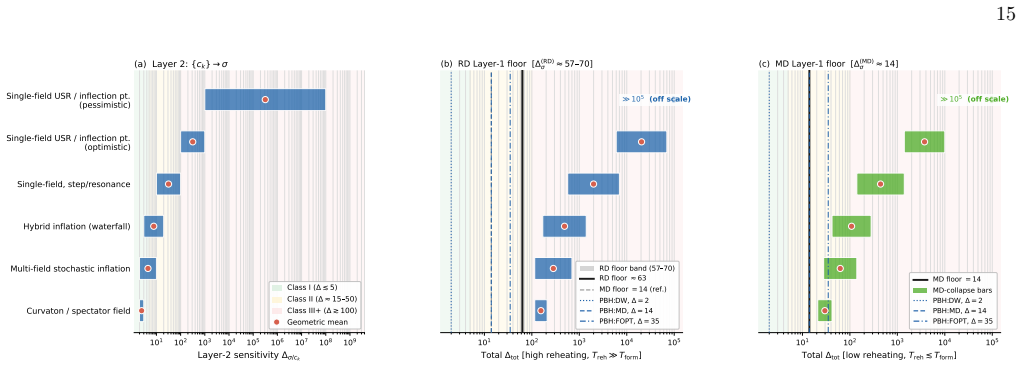
- Single-field ultra-slow-roll inflation is severely tuned because of an extra exponential layer in the power spectrum amplitude on top of the abundance map sensitivity.
- The Barbieri-Giudice and Iovino-Riotto measures answer complementary questions and reconcile inside the two-layer decomposition used here.
Where Pith is reading between the lines
- The same three-measure protocol could classify the naturalness of other proposed dark matter candidates whose abundance maps have similar analytic forms.
- Observational searches might gain from focusing first on PBH production channels that land in the least-tuned class.
- The two-layer decomposition offers a template for resolving similar tensions between different fine-tuning measures in other cosmological settings.
Load-bearing premise
The three fine-tuning measures can be applied uniformly to PBH mechanisms and particle benchmarks against the same observable target without model-specific adjustments that would change the resulting universality classes.
What would settle it
A calculation showing that model-specific adjustments to any one of the three measures for a biased-domain-wall or early-matter-domination PBH mechanism shift its fine-tuning value out of the predicted universality class relative to the particle benchmarks.
Figures



read the original abstract
Primordial black holes (PBHs) in the asteroid-mass window ($10^{17}$-$10^{22}$ g) can account for all of the dark matter without violating any observational constraint, yet are routinely dismissed as fine-tuned. I put that dismissal to the test by applying three complementary fine-tuning measures uniformly across a broad landscape: three non-inflationary PBH production mechanisms, six classes of inflationary PBH models, and seven particle dark matter benchmarks, all evaluated against the same observable target. Three distinct naturalness universality classes emerge, determined entirely by the analytic structure of the abundance map rather than by the nature of the dark matter candidate. Biased-domain-wall PBHs are as natural as off-resonance weakly interacting massive particles and freeze-in particles; early-matter-domination and first-order phase transition PBH mechanisms occupy an intermediate tier alongside coannihilating WIMPs, unified by a structural identity in which the fine-tuning measure equals the logarithm of the ratio of the formation scale to the matter-radiation equality scale; and single-field ultra-slow-roll inflationary collapse is severely tuned for a distinct reason: a double exponential in which the power spectrum amplitude is itself exponentially sensitive to the inflaton potential coefficients, on top of the exponential collapse sensitivity of the abundance map. My main conclusion is that {\em the claim that PBH dark matter is generically fine-tuned conflates the worst case with a landscape spanning every naturalness tier}. The three-measure protocol also resolves a tension in the recent literature: the Barbieri-Giudice and Iovino-Riotto fine-tuning measures answer complementary questions and are reconciled within the two-layer decomposition developed here.
Editorial analysis
A structured set of objections, weighed in public.
Referee Report
Summary. The manuscript claims that PBH dark matter in the asteroid-mass window is not generically fine-tuned. By applying three complementary fine-tuning measures uniformly to three non-inflationary PBH mechanisms, six classes of inflationary PBH models, and seven particle DM benchmarks—all targeting the same observable—it identifies three naturalness universality classes determined solely by the analytic structure of the abundance map. Biased-domain-wall PBHs match the naturalness of off-resonance WIMPs and freeze-in particles; early-matter-domination and first-order phase transition mechanisms occupy an intermediate tier with coannihilating WIMPs due to a structural identity (fine-tuning measure equals log of formation-to-equality scale ratio); single-field ultra-slow-roll is severely tuned due to a double exponential. The work concludes that the generic fine-tuning dismissal conflates the worst case with a landscape spanning all tiers and reconciles Barbieri-Giudice and Iovino-Riotto measures via a two-layer decomposition.
Significance. If the result holds, the paper would offer a systematic, multi-measure protocol for comparing naturalness across DM candidates, providing a nuanced counter to the routine dismissal of PBH DM and clarifying why certain mechanisms appear tuned while others do not. The uniform application across disparate models and the reconciliation of complementary measures are notable strengths that could influence how fine-tuning arguments are deployed in beyond-Standard-Model phenomenology.
major comments (1)
- [Abstract (paragraph on three-measure protocol)] Abstract (paragraph on three-measure protocol): the assertion that the three universality classes are 'determined entirely by the analytic structure of the abundance map rather than by the nature of the dark matter candidate' rests on the measures yielding basis-independent tier assignments. However, Barbieri-Giudice-type measures are defined relative to a chosen set of input parameters, and the manuscript selects potential coefficients for inflationary models versus formation scales for non-inflationary ones (with particle benchmarks using masses and couplings). No demonstration is given that the resulting classes remain invariant under reparameterization (e.g., trading a coefficient for a composite slow-roll parameter or rescaling the bias term). This invariance is load-bearing for the central claim that PBH mechanisms occupy fixed tiers independent of model details.
Simulated Author's Rebuttal
We thank the referee for their careful reading and for identifying a key point regarding the robustness of our universality classes. The concern about basis independence is well taken and directly impacts the strength of our central claim. We respond below and will revise the manuscript to address it.
read point-by-point responses
-
Referee: the assertion that the three universality classes are 'determined entirely by the analytic structure of the abundance map rather than by the nature of the dark matter candidate' rests on the measures yielding basis-independent tier assignments. However, Barbieri-Giudice-type measures are defined relative to a chosen set of input parameters, and the manuscript selects potential coefficients for inflationary models versus formation scales for non-inflationary ones (with particle benchmarks using masses and couplings). No demonstration is given that the resulting classes remain invariant under reparameterization (e.g., trading a coefficient for a composite slow-roll parameter or rescaling the bias term). This invariance is load-bearing for the central claim that PBH mechanisms occupy fixed tiers independent of model details.
Authors: We agree that the manuscript does not contain an explicit demonstration of invariance under reparameterization, and that such a demonstration is required to substantiate the claim that the tiers are determined solely by the analytic structure of the abundance map. The parameter choices in the original text were selected on physical grounds (potential coefficients enter the inflationary dynamics directly; formation scales parameterize the abundance maps for non-inflationary mechanisms), but this does not replace a check. In the revised manuscript we will add a dedicated subsection (or appendix) that recomputes the three fine-tuning measures for one representative model from each universality class after common reparameterizations, including replacement of potential coefficients by equivalent slow-roll parameters and rescaling of the bias term. We expect the tier assignments to remain stable, but the new analysis will make this explicit rather than implicit. revision: yes
Circularity Check
No significant circularity detected
full rationale
The paper applies three standard external fine-tuning measures uniformly across PBH and particle DM models, with universality classes stated to emerge from the analytic structure of the abundance map. No self-definitional reductions, fitted inputs renamed as predictions, or load-bearing self-citations appear in the abstract or described protocol. The two-layer decomposition is developed in the paper itself to reconcile complementary measures, constituting an original contribution rather than a reduction to prior inputs by construction. The central claim compares measures across a landscape and does not reduce to tautology or fitted parameters.
Axiom & Free-Parameter Ledger
Forward citations
Cited by 1 Pith paper
-
Is dark matter decaying ?
Uncertainties in measuring today's matter content prevent confirming or ruling out dark matter decay, but upcoming surveys could change that.
Reference graph
Works this paper leans on
-
[1]
Production mechanism and abundance map Feebly interacting massive particles (FIMPs) [6, 7] never reach thermal equilibrium with the Standard Model bath; instead, they are produced gradually in the forward direction through infrequent collisions or decays. In the IR-dominated freeze-in scenario relevant here, pro- duction is dominated by decays of a heavy ...
-
[2]
(56) is a pure monomial in (M DM, y) with fixedM B, ∆(B4) MDM = 1,∆ (B4) y = 2,∆ (B4) = 2 (57) exactly, everywhere in the (M DM, y) plane
Fine-tuning structure Since Eq. (56) is a pure monomial in (M DM, y) with fixedM B, ∆(B4) MDM = 1,∆ (B4) y = 2,∆ (B4) = 2 (57) exactly, everywhere in the (M DM, y) plane. The mass sensitivity is unity because Ω∝M DM linearly; the cou- pling sensitivity is two because Ω∝y 2. These are constants, independent of the benchmark point, for the same structural r...
-
[3]
Parameter-space heatmap Figure 4(a) shows log 10 ∆ in the (M DM, y) plane for MB = 100 GeV. The panel is uniformly pale yellow at the minimum of the color scale (∆ = 2) throughout the physically accessible region, with the natural island (green hatching along the Ωh 2 = 0.12 contour) form- ing a clean diagonal stripe of slope−1/2 in the log–log plane, as ...
-
[4]
canonical ADM
Abundance map and fine-tuning Asymmetric dark matter (ADM) [8, 9] posits that the present-day dark matter abundance is set not by ther- mal freeze-out but by a primordial asymmetry between DM particles and antiparticles, generated by the same baryogenesis mechanism that produced the baryon asym- metry. If the DM asymmetry per comoving entropy is ηDM = (nD...
2024
-
[5]
canonical ADM
Misalignment (pre-inflationary PQ breaking) If PQ symmetry breaks before the end of inflation, the axion fieldθ=a/f a is homogenized over superhorizon 20 6 4 2 0 2 4 log10 (MDM/GeV) (a) Freeze-in (MB = 100GeV) --- ∆ = 2 everywhere 15 14 13 12 11 10 9 8 7 log10 y (decay coupling) Lyα excluded (MDM < 3keV) 1 0 1 2 3 4 5 log10 (MDM/GeV) (b) Asymmetric DM ---...
-
[6]
unquenched
Post-inflationary PQ (string decay) If PQ symmetry breaksafterinflation, different Hub- ble patches independently choose their phase when the U(1)PQ symmetry breaks, and the axion field has no single misalignment angle. Instead, a network of cos- mic strings forms at the PQ transition and radiates ax- ions as it evolves; the axion relic density is dominat...
2024
-
[7]
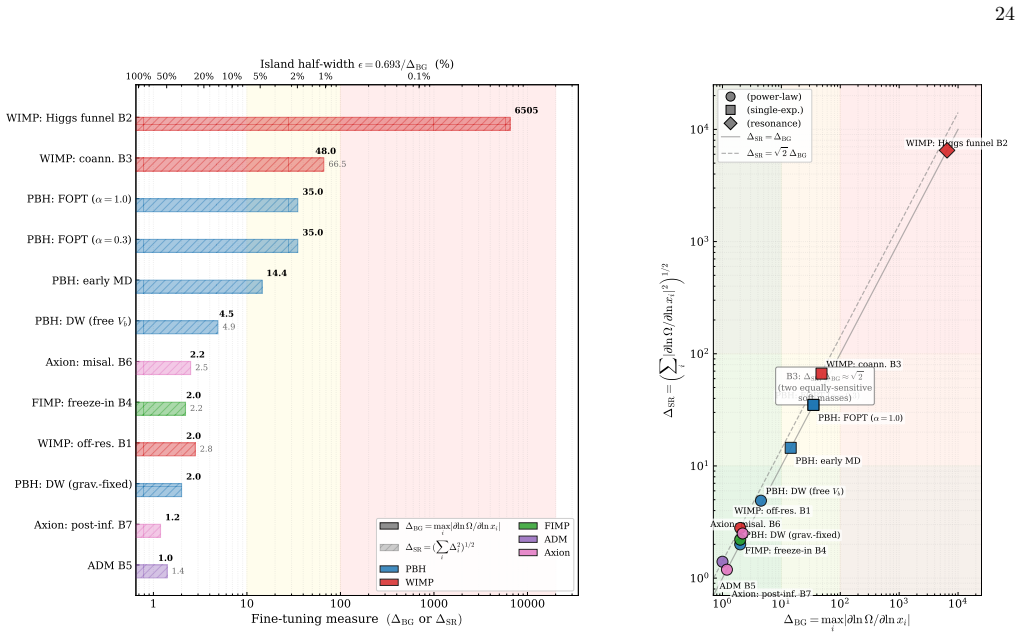
Fine-tuning is a property of the abundance map, not of the dark matter candidate.The BG hierarchy in Table II contains representatives from every paradigm at every tier: the most natural scenario (ADM, ∆ =
-
[8]
PBHs are tuned while WIMPs are natural
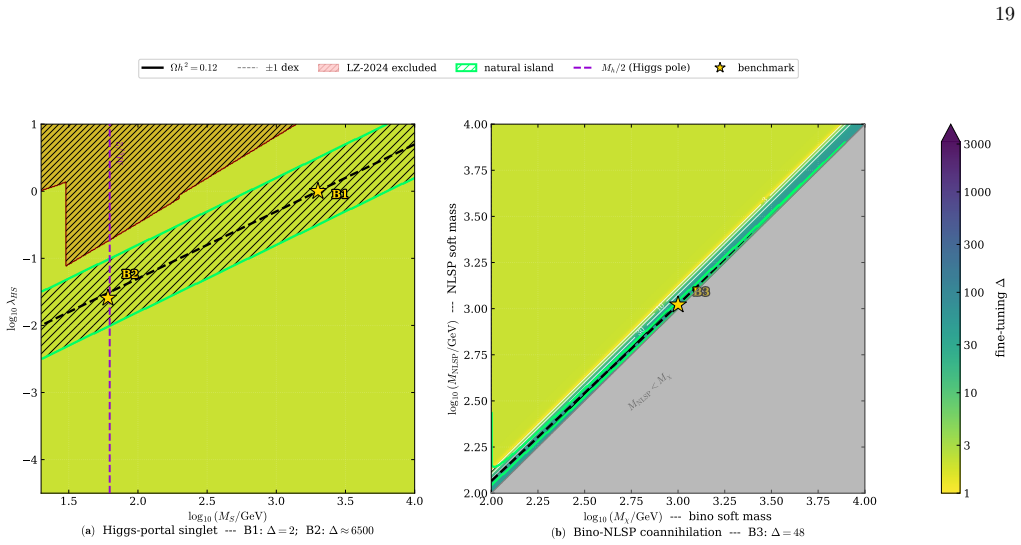
and the second most natural (post-inflationary axion, ∆ = 1.19) are particle dark matter; Class I also includes both a WIMP and a gravitational relic (PBH-DW) at ∆ = 2; and the most tuned precisely computed scenario (Higgs funnel, ∆ = 6500) is a thermal relic, not a PBH. The narrative that “PBHs are tuned while WIMPs are natural” is not supported by a qua...
-
[9]
Three universality classes classify the dark mat- ter landscape.Class I (∆≲5) contains power-law abundance maps with no exponential factor; Class II (∆≈15–50) contains constructions with a single expo- nential; Class III and beyond (∆≳10 3) contains res- onance, cancellation, and double-exponential construc- tions. PBH dark matter appears in all three cla...
-
[10]
fine-tuned
Biased-domain-wall PBHs are as natural as any particle dark matter construction.With ∆ = 4.5 in the free-Vb case and ∆ = 2 in the gravity-induced-bias case, domain-wall PBHs occupy Class I alongside off-resonance WIMPs and FIMPs. The characterization of PBH dark matter as “fine-tuned” does not apply to this mechanism
-
[11]
Single-exponential constructions satisfy a univer- sal identity, regardless of the underlying physics.Any construction whose abundance is set by a single ex- ponential satisfies, on the Ω = Ω DM contour, ∆ = ln(Ωnatural/ΩDM)≈ln(T form/Teq)≈14–50 (Eq. 68). Within the single-exponential approximation, this unifies FOPT-PBH, early-matter-domination PBH, and ...
-
[12]
super- natural
The Layer 1 floor for inflationary PBH production is set by the reheating temperature.For standard high- reheating (T reh ≫T form), all inflationary model classes fall in Class III or beyond, with the Press–Schechter floor ∆(RD) σ ≈57–70 applying universally. For low-reheating (Treh ≲T form), the HYKN floor ∆ (MD) σ ≈14 reduces the total tuning by a facto...
-
[13]
Biased domain walls Starting from Eqs. (13)–(16), the dark matter fraction is fPBH = p V 4 b π2 30 g∗ T 4ann · Tann 0.84T eq = 30p π2g∗ ·0.84T eq ·T −3 ann V 4 b .(A1) SubstitutingT ann = (ctMPlV 4 b /η3)1/2, T −3 ann =c −3/2 t M −3/2 Pl η9/2 V −6 b ,(A2) so that fPBH ∝η 9/2 V −6 b ·V 4 b =η 9/2 V −2 b .(A3) This is Eq. (17). Log-differentiation gives ∂ln...
-
[14]
Early matter domination Fromf PBH =β AM(σ)T reh/(0.84T eq) withT reh ∝ m3/2 ϕ , ∂lnf PBH ∂lnm ϕ = ∂lnT reh ∂lnm ϕ = 3 2 .(A4) For theσ-dependence, lnβ AM = const + 5 lnσ− 0.147σ −4/3, so ∂lnf PBH ∂lnσ = 5 + ∂ ∂lnσ −0.147σ −4/3 = 5 + 4 3 ·0.147σ −4/3 = 5 + 0.196 σ4/3 ,(A5) which is Eq. (27).□
-
[15]
(32), ∂lnf PBH ∂ln(β/H ∗) =−S(α) β H∗ ,(A6) ∂lnf PBH ∂lnT ∗ = 1,(A7) ∂lnf PBH ∂lnα =− ∂S ∂α ·α· β H∗ = 0.6α (α+ 0.3) 2 · β H∗ ,(A8) using∂S/∂α=−0.6/(α+ 0.3) 2
FOPT late-blooming From Eq. (32), ∂lnf PBH ∂ln(β/H ∗) =−S(α) β H∗ ,(A6) ∂lnf PBH ∂lnT ∗ = 1,(A7) ∂lnf PBH ∂lnα =− ∂S ∂α ·α· β H∗ = 0.6α (α+ 0.3) 2 · β H∗ ,(A8) using∂S/∂α=−0.6/(α+ 0.3) 2. On thef PBH = 1 contour,e −S(α)β/H ∗ = 0.84T eq/T∗, henceS(α)β/H ∗ = ln(T∗/0.84T eq), giving ∆ β/H =|−S(α)β/H ∗|= ln(T∗/0.84T eq) as in Eq. (37). This derivation assumes...
2024
-
[16]
G. Jungman, M. Kamionkowski, and K. Griest, Super- symmetric dark matter, Phys. Rep.267, 195 (1996), arXiv:hep-ph/9506380. 31 TABLE III. Benchmark calibration and fine-tuning measures. For each scenario the fundamental parameters are listed with their benchmark values, the resulting abundance (“Ωh2” denotes ΩDMh2 for particle DM scenarios andf PBH for PBH...
Pith/arXiv arXiv 1996
-
[17]
G. Bertone, D. Hooper, and J. Silk, Particle dark mat- ter: Evidence, candidates and constraints, Phys. Rep. 405, 279 (2005), arXiv:hep-ph/0404175
Pith/arXiv arXiv 2005
-
[18]
R. D. Peccei and H. R. Quinn, CP conservation in the presence of pseudoparticles, Phys. Rev. Lett.38, 1440 (1977)
1977
-
[19]
Weinberg, A new light boson?, Phys
S. Weinberg, A new light boson?, Phys. Rev. Lett.40, 223 (1978)
1978
-
[20]
Wilczek, Problem of strong P and T invariance in the presence of instantons, Phys
F. Wilczek, Problem of strong P and T invariance in the presence of instantons, Phys. Rev. Lett.40, 279 (1978)
1978
-
[21]
L. J. Hall, K. Jedamzik, J. March-Russell, and S. M. West, Freeze-in production of FIMP dark matter, JHEP 2010(3), 080, arXiv:0911.1120 [hep-ph]
Pith/arXiv arXiv 2010
-
[22]
McDonald, Thermally generated gauge singlet scalars as self-interacting dark matter, Phys
J. McDonald, Thermally generated gauge singlet scalars as self-interacting dark matter, Phys. Rev. Lett.88, 091304 (2002), arXiv:hep-ph/0106249
Pith/arXiv arXiv 2002
-
[23]
Nussinov, Technocosmology: Could a technibaryon excess provide a “natural” missing mass candidate?, Phys
S. Nussinov, Technocosmology: Could a technibaryon excess provide a “natural” missing mass candidate?, Phys. Lett. B165, 55 (1985)
1985
-
[24]
D. E. Kaplan, M. A. Luty, and K. M. Zurek, Asymmet- ric dark matter, Phys. Rev. D79, 115016 (2009)
2009
-
[25]
B. J. Carr and S. W. Hawking, Black holes in the early Universe, Mon. Not. Roy. Astron. Soc.168, 399 (1974)
1974
-
[26]
A. M. Green and A. R. Liddle, Constraints on the den- sity perturbation spectrum from primordial black holes, Phys. Rev. D56, 6166 (1997), arXiv:astro-ph/9704251
Pith/arXiv arXiv 1997
-
[27]
Carr and F
B. Carr and F. K¨ uhnel, Primordial black holes as dark matter: Recent developments, Ann. Rev. Nucl. Part. Sci.70, 355 (2020)
2020
-
[28]
A. M. Green and B. J. Kavanagh, Primordial black holes as a dark matter candidate, J. Phys. G48, 043001 (2021), arXiv:2007.10722 [astro-ph.CO]
Pith/arXiv arXiv 2021
-
[29]
A. Escriv` a, F. Kuhnel, and Y. Tada, Primordial black holes, arXiv preprint (2022), arXiv:2211.05767 [astro- ph.CO]
arXiv 2022
-
[30]
P. Grothaus, M. Lindner, and Y. Takanishi, Natu- ralness of Neutralino Dark Matter, JHEP07, 094, arXiv:1207.4434 [hep-ph]
-
[31]
Barbieri and G
R. Barbieri and G. F. Giudice, Upper bounds on su- persymmetric particle masses, Nucl. Phys. B306, 63 (1988)
1988
-
[32]
M. E. Cabrera, J. A. Casas, A. Delgado, S. Robles, and R. Ruiz de Austri, Naturalness of MSSM dark matter, JHEP08, 058, arXiv:1604.02102 [hep-ph]
-
[33]
S. F. King and J. P. Roberts, Natural implementation of neutralino dark matter, JHEP2006(9), 036, arXiv:hep- ph/0603095
-
[34]
M. P. Hertzberg and M. Yamada, Primordial black holes from polynomial potentials in single field infla- tion, Phys. Rev. D97, 083509 (2018), arXiv:1712.09750 [astro-ph.CO]
Pith/arXiv arXiv 2018
-
[35]
I. Stamou, Mechanisms for producing primordial black holes from inflationary models beyond fine-tuning, Uni- verse10, 241 (2024), arXiv:2404.14321 [astro-ph.CO]
arXiv 2024
- [36]
-
[37]
A. J. Iovino and A. Riotto, Are Primordial Black Holes Truly Fine-Tuned?, (2025), arXiv:2512.19668 [astro- ph.CO]
Pith/arXiv arXiv 2025
-
[38]
J. R. Ellis, K. Enqvist, D. V. Nanopoulos, and F. Zwirner, Observables in low-energy superstring mod- els, Mod. Phys. Lett. A1, 57 (1986)
1986
-
[39]
Aghanimet al.(Planck), Planck 2018 results
N. Aghanimet al.(Planck), Planck 2018 results. VI. Cosmological parameters, Astron. Astrophys.641, A6 (2020), erratum:ibid.652(2021) C4, arXiv:1807.06209 [astro-ph.CO]
Pith/arXiv arXiv 2018
-
[40]
A. Strumia, Naturalness of supersymmetric models, in 34th Rencontres de Moriond: Electroweak Interactions 32 and Unified Theories(1999) pp. 441–446, arXiv:hep- ph/9904247
arXiv 1999
-
[41]
G. W. Anderson and D. J. Castano, Measures of fine tuning, Phys. Lett. B347, 300 (1995), arXiv:hep- ph/9409419
arXiv 1995
-
[42]
M. E. Cabrera, J. A. Casas, and R. Ruiz de Austri, Bayesian approach and Naturalness in MSSM analyses for the LHC, JHEP03, 075, arXiv:0812.0536 [hep-ph]
-
[43]
S. P. Martin, A supersymmetry primer, Adv. Ser. Direct. High Energy Phys.18, 1 (1998), arXiv:hep- ph/9709356
arXiv 1998
-
[44]
Griest and D
K. Griest and D. Seckel, Three exceptions in the calcula- tion of relic abundances, Phys. Rev. D43, 3191 (1991)
1991
-
[45]
J. Edsjo and P. Gondolo, Neutralino relic density in- cluding coannihilations, Phys. Rev. D56, 1879 (1997), arXiv:hep-ph/9704361
Pith/arXiv arXiv 1997
-
[46]
H. Baer, V. Barger, and A. Mustafayev, Implications of a 125 GeV Higgs scalar for LHC SUSY and neutralino dark matter searches, Phys. Rev. D85, 075010 (2012), arXiv:1112.3017 [hep-ph]
Pith/arXiv arXiv 2012
-
[47]
J. Aalberset al.(LZ), Dark Matter Search Results from 4.2 Tonne-Years of Exposure of the LUX-ZEPLIN (LZ) Experiment, Phys. Rev. Lett.135, 011802 (2025), arXiv:2410.17036 [hep-ex]
Pith/arXiv arXiv 2025
-
[48]
J. M. Alarcon, J. Martin Camalich, and J. A. Oller, The chiral representation of theπNscattering ampli- tude and the pion-nucleon sigma term, Phys. Rev. D 85, 051503 (2012), arXiv:1110.3797 [hep-ph]
Pith/arXiv arXiv 2012
-
[49]
G. Ballesteros, M. A. G. Garcia, and M. Pierre, How warm are non-thermal relics? Lyman-αbounds on out-of-equilibrium dark matter, JCAP2021(3), 101, arXiv:2011.13458 [hep-ph]
arXiv 2011
- [50]
-
[51]
F. Ferrer, E. Mass` o, G. Panico, O. Pujolas, and F. Rompineve, Primordial black holes from the QCD axion, Phys. Rev. Lett.122, 101301 (2019), arXiv:1807.01707 [hep-ph]
Pith/arXiv arXiv 2019
-
[52]
Y. Gouttenoire and E. Vitagliano, Primordial black holes and wormholes from domain wall networks, Phys. Rev. D109, 123507 (2024), arXiv:2311.07670 [hep-ph]
arXiv 2024
-
[53]
R. Z. Ferreira, A. Notari, O. Pujol` as, and F. Rompineve, Collapsing domain wall networks: impact on pulsar tim- ing arrays and primordial black holes, JCAP06, 020, arXiv:2401.14331 [astro-ph.CO]
-
[54]
J. Georg and S. Watson, A Preferred Mass Range for Primordial Black Hole Formation and Black Holes as Dark Matter Revisited, JHEP09, 138, arXiv:1703.04825 [astro-ph.CO]
- [55]
-
[56]
I. Dalianis and C. Kouvaris, Gravitational waves from density perturbations in an early matter domination era, JCAP2021(7), 046, arXiv:2012.09255 [astro- ph.CO]
arXiv 2012
-
[57]
B. Carr, K. Kohri, Y. Sendouda, and J. Yokoyama, Con- straints on primordial black holes, Rept. Prog. Phys.84, 116902 (2021), arXiv:2002.12778 [astro-ph.CO]
Pith/arXiv arXiv 2021
-
[58]
J. Liu, L. Bian, R.-G. Cai, Z.-K. Guo, and S.-J. Wang, Primordial black hole production during first- order phase transitions, Phys. Rev. D105, L021303 (2022), arXiv:2106.05637 [astro-ph.CO]
arXiv 2022
-
[59]
M. Lewicki, P. Toczek, and V. Vaskonen, Primordial black holes from strong first-order phase transitions, JHEP09, 092, arXiv:2305.04924 [astro-ph.CO]
-
[60]
T. C. Gehrman, B. Shams Es Haghi, K. Sinha, and T. Xu, Baryogenesis, primordial black holes and MHz–GHz gravitational waves, JCAP02, 062, arXiv:2211.08431 [hep-ph]
-
[61]
Vilenkin and E
A. Vilenkin and E. P. S. Shellard,Cosmic Strings and Other Topological Defects(Cambridge University Press, Cambridge, 2000)
2000
-
[62]
G. Franciolini and A. Urbano, Primordial black hole dark matter from inflation: The reverse engineer- ing approach, Phys. Rev. D106, 123519 (2022), arXiv:2207.10056 [astro-ph.CO]
arXiv 2022
-
[63]
O. ¨Ozsoy and G. Tasinato, Inflation and primordial black holes, Universe9, 203 (2023), arXiv:2301.03600 [astro-ph.CO]
arXiv 2023
-
[64]
S. R. Geller, W. Qin, E. McDonough, and D. I. Kaiser, Primordial black holes from multifield inflation with nonminimal couplings, Phys. Rev. D106, 063535 (2022), arXiv:2205.04471 [hep-th]
arXiv 2022
-
[65]
W. Qin, S. R. Geller, S. Balaji, E. McDonough, and D. I. Kaiser, Planck constraints and gravitational wave forecasts for primordial black hole dark matter seeded by multifield inflation, Phys. Rev. D108, 043508 (2023), arXiv:2303.02168 [astro-ph.CO]
arXiv 2023
-
[66]
D. L. Lorenzoni, S. R. Geller, Z. Ireland, D. I. Kaiser, E. McDonough, and K. A. Wittmeier, Light Scalar Fields Foster Production of Primordial Black Holes, (2025), arXiv:2504.13251 [astro-ph.CO]
arXiv 2025
-
[67]
D. L. Lorenzoni, S. R. Geller, D. I. Kaiser, and E. Mc- Donough, Primordial Black Holes from Inflation with a Spectator Field, (2025), arXiv:2512.04199 [astro- ph.CO]
arXiv 2025
-
[68]
J. R. Espinosa, D. Racco, and A. Riotto, Cosmological Signature of the Standard Model Higgs Vacuum Insta- bility: Primordial Black Holes as Dark Matter, Phys. Rev. Lett.120, 121301 (2018), arXiv:1710.11196 [hep- ph]
Pith/arXiv arXiv 2018
-
[69]
T. W. B. Kibble, Topology of cosmic domains and strings, J. Phys. A9, 1387 (1976)
1976
-
[70]
S. M. Barr and D. Seckel, Planck-scale corrections to axion models, Phys. Rev. D46, 539 (1992)
1992
-
[71]
R. Holman, S. D. H. Hsu, T. W. Kephart, E. W. Kolb, R. Watkins, and L. M. Widrow, Solutions to the strong CP problem in a world with gravity, Phys. Lett. B282, 132 (1992), arXiv:hep-ph/9203206
Pith/arXiv arXiv 1992
-
[72]
M. Kawasaki, K. Saikawa, and T. Sekiguchi, Axion dark matter from topological defects, Phys. Rev. D91, 065014 (2015), arXiv:1412.0789 [hep-ph]
Pith/arXiv arXiv 2015
-
[73]
K. J. Bae, H. Baer, V. Barger, and R. W. Deal, The cos- mological moduli problem and naturalness, JHEP02, 138, arXiv:2201.06633 [hep-ph]
-
[74]
R. Allahverdiet al., The first three seconds: A re- view of possible expansion histories of the early Uni- verse, Open J. Astrophys.4, 1 (2021), arXiv:2006.16182 [astro-ph.CO]
arXiv 2021
-
[75]
M. Y. Khlopov and A. G. Polnarev, Primordial black holes as a cosmological test of grand unification, Phys. Lett. B97, 383 (1980)
1980
-
[76]
T. Harada, C.-M. Yoo, K. Kohri, and T. Nakama, Pri- mordial black hole formation in the matter-dominated 33 phase of the Universe, Phys. Rev. D96, 083517 (2017), arXiv:1707.03595 [gr-qc]
Pith/arXiv arXiv 2017
-
[77]
W. H. Press and P. Schechter, Formation of galaxies and clusters of galaxies by self-similar gravitational conden- sation, Astrophys. J.187, 425 (1974)
1974
-
[78]
Z. Zhou, J. Jiang, Y.-F. Cai, M. Sasaki, and S. Pi, Pri- mordial black holes and gravitational waves from reso- nant amplification during inflation, Phys. Rev. D102, 103527 (2020), arXiv:2010.03537 [astro-ph.CO]
arXiv 2020
-
[79]
K. N. Ananda, C. Clarkson, and D. Wands, The cosmo- logical gravitational wave background from primordial density perturbations, Phys. Rev. D75, 123518 (2007), arXiv:gr-qc/0612013
Pith/arXiv arXiv 2007
-
[80]
D. Baumann, P. J. Steinhardt, K. Takahashi, and K. Ichiki, Gravitational wave spectrum induced by pri- mordial scalar perturbations, Phys. Rev. D76, 084019 (2007), arXiv:hep-th/0703290
Pith/arXiv arXiv 2007
discussion (0)
Sign in with ORCID, Apple, or X to comment. Anyone can read and Pith papers without signing in.