Deep optical spectroscopic monitoring of the pulsating ULX NGC 1313 X-2 with longslit Gemini observations
Pith reviewed 2026-06-27 06:04 UTC · model grok-4.3
The pith
Stacked Gemini spectra show a Balmer break consistent with an A-type supergiant donor in the pulsating ULX NGC 1313 X-2.
A machine-rendered reading of the paper's core claim, the machinery that carries it, and where it could break.
Core claim
After stacking spectra from ten nights and fitting with stellar templates, a possible Balmer break is detected below 4000 Angstroms that is suggestive of an A-type supergiant donor. This leads to updated constraints on the orbital parameters of the binary and on the nature of the system, together with information on accretion-disk size scale from X-ray and optical variability and corroboration of gas-bubble expansion rates from modeling of the [O III] emission-line profiles.
What carries the argument
The Balmer break (spectral discontinuity below 4000 Angstroms) identified in the stacked GMOS-S spectra after template fitting, used to infer donor-star type and binary constraints.
If this is right
- Revised orbital period and separation limits follow from the inferred A-type supergiant radius.
- Lag-frequency analysis of X-ray and optical variability constrains the accretion-disk size scale.
- Modeling of [O III] line profiles corroborates earlier gas-bubble expansion rates and wind/jet kinetic power.
- Multi-wavelength data extend previous constraints on the binary formation history.
Where Pith is reading between the lines
- Detection of a supergiant donor in one pulsating ULX raises the possibility that similar features exist in other systems once comparable stacked spectra are obtained.
- The orbital constraints could be tested by searching for periodic photometric or radial-velocity signals at the predicted periods.
- If the donor is confirmed, population-synthesis models of high-mass X-ray binaries will need to accommodate an A-type supergiant in a ULX configuration.
Load-bearing premise
The optical spectrum and Balmer break are dominated by light from the companion star rather than significant contamination from the accretion disk or nebula.
What would settle it
Higher signal-to-noise spectra that show no Balmer break or instead exhibit strong disk or nebular features dominating below 4000 Angstroms.
Figures





read the original abstract
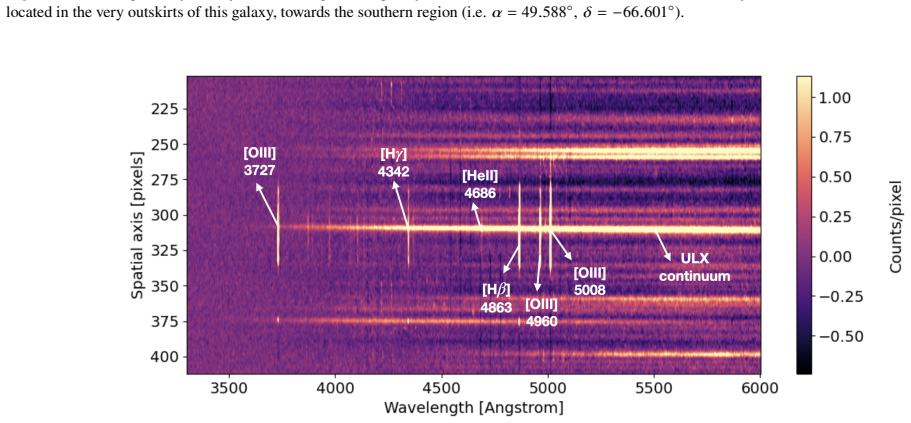
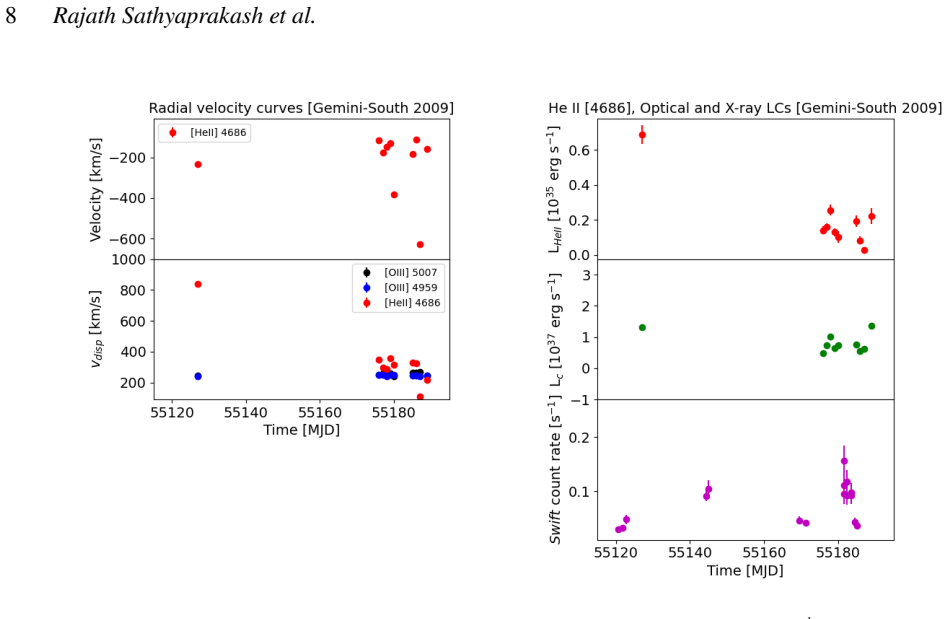
This study reports the nature of the companion star to the pulsating ULX NGC 1313 X-2, using long-slit spectroscopic data from Gemini-South observations, based on archival data from 2009. After stacking flux-calibrated spectra from ten nights of observations and fitting the spectra with stellar templates, we find a possible Balmer break in the GMOS-S spectrum below 4000 Angstroms, which is suggestive of an A-type supergiant donor. Using the inferred stellar radii, we report updated constraints on the orbital parameters of the system and on the nature of the binary. We also add some information on the accretion disc size scale by studying the X-ray and optical variability using the lag-frequency spectrum and corroborate on results from earlier studies for the gas bubble expansion rates by modelling the [O III] emission line profiles, allowing constraints on the kinetic power of the wind/jet relative to the accretion power. This study also expands on previous efforts to study the formation history of the binary using multi-wavelength observations.
Editorial analysis
A structured set of objections, weighed in public.
Referee Report
Summary. The manuscript reports archival long-slit Gemini GMOS-S spectroscopic observations of the pulsating ULX NGC 1313 X-2 from 2009. Stacking flux-calibrated spectra from ten nights and fitting with stellar templates yields a possible Balmer break below 4000 Å interpreted as evidence for an A-type supergiant donor. This identification is used to derive updated orbital parameters and binary constraints. Additional sections analyze X-ray/optical lag-frequency spectra for accretion-disk size scales, model [O III] emission-line profiles to constrain gas-bubble expansion and wind/jet kinetic power, and discuss the binary formation history with multi-wavelength data.
Significance. If the donor identification is robust, the work would provide rare direct constraints on the companion in a pulsating ULX, informing super-Eddington accretion models and binary evolution. The multi-pronged approach combining template fitting, variability analysis, and nebular kinematics is a strength. The result's impact is limited by the lack of quantitative tests for non-stellar continuum contributions that could affect the Balmer-break detection and downstream orbital inferences.
major comments (1)
- [Abstract and spectral analysis] Abstract and spectral-analysis section: The central claim that the Balmer break indicates an A-type supergiant donor rests on the optical continuum being stellar-dominated. No quantitative limits are reported on the fractional contribution from the accretion disk or the [O III] nebula below 4000 Å, and no tests are described for whether the break survives subtraction of plausible non-stellar continua (power-law or irradiated-disk spectra). Because the inferred stellar radius is then used to constrain orbital parameters, any systematic bias in the decomposition directly affects those results.
minor comments (2)
- [Abstract] Abstract: The description of the template fitting omits fit statistics, reduced-chi-squared values, error bars on the Balmer-break detection, and any criteria used to exclude individual nights from the stack.
- The manuscript should specify the exact wavelength range, spectral resolution, and flux-calibration uncertainties of the GMOS-S data used for the stacked spectrum.
Simulated Author's Rebuttal
We thank the referee for their careful and constructive review of our manuscript. The single major comment raises a valid point about the need for quantitative tests on non-stellar continuum contributions, which we will address through additional analysis in the revision.
read point-by-point responses
-
Referee: [Abstract and spectral analysis] Abstract and spectral-analysis section: The central claim that the Balmer break indicates an A-type supergiant donor rests on the optical continuum being stellar-dominated. No quantitative limits are reported on the fractional contribution from the accretion disk or the [O III] nebula below 4000 Å, and no tests are described for whether the break survives subtraction of plausible non-stellar continua (power-law or irradiated-disk spectra). Because the inferred stellar radius is then used to constrain orbital parameters, any systematic bias in the decomposition directly affects those results.
Authors: We agree that the robustness of the Balmer-break detection would be strengthened by explicit tests against non-stellar contributions. In the revised manuscript we will add quantitative limits on the maximum fractional contribution from a power-law or irradiated-disk component below 4000 Å, derived from the observed [O III] flux and the lack of strong variability in the blue continuum across the ten nights. We will also show the result of subtracting scaled versions of these continua before re-fitting the stellar templates and demonstrate that the break feature remains significant for plausible disk fractions. These additions will directly support the donor identification and the derived orbital constraints. revision: yes
Circularity Check
No significant circularity detected
full rationale
The paper performs direct empirical analysis of stacked Gemini spectra via stellar template fitting to identify a possible Balmer break, then derives binary constraints from the resulting stellar radius estimates and models [O III] profiles and variability separately. No step reduces by construction to its own inputs, renames a fitted quantity as a prediction, or relies on a load-bearing self-citation chain; the central claims rest on observational data reduction and standard modeling that remain independent of the target results.
Axiom & Free-Parameter Ledger
Reference graph
Works this paper leans on
-
[1]
Ultraluminous X-ray sources. , keywords =. doi:10.1016/j.newar.2022.101672 , archivePrefix =. 2302.10605 , primaryClass =
-
[2]
Effects of feedback on the morphology of galaxy discs. , keywords =. doi:10.1111/j.1365-2966.2005.09525.x , archivePrefix =. astro-ph/0503676 , primaryClass =
-
[3]
The Strength and Structure of the Magnetic Field in the Galactic Outflow of Messier 82. , keywords =. doi:10.3847/1538-4357/abf934 , archivePrefix =. 2102.03362 , primaryClass =
-
[4]
Ultra-luminous X-ray sources: extreme accretion and feedback. arXiv e-prints , keywords =. doi:10.48550/arXiv.2302.00006 , archivePrefix =. 2302.00006 , primaryClass =
-
[5]
Astronomische Nachrichten , keywords =
Winds in ultraluminous X‑ray sources: New challenges. Astronomische Nachrichten , keywords =. doi:10.1002/asna.20220134 , archivePrefix =. 2211.00014 , primaryClass =
-
[6]
A new, clean catalogue of extragalactic non-nuclear X-ray sources in nearby galaxies. , keywords =. doi:10.1093/mnras/sty3403 , archivePrefix =. 1812.04684 , primaryClass =
-
[7]
A census of ultraluminous X-ray sources in the local Universe. , keywords =. doi:10.1093/mnras/staa2481 , archivePrefix =. 2008.10572 , primaryClass =
-
[8]
A multimission catalogue of ultraluminous X-ray source candidates. , keywords =. doi:10.1093/mnras/stab3001 , archivePrefix =. 2110.07625 , primaryClass =
-
[9]
Chandra Observations of ``The Antennae'' Galaxies (NGC 4038/9). , keywords =. doi:10.1086/321397 , archivePrefix =. astro-ph/0102256 , primaryClass =
-
[10]
A Chandra observation of the interacting pair of galaxies NGC 4485/4490. , keywords =. doi:10.1046/j.1365-8711.2002.05950.x , archivePrefix =. astro-ph/0208196 , primaryClass =
-
[11]
The ultraluminous X-ray source population of NGC 4485/4490. , keywords =. doi:10.1111/j.1365-2966.2009.14937.x , archivePrefix =. 0904.3852 , primaryClass =
-
[12]
Do Ultraluminous X-Ray Sources Exist in Dwarf Galaxies?. , keywords =. doi:10.1086/587776 , archivePrefix =. 0803.1984 , primaryClass =
-
[13]
2XMM ultraluminous X-ray source candidates in nearby galaxies. , keywords =. doi:10.1111/j.1365-2966.2011.19154.x , archivePrefix =. 1106.0197 , primaryClass =
-
[14]
22nd Texas Symposium on Relativistic Astrophysics , year = 2005, editor =
Runaway Core Collapse and Cluster Survival: Where are the Parent Clusters of ULXs?. 22nd Texas Symposium on Relativistic Astrophysics , year = 2005, editor =. doi:10.48550/arXiv.astro-ph/0503340 , archivePrefix =. astro-ph/0503340 , primaryClass =
-
[15]
Galactic Globular Clusters with Luminous X-Ray Binaries. , keywords =. doi:10.1086/500037 , archivePrefix =. astro-ph/0511635 , primaryClass =
-
[16]
Globular cluster ultraluminous X-ray sources in the furthest early-type galaxies. , keywords =. doi:10.1093/mnras/stac3244 , archivePrefix =. 2211.07699 , primaryClass =
-
[17]
X-ray binary formation in low-metallicity blue compact dwarf galaxies. , keywords =. doi:10.1093/mnras/stu736 , archivePrefix =. 1404.3132 , primaryClass =
-
[18]
Clumpy wind accretion in Supergiant X-ray Binaries. High-mass X-ray Binaries: Illuminating the Passage from Massive Binaries to Merging Compact Objects , year = 2019, editor =. doi:10.1017/S1743921318008414 , adsurl =
-
[19]
Resolved atomic lines reveal outflows in two ultraluminous X-ray sources. , keywords =. doi:10.1038/nature17417 , archivePrefix =. 1604.08593 , primaryClass =
-
[20]
Searching for outflows in ultraluminous X-ray sources through high-resolution X-ray spectroscopy. , keywords =. doi:10.1093/mnras/stx2695 , archivePrefix =. 1710.06438 , primaryClass =
-
[21]
XMM-Newton campaign on the ultraluminous X-ray source NGC 247 ULX-1: outflows. , keywords =. doi:10.1093/mnras/stab1648 , archivePrefix =. 2104.11164 , primaryClass =
-
[22]
Unveiling the disc structure in ultraluminous X-ray source NGC 55 ULX-1. , keywords =. doi:10.1093/mnras/stac2453 , archivePrefix =. 2207.12870 , primaryClass =
-
[23]
Broadband X-ray spectral variability of the pulsing ULX NGC 1313 X-2. , keywords =. doi:10.1051/0004-6361/202140884 , archivePrefix =. 2106.04501 , primaryClass =
-
[24]
An ultraluminous X-ray source powered by an accreting neutron star. , keywords =. doi:10.1038/nature13791 , archivePrefix =. 1410.3590 , primaryClass =
-
[25]
, keywords =
Core-collapse supernovae and evidence for black hole formation. , keywords =
-
[26]
An accreting pulsar with extreme properties drives an ultraluminous x-ray source in NGC 5907. Science , keywords =. doi:10.1126/science.aai8635 , archivePrefix =. 1609.07375 , primaryClass =
-
[27]
Discovery of Coherent Pulsations from the Ultraluminous X-Ray Source NGC 7793 P13. , keywords =. doi:10.3847/2041-8205/831/2/L14 , archivePrefix =. 1609.07129 , primaryClass =
-
[28]
Discovery of a 0.42-s pulsar in the ultraluminous X-ray source NGC 7793 P13. , keywords =. doi:10.1093/mnrasl/slw218 , archivePrefix =. 1609.06538 , primaryClass =
-
[29]
Discovery of pulsations from NGC 300 ULX1 and its fast period evolution. , keywords =. doi:10.1093/mnrasl/sly030 , archivePrefix =. 1802.10341 , primaryClass =
-
[30]
The discovery of weak coherent pulsations in the ultraluminous X-ray source NGC 1313 X-2. , keywords =. doi:10.1093/mnrasl/slz086 , archivePrefix =. 1906.00640 , primaryClass =
-
[31]
X-ray luminosity function of high-mass X-ray binaries: Studying the signatures of different physical processes using detailed binary evolution calculations. , keywords =. doi:10.1051/0004-6361/202244929 , archivePrefix =. 2209.05505 , primaryClass =
-
[32]
Early evolution of super-Eddington accretion flow in tidal disruption events. , keywords =. doi:10.1093/mnras/staf719 , archivePrefix =. 2505.02434 , primaryClass =
-
[33]
Discovery of a 2.8 s Pulsar in a 2 Day Orbit High-mass X-Ray Binary Powering the Ultraluminous X-Ray Source ULX-7 in M51. , keywords =. doi:10.3847/1538-4357/ab8a44 , archivePrefix =. 1906.04791 , primaryClass =
-
[34]
The 2019 super-Eddington outburst of RX J0209.6-7427: detection of pulsations and constraints on the magnetic field strength. , keywords =. doi:10.1093/mnras/staa991 , archivePrefix =. 2004.03022 , primaryClass =
-
[35]
Study of recent outburst in the Be/X-ray binary RX J0209.6-7427 with AstroSat: a new ultraluminous X-ray pulsar in the Magellanic Bridge?. , keywords =. doi:10.1093/mnras/staa1041 , archivePrefix =. 2004.04930 , primaryClass =
-
[36]
The Astronomer's Telegram , keywords =
Swift J0243.6+6124: Swift discovery of an accreting NS transient. The Astronomer's Telegram , keywords =
-
[37]
A 60 day Super-orbital Period Originating from the Ultraluminous X-Ray Pulsar in M82. , keywords =. doi:10.3847/1538-4357/ab0215 , archivePrefix =. 1901.10491 , primaryClass =
-
[38]
Two Eclipsing Ultraluminous X-Ray Sources in M51. , keywords =. doi:10.3847/0004-637X/831/1/56 , archivePrefix =. 1608.01111 , primaryClass =
-
[39]
Characteristics and evolution of Be-type high-mass X-ray binaries as potential ultraluminous X-ray sources. , keywords =. doi:10.1093/mnras/stac1334 , archivePrefix =. 2205.04607 , primaryClass =
-
[40]
Searching for propeller-phase ULXs in the XMM-Newton Serendipitous Source Catalogue. , keywords =. doi:10.1093/mnras/sty501 , archivePrefix =. 1802.07753 , primaryClass =
-
[41]
arXiv e-prints , keywords =
The long-term variability of a population of ULXs monitored by Chandra. arXiv e-prints , keywords =
-
[42]
Propeller effect in action in the ultraluminous accreting magnetar M82 X-2. , keywords =. doi:10.1093/mnras/stw046 , archivePrefix =. 1507.08288 , primaryClass =
-
[43]
SIMBOL-X: Focusing on the Hard X-ray Universe , year = 2009, editor =
The ULX NGC 1313 X-2: an Optical Study Revealing an Interesting Behavior. SIMBOL-X: Focusing on the Hard X-ray Universe , year = 2009, editor =. doi:10.1063/1.3149412 , archivePrefix =. 0902.4431 , primaryClass =
-
[44]
Optical Properties of the Ultraluminous X-Ray Source Holmberg IX X-1 and Its Stellar Environment. , keywords =. doi:10.1088/0004-637X/734/1/23 , archivePrefix =. 1104.5523 , primaryClass =
-
[45]
Optical Emission of the Ultraluminous X-Ray Source NGC 5408 X-1: Donor Star or Irradiated Accretion Disk?. , keywords =. doi:10.1088/0004-637X/745/2/123 , archivePrefix =. 1109.4423 , primaryClass =
-
[46]
Populations of High Energy Sources in Galaxies , year = 2006, editor =
Ultraluminous X-ray Sources: Bubbles and Optical Counterparts. Populations of High Energy Sources in Galaxies , year = 2006, editor =. doi:10.1017/S1743921306008489 , archivePrefix =. astro-ph/0603771 , primaryClass =
-
[47]
Ultraluminous X-ray Sources: Beambags and Optical Counterparts. A Population Explosion: The Nature & Evolution of X-ray Binaries in Diverse Environments , year = 2008, editor =. doi:10.1063/1.2945062 , archivePrefix =. 0803.4345 , primaryClass =
-
[48]
Optical Spectroscopy of the ULX-Associated Nebula MF16. arXiv e-prints , keywords =. doi:10.48550/arXiv.0809.0409 , archivePrefix =. 0809.0409 , primaryClass =
-
[49]
Direct Detection of an Ultraluminous Ultraviolet Source. , keywords =. doi:10.1088/2041-8205/714/1/L167 , archivePrefix =. 1003.4257 , primaryClass =
-
[50]
Absence of nebular He II 4686 constrains the UV emission from the ultraluminous X-ray pulsar NGC 1313 X-2. , keywords =. doi:10.1093/mnras/stae1336 , archivePrefix =. 2405.13714 , primaryClass =
-
[51]
Quasi-isotropic UV emission in the ULX NGC 1313 X-1. , keywords =. doi:10.1093/mnras/stae1329 , archivePrefix =. 2405.14512 , primaryClass =
-
[52]
Exploring the case for hard-X-ray beaming in NGC 6946 X-1. , keywords =. doi:10.1093/mnras/stae1975 , archivePrefix =. 2408.07751 , primaryClass =
-
[53]
Unveiling recurrent jets of the ULX Holmberg II X-1: evidence for a massive stellar-mass black hole?. , keywords =. doi:10.1093/mnrasl/slt166 , archivePrefix =. 1311.4867 , primaryClass =
-
[54]
, year = 2010, month = jul, volume =
A 300-parsec-long jet-inflated bubble around a powerful microquasar in the galaxy NGC 7793. , year = 2010, month = jul, volume =. doi:10.1038/nature09168 , adsurl =
-
[55]
The powerful jet of an off-nuclear intermediate-mass black hole in the spiral galaxy NGC 2276. , keywords =. doi:10.1093/mnras/stv143 , archivePrefix =. 1501.04897 , primaryClass =
-
[56]
ALMA/NICER observations of GRS 1915+105 indicate a return to a hard state. , keywords =. doi:10.1051/0004-6361/202039581 , archivePrefix =. 2102.00693 , primaryClass =
-
[57]
A mass of less than 15 solar masses for the black hole in an ultraluminous X-ray source. , keywords =. doi:10.1038/nature13730 , archivePrefix =. 1410.4250 , primaryClass =
-
[58]
Puzzling accretion onto a black hole in the ultraluminous X-ray source M 101 ULX-1. , keywords =. doi:10.1038/nature12762 , archivePrefix =. 1312.0337 , primaryClass =
-
[59]
Discovery of a Red Supergiant Donor Star in SN2010da/NGC 300 ULX-1. , keywords =. doi:10.3847/2041-8213/ab4139 , archivePrefix =. 1909.02171 , primaryClass =
-
[60]
Searching for the Donor Stars of ULX Pulsars. , keywords =. doi:10.3847/1538-4357/aafa77 , archivePrefix =. 1901.03776 , primaryClass =
-
[61]
New Hubble Space Telescope imaging of the counterparts to six ultraluminous X-ray sources. , keywords =. doi:10.1111/j.1365-2966.2008.13293.x , archivePrefix =. 0803.4470 , primaryClass =
-
[62]
Optical Counterparts of the Nearest Ultraluminous X-Ray Sources. , keywords =. doi:10.1088/0067-0049/206/2/14 , archivePrefix =. 1303.1213 , primaryClass =
-
[63]
The first glimpse of ULXs through the near-infrared images captured by the JWST. , keywords =. doi:10.1093/mnras/stad3332 , archivePrefix =. 2306.11163 , primaryClass =
-
[64]
Compact Optical Counterparts of Ultraluminous X-Ray Sources. , keywords =. doi:10.1088/0004-637X/737/2/81 , archivePrefix =. 1106.0315 , primaryClass =
-
[65]
Near-infrared counterparts of ultraluminous X-ray sources. , keywords =. doi:10.1093/mnras/stu928 , archivePrefix =. 1405.1733 , primaryClass =
-
[66]
Keck/MOSFIRE spectroscopy of five ULX counterparts. , keywords =. doi:10.1093/mnras/stw695 , archivePrefix =. 1603.07024 , primaryClass =
-
[67]
Outbursts of the intermediate-mass black hole HLX-1: a wind-instability scenario. , keywords =. doi:10.1093/mnras/stx888 , archivePrefix =. 1704.05468 , primaryClass =
-
[68]
Understanding the environment around the intermediate mass black hole candidate ESO 243-49 HLX-1. , keywords =. doi:10.1051/0004-6361/201630042 , archivePrefix =. 1704.04434 , primaryClass =
-
[69]
A systematic search for near-infrared counterparts of nearby ultraluminous X-ray sources (II). , keywords =. doi:10.1093/mnras/stx857 , archivePrefix =. 1704.01068 , primaryClass =
-
[70]
NIR counterparts to ULXs (III): completing the photometric survey and selected spectroscopic results. , keywords =. doi:10.1093/mnras/staa1920 , archivePrefix =. 2006.02795 , primaryClass =
-
[71]
Uncovering Red and Dusty Ultraluminous X-Ray Sources with Spitzer. , keywords =. doi:10.3847/1538-4357/ab1b1c , archivePrefix =. 1904.09852 , primaryClass =
-
[72]
Spitzer IRAC Observations of IR Excess in Holmberg IX X-1: A Circumbinary Disk or a Variable Jet?. , keywords =. doi:10.3847/0004-637X/831/1/88 , archivePrefix =. 1608.05348 , primaryClass =
-
[73]
A multi-wavelength view of distinct accretion regimes in the pulsating ultraluminous X-ray source NGC 1313 X-2. , keywords =. doi:10.1093/mnras/stac402 , archivePrefix =. 2202.06986 , primaryClass =
-
[74]
PyRAF: Python alternative for IRAF
-
[75]
Optical Counterparts of Ultraluminous X-Ray Sources. arXiv e-prints , keywords =. doi:10.48550/arXiv.astro-ph/0202488 , archivePrefix =. astro-ph/0202488 , primaryClass =
-
[76]
Space Telescope and Optical Reverberation Mapping Project. IX. Velocity-Delay Maps for Broad Emission Lines in NGC 5548. , keywords =. doi:10.3847/1538-4357/abce60 , archivePrefix =. 2003.01448 , primaryClass =
-
[77]
Astronomische Nachrichten , keywords =
(No) dynamical constraints on the mass of the black hole in two ULXs. Astronomische Nachrichten , keywords =. doi:10.1002/asna.201011508 , archivePrefix =. 1011.2155 , primaryClass =
-
[78]
Very Large Telescope MUSE Observations of the Bubble Nebula around NGC 1313 X-2 and Evidence for Additional Photoionization. , keywords =. doi:10.3847/1538-4357/ac815f , archivePrefix =. 2207.06577 , primaryClass =
-
[79]
Modelling of Stellar Atmospheres , year = 2003, editor =
New Grids of ATLAS9 Model Atmospheres. Modelling of Stellar Atmospheres , year = 2003, editor =. doi:10.48550/arXiv.astro-ph/0405087 , archivePrefix =. astro-ph/0405087 , primaryClass =
-
[80]
Astronomische Nachrichten , keywords =
The metallicity of the nebula surrounding the ultra-luminous X-ray source NGC 1313 X-2. Astronomische Nachrichten , keywords =. doi:10.1002/asna.201011512 , archivePrefix =. 1009.5708 , primaryClass =
discussion (0)
Sign in with ORCID, Apple, or X to comment. Anyone can read and Pith papers without signing in.