On the Counting Sequence of Z-convex Polyominoes
Pith reviewed 2026-06-27 05:08 UTC · model grok-4.3
The pith
Formulas and equations enable a C++ program to compute the number of Z-convex polyominoes by area for a longer sequence than known before.
A machine-rendered reading of the paper's core claim, the machinery that carries it, and where it could break.
Core claim
The paper presents a set of formulas and equations that are the basis of a C++ program that allows computation of the longest counting sequence known to date, with respect to the area, of convex polyominoes of degree of convexity at most 2.
What carries the argument
The set of formulas and equations that generate each Z-convex polyomino exactly once for every area.
If this is right
- The number of Z-convex polyominoes becomes available for areas larger than those reached by prior methods.
- The sequence supplies data that can be used to examine the growth rate of these polyominoes.
- The same approach yields a basis for comparing Z-convex polyominoes with other restricted classes of polyominoes.
- The counts allow checking whether conjectured closed forms or generating functions match the enumerated values.
Where Pith is reading between the lines
- The sequence produced could be checked against existing tables of polyomino counts to confirm consistency at small sizes.
- Similar formulas might be developed for polyominoes whose degree of convexity is bounded by a higher integer.
- The enumeration data could help test whether the growth is governed by a simple algebraic generating function.
Load-bearing premise
The formulas correctly generate each Z-convex polyomino exactly once for every area with no overcounting or omissions, and the C++ program faithfully realizes those formulas.
What would settle it
Running the derived formulas for a small known area and obtaining a total that differs from the number obtained by exhaustive manual listing of all Z-convex polyominoes of that area.
Figures

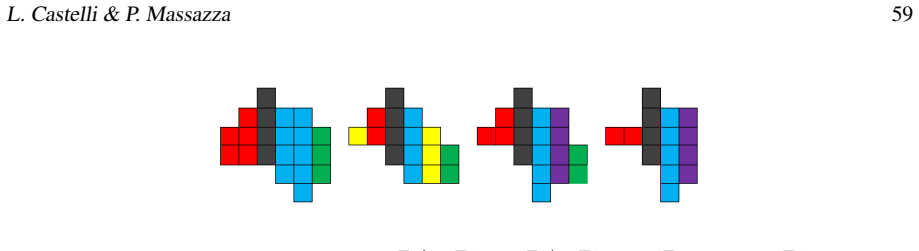
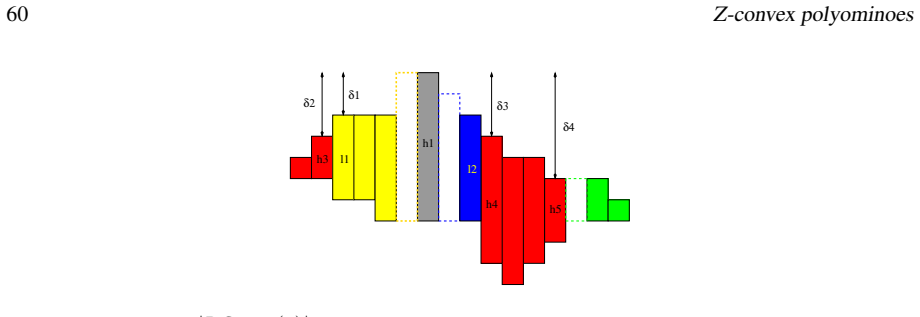
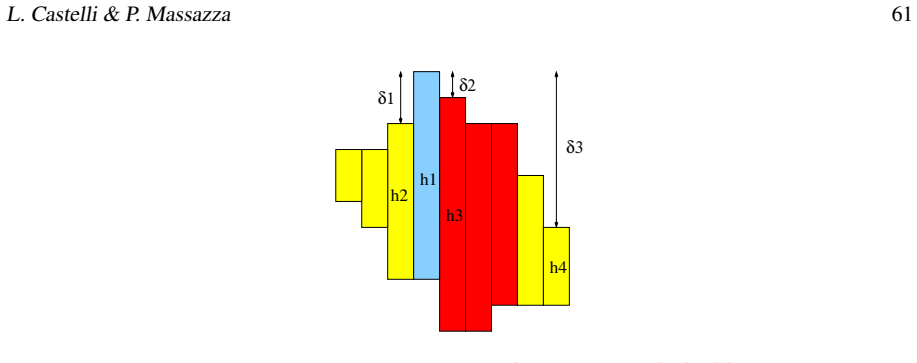
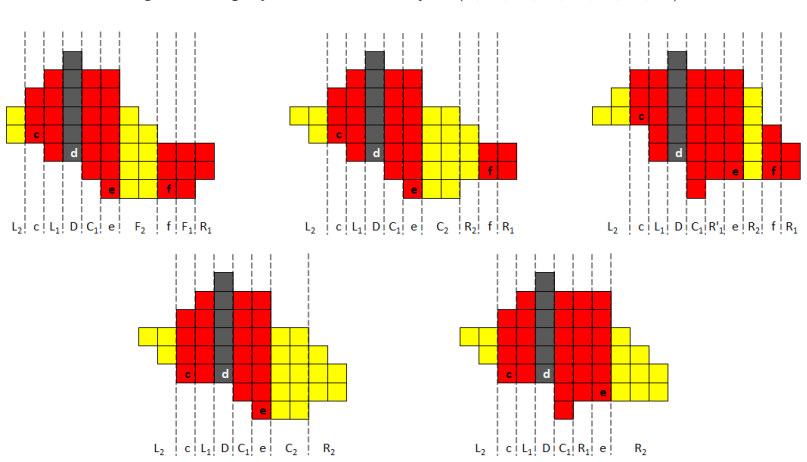

read the original abstract
The degree of convexity of a convex polyomino P is the smallest integer k such that any two cells of P can be joined by a monotone path inside P with at most k changes of direction. In this paper, we present a set of formulas and equations that are the basis of a C++ program that allows you to compute the longest counting sequence known to date (with respect to the area) of convex polyominoes of degree of convexity at most 2
Editorial analysis
A structured set of objections, weighed in public.
Referee Report
Summary. The manuscript asserts that it presents a set of formulas and equations serving as the basis for a C++ program that computes the longest known counting sequence (by area) of Z-convex polyominoes, i.e., convex polyominoes whose degree of convexity is at most 2.
Significance. If the formulas were shown to be correct, the resulting sequence would extend the known enumeration data for polyominoes with bounded convexity and could support further structural or generating-function studies in combinatorial enumeration.
major comments (2)
- [Abstract] Abstract: the central claim that the formulas generate exactly the Z-convex polyominoes (with no over- or under-counting) is asserted without any derivation, recurrence justification, bijection argument, or explicit construction provided in the text.
- [Abstract] Abstract: no sample computations, tabulated terms for small areas, comparison against brute-force enumeration or prior literature values, or error analysis is supplied, leaving the correctness of the extended sequence unverified.
Simulated Author's Rebuttal
We thank the referee for the constructive comments. We address each major point below and indicate the revisions we will make.
read point-by-point responses
-
Referee: [Abstract] Abstract: the central claim that the formulas generate exactly the Z-convex polyominoes (with no over- or under-counting) is asserted without any derivation, recurrence justification, bijection argument, or explicit construction provided in the text.
Authors: The manuscript's primary contribution is the explicit set of formulas together with the C++ implementation that realizes them. While the formulas themselves appear in the text, we acknowledge that a self-contained recurrence justification or outline of the underlying construction would improve clarity. In the revised version we will insert a short dedicated subsection that derives the recurrence relations from the definition of Z-convexity and indicates how the state transitions in the program correspond to the allowed paths. revision: yes
-
Referee: [Abstract] Abstract: no sample computations, tabulated terms for small areas, comparison against brute-force enumeration or prior literature values, or error analysis is supplied, leaving the correctness of the extended sequence unverified.
Authors: We agree that verification data are essential. The revised manuscript will include a table of the first 20 terms (by area), direct comparisons with the previously published values for smaller areas, and a brief description of the brute-force cross-check performed on the C++ code for areas up to 12. An error-analysis paragraph will also be added. revision: yes
Circularity Check
No circularity; formulas presented as independent combinatorial construction
full rationale
The paper states it presents formulas and equations as the basis for a C++ program to enumerate Z-convex polyominoes by area. No self-definitional steps, fitted inputs renamed as predictions, or load-bearing self-citations appear in the provided text. The central claim reduces to deriving recurrences or generating constructions for the objects, which is self-contained and does not reduce to its own outputs by construction. Absence of an explicit bijection proof or external verification is a correctness issue, not circularity.
Axiom & Free-Parameter Ledger
axioms (1)
- domain assumption The degree of convexity of a convex polyomino P is the smallest integer k such that any two cells of P can be joined by a monotone path inside P with at most k changes of direction.
Reference graph
Works this paper leans on
-
[1]
G. Barequet & G. Ben-Shachar (2024): Counting Polyominoes, Revisited . 2024 Proceed- ings of the Symposium on Algorithm Engineering and Experiments (ALENEX) , pp. 133–143, doi:10.1137/1.9781611977929.10
-
[2]
Bousquet-Mélou (1992): Convex polyominoes and heaps of segments
M. Bousquet-Mélou (1992): Convex polyominoes and heaps of segments. Journal of Physics A: Mathematical and General 25(7), pp. 1925–1934, doi:10.1088/0305-4470/25/7/031
-
[3]
Bousquet-Mélou (1996): A method for the enumeration of various classes of column-convex polygons
M. Bousquet-Mélou (1996): A method for the enumeration of various classes of column-convex polygons. Discrete Math. 154(1-3), pp. 1–25, doi:10.1016/0012-365X(95)00003-F
-
[4]
G. Castiglione & P. Massazza (2014): An efficient algorithm for the generation of Z-convex polyominoes. In: IWCIA 2014, Lecture Notes in Comput. Sci. 8466, Springer, pp. 51–61, doi:10.1007/978-3-319-07148-0_6
-
[5]
G. Castiglione & A. Restivo (2005): Ordering and Convex Polyominoes. In: MCU 2004, Lecture Notes in Comput. Sci. 3354, Springer, pp. 128–139, doi:10.1007/978-3-540-31834-7_10
-
[6]
A. Del Lungo, E. Duchi, A. Frosini & S. Rinaldi (2004): On the Generation and Enumeration of some Classes of Convex Polyominoes. Electron. J. Comb. 11(1), doi:10.37236/1813
-
[7]
A. Del Lungo, A. Frosini & S. Rinaldi (2003): ECO Method and the Exhaustive Generation of Convex Polyominoes. In: DMTC 2003, Lecture Notes in Comput. Sci. 6795, Springer, pp. 129–140, doi:10.1007/3- 540-45066-1_10
work page doi:10.1007/3- 2003
-
[8]
E. Duchi, S. Rinaldi & G. Schaeffer (2008): The number of Z-convex polyominoes. Adv. Appl. Math. 40(1), pp. 54 – 72, doi:10.1016/j.aam.2006.07.004
-
[9]
O’Rourke E
J. O’Rourke E. D. Demaine, J. S. B. Mitchell: The Open Problems Project. Available at http://cs.smith. edu/~jorourke/TOPP
-
[10]
E. Formenti & P. Massazza (2017): From Tetris to polyominoes generation . Electronic Notes in Discrete Mathematics 59, pp. 79 – 98, doi:10.1016/j.endm.2017.05.007
-
[11]
E. Formenti & P. Massazza (2018): On the Generation of 2-Polyominoes. In: DCFS 2018, Lecture Notes in Comput. Sci. 10952, Springer, pp. 101–113, doi:10.1007/978-3-319-94631-3_9
-
[12]
& Massazza, Paolo (2024): Asymptotics of Z-convex polyominoes
Guttmann, Anthony J. & Massazza, Paolo (2024): Asymptotics of Z-convex polyominoes. RAIRO-Theor. Inf. Appl. 58, p. 26, doi:10.1051/ita/2024009
-
[13]
D. A. Klarner, S.W. Golomb & G. Barequet (2017): Polyominoes. In J.E. Goodman, J. O’Rourke & C. D. Tóth, editors: Handbook of Discrete and Computational Geometry , CRC Press, Boca Raton, FL, pp. 359–
2017
-
[14]
Available at https://www.csun.edu/~ctoth/Handbook/chap14.pdf
-
[15]
A. Del Lungo, M. Nivat, R. Pinzani & S. Rinaldi (2004): A bijection for the total area of parallelogram polyominoes. Discret. Appl. Math. 144(3), pp. 291–302, doi:10.1016/j.dam.2003.11.007
-
[16]
(2026): The On-Line Encyclopedia of Integer Sequences
OEIS Foundation Inc. (2026): The On-Line Encyclopedia of Integer Sequences. Published electronically at http://oeis.org
2026
-
[17]
K. Tawbe & L. Vuillon (2011): 2L-convex polyominoes: Geometrical aspects. Contributions Discret. Math. 6(1), doi:10.55016/ojs/cdm.v6i1.62040
discussion (0)
Sign in with ORCID, Apple, or X to comment. Anyone can read and Pith papers without signing in.