The cosmic tetrarchy: four estimators breaking the assumption degeneracy in cosmological distance tensions
Pith reviewed 2026-06-30 10:24 UTC · model grok-4.3
The pith
Four BAO estimators split by direction and anchor isolate which assumption drives distance tensions.
A machine-rendered reading of the paper's core claim, the machinery that carries it, and where it could break.
Core claim
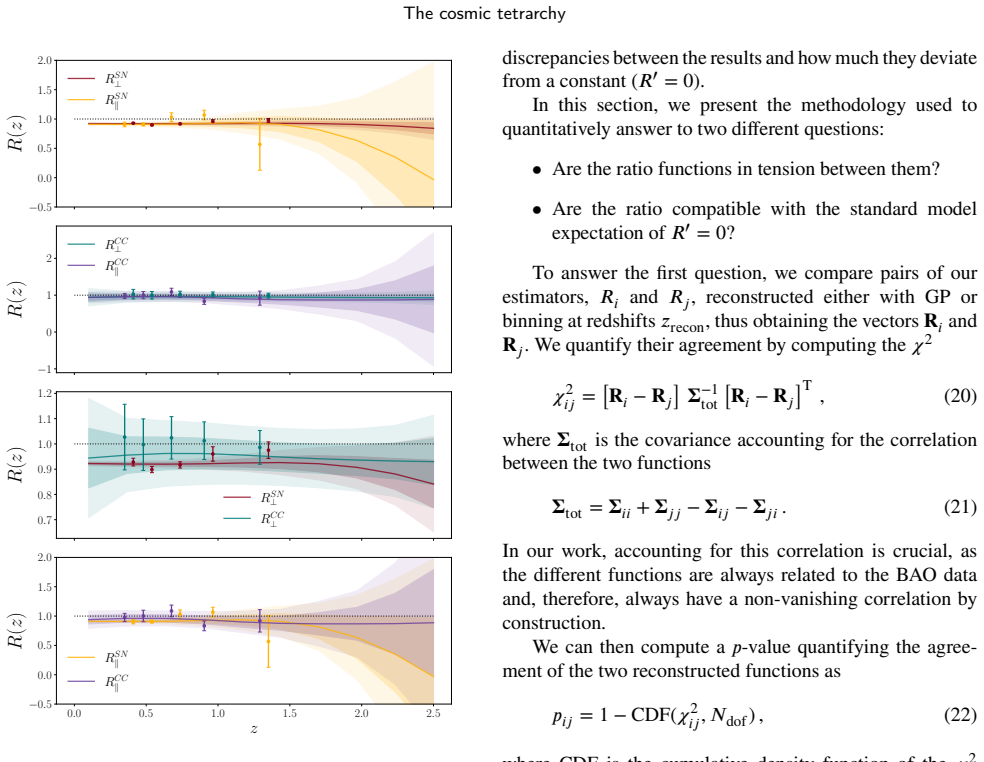
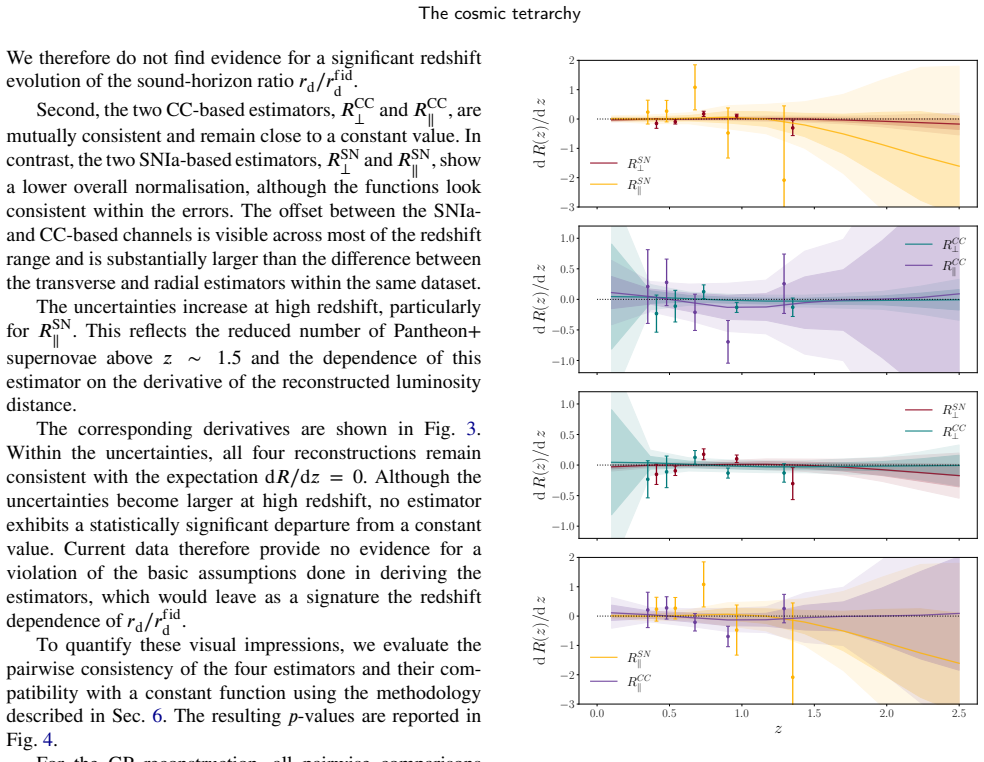
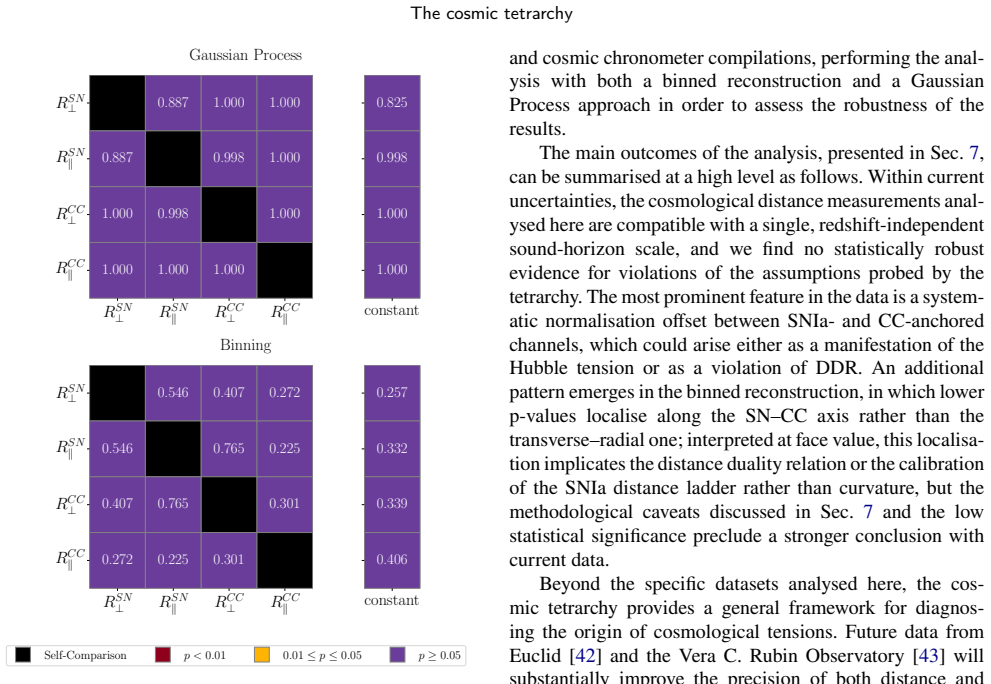
The requirement that the dimensionless sound-horizon ratio r_d / r_d^fid equal one redshift-independent number admits four complementary measurements obtained by pairing BAO data with either SNIa or CC in either the transverse or radial direction. These four channels rest on distinct subsets of assumptions—distance-ladder calibration, distance duality, spatial flatness, and the standard-ruler picture—while the radial CC-anchored channel requires none and serves as the natural reference. The pattern of agreement or disagreement among the four therefore localizes the assumption responsible for any observed tension. Current data remain compatible with a single, redshift-independent sound-horizo
What carries the argument
The cosmic tetrarchy: the fourfold decomposition of the sound-horizon ratio null test into transverse/radial BAO crossed with SNIa/CC anchors, each relying on a distinct subset of cosmological assumptions.
If this is right
- Disagreement between particular pairs of the four estimators points directly to violation of one specific assumption among the four listed.
- The radial CC channel provides an assumption-minimal anchor against which the other three estimators can be compared.
- Present data from DESI DR2 BAO combined with Pantheon+ and cosmic chronometers are compatible with one common sound-horizon value across redshift.
- Low-significance differences between SNIa-based and CC-based estimators may trace to the Hubble tension or to a breaking of distance duality.
Where Pith is reading between the lines
- If future data increase the significance of the SNIa–CC split while the reference channel remains stable, the tension would be localized to late-universe distance measures rather than the sound horizon itself.
- The same four-channel logic could be applied to other cosmological discrepancies to isolate their originating assumptions without prior commitment to which dataset is correct.
- Confirmation that the reference channel holds would tighten constraints on early-universe physics by removing the need to invoke new physics that alters the sound horizon at different redshifts.
Load-bearing premise
The radial cosmic-chronometer channel truly depends on none of the four listed assumptions and can therefore serve as an unbiased reference.
What would settle it
A statistically significant redshift dependence or deviation from unity in the sound-horizon ratio measured from the radial CC-anchored channel alone would falsify the central null test.
Figures


read the original abstract
The origin of cosmological distance tensions remains a central open question in precision cosmology, complicated by the fact that most consistency tests between datasets cannot isolate which physical assumption is responsible for an observed discrepancy. We address this by reformulating the standard cosmological framework as a single null test: the requirement that the dimensionless sound-horizon ratio $r_{\rm d}/r_{\rm d}^{\rm fid}$ be one redshift-independent number. We show that this test admits four complementary measurements, obtained by combining Baryon Acoustic Oscillation (BAO) data with either Type Ia supernovae (SNIa) or cosmic chronometers (CC), in either the transverse or the radial direction. The four channels rely on distinct subsets of physical assumptions -- distance-ladder calibration, the distance duality relation, spatial flatness, and the standard-ruler picture -- and one of them, the radial CC-anchored channel, requires none and serves as the natural reference of the framework. The pattern of agreement or disagreement among the four therefore localises the assumption responsible for any observed tension. We refer to this fourfold decomposition as the \emph{cosmic tetrarchy} and evaluate it on DESI DR2 BAO data combined with Pantheon+ and cosmic chronometers, using both a binned analysis with full analytic covariance propagation and a non-parametric Gaussian Process reconstruction. We find that current data are compatible with a single, redshift-independent sound-horizon scale; when comparing the different estimators, we find hints of discrepancies between those based on SNIa and those relying on CC, although with a lack of statistical significance, which might hint to a manifestation of the Hubble tension or to the breaking of assumptions such as the distance duality relation.
Editorial analysis
A structured set of objections, weighed in public.
Referee Report
Summary. The paper introduces the cosmic tetrarchy: a null test requiring the dimensionless sound-horizon ratio r_d / r_d^fid to be a single redshift-independent number, realized via four BAO-based estimators (transverse/radial combined with SNIa or CC). These channels depend on distinct subsets of assumptions (distance-ladder calibration, distance duality, spatial flatness, standard-ruler picture), with the radial CC-anchored channel asserted to require none and thus serve as reference. Applied to DESI DR2 BAO + Pantheon+ + CC data using binned analytic-covariance analysis and Gaussian Process reconstruction, the work finds compatibility with constant r_d and non-significant hints of SNIa vs. CC discrepancies.
Significance. If the reference channel is verifiably assumption-free, the tetrarchy offers a systematic way to localize which assumption drives distance tensions. The analytic covariance propagation and non-parametric GP approach are methodological strengths that enhance reproducibility. The compatibility result with a single r_d scale is consistent with standard cosmology but does not yet resolve tensions; the framework's diagnostic power depends directly on the independence claim for the radial CC channel.
major comments (2)
- [Abstract] Abstract (and the section defining the four channels): the localization logic is load-bearing on the assertion that the radial CC-anchored estimator 'requires none' of the four listed assumptions. No explicit derivation or assumption ledger is supplied showing how the conversion of radial BAO scale plus CC H(z) to r_d avoids the FLRW metric, the fixed-comoving interpretation of the BAO feature, or redshift-dependent CC systematics; without this, discrepancies cannot be unambiguously attributed.
- [Results] The results section (binned and GP analyses): the claim of compatibility with a single redshift-independent sound-horizon scale rests on quantitative tension metrics and covariance details that are not shown in the provided abstract or summary; the reported 'lack of statistical significance' for SNIa-CC hints therefore cannot be evaluated for robustness against the reference channel's potential hidden assumptions.
minor comments (2)
- [Abstract] Notation for r_d / r_d^fid should be defined at first use with an explicit equation rather than only in the abstract.
- The manuscript would benefit from a table explicitly mapping each of the four channels to the assumptions it does and does not invoke.
Simulated Author's Rebuttal
We thank the referee for the thoughtful report and for highlighting areas where the presentation of the tetrarchy framework can be strengthened. We address each major comment below and will incorporate revisions to improve clarity and completeness.
read point-by-point responses
-
Referee: [Abstract] Abstract (and the section defining the four channels): the localization logic is load-bearing on the assertion that the radial CC-anchored estimator 'requires none' of the four listed assumptions. No explicit derivation or assumption ledger is supplied showing how the conversion of radial BAO scale plus CC H(z) to r_d avoids the FLRW metric, the fixed-comoving interpretation of the BAO feature, or redshift-dependent CC systematics; without this, discrepancies cannot be unambiguously attributed.
Authors: We agree that an explicit assumption ledger and derivation would strengthen the localization claim. The radial CC channel constructs r_d directly from the observed radial BAO scale Δz_BAO and the local H(z) from CC via r_d = c Δz_BAO / H(z) at the same effective redshift; this uses only the definition of redshift as a time interval and the interpretation of the BAO feature as a fixed comoving scale at that redshift, without invoking luminosity distances, duality, or global geometry. We will add a dedicated subsection (or table) in the revised manuscript that tabulates the assumptions for all four channels and derives the radial CC expression step-by-step, including a brief discussion of potential CC systematics. This revision will make the reference status unambiguous. revision: yes
-
Referee: [Results] The results section (binned and GP analyses): the claim of compatibility with a single redshift-independent sound-horizon scale rests on quantitative tension metrics and covariance details that are not shown in the provided abstract or summary; the reported 'lack of statistical significance' for SNIa-CC hints therefore cannot be evaluated for robustness against the reference channel's potential hidden assumptions.
Authors: The full manuscript contains the quantitative tension metrics (including σ-level discrepancies and p-values), full analytic covariance matrices, and robustness checks for both the binned and GP analyses in Sections 4 and 5, with explicit comparison to the radial CC reference channel. However, to improve accessibility, we will add a summary table of the key tension statistics and a brief statement on the reference-channel robustness in the abstract and/or a new results subsection. This addresses the evaluation concern without altering the compatibility conclusion. revision: yes
Circularity Check
No significant circularity; derivation self-contained against external data
full rationale
The paper reformulates the null test as r_d / r_d^fid being redshift-independent and decomposes it into four channels whose assumption subsets are stated explicitly. The radial CC-anchored channel is asserted to require none of the four listed assumptions by direct construction of the channel (radial BAO scale combined with CC H(z)), without any equation reducing a prediction to a fitted input or to a self-citation. No load-bearing step invokes a uniqueness theorem from the authors' prior work, no ansatz is smuggled via citation, and no known empirical pattern is merely renamed. The localization claim follows from the distinct assumption sets and is tested on external datasets (DESI DR2, Pantheon+, cosmic chronometers) via binned analysis and Gaussian Process reconstruction; the result (compatibility with a single scale) is therefore falsifiable outside the paper's own fitted values. No circular reduction is exhibited by the provided text.
Axiom & Free-Parameter Ledger
axioms (1)
- domain assumption The dimensionless sound-horizon ratio r_d / r_d^fid must be a single redshift-independent number under the standard cosmological framework.
Reference graph
Works this paper leans on
-
[1]
N.Aghanim,etal.,Planck2018results.VI.Cosmologicalparameters, Astron.Astrophys.641(2020)A6,[Erratum:Astron.Astrophys.652, C4 (2021)].arXiv:1807.06209,doi:10.1051/0004-6361/201833910
work page internal anchor Pith review Pith/arXiv arXiv doi:10.1051/0004-6361/201833910 2020
-
[2]
DESI DR2 Results II: Measurements of Baryon Acoustic Oscillations and Cosmological Constraints
M. Abdul Karim, et al., DESI DR2 results. II. Measurements of baryonacousticoscillationsandcosmologicalconstraints,Phys.Rev. D 112 (8) (2025) 083515.arXiv:2503.14738,doi:10.1103/tr6y-kpc6
work page internal anchor Pith review Pith/arXiv arXiv doi:10.1103/tr6y-kpc6 2025
-
[3]
K. S. Dawson, et al., The Baryon Oscillation Spectroscopic Survey ofSDSS-III,Astron.J.145(2013)10.arXiv:1208.0022,doi:10.1088/ 0004-6256/145/1/10
work page internal anchor Pith review Pith/arXiv arXiv 2013
-
[4]
Constraining Cosmological Parameters Based on Relative Galaxy Ages
R. Jimenez, A. Loeb, Constraining cosmological parameters based on relative galaxy ages, Astrophys. J. 573 (2002) 37–42.arXiv: astro-ph/0106145,doi:10.1086/340549
work page internal anchor Pith review Pith/arXiv arXiv doi:10.1086/340549 2002
-
[5]
In the Realm of the Hubble tension $-$ a Review of Solutions
E. Di Valentino, O. Mena, S. Pan, L. Visinelli, W. Yang, A. Mel- chiorri, D. F. Mota, A. G. Riess, J. Silk, In the realm of the Hubble tension—a review of solutions, Class. Quant. Grav. 38 (15) (2021) 153001.arXiv:2103.01183,doi:10.1088/1361-6382/ac086d
work page internal anchor Pith review Pith/arXiv arXiv doi:10.1088/1361-6382/ac086d 2021
-
[6]
E. Di Valentino, et al., The CosmoVerse White Paper: Addressing observationaltensionsincosmologywithsystematicsandfundamen- tal physics, Phys. Dark Univ. 49 (2025) 101965.arXiv:2504.01669, doi:10.1016/j.dark.2025.101965. 5Weassumeadiagonalcovarianceforthesimulatedcosmicchronome- ters dataset. M. Martinelli, D. Sapone:Preprint submitted to ElsevierPage 11 ...
work page internal anchor Pith review Pith/arXiv arXiv doi:10.1016/j.dark.2025.101965 2025
-
[7]
A.G.Riess,etal.,AComprehensiveMeasurementoftheLocalValue of the Hubble Constant with 1 km s−1 Mpc−1 Uncertainty from the Hubble Space Telescope and the SH0ES Team, Astrophys. J. Lett. 934 (1) (2022) L7.arXiv:2112.04510,doi:10.3847/2041-8213/ac5c5b
work page internal anchor Pith review Pith/arXiv arXiv doi:10.3847/2041-8213/ac5c5b 2022
-
[8]
J.Hu,Y.Liu,J.-P.Hu,Z.Li,Amodel-independenttestofthecosmic distance-dualityrelationusinggalaxyclustersandTypeIasupernovae matched pairs (5 2026).arXiv:2605.16084
work page internal anchor Pith review Pith/arXiv arXiv 2026
-
[9]
S.Das,S.More,S.Alam,Cosmology-IndependentConstraintsonthe EtheringtonRelationandSNeIaAbsoluteMagnitudeEvolutionfrom DESI-DR2 (4 2026).arXiv:2604.02433
work page internal anchor Pith review Pith/arXiv arXiv 2026
- [10]
-
[11]
J. Zheng, D.-C. Qiang, Z.-Q. You, D. Kumar, The impact of 2D and 3DBAOmeasurementsontheCosmicDistanceDualityRelationwith HII galaxies, JCAP 10 (2025) 029.arXiv:2507.17113,doi:10.1088/ 1475-7516/2025/10/029
-
[12]
B. Kanodia, U. Upadhyay, Y. Tiwari, Revisiting cosmic distance duality with megamasers and DESI DR2 observations: Model- independentconstraintsonearly-latecalibration,Phys.Rev.D113(2) (2026) 023505.arXiv:2507.11518,doi:10.1103/h3f5-7lcr
-
[13]
Testing Cosmic Distance Duality Relation and Transparency with DESI DR2
X. Zhang, X. Yang, Y. Ren, S. Chen, Y. Shi, C. Cheng, M. Zhang, X. He, Testing Cosmic Distance Duality Relation and transparency withDESIDR2,JCAP06(2026)012.arXiv:2506.17926,doi:10.1088/ 1475-7516/2026/06/012
work page internal anchor Pith review Pith/arXiv arXiv 2026
-
[14]
E. M. Teixeira, W. Giarè, N. B. Hogg, T. Montandon, A. Poudou, V.Poulin,ImplicationsofdistancedualityviolationfortheH0tension andevolvingdarkenergy,Phys.Rev.D112(2)(2025)023515.arXiv: 2504.10464,doi:10.1103/zzmp-rxrh
-
[15]
A. C. Alfano, O. Luongo, Cosmic distance duality after DESI 2024 data release and dark energy evolution, Phys. Dark Univ. 51 (2026) 102205.arXiv:2501.15233,doi:10.1016/j.dark.2025.102205
-
[16]
B. Xu, Z. Wang, K. Zhang, Q. Huang, J. Zhang, Model-independent Test for the Cosmic Distance–Duality Relation with Pantheon and eBOSS DR16 Quasar Sample, Astrophys. J. 939 (2) (2022) 115. arXiv:2212.00269,doi:10.3847/1538-4357/ac9793
-
[17]
F. Renzi, N. B. Hogg, W. Giarè, The resilience of the Ethering- ton–Hubble relation, Mon. Not. Roy. Astron. Soc. 513 (3) (2022) 4004–4014.arXiv:2112.05701,doi:10.1093/mnras/stac1030
-
[18]
M. Martinelli, et al., Euclid: Forecast constraints on the cosmic distance duality relation with complementary external probes, As- tron. Astrophys. 644 (2020) A80.arXiv:2007.16153,doi:10.1051/ 0004-6361/202039078
-
[19]
N. B. Hogg, M. Martinelli, S. Nesseris, Constraints on the distance duality relation with standard sirens, JCAP 12 (2020) 019.arXiv: 2007.14335,doi:10.1088/1475-7516/2020/12/019
-
[20]
C.Clarkson,B.Bassett,T.H.-C.Lu,AgeneraltestoftheCopernican Principle, Phys. Rev. Lett. 101 (2008) 011301.arXiv:0712.3457, doi:10.1103/PhysRevLett.101.011301
work page internal anchor Pith review Pith/arXiv arXiv doi:10.1103/physrevlett.101.011301 2008
-
[21]
Curvature vs Distances: testing the FLRW cosmology
D. Sapone, E. Majerotto, S. Nesseris, Curvature versus distances: Testing the FLRW cosmology, Phys. Rev. D 90 (2) (2014) 023012. arXiv:1402.2236,doi:10.1103/PhysRevD.90.023012
work page internal anchor Pith review Pith/arXiv arXiv doi:10.1103/physrevd.90.023012 2014
-
[22]
R. Arjona, S. Nesseris, Novel null tests for the spatial curvature and homogeneity of the Universe and their machine learning reconstruc- tions, Phys. Rev. D 103 (10) (2021) 103539.arXiv:2103.06789,doi: 10.1103/PhysRevD.103.103539
-
[23]
Nesseris, et al., Euclid: Forecast constraints on consistency tests of theΛCDM model, Astron
S. Nesseris, et al., Euclid: Forecast constraints on consistency tests of theΛCDM model, Astron. Astrophys. 660 (2022) A67.arXiv: 2110.11421,doi:10.1051/0004-6361/202142503
-
[24]
M. L. S. Dias, A. F. B. da Cunha, C. A. P. Bengaly, R. S. Gonçalves, J. Morais, Non-parametric reconstructions of cosmic curvature: cur- rent constraints and forecasts, Eur. Phys. J. C 85 (4) (2025) 432. arXiv:2411.19252,doi:10.1140/epjc/s10052-025-14159-0
-
[25]
B. R. Dinda, R. Maartens, C. Clarkson, Calibration-independent consistency test of DESI DR2 BAO and SNIa, JCAP 12 (2025) 025. arXiv:2509.19899,doi:10.1088/1475-7516/2025/12/025
-
[26]
B. R. Dinda, R. Maartens, S. Saito, C. Clarkson, Improved null tests ofΛCDM and FLRW in light of DESI DR2, JCAP 08 (2025) 018. arXiv:2504.09681,doi:10.1088/1475-7516/2025/08/018
-
[27]
Null tests of the standard model using the linear model formalism
V. Marra, D. Sapone, Null tests of the standard model using the linear model formalism, Phys. Rev. D 97 (8) (2018) 083510.arXiv: 1712.09676,doi:10.1103/PhysRevD.97.083510
work page internal anchor Pith review Pith/arXiv arXiv doi:10.1103/physrevd.97.083510 2018
-
[28]
I. Ocampo, et al., Euclid: Forecasts onΛCDM consistency tests with growth rate data (7 2025).arXiv:2507.22780
-
[29]
D. H. Weinberg, M. J. Mortonson, D. J. Eisenstein, C. Hirata, A. G. Riess, E. Rozo, Observational Probes of Cosmic Acceleration, Phys. Rept. 530 (2013) 87–255.arXiv:1201.2434,doi:10.1016/j.physrep. 2013.05.001
work page internal anchor Pith review Pith/arXiv arXiv doi:10.1016/j.physrep 2013
-
[30]
D. J. Eisenstein, et al., Detection of the Baryon Acoustic Peak in the Large-Scale Correlation Function of SDSS Luminous Red Galaxies, Astrophys. J. 633 (2005) 560–574.arXiv:astro-ph/0501171,doi: 10.1086/466512
work page internal anchor Pith review Pith/arXiv arXiv doi:10.1086/466512 2005
-
[31]
S. Cole, et al., The 2dF Galaxy Redshift Survey: Power-spectrum analysis of the final dataset and cosmological implications, Mon. Not.Roy.Astron.Soc.362(2005)505–534.arXiv:astro-ph/0501174, doi:10.1111/j.1365-2966.2005.09318.x
work page internal anchor Pith review Pith/arXiv arXiv doi:10.1111/j.1365-2966.2005.09318.x 2005
-
[32]
C. Blake, et al., The WiggleZ Dark Energy Survey: mapping the distance-redshiftrelationwithbaryonacousticoscillations,Mon.Not. Roy. Astron. Soc. 418 (2011) 1707–1724.arXiv:1108.2635,doi: 10.1111/j.1365-2966.2011.19592.x
work page internal anchor Pith review Pith/arXiv arXiv doi:10.1111/j.1365-2966.2011.19592.x 2011
-
[33]
The SDSS-IV extended Baryon Oscillation Spectroscopic Survey: Overview and Early Data
K.S.Dawson,etal.,TheSDSS-IVextendedBaryonOscillationSpec- troscopicSurvey:OverviewandEarlyData,Astron.J.151(2016)44. arXiv:1508.04473,doi:10.3847/0004-6256/151/2/44
work page internal anchor Pith review Pith/arXiv arXiv doi:10.3847/0004-6256/151/2/44 2016
- [34]
-
[35]
A. G. Riess, et al., A 2.4% Determination of the Local Value of the Hubble Constant, Astrophys. J. 826 (1) (2016) 56.arXiv:1604.01424, doi:10.3847/0004-637X/826/1/56
work page internal anchor Pith review Pith/arXiv arXiv doi:10.3847/0004-637x/826/1/56 2016
-
[36]
C. De Leo, M. Martinelli, R. D’Agostino, G. Gianfagna, C. J. A. P. Martins, Distinguishing distance duality breaking models using elec- tromagnetic and gravitational waves measurements, JCAP 11 (2025) 001.arXiv:2505.13613,doi:10.1088/1475-7516/2025/11/001
-
[37]
B. P. Abbott, et al., GW170817: Observation of Gravitational Waves fromaBinaryNeutronStarInspiral,Phys.Rev.Lett.119(16)(2017) 161101.arXiv:1710.05832,doi:10.1103/PhysRevLett.119.161101
work page internal anchor Pith review Pith/arXiv arXiv doi:10.1103/physrevlett.119.161101 2017
-
[38]
S. Alam, et al., The clustering of galaxies in the completed SDSS-III Baryon Oscillation Spectroscopic Survey: cosmological analysis of theDR12galaxysample,Mon.Not.Roy.Astron.Soc.470(3)(2017) 2617–2652.arXiv:1607.03155,doi:10.1093/mnras/stx721
work page internal anchor Pith review Pith/arXiv arXiv doi:10.1093/mnras/stx721 2017
-
[39]
The Pantheon+ Analysis: Cosmological Constraints
D. Brout, et al., The Pantheon+ Analysis: Cosmological Constraints, Astrophys. J. 938 (2) (2022) 110.arXiv:2202.04077,doi:10.3847/ 1538-4357/ac8e04
work page internal anchor Pith review Pith/arXiv arXiv 2022
-
[40]
Moresco, et al., Unveiling the Universe with emerging cosmo- logical probes, Living Rev
M. Moresco, et al., Unveiling the Universe with emerging cosmo- logical probes, Living Rev. Rel. 25 (1) (2022) 6.arXiv:2201.07241, doi:10.1007/s41114-022-00040-z
-
[41]
A.Lewis,GetDist:aPythonpackageforanalysingMonteCarlosam- ples,JCAP08(2025)025.arXiv:1910.13970,doi:10.1088/1475-7516/ 2025/08/025
work page internal anchor Pith review Pith/arXiv arXiv doi:10.1088/1475-7516/ 2025
-
[42]
Y. Mellier, et al., Euclid. I. Overview of the Euclid mission, Astron. Astrophys.697(2025)A1.arXiv:2405.13491,doi:10.1051/0004-6361/ 202450810
-
[43]
R.Mandelbaum,etal.,TheLSSTDarkEnergyScienceCollaboration (DESC) Science Requirements Document (9 2018).arXiv:1809. 01669,doi:10.2172/1471560
-
[44]
J. U. Lange, nautilus: boosting Bayesian importance nested sampling with deep learning, Monthly Notices of the Royal Astronomical Society 525 (2) (2023) 3181–3194.arXiv:https://academic. oup.com/mnras/article-pdf/525/2/3181/51331635/stad2441.pdf, doi:10.1093/mnras/stad2441. URLhttps://doi.org/10.1093/mnras/stad2441
-
[45]
L.Perenon,M.Martinelli,S.Ilić,R.Maartens,M.Lochner,C.Clark- son,Multi-taskingthegrowthofcosmologicalstructures,Phys.Dark Univ.34(2021)100898.arXiv:2105.01613,doi:10.1016/j.dark.2021. 100898. M. Martinelli, D. Sapone:Preprint submitted to ElsevierPage 12 of 12
discussion (0)
Sign in with ORCID, Apple, or X to comment. Anyone can read and Pith papers without signing in.