Chemical hints of Population III stars from silicon abundances in massive galaxies
Pith reviewed 2026-06-27 03:04 UTC · model grok-4.3
The pith
Elevated silicon-to-magnesium ratio in NGC 1277 indicates enrichment from pair-instability supernovae.
A machine-rendered reading of the paper's core claim, the machinery that carries it, and where it could break.
Core claim
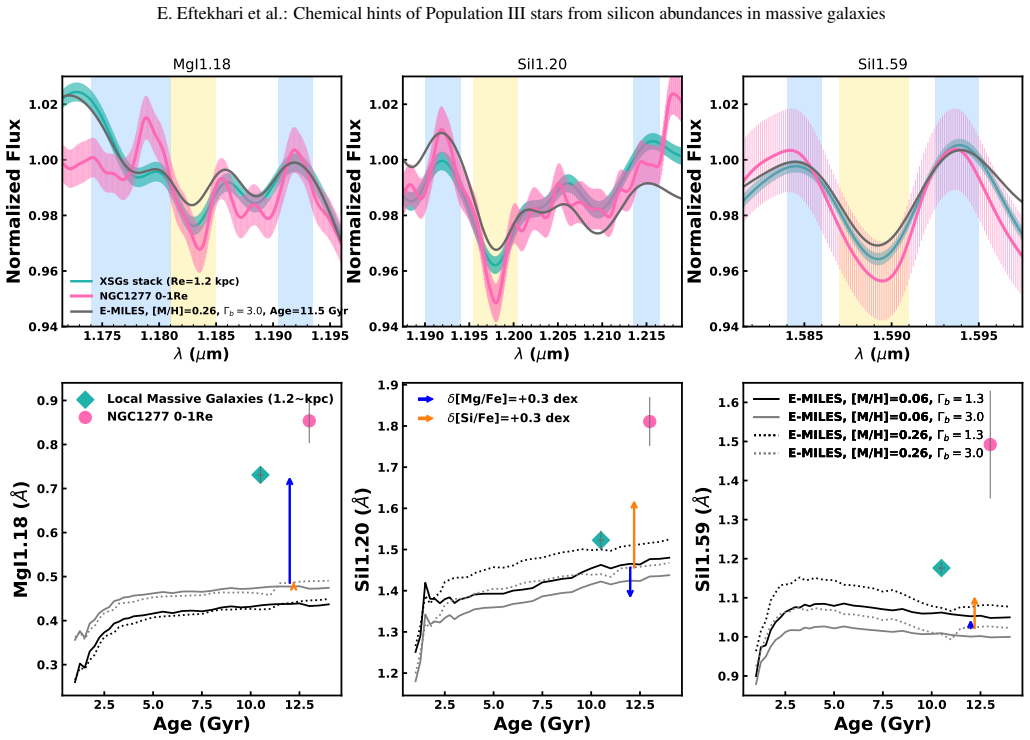
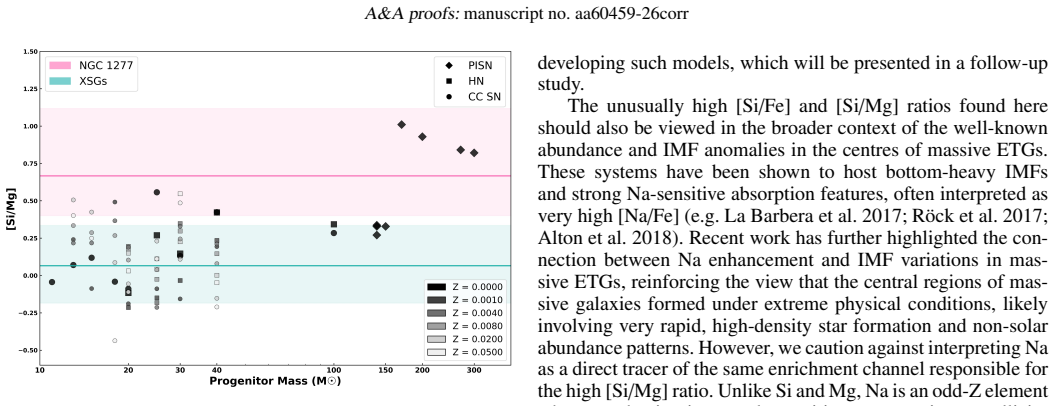
Using deep near-infrared spectroscopy of NGC 1277, the authors measure [Si/Fe]=1.05^{+0.45}_{-0.27} and [Mg/Fe]=0.36^{+0.27}_{-0.24}, resulting in [Si/Mg]=0.67^{+0.45}_{-0.27}. This ratio exceeds predictions from current models and typical core-collapse supernova yields. The enhancement is attributed to contributions from pair-instability supernovae or similar channels linked to very massive stars. The rapid formation of this relic galaxy allows these signatures to persist undiluted.
What carries the argument
The [Si/Mg] abundance ratio measured via silicon absorption features in the near-infrared spectrum of NGC 1277, used as a tracer for the nucleosynthetic yields of pair-instability supernovae.
If this is right
- Massive relic galaxies can retain chemical evidence of the first generations of stars.
- Pair-instability supernovae played a role in the chemical enrichment of the early universe.
- Current supernova yield models require updates to account for extremely massive star contributions.
- Similar chemical anomalies may be found in other compact high-redshift formed galaxies.
- JWST data on early galaxies could be interpreted in light of these local constraints.
Where Pith is reading between the lines
- Confirmation in more galaxies would strengthen the case for Population III star contributions to massive galaxy formation.
- This approach could be applied to other abundance ratios to probe different aspects of early nucleosynthesis.
- It raises the possibility that the initial mass function in high-redshift star formation was top-heavy.
- Future observations might detect direct signatures in high-redshift systems.
Load-bearing premise
The observed abundance ratio truly reflects the nucleosynthetic output of the galaxy's stars rather than resulting from inaccuracies in the spectral analysis or supernova yield predictions.
What would settle it
Reproducing the measured [Si/Mg] ratio using updated stellar population models that include only standard core-collapse supernovae without pair-instability contributions would falsify the claim.
Figures
read the original abstract
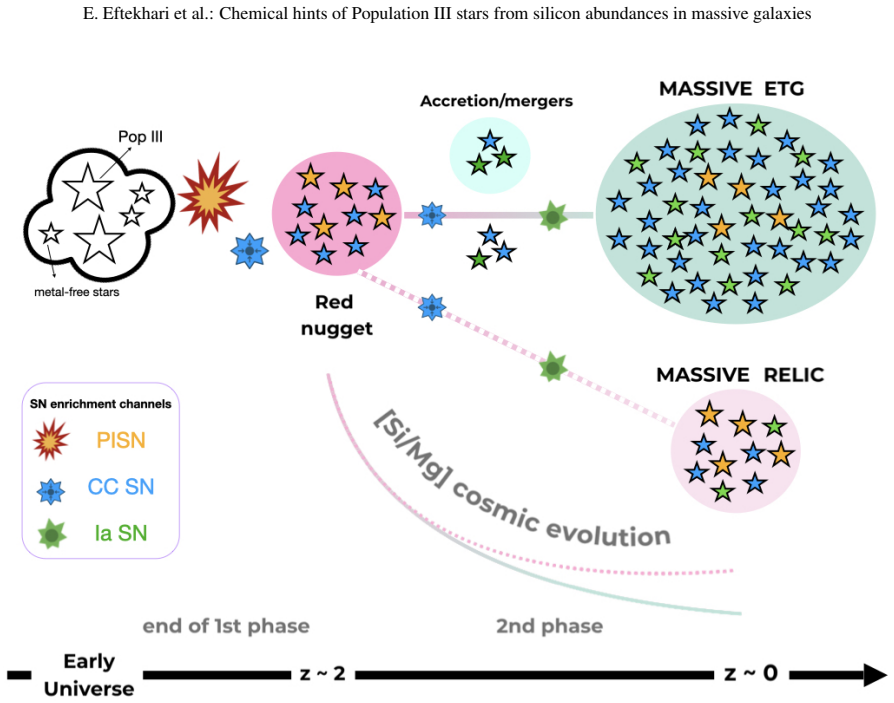
The formation of massive galaxies remains a fundamental question in astrophysics, with recent JWST observations suggesting that intense star formation occurred earlier than previously expected. We used the prototypical massive relic galaxy NGC 1277 as a fossil record to probe the chemical signatures of early star formation. With a stellar mass of $1.2 \pm 0.4 \times 10^{11}M_\odot$ and a compact structure (half-light radius of 1.2 kpc), NGC 1277 is representative of massive relic galaxies-systems that formed rapidly at high redshifts ("red nuggets" at $z>2$) and have since undergone largely passive evolution, preserving the imprint of their earliest stellar populations. Using deep near-infrared spectroscopy, we identified unusually strong silicon (Si) absorption features in this galaxy. We measure $[\mathrm{Si}/\mathrm{Fe}]=1.05^{+0.45}_{-0.27}$ and $[\mathrm{Mg}/\mathrm{Fe}]=0.36^{+0.27}_{-0.24}$, corresponding to a significantly enhanced silicon-to-magnesium ratio ($[\mathrm{Si}/\mathrm{Mg}]=0.67^{+0.45}_{-0.27}$) which cannot be reproduced by current stellar population models or typical core-collapse supernova yields. This enhancement suggests a contribution from very massive, metal-poor progenitors during the earliest phases of star formation. Such conditions are consistent with nucleosynthetic yields from pair-instability supernovae or other enrichment channels associated with extremely massive stars, whose chemical signatures are expected to remain less diluted in systems like NGC 1277 due to their rapid formation timescales and minimal late-time accretion. This result provides rare chemical evidence of early massive-star enrichment preserved in a local relic galaxy and opens a new observational window into the chemical evolution of the Universe.
Editorial analysis
A structured set of objections, weighed in public.
Referee Report
Summary. The paper reports deep near-infrared spectroscopy of the massive relic galaxy NGC 1277, deriving [Si/Fe] = 1.05^{+0.45}_{-0.27}, [Mg/Fe] = 0.36^{+0.27}_{-0.24} and thus [Si/Mg] = 0.67^{+0.45}_{-0.27}. The authors argue that this elevated silicon-to-magnesium ratio lies outside the range produced by standard stellar population synthesis models and typical core-collapse supernova yields, and interpret it as evidence for an early contribution from pair-instability supernovae or other channels associated with extremely massive, metal-poor stars whose signatures are preserved in this rapidly formed, passively evolving system.
Significance. If the abundance ratio and its discrepancy with existing yields are robust, the result supplies rare local chemical evidence for very massive star enrichment at high redshift, complementing JWST observations of early intense star formation. The choice of a compact relic galaxy as a fossil record is a clear methodological strength, as is the falsifiable nature of the claimed mismatch with standard yields.
major comments (2)
- [Methods (spectral analysis)] The central claim that the observed [Si/Mg] cannot be reproduced by current models rests on the spectral fitting and yield comparison; the abstract supplies no quantitative details on the fitting procedure, line list, or specific supernova yield grids employed, so the manuscript must demonstrate in the methods section that the ratio remains discrepant after systematic tests (e.g., alternative stellar libraries or continuum placement).
- [Discussion (final paragraph)] The interpretation that the enhancement is undiluted relies on NGC 1277 having experienced minimal late-time accretion; this assumption is load-bearing for the Population III / PISN conclusion and should be supported by explicit comparison to chemical-evolution models that include varying accretion histories.
minor comments (2)
- Error bars on the abundance ratios are asymmetric; ensure that all figures and tables report them consistently and that the text clarifies how they were derived from the spectral fits.
- [Abstract] The notation [Si/Mg] is used without explicit definition in the abstract; add a brief parenthetical reminder of the solar reference scale for clarity.
Simulated Author's Rebuttal
We thank the referee for their positive assessment and constructive comments, which have helped us improve the manuscript. We address each major comment below.
read point-by-point responses
-
Referee: [Methods (spectral analysis)] The central claim that the observed [Si/Mg] cannot be reproduced by current models rests on the spectral fitting and yield comparison; the abstract supplies no quantitative details on the fitting procedure, line list, or specific supernova yield grids employed, so the manuscript must demonstrate in the methods section that the ratio remains discrepant after systematic tests (e.g., alternative stellar libraries or continuum placement).
Authors: We agree that additional quantitative details and robustness tests will strengthen the presentation. The full manuscript contains a Methods section on the spectral fitting, but we will expand it to include explicit descriptions of the fitting procedure, line list, supernova yield grids employed, and results from systematic tests using alternative stellar libraries and continuum placements. These tests show that the [Si/Mg] discrepancy persists. revision: yes
-
Referee: [Discussion (final paragraph)] The interpretation that the enhancement is undiluted relies on NGC 1277 having experienced minimal late-time accretion; this assumption is load-bearing for the Population III / PISN conclusion and should be supported by explicit comparison to chemical-evolution models that include varying accretion histories.
Authors: The manuscript already highlights NGC 1277's rapid formation at high redshift and subsequent passive evolution as evidence for limited late-time accretion. To further support this, we will add explicit comparisons to chemical-evolution models with varying accretion histories in the revised Discussion, demonstrating consistency with the observed undiluted enhancement. revision: yes
Circularity Check
No significant circularity detected
full rationale
The paper derives [Si/Mg] from direct spectroscopic measurements of absorption features in NGC 1277 and compares the value to independent external grids of stellar population synthesis models and core-collapse supernova yield tables. No step in the provided text defines a quantity in terms of itself, renames a fitted parameter as a prediction, or relies on a load-bearing self-citation whose content reduces to the present result. The discrepancy claim is therefore falsifiable against external benchmarks and does not reduce to the paper's own inputs by construction.
Axiom & Free-Parameter Ledger
free parameters (1)
- spectral fitting parameters
axioms (1)
- domain assumption Current stellar population synthesis models and core-collapse supernova yield tables are sufficiently complete that a mismatch indicates new physics rather than model incompleteness.
Reference graph
Works this paper leans on
-
[1]
Calibration of metallicity effects on the integrated colors of globular clusters and early-type galaxies. , keywords =. doi:10.1086/156315 , adsurl =
-
[2]
An atlas of stellar spectra between 2.00 and 2.45 mu.m. , keywords =. doi:10.1093/mnras/237.2.495 , adsurl =
-
[3]
The Astrophysical Journal , volume=
A simple void-searching algorithm , author=. The Astrophysical Journal , volume=. 1998 , publisher=
1998
-
[4]
, volume=
Ram pressure stripping of spiral galaxies in clusters , author=. , volume=. 1999 , publisher=
1999
-
[5]
Astronomy & Astrophysics , volume=
Spectral and photometric evolution of young stellar populations: The impact of gaseous emission at various metallicities , author=. Astronomy & Astrophysics , volume=. 2003 , publisher=
2003
-
[6]
Cosmic Abundances as Records of Stellar Evolution and Nucleosynthesis , year = 2005, series =
The Solar Chemical Composition. Cosmic Abundances as Records of Stellar Evolution and Nucleosynthesis , year = 2005, series =
2005
-
[7]
The Chemical Composition of the Sun. , keywords =. doi:10.1146/annurev.astro.46.060407.145222 , archivePrefix =. 0909.0948 , primaryClass =
-
[8]
, volume=
The seventh data release of the Sloan Digital Sky Survey , author=. , volume=. 2009 , publisher=
2009
-
[9]
Monthly Notices of the Royal Astronomical Society , volume=
Multiscale phenomenology of the cosmic web , author=. Monthly Notices of the Royal Astronomical Society , volume=. 2010 , publisher=
2010
-
[10]
, volume=
Dark matter contraction and the stellar content of massive early-type galaxies: disfavoring “Light” initial mass functions , author=. , volume=. 2010 , publisher=
2010
-
[11]
The Astrophysical Journal , volume=
Qualitative interpretation of galaxy spectra , author=. The Astrophysical Journal , volume=. 2012 , publisher=
2012
-
[12]
, volume=
The tenth data release of the sloan digital sky survey: First spectroscopic data from the sdss-iii apache point observatory galactic evolution experiment , author=. , volume=. 2014 , publisher=
2014
-
[13]
Monthly Notices of the Royal Astronomical Society , volume=
KINETyS: constraining spatial variations of the stellar initial mass function in early-type galaxies★ , author=. Monthly Notices of the Royal Astronomical Society , volume=. 2017 , publisher=
2017
-
[14]
, archivePrefix = "arXiv", eprint =
The 13th Data Release of the Sloan Digital Sky Survey: First Spectroscopic Data from the SDSS-IV Survey Mapping Nearby Galaxies at Apache Point Observatory. , archivePrefix = "arXiv", eprint =. doi:10.3847/1538-4365/aa8992 , adsurl =
-
[15]
KINETyS II: Constraints on spatial variations of the stellar initial mass function from K-band spectroscopy. , keywords =. doi:10.1093/mnras/sty1242 , archivePrefix =. 1805.05964 , primaryClass =
work page internal anchor Pith review Pith/arXiv arXiv doi:10.1093/mnras/sty1242
-
[16]
The APOGEE Library of Infrared SSP Templates (A-LIST): High-resolution Simple Stellar Population Spectral Models in the H Band. , keywords =. doi:10.3847/1538-3881/abd7f1 , archivePrefix =. 2012.15773 , primaryClass =
-
[17]
, year = 1973, month = jan, volume =
The Stellar Content of Bright Galactic Nuclei. , year = 1973, month = jan, volume =
1973
-
[18]
, year = 1973, month = sep, volume =
The Strengths of Infrared CO and h, O Bands in Late-Type Stars. , year = 1973, month = sep, volume =. doi:10.1086/152341 , adsurl =
-
[19]
, keywords =
A base of star clusters for stellar population synthesis. , keywords =
-
[20]
III - Radial gradients in spectral features
Color distributions in early type galaxies. III - Radial gradients in spectral features. , keywords =. doi:10.1086/115672 , adsurl =
-
[21]
Metal enrichment in elliptical galaxies and globular clusters through the study of iron and H-beta spectral indices. , keywords =. doi:10.1086/116873 , adsurl =
-
[22]
How filaments of galaxies are woven into the cosmic web. , eprint =. doi:10.1038/380603a0 , adsurl =
work page internal anchor Pith review doi:10.1038/380603a0
-
[23]
The Astrophysical Journal Letters , volume=
Cluster versus field elliptical galaxies and clues on their formation , author=. The Astrophysical Journal Letters , volume=. 1998 , publisher=
1998
-
[24]
, keywords =
Evolutionary models for solar metallicity low-mass stars: mass-magnitude relationships and color-magnitude diagrams. , keywords =
-
[25]
Stellar populations and surface brightness fluctuations: new observations and models. , keywords =. doi:10.1046/j.1365-8711.2001.03937.x , archivePrefix =. astro-ph/0008218 , primaryClass =
-
[26]
The Metallicity of Pre-Galactic Globular Clusters: Observational consequences of the first stars
The Metallicity of Pregalactic Globular Clusters: The Observational Consequences of the First Stars. , keywords =. doi:10.1086/379531 , archivePrefix =. astro-ph/0309198 , primaryClass =
work page internal anchor Pith review Pith/arXiv arXiv doi:10.1086/379531
-
[27]
Monthly Notices of the Royal Astronomical Society , volume=
Stellar population synthesis at the resolution of 2003 , author=. Monthly Notices of the Royal Astronomical Society , volume=. 2003 , publisher=
2003
-
[28]
The Messenger , year = 2003, month = dec, volume =
The UVES Paranal Observatory Project: A Library of High- Resolution Spectra of Stars across the Hertzsprung-Russell Diagram. The Messenger , year = 2003, month = dec, volume =
2003
-
[29]
M Balogh and V Eke and C Miller and I Lewis and R Bower and W Couch and R Nichol and J Bland-Hawthorn and Baldry, I K and C Baugh and T Bridges and R Cannon and S Cole and M Colless and C Collins and N Cross and G Dalton and De Propris , R and Driver, S P and G Efstathiou and Ellis, R S and Frenk, C S and K Glazebrook and P Gomez and A Gray and E Hawkins ...
-
[30]
Monthly Notices of the Royal Astronomical Society , volume=
Keck spectroscopy and imaging of globular clusters in the lenticular galaxy NGC 524 , author=. Monthly Notices of the Royal Astronomical Society , volume=. 2004 , publisher=
2004
-
[31]
Intermediate Element Abundances in Galaxy Clusters
Intermediate-Element Abundances in Galaxy Clusters. , keywords =. doi:10.1086/427158 , archivePrefix =. astro-ph/0309166 , primaryClass =
work page internal anchor Pith review Pith/arXiv arXiv doi:10.1086/427158
-
[32]
, volume=
New York University Value-Added Galaxy Catalog: a galaxy catalog based on new public surveys , author=. , volume=. 2005 , publisher=
2005
-
[33]
, volume=
Relationship between Environment and the Broadband Optical Properties of Galaxies in the Sloan Digital Sky Survey , author=. , volume=. 2005 , publisher=
2005
-
[34]
Old Globular Clusters Masquerading as Young in NGC 4365?
Old Globular Clusters Masquerading as Young in NGC 4365?. , keywords =. doi:10.1086/429889 , archivePrefix =. astro-ph/0502467 , primaryClass =
work page internal anchor Pith review Pith/arXiv arXiv doi:10.1086/429889
-
[35]
The Astronomical Journal , volume=
Evolution and environment of early-type galaxies , author=. The Astronomical Journal , volume=. 2006 , publisher=
2006
-
[36]
Galaxy bimodality versus stellar mass and environment. , eprint =. doi:10.1111/j.1365-2966.2006.11081.x , adsurl =
-
[37]
title An accretion disc-corona model for X-ray spectra of active galactic nuclei
A 2dF spectroscopic study of globular clusters in NGC 5128: probing the formation history of the nearest giant elliptical. , keywords =. doi:10.1111/j.1365-2966.2008.13123.x , archivePrefix =. 0803.1066 , primaryClass =
-
[38]
and Nichol, Robert C
Bamford, Steven P. and Nichol, Robert C. and Baldry, Ivan K. and Land, Kate and Lintott, Chris J. and Schawinski, Kevin and Slosar, Anže and Szalay, Alexander S. and Thomas, Daniel and Torki, Mehri and Andreescu, Dan and Edmondson, Edward M. and Miller, Christopher J. and Murray, Phil and Raddick, M. Jordan and Vandenberg, Jan , title =. , volume =. 2009 , doi =
2009
-
[39]
Annual Review of Astronomy and Astrophysics , volume=
Physical properties and environments of nearby galaxies , author=. Annual Review of Astronomy and Astrophysics , volume=. 2009 , publisher=
2009
-
[40]
, volume=
A universal stellar initial mass function? A critical look at variations , author=. , volume=. 2010 , publisher=
2010
-
[41]
2012 , publisher=
A panchromatic view of galaxies , author=. 2012 , publisher=
2012
-
[42]
Monthly Notices of the Royal Astronomical Society , volume=
PARSEC: stellar tracks and isochrones with the PAdova and TRieste Stellar Evolution Code , author=. Monthly Notices of the Royal Astronomical Society , volume=. 2012 , publisher=
2012
-
[43]
, volume=
On the occurrence of galaxy harassment , author=. , volume=. 2015 , publisher=
2015
-
[44]
, archivePrefix = "arXiv", eprint =
Star formation quenching in simulated group and cluster galaxies: when, how, and why?. , archivePrefix = "arXiv", eprint =. doi:10.1093/mnras/stu2293 , adsurl =
-
[45]
MOSFIRE Spectroscopy of Quiescent Galaxies at 1.5 z 2.5. I. Evolution of Structural and Dynamical Properties. , archivePrefix = "arXiv", eprint =. doi:10.3847/1538-4357/834/1/18 , adsurl =
-
[46]
A single population of red globular clusters around the massive compact galaxy NGC 1277
A single population of red globular clusters around the massive compact galaxy NGC 1277. , keywords =. doi:10.1038/nature25756 , archivePrefix =. 1803.04893 , primaryClass =
work page internal anchor Pith review Pith/arXiv arXiv doi:10.1038/nature25756
-
[47]
Comparison of Stellar Population Model Predictions Using Optical and Infrared Spectroscopy
Comparison of stellar population model predictions using optical and infrared spectroscopy. , keywords =. doi:10.1093/mnras/stx2502 , archivePrefix =. 1709.09300 , primaryClass =
work page internal anchor Pith review Pith/arXiv arXiv doi:10.1093/mnras/stx2502
-
[48]
, volume=
Near-infrared luminosity-sensitive features in M dwarfs and giants, and in M31 and M32 , author=. , volume=
-
[49]
Observations and interpretations of radial gradients of absorption features in galaxies. , keywords =. doi:10.1086/156859 , adsurl =
-
[50]
, volume=
The dwarf star content of elliptical and lenticular galaxies , author=. , volume=
-
[51]
, keywords =
Structure and evolution of low-mass stars. , keywords =
-
[52]
Reliable random error estimation in the measurement of line-strength indices
Reliable random error estimation in the measurement of line-strength indices. , keywords =. doi:10.1051/aas:1998123 , archivePrefix =. astro-ph/9706116 , primaryClass =
work page internal anchor Pith review Pith/arXiv arXiv doi:10.1051/aas:1998123
-
[53]
The stellar library and index definition , author=
Empirical calibration of the near-infrared Ca II triplet—I. The stellar library and index definition , author=. , volume=. 2001 , publisher=
2001
-
[54]
The Galactic Disk Mass Budget. I. Stellar Mass Function and Density. , keywords =. doi:10.1086/321401 , archivePrefix =. astro-ph/0107018 , primaryClass =
work page internal anchor Pith review Pith/arXiv arXiv doi:10.1086/321401
-
[55]
Monthly Notices of the Royal Astronomical Society , volume=
The 2df galaxy redshift survey: spectra and redshifts , author=. Monthly Notices of the Royal Astronomical Society , volume=. 2001 , publisher=
2001
-
[56]
, volume=
Near-infrared line-strengths in elliptical galaxies: evidence for initial mass function variations? , author=. , volume=. 2003 , publisher=
2003
-
[57]
, volume=
Galactic stellar and substellar initial mass function , author=. , volume=. 2003 , publisher=
2003
-
[58]
Parametric Recovery of Line-of-Sight Velocity Distributions from Absorption-Line Spectra of Galaxies via Penalized Likelihood. , keywords =. doi:10.1086/381875 , archivePrefix =. astro-ph/0312201 , primaryClass =
work page internal anchor Pith review Pith/arXiv arXiv doi:10.1086/381875
-
[59]
Spextool: A Spectral Extraction Package for SpeX, a 0.8-5.5 Micron Cross-Dispersed Spectrograph. , keywords =. doi:10.1086/382907 , adsurl =
-
[60]
First stars V - Abundance patterns from C to Zn and supernova yields in the early Galaxy
First stars V - Abundance patterns from C to Zn and supernova yields in the early Galaxy. , keywords =. doi:10.1051/0004-6361:20034074 , archivePrefix =. astro-ph/0311082 , primaryClass =
work page internal anchor Pith review Pith/arXiv arXiv doi:10.1051/0004-6361:20034074
-
[61]
On the Environmental Dependence of Cluster Galaxy Assembly Timescale
On the Environmental Dependence of the Cluster Galaxy Assembly Timescale. , keywords =. doi:10.1086/422749 , archivePrefix =. astro-ph/0405512 , primaryClass =
work page internal anchor Pith review Pith/arXiv arXiv doi:10.1086/422749
-
[62]
Abundances In Very Metal Poor Dwarf Stars
Abundances In Very Metal-Poor Dwarf Stars. , keywords =. doi:10.1086/422576 , archivePrefix =. astro-ph/0405286 , primaryClass =
work page internal anchor Pith review Pith/arXiv arXiv doi:10.1086/422576
-
[63]
Astronomy and Astrophysics , eprint =
X-ray source overdensities in Chandra distant cluster fields: A new probe to map the cosmic tapestry?. Astronomy and Astrophysics , eprint =. doi:10.1051/0004-6361:20041534 , adsurl =
-
[64]
An Infrared Spectroscopic Sequence of M, L and T Dwarfs
An Infrared Spectroscopic Sequence of M, L, and T Dwarfs. , keywords =. doi:10.1086/428040 , archivePrefix =. astro-ph/0412313 , primaryClass =
work page internal anchor Pith review Pith/arXiv arXiv doi:10.1086/428040
-
[65]
Semi-empirical analysis of Sloan Digital Sky Survey galaxies - I. Spectral synthesis method. , keywords =. doi:10.1111/j.1365-2966.2005.08752.x , archivePrefix =. astro-ph/0412481 , primaryClass =
-
[66]
Stellar populations of Globular Clusters in the Elliptical galaxy NGC1407
Stellar Populations of Globular Clusters in the Elliptical Galaxy NGC 1407. , keywords =. doi:10.1086/518504 , archivePrefix =. astro-ph/0703472 , primaryClass =
work page internal anchor Pith review Pith/arXiv arXiv doi:10.1086/518504
-
[67]
, volume=
Where do ‘red and dead’early-type void galaxies come from? , author=. , volume=. 2008 , publisher=
2008
-
[68]
Evidence for Blue Straggler Stars Rejuvenating the Integrated Spectra of Globular Clusters
Evidence for Blue Straggler Stars Rejuvenating the Integrated Spectra of Globular Clusters. , keywords =. doi:10.1086/595748 , archivePrefix =. 0810.3902 , primaryClass =
work page internal anchor Pith review Pith/arXiv arXiv doi:10.1086/595748
-
[69]
title An accretion disc-corona model for X-ray spectra of active galactic nuclei
An optimized H index for disentangling stellar population ages. , archivePrefix = "arXiv", eprint =. doi:10.1111/j.1365-2966.2008.14079.x , adsurl =
-
[70]
Early-type galaxies in the near-infrared: 1.5-2.4\mum spectroscopy
Early-type galaxies in the near-infrared: 1.5-2.4 m spectroscopy. , keywords =. doi:10.1051/0004-6361/200810506 , archivePrefix =. 0808.3573 , primaryClass =
work page internal anchor Pith review Pith/arXiv arXiv doi:10.1051/0004-6361/200810506
-
[71]
, volume=
Comparing six evolutionary population synthesis models by performing spectral synthesis for galaxies , author=. , volume=. 2010 , publisher=
2010
-
[72]
, volume=
Galaxy assembly bias on the red sequence , author=. , volume=. 2010 , publisher=
2010
-
[73]
ascl:1010.046 , adsurl =
indexf: Line-strength Indices in Fully Calibrated FITS Spectra. ascl:1010.046 , adsurl =
-
[74]
An optical/NIR survey of globular clusters in early-type galaxies. II. Ages of globular cluster systems and the relation to galaxy morphology. , keywords =. doi:10.1051/0004-6361/201015683 , archivePrefix =. 1010.4801 , primaryClass =
work page internal anchor Pith review Pith/arXiv arXiv doi:10.1051/0004-6361/201015683
-
[75]
The ATLAS ^ 3D project - I. A volume-limited sample of 260 nearby early-type galaxies: science goals and selection criteria. , keywords =. doi:10.1111/j.1365-2966.2010.18174.x , archivePrefix =. 1012.1551 , primaryClass =
-
[76]
XSL: The X-Shooter Spectral Library
XSL: The X-Shooter Spectral Library. Journal of Physics Conference Series , year = 2011, series =. doi:10.1088/1742-6596/328/1/012023 , archivePrefix =. 1112.3651 , primaryClass =
work page internal anchor Pith review Pith/arXiv arXiv doi:10.1088/1742-6596/328/1/012023 2011
-
[77]
The old globular cluster system of NGC 4365: new VLT/FORS2 spectra. , keywords =. doi:10.1111/j.1365-2966.2012.22135.x , archivePrefix =. 1209.3020 , primaryClass =
-
[78]
Counting Low-Mass Stars in Integrated Light
Counting Low-mass Stars in Integrated Light. , keywords =. doi:10.1088/0004-637X/747/1/69 , archivePrefix =. 1109.0007 , primaryClass =
work page internal anchor Pith review Pith/arXiv arXiv doi:10.1088/0004-637x/747/1/69
-
[79]
The stellar initial mass function in early-type galaxies from absorption line spectroscopy. II. Results , author=. , volume=. 2012 , publisher=
2012
-
[80]
Systematic variation of the stellar initial mass function in early-type galaxies. , archivePrefix = "arXiv", eprint =. doi:10.1038/nature10972 , adsurl =
discussion (0)
Sign in with ORCID, Apple, or X to comment. Anyone can read and Pith papers without signing in.