How twist angle inhomogeneity masks the BKT transition and the order parameter symmetry
Pith reviewed 2026-06-27 02:22 UTC · model grok-4.3
The pith
Twist angle inhomogeneity in moiré systems turns the BKT transition into a smeared percolative one and hides whether the superconducting order parameter is nodal or gapped.
A machine-rendered reading of the paper's core claim, the machinery that carries it, and where it could break.
Core claim
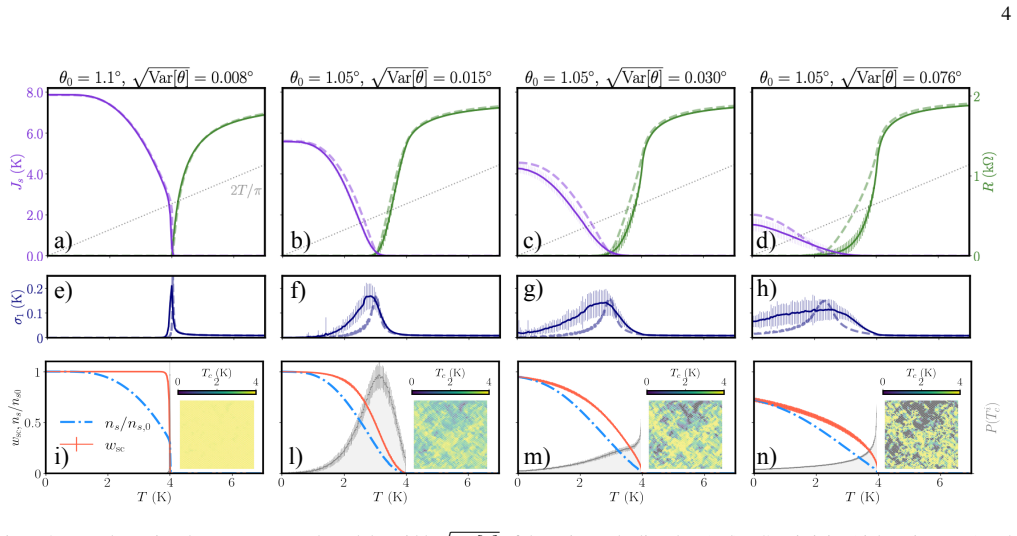
Spatially correlated disorder in local Tc, generated by twist-angle inhomogeneities through an elasticity-theory model, replaces the expected BKT transition with a smeared percolative transition in finite-frequency conductance and renders the low-temperature superfluid stiffness insensitive to whether the order parameter is nodal or fully gapped.
What carries the argument
Random impedance network built from a spatially correlated disorder landscape in local Tc that is derived from elasticity theory applied to twist-angle variations.
If this is right
- Finite-frequency conductance measurements will exhibit a broad, percolative crossover rather than the sharp BKT signature.
- The temperature dependence of superfluid stiffness at low T cannot reliably distinguish nodal from fully gapped order parameters.
- The real part of the conductivity becomes the primary experimental probe for the strength of correlated disorder.
Where Pith is reading between the lines
- Experiments that aim to detect BKT physics in moiré superconductors must first quantify or suppress twist-angle variations.
- The same modeling approach could be applied to other two-dimensional superconductors whose local Tc is spatially inhomogeneous.
- If the percolative picture holds, the apparent critical temperature extracted from transport will be higher than the local mean Tc.
Load-bearing premise
That twist-angle inhomogeneities produce spatially correlated disorder in local Tc via elasticity theory and that this disorder dominates the finite-frequency conductance response.
What would settle it
A measurement on a twisted multilayer graphene sample with documented twist-angle inhomogeneity that nevertheless shows a sharp, frequency-independent jump in superfluid stiffness at a well-defined temperature would falsify the claim that the disorder produces a smeared percolative transition.
Figures

read the original abstract
Two-dimensional superconductors, including twisted multilayer graphene, should exhibit a BKT transition, and the $T$-dependence of the superfluid stiffness should distinguish between nodal or gapped order parameter symmetries. However, this picture dramatically changes when spatially correlated disorder is taken into account. Such correlations naturally arise in moir\'e systems due to twist angle inhomogeneities, which we model using elasticity theory. Using a random impedance network based on realistic disorder in the local $T_c$, we show that the finite-frequency conductance reveals a smeared percolative transition instead of a BKT transition. At low temperatures, the disorder can effectively obscure the distinction between nodal and fully gapped superconducting order parameters. We propose that the real part of the conductivity can be used as a key diagnostic observable to probe the relevance of correlated disorder.
Editorial analysis
A structured set of objections, weighed in public.
Referee Report
Summary. The paper claims that twist-angle inhomogeneities in moiré superconductors, modeled via linear elasticity theory, generate spatially correlated variations in local Tc. A random impedance network built from this disorder produces finite-frequency conductance that exhibits a smeared percolative transition rather than a BKT jump; at low T the same disorder erases the distinction between nodal and fully gapped order-parameter symmetries. The real part of the conductivity is proposed as the key experimental diagnostic for the relevance of such correlated disorder.
Significance. If the elasticity-to-Tc mapping and the impedance-network results hold, the work supplies a concrete mechanism that can reconcile the frequent absence of sharp BKT signatures in twisted-multilayer-graphene experiments and offers a falsifiable observable (Re[σ(ω)]) to test the importance of twist-angle disorder versus other sources of inhomogeneity.
major comments (2)
- [Modeling of twist-angle inhomogeneity (elasticity step)] The central claim rests on the step that linear elasticity theory applied to twist-angle disorder produces the specific long-range spatial correlations in local Tc that drive percolation. No independent validation (e.g., comparison of the computed correlation function or its amplitude against measured local-Tc maps) is supplied; if this mapping deviates from real moiré samples the network output no longer demonstrates that correlated disorder masks BKT.
- [Random impedance network and conductance calculation] The impedance-network construction converts the elasticity-derived Tc distribution into conductance; the manuscript must specify how the network parameters are fixed by microscopic quantities rather than chosen to illustrate percolation, and must report the sensitivity of the smeared transition to the free parameters of the local-Tc distribution.
minor comments (1)
- [Abstract] The abstract states the conclusions but supplies neither equations nor validation steps; the main text should include at least one explicit equation for the elasticity-derived correlation function and one for the network impedance.
Simulated Author's Rebuttal
We thank the referee for the careful reading and constructive comments on our manuscript. We address the two major points below. Revisions have been made to strengthen the justification of the elasticity modeling and to provide explicit parameter specifications and sensitivity analysis for the impedance network.
read point-by-point responses
-
Referee: [Modeling of twist-angle inhomogeneity (elasticity step)] The central claim rests on the step that linear elasticity theory applied to twist-angle disorder produces the specific long-range spatial correlations in local Tc that drive percolation. No independent validation (e.g., comparison of the computed correlation function or its amplitude against measured local-Tc maps) is supplied; if this mapping deviates from real moiré samples the network output no longer demonstrates that correlated disorder masks BKT.
Authors: We acknowledge that direct experimental validation against local-Tc maps would be desirable. Such spatially resolved maps with sufficient resolution are not yet available in the published literature for twisted multilayer graphene. In the revised manuscript we have expanded the discussion in Section II to include a more detailed derivation of the strain-to-Tc mapping from linear elasticity theory, supported by references to prior theoretical studies of moiré strain and twist disorder. We also compare the predicted correlation length scale with indirect estimates from existing STM and transport data on similar systems, while explicitly noting the current lack of direct local-Tc validation as a limitation. revision: partial
-
Referee: [Random impedance network and conductance calculation] The impedance-network construction converts the elasticity-derived Tc distribution into conductance; the manuscript must specify how the network parameters are fixed by microscopic quantities rather than chosen to illustrate percolation, and must report the sensitivity of the smeared transition to the free parameters of the local-Tc distribution.
Authors: We agree that the connection to microscopic quantities and parameter sensitivity should be made explicit. In the revised manuscript we have added a dedicated subsection (Section III.B) that derives the local conductance elements from the BKT superfluid stiffness formula, with the normal-state resistivity and coherence length fixed to experimental values reported for twisted bilayer graphene. A new appendix presents a sensitivity analysis in which the disorder amplitude and correlation length are varied by ±20% around the nominal values; the smeared percolative transition and the loss of distinction between nodal and gapped symmetries remain robust across this range. revision: yes
Circularity Check
No significant circularity; derivation relies on external elasticity theory and standard impedance network simulation without reducing claims to fitted inputs or self-citations by construction.
full rationale
The paper models twist-angle inhomogeneities via elasticity theory to generate spatially correlated local Tc disorder, then feeds those statistics into a random impedance network to compute finite-frequency conductance. This produces a smeared percolative transition rather than a BKT jump. Neither step is self-definitional: the elasticity mapping is an external physical model, the network is a standard computational tool, and the output (conductance signatures) is not equivalent to the input disorder parameters by construction. No load-bearing self-citation chain, ansatz smuggling, or renaming of known results is evident in the abstract or described chain. The central claim remains an independent numerical demonstration under stated assumptions.
Axiom & Free-Parameter Ledger
free parameters (1)
- local Tc distribution parameters
axioms (1)
- domain assumption Elasticity theory accurately describes the spatial correlations induced by twist angle inhomogeneities in moire lattices.
Reference graph
Works this paper leans on
-
[1]
Saito, T
Y. Saito, T. Nojima, and Y. Iwasa, Highly crystalline 2d super- conductors,2, 16094 (2016)
2016
-
[2]
D. Qiu, C. Gong, S. Wang, M. Zhang, C. Yang, X. Wang, and J. Xiong, Recent advances in 2d superconductors,33, 2006124 (2021), eprint: https://onlinelibrary.wiley.com/doi/pdf/10.1002/adma.202006124
-
[3]
H. Ji, Y. Liu, C. Ji, and J. Wang, Two-dimensional and interface superconductivity in crystalline systems,5, 1146 (2024)
2024
-
[4]
Reyren, S
N. Reyren, S. Thiel, A. Caviglia, L. F. Kourkoutis, G. Hammerl, C. Richter, C. W. Schneider, T. Kopp, A.-S. R¨ uetschi, D. Jaccard, et al., Superconducting interfaces between insulating oxides, Science317, 1196 (2007)
2007
-
[5]
C. Liu, X. Yan, D. Jin, Y. Ma, H.-W. Hsiao, Y. Lin, T. M. Bretz- Sullivan, X. Zhou, J. Pearson, B. Fisher, J. S. Jiang, W. Han, J.-M. Zuo, J. Wen, D. D. Fong, J. Sun, H. Zhou, and A. Bhattacharya, Two-dimensional superconductivity and anisotropic transport at KTaO3 (111) interfaces,371, 716 (2021)
2021
-
[6]
Z. Chen, Y. Liu, H. Zhang, Z. Liu, H. Tian, Y. Sun, M. Zhang, Y. Zhou, J. Sun, and Y. Xie, Electric field control of super- conductivity at the LaAlO3/KTaO3(111) interface,372, 721 (2021)
2021
-
[7]
X. Xi, Z. Wang, W. Zhao, J.-H. Park, K. T. Law, H. Berger, L. Forr´o, J. Shan, and K. F. Mak, Ising pairing in superconducting NbSe2 atomic layers,12, 139 (2016)
2016
-
[8]
J. M. Lu, O. Zheliuk, I. Leermakers, N. F. Q. Yuan, U. Zeitler, K. T. Law, and J. T. Ye, Evidence for two-dimensional ising superconductivity in gated MoS2,350, 1353 (2015)
2015
-
[9]
E. Y. Andrei, D. K. Efetov, P. Jarillo-Herrero, A. H. MacDonald, K. F. Mak, T. Senthil, E. Tutuc, A. Yazdani, and A. F. Young, The marvels of moir´e materials,6, 201 (2021), number: 3
2021
-
[10]
D. M. Kennes, M. Claassen, L. Xian, A. Georges, A. J. Millis, J. Hone, C. R. Dean, D. N. Basov, A. N. Pasupathy, and A. Rubio, Moir´e heterostructures as a condensed-matter quantum simulator (2021)
2021
-
[11]
Y. Cao, V. Fatemi, S. Fang, K. Watanabe, T. Taniguchi, E. Kaxiras, and P. Jarillo-Herrero, Unconventional superconductivity in magic-angle graphene superlattices, Nature 2018 556:7699556, 43 (2018)
2018
-
[12]
Z. Zhou, J. Jiang, P. Karnatak, Z. Wang, G. Wagner, K. Watan- abe, T. Taniguchi, C. Sch¨onenberger, S. A. Parameswaran, S. H. Simon, and M. Banerjee, Gate-tunable double-dome supercon- ductivity in twisted trilayer graphene,21, 1773
-
[13]
Wang, E.-M
L. Wang, E.-M. Shih, A. Ghiotto, L. Xian, D. A. Rhodes, C. Tan, M. Claassen, D. M. Kennes, Y. Bai, B. Kim, K. Watanabe, T. Taniguchi, X. Zhu, J. Hone, A. Rubio, A. N. Pasupathy, and C. R. Dean, Correlated electronic phases in twisted bilayer transition metal dichalcogenides,19, 861 (2020)
2020
-
[14]
H. Zhou, T. Xie, T. Taniguchi, K. Watanabe, and A. F. Young, Superconductivity in rhombohedral trilayer graphene,598, 434 (2021)
2021
-
[15]
T. Han, Z. Lu, Z. Hadjri, L. Shi, Z. Wu, W. Xu, Y. Yao, A. A. Cotten, O. Sharifi Sedeh, H. Weldeyesus, J. Yang, J. Seo, S. Ye, M. Zhou, H. Liu, G. Shi, Z. Hua, K. Watanabe, T. Taniguchi, P. Xiong, D. M. Zumb¨ uhl, L. Fu, and L. Ju, Signatures of chiral superconductivity in rhombohedral graphene,643, 654 (2025)
2025
-
[16]
V. L. Berezinsky, Destruction of long-range order in one- dimensional and two-dimensional systems having a continuous symmetry group I. Classical systems, Soviet Physics JETP32, 907 (1972)
1972
-
[17]
J. M. Kosterlitz and D. J. Thouless, Ordering, metastability and phase transitions in two-dimensional systems, Journal of Physics C: Solid State Physics6, 1181 (1973)
1973
-
[18]
Kosterlitz, The critical properties of the two-dimensional XY model, Journal of Physics C: Solid State Physics7, 1046 (1974)
J. Kosterlitz, The critical properties of the two-dimensional XY model, Journal of Physics C: Solid State Physics7, 1046 (1974). 6
1974
-
[19]
D. R. Nelson and J. Kosterlitz, Universal jump in the superfluid density of two-dimensional superfluids, Physical Review Letters 39, 1201 (1977)
1977
-
[20]
Z. Wang, Y. Liu, C. Ji, and J. Wang, Quantum phase transi- tions in two-dimensional superconductors: a review on recent experimental progress,87, 014502 (2023)
2023
-
[21]
A. B. Harris, Effect of random defects on the critical behaviour of ising models, J. Phys. C Solid State Phys.7, 1671 (1974)
1974
-
[22]
A. T. Fiory, A. F. Hebard, and W. I. Glaberson, Superconducting phase transitions in indium/indium-oxide thin-film composites, Phys. Rev. B28, 5075 (1983)
1983
-
[23]
S. J. Turneaure, T. R. Lemberger, and J. M. Graybeal, Effect of thermal phase fluctuations on the superfluid density of two- dimensional superconducting films, Phys. Rev. Lett.84, 987 (2000)
2000
-
[24]
Y. Zuev, M. Seog Kim, and T. R. Lemberger, Correlation between superfluid density and 𝑇𝐶 of underdoped yba2cu3o6+𝑥 near the superconductor-insulator transition, Phys. Rev. Lett.95, 137002 (2005)
2005
-
[25]
D. M. Broun, W. A. Huttema, P. J. Turner, S. ¨Ozcan, B. Morgan, R. Liang, W. N. Hardy, and D. A. Bonn, Superfluid density in a highly underdoped yba2cu3o6+𝑦 superconductor, Phys. Rev. Lett. 99, 237003 (2007)
2007
-
[26]
Sac´ep´e, C
B. Sac´ep´e, C. Chapelier, T. I. Baturina, V. M. Vinokur, M. R. Baklanov, and M. Sanquer, Disorder-induced inhomogeneities of the superconducting state close to the superconductor-insulator transition, Phys. Rev. Lett.101, 157006 (2008)
2008
-
[27]
Mondal, S
M. Mondal, S. Kumar, M. Chand, A. Kamlapure, G. Saraswat, G. Seibold, L. Benfatto, and P. Raychaudhuri, Role of the vortex- core energy on the berezinskii-kosterlitz-thouless transition in thin films of nbn, Phys. Rev. Lett.107, 217003 (2011)
2011
-
[28]
J. Yong, T. R. Lemberger, L. Benfatto, K. Ilin, and M. Siegel, Robustness of the berezinskii-kosterlitz-thouless transition in ultrathin nbn films near the superconductor-insulator transition, Phys. Rev. B87, 184505 (2013)
2013
-
[29]
Mandal, S
S. Mandal, S. Dutta, S. Basistha, I. Roy, J. Jesudasan, V. Bagwe, L. Benfatto, A. Thamizhavel, and P. Raychaudhuri, Destruction of superconductivity through phase fluctuations in ultrathin𝑎-moge films, Phys. Rev. B102, 060501(R) (2020)
2020
-
[30]
Mallik, G
S. Mallik, G. C. M´enard, G. Sa¨ız, H. Witt, J. Lesueur, A. Gloter, L. Benfatto, M. Bibes, and N. Bergeal, Superfluid stiffness of a KTaO3-based two-dimensional electron gas,13, 4625, number: 1
-
[31]
Jarjour, G
A. Jarjour, G. M. Ferguson, B. T. Schaefer, M. Lee, Y. L. Loh, N. Trivedi, and K. C. Nowack, Superfluid response of an atomically thin gate-tuned van der waals superconductor,14, 2055
2055
-
[32]
Benfatto, C
L. Benfatto, C. Castellani, and T. Giamarchi, Broadening of the Berezinskii−Kosterlitz−Thouless superconducting transition by inhomogeneity and finite-size effects, Physical Review B80, 214506 (2009)
2009
-
[33]
Maccari, L
I. Maccari, L. Benfatto, and C. Castellani, Broadening of the Berezinskii−Kosterlitz−Thouless transition by correlated dis- order, Physical Review B96, 1 (2017)
2017
-
[34]
Maccari, L
I. Maccari, L. Benfatto, and C. Castellani, DisorderedXY model: Effective medium theory and beyond, Physical Review B99, 104509 (2019)
2019
-
[35]
Weitzel, L
A. Weitzel, L. Pfaffinger, I. Maccari, K. Kronfeldner, T. Huber, L. Fuchs, J. Mallord, S. Linzen, E. Il’ichev, N. Paradiso, and C. Strunk, Sharpness of the Berezinskii-Kosterlitz-Thouless transition in disordered NbN films, Physical Review Letters131, 186002 (2023)
2023
-
[36]
Caprara, M
S. Caprara, M. Grilli, L. Benfatto, and C. Castellani, Effective medium theory for superconducting layers: A systematic analysis including space correlation effects, Physical Review B84, 014514 (2011)
2011
-
[37]
Caprara, J
S. Caprara, J. Biscaras, N. Bergeal, D. Bucheli, S. Hurand, C. Feuillet-Palma, A. Rastogi, R. C. Budhani, J. Lesueur, and M. Grilli, Multiband superconductivity and nanoscale inho- mogeneity at oxide interfaces, Physical Review B88, 020504 (2013)
2013
-
[38]
Bucheli, S
D. Bucheli, S. Caprara, C. Castellani, and M. Grilli, Metal– superconductor transition in low-dimensional superconducting clusters embedded in two-dimensional electron systems, New Journal of Physics15, 023014 (2013)
2013
-
[39]
Caprara, D
S. Caprara, D. Bucheli, N. Scopigno, N. Bergeal, J. Biscaras, S. Hurand, J. Lesueur, and M. Grilli, Inhomogeneous multi carrier superconductivity atLaXO3/SrTiO3 (X=Al or Ti ) oxide interfaces, Superconductor Science and Technology28, 014002 (2014)
2014
-
[40]
G. Singh, A. Jouan, L. Benfatto, F. Cou¨edo, P. Kumar, A. Dogra, R. C. Budhani, S. Caprara, M. Grilli, E. Lesne, A. Barth´el´emy, M. Bibes, C. Feuillet-Palma, J. Lesueur, and N. Bergeal, Com- petition between electron pairing and phase coherence in su- perconducting interfaces, Nature Communications9, 1 (2018), arXiv:1704.03365
Pith/arXiv arXiv 2018
-
[41]
Bucheli, S
D. Bucheli, S. Caprara, and M. Grilli, Pseudo-gap as a signa- ture of inhomogeneous superconductivity in oxide interfaces, Superconductor Science and Technology28, 045004 (2015)
2015
-
[42]
Venditti, J
G. Venditti, J. Biscaras, S. Hurand, N. Bergeal, J. Lesueur, A. Dogra, R. C. Budhani, M. Mondal, J. Jesudasan, P. Raychaudhuri, S. Caprara, and L. Benfatto, Nonlinear I−V characteristics of two-dimensional superconductors: Berezinskii−Kosterlitz−Thouless physics versus inhomogene- ity, Physical Review B100, 064506 (2019)
2019
-
[43]
Venditti, I
G. Venditti, I. Maccari, M. Grilli, and S. Caprara, Superfluid properties of superconductors with disorder at the nanoscale: A random impedance model, Condensed Matter5, 36 (2020)
2020
-
[44]
Venditti, I
G. Venditti, I. Maccari, M. Grilli, and S. Caprara, Finite- frequency dissipation in two-dimensional superconductors with disorder at the nanoscale, Nanomaterials11, 1888 (2021)
2021
-
[45]
G. Venditti, I. Maccari, A. Jouan, G. Singh, R. C. Budhani, C. Feuillet-Palma, J. Lesueur, N. Bergeal, S. Caprara, and M. Grilli, Superfluid response of two-dimensional filamen- tary superconductors, SciPost Physics15, 10.21468/SciPost- Phys.15.6.239 (2023)
-
[46]
T. E. Beechem, T. Ohta, B. Diaconescu, and J. T. Robinson, Rotational disorder in twisted bilayer graphene, ACS Nano8, 1655 (2014)
2014
-
[47]
Rhodes, S
D. Rhodes, S. H. Chae, R. Ribeiro-Palau, and J. Hone, Disorder in van der waals heterostructures of 2d materials,18, 541
-
[48]
A. Uri, S. Grover, Y. Cao, J. A. Crosse, K. Bagani, D. Rodan- Legrain, Y. Myasoedov, K. Watanabe, T. Taniguchi, P. Moon, M. Koshino, P. Jarillo-Herrero, and E. Zeldov, Mapping the twist-angle disorder and Landau levels in magic-angle graphene, Nature581, 47 (2020)
2020
-
[49]
Turkel, J
S. Turkel, J. Swann, Z. Zhu, M. Christos, K. Watanabe, T. Taniguchi, S. Sachdev, M. S. Scheurer, E. Kaxiras, C. R. Dean, and A. N. Pasupathy, Orderly disorder in magic-angle twisted trilayer graphene, Science376, 193 (2022)
2022
-
[50]
Grover, M
S. Grover, M. Bocarsly, A. Uri, P. Stepanov, G. D. Battista, I. Roy, J. Xiao, A. Y. Meltzer, Y. Myasoedov, K. Pareek, K. Watanabe, T. Taniguchi, B. Yan, A. Stern, E. Berg, D. K. Efetov, and E. Zeldov, Chern mosaic and berry-curvature magnetism in magic-angle graphene, Nature Physics 2022 18:818, 885 (2022)
2022
-
[51]
R. J. Dolleman, A. Rothstein, A. Fischer, L. Klebl, L. Waldecker, K. Watanabe, T. Taniguchi, D. M. Kennes, F. Libisch, B. Beschoten, and C. Stampfer, Negative electronic compress- 7 ibility in charge islands in twisted bilayer graphene, Physical Review B109, 155430 (2024)
2024
-
[52]
Tanaka, J.ˆI.j
M. Tanaka, J.ˆI.j. Wang, T. H. Dinh, D. Rodan-Legrain, S. Zaman, M. Hays, A. Almanakly, B. Kannan, D. K. Kim, B. M. Niedzielski, K. Serniak, M. E. Schwartz, K. Watanabe, T. Taniguchi, T. P. Orlando, S. Gustavsson, J. A. Grover, P. Jarillo-Herrero, and W. D. Oliver, Superfluid stiffness of magic-angle twisted bilayer graphene, Nature638, 99 (2025)
2025
-
[53]
Banerjee, Z
A. Banerjee, Z. Hao, M. Kreidel, P. Ledwith, I. Phinney, J. M. Park, A. Zimmerman, M. E. Wesson, K. Watanabe, T. Taniguchi, R. M. Westervelt, A. Yacoby, P. Jarillo-Herrero, P. A. Volkov, A. Vishwanath, K. C. Fong, and P. Kim, Superfluid stiffness of twisted trilayer graphene superconductors, Nature 2025 638:8049 638, 93 (2025)
2025
-
[54]
Mukherjee, S
A. Mukherjee, S. Layek, S. Sinha, R. Kundu, A. H. Marchawala, M. Hingankar, J. Sarkar, L. D. Sangani, H. Agarwal, S. Ghosh, A. B. Tazi, K. Watanabe, T. Taniguchi, A. N. Pasupathy, A. Kundu, and M. M. Deshmukh, Superconducting magic-angle twisted trilayer graphene with competing magnetic order and moir ´e inhomogeneities, Nature Materials , 1 (2025)
2025
-
[55]
J. M. Park, S. Sun, K. Watanabe, T. Taniguchi, and P. Jarillo- Herrero, Experimental evidence for nodal superconducting gap in moir´e graphene, Science 10.1126/SCIENCE.ADV8376 (2025)
-
[56]
K. Wang, Q. Chen, R. Boyack, and K. Levin, Geometric super- fluid stiffness of kekul´e superconductivity in magic-angle twisted bilayer graphene, arXiv preprint arXiv:2603.24766 (2026), arXiv:2603.24766 [cond-mat.supr-con]
arXiv 2026
-
[57]
Landau, E
L. Landau, E. Lifshitz, A. Kosevich, and L. Pitaevskii,Theory of Elasticity: Volume 7, Course of theoretical physics (Elsevier Science, 1986)
1986
-
[58]
L. Balents, General continuum model for twisted bilayer graphene and arbitrary smooth deformations, SciPost Physics7, 10.21468/SciPostPhys.7.4.048 (2019)
-
[59]
Z. Bi, N. F. Yuan, and L. Fu, Designing flat bands by strain, Physical Review B100, 035448 (2019)
2019
-
[60]
I. V. Lebedeva, A. S. Minkin, A. M. Popov, and A. A. Knizhnik, Elastic constants of graphene: Comparison of empirical poten- tials and dft calculations, Physica E: Low-dimensional Systems and Nanostructures108, 326 (2019)
2019
-
[61]
Kang and O
J. Kang and O. Vafek, Analytical solution for the relaxed atomic configuration of twisted bilayer graphene including heterostrain, Physical Review B112, 125138 (2025)
2025
-
[62]
Halperin and D
B. Halperin and D. R. Nelson, Resistive transition in super- conducting films, Journal of low temperature physics36, 599 (1979)
1979
-
[63]
Mallik, G
S. Mallik, G. C. M´enard, G. Sa¨ız, H. Witt, J. Lesueur, A. Gloter, L. Benfatto, M. Bibes, and N. Bergeal, Superfluid stiffness of a KTaO3-based two-dimensional electron gas, Nature Communi- cations 2022 13:113, 4625 (2022)
2022
-
[64]
G. Dezi, N. Scopigno, S. Caprara, and M. Grilli, Negative electronic compressibility and nanoscale inhomogeneity in ionic- liquid gated two-dimensional superconductors, Physical Review B98, 214507 (2018)
2018
-
[65]
See Supplemental Material for details
-
[66]
Rothstein, R
A. Rothstein, R. J. Dolleman, L. Klebl, A. Achtermann, F. Volmer, K. Watanabe, T. Taniguchi, F. Hassler, L. Banszerus, B. Beschoten, and C. Stampfer, Gate-tunable josephson diodes in magic-angle twisted bilayer graphene, Nano Letters26, 2119 (2026)
2026
-
[67]
C. N. Lau, M. W. Bockrath, K. F. Mak, and F. Zhang, Repro- ducibility in the fabrication and physics of moir´e materials,602, 41
-
[68]
W. J. Meese and R. M. Fernandes, Compatible instability: Gauge constraints of elasticity inherited by electronic nematic criticality, Phys. Rev. Lett.136, 166501 (2026)
2026
-
[69]
W. J. Meese and R. M. Fernandes, Theory of electronic nematic criticality constrained by elastic compatibility, Phys. Rev. B113, 165136 (2026)
2026
-
[70]
H. Kim, Y. Choi, C. Lewandowski, A. Thomson, Y. Zhang, R. Polski, K. Watanabe, T. Taniguchi, J. Alicea, and S. Nadj- Perge, Evidence for unconventional superconductivity in twisted trilayer graphene, Nature606, 494 (2022)
2022
-
[71]
M. Oh, K. P. Nuckolls, D. Wong, R. L. Lee, X. Liu, K. Watanabe, T. Taniguchi, and A. Yazdani, Evidence for unconventional superconductivity in twisted bilayer graphene, Nature600, 240 (2021)
2021
-
[72]
M. E. Barber, E. Y. Ma, and Z. X. Shen, Microwave impedance microscopy and its application to quantum materials (2022)
2022
-
[73]
T¨orm¨a, S
P. T¨orm¨a, S. Peotta, and B. A. Bernevig, Superconductivity, superfluidity and quantum geometry in twisted multilayer systems (2022)
2022
-
[74]
H. Tian, X. Gao, Y. Zhang, S. Che, T. Xu, P. Cheung, K. Watanabe, T. Taniguchi, M. Randeria, F. Zhang, C. N. Lau, and M. W. Bockrath, Evidence for dirac flat band superconductivity enabled by quantum geometry, Nature614, 440 (2023)
2023
-
[75]
Y. M. Blanter and M. B¨ uttiker, Shot noise in mesoscopic con- ductors, Physics Reports336, 1 (2000), standard review paper on noise spectroscopy. 8 End Matter Effective medium approximation —The RIN model can be solved in the EMT approximation [43, 44], implicitly assum- ing uncorrelated inhomogeneities. It is convenient to split the bonds into two speci...
2000
discussion (0)
Sign in with ORCID, Apple, or X to comment. Anyone can read and Pith papers without signing in.