Kernel-Based Functional Balancing for Causal Inference with Compositional Treatments
Pith reviewed 2026-06-27 01:58 UTC · model grok-4.3
The pith
Kernel-based balancing constructs weights for causal effects with compositional treatments by minimizing worst-case error in a joint RKHS of treatments and covariates.
A machine-rendered reading of the paper's core claim, the machinery that carries it, and where it could break.
Core claim
By minimizing a worst-case balancing error over the reproducing kernel Hilbert space defined jointly on treatments and covariates, the method produces weights that identify the projected average potential outcome. The augmented weighted estimator, formed by adding a kernel ridge regression outcome model and marginal covariate augmentation, achieves sqrt(n)-consistency and asymptotic normality around a sample-specific target without requiring consistent estimation of the weights or smoothness assumptions on them. A finite-dimensional convex optimization problem is obtained via the representer theorem and low-rank approximation.
What carries the argument
The joint RKHS balancing criterion that directly minimizes worst-case error for weight construction, combined with the augmented weighted estimator using kernel ridge regression.
If this is right
- The estimator remains root-n consistent for the projected estimand even without consistent estimation of the balancing weights.
- Asymptotic normality holds around a sample-specific target rather than the population parameter.
- The complex objective reduces to a finite-dimensional convex program via the representer theorem and low-rank approximation.
- Empirical performance is shown through simulation studies and a real-data application.
Where Pith is reading between the lines
- The projection step may allow similar balancing constructions for other constrained treatment domains that admit a natural linear embedding.
- Sample-specific centering could support finite-sample inference procedures that condition on the observed covariate and treatment realizations.
- Low-rank approximations in the optimization may extend the method to moderately large datasets while preserving the root-n rate.
- Hybridization with other outcome regression techniques could be explored while retaining the balancing weights.
Load-bearing premise
Minimizing the worst-case balancing error over the joint RKHS of treatments and covariates produces weights that correctly identify the projected average potential outcome.
What would settle it
A simulation study in which the true projected average potential outcome differs from the value recovered by the balancing weights even after the RKHS minimization step is performed.
Figures

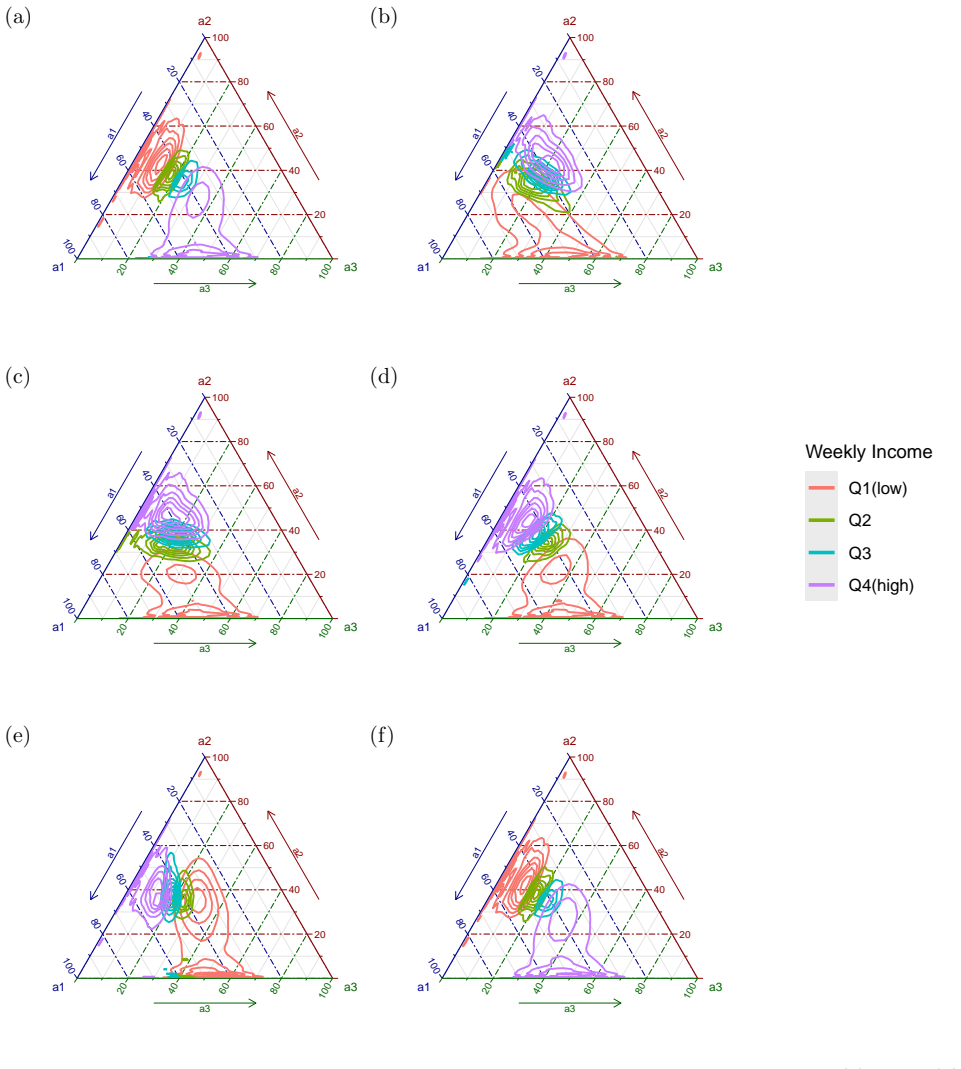
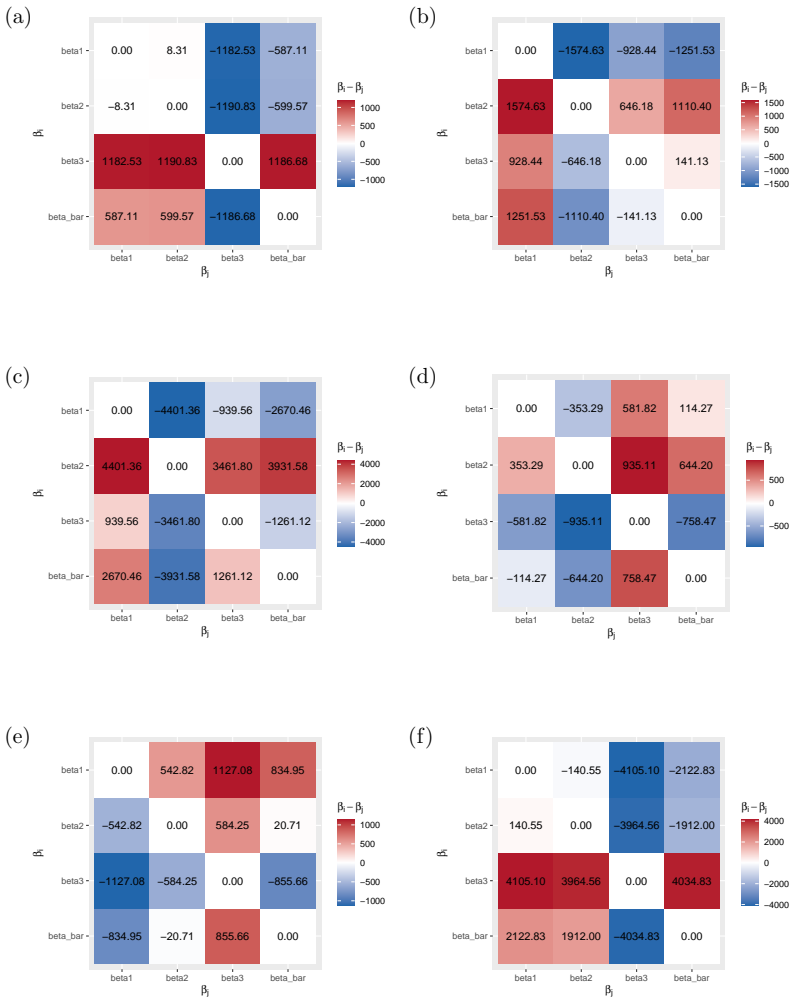
read the original abstract
We study causal effect estimation with compositional treatments, where the exposure lies on a simplex and the estimand is defined over compositions rather than scalar or binary values. By considering a projection of the average potential outcome onto the treatment space, a kernel-based covariate functional balancing approach is adopted for weight construction. The weights are obtained by directly minimizing a worst-case balancing error over a reproducing kernel Hilbert space (RKHS) defined on the joint space of treatments and covariates, instead of being estimated under a treatment assignment model. Building on these weights, an augmented weighted estimator (AWE) is proposed, where the outcome function is estimated via kernel ridge regression and combined with a marginal augmentation over the covariate distribution. Despite the complex structure of the resulting objective, a finite-dimensional convex optimization problem is formulated via a representer theorem and a low-rank approximation. The proposed estimator achieves $\sqrt{n}$-consistency without requiring consistent estimation or smoothness of the weights. An asymptotic normality result is established around a sample-specific target. Empirical performance is demonstrated through simulation studies and a real data application.
Editorial analysis
A structured set of objections, weighed in public.
Referee Report
Summary. The paper develops a kernel-based covariate functional balancing method for estimating projected average potential outcomes under compositional treatments on the simplex. Weights are constructed by minimizing a worst-case balancing error over the joint RKHS of treatments and covariates rather than via a propensity model. An augmented weighted estimator (AWE) is formed by combining these weights with a kernel ridge regression estimate of the outcome function and a marginal augmentation step over covariates. The resulting finite-dimensional convex program is obtained via the representer theorem and low-rank approximation. The central claims are √n-consistency of the AWE without requiring consistent or smooth weight estimation, together with asymptotic normality around a sample-specific target; performance is illustrated in simulations and a real-data example.
Significance. If the rate at which the sample-specific target converges to the population projected APO can be shown to be o_p(n^{-1/2}), the approach would supply a useful semiparametric tool for compositional treatments that avoids parametric modeling of the assignment mechanism. The computational reduction to a convex program is a practical strength. At present the asymptotic justification for population-level consistency remains incomplete, limiting the strength of the contribution.
major comments (3)
- [Abstract] Abstract: the claim that the AWE 'achieves √n-consistency' is stated without qualification, yet the same sentence immediately restricts asymptotic normality to a 'sample-specific target.' No rate is supplied for the convergence of this target to the population projected APO; without such a rate the population consistency claim does not follow from the stated result.
- [Abstract / weight construction paragraph] The construction of the weights via minimization of worst-case balancing error over the joint RKHS is asserted to 'correctly identify' the projected APO (abstract). The manuscript provides no explicit identification argument showing that the population minimizer of this criterion recovers the desired functional of the potential-outcome surface; the step from balancing to identification therefore remains unverified.
- [Computational formulation section] The low-rank approximation and representer reduction are used to obtain a tractable convex program, yet the manuscript does not quantify how the approximation error enters the asymptotic expansion or whether it preserves the o_p(n^{-1/2}) requirement needed for the sample-specific target.
minor comments (1)
- [Abstract] The abstract and introduction should explicitly state whether error bars or sensitivity analyses for the sample-specific target are provided in the empirical sections.
Simulated Author's Rebuttal
We thank the referee for the constructive comments on our manuscript. We address each of the major comments point by point below. We agree that clarifications are needed in the abstract and additional details on identification and approximation errors would improve the paper. We plan to incorporate these changes in a revised version.
read point-by-point responses
-
Referee: [Abstract] Abstract: the claim that the AWE 'achieves √n-consistency' is stated without qualification, yet the same sentence immediately restricts asymptotic normality to a 'sample-specific target.' No rate is supplied for the convergence of this target to the population projected APO; without such a rate the population consistency claim does not follow from the stated result.
Authors: We appreciate this observation. The primary theoretical contribution establishes √n-consistency and asymptotic normality of the augmented weighted estimator to the sample-specific target, which is the finite-sample analogue of the projected APO. The manuscript does not assert population-level √n-consistency without further conditions. To resolve the ambiguity, we will revise the abstract to explicitly qualify that the consistency result pertains to the sample-specific target. Additionally, we can include a brief discussion of the conditions (e.g., on the RKHS approximation properties) under which the sample-specific target converges to the population quantity at rate o_p(n^{-1/2}). revision: yes
-
Referee: [Abstract / weight construction paragraph] The construction of the weights via minimization of worst-case balancing error over the joint RKHS is asserted to 'correctly identify' the projected APO (abstract). The manuscript provides no explicit identification argument showing that the population minimizer of this criterion recovers the desired functional of the potential-outcome surface; the step from balancing to identification therefore remains unverified.
Authors: This comment highlights an important gap. Although the joint RKHS balancing is motivated by the idea that a sufficiently expressive RKHS can enforce the necessary orthogonality conditions for identification, we did not provide a formal proof. In the revised manuscript, we will add an identification result (as a new lemma) demonstrating that, when the RKHS is universal or contains the relevant regression functions, the population-level minimizer of the worst-case balancing criterion indeed recovers the projected average potential outcome. This will be placed in the methodology section prior to the estimator construction. revision: yes
-
Referee: [Computational formulation section] The low-rank approximation and representer reduction are used to obtain a tractable convex program, yet the manuscript does not quantify how the approximation error enters the asymptotic expansion or whether it preserves the o_p(n^{-1/2}) requirement needed for the sample-specific target.
Authors: We acknowledge that the impact of the low-rank approximation on the asymptotics was not explicitly analyzed. The representer theorem yields an exact finite-dimensional representation for the weights in the RKHS, while the low-rank approximation is a numerical device to reduce dimensionality. We will augment the supplementary material with an analysis showing that the approximation error, controlled by the choice of rank (which can be taken to grow slowly with n), contributes a term that is o_p(n^{-1/2}) under standard eigenvalue decay assumptions on the kernel operator. This ensures the asymptotic expansion remains valid. revision: yes
Circularity Check
No significant circularity detected
full rationale
The derivation relies on standard RKHS theory, the representer theorem, and convex optimization to construct weights via worst-case balancing error minimization and to form the augmented estimator via kernel ridge regression plus marginal augmentation. The abstract explicitly states that asymptotic normality holds around a sample-specific target rather than claiming direct population consistency without qualification. No self-definitional reductions, no fitted quantities renamed as independent predictions, and no load-bearing self-citations or uniqueness theorems imported from the authors' prior work appear in the provided material. The central claims rest on external mathematical results for kernels and optimization rather than reducing to the paper's own fitted outputs by construction.
Axiom & Free-Parameter Ledger
axioms (2)
- standard math Reproducing kernel Hilbert space properties and the representer theorem apply to the joint treatment-covariate space.
- domain assumption The projection of the average potential outcome onto the simplex is a well-defined and scientifically relevant estimand.
Reference graph
Works this paper leans on
-
[1]
Boonen, T. J. and Guill\'en, M. and Santolino, M. , title =. Insurance Mathematics and Economics , volume =
-
[2]
and Alonso-Gonz\'alez, P
Vega-G\'amez, F. and Alonso-Gonz\'alez, P. J. , title =. Financial Innovation , volume =
-
[3]
and Pedisi\'
Dumuid, D. and Pedisi\'. Compositional Data Analysis in Time-Use Epidemiology: What, Why, How , journal =. 2020 , doi =
2020
-
[4]
Bennett, A. R. and Lundstr. Compositional data analysis enables statistical rigor in comparative glycomics , journal =
-
[5]
Verswijveren, S. J. J. M. and Lamb, K. E. and Martin-Fernandez, J. A. and Winkler, E. and Leech, R. M. and Timperio, A. and Salmon, J. and Daly, R. M. and Cerin, E. and Dunstan, D. W. and Telford, R. M. and Telford, R. D. and Olive, L. S. and Ridgers, N. D. , title =. J Sport Health Sci. , volume =. 2022 , doi =
2022
-
[6]
and Tremblay, M
Carson, V. and Tremblay, M. S. and Chaput, J. P. and McGregor, D. and Chastin, S. F. M. , title =. Appl Physiol Nutr Metab. , volume =. 2016 , doi =
2016
-
[7]
and Thomas-Agnan, C
Morais, J. and Thomas-Agnan, C. and Simioni, M. , title =. Journal of Applied Statistics , volume =. 2018 , doi =
2018
-
[8]
Raymond K. W. Wong and Kwun Chuen Gary Chan , title =. Biometrika , year =
-
[9]
Hirshberg and Stefan Wager , title =
David A. Hirshberg and Stefan Wager , title =. arXiv preprint arXiv:1712.00038v6 , year =
-
[10]
Biometrics , year =
Gen Li and Yan Li and Kun Chen , title =. Biometrics , year =
-
[11]
and Martin-Fuentes, E
Ferrer-Rosell, B. and Martin-Fuentes, E. and Vives-Mestres, M. and Coenders, G. , title =. Handbook of Research Methods for Marketing Management , pages =. 2021 , publisher =
2021
-
[12]
Angrist and J
Joshua D. Angrist and J. Mostly Harmless Econometrics: An Empiricist's Companion , publisher =. 2009 , isbn =
2009
-
[13]
Rubin , title =
Donald B. Rubin , title =. ETS Research Bulletin Series , volume =. 1972 , publisher =
1972
-
[14]
Rosenbaum and Donald B
Paul R. Rosenbaum and Donald B. Rubin , title =. Biometrika , volume =. 1983 , month =
1983
-
[15]
James M. Robins and Miguel A. Hern. Marginal structural models and causal inference in epidemiology , journal =. 2000 , month =. doi:10.1097/00001648-200009000-00011 , pmid =
-
[16]
Journal of the Royal Statistical Society: Series B (Methodological) , volume =
John Aitchison , title =. Journal of the Royal Statistical Society: Series B (Methodological) , volume =. 1982 , publisher =
1982
-
[17]
2009 , series =
Trevor Hastie and Robert Tibshirani and Jerome Friedman , title =. 2009 , series =
2009
-
[18]
Found Comput Math , volume =
Andrea Caponnetto and Ernesto De Vito , title =. Found Comput Math , volume =. 2007 , doi =
2007
-
[19]
A. W. van der Vaart , title =. 1998 , series =
1998
-
[20]
The Econometrics Journal , volume =
Victor Chernozhukov and Denis Chetverikov and Mert Demirer and Esther Duflo and Christian Hansen and Whitney Newey and James Robins , title =. The Econometrics Journal , volume =. 2018 , month =
2018
-
[21]
Cross-Fitting and Fast Remainder Rates for Semiparametric Estimation
Whitney K. Newey and James R. Robins , title =. arXiv preprint arXiv:1801.09138 , year =
work page internal anchor Pith review Pith/arXiv arXiv
-
[22]
Modelling and Analysis of Compositional Data , publisher =
Vera Pawlowsky-Glahn and Juan Jos. Modelling and Analysis of Compositional Data , publisher =. 2015 , isbn =
2015
-
[23]
Joseph D. Y. Kang and Joseph L. Schafer , title =. Statistical Science , volume =. 2007 , doi =
2007
-
[24]
Scharfstein and Andrea Rotnitzky and James M
Daniel O. Scharfstein and Andrea Rotnitzky and James M. Robins , title =. Journal of the American Statistical Association , volume =. 1999 , month =. doi:10.2307/2669923 , url =
-
[25]
A Distribution-Free Theory of Nonparametric Regression , publisher =
L. A Distribution-Free Theory of Nonparametric Regression , publisher =. 2002 , series =
2002
-
[26]
Journal of Complexity , volume =
Ding-Xuan Zhou , title =. Journal of Complexity , volume =. 2002 , doi =
2002
- [27]
-
[28]
Electronic Communications in Probability , volume=
Sums of random Hermitian matrices and an inequality by Rudelson , author=. Electronic Communications in Probability , volume=. 2010 , publisher=
2010
-
[29]
J. J. Egozcue and V. Pawlowsky-Glahn and G. Mateu-Figueras and C. Barcel. Isometric logratio transformations for compositional data analysis , journal =. 2003 , doi =
2003
-
[30]
2015 , publisher=
Causal Inference in Statistics, Social, and Biomedical Sciences , author=. 2015 , publisher=
2015
-
[31]
and Powell, James L
Newey, Whitney K. and Powell, James L. , title =. Econometrica , year =
-
[32]
van der Laan and Sherri Rose , title =
Mark J. van der Laan and Sherri Rose , title =. 2011 , series =
2011
-
[33]
Robins and Andrea Rotnitzky , title =
James M. Robins and Andrea Rotnitzky , title =. Journal of the American Statistical Association , volume =. 1995 , month =
1995
-
[34]
Stone , title =
Charles J. Stone , title =. The Annals of Statistics , volume =. 1982 , doi =
1982
-
[35]
Jiayi Wang and Raymond K. W. Wong and Xiaoke Zhang and Kwun Chuen Gary Chan , title =. Journal of Machine Learning Research , volume =
-
[36]
and Imbens, G
Hirano, K. and Imbens, G. W. and Ridder, G. , title =. Econometrica , volume =. 2003 , month =
2003
-
[37]
Graham and Cristine Campos de Xavier Pinto and Daniel Egel , title =
Bryan S. Graham and Cristine Campos de Xavier Pinto and Daniel Egel , title =. The Review of Economic Studies , volume =. 2012 , doi =
2012
-
[38]
Newey , title =
Hidehiko Ichimura and Whitney K. Newey , title =. Quantitative Economics , volume =. 2022 , doi =
2022
-
[39]
, title =
Newey, Whitney K. , title =. Econometrica , volume =. 1994 , month =
1994
-
[40]
Sriperumbudur and Arthur Gretton and Kenji Fukumizu and Bernhard Sch
Bharath K. Sriperumbudur and Arthur Gretton and Kenji Fukumizu and Bernhard Sch. Hilbert space embeddings and metrics on probability measures , journal =. 2010 , doi =
2010
-
[41]
Journal of Machine Learning Research , volume =
Simon Fischer and Ingo Steinwart , title =. Journal of Machine Learning Research , volume =
-
[42]
Learning with Kernels: Support Vector Machines, Regularization, Optimization, and Beyond , publisher =
Sch. Learning with Kernels: Support Vector Machines, Regularization, Optimization, and Beyond , publisher =
-
[43]
and Christmann, A
Steinwart, I. and Christmann, A. , title =
-
[44]
Tropp, J. A. , title =. Foundations of Computational Mathematics , year =
-
[45]
Political Analysis , volume =
Hainmueller, Jens , title =. Political Analysis , volume =
-
[46]
Journal of the Royal Statistical Society: Series B , volume =
Imai, Kosuke and Ratkovic, Marc , title =. Journal of the Royal Statistical Society: Series B , volume =
-
[47]
Statistica Sinica , volume =
Hazlett, Chad , title =. Statistica Sinica , volume =
-
[48]
Annals of Applied Statistics , volume =
Fong, Christian and Hazlett, Chad and Imai, Kosuke , title =. Annals of Applied Statistics , volume =. 2018 , doi =
2018
-
[49]
, title =
Imbens, Guido W. , title =. 2003 , address =
2003
-
[50]
Journal of Econometric Methods , volume =
Entropy Balancing for Continuous Treatments , author =. Journal of Econometric Methods , volume =. 2022 , doi =
2022
-
[51]
Journal of the American Statistical Association , volume =
Independence Weights for Causal Inference with Continuous Treatments , author =. Journal of the American Statistical Association , volume =. 2024 , doi =
2024
-
[52]
Biometrical Journal , volume =
Causal Effect Estimation for Multivariate Continuous Treatments , author =. Biometrical Journal , volume =. 2023 , doi =
2023
-
[53]
, title =
van der Vaart, Aad. , title =. The Annals of Statistics , volume =. 1991 , publisher =
1991
-
[54]
, title =
Abadie, Alberto and Imbens, Guido W. , title =. Journal of Business & Economic Statistics , year =
-
[55]
, title =
Abadie, Alberto and Imbens, Guido W. , title =. Econometrica , year =
-
[56]
Journal of the American Statistical Association , volume=
Estimation of Regression Coefficients When Some Regressors are not Always Observed , author=. Journal of the American Statistical Association , volume=. 1994 , publisher=
1994
-
[57]
Biometrics , volume=
Doubly Robust Estimation in Missing Data and Causal Inference Models , author=. Biometrics , volume=. 2005 , publisher=
2005
discussion (0)
Sign in with ORCID, Apple, or X to comment. Anyone can read and Pith papers without signing in.