Verifying the Rust Standard Library
Pith reviewed 2026-06-26 22:56 UTC · model grok-4.3
The pith
An open crowdsourced effort has integrated multiple verification tools into continuous integration to produce machine-checked proofs for unsafe code in the Rust standard library.
A machine-rendered reading of the paper's core claim, the machinery that carries it, and where it could break.
Core claim
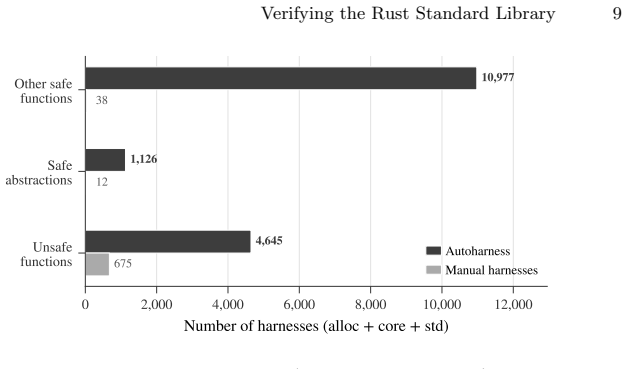
We present what is, to the best of our knowledge, the largest verification campaign reported for a software library: an open, crowdsourced effort that integrates complementary verification tools into the continuous integration of a verification repository forked from the Rust standard library. We analyze the campaign's effectiveness, discuss the practical value of machine-checked proofs for a subset of undefined behaviors (e.g., out-of-bounds access, null and dangling pointer dereferences, and use of uninitialized memory), and frame the remaining obstacles as open challenges for the formal-methods community.
What carries the argument
Integration of complementary verification tools into the continuous integration pipeline of a forked Rust standard library repository, with open crowdsourced proof contributions.
If this is right
- Machine-checked proofs can give stronger guarantees than testing alone for the targeted undefined behaviors inside the standard library.
- Complementary verification tools can be combined effectively inside a single continuous-integration workflow for a large code base.
- An open repository model allows ongoing maintenance of proofs as the library evolves.
- The campaign surfaces concrete open challenges for tool builders rather than claiming full coverage.
Where Pith is reading between the lines
- Similar crowdsourced verification repositories could be created for other widely used libraries that contain unsafe or low-level code.
- Success at this scale would strengthen the case for treating machine-checked absence of specific undefined behaviors as a practical quality metric for language implementations.
- The open nature of the effort creates a living artifact that future changes to Rust can be checked against without restarting from scratch.
Load-bearing premise
The verification tools are sound with respect to Rust's operational semantics and correctly capture the targeted classes of undefined behavior.
What would settle it
Discovery of an out-of-bounds access, null or dangling pointer dereference, or use of uninitialized memory inside a module for which the campaign claims a machine-checked proof, or demonstration that one of the integrated tools accepts such an error.
Figures

read the original abstract
Rust's type system prevents many classes of memory errors, yet its standard library relies heavily on unsafe code whose correctness is validated through testing, including dynamic checks under Miri, but lacks static verification. We present what is, to the best of our knowledge, the largest verification campaign reported for a software library: an open, crowdsourced effort that integrates complementary verification tools into the continuous integration of a verification repository forked from the Rust standard library. We analyze the campaign's effectiveness, discuss the practical value of machine-checked proofs for a subset of undefined behaviors (e.g., out-of-bounds access, null and dangling pointer dereferences, and use of uninitialized memory), and frame the remaining obstacles as open challenges for the formal-methods community.
Editorial analysis
A structured set of objections, weighed in public.
Referee Report
Summary. The manuscript presents a crowdsourced verification campaign for the Rust standard library: a forked repository integrates complementary verification tools into continuous integration, claimed as the largest such effort reported for a software library. It analyzes the campaign's effectiveness, discusses the practical value of machine-checked proofs for a subset of undefined behaviors (out-of-bounds access, null/dangling pointer dereferences, use of uninitialized memory), and frames remaining obstacles as open challenges.
Significance. If the soundness assumptions hold and quantitative results substantiate the claims, the work would represent a notable engineering achievement in scaling formal verification to a large, widely-used library containing unsafe code, providing concrete evidence of the feasibility of tool integration for real-world Rust verification.
major comments (2)
- [Abstract] Abstract: the claim of analyzing the campaign's effectiveness is not supported by any quantitative results, coverage metrics, or tool-specific soundness arguments in the text; this prevents evaluation of the central claim that the effort produces machine-checked proofs for the targeted UB classes.
- [Abstract / Setup] Setup description (implied in abstract and introduction): the soundness of the integrated verification tools w.r.t. Rust's operational semantics is assumed without argument, reference to a machine-checked semantics, or discussion of how CI integration preserves soundness across tool combinations; this is load-bearing for interpreting reported results as evidence that the targeted UB classes are absent.
Simulated Author's Rebuttal
We thank the referee for the careful review and constructive feedback. We address each major comment below, indicating planned revisions where appropriate.
read point-by-point responses
-
Referee: [Abstract] Abstract: the claim of analyzing the campaign's effectiveness is not supported by any quantitative results, coverage metrics, or tool-specific soundness arguments in the text; this prevents evaluation of the central claim that the effort produces machine-checked proofs for the targeted UB classes.
Authors: We agree that the abstract's reference to analyzing effectiveness would benefit from clearer pointers to supporting details. The manuscript body describes the campaign outcomes, including which verification tools succeeded on which library components and the specific obstacles encountered for the targeted UB classes. To strengthen the presentation, we will revise the abstract to explicitly reference the quantitative elements already present (such as the scale of the forked repository and the number of functions addressed by each tool) and add a new subsection summarizing coverage metrics drawn from the CI runs. revision: yes
-
Referee: [Abstract / Setup] Setup description (implied in abstract and introduction): the soundness of the integrated verification tools w.r.t. Rust's operational semantics is assumed without argument, reference to a machine-checked semantics, or discussion of how CI integration preserves soundness across tool combinations; this is load-bearing for interpreting reported results as evidence that the targeted UB classes are absent.
Authors: The manuscript relies on the established soundness claims of the individual tools as reported in their source publications rather than providing a new combined proof. No complete machine-checked operational semantics for Rust exists in the literature, which precludes referencing one. We will add an explicit subsection to the setup section that states the per-tool soundness assumptions, acknowledges the lack of a unified semantics, and explains that the CI configuration runs each tool independently on the same code base without composing their analyses, thereby preserving the individual soundness guarantees. revision: yes
Circularity Check
No significant circularity; empirical engineering report
full rationale
The paper reports on a crowdsourced verification campaign integrating tools into CI for a forked Rust stdlib. It makes no mathematical derivations, predictions, or first-principles claims that could reduce to inputs by construction. No self-definitional steps, fitted inputs renamed as predictions, or load-bearing self-citations appear. The central claim is the scale and practical value of the effort; soundness of tools is an external assumption, not a derived result within the paper. This matches the default case of a self-contained empirical report.
Axiom & Free-Parameter Ledger
axioms (1)
- domain assumption The verification tools used are sound for the targeted undefined behaviors in Rust
Reference graph
Works this paper leans on
-
[1]
In: Pro- ceedings of the 38th International Conference on Software Engineering Companion
Anderson, B., Bergstrom, L., Goregaokar, M., Matthews, J., McAllister, K., Mof- fitt, J., Sapin, S.: Engineering the servo web browser engine using rust. In: Pro- ceedings of the 38th International Conference on Software Engineering Companion. p. 81–89. ICSE ’16, Association for Computing Machinery, New York, NY, USA (2016).https://doi.org/10.1145/2889160.2889229
-
[2]
Astrauskas, V., B´ ıl´ y, A., Fiala, J., Grannan, Z., Matheja, C., M¨ uller, P., Poli, F., Summers, A.J.: The prusti project: Formal verification for rust. In: NASA Formal Methods: 14th International Symposium, NFM 2022, Pasadena, CA, USA, May 24–27, 2022, Proceedings. p. 88–108. Springer-Verlag, Berlin, Heidelberg (2022). https://doi.org/10.1007/978-3-03...
-
[3]
Astrauskas, V., Matheja, C., Poli, F., M¨ uller, P., Summers, A.J.: How do pro- grammers use unsafe rust? Proc. ACM Program. Lang.4(OOPSLA) (Nov 2020). https://doi.org/10.1145/3428204
-
[4]
Ayoun, S.E., Denis, X., Maksimovi´ c, P., Gardner, P.: A hybrid approach to semi- automated rust verification. Proc. ACM Program. Lang.9(PLDI) (Jun 2025). https://doi.org/10.1145/3729289
-
[5]
ACM Transactions on Programming Lan- guages and Systems (2025),https://project-everest.github.io/assets/ everest-perspectives-2025.pdf, to appear
Bhargavan, K., Bond, B., Delignat-Lavaud, A., Fournet, C., Hawblitzel, C., Hrit ¸cu, C., Ishtiaq, S., Kohlweiss, M., Leino, R., Lorch, J., Maillard, K., Parno, B., Protzenko, J., Ramananandro, T., Rastogi, A., Swamy, N., Zanella-B´ eguelin, S.: Project Everest: Perspectives from developing industrial- grade high-assurance software. ACM Transactions on Pro...
2025
-
[6]
In: Verified Software
Bhargavan, K., Buyse, M., Franceschino, L., Hansen, L.L., Kiefer, F., Schneider- Bensch, J., Spitters, B.: hax: Verifying security-critical Rust software using multiple provers. In: Verified Software. Theories, Tools and Experiments (VSTTE). pp. 96–
-
[7]
Springer (2025).https://doi.org/10.1007/978-3-031-86695-1_7
-
[8]
In: Proceedings of the 2025 ACM SIGSAC Conference on Computer and Com- munications Security
Bhargavan, K., Hansen, L.L., Kiefer, F., Schneider-Bensch, J., Spitters, B.: Formal security and functional verification of cryptographic protocol implementations in rust. In: Proceedings of the 2025 ACM SIGSAC Conference on Computer and Com- munications Security. p. 2729–2743. CCS ’25, Association for Computing Machin- ery, New York, NY, USA (2025).https...
-
[9]
Blanc, A.L., Lam, P.: Lessons learned so far from a community effort to verify the Rust standard library (work-in-progress).https://arxiv.org/abs/2510.01072 (2025) 20 Cook et al
arXiv 2025
-
[10]
In: Proceedings of the 14th USENIX Conference on Operating Systems Design and Implementation
Boos, K., Liyanage, N., Ijaz, R., Zhong, L.: Theseus: an experiment in operating system structure and state management. In: Proceedings of the 14th USENIX Conference on Operating Systems Design and Implementation. OSDI’20, USENIX Association, USA (2020)
2020
-
[11]
InProceedings of the 25th ACM Symposium on Operating Systems Principles (SOSP)
Chen, H., Ziegler, D., Chajed, T., Chlipala, A., Kaashoek, M.F., Zeldovich, N.: Using crash hoare logic for certifying the FSCQ file system. In: Proceedings of SOSP. pp. 18–37 (2015).https://doi.org/10.1145/2815400.2815402
-
[12]
Chong, N., Cook, B., Eidelman, J., Kallas, K., Khazem, K., Monteiro, F.R., Schwartz-Narbonne, D., Tasiran, S., Tautschnig, M., Tuttle, M.R.: Code-level model checking in the software development workflow at amazon web services. Soft- ware: Practice and Experience51(4), 772–797 (2021).https://doi.org/https: //doi.org/10.1002/spe.2949
-
[13]
Chong, N., Cook, B., Kallas, K., Khazem, K., Monteiro, F.R., Schwartz-Narbonne, D., Tasiran, S., Tautschnig, M., Tuttle, M.R.: Code-level model checking in the software development workflow. In: Proceedings of the ACM/IEEE 42nd Inter- national Conference on Software Engineering: Software Engineering in Practice. p. 11–20. ICSE-SEIP ’20, Association for Co...
-
[14]
In: Chockler, H., Weissenbacher, G
Chudnov, A., Collins, N., Cook, B., Dodds, J., Huffman, B., MacC´ arthaigh, C., Magill, S., Mertens, E., Mullen, E., Tasiran, S., Tomb, A., Westbrook, E.: Con- tinuous formal verification of amazon s2n. In: Chockler, H., Weissenbacher, G. (eds.) Computer Aided Verification. pp. 430–446. Springer International Publish- ing, Cham (2018)
2018
-
[15]
Cook, B., Khazem, K., Kroening, D., Tasiran, S., Tautschnig, M., Tuttle, M.R.: Model checking boot code from aws data centers. Form. Methods Syst. Des.57(1), 34–52 (Jul 2021).https://doi.org/10.1007/s10703-020-00344-2
-
[16]
In: Proceedings of ICSE (2024).https://doi.org/10.1145/3597503.3639136
Cui, M., Sun, S., Xu, H., Zhou, Y.: Is unsafe an achilles’ heel? A comprehensive study of safety requirements in unsafe Rust programming. In: Proceedings of ICSE (2024).https://doi.org/10.1145/3597503.3639136
-
[17]
Dang, H.H., Jourdan, J.H., Kaiser, J.O., Dreyer, D.: RustBelt meets relaxed mem- ory. Proc. ACM Program. Lang.4(POPL) (2019).https://doi.org/10.1145/ 3371102
2019
-
[18]
In: Formal Methods and Software Engineering (ICFEM)
Denis, X., Jourdan, J.H., March´ e, C.: Creusot: A foundry for the deductive verification of Rust programs. In: Formal Methods and Software Engineering (ICFEM). LNCS, vol. 13478, pp. 90–105 (2022).https://doi.org/10.1007/ 978-3-031-17244-1_6
2022
-
[19]
In: Proceedings of the 33rd ACM/IEEE International Conference on Automated Software Engineering
Gadelha, M.R., Monteiro, F.R., Morse, J., Cordeiro, L.C., Fischer, B., Nicole, D.A.: Esbmc 5.0: an industrial-strength c model checker. In: Proceedings of the 33rd ACM/IEEE International Conference on Automated Software Engineering. p. 888–891. ASE ’18, Association for Computing Machinery, New York, NY, USA (2018).https://doi.org/10.1145/3238147.3240481
-
[20]
G¨ aher, L., Sammler, M., Jung, R., Krebbers, R., Dreyer, D.: RefinedRust: A type system for high-assurance verification of Rust programs. Proc. ACM Program. Lang.8(PLDI) (2024).https://doi.org/10.1145/3656422
-
[21]
Greenaway, D., Lim, J., Andronick, J., Klein, G.: Don’t sweat the small stuff: For- mal verification of C code without the pain. In: Proceedings of the 35th ACM SIG- PLAN Conference on Programming Language Design and Implementation (PLDI). pp. 429–439 (2014).https://doi.org/10.1145/2594291.2594296
-
[22]
In: Proceedings of OSDI
Gu, R., Shao, Z., Chen, H., Wu, X., Kim, J., Sj¨ oberg, V., Costanzo, D.: Cer- tiKOS: An extensible architecture for building certified concurrent OS kernels. In: Proceedings of OSDI. pp. 653–669 (2016) Verifying the Rust Standard Library 21
2016
-
[23]
In: Proceedings of the 11th USENIX Conference on Operating Systems Design and Implementation (OSDI)
Hawblitzel, C., Howell, J., Lorch, J.R., Narayan, A., Parno, B., Zhang, D., Zill, B.: Ironclad apps: End-to-end security via automated full-system verification. In: Proceedings of the 11th USENIX Conference on Operating Systems Design and Implementation (OSDI). pp. 165–181. USENIX Association (2014)
2014
-
[24]
Huang, L., Ebersold, S., Kogtenkov, A., Meyer, B., Liu, Y.: Lessons from formally verified deployed software systems. ACM Comput. Surv.58(8) (Feb 2026).https: //doi.org/10.1145/3785652
-
[25]
Jour- nal of Object Technology25(3) (2025).https://doi.org/10.5381/jot.2025.25
Jacobs, B., Fasse, J.: An approach for modularly verifying the core of Rust’s atomic reference counting algorithm against the (Y)C20 memory consistency model. Jour- nal of Object Technology25(3) (2025).https://doi.org/10.5381/jot.2025.25. 3.a5
-
[26]
In: Proceed- ings of the Third International Conference on NASA Formal Methods
Jacobs, B., Smans, J., Philippaerts, P., Vogels, F., Penninckx, W., Piessens, F.: Verifast: a powerful, sound, predictable, fast verifier for c and java. In: Proceed- ings of the Third International Conference on NASA Formal Methods. p. 41–55. NFM’11, Springer-Verlag, Berlin, Heidelberg (2011)
2011
-
[27]
Jung, R., Dang, H.H., Kang, J., Dreyer, D.: Stacked borrows: an aliasing model for rust. Proc. ACM Program. Lang.4(POPL) (Dec 2019).https://doi.org/10. 1145/3371109
2019
-
[28]
Jung, R., Jourdan, J.H., Krebbers, R., Dreyer, D.: Rustbelt: securing the foun- dations of the rust programming language. Proc. ACM Program. Lang.2(POPL) (Dec 2017).https://doi.org/10.1145/3158154
-
[29]
Jung, R., Jourdan, J.H., Krebbers, R., Dreyer, D.: Safe systems programming in rust. Commun. ACM64(4), 144–152 (Mar 2021).https://doi.org/10.1145/ 3418295
2021
-
[30]
Jung, R., Kimock, B., Poveda, C., S´ anchez Mu˜ noz, E., Scherer, O., Wang, Q.: Miri: Practical undefined behavior detection for Rust. Proc. ACM Program. Lang. 10(POPL) (2026).https://doi.org/10.1145/3776690
-
[31]
Klein, G., Elphinstone, K., Heiser, G., Andronick, J., Cock, D., Derrin, P., Elka- duwe, D., Engelhardt, K., Kolanski, R., Norrish, M., Sewell, T., Tuch, H., Win- wood, S.: seL4: Formal verification of an OS kernel. In: Proceedings of SOSP. pp. 207–220 (2009).https://doi.org/10.1145/1629575.1629596
-
[32]
Lattuada, A., Hance, T., Cho, C., Brun, M., Subasinghe, I., Zhou, Y., Howell, J., Parno, B., Hawblitzel, C.: Verus: Verifying Rust programs using linear ghost types. Proc. ACM Program. Lang.7(OOPSLA2) (2023).https://doi.org/10. 1145/3586037
2023
-
[33]
Lehmann, N., Geller, A.T., Vazou, N., Jhala, R.: Flux: Liquid types for rust. Proc. ACM Program. Lang.7(PLDI) (Jun 2023).https://doi.org/10.1145/3591283
-
[34]
doi:10.1145/1538788.1538814 Xupeng Li, Xuheng Li, Wei Qiang, Ronghui Gu, and Jason Nieh
Leroy, X.: Formal verification of a realistic compiler. Communications of the ACM 52(7), 107–115 (2009).https://doi.org/10.1145/1538788.1538814
-
[35]
In: Proceedings of the 26th Symposium on Operating Systems Principles
Levy, A., Campbell, B., Ghena, B., Giffin, D.B., Pannuto, P., Dutta, P., Levis, P.: Multiprogramming a 64kb computer safely and efficiently. In: Proceedings of the 26th Symposium on Operating Systems Principles. p. 234–251. SOSP ’17, Association for Computing Machinery, New York, NY, USA (2017).https://doi. org/10.1145/3132747.3132786
-
[36]
rust-lang.org/reference/behavior-considered-undefined.html(2024)
Rust Team: The rust reference: Behavior considered undefined.https://doc. rust-lang.org/reference/behavior-considered-undefined.html(2024)
2024
-
[37]
VanHattum, A., Schwartz-Narbonne, D., Chong, N., Sampson, A.: Verifying dy- namic trait objects in Rust. In: Proceedings of the 44th International Conference on Software Engineering: Software Engineering in Practice. pp. 321–330. ICSE- SEIP ’22, Association for Computing Machinery (2022).https://doi.org/10. 1145/3510457.3513031 22 Cook et al
arXiv 2022
-
[38]
Villani, N., Hostert, J., Dreyer, D., Jung, R.: Tree borrows. Proc. ACM Program. Lang.9(PLDI) (2025).https://doi.org/10.1145/3735592
-
[39]
In: 2018 International Symposium on Theoretical Aspects of Software Engineering (TASE)
Wang, F., Song, F., Zhang, M., Zhu, X., Zhang, J.: KRust: A Formal Executable Semantics of Rust . In: 2018 International Symposium on Theoretical Aspects of Software Engineering (TASE). pp. 44–51. IEEE Computer Society, Los Alamitos, CA, USA (Aug 2018).https://doi.org/10.1109/TASE.2018.00014
discussion (0)
Sign in with ORCID, Apple, or X to comment. Anyone can read and Pith papers without signing in.