A symmetric mechanism for symmetry-breaking in oscillator networks with strong nonlinear coupling
Pith reviewed 2026-06-26 22:45 UTC · model grok-4.3
The pith
Symmetry-breaking in oscillator networks with strong nonlinear coupling originates from canard dynamics of a symmetric folded node.
A machine-rendered reading of the paper's core claim, the machinery that carries it, and where it could break.
Core claim
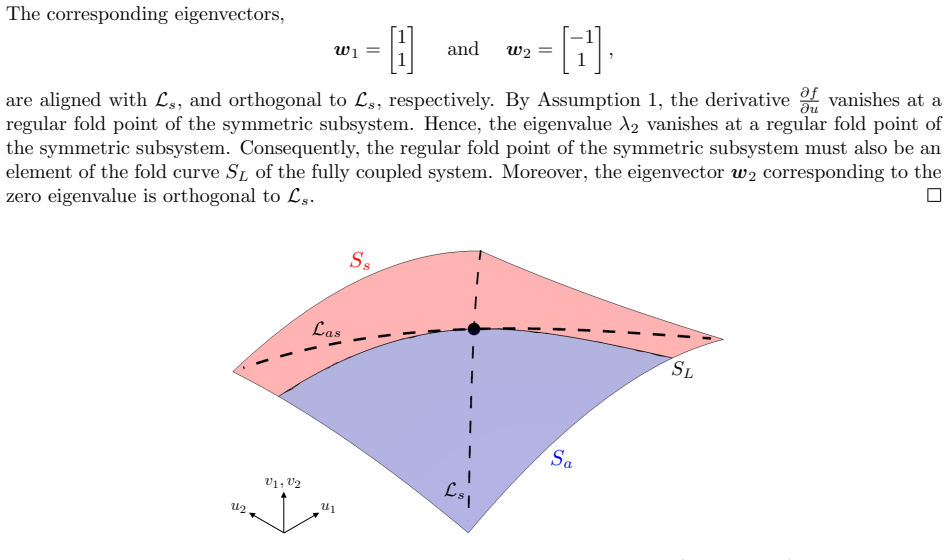
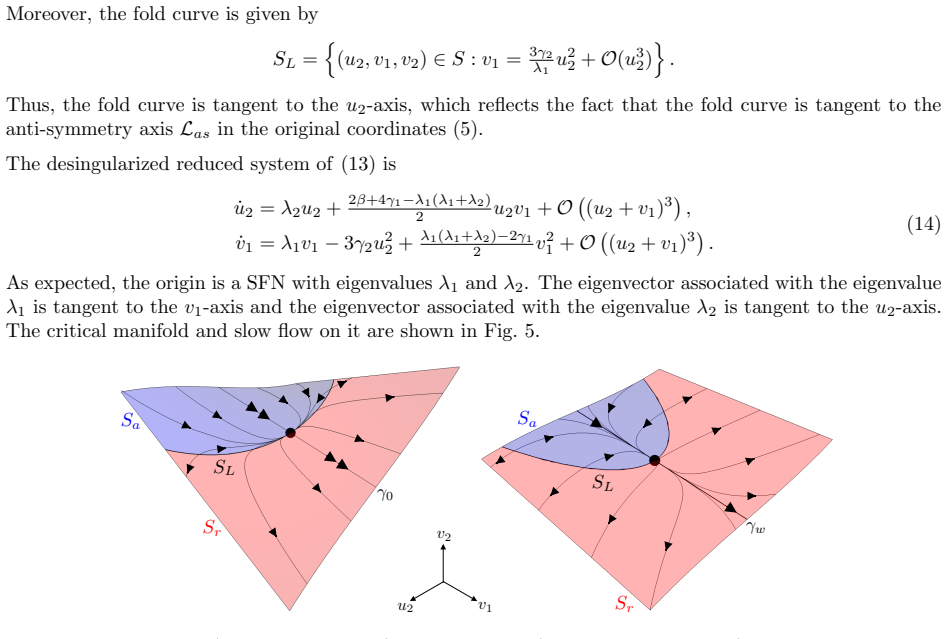
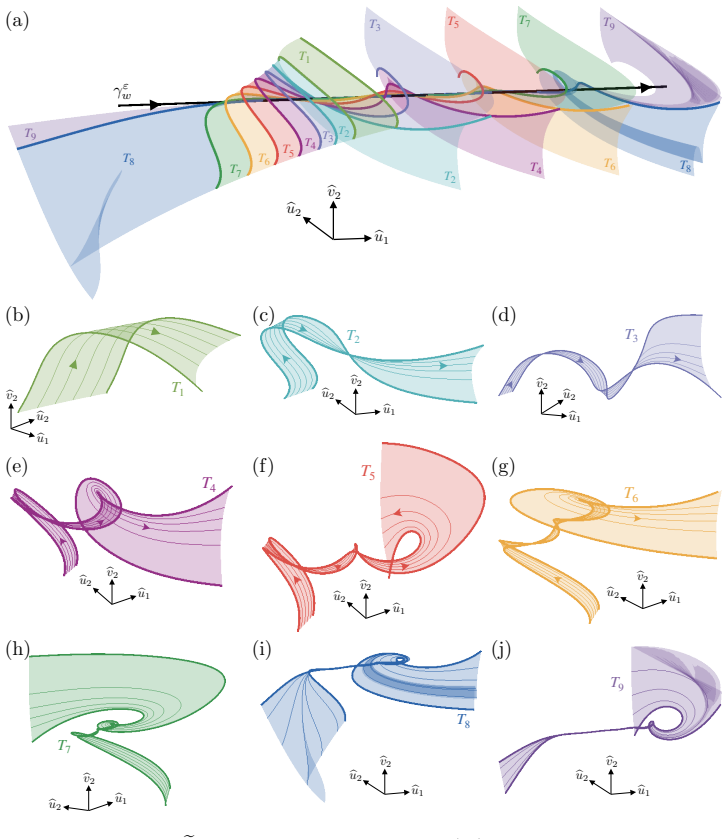
The symmetry-breaking originates from the canard dynamics of a folded node that lies on the axis of symmetry. Applying geometric singular perturbation theory and blow-up to the normal form reveals that the fold curve is orthogonal to the axis at the symmetric folded node, there is only one primary maximal canard on the axis which is the axis of rotation for twisting solutions, and the number of rotations is the key local diagnostic feature that breaks the symmetry. This mechanism generates small-amplitude oscillations in mixed-mode dynamics of the cell cycle model.
What carries the argument
The symmetric folded node and its associated maximal canard, which induces twisting of solutions whose number of rotations breaks symmetry.
Load-bearing premise
The blow-up technique applied to the normal form of the strongly nonlinearly coupled system correctly captures the local twisting behavior near the symmetric folded node.
What would settle it
A simulation or experiment where the symmetric folded node is removed or perturbed such that the fold curve is no longer orthogonal to the axis, resulting in no symmetry-breaking despite the symmetric setup.
Figures







read the original abstract
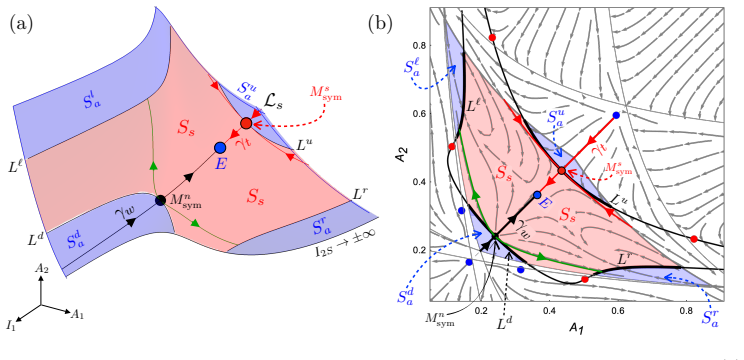
In this article, we describe and analyse a novel mechanism for symmetry-breaking in minimal symmetrically coupled identical slow/fast oscillator networks with strong nonlinear mutually inhibitory coupling. We show that the symmetry-breaking, surprisingly, originates from the canard dynamics of a folded node that lies on the axis of symmetry. By applying geometric singular perturbation theory and the blow-up technique to a normal form, we determine the geometric mechanisms by which the {\em symmetric folded node} induces symmetry-breaking. More specifically, we show that (i) the fold curve of the coupled system is orthogonal to the axis of symmetry at the symmetric folded node; (ii) there is only one primary maximal canard (either strong or weak, depending on parameters), which always lies on the axis of symmetry and is the axis of rotation for the twisting of solutions; and (iii) the number of rotations is the key local diagnostic feature that breaks the symmetry. Our work is closely related to that of Kristiansen and Pedersen [SIAM J. Appl. Dyn. Syst., {\bf 22} (2023)] on symmetrically coupled FitzHugh-Nagumo oscillators with strong linear inhibitory gap junctional coupling, however, we consider nonlinear coupling and we identify and study multiple sub-types of their `cusped singularities'. We demonstrate our theoretical results by applying them to a model of the eukaryotic cell cycle in which the symmetric folded node plays a key role in rhythmogenesis. More specifically, we study periodic and quasi-periodic symmetry-breaking mixed-mode oscillatory attractors of the cell cycle model. We show that the local twisting induced by the symmetric folded node is the local mechanism that both breaks the symmetry and generates the small-amplitude oscillations in the mixed-mode dynamics.
Editorial analysis
A structured set of objections, weighed in public.
Referee Report
Summary. The manuscript describes a novel mechanism for symmetry-breaking in minimal symmetrically coupled identical slow/fast oscillator networks with strong nonlinear mutually inhibitory coupling. The symmetry-breaking originates from the canard dynamics of a folded node on the axis of symmetry. Using geometric singular perturbation theory and the blow-up technique applied to a normal form, the authors show that the fold curve is orthogonal to the symmetry axis at the symmetric folded node, that there is only one primary maximal canard (strong or weak) lying on the axis of symmetry and serving as the rotation axis for twisting solutions, and that the number of rotations is the key local diagnostic that breaks symmetry. The work extends Kristiansen and Pedersen (2023) from linear to nonlinear coupling by identifying multiple sub-types of cusped singularities. The results are demonstrated on a eukaryotic cell cycle model, where the symmetric folded node generates periodic and quasi-periodic symmetry-breaking mixed-mode oscillatory attractors.
Significance. If the central geometric claims hold, the paper provides a surprising and technically detailed explanation of how symmetry-breaking can emerge locally from canard dynamics even in fully symmetric systems. The application of blow-up to analyze twisting around the symmetric folded node, together with the concrete demonstration in the cell cycle model, strengthens the contribution. The explicit identification of sub-types of cusped singularities and the link between rotation count and symmetry-breaking are potentially useful for other oscillator networks.
major comments (1)
- [Normal-form derivation and blow-up analysis (geometric analysis section)] The central claim that the blow-up of the normal form correctly captures the local twisting behavior near the symmetric folded node (and that the symmetry axis remains invariant under the leading-order blown-up dynamics) is load-bearing for all three numbered results (i)–(iii) in the abstract. The manuscript should exhibit the explicit blown-up vector field after the normal-form reduction for the nonlinear coupling and confirm that no retained non-generic terms alter the canard manifold or the rotation count.
minor comments (2)
- [Introduction and related-work discussion] Clarify the precise definition and classification criteria for the multiple sub-types of cusped singularities introduced in the nonlinear-coupling case, and indicate how they reduce to the linear-coupling case of Kristiansen and Pedersen (2023).
- [Cell-cycle model section] In the cell-cycle application, state explicitly which parameter values place the system near the symmetric folded node and which diagnostic (rotation count) is used to distinguish the periodic versus quasi-periodic mixed-mode attractors.
Simulated Author's Rebuttal
We thank the referee for their careful reading of the manuscript and for highlighting the importance of the blow-up analysis in supporting the central claims. We address the single major comment below.
read point-by-point responses
-
Referee: [Normal-form derivation and blow-up analysis (geometric analysis section)] The central claim that the blow-up of the normal form correctly captures the local twisting behavior near the symmetric folded node (and that the symmetry axis remains invariant under the leading-order blown-up dynamics) is load-bearing for all three numbered results (i)–(iii) in the abstract. The manuscript should exhibit the explicit blown-up vector field after the normal-form reduction for the nonlinear coupling and confirm that no retained non-generic terms alter the canard manifold or the rotation count.
Authors: We agree that an explicit display of the blown-up vector field strengthens the verification of the geometric claims. In the revised manuscript we will insert the full leading-order blown-up vector field obtained after the normal-form reduction for the nonlinear coupling. We will also add a short paragraph confirming that the retained non-generic terms at this order preserve the invariance of the symmetry axis, leave the primary maximal canard on the axis, and do not change the rotation count beyond the classification into sub-types of cusped singularities already given in the paper. revision: yes
Circularity Check
No circularity: derivation applies standard GSPT and blow-up to normal form without reduction to inputs or self-citation loops
full rationale
The paper's central claims—that symmetry-breaking originates from canard dynamics of a symmetric folded node—are obtained by applying geometric singular perturbation theory and the blow-up technique to a normal form of the coupled oscillator system. This is a standard, independent analytic procedure whose outputs (fold curve orthogonality, unique primary maximal canard on the symmetry axis, rotation count as diagnostic) are not equivalent to the inputs by construction. The only citation is to external prior work by Kristiansen and Pedersen (different authors) on linear coupling; the present paper extends it to nonlinear coupling and sub-types of cusped singularities without invoking self-citations as load-bearing premises. No fitted parameters are renamed as predictions, no ansatz is smuggled via self-citation, and the derivation chain remains self-contained against external benchmarks.
Axiom & Free-Parameter Ledger
axioms (1)
- domain assumption Geometric singular perturbation theory and the blow-up technique apply to the normal form of the coupled slow/fast system near the symmetric folded node
Reference graph
Works this paper leans on
-
[1]
Abrams and S.H
D.M. Abrams and S.H. Strogatz, Chimera states for coupled oscillators,Phys. Rev. Lett.(2004)93, 174102
2004
-
[2]
Awal and D
N.M. Awal and D. Bullara and I.R. Epstein, The smallest chimera: Periodicity and chaos in a pair of coupled chemical oscillators,Chaos(2019)29, 013131
2019
-
[3]
Awal and I.R
N.M. Awal and I.R. Epstein and T.J. Kaper and T. Vo, Symmetry-breaking rhythms in coupled, identical fast-slow oscillators,Chaos(2023)33, 011102
2023
-
[4]
Awal and I.R
N.M. Awal and I.R. Epstein and T.J. Kaper and T. Vo, Strong Symmetry Breaking in Coupled, Identical Lengyel-Epstein Oscillators via Folded Singularities,J. Nonlinear Sci.(2024)34, 53
2024
-
[5]
J. Best, A. Borisyuk, J. Rubin, D. Terman and M. Wechselberger, The dynamic range of bursting in a model respiratory pacemaker network,SIAM J. Appl. Dyn. Syst.(2005)4, 1107–1139
2005
-
[6]
Broer, T.J
H.W. Broer, T.J. Kaper and M. Krupa, Geometric Desingularization of a Cusp Singularity in Slow-Fast Systems with Applications to Zeeman’s Examples,J. Dyn. Diff. Eq.(2013)25, 925–958
2013
-
[7]
Brøns, M
M. Brøns, M. Krupa and M. Wechselberger, Mixed Mode Oscillations Due to the Generalized Canard Phe- nomenon,Fields Institute Communications(2006)49, 39–63
2006
-
[8]
Collins and I.N
J.J. Collins and I.N. Stewart, Coupled Nonlinear Oscillators and the Symmetries of Animal Gaits,J. Nonlinear Sci.(1993)3, 349–392
1993
-
[9]
Cooper, The Cell: A Molecular Approach, Sinauer Associates (2000)
G.M. Cooper, The Cell: A Molecular Approach, Sinauer Associates (2000). 42
2000
-
[10]
Cross, V
F.R. Cross, V. Archambault, M. Miller, and M. Klovstad, Testing a mathematical model of the yeast cycle,Mol. Biol. Cell(2002)13, 52–70
2002
-
[11]
Desroches, B
M. Desroches, B. Krauskopf, and H.M. Osinga, The geometry of slow manifolds near a folded node,SIAM J. Appl. Dyn. Syst.(2008)7, 1131–1162
2008
-
[12]
Dragoi, J.J
C.-M. Dragoi, J.J. Tyson, and B. Nov´ ak, Newton’s cradle: Cell cycle regulation by two mutually inhibitory oscillators,Mathematical Biosciences(2024)377, 109291
2024
-
[13]
Dumortier and R.H
F. Dumortier and R.H. Roussarie, Canard cycles and center manifolds,Mem. Amer. Math. Soc.(1996)121, 577
1996
-
[14]
Edgar and T.L
B.A. Edgar and T.L. Orr-Weaver, Endoreplication cell cycles: more for less,Cell(2001)105, 297–306
2001
-
[15]
Epstein and N.M
I.R. Epstein and N.M. Awal and T.J. Kaper and T. Vo, Strong symmetry breaking rhythms created by folded nodes in a pair of symmetrically coupled, identical Koper oscillators,Chaos(2024)34, 053142
2024
-
[16]
Fenichel, Geometric singular perturbation theory for ordinary differential equations,J
N. Fenichel, Geometric singular perturbation theory for ordinary differential equations,J. Differ. Eq.(1979)31, 53–98
1979
-
[17]
Gandhi and Y
P. Gandhi and Y. Wang, A conceptual framework for modeling a latching mechanism for cell cycle regulation, Mathematical biosciences(2025)382, 109396
2025
-
[18]
Gross, The role of symmetry in fundamental physics,Proc
D.J. Gross, The role of symmetry in fundamental physics,Proc. Natl. Acad. Sci.(1996)93, pp. 14256–14259
1996
-
[19]
Hasan and B
C.R. Hasan and B. Krauskopf and H.M. Osinga, Mixed-Mode Oscillations and Twin Canard Orbits in an Autocatalytic Chemical Reaction,SIAM J. Appl. Dyn. Syst.(2017)16, pp. 2165–2195
2017
-
[20]
Hasan and B
C.R. Hasan and B. Krauskopf and H.M. Osinga, Saddle Slow Manifolds and Canard Orbits inR4 and Application to the Full Hodgkin-Huxley Model,J. Math. Neurosci.(2018)8, 5
2018
-
[21]
Jones, Geometric singular perturbation theory, in: R
C.K.R.T. Jones, Geometric singular perturbation theory, in: R. Johnson (Ed.), Dynamical Systems, Montecatini Terme, in: Lecture Notes in Mathematics, vol. 1609, Springer, New York, 1994, pp. 44–118
1994
-
[22]
Kristiansen and M.G
K.U. Kristiansen and M.G. Pedersen, Mixed-Mode Oscillations in Coupled FitzHugh-Nagumo Oscillators: Blow- Up Analysis of Cusped Singularities,SIAM J. Appl. Dyn. Syst.(2023)22, 1383–1422
2023
-
[23]
Kuramoto and D
Y. Kuramoto and D. Battogtokh, Coexistence of coherence and incoherence in nonlocally coupled phase oscil- lators: A soluble case,J. Nonlinear Phenom. Complex Syst.(2002)5, 380–385
2002
-
[24]
Krupa and P
M. Krupa and P. Szmolyan, Extending geometric singular perturbation theory to nonhyperbolic points—fold and canard points in two dimensions,SIAM J. Math. Anal.(2001)33, 286–314
2001
-
[25]
M. Krupa and M. Wechselberger, Local analysis near a folded saddle-node singularity,J. Differ. Eq.(2010)248, 2841–2888; doi: http://dx.doi.org/10.1016/j.jde.2010.02.006
-
[26]
L´ opez-Aviles, O
S. L´ opez-Aviles, O. Kapuy, B. Nov´ ak, and F. Uhlmann Irreversibility of mitotic exit is the consequence of systems-level feedback,Nature(2009)459, 592–595
2009
-
[27]
Lu and F.R
Y. Lu and F.R. Cross, Periodic cyclin-Cdk activity entrains an autonomous Cdc14 release oscillator,Cell(2010) 141, 268–279
2010
-
[28]
Mainzer, Symmetry and complexity: Fundamental concepts of research in chemistry,HYLE–Int
K. Mainzer, Symmetry and complexity: Fundamental concepts of research in chemistry,HYLE–Int. J. Phil. Chem.(1997)3, 29–49
1997
-
[29]
Manzoni, F
R. Manzoni, F. Montani, C. Visinitin, F. Caudron, A. Ciliberto, and R. Visintin,J. Cell Biol.,190, 209–222
-
[30]
Mayora-Cebollero, J.A
A. Mayora-Cebollero, J.A. Jover-Galtier, F. Drubi, S. Ib´ a˜ nez,´A. Lozano, C. Mayora-Cebollero, and R. Barrio, Almost synchronization phenomena in the two and three coupled Brusselator systems,Physica D(2025)472, 134457
2025
-
[31]
Mitry and M
J. Mitry and M. Wechselberger, Folded Saddles and Faux Canards,SIAM J. Appl. Dyn. Syst.(2017)16, 546–596
2017
-
[32]
D. O. Morgan. The cell cycle: principles of control. New science press. (2007)
2007
-
[33]
Cusped singularities organize mixed-mode oscillations in mutually inhibitory slow-fast systems
M.G. Pedersen, Cusped singularities organize mixed-mode oscillations in mutually inhibitory slow-fast systems, arXiv:2605.03606[math.DS](2026), https://doi.org/10.48550/arXiv.2605.03606
work page internal anchor Pith review Pith/arXiv arXiv doi:10.48550/arxiv.2605.03606 2026
-
[34]
K.-L. Roberts, J.E. Rubin, and M. Wechselberger, Averaging, Folded Singularities, and Torus Canards: Explain- ing Transitions between Bursting and Spiking in a Coupled Neuron Model,SIAM J. Appl. Dyn. Syst.(2015) 14, 1808–1844; doi: http://dx.doi.org/10.1137/140981770
-
[35]
Roberts,Geometric Singular Perturbation Theory and Averaging: Analysing Torus Canards in Neural Models, PhD thesis
K.-L. Roberts,Geometric Singular Perturbation Theory and Averaging: Analysing Torus Canards in Neural Models, PhD thesis. Uni. Sydney, 2017. http://hdl.handle.net/2123/18085
2017
-
[36]
Szmolyan and M
P. Szmolyan and M. Wechselberger, Canards inR 3,J. Differ. Eq.(2001)177, 419–453
2001
-
[37]
Wechselberger, Existence and Bifurcation of Canards inR 3 in the Case of a Folded Node,SIAM J
M. Wechselberger, Existence and Bifurcation of Canards inR 3 in the Case of a Folded Node,SIAM J. Appl. Dyn. Syst.(2005)4, 101–139
2005
-
[38]
Wechselberger, Geometric Singular Perturbation Theory Beyond the Standard Form, (2005)4, 101–139
M. Wechselberger, Geometric Singular Perturbation Theory Beyond the Standard Form, (2005)4, 101–139
2005
-
[39]
T. Vo and M. Wechselberger, Canards of Folded Saddle-Node Type I,SIAM J. Math. Anal.(2015)47, 3235– 3283; doi: http://dx.doi.org/10.1137/140965818. 43
discussion (0)
Sign in with ORCID, Apple, or X to comment. Anyone can read and Pith papers without signing in.