Recognition: unknown
Cusped singularities organize mixed-mode oscillations in mutually inhibitory slow-fast systems
Pith reviewed 2026-05-07 12:47 UTC · model grok-4.3
The pith
Cusped singularities organize mixed-mode oscillations in mutually inhibitory slow-fast systems
A machine-rendered reading of the paper's core claim, the machinery that carries it, and where it could break.
Core claim
Cusped singularities, defined as folded singularities located at cusp points of critical manifolds, provide a universal organizing mechanism for mixed-mode oscillations in coupled slow-fast systems with mutual inhibition. The geometric setup of these systems generically satisfies the conditions required by geometric singular perturbation theory and blow-up methods, guaranteeing that such cusped singularities yield small-amplitude oscillations. Mixed-mode oscillations appear from these small-amplitude oscillations combined with an appropriate return mechanism. The geometric presence of a cusped singularity is strictly related to the occurrence of a nearby singular Hopf bifurcation. In the two
What carries the argument
The cusped singularity, a folded singularity located at a cusp point of the critical manifold, which generates small-amplitude oscillations through local canard dynamics in the singular limit before the system returns to large excursions.
Load-bearing premise
The mutual inhibition and slow-fast separation generically produce a critical manifold with cusp points where folded singularities form and satisfy the conditions for geometric singular perturbation theory.
What would settle it
In the Curtu rate model or coupled Morris-Lecar neurons, moving the full-system equilibrium near the predicted location of the cusped singularity produces no small-amplitude oscillations or fails to yield mixed-mode patterns linked to the singular Hopf bifurcation.
Figures

read the original abstract
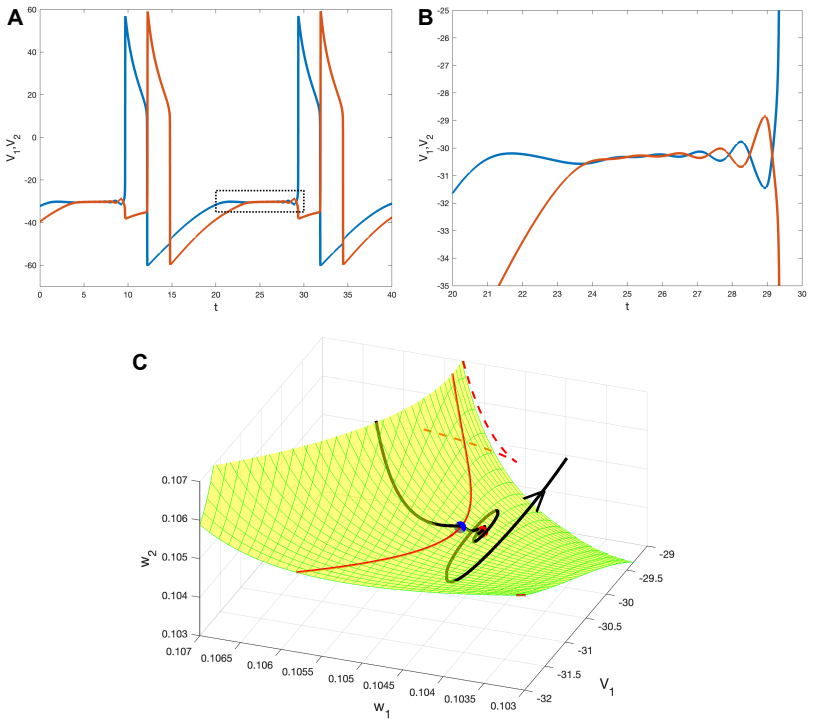
Mutual inhibition is a common motif in neural systems. Here, we establish that cusped singularities - folded singularities located at cusp points of critical manifolds - provide a universal organizing mechanism for mixed-mode oscillations (MMOs) in coupled slow-fast systems with mutual inhibition. We show that the geometric setup of these systems generically satisfies the conditions required by established geometric singular perturbation theory and blow-up methods, guaranteeing that such cusped singularities yield small-amplitude oscillations (SAOs). MMOs appear from the SAOs combined with an appropriate return mechanism. Further, we show that the geometric presence of a cusped singularity is strictly related to occurrence of a nearby singular Hopf bifurcation. We demonstrate the efficacy of this framework in two distinct neuronal models: the Curtu rate model of mutually inhibitory neural populations and coupled Morris-Lecar neurons with synaptic inhibition. In both cases, pushing the full system equilibrium near the cusped singularity triggers SAOs as the system passes near the cusp and approaches a full-system saddle-focus related to the singular Hopf bifurcation. Large-amplitude oscillations appear as the system spirals away from the saddle-focus, leading to MMOs, which may exhibit distinctive alternating patterns, in contrast to standard saddle-node induced MMOs. Our results establish cusped singularities as a generic, biologically relevant mechanism for complex oscillatory dynamics in inhibitory neural networks as well as for other inhibitory slow-fast systems.
Editorial analysis
A structured set of objections, weighed in public.
Referee Report
Summary. The paper claims that cusped singularities—folded singularities located at cusp points of critical manifolds—provide a universal organizing mechanism for mixed-mode oscillations (MMOs) in mutually inhibitory slow-fast systems. It uses geometric singular perturbation theory (GSPT) and blow-up methods to argue that the geometric setup of these systems generically satisfies the required conditions, producing small-amplitude oscillations (SAOs) that combine with a return mechanism to yield MMOs. The presence of a cusped singularity is linked to a nearby singular Hopf bifurcation. The framework is demonstrated in the Curtu rate model of mutually inhibitory populations and in coupled Morris-Lecar neurons with synaptic inhibition, where equilibria near the cusped singularity trigger SAOs followed by large-amplitude oscillations and distinctive MMO patterns.
Significance. If the central claims hold, the work is significant because it identifies a new, geometrically grounded mechanism for MMOs that is distinct from saddle-node-induced MMOs and directly tied to mutual inhibition, a common motif in neural systems. The reliance on established GSPT and blow-up techniques, combined with explicit demonstrations in two different neuronal models showing passage near the cusp triggering SAOs and spiraling away from the saddle-focus, provides concrete support. This could explain alternating MMO patterns observed in inhibitory networks and offers a biologically relevant organizing center with potential for broader application to other slow-fast inhibitory systems.
minor comments (4)
- The introduction would benefit from an early, self-contained definition or diagram distinguishing cusped singularities from standard folded singularities and from cusp points of the critical manifold alone.
- In the model demonstrations, explicit parameter values or bifurcation diagrams showing how the full-system equilibrium is pushed near the cusped singularity would improve reproducibility and clarity of the numerical evidence.
- The precise geometric relation between the cusped singularity and the singular Hopf bifurcation (e.g., via the slow flow or blow-up coordinates) is stated but could be expanded with a short schematic or reference to the relevant coordinate chart.
- Figure captions should specify the time scales, initial conditions, and which variables are plotted to make the MMO patterns and SAO passages easier to interpret without consulting the main text.
Simulated Author's Rebuttal
We thank the referee for their positive summary and significance assessment of our work on cusped singularities as an organizing mechanism for MMOs in mutually inhibitory slow-fast systems. The referee's description accurately reflects the manuscript's use of GSPT and blow-up methods, the link to singular Hopf bifurcations, and the demonstrations in the Curtu and Morris-Lecar models. We appreciate the recommendation for minor revision. No specific major comments were provided in the report.
Circularity Check
No significant circularity; derivation applies external GSPT and blow-up methods
full rationale
The paper's derivation chain begins from the geometric setup of mutually inhibitory slow-fast systems and invokes established geometric singular perturbation theory plus blow-up methods to show that cusped singularities (folded singularities at cusp points) generically produce SAOs, which combine with a return mechanism to yield MMOs. It further derives the relation to a nearby singular Hopf bifurcation directly from the same geometry and nondegeneracy conditions. Concrete demonstrations in the Curtu rate model and coupled Morris-Lecar neurons confirm passage near the cusp triggers the predicted SAOs followed by spiraling away from the saddle-focus. No step reduces by construction to a fitted parameter, self-defined quantity, or load-bearing self-citation; the cited theory is external, the nondegeneracy conditions are stated as generically satisfied rather than assumed from the target result, and the models serve as independent verification rather than circular input. The argument is therefore self-contained against external benchmarks.
Axiom & Free-Parameter Ledger
axioms (1)
- domain assumption The geometric setup of these systems generically satisfies the conditions required by established geometric singular perturbation theory and blow-up methods
Reference graph
Works this paper leans on
-
[1]
M. Desroches, J. Guckenheimer, B. Krauskopf, C. Kuehn, H. M. Osinga, M. Wechselberger, Mixed-mode oscillations with multiple time scales, SIAM Rev. 54 (2012) 211–288. DOI: 10.1137/100791233
-
[2]
Wechselberger, Existence and bifurcation of canards inR 3 in the case of a folded node, SIAM J
M. Wechselberger, Existence and bifurcation of canards inR 3 in the case of a folded node, SIAM J. Appl. Dyn. Syst. 4 (2005) 101–139. DOI: 10.1137/030601995
-
[3]
M. Krupa, M. Wechselberger, Local analysis near a folded saddle-node singularity, J. Differ. Equ. 248 (2010) 2841–2888. DOI: 10.1016/j.jde.2010.02.006
-
[4]
Guckenheimer, Singular Hopf bifurcation in systems with two slow variables, SIAM J
J. Guckenheimer, Singular Hopf bifurcation in systems with two slow variables, SIAM J. Appl. Dyn. Syst. 7 (2008) 1355–1377. DOI: 10.1137/080718528
-
[5]
S. Battaglin, M. G. Pedersen, Geometric analysis of mixed-mode oscillations in a model of electrical activity in human beta-cells, Nonlinear Dyn. 104 (2021) 4445–4457. DOI: 10.1007/s11071-021-06514-z
-
[6]
K.U. Kristiansen, M.G. Pedersen, Mixed-mode oscillations in coupled FitzHugh-Nagumo oscillators: Blow-up analysis of cusped singularities, SIAM J. Appl. Dyn. Syst. 22 (2023) 1383–1422. DOI: 10.1137/22M1480495
-
[7]
M. G. Pedersen, M. Brøns, M. P. Sørensen, Amplitude-modulated spiking as a novel route to bursting: Coupling-induced mixed-mode oscillations by symmetry breaking, Chaos 32 (2022) 013121. DOI: 10.1063/5.0072497
-
[8]
R. Curtu, Singular Hopf bifurcations and mixed-mode oscillations in a two-cell inhibitory neural network, Phys. D 239 (2010) 504–514. DOI: 10.1016/j.physd.2009.12.010
-
[9]
C. Morris, H. Lecar, Voltage oscillations in the barnacle giant muscle fiber, Biophys. J. 35 (1981) 193–213. DOI: 10.1016/S0006-3495(81)84782-0
-
[10]
Carr, Applications of Centre Manifold Theory, Appl
J. Carr, Applications of Centre Manifold Theory, Appl. Math. Sci. 35, Springer-Verlag, New York, 1981
1981
-
[11]
V.K. Vanag, I.R. Epstein, Periodic perturbation of one of two identical chemical oscillators coupled via inhibition, Phys. Rev. E 81(2010) 066213. DOI: 10.1103/PhysRevE.81.066213 13
discussion (0)
Sign in with ORCID, Apple, or X to comment. Anyone can read and Pith papers without signing in.