High-energy Particle Transport in Three-dimensional Anisotropic Turbulent Magnetic Fields
Pith reviewed 2026-06-26 21:55 UTC · model grok-4.3
The pith
In the absence of a guide magnetic field, high-energy particle scattering in anisotropic turbulence is not governed by the correlation length.
A machine-rendered reading of the paper's core claim, the machinery that carries it, and where it could break.
Core claim
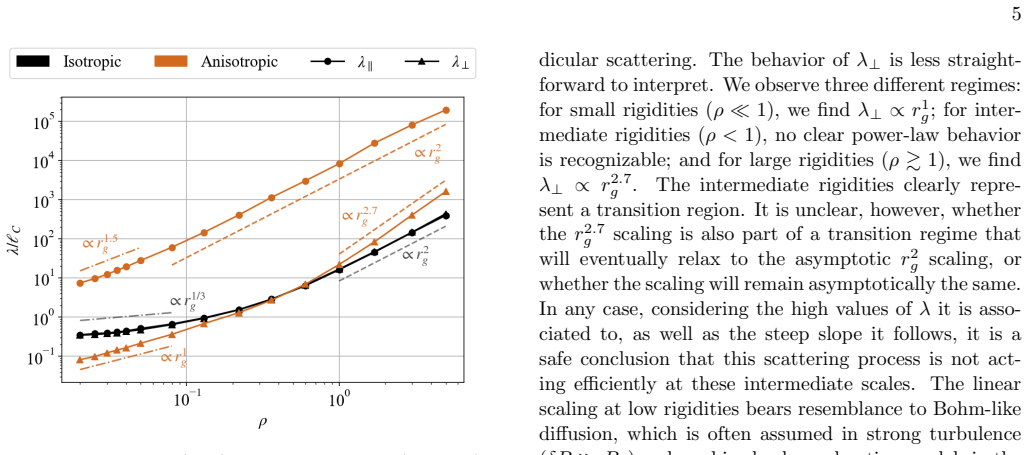
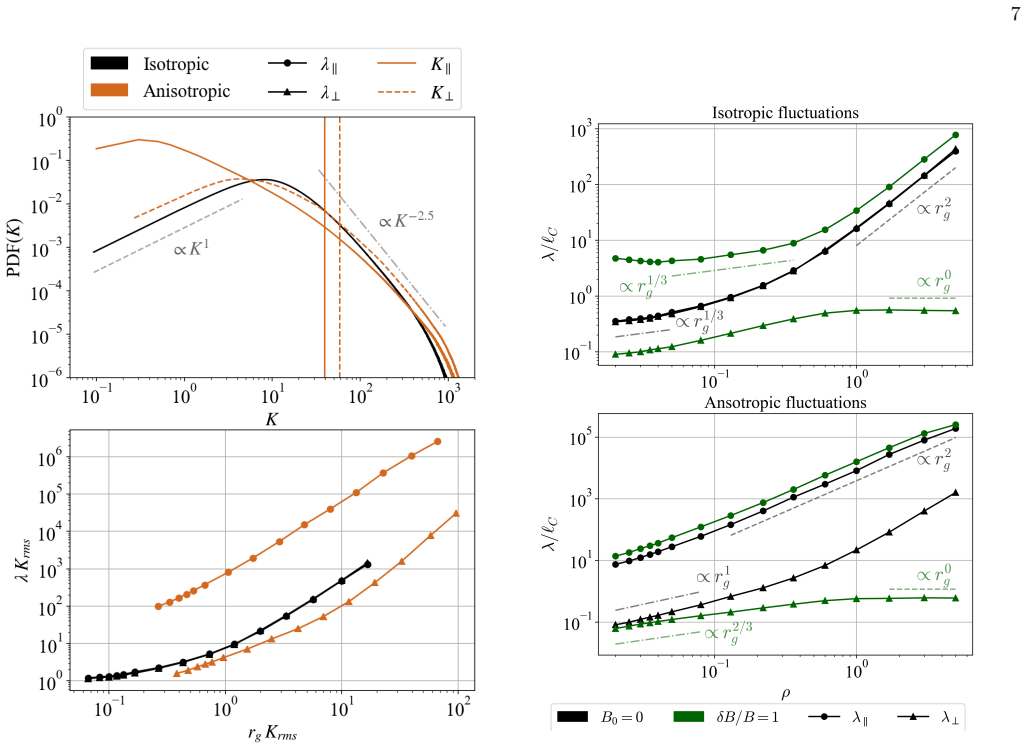
The paper establishes that, in the absence of a uniform background or guide magnetic field, the scattering process of high-energy particles in strongly turbulent anisotropic magnetic fields is not governed by the turbulence correlation length, indicating a scattering mechanism different from the pitch-angle diffusion used to describe scattering in strong-guide-field settings.
What carries the argument
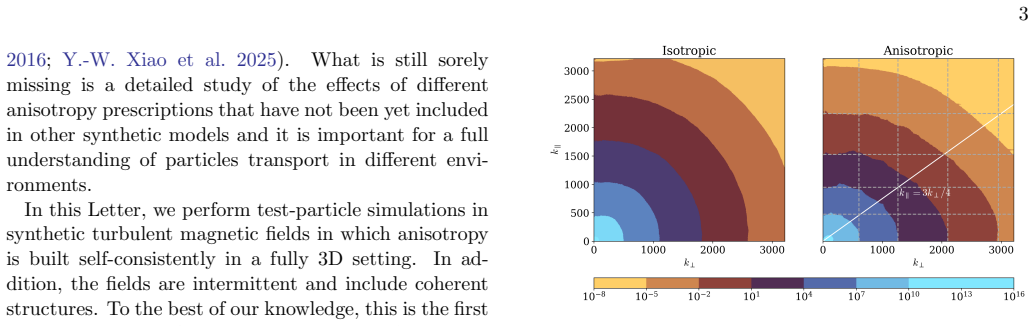
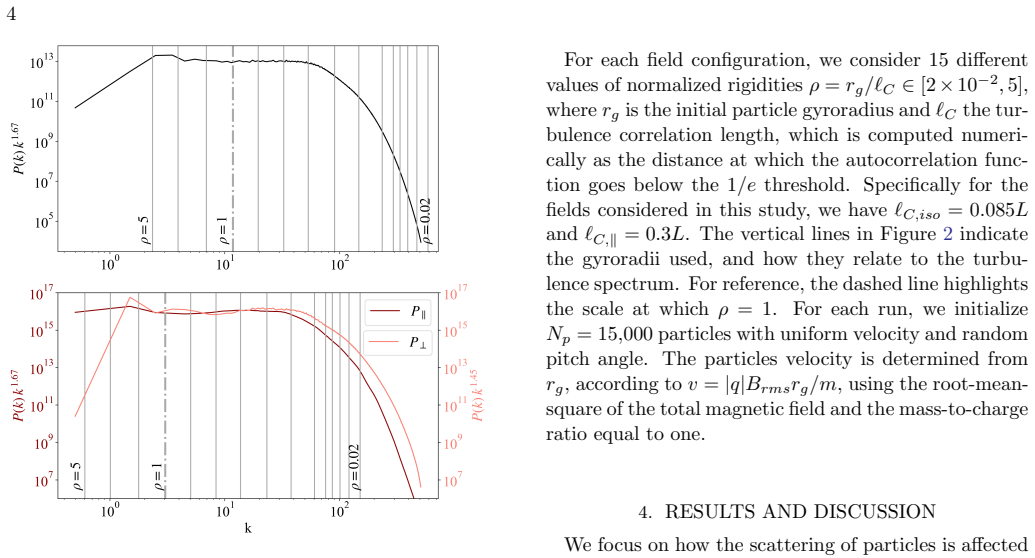
Synthetic turbulent magnetic field realizations used to compute particle trajectories and scattering statistics in three-dimensional anisotropic turbulence.
If this is right
- Scattering rates do not scale with the turbulence correlation length when no guide field is present.
- A mechanism other than pitch-angle diffusion must be invoked to describe particle scattering in such fields.
- Adding a guide field restores behavior closer to standard pitch-angle diffusion descriptions.
- Transport calculations for high-energy particles must distinguish between guide-field and guide-field-free regimes.
Where Pith is reading between the lines
- Cosmic-ray propagation models in astrophysical plasmas with weak or absent guide fields may require revised diffusion coefficients.
- The result points to a possible role for large-scale field-line wandering or other global structures in controlling scattering.
- Spacecraft observations in regions like the heliosheath could be re-analyzed to test for correlation-length independence.
- Varying the degree of anisotropy in follow-on simulations would map the transition between the two scattering regimes.
Load-bearing premise
The synthetic turbulent magnetic field realizations accurately represent the statistical properties of real anisotropic turbulence in the absence of a guide field.
What would settle it
A measurement or simulation in which scattering times scale directly with the turbulence correlation length in the complete absence of a guide field would contradict the central claim.
Figures
read the original abstract
The understanding and modeling of high-energy particles transport in turbulent magnetic fields is an important open question in space- and astrophysics. The multiscale, nonlinear nature of turbulence, and the high variability of turbulence properties across different environments, make it particularly challenging to reach a full understanding of the interactions between particles and turbulent fluctuations. Using synthetic, realistically looking turbulent magnetic field realizations generated by the BxC toolkit, we investigate how the scattering of particles is affected by anisotropic fluctuations in strongly turbulent fields. We find evidence that, in the absence of a uniform background or guide magnetic field, the scattering process is not governed by the turbulence correlation length. We then further verify this hypothesis by studying particle transport in the presence of a guide field. We find evidence of a different scattering mechanism than the usual pitch-angle diffusion used to describe scattering in strong-guide-field settings.
Editorial analysis
A structured set of objections, weighed in public.
Referee Report
Summary. The manuscript uses synthetic 3D anisotropic turbulent magnetic field realizations generated by the BxC toolkit to simulate high-energy particle transport. It reports evidence that, without a guide field, scattering is not controlled by the turbulence correlation length and proceeds via a mechanism distinct from standard pitch-angle diffusion, with the latter claim checked by repeating the runs in the presence of a guide field.
Significance. If the synthetic fields faithfully reproduce the relevant statistics of real guide-field-free turbulence, the result would require revision of quasi-linear and nonlinear transport theories used for cosmic-ray propagation in strong-turbulence astrophysical environments.
major comments (1)
- [Numerical setup / BxC toolkit description] The manuscript provides no validation, convergence tests, or direct comparison of the BxC-generated fields (power spectra, anisotropy ratios, absence of spurious mean-field effects) against MHD simulations or observations in the guide-field-free regime. Because the central claims rest entirely on particle trajectories computed in these realizations, this omission is load-bearing.
minor comments (1)
- [Abstract] The abstract states the main findings but does not specify the particle rigidity range, the number of independent turbulence realizations, or the integration time relative to the correlation time; these details should be added for clarity.
Simulated Author's Rebuttal
We thank the referee for their careful reading of the manuscript and for highlighting the importance of validating the synthetic turbulence realizations. We address the single major comment below and will revise the manuscript to incorporate the requested material.
read point-by-point responses
-
Referee: [Numerical setup / BxC toolkit description] The manuscript provides no validation, convergence tests, or direct comparison of the BxC-generated fields (power spectra, anisotropy ratios, absence of spurious mean-field effects) against MHD simulations or observations in the guide-field-free regime. Because the central claims rest entirely on particle trajectories computed in these realizations, this omission is load-bearing.
Authors: We agree that the manuscript would be strengthened by explicit validation of the BxC-generated fields specifically in the guide-field-free regime. Although the BxC construction has been documented in earlier works, the present study’s central claims do depend on the statistical fidelity of these realizations. In the revised version we will add a new subsection (or appendix) that reports: (i) the realized power spectra and their comparison to the target anisotropic spectrum, (ii) measured anisotropy ratios as a function of wavenumber, (iii) verification that the volume-averaged field remains zero to machine precision, and (iv) direct quantitative comparisons of these diagnostics against published MHD simulations of strong, guide-field-free turbulence. We will also document convergence tests with respect to the number of Fourier modes and grid resolution, confirming that the reported particle transport statistics remain unchanged within statistical uncertainties. revision: yes
Circularity Check
No circularity: claims rest on direct simulation output
full rationale
The paper reports numerical findings on particle scattering from trajectories computed in BxC-generated synthetic fields, with no derivation chain, parameter fitting to data subsets, or predictions that reduce to the same inputs by construction. The abstract and description contain no self-definitional steps, fitted-input predictions, or load-bearing self-citations; the central claims (scattering independent of correlation length, distinct from pitch-angle diffusion) are presented as direct outputs of the simulations rather than tautologies. This is the most common honest non-finding for simulation papers.
Axiom & Free-Parameter Ledger
Reference graph
Works this paper leans on
-
[1]
Alouani-Bibi, F., & le Roux, J. A. 2014, The Astrophysical Journal, 781, 93, doi: 10.1088/0004-637X/781/2/93
-
[2]
2024, MNRAS, 529, 2399, doi: 10.1093/mnras/stae723
Bacchini, F., Ruan, W., & Keppens, R. 2024, MNRAS, 529, 2399, doi: 10.1093/mnras/stae723
-
[3]
2019, Living Reviews in Computational Astrophysics, 5, 2, doi: 10.1007/s41115-019-0005-8
Beresnyak, A. 2019, Living Reviews in Computational Astrophysics, 5, 2, doi: 10.1007/s41115-019-0005-8
-
[4]
2011, ApJ, 728, 60, doi: 10.1088/0004-637X/728/1/60
Beresnyak, A., Yan, H., & Lazarian, A. 2011, ApJ, 728, 60, doi: 10.1088/0004-637X/728/1/60
-
[5]
W., & Matthaeus, W
Bieber, J. W., & Matthaeus, W. H. 1997, ApJ, 485, 655
1997
-
[6]
M., 2011, @doi [ ] 10.1111/j.1365-2966.2010.17821.x , 411, 1917
Bykov, A. M., Osipov, S. M., & Ellison, D. C. 2011, MNRAS, 410, 39, doi: 10.1111/j.1365-2966.2010.17421.x
-
[7]
Cametti, F., Carbone, V., & Veltri, P. 1998, J. Phys. IV, 08, Pr6
1998
-
[8]
2001, Physical Review D, 65, doi: 10.1103/physrevd.65.023002
Casse, F., Lemoine, M., & Pelletier, G. 2001, Physical Review D, 65, doi: 10.1103/physrevd.65.023002
-
[9]
Chandran, B. D. G. 2000, PhRvL, 85, 4656, doi: 10.1103/PhysRevLett.85.4656
-
[10]
2016, A&A, 588, A73, doi: 10.1051/0004-6361/201527376
Cohet, R., & Marcowith, A. 2016, A&A, 588, A73, doi: 10.1051/0004-6361/201527376
-
[11]
Dundovic, A., Pezzi, O., Blasi, P., Evoli, C., & Matthaeus, W. H. 2020, Phys. Rev. D, 102, 103016
2020
-
[12]
2022, PhRvE, 106, 025307, doi: 10.1103/PhysRevE.106.025307
Durrive, J.-B., Changmai, M., Keppens, R., et al. 2022, PhRvE, 106, 025307, doi: 10.1103/PhysRevE.106.025307
-
[13]
Thermodynamics and dynamics of two-dimensional systems with dipole-like repulsive interactions
Elmegreen, B. G., & Scalo, J. 2004, ARA&A, 42, 211, doi: 10.1146/annurev.astro.41.011802.094859
work page internal anchor Pith review Pith/arXiv arXiv doi:10.1146/annurev.astro.41.011802.094859 2004
-
[14]
Els, P. L., Engelbrecht, N. E., Lang, J. T., & Strauss, R. D. 2024, ApJ, 975, 134, doi: 10.3847/1538-4357/ad7c44
-
[15]
E., Effenberger, F., Florinski, V., et al
Engelbrecht, N. E., Effenberger, F., Florinski, V., et al. 2022, SSRv, 218, 33, doi: 10.1007/s11214-022-00896-1
-
[16]
Esquivel, A., Lazarian, A., & Pogosyan, D. 2015, ApJ, 814, 77, doi: 10.1088/0004-637X/814/1/77 9 Falceta-Gon¸ calves, D., Kowal, G., Falgarone, E., & Chian, A. C.-L. 2014, Nonlinear Processes in Geophysics, 21, 587, doi: 10.5194/npg-21-587-2014
-
[17]
1995, ApJ, 438, 763, doi: 10.1086/175121
Goldreich, P., & Sridhar, S. 1995, ApJ, 438, 763, doi: 10.1086/175121
-
[18]
Hall, D. E., & Sturrock, P. A. 1967, Physics of Fluids, 10, 2620, doi: 10.1063/1.1762084
-
[19]
1970, ApJ, 162, 1049, doi: 10.1086/150736
Hasselmann, K., & Wibberenz, G. 1970, ApJ, 162, 1049, doi: 10.1086/150736
-
[20]
2015, in Astrophysics and Space Science
Haverkorn, M. 2015, in Astrophysics and Space Science
2015
-
[21]
407, Magnetic Fields in Diffuse Media, ed
Library, Vol. 407, Magnetic Fields in Diffuse Media, ed. A. Lazarian, E. M. de Gouveia Dal Pino, & C. Melioli, 483, doi: 10.1007/978-3-662-44625-6 17
-
[22]
Horbury, T. S., Wicks, R. T., & Chen, C. H. K. 2012, SSRv, 172, 325, doi: 10.1007/s11214-011-9821-9
-
[23]
2014, ApJ, 785, 31, doi: 10.1088/0004-637X/785/1/31
Hussein, M., & Shalchi, A. 2014, ApJ, 785, 31, doi: 10.1088/0004-637X/785/1/31
-
[24]
2013, A&A, 558, A72, doi: 10.1051/0004-6361/201322013
Iacobelli, M., Haverkorn, M., Orr´ u, E., et al. 2013, A&A, 558, A72, doi: 10.1051/0004-6361/201322013
-
[25]
Jokipii, J. R. 1966, ApJ, 146, 480
1966
-
[26]
1994, Phys
Stolovitzky, G. 1994, Phys. Rev. E, 49, 5179
1994
-
[27]
Kempski, P., Fielding, D. B., Quataert, E., et al. 2023, MNRAS, 525, 4985, doi: 10.1093/mnras/stad2609
-
[28]
Kennel, C. F., & Engelmann, F. 1966, Physics of Fluids, 9, 2377, doi: 10.1063/1.1761629
-
[29]
P., Zhou, Y., et al
Keppens, R., Braileanu, B. P., Zhou, Y., et al. 2023, A & A, 673, A66
2023
-
[30]
Journal of Plasma Physics , keywords =
Lemoine, M. 2023, Journal of Plasma Physics, 89, 175890501, doi: 10.1017/S0022377823000946 L¨ ubke, J., Effenberger, F., Wilbert, M., Fichtner, H., &
-
[31]
Grauer, R. 2025, arXiv e-prints, arXiv:2509.15320, doi: 10.48550/arXiv.2509.15320 L¨ ubke, J., Reichherzer, P., Effenberger, F., et al. 2024, in AGU Fall Meeting Abstracts, Vol. 2024, AGU Fall Meeting Abstracts, SH44B–06 L¨ ubke, J., Friedrich, J., & Grauer, R. 2023, Journal of Physics: Complexity, 4, 015005
-
[32]
2024, ApJS, 273, 11, doi: 10.3847/1538-4365/ad4bdf
Maci, D., Keppens, R., & Bacchini, F. 2024, ApJS, 273, 11, doi: 10.3847/1538-4365/ad4bdf
-
[33]
2025, Journal of Physics: Conference Series, 2997, 012003, doi: 10.1088/1742-6596/2997/1/012003
Maci, D., Keppens, R., & Bacchini, F. 2025, Journal of Physics: Conference Series, 2997, 012003, doi: 10.1088/1742-6596/2997/1/012003
-
[34]
2016,Phys
Malara, F., Di Mare, F., Nigro, G., & Sorriso-Valvo, L. 2016,Phys. Rev. E,94, 053109
2016
-
[35]
Matthaeus, W. H., Goldstein, M. L., & Roberts, D. A. 1990, J. Geophys. Res., 95, 20673, doi: 10.1029/JA095iA12p20673
-
[36]
H., Qin, G., Bieber, J
Matthaeus, W. H., Qin, G., Bieber, J. W., & Zank, G. P. 2003, ApJL, 590, L53
2003
-
[37]
2020, Ap&SS, 365, 135
Mertsch, P. 2020, Ap&SS, 365, 135
2020
-
[38]
Burger, R. A. 2009, Journal of Geophysical Research (Space Physics), 114, A01102, doi: 10.1029/2008JA013349
-
[39]
2026, A&A, 706, A32, doi: 10.1051/0004-6361/202557693
Mora, C., Bacchini, F., & Keppens, R. 2026, A&A, 706, A32, doi: 10.1051/0004-6361/202557693
-
[40]
2025, Physics of Plasmas, 32, 022106, doi: 10.1063/5.0244271
Nishimura, Y. 2025, Physics of Plasmas, 32, 022106, doi: 10.1063/5.0244271
-
[41]
H., Wan, M., & Osman, K
Oughton, S., Matthaeus, W. H., Wan, M., & Osman, K. T. 2015, Philosophical Transactions of the Royal Society A:
2015
-
[42]
Mathematical, Physical and Engineering Sciences, 373, 20140152, doi: 10.1098/rsta.2014.0152
-
[43]
2024, MNRAS, 529, L13
Pezzi, O., & Blasi, P. 2024, MNRAS, 529, L13
2024
-
[44]
2011, A&A, 532, A68, doi: 10.1051/0004-6361/201117182
Plotnikov, I., Pelletier, G., & Lemoine, M. 2011, A&A, 532, A68, doi: 10.1051/0004-6361/201117182
-
[45]
J., Lyutikov, M., & Engelbrecht, N
Porth, O., Vorster, M. J., Lyutikov, M., & Engelbrecht, N. E. 2016, MNRAS, 460, 4135, doi: 10.1093/mnras/stw1152
-
[46]
2016, MNRAS, 459, 3395
Pucci, F., Malara, F., Perri, S., et al. 2016, MNRAS, 459, 3395
2016
-
[47]
G., Merten, L., & Pueschel, M
Reichherzer, P., Becker Tjus, J., Zweibel, E. G., Merten, L., & Pueschel, M. J. 2020, MNRAS, 498, 5051
2020
-
[48]
2018, ApJS, 235, 21, doi: 10.3847/1538-4365/aab114
Ripperda, B., Bacchini, F., Teunissen, J., et al. 2018, ApJS, 235, 21, doi: 10.3847/1538-4365/aab114
-
[49]
Ruffolo, D., Chuychai, P., & Matthaeus, W. H. 2006, ApJ, 644, 971
2006
-
[50]
Saur, J., Politano, H., Pouquet, A., & Matthaeus, W. H. 2002, A&A, 386, 699, doi: 10.1051/0004-6361:20020305
-
[51]
2002, Cosmic Ray Astrophysics
Schlickeiser, R. 2002, Cosmic Ray Astrophysics
2002
-
[52]
2005, Physics of Plasmas, 12, 052905, doi: 10.1063/1.1895805
Shalchi, A. 2005, Physics of Plasmas, 12, 052905, doi: 10.1063/1.1895805
-
[53]
W., Matthaeus, W
Shalchi, A., Bieber, J. W., Matthaeus, W. H., & Qin, G. 2004, ApJ, 616, 617
2004
-
[54]
Shalchi, A., Skoda, T., Tautz, R. C., & Schlickeiser, R. 2009, A&A, 507, 589, doi: 10.1051/0004-6361/200912755
-
[55]
2017, ApJL, 839, L16
Shukurov, Snodin, Seta, Bushby, & Wood. 2017, ApJL, 839, L16
2017
-
[56]
P., Shukurov, A., Sarson, G
Snodin, A. P., Shukurov, A., Sarson, G. R., Bushby, P. J., & Rodrigues, L. F. S. 2016, MNRAS, 457, 3975
2016
-
[57]
Matthaeus, W. H. 2014 796, 97, doi: 10.1088/0004-637X/796/2/97
-
[58]
C., Shalchi, A., & Schlickeiser, R
Tautz, R. C., Shalchi, A., & Schlickeiser, R. 2008, ApJ, 672, 642, doi: 10.1086/524126
-
[59]
2019, ApJ, 887, 160, doi: 10.3847/1538-4357/ab517b
Telloni, D., Carbone, F., Bruno, R., et al. 2019, ApJ, 887, 160, doi: 10.3847/1538-4357/ab517b
-
[60]
Wiener, J., Zweibel, E. G., & Oh, S. P. 2018, MNRAS, 473, 3095, doi: 10.1093/mnras/stx2603 10
-
[61]
2025, ApJ, 992, 81, doi: 10.3847/1538-4357/adfed4
Wu, H., Guo, Y., Keppens, R., et al. 2025, ApJ, 992, 81, doi: 10.3847/1538-4357/adfed4
-
[62]
2018, ApJS, 234, 30
Xia, C., Teunissen, J., El Mellah, I., Chan´ e, E., & Keppens, R. 2018, ApJS, 234, 30
2018
-
[63]
2025, A&A, 699, A317, doi: 10.1051/0004-6361/202453340
Xiao, Y.-W., Zhang, J.-F., & Xu, S. 2025, A&A, 699, A317, doi: 10.1051/0004-6361/202453340
-
[64]
2002, PhRvL, 89, 281102, doi: 10.1103/PhysRevLett.89.281102
Yan, H., & Lazarian, A. 2002, PhRvL, 89, 281102, doi: 10.1103/PhysRevLett.89.281102
-
[65]
Yang, Y., Wan, M., Matthaeus, W. H., et al. 2019, Physics of Plasmas, 26, 072306, doi: 10.1063/1.5099360
-
[66]
2025, PhRvD, 111, 123050, doi: 10.1103/mzkz-z24p
Zeng, S., Bai, X.-N., & Sun, X. 2025, PhRvD, 111, 123050, doi: 10.1103/mzkz-z24p
-
[67]
2000, Phys
Zimbardo, G., Veltri, P., & Pommois, P. 2000, Phys. Rev. E, 61, 1940
2000
discussion (0)
Sign in with ORCID, Apple, or X to comment. Anyone can read and Pith papers without signing in.