Kerr Soliton Generation in Ultra-Compact Photonic Devices
Pith reviewed 2026-06-26 23:21 UTC · model grok-4.3
The pith
A thermal feedback loop stabilizes Kerr soliton combs in tight-spiral microresonators down to 16 GHz spacing.
A machine-rendered reading of the paper's core claim, the machinery that carries it, and where it could break.
Core claim
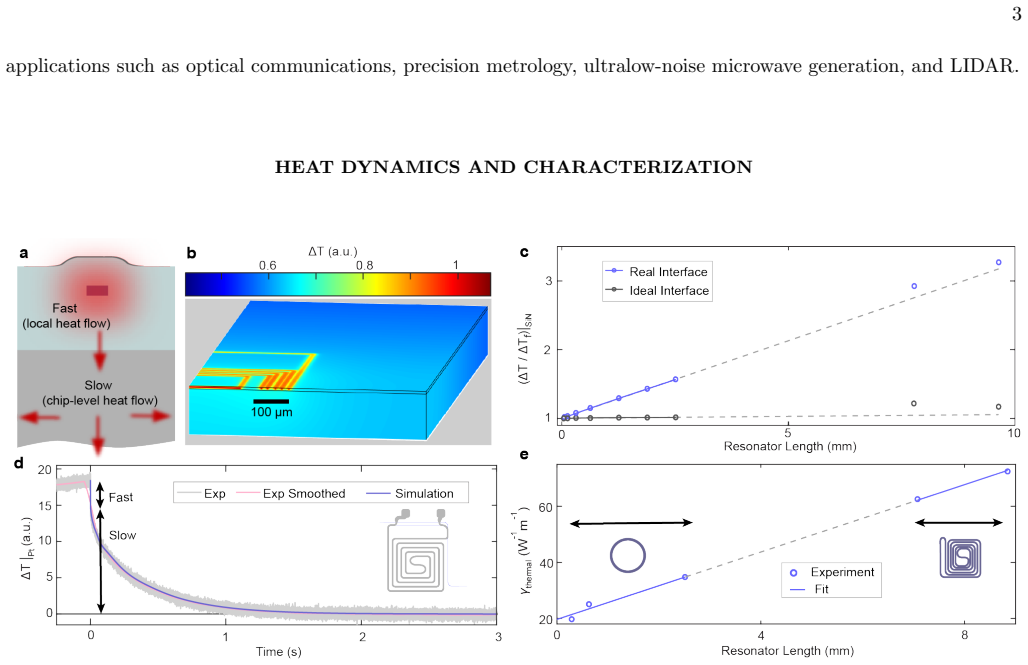
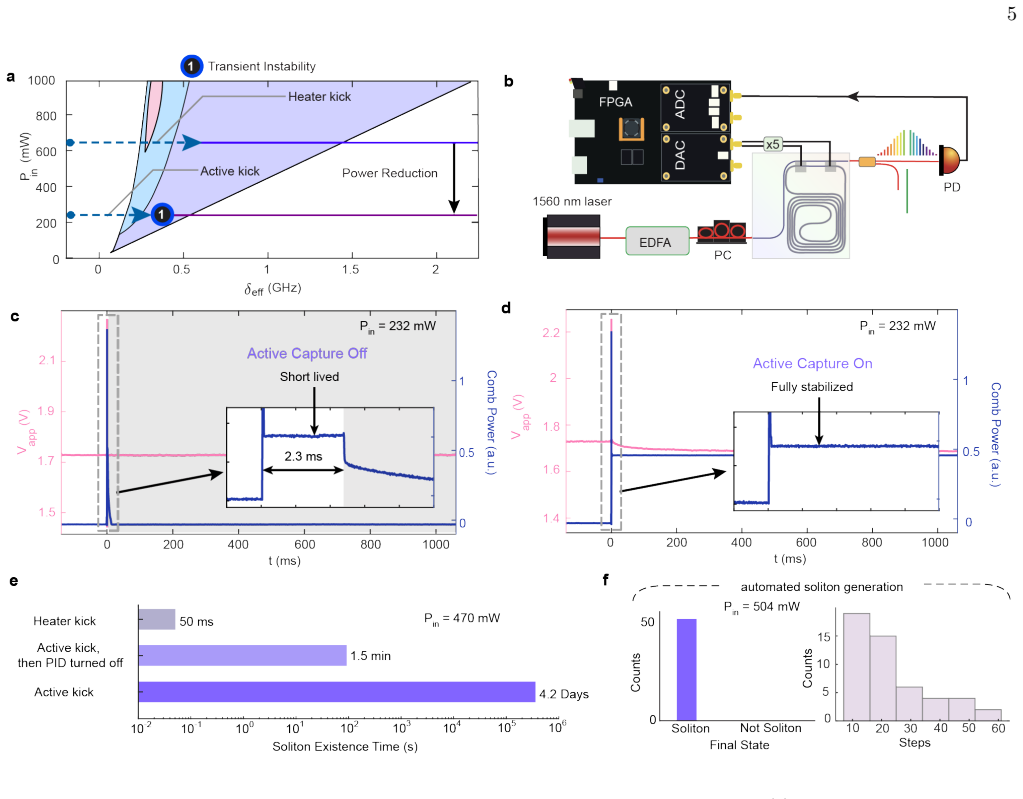
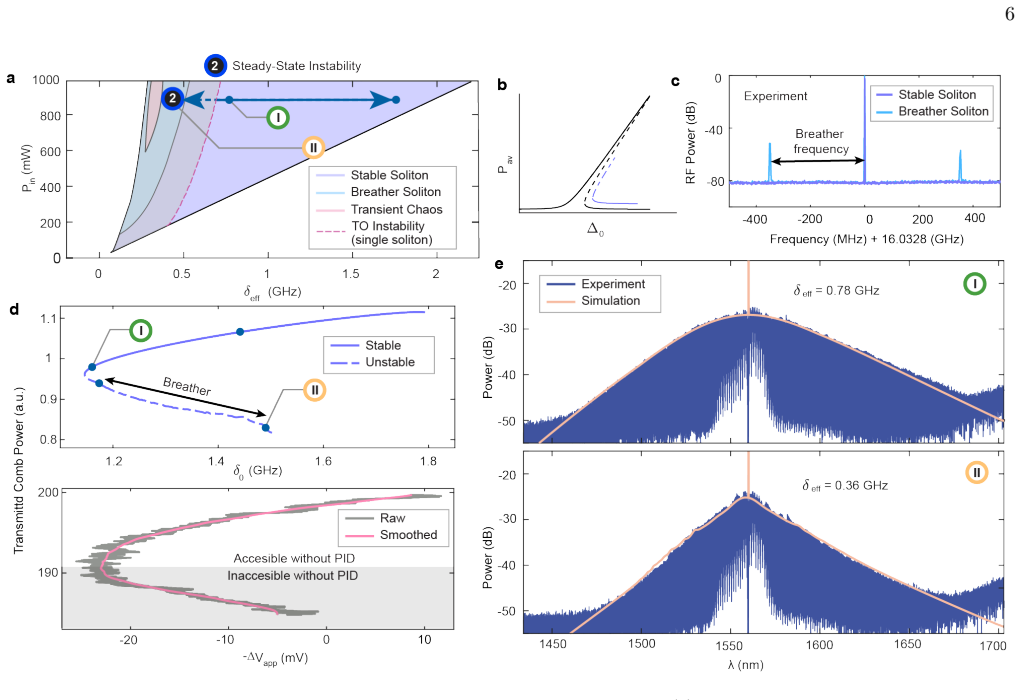
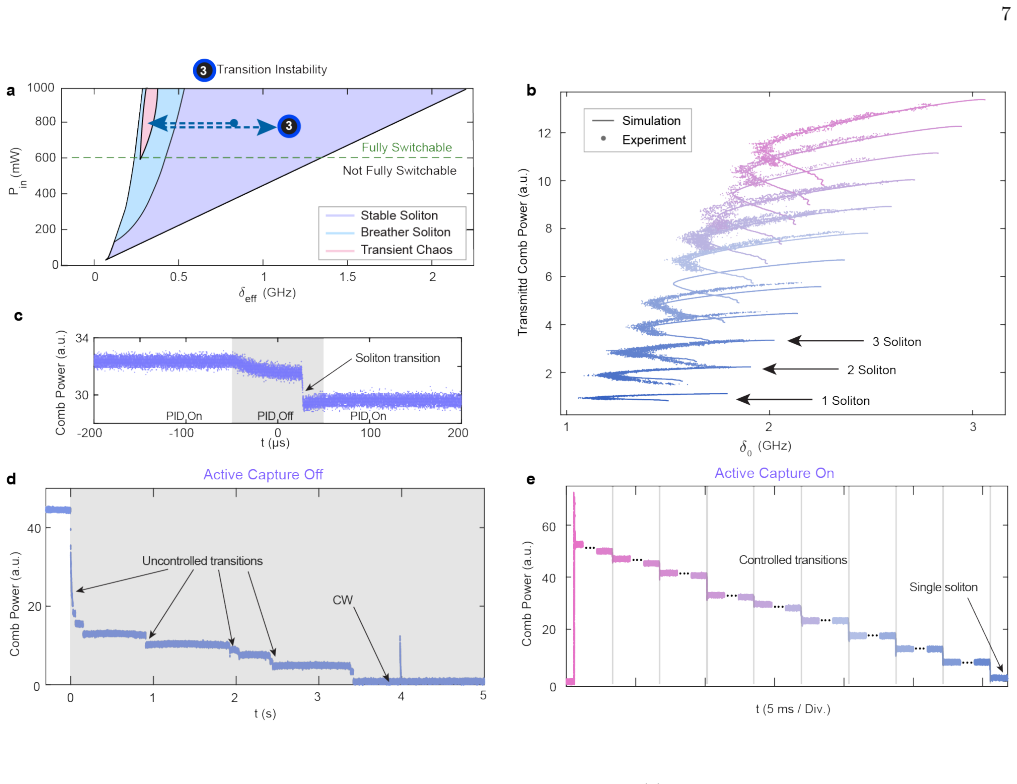
We demonstrate deterministic and highly stable Kerr soliton comb generation in tight-spiral microresonators with comb spacings as low as 16 GHz. An experimentally-validated thermal model identifies the non-trivial thermally-driven instabilities that govern cavity-soliton dynamics. A fast feedback loop is implemented to overcome these perturbations, stabilize cavity-soliton states including those that are otherwise unstable, and allow controlled transitions between soliton states.
What carries the argument
The fast feedback loop, informed by the thermal model of the compact spiral microresonator, that actively counters heating-induced detuning to lock and switch soliton states.
If this is right
- Thermally stable soliton microcombs become feasible in highly compact form factors.
- Controlled transitions between soliton states are achievable on demand.
- The same stabilization method applies across a wide variety of photonic material platforms.
- Applications in optical communications, precision metrology, microwave generation and LIDAR gain practical chip-scale sources.
Where Pith is reading between the lines
- The approach may allow comb spacings below 16 GHz without enlarging the device footprint.
- Similar thermal compensation could stabilize other nonlinear processes such as parametric oscillation in the same compact geometries.
- Integration with on-chip heaters and monitors could eliminate the need for external cooling in deployed systems.
Load-bearing premise
The feedback loop can reliably detect and correct the thermal perturbations that the model predicts will occur in real fabricated devices.
What would settle it
Observation that the feedback loop fails to maintain soliton locking for minutes or cannot produce stable 16 GHz combs in multiple fabricated spiral resonators would falsify the central claim.
Figures

read the original abstract
Chip-based nonlinear photonics offer the capability to integrate devices with all the requisite photonic components (e.g., filters, couplers, detectors) into highly compact form factors. This offers the possibility of making the devices scalable, robust, and manufacturable. Such integrated photonic devices will enable applications in optical communications, precision metrology, microwave generation, and LIDAR. However, thermal instabilities represent a major hurdle in the deterministic operation of nonlinear optical processes in such integrated resonant structures such as microresonators. In this work we demonstrate deterministic and highly stable Kerr soliton comb generation in tight-spiral microresonators with comb spacings as low as 16 GHz. We perform a comprehensive experimentally-validated thermal model of such compact microresonators and reveal non-trivial thermally-driven instabilities governing the cavity soliton dynamics. We design and implement a fast feedback loop on the devices to overcome thermal perturbations and stabilize cavity-soliton states, including those that are otherwise unstable, and to allow for controlled transitions between the soliton states. Our approach enables the realization of thermally-stable highly compact soliton microcomb devices in a wide variety of photonic platforms.
Editorial analysis
A structured set of objections, weighed in public.
Referee Report
Summary. The manuscript claims to demonstrate deterministic and highly stable Kerr soliton comb generation in tight-spiral microresonators with comb spacings as low as 16 GHz. It presents a comprehensive experimentally-validated thermal model that identifies non-trivial thermally-driven instabilities in cavity soliton dynamics, along with a fast feedback loop implemented on the devices to overcome thermal perturbations, stabilize otherwise unstable soliton states, and enable controlled transitions between states. The approach is positioned as enabling thermally-stable ultra-compact soliton microcomb devices across photonic platforms.
Significance. If the experimental validation and device performance hold, the work would represent a meaningful practical advance in integrated nonlinear photonics by directly addressing thermal instabilities that currently limit deterministic soliton operation in compact resonators. The combination of thermal modeling with active feedback control could facilitate scalable, robust microcomb sources for communications, metrology, and sensing applications. The low 16 GHz spacing in a tight-spiral geometry is a notable engineering achievement if reproducibly shown.
minor comments (1)
- The abstract references 'experimentally-validated' aspects and 'fabricated devices' but the provided text contains no figures, data tables, or detailed methods sections; this prevents assessment of whether the thermal model predictions match measurements or whether the feedback loop reliably achieves the claimed stabilization.
Simulated Author's Rebuttal
We thank the referee for their review and for recognizing the potential significance of our work in addressing thermal instabilities for deterministic soliton operation in compact resonators. The referee summary correctly reflects our demonstration of stable Kerr soliton combs at 16 GHz spacing using thermal modeling and feedback control. No specific major comments were provided in the report.
Circularity Check
No significant circularity; experimental demonstration is self-contained
full rationale
The paper reports an experimental demonstration of deterministic Kerr soliton comb generation in tight-spiral microresonators, including a thermal model that is validated against experimental data and a feedback loop for stabilization. No derivation chain reduces a claimed prediction or result to its own inputs by construction, no load-bearing self-citation chain is invoked to justify uniqueness, and the central claims rest on fabricated devices, measurements, and external validation rather than fitted parameters renamed as predictions. The approach is self-contained against the reported experimental benchmarks.
Axiom & Free-Parameter Ledger
Reference graph
Works this paper leans on
-
[1]
T. Herr, V. Brasch, J. D. Jost, C. Y. Wang, N. M. Kondratiev, M. L. Gorodetsky, and T. J. Kippenberg, Nature Photonics 8, 145 (2014)
2014
-
[2]
Marin-Palomo, J
P. Marin-Palomo, J. N. Kemal, M. Karpov, A. Kordts, J. Pfeifle, M. H. P. Pfeiffer, P. Trocha, S. Wolf, V. Brasch, M. H. Anderson, R. Rosenberger, K. Vijayan, W. Freude, T. J. Kippenberg, and C. Koos, Nature546, 274 (2017)
2017
-
[3]
Riemensberger, A
J. Riemensberger, A. Lukashchuk, M. Karpov, W. Weng, E. Lucas, J. Liu, and T. J. Kippenberg, Nature581, 164 (2020)
2020
-
[4]
Feldmann, N
J. Feldmann, N. Youngblood, M. Karpov, H. Gehring, X. Li, M. Stappers, M. Le Gallo, X. Fu, A. Lukashchuk, A. S. Raja, J. Liu, C. D. Wright, A. Sebastian, T. J. Kippenberg, W. H. P. Pernice, and H. Bhaskaran, Nature589, 52 (2021)
2021
-
[5]
Brasch, E
V. Brasch, E. Lucas, J. D. Jost, M. Geiselmann, and T. J. Kippenberg, Light: Science & Applications6, e16202 (2017)
2017
-
[6]
L. Stern, J. R. Stone, S. Kang, D. C. Cole, M.-G. Suh, C. Fredrick, Z. Newman, K. Vahala, J. Kitching, S. A. Diddams, and S. B. Papp, Science Advances6, eaax6230 (2020), https://www.science.org/doi/pdf/10.1126/sciadv.aax6230
-
[7]
Q.-F. Yang, B. Shen, H. Wang, M. Tran, Z. Zhang, K. Y. Yang, L. Wu, C. Bao, J. Bowers, A. Yariv, and K. Vahala, Science363, 965 (2019), https://www.science.org/doi/pdf/10.1126/science.aaw2317
-
[8]
M.-G. Suh, X. Yi, Y.-H. Lai, S. Leifer, I. S. Grudinin, G. Vasisht, E. C. Martin, M. P. Fitzgerald, G. Doppmann, J. Wang, D. Mawet, S. B. Papp, S. A. Diddams, C. Beichman, and K. Vahala, Nature Photonics13, 25 (2019), publisher: Nature Publishing Group
2019
-
[9]
Obrzud, M
E. Obrzud, M. Rainer, A. Harutyunyan, M. H. Anderson, J. Liu, M. Geiselmann, B. Chazelas, S. Kundermann, S. Lecomte, M. Cecconi, A. Ghedina, E. Molinari, F. Pepe, F. Wildi, F. Bouchy, T. J. Kippenberg, and T. Herr, Nature Photonics 13, 31 (2019), publisher: Nature Publishing Group
2019
-
[10]
D. T. Spencer, T. Drake, T. C. Briles, J. Stone, L. C. Sinclair, C. Fredrick, Q. Li, D. Westly, B. R. Ilic, A. Bluestone, N. Volet, T. Komljenovic, L. Chang, S. H. Lee, D. Y. Oh, M.-G. Suh, K. Y. Yang, M. H. P. Pfeiffer, T. J. Kippenberg, E. Norberg, L. Theogarajan, K. Vahala, N. R. Newbury, K. Srinivasan, J. E. Bowers, S. A. Diddams, and S. B. Papp, Natu...
2018
-
[11]
Kudelin, W
I. Kudelin, W. Groman, Q.-X. Ji, J. Guo, M. L. Kelleher, D. Lee, T. Nakamura, C. A. McLemore, P. Shirmohammadi, S. Hanifi, H. Cheng, N. Jin, L. Wu, S. Halladay, Y. Luo, Z. Dai, W. Jin, J. Bai, Y. Liu, W. Zhang, C. Xiang, L. Chang, 13 V. Iltchenko, O. Miller, A. Matsko, S. M. Bowers, P. T. Rakich, J. C. Campbell, J. E. Bowers, K. J. Vahala, F. Quinlan, and...
2024
-
[12]
S. Sun, B. Wang, K. Liu, M. W. Harrington, F. Tabatabaei, R. Liu, J. Wang, S. Hanifi, J. S. Morgan, M. Jahanbozorgi, Z. Yang, S. M. Bowers, P. A. Morton, K. D. Nelson, A. Beling, D. J. Blumenthal, and X. Yi, Nature627, 540 (2024)
2024
-
[13]
Y. Zhao, J. K. Jang, G. J. Beals, K. J. McNulty, X. Ji, Y. Okawachi, M. Lipson, and A. L. Gaeta, Nature627, 546 (2024)
2024
-
[14]
Yi, Q.-F
X. Yi, Q.-F. Yang, K. Y. Yang, M.-G. Suh, and K. Vahala, Optica2, 1078 (2015)
2015
-
[15]
Liang, D
W. Liang, D. Eliyahu, V. S. Ilchenko, A. A. Savchenkov, A. B. Matsko, D. Seidel, and L. Maleki, Nature Communications 6, 7957 (2015)
2015
-
[16]
K. Y. Yang, D. Y. Oh, S. H. Lee, Q.-F. Yang, X. Yi, B. Shen, H. Wang, and K. Vahala, Nature Photonics12, 297 (2018), number: 5 Publisher: Nature Publishing Group
2018
-
[17]
G. Liu, V. S. Ilchenko, T. Su, Y.-C. Ling, S. Feng, K. Shang, Y. Zhang, W. Liang, A. A. Savchenkov, A. B. Matsko, L. Maleki, and S. J. B. Yoo, Optica5, 219 (2018)
2018
-
[18]
J. Liu, E. Lucas, A. S. Raja, J. He, J. Riemensberger, R. N. Wang, M. Karpov, H. Guo, R. Bouchand, and T. J. Kippenberg, Nature Photonics14, 486 (2020), number: 8 Publisher: Nature Publishing Group
2020
-
[19]
Y. Xuan, Y. Liu, L. T. Varghese, A. J. Metcalf, X. Xue, P.-H. Wang, K. Han, J. A. Jaramillo-Villegas, A. A. Noman, C. Wang, S. Kim, M. Teng, Y. J. Lee, B. Niu, L. Fan, J. Wang, D. E. Leaird, A. M. Weiner, and M. Qi, Optica3, 1171 (2016)
2016
-
[20]
Z. Ye, F. Lei, K. Twayana, M. Girardi, P. A. Andrekson, and V. Torres-Company, Laser & Photonics Reviews16, 2100147 (2022), eprint: https://onlinelibrary.wiley.com/doi/pdf/10.1002/lpor.202100147
-
[21]
X. Ji, R. N. Wang, Y. Liu, J. Riemensberger, Z. Qiu, and T. J. Kippenberg, Optica11, 1397 (2024)
2024
-
[22]
X. Ji, X. Li, Z. Qiu, R. N. Wang, M. Divall, A. Gelash, G. Lihachev, and T. J. Kippenberg, Nature646, 843 (2025)
2025
-
[23]
Brasch, M
V. Brasch, M. Geiselmann, M. H. P. Pfeiffer, and T. J. Kippenberg, Opt. Express24, 29312 (2016)
2016
-
[24]
Yi, Q.-F
X. Yi, Q.-F. Yang, K. Y. Yang, and K. Vahala, Optics Letters41, 2037 (2016), publisher: Optica Publishing Group
2037
-
[25]
Z. Wang, J. Baek, C. Ahn, D. Suk, H. Lee, and J. Kim, Journal of Lightwave Technology , 1 (2025)
2025
-
[26]
Obrzud, S
E. Obrzud, S. Lecomte, and T. Herr, Nature Photonics11, 600 (2017)
2017
-
[27]
Zhang, J
S. Zhang, J. M. Silver, L. D. Bino, F. Copie, M. T. M. Woodley, G. N. Ghalanos, A. Ø. Svela, N. Moroney, and P. Del’Haye, Optica6, 206 (2019)
2019
-
[28]
H. Zhou, Y. Geng, W. Cui, S.-W. Huang, Q. Zhou, K. Qiu, and C. Wei Wong, Light: Science & Applications8, 50 (2019)
2019
-
[29]
Wildi, V
T. Wildi, V. Brasch, J. Liu, T. J. Kippenberg, and T. Herr, Opt. Lett.44, 4447 (2019)
2019
-
[30]
J. R. Stone, T. C. Briles, T. E. Drake, D. T. Spencer, D. R. Carlson, S. A. Diddams, and S. B. Papp, Phys. Rev. Lett. 121, 063902 (2018)
2018
-
[31]
Q. Li, T. C. Briles, D. A. Westly, T. E. Drake, J. R. Stone, B. R. Ilic, S. A. Diddams, S. B. Papp, and K. Srinivasan, Optica4, 193 (2017)
2017
-
[32]
H. Weng, A. A. Afridi, J. Li, M. McDermott, H. Tu, L. P. Barry, Q. Lu, W. Guo, and J. F. Donegan, APL Photonics7, 066103 (2022), eprint: https://pubs.aip.org/aip/app/article-pdf/doi/10.1063/5.0089036/16492580/066103 1 online.pdf
-
[33]
B. Shen, L. Chang, J. Liu, H. Wang, Q.-F. Yang, C. Xiang, R. N. Wang, J. He, T. Liu, W. Xie, J. Guo, D. Kinghorn, L. Wu, Q.-X. Ji, T. J. Kippenberg, K. Vahala, and J. E. Bowers, Nature582, 365 (2020)
2020
-
[34]
Joshi, J
C. Joshi, J. K. Jang, K. Luke, X. Ji, S. A. Miller, A. Klenner, Y. Okawachi, M. Lipson, and A. L. Gaeta, Optics Letters 41, 2565 (2016), publisher: Optica Publishing Group
2016
-
[35]
S. K. Dacha, Y. Zhao, K. J. McNulty, G. R. Bhatt, M. Lipson, and A. L. Gaeta, Nature Photonics20, 71 (2026)
2026
-
[36]
H. Guo, M. Karpov, E. Lucas, A. Kordts, M. H. P. Pfeiffer, V. Brasch, G. Lihachev, V. E. Lobanov, M. L. Gorodetsky, and T. J. Kippenberg, Nature Physics13, 94 (2017)
2017
-
[37]
C. Bao, J. A. Jaramillo-Villegas, Y. Xuan, D. E. Leaird, M. Qi, and A. M. Weiner, Phys. Rev. Lett.117, 163901 (2016)
2016
-
[38]
M. Yu, J. K. Jang, Y. Okawachi, A. G. Griffith, K. Luke, S. A. Miller, X. Ji, M. Lipson, and A. L. Gaeta, Nature Communications8, 14569 (2017)
2017
-
[39]
Lucas, M
E. Lucas, M. Karpov, H. Guo, M. L. Gorodetsky, and T. J. Kippenberg, Nature Communications8, 736 (2017)
2017
-
[40]
L. A. Lugiato and R. Lefever, Phys. Rev. Lett.58, 2209 (1987)
1987
-
[41]
X. Ji, F. A. S. Barbosa, S. P. Roberts, A. Dutt, J. Cardenas, Y. Okawachi, A. Bryant, A. L. Gaeta, and M. Lipson, Optica 4, 619 (2017)
2017
-
[42]
T. Chen, H. Lee, J. Li, and K. J. Vahala, Optics Express20, 22819 (2012), publisher: Optica Publishing Group
2012
-
[43]
Del’Haye, O
P. Del’Haye, O. Arcizet, M. L. Gorodetsky, R. Holzwarth, and T. J. Kippenberg, Nature Photonics3, 529 (2009)
2009
-
[44]
S. K. Dacha, Y. Zhao, K. J. McNulty, G. R. Bhatt, M. Lipson, and A. L. Gaeta, Nature Photonics (2025), 10.1038/s41566- 025-01789-9
-
[45]
Rokhsari, S
H. Rokhsari, S. M. Spillane, and K. J. Vahala, Applied Physics Letters85, 3029 (2004)
2004
-
[46]
Z. Qi, S. Wang, J. Jaramillo-Villegas, M. Qi, A. M. Weiner, G. D’Aguanno, T. F. Carruthers, and C. R. Menyuk, Optica 6, 1220 (2019)
2019
discussion (0)
Sign in with ORCID, Apple, or X to comment. Anyone can read and Pith papers without signing in.