Tensor-based second-order causal discovery
Pith reviewed 2026-06-26 22:28 UTC · model grok-4.3
The pith
Tensor method recovers causal order and parameters from logarithmic interventions.
A machine-rendered reading of the paper's core claim, the machinery that carries it, and where it could break.
Core claim
TSCD takes as input a tensor formed from covariance matrices of observational and interventional data and outputs the DAG together with the functions on its edges; under the linear SEM assumption with uncorrelated noise, both the causal order and the parameters are identifiable from a number of interventions that is logarithmic in the number of variables.
What carries the argument
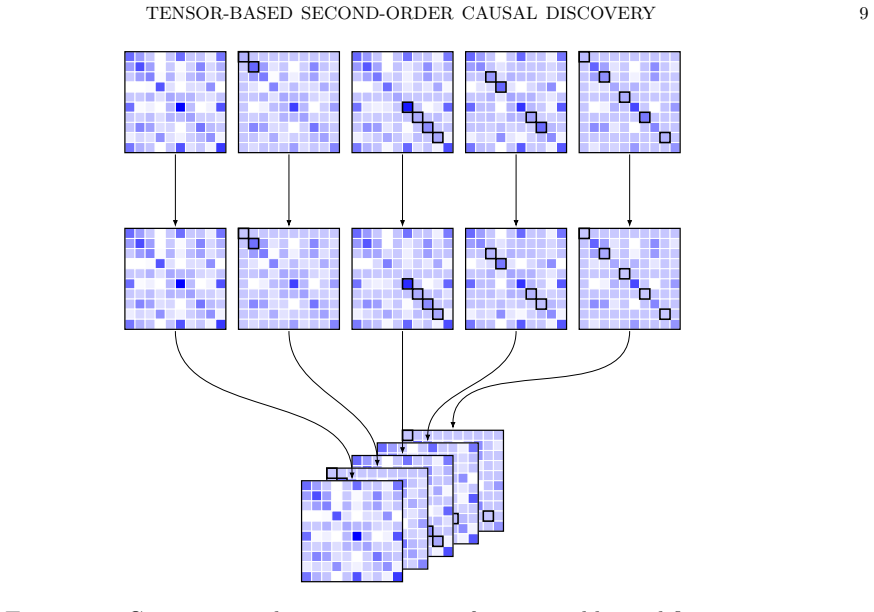
The tensor assembled from covariance matrices of observational and interventional data, which encodes second-order statistics to enable recovery of the DAG and edge parameters.
If this is right
- The method requires only logarithmically many interventions for identifiability of order and parameters.
- Second-order statistics suffice for recovery without assuming Gaussianity.
- The algorithm extends to nonlinear models while preserving the use of covariance tensors.
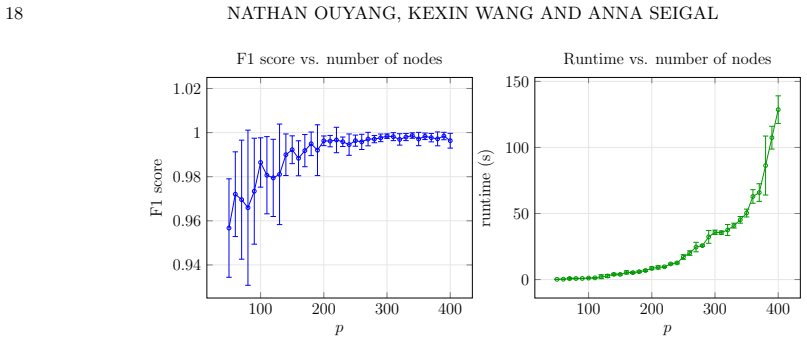
- Scalability to hundreds of variables follows from the computational efficiency of covariance matrices.
Where Pith is reading between the lines
- Real-world data with approximately uncorrelated noise could allow causal discovery at substantially lower experimental cost than methods needing more interventions.
- Hybrid algorithms might combine the tensor construction with other second-order techniques to handle mixed linear and nonlinear relations.
- Testing the nonlinear variant on data with known ground-truth graphs would clarify how far the logarithmic intervention bound carries over beyond the linear case.
Load-bearing premise
Causal dependencies follow a linear structural equation model on a DAG and the noise variables are uncorrelated.
What would settle it
A dataset generated from a linear SEM on a DAG with uncorrelated noise where TSCD, given only a logarithmic number of interventions, returns an incorrect causal order.
Figures
read the original abstract
Causal discovery seeks to uncover the causal dependencies among variables. For this purpose, we propose an algorithm called Tensor-based Second-order Causal Discovery (TSCD). Its input is a tensor obtained from the covariance matrices of observational and interventional data. Assuming the causal dependencies follow a linear structural equation model on a directed acyclic graph (DAG), TSCD outputs the DAG and the functions on its edges, requiring only that the noise variables are uncorrelated. We also implement a version of the approach for nonlinear models. Our focus on second-order statistics (via the covariance matrices) is motivated by their statistical and computational efficiency relative to higher-order moments, their identifiability relative to first-order statistics, and that they work regardless of whether the variables are Gaussian. We show that TSCD has identifiable causal order and parameters from a number of interventions that is logarithmic in the number of variables. Experiments show that TSCD is robust to noise, competitive with existing methods, and scales to hundreds of variables.
Editorial analysis
A structured set of objections, weighed in public.
Referee Report
Summary. The manuscript proposes Tensor-based Second-order Causal Discovery (TSCD), which constructs a tensor from covariance matrices of observational and interventional data to recover both the causal order and the parameters (edge functions) of a linear SEM on a DAG, assuming only that noise terms are uncorrelated. It claims that the causal order and parameters are identifiable from a number of interventions logarithmic in the number of variables, provides a nonlinear implementation, and reports experiments indicating robustness to noise, competitiveness with existing methods, and scalability to hundreds of variables.
Significance. If the identifiability result is established, the work would be a meaningful contribution by showing that second-order statistics suffice for identifiability under standard linear SEM assumptions while requiring only logarithmically many interventions. This efficiency, combined with the reported scalability, could be useful for high-dimensional causal discovery where interventions are costly.
minor comments (2)
- The abstract asserts identifiability but supplies no theorem number, proof outline, or key equation; adding a pointer to the relevant section or theorem would improve readability without altering the technical content.
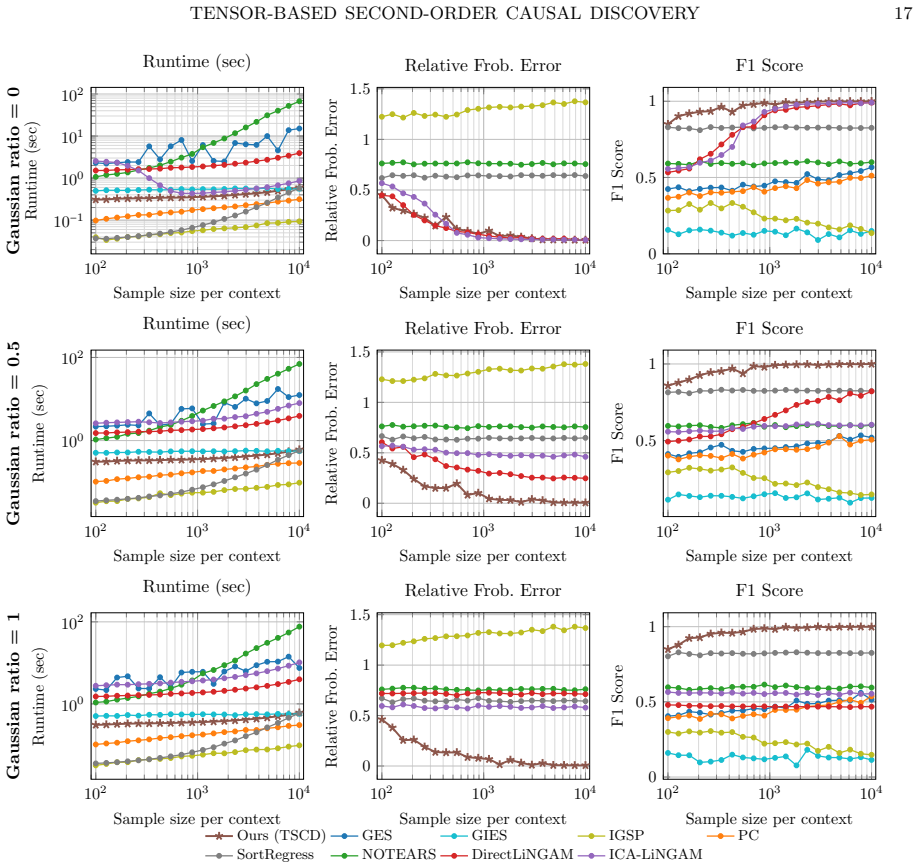
- In the experimental section, explicitly state how many interventions were used relative to the claimed logarithmic bound and whether the observed performance matches the theoretical scaling.
Simulated Author's Rebuttal
We thank the referee for the positive summary, significance assessment, and recommendation of minor revision. No specific major comments were provided in the report.
Circularity Check
No significant circularity detected
full rationale
The paper presents TSCD as recovering the DAG and edge functions from a tensor of covariance matrices under linear SEM assumptions on a DAG with uncorrelated noise. The identifiability result for causal order and parameters (logarithmic interventions) is stated as following from the tensor construction and second-order statistics properties, without any quoted reduction of the target claim to a fitted parameter, self-definition, or load-bearing self-citation chain. The derivation is self-contained against the explicit assumptions; no steps match the enumerated circularity patterns.
Axiom & Free-Parameter Ledger
axioms (2)
- domain assumption The causal dependencies follow a linear structural equation model on a directed acyclic graph (DAG)
- domain assumption The noise variables are uncorrelated
Reference graph
Works this paper leans on
-
[1]
Stat , volume=
Learning directed acyclic graph models based on sparsest permutations , author=. Stat , volume=. 2018 , publisher=
2018
-
[2]
SIAM review , volume=
A rank--one reduction formula and its applications to matrix factorizations , author=. SIAM review , volume=. 1995 , publisher=
1995
-
[3]
Biometrika , volume=
Identifiability of Gaussian structural equation models with equal error variances , author=. Biometrika , volume=. 2014 , publisher=
2014
-
[4]
Advances in neural information processing systems , volume=
Nonlinear causal discovery with additive noise models , author=. Advances in neural information processing systems , volume=
-
[5]
Uncertainty in artificial intelligence , pages=
Causal discovery with general non-linear relationships using non-linear ICA , author=. Uncertainty in artificial intelligence , pages=. 2020 , organization=
2020
-
[6]
International conference on artificial intelligence and statistics , pages=
Learning sparse nonparametric dags , author=. International conference on artificial intelligence and statistics , pages=. 2020 , organization=
2020
-
[7]
Proceedings of the Twenty-First Conference on Uncertainty in Artificial Intelligence , pages=
On the number of experiments sufficient and in the worst case necessary to identify all causal relations among N variables , author=. Proceedings of the Twenty-First Conference on Uncertainty in Artificial Intelligence , pages=
-
[8]
Journal of Symbolic Computation , volume=
Lower bounds on the rank and symmetric rank of real tensors , author=. Journal of Symbolic Computation , volume=. 2023 , publisher=
2023
-
[9]
SIAM journal on Matrix Analysis and Applications , volume=
A link between the canonical decomposition in multilinear algebra and simultaneous matrix diagonalization , author=. SIAM journal on Matrix Analysis and Applications , volume=. 2006 , publisher=
2006
-
[10]
Carl D. Meyer , title =. The American Mathematical Monthly , volume =. 2018 , publisher =. doi:10.1080/00029890.2017.1389199 , URL =
-
[11]
2023 IEEE 64th Annual Symposium on Foundations of Computer Science (FOCS) , pages=
Computing linear sections of varieties: quantum entanglement, tensor decompositions and beyond , author=. 2023 IEEE 64th Annual Symposium on Foundations of Computer Science (FOCS) , pages=. 2023 , organization=
2023
-
[12]
arXiv preprint arXiv:2510.18627 , year=
Multi-subspace power method for decomposing all tensors , author=. arXiv preprint arXiv:2510.18627 , year=
-
[13]
Perturb-Seq: dissecting molecular circuits with scalable single-cell
Dixit, Atray and Parnas, Oren and Li, Biyu and Chen, Jenny and Fulco, Charles P and Jerby-Arnon, Livnat and Marjanovic, Nemanja D and Dionne, Danielle and Burks, Tyler and Raychowdhury, Raktima and others , journal=. Perturb-Seq: dissecting molecular circuits with scalable single-cell. 2016 , publisher=
2016
-
[14]
2000 , publisher=
Causation, prediction, and search , author=. 2000 , publisher=
2000
-
[15]
and Hyvärinen, Aapo and Kerminen, Antti , journal=
Shimizu, Shohei and Hoyer, Patrik O. and Hyvärinen, Aapo and Kerminen, Antti , journal=. A Linear Non-
-
[16]
2017 , publisher=
Elements of causal inference: foundations and learning algorithms , author=. 2017 , publisher=
2017
-
[17]
2011 , publisher=
Tensors: geometry and applications: geometry and applications , author=. 2011 , publisher=
2011
-
[18]
The annals of mathematical statistics , volume=
The method of path coefficients , author=. The annals of mathematical statistics , volume=. 1934 , publisher=
1934
-
[19]
SIAM review , volume=
Tensor decompositions and applications , author=. SIAM review , volume=. 2009 , publisher=
2009
-
[20]
IEEE journal of selected topics in signal processing , volume=
Structured data fusion , author=. IEEE journal of selected topics in signal processing , volume=. 2015 , publisher=
2015
-
[21]
SIAM Journal on Matrix Analysis and Applications , volume=
On generic identifiability of 3-tensors of small rank , author=. SIAM Journal on Matrix Analysis and Applications , volume=. 2012 , publisher=
2012
-
[22]
The Annals of Statistics , volume=
Global identifiability of linear structural equation models , author=. The Annals of Statistics , volume=
-
[23]
International conference on machine learning , pages=
Linear causal disentanglement via interventions , author=. International conference on machine learning , pages=. 2023 , organization=
2023
-
[24]
and Bollen, Kenneth , journal=
Shimizu, Shohei and Inazumi, Takanori and Sogawa, Yasuhiro and Hyvärinen, Aapo and Kawahara, Yoshinobu and Washio, Takashi and Hoyer, Patrik O. and Bollen, Kenneth , journal=. DirectLiNGAM: A Direct Method for Learning a Linear Non-
-
[25]
Journal of Machine Learning Research , volume=
Optimal Structure Identification with Greedy Search , author=. Journal of Machine Learning Research , volume=
-
[26]
arXiv e-prints , pages=
Identifiable multi-view causal discovery without non-gaussianity , author=. arXiv e-prints , pages=
-
[27]
Characterization and Greedy Learning of Interventional
Hauser, Alain and Bühlmann, Peter , journal=. Characterization and Greedy Learning of Interventional
-
[28]
The Annals of Statistics , pages=
Half-trek criterion for generic identifiability of linear structural equation models , author=. The Annals of Statistics , pages=. 2012 , publisher=
2012
-
[29]
Conference on Uncertainty in Artificial Intelligence , pages=
Permutation-based causal structure learning with unknown intervention targets , author=. Conference on Uncertainty in Artificial Intelligence , pages=. 2020 , organization=
2020
-
[30]
, booktitle=
Zheng, Xun and Aragam, Bryon and Ravikumar, Pradeep and Xing, Eric P. , booktitle=
-
[31]
Beware of the simulated
Reisach, Alexander and Seiler, Christof and Weichwald, Sebastian , journal=. Beware of the simulated
-
[32]
Journal of the Royal Statistical Society: Series B , volume=
Causal Inference using Invariant Prediction: Identification and Confidence Intervals , author=. Journal of the Royal Statistical Society: Series B , volume=
-
[33]
Linear algebra and its applications , volume=
Three-way arrays: rank and uniqueness of trilinear decompositions, with application to arithmetic complexity and statistics , author=. Linear algebra and its applications , volume=. 1977 , publisher=
1977
-
[34]
Biometrika , pages=
The probable error of a mean , author=. Biometrika , pages=. 1908 , publisher=
1908
-
[35]
Biometrika , volume=
Frequency distribution of the values of the correlation coefficient in samples from an indefinitely large population , author=. Biometrika , volume=. 1915 , publisher=
1915
-
[36]
Friedman, Nir and Linial, Michal and Nachman, Iftach and Pe'er, Dana , booktitle=. Using
-
[37]
Science , volume=
Causal protein-signaling networks derived from multiparameter single-cell data , author=. Science , volume=. 2005 , publisher=
2005
-
[38]
Nature reviews neuroscience , volume=
Causal mapping of human brain function , author=. Nature reviews neuroscience , volume=. 2022 , publisher=
2022
-
[39]
Journal of Economic Literature , volume=
Potential outcome and directed acyclic graph approaches to causality: Relevance for empirical practice in economics , author=. Journal of Economic Literature , volume=. 2020 , publisher=
2020
-
[40]
Epidemiology , volume=
Causal diagrams for epidemiologic research , author=. Epidemiology , volume=. 1999 , publisher=
1999
-
[41]
Proceedings of the IEEE , volume=
Toward causal representation learning , author=. Proceedings of the IEEE , volume=. 2021 , publisher=
2021
-
[42]
arXiv preprint arXiv:2601.15239 , year=
Multi-context principal component analysis , author=. arXiv preprint arXiv:2601.15239 , year=
-
[43]
Proceedings of the National Academy of Sciences , volume=
Methods for causal inference from gene perturbation experiments and validation , author=. Proceedings of the National Academy of Sciences , volume=. 2016 , publisher=
2016
-
[44]
Causality: Objectives and assessment , pages=
Structure learning in causal cyclic networks , author=. Causality: Objectives and assessment , pages=. 2010 , organization=
2010
-
[45]
Proceedings of the Sixth Annual Conference on Uncertainty in Artificial Intelligence , pages=
Equivalence and synthesis of causal models , author=. Proceedings of the Sixth Annual Conference on Uncertainty in Artificial Intelligence , pages=
-
[46]
Advances in neural information processing systems , volume=
Permutation-based causal inference algorithms with interventions , author=. Advances in neural information processing systems , volume=
-
[47]
Biometrika , volume=
Ancestor regression in linear structural equation models , author=. Biometrika , volume=. 2023 , publisher=
2023
-
[48]
Advances in neural information processing systems , volume=
BACKSHIFT: Learning causal cyclic graphs from unknown shift interventions , author=. Advances in neural information processing systems , volume=
-
[49]
2009 , publisher=
Causality , author=. 2009 , publisher=
2009
-
[50]
Probabilistic soft interventions in conditional
Markowetz, Florian and Grossmann, Steffen and Spang, Rainer , booktitle=. Probabilistic soft interventions in conditional. 2005 , organization=
2005
-
[51]
Causal chambers as a real-world physical testbed for
Gamella, Juan L and Peters, Jonas and B. Causal chambers as a real-world physical testbed for. Nature Machine Intelligence , volume=. 2025 , publisher=
2025
-
[52]
Structural Equation Modeling , volume=
A new identification condition for recursive models with correlated errors , author=. Structural Equation Modeling , volume=. 2002 , publisher=
2002
-
[53]
2023 , publisher=
Algebraic statistics , author=. 2023 , publisher=
2023
-
[54]
1934 , publisher=
Lectures on matrices , author=. 1934 , publisher=
1934
-
[55]
Numerical Algorithms , pages=
Subspace power method for symmetric tensor decomposition , author=. Numerical Algorithms , pages=. 2025 , publisher=
2025
-
[56]
Journal of Algebra , year=
A real generalized trisecant trichotomy , author=. Journal of Algebra , year=
discussion (0)
Sign in with ORCID, Apple, or X to comment. Anyone can read and Pith papers without signing in.