A Sensitivity Framework for Identifying Contagion under Latent Homophily for Fixed-in-Time Network Analyses, with an Application to U.S. House Congressional Voting
Pith reviewed 2026-06-26 21:38 UTC · model grok-4.3
The pith
The gap between observed network contagion and true controlled direct effect is set by how strongly latent homophily changes which dyads connect.
A machine-rendered reading of the paper's core claim, the machinery that carries it, and where it could break.
Core claim
We show that the gap between the CDE and the observed connected-dyad risk ratio is governed by how strongly a latent homophily variable shifts the composition of connected dyads. Inspired by Smith-style selection-bias sensitivity analysis and the risk-ratio bounding function of Ding and VanderWeele we develop interpretable nonparametric bounds. This translates the question 'is there contagion?' into the question 'how strong would latent homophily have to be to explain away the observed contagion?'
What carries the argument
A single sensitivity parameter that quantifies how strongly an unobserved homophily factor alters the composition of connected dyads, used to bound the difference between the controlled direct effect and the raw observed risk ratio.
If this is right
- Under the derived bounds, contagion can be declared plausible once the homophily strength needed to explain the data away exceeds any value judged credible for that population.
- The framework applies directly to any fixed network with two waves of binary nodal outcomes without requiring a parametric model of tie formation.
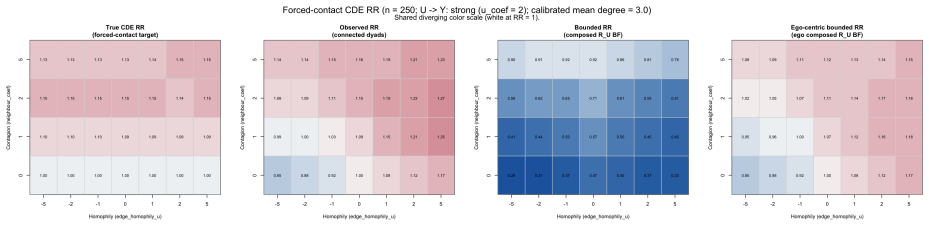
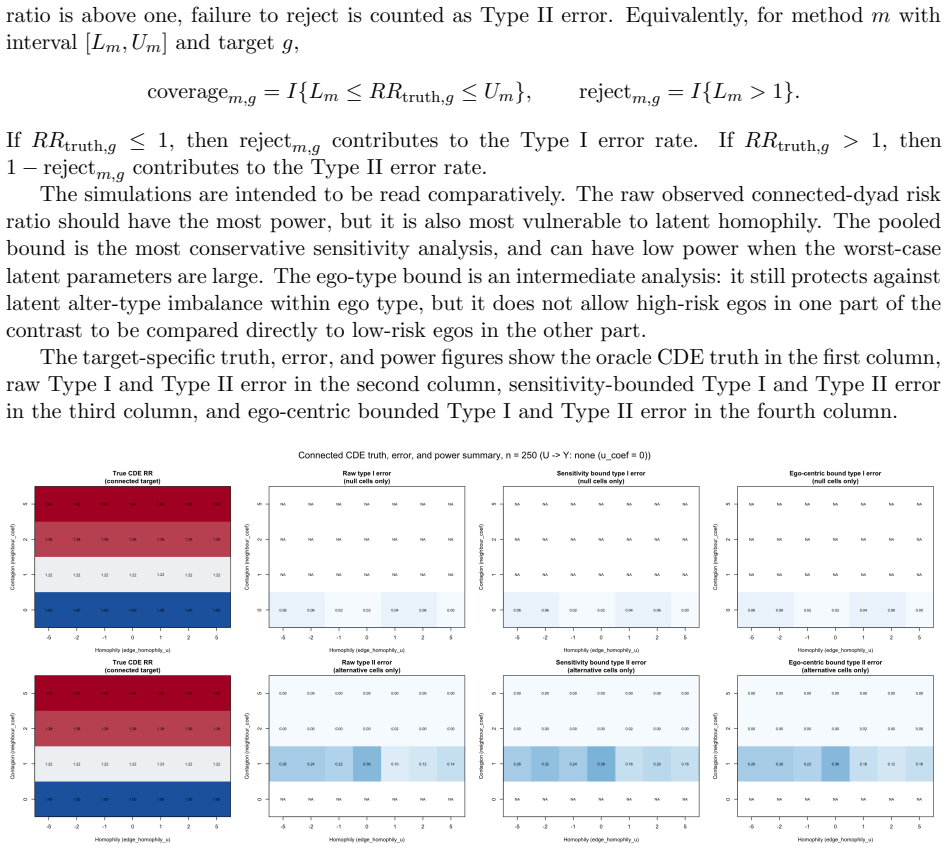
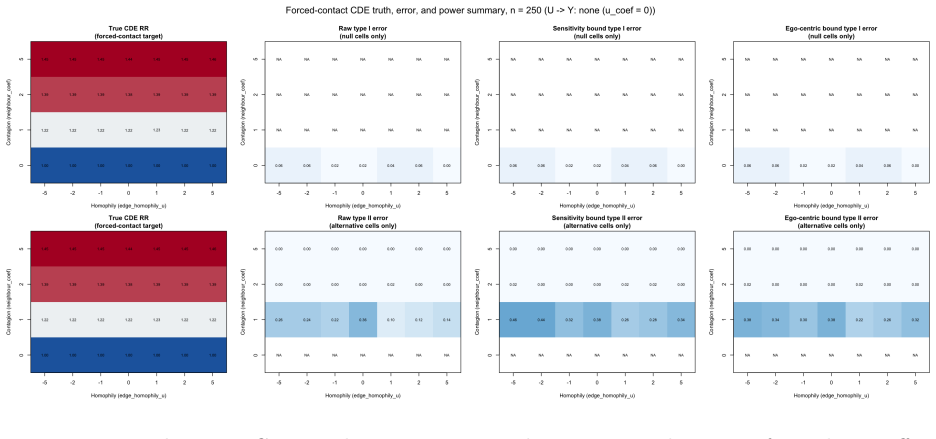
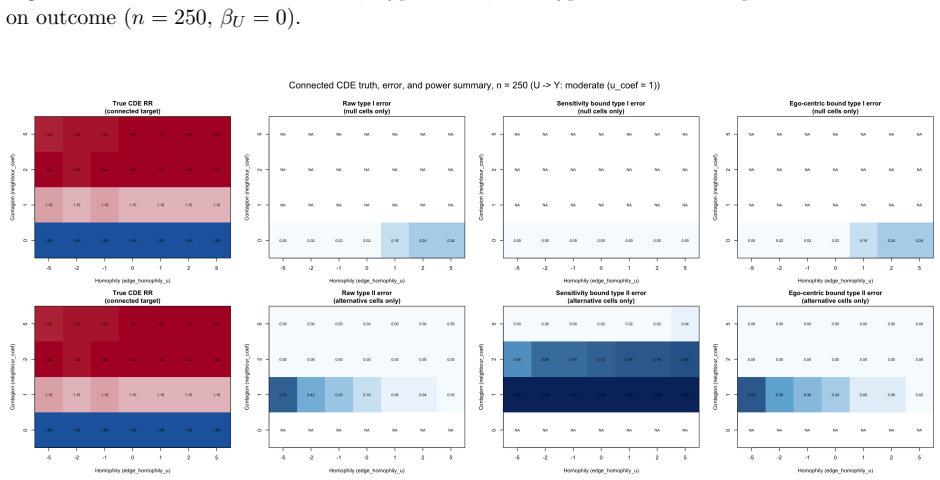
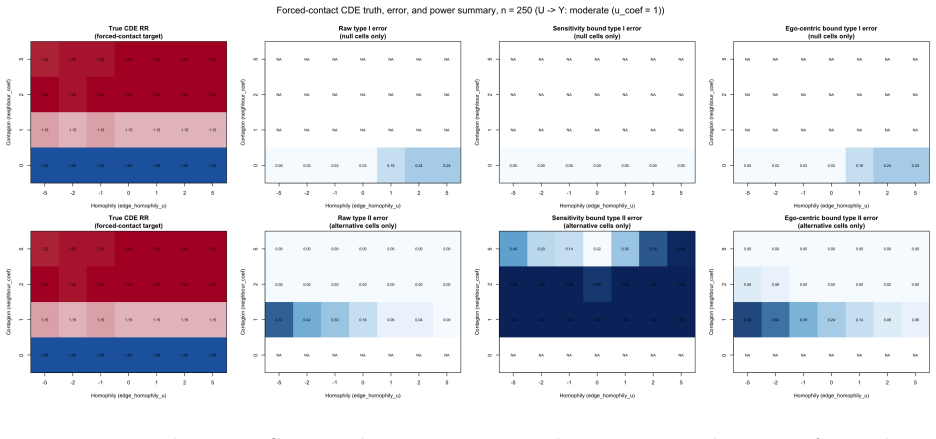
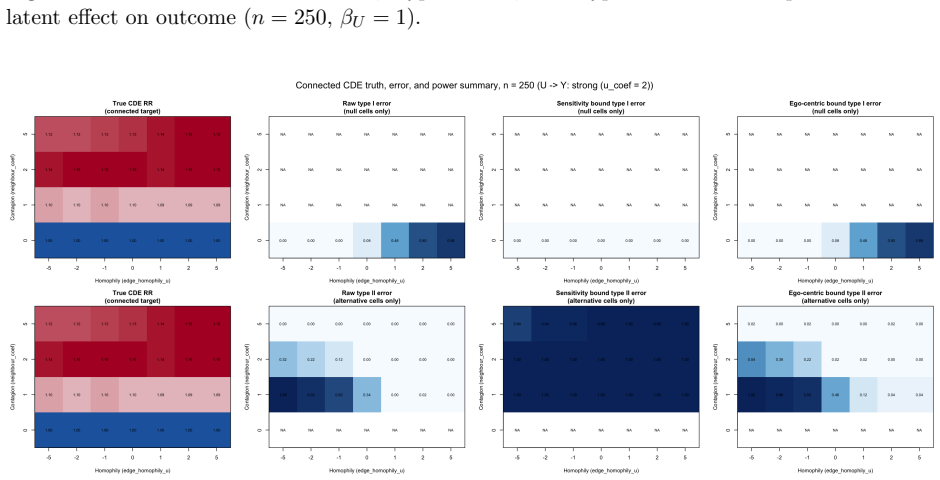
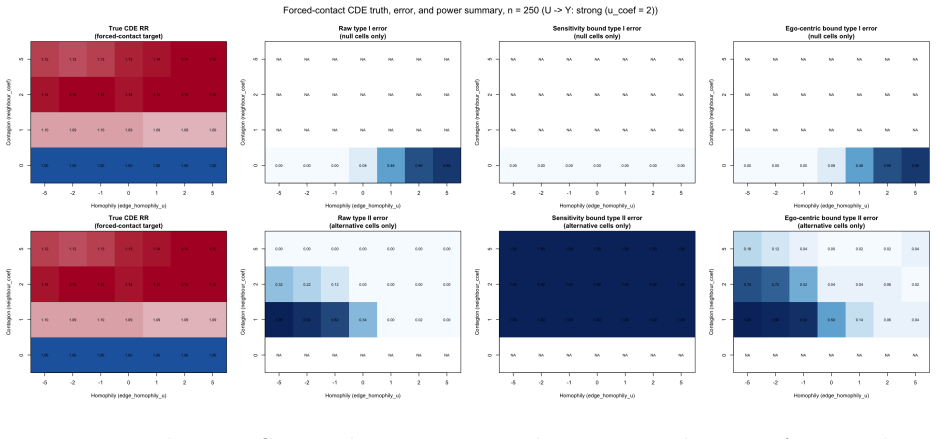
- Simulation results show the bounds maintain nominal error control while retaining power to detect contagion when homophily is weak.
- In the TARP vote data the method identifies the precise homophily threshold at which contagion remains credible.
Where Pith is reading between the lines
- The same selection-bias reframing could be applied to directed or weighted networks once an appropriate dyad-composition parameter is defined.
- Bounds derived here might be combined with measured covariates to tighten the required homophily threshold in empirical applications.
- The approach suggests a design for future network studies: collect auxiliary data on potential homophily factors precisely to calibrate the sensitivity parameter.
Load-bearing premise
The only source of bias between the controlled direct effect and the observed association is latent homophily whose strength is captured by the sensitivity parameter.
What would settle it
Collect direct measures or proxies of the latent homophily variable in the same network setting and test whether its observed strength exceeds the value required by the bounds to nullify the contagion claim.
Figures




read the original abstract
Whether connected units are similar because influence spreads across ties or because similar units form ties, is a long-standing problem. Contagion or influence is generically unidentified from observational network data. We consider the minimal and common setting of a single network, fixed over time, with two waves of a binary nodal outcome. Rather than positing a parametric model for network formation, we reframe identification of contagion as a selection-bias problem and develop a sensitivity framework. We define a controlled direct effect (CDE) holding a tie present while intervening on an alter's outcome. We show that the gap between the CDE and the observed connected-dyad risk ratio is governed by how strongly a latent homophily variable shifts the composition of connected dyads. Inspired by Smith-style selection-bias sensitivity analysis and the risk-ratio bounding function of Ding and VanderWeele we develop interpretable nonparametric bounds. This translates the question "is there contagion?" into the question "how strong would latent homophily have to be to explain away the observed contagion?" A simulation study characterizes the bounds' error control and power. We apply the framework to the 2008 U.S. House votes on the Troubled Asset Relief Program, identifying under which assumptions contagion is plausible.
Editorial analysis
A structured set of objections, weighed in public.
Referee Report
Summary. The paper develops a sensitivity framework for contagion identification in a minimal setting of one fixed network observed at two time points with binary nodal outcomes. It reframes the problem as selection bias due to latent homophily, defines a controlled direct effect (CDE) holding ties fixed while intervening on alter outcomes, and derives nonparametric bounds (inspired by Smith-style selection-bias analysis and Ding-VanderWeele risk-ratio bounds) on the gap between the CDE and the observed connected-dyad risk ratio. The central translation is that assessing contagion reduces to assessing how strong latent homophily must be to explain away the observed association. The framework is evaluated in a simulation study on error control and power and applied to 2008 U.S. House TARP votes.
Significance. If the bounds derivation holds, the work supplies a practical, nonparametric sensitivity tool for distinguishing contagion from latent homophily without parametric network-formation models. Strengths include the explicit single sensitivity parameter, the simulation characterizing bound behavior, and the empirical demonstration; these make the contribution concrete and falsifiable in applied settings. The approach extends established selection-bias techniques to network contagion questions in a way that could see routine use in social-science network analyses.
minor comments (2)
- [Simulation study] The simulation section would benefit from an explicit table or figure reporting numerical power and coverage rates across the range of homophily strengths examined, to allow direct verification of the claimed error-control properties.
- [Methods] Notation for the bounding function and the latent-homophily sensitivity parameter should be introduced with a single consolidated definition early in the methods section rather than piecemeal.
Simulated Author's Rebuttal
We thank the referee for their accurate summary of the manuscript and for recognizing its potential contribution. The recommendation for minor revision is noted. No specific major comments appear in the report, so there are no individual points requiring rebuttal or revision at this stage. We will incorporate any editorial or minor changes in the revised version.
Circularity Check
No significant circularity; derivation is self-contained sensitivity analysis
full rationale
The paper reframes contagion identification as a selection-bias problem under a fixed network with two binary outcome waves, defines the CDE, and derives nonparametric bounds on the gap to the observed risk ratio using the strength of latent homophily as the sensitivity parameter. This directly follows established external techniques (Smith-style selection-bias analysis and Ding-VanderWeele risk-ratio bounds) without any reduction of the target quantity to a fitted parameter defined by the same equations, without self-citation load-bearing on the central claim, and without ansatz smuggling or renaming. The result is explicitly a sensitivity framework (not point identification), with the single parameter acknowledged as the modeling choice; the logic remains internally consistent and independent of the paper's own inputs.
Axiom & Free-Parameter Ledger
free parameters (1)
- latent homophily sensitivity parameter
axioms (2)
- domain assumption Single fixed network with two waves of binary nodal outcome
- domain assumption No parametric model for network formation is posited
Reference graph
Works this paper leans on
-
[1]
Thomas , title =
Cosma Rohilla Shalizi and Andrew C. Thomas , title =. Sociological Methods & Research , volume =. 2011 , doi =
2011
-
[2]
Contagion, Confounding, and Causality: Confronting the Three C’s of Observational Political Networks Research , volume=. Political Analysis , author=. 2023 , pages=. doi:10.1017/pan.2022.35 , number=
-
[3]
Journal of the Royal Statistical Society Series A: Statistics in Society , volume =
Clark, Duncan A and Handcock, Mark S , title =. Journal of the Royal Statistical Society Series A: Statistics in Society , volume =. 2024 , month =. doi:10.1093/jrsssa/qnae001 , url =
-
[4]
Graphical and Recursive Models for Contingency Tables , volume =
Wermuth, Nanny and Lauritzen, Steffen , year =. Graphical and Recursive Models for Contingency Tables , volume =. Biometrika , doi =
-
[5]
Spirtes, Peter and Glymour, Clark and Scheines, Richard , title =. 2001 , month =. doi:10.7551/mitpress/1754.001.0001 , url =
-
[6]
Proceedings of the Sixteenth International Conference on Artificial Intelligence and Statistics , pages =
Statistical Tests for Contagion in Observational Social Network Studies , author =. Proceedings of the Sixteenth International Conference on Artificial Intelligence and Statistics , pages =. 2013 , editor =
2013
-
[7]
Sharp sensitivity bounds for mediation under unmeasured mediator-outcome confounding , volume =
Ding, Peng and VanderWeele, Tyler , year =. Sharp sensitivity bounds for mediation under unmeasured mediator-outcome confounding , volume =. Biometrika , doi =
-
[8]
Smith and Tyler J
Louisa H. Smith and Tyler J. VanderWeele , title =. Epidemiology , volume =. 2019 , doi =
2019
-
[9]
2009 , isbn =
Pearl, Judea , title =. 2009 , isbn =
2009
-
[10]
Probabilistic reasoning in intelligent systems: networks of plausible inference , url =
Pearl, Judea , biburl =. Probabilistic reasoning in intelligent systems: networks of plausible inference , url =
-
[11]
and Arah, Onyebuchi A
VanderWeele, Tyler J. and Arah, Onyebuchi A. , title =. Epidemiology , volume =. 2011 , doi =
2011
-
[12]
and Robins, James M
Hernan, Miguel A. and Robins, James M. , title =. 2020 , publisher =
2020
-
[13]
1995 , url=
Structure and influence : statistical models for the dynamics of actor attributes, network structure, and their interdependence , author=. 1995 , url=
1995
-
[14]
Christakis, Nicholas A. and Fowler, James H. , title =. New England Journal of Medicine , volume =. 2007 , month =. doi:10.1056/NEJMsa066082 , pmid =
-
[15]
McFowland, III, Edward and Shalizi, Cosma Rohilla , title =. Journal of the American Statistical Association , volume =. 2023 , publisher =. doi:10.1080/01621459.2021.1953506 , URL =
-
[16]
Roll Call Vote XML Files , year =
-
[17]
United States Congress Legislative Data , year =
-
[18]
and Haenszel, W
Cornfield, J. and Haenszel, W. and Hammond, E. C. and Lilienfeld, A. M. and Shimkin, M. B. and Wynder, E. L. , title =. Journal of the National Cancer Institute , year =
-
[19]
Bross, Irwin D. , title =. Journal of Chronic Diseases , year =. doi:10.1016/0021-9681(66)90062-2 , pmid =
-
[20]
Journal of the Royal Statistical Society Series B: Statistical Methodology , volume =
Cinelli, Carlos and Hazlett, Chad , title =. Journal of the Royal Statistical Society Series B: Statistical Methodology , volume =. 2020 , month =. doi:10.1111/rssb.12348 , url =
-
[21]
VanderWeele, Tyler J. and Ding, Peng , title =. Annals of Internal Medicine , year =. doi:10.7326/M16-2607 , pmid =
-
[22]
Proceedings of the National Academy of Sciences , volume =
Sinan Aral and Lev Muchnik and Arun Sundararajan , title =. Proceedings of the National Academy of Sciences , volume =. 2009 , doi =
2009
-
[23]
, title =
Butts, Carter T. , title =. Sociological Methodology , volume =. 2008 , doi =
2008
-
[24]
Disentangling social contagion from prior similarity in time-ordered behaviour sequences , journal =
Leifeld, Philip and Mart. Disentangling social contagion from prior similarity in time-ordered behaviour sequences , journal =. 2026 , note =. doi:10.1093/jrsssa/qnag069 , url =
-
[25]
, title =
Artico, Igor and Wit, Ernst C. , title =. Journal of the Royal Statistical Society Series A: Statistics in Society , volume =. 2023 , doi =
2023
-
[26]
Steglich, Christian and Snijders, Tom A. B. and Pearson, Michael , title =. Sociological Methodology , volume =. doi:https://doi.org/10.1111/j.1467-9531.2010.01225.x , url =. https://onlinelibrary.wiley.com/doi/pdf/10.1111/j.1467-9531.2010.01225.x , abstract =
-
[27]
and Handcock, Mark S
Krivitsky, Pavel N. and Handcock, Mark S. , title =. Journal of the Royal Statistical Society: Series B (Statistical Methodology) , volume =. 2014 , doi =
2014
-
[28]
British Journal of Management , volume =
Cai, Wanxiang and Polzin, Friedemann , title =. British Journal of Management , volume =. doi:https://doi.org/10.1111/1467-8551.12917 , url =. https://onlinelibrary.wiley.com/doi/pdf/10.1111/1467-8551.12917 , abstract =
-
[29]
Epidemic processes in complex networks , author =. Rev. Mod. Phys. , volume =. 2015 , month =. doi:10.1103/RevModPhys.87.925 , url =
-
[30]
Kudos make you run! How runners influence each other on the online social network Strava , journal =
Rob Franken and Hidde Bekhuis and Jochem Tolsma , keywords =. Kudos make you run! How runners influence each other on the online social network Strava , journal =. 2023 , issn =. doi:https://doi.org/10.1016/j.socnet.2022.10.001 , url =
-
[31]
and Foster, Mark D
Couch, Jim F. and Foster, Mark D. and Malone, Keith and Black, David L. , title =. Cato Journal , year =
-
[32]
The Washington Post , year =
Montgomery, Lori and Cho, David , title =. The Washington Post , year =
-
[33]
American Economic Review , Volume =
Mian, Atif and Sufi, Amir and Trebbi, Francesco , Title =. American Economic Review , Volume =. 2010 , Month =. doi:10.1257/aer.100.5.1967 , URL =
-
[34]
, title =
Ramirez, Carlos D. , title =. Review of Law & Economics , year =
-
[35]
Tahoun, Ahmed and van Lent, Laurence , title =. Review of Finance , year =. doi:10.1093/rof/rfy015 , url =
-
[36]
http://www.nber.org/papers/w16437
Cohen, Lauren and Malloy, Christopher. Friends in High Places. 2010. doi:10.3386/w16437 , URL = "http://www.nber.org/papers/w16437", abstract =
-
[37]
, title =
Fowler, James H. , title =. Political Analysis , volume =. 2006 , doi =
2006
-
[38]
, title =
Kirkland, Justin H. , title =. The Journal of Politics , volume =. 2011 , doi =
2011
-
[39]
and Halloran, M
Hudgens, Michael G. and Halloran, M. Elizabeth , title =. Journal of the American Statistical Association , volume =. 2008 , doi =
2008
-
[40]
and VanderWeele, Tyler J
Ogburn, Elizabeth L. and VanderWeele, Tyler J. , title =. Statistical Science , volume =. 2014 , doi =
2014
-
[41]
and Samii, Cyrus , title =
Aronow, Peter M. and Samii, Cyrus , title =. The Annals of Applied Statistics , volume =. 2017 , doi =
2017
-
[42]
Average Treatment Effects in the Presence of Unknown Interference , journal =
S. Average Treatment Effects in the Presence of Unknown Interference , journal =. 2021 , doi =
2021
discussion (0)
Sign in with ORCID, Apple, or X to comment. Anyone can read and Pith papers without signing in.