A Long Period Stellar-Mass Black Hole Binary in ω Centauri
Pith reviewed 2026-06-26 23:42 UTC · model grok-4.3
The pith
A 4.5 solar mass black hole in ω Centauri forms a 94-year binary with a main-sequence star.
A machine-rendered reading of the paper's core claim, the machinery that carries it, and where it could break.
Core claim
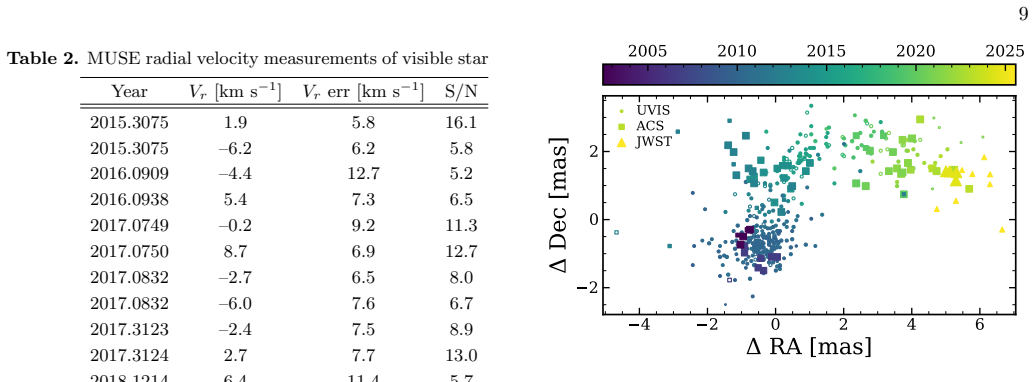
Multi-epoch astrometry spanning 23 years reveals the orbital motion of a main-sequence turnoff star around an unseen companion. The fitted elements are a period of 94 years, semi-major axis 31 AU, and eccentricity 0.72. With the companion mass estimated from photometry and cluster properties, Kepler's third law applied to the observed partial orbit near periastron gives a black hole mass of 4.46 solar masses. The system is the longest-period black hole binary known and the first stellar-mass black hole found astrometrically in any globular cluster.
What carries the argument
The partial astrometric orbit fitted to the luminous companion's positions near periastron, which supplies the period and angular semi-major axis needed to solve for the black hole mass once the companion mass is supplied.
If this is right
- The binary is soft and expected to disrupt on a timescale of roughly 800 million years.
- Low-mass black holes form at metallicities below 10 to the minus 3.
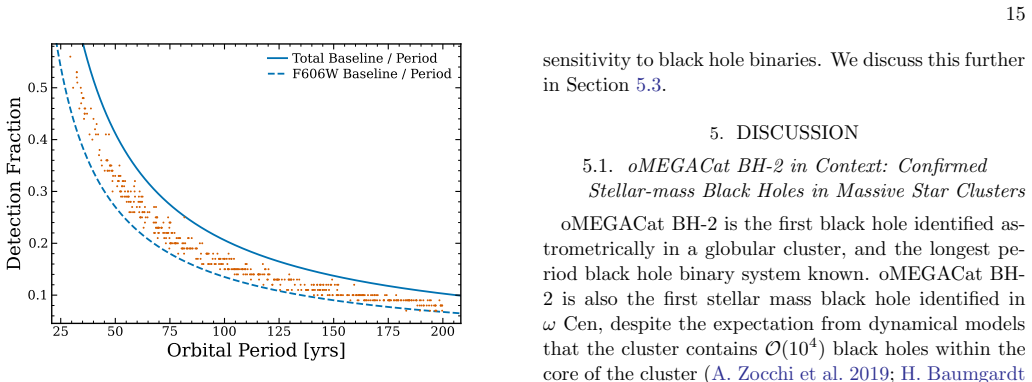
- Existing surveys cover only a small fraction of the relevant parameter space, so additional detectable black hole binaries are likely present in the cluster.
- The system must have formed through dynamical interactions rather than isolated stellar evolution.
Where Pith is reading between the lines
- This single detection supports the idea from simulations that stellar-mass black holes play a major role in globular cluster dynamics.
- Extending the time baseline by another decade would allow a full orbit solution and a mass ratio measurement independent of the companion mass assumption.
- Targeted astrometric searches in other massive clusters could uncover similar long-period systems that have so far been missed.
Load-bearing premise
The mass of the visible main-sequence turnoff star is estimated from its photometry together with the cluster's known age and metallicity, and this mass is required to turn the observed angular orbit into physical masses via Kepler's third law.
What would settle it
An independent mass for the visible star from spectroscopy or radial-velocity data that differs enough from the photometric estimate to shift the black hole mass outside the reported 3.45-5.68 solar mass range.
Figures





read the original abstract
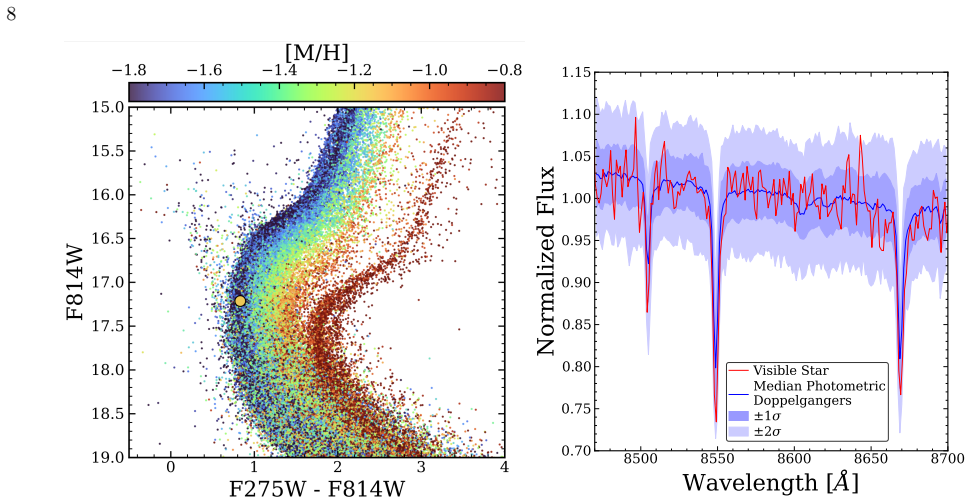
Modern simulations of stellar dynamics in globular clusters peg a dominant role for stellar-mass black holes, but direct evidence for black holes in clusters remains limited. We present the discovery of an astrometric stellar-mass black hole--main sequence star binary in $\omega$ Centauri, the most massive Galactic globular cluster, using Hubble Space Telescope data from the oMEGACat project and additional JWST data that span a total of 23 years. The luminous companion to the black hole is a main-sequence turnoff star, and has a period of $94^{+63}_{-42}$ years, a semi-major axis of $31^{+15}_{-12}$ AU, and an eccentricity of $e=0.72^{+0.08}_{-0.13}$. Since we observe the binary during periastron, the mass of the black hole is well-constrained even though we only observe a partial orbit: the inferred black hole mass is $4.46^{+1.22}_{-1.01}$ M$_\odot$. We call this black hole oMEGACat BH-2. This is the first astrometric discovery of a stellar-mass black hole in a globular cluster, and is the longest period black hole binary system yet discovered. The low mass of this black hole is perhaps surprising given the low metallicity of the cluster, and shows that at least some low-mass black holes form at metallicity $Z<10^{-3}$. We find that the binary is almost certainly dynamically formed and is soft, with an expected binary disruption timescale of $\sim$800 Myr. While the total number of black hole binaries in $\omega$ Centauri is uncertain, we show that existing surveys only cover a small area of parameter space, and that the presence of additional detectable black hole binaries is likely.
Editorial analysis
A structured set of objections, weighed in public.
Referee Report
Summary. The paper reports the astrometric discovery of a long-period (P = 94^{+63}_{-42} yr) binary in ω Centauri consisting of a main-sequence turnoff star and an unseen companion interpreted as a stellar-mass black hole of mass 4.46^{+1.22}_{-1.01} M_⊙. The orbit is only partially observed over a 23-year HST+JWST baseline near periastron, with fitted a = 31^{+15}_{-12} AU and e = 0.72^{+0.08}_{-0.13}; the BH mass follows from Kepler's third law once the visible star's mass is adopted from photometry plus the cluster's age and metallicity. The system is argued to be dynamically formed, soft, and the first such astrometric BH detection in a globular cluster.
Significance. If the mass and orbital solution hold, the result supplies direct evidence for stellar-mass black holes in globular clusters, supports dynamical-formation channels, and demonstrates that low-mass BHs can form at Z < 10^{-3}. The 23-year multi-facility astrometric baseline and the emphasis on periastron coverage are methodological strengths; the work also usefully flags the limited parameter space covered by existing surveys.
major comments (2)
- [Abstract / mass derivation] Abstract and the mass-inference paragraph: the quoted BH mass and uncertainties are obtained only after adopting an external value for the visible companion mass from isochrone fitting (photometry + cluster age/metallicity). This assumption enters directly into the total-mass term of Kepler's third law and rescales M_BH through the mass ratio; no sensitivity analysis or systematic error budget for the isochrone mass is provided, making it a load-bearing step for the central numerical claim.
- [Abstract] The statement that the BH mass is 'well-constrained' because the observations occurred near periastron is only partially correct: while periastron coverage helps constrain the angular elements, the absolute mass scale still requires the external M_visible and an assumed cluster distance. The manuscript should quantify how uncertainties in these two inputs propagate into the reported M_BH error bars.
minor comments (2)
- Notation for the semi-major axis should explicitly state whether the reported value is the angular or physical a1 (visible star) and how the conversion to AU is performed.
- The disruption timescale of ~800 Myr is stated without the formula or input parameters (velocity dispersion, total mass) used to obtain it; a short derivation or reference would improve reproducibility.
Simulated Author's Rebuttal
We thank the referee for their constructive comments, which help clarify the presentation of our mass inference. We address each major comment below.
read point-by-point responses
-
Referee: [Abstract / mass derivation] Abstract and the mass-inference paragraph: the quoted BH mass and uncertainties are obtained only after adopting an external value for the visible companion mass from isochrone fitting (photometry + cluster age/metallicity). This assumption enters directly into the total-mass term of Kepler's third law and rescales M_BH through the mass ratio; no sensitivity analysis or systematic error budget for the isochrone mass is provided, making it a load-bearing step for the central numerical claim.
Authors: We agree that the reported black-hole mass depends on the adopted mass of the luminous companion, which is taken from isochrone fitting. In the revised manuscript we will add an explicit sensitivity analysis that varies the companion mass over the plausible range allowed by the photometry, cluster age, and metallicity, and we will propagate those variations into the final M_BH uncertainties. We will also include a brief discussion of possible systematic uncertainties in the isochrone models themselves. revision: yes
-
Referee: [Abstract] The statement that the BH mass is 'well-constrained' because the observations occurred near periastron is only partially correct: while periastron coverage helps constrain the angular elements, the absolute mass scale still requires the external M_visible and an assumed cluster distance. The manuscript should quantify how uncertainties in these two inputs propagate into the reported M_BH error bars.
Authors: We accept the referee's clarification. The periastron passage tightly constrains the angular orbital elements and the angular semi-major axis, but the conversion to physical mass still requires the adopted companion mass and the cluster distance. We will revise the abstract and the mass-inference section to remove the implication that periastron coverage alone renders the mass 'well-constrained,' and we will add a quantitative propagation of the uncertainties in both M_visible and distance into the quoted M_BH error bars. revision: yes
Circularity Check
No circularity; mass follows from standard Keplerian mechanics on measured orbit plus external isochrone mass
full rationale
The reported black hole mass is computed from the fitted orbital elements (P, a, e) via Kepler's third law after converting the observed angular semi-major axis to physical units with the known cluster distance and adopting an independent M_visible from photometry plus the cluster's age and metallicity. No equation defines the black hole mass in terms of itself, renames a fitted parameter as a prediction, or reduces the result to a self-citation chain. The isochrone mass is an external input whose uncertainty propagates but does not create a definitional loop within the paper's derivation.
Axiom & Free-Parameter Ledger
free parameters (4)
- orbital period =
94 years
- semi-major axis =
31 AU
- eccentricity =
0.72
- visible star mass
axioms (2)
- domain assumption The observed motion is produced by a single bound Keplerian companion
- standard math Newtonian two-body orbital mechanics apply at these separations
Reference graph
Works this paper leans on
-
[1]
Abbott, B. P., Abbott, R., Abbott, T. D., et al. 2016, Physical Review X, 6, 041015, doi: 10.1103/PhysRevX.6.041015
-
[2]
2022,, Instrument Science Report WFC3 2022-5, 55 pages
Anderson, J. 2022,, Instrument Science Report WFC3 2022-5, 55 pages
2022
-
[3]
Anderson, J., & van der Marel, R. P. 2010, ApJ, 710, 1032, doi: 10.1088/0004-637X/710/2/1032
-
[4]
Antonini, F., & Rasio, F. A. 2016, ApJ, 831, 187, doi: 10.3847/0004-637X/831/2/187 Ba˜ nares-Hern´ andez, A., Calore, F., Martin Camalich, J., &
-
[5]
Read, J. I. 2025, A&A, 693, A104, doi: 10.1051/0004-6361/202451763
-
[6]
2024, Astronomy and Astrophysics, 687, L3, doi: 10.1051/0004-6361/202450425
Balbinot, E., Dodd, E., Matsuno, T., et al. 2024, Astronomy and Astrophysics, 687, L3, doi: 10.1051/0004-6361/202450425
-
[7]
Barr, E. D., Dutta, A., Freire, P. C. C., et al. 2024, Science, 383, 275, doi: 10.1126/science.adg3005
-
[8]
Sollima, A. 2023, MNRAS, 521, 3991, doi: 10.1093/mnras/stad631
-
[9]
Baumgardt, H., He, C., Sweet, S. M., et al. 2019, MNRAS, 488, 5340, doi: 10.1093/mnras/stz2060
-
[10]
Bekki, K., & Freeman, K. C. 2003, MNRAS, 346, L11, doi: 10.1046/j.1365-2966.2003.07275.x
-
[11]
Bellini, A., Anderson, J., Bedin, L. R., et al. 2017, ApJ, 842, 6, doi: 10.3847/1538-4357/aa7059
-
[12]
Bernadich, M. C. i., Dai, S., Abbate, F., et al. 2026, arXiv e-prints, arXiv:2603.21845, doi: 10.48550/arXiv.2603.21845
-
[13]
Boccioli, L., & Fragione, G. 2024, Physical Review D, 110, 023007, doi: 10.1103/PhysRevD.110.023007
-
[14]
Breen, P. G., & Heggie, D. C. 2013, Monthly Notices of the Royal Astronomical Society, 432, 2779, doi: 10.1093/mnras/stt628
-
[15]
2021, Journal of Open Source Software, 6, 3001, doi: 10.21105/joss.03001
Buchner, J. 2021, The Journal of Open Source Software, 6, 3001, doi: 10.21105/joss.03001
-
[16]
2023, Statistics Surveys, 17, 169, doi: 10.1214/23-SS144
Buchner, J. 2023, Statistics Surveys, 17, 169, doi: 10.1214/23-SS144
-
[17]
J., Katz, H., Witten, C., et al
Cameron, A. J., Katz, H., Witten, C., et al. 2024, Monthly Notices of the Royal Astronomical Society, 534, 523, doi: 10.1093/mnras/stae1547
-
[18]
Chatterjee, S., Rodriguez, C. L., & Rasio, F. A. 2017, The Astrophysical Journal, 834, 68, doi: 10.3847/1538-4357/834/1/68
-
[19]
2026, ApJ, 1001, 127, doi: 10.3847/1538-4357/ae5242
Chen, S., Hare, J., Kargaltsev, O., et al. 2026, ApJ, 1001, 127, doi: 10.3847/1538-4357/ae5242
-
[20]
Chomiuk, L., Strader, J., Maccarone, T. J., et al. 2013, The Astrophysical Journal, 777, 69, doi: 10.1088/0004-637X/777/1/69
-
[21]
Clark, G. W. 1975, The Astrophysical Journal, 199, L143, doi: 10.1086/181869
-
[22]
Clontz, C., Seth, A. C., Dotter, A., et al. 2024, ApJ, 977, 14, doi: 10.3847/1538-4357/ad8621
-
[23]
Clontz, C., Seth, A. C., Wang, Z., et al. 2025, ApJ, 984, 162, doi: 10.3847/1538-4357/adc1c5
-
[24]
J., H´ enault-Brunet, V., Gieles, M., & Baumgardt, H
Dickson, N., Smith, P. J., H´ enault-Brunet, V., Gieles, M., & Baumgardt, H. 2024, MNRAS, 529, 331, doi: 10.1093/mnras/stae470 Din¸ cer, T., Bailyn, C. D., Miller-Jones, J. C. A., Buxton, M., & MacDonald, R. K. D. 2018, The Astrophysical Journal, 852, 4, doi: 10.3847/1538-4357/aa9a46
-
[25]
The Dartmouth Stellar Evolution Database
Dotter, A., Chaboyer, B., Jevremovi´ c, D., et al. 2008, ApJS, 178, 89, doi: 10.1086/589654
-
[26]
2023a, MNRAS, 518, 1057, doi: 10.1093/mnras/stac3140
El-Badry, K., Rix, H.-W., Quataert, E., et al. 2023a, MNRAS, 518, 1057, doi: 10.1093/mnras/stac3140
-
[27]
2023b, MNRAS, 521, 4323, doi: 10.1093/mnras/stad799
El-Badry, K., Rix, H.-W., Cendes, Y., et al. 2023b, MNRAS, 521, 4323, doi: 10.1093/mnras/stad799
-
[28]
E., Sukhbold, T., & Janka, H.-T
Ertl, T., Woosley, S. E., Sukhbold, T., & Janka, H.-T. 2020, The Astrophysical Journal, 890, 51, doi: 10.3847/1538-4357/ab6458
-
[29]
Fabian, A. C., Pringle, J. E., & Rees, M. J. 1975, Monthly Notices of the Royal Astronomical Society, 172, 15, doi: 10.1093/mnras/172.1.15P
-
[30]
Fall, S. M., & Zhang, Q. 2001, The Astrophysical Journal, 561, 751, doi: 10.1086/323358
-
[31]
Fonseca, E., Cromartie, H. T., Pennucci, T. T., et al. 2021, The Astrophysical Journal, 915, L12, doi: 10.3847/2041-8213/ac03b8
-
[32]
2013, 22
Foreman-Mackey, D., Conley, A., Meierjurgen Farr, W., et al. 2013, 22
2013
-
[33]
Monthly Notices of the Royal Astronomical Society , volume =
Perna, R. 2019, MNRAS, 488, 47, doi: 10.1093/mnras/stz1651
-
[34]
Rasio, F. A. 2004, MNRAS, 352, 1, doi: 10.1111/j.1365-2966.2004.07914.x Gaia Collaboration, Brown, A. G. A., Vallenari, A., et al. 2021, A&A, 649, A1, doi: 10.1051/0004-6361/202039657 Gaia Collaboration, Panuzzo, P., Mazeh, T., et al. 2024, Astronomy and Astrophysics, 686, L2, doi: 10.1051/0004-6361/202449763
-
[35]
Gallo, E., Fender, R. P., Miller-Jones, J. C. A., et al. 2006, Monthly Notices of the Royal Astronomical Society, 370, 1351, doi: 10.1111/j.1365-2966.2006.10560.x
-
[36]
2018, Monthly Notices of the Royal Astronomical Society, 475, L15, doi: 10.1093/mnrasl/slx203
Giesers, B., Dreizler, S., Husser, T.-O., et al. 2018, Monthly Notices of the Royal Astronomical Society, 475, L15, doi: 10.1093/mnrasl/slx203
-
[37]
2019, Astronomy and Astrophysics, 632, A3, doi: 10.1051/0004-6361/201936203
Giesers, B., Kamann, S., Dreizler, S., et al. 2019, Astronomy and Astrophysics, 632, A3, doi: 10.1051/0004-6361/201936203
-
[38]
Gnedin, O. Y., Zhao, H., Pringle, J. E., et al. 2002, The Astrophysical Journal, 568, L23, doi: 10.1086/340319 Gonz´ alez Prieto, E., Rodriguez, C. L., & Cabrera, T. 2025, ApJL, 990, L69, doi: 10.3847/2041-8213/adfd4a H¨ aberle, M., Neumayer, N., Bellini, A., et al. 2024a, ApJ, 970, 192, doi: 10.3847/1538-4357/ad47f5 H¨ aberle, M., Neumayer, N., Seth, A.,...
-
[39]
2025,, JWST Proposal
Haeberle, M., Anderson, J., Baumgardt, H., et al. 2025,, JWST Proposal. Cycle 4, ID. #8322
2025
-
[40]
Haggard, D., Cool, A. M., Heinke, C. O., et al. 2013, ApJL, 773, L31, doi: 10.1088/2041-8205/773/2/L31
-
[41]
Harris, W. E. 1996, AJ, 112, 1487, doi: 10.1086/118116
-
[42]
Heggie, D. C. 1975, Monthly Notices of the Royal Astronomical Society, 173, 729, doi: 10.1093/mnras/173.3.729
-
[43]
Heggie, D. C., & Giersz, M. 2014, Monthly Notices of the Royal Astronomical Society, 439, 2459, doi: 10.1093/mnras/stu102
-
[44]
Henleywillis, S., Cool, A. M., Haggard, D., et al. 2018, Monthly Notices of the Royal Astronomical Society, 479, 2834, doi: 10.1093/mnras/sty675
-
[45]
Hertz, P., & Grindlay, J. E. 1983, The Astrophysical Journal, 275, 105, doi: 10.1086/161516
-
[46]
Hut, P., & Bahcall, J. N. 1983, ApJ, 268, 319, doi: 10.1086/160956
-
[47]
Jacoby, B. A., Cameron, P. B., Jenet, F. A., et al. 2006, The Astrophysical Journal, 644, L113, doi: 10.1086/505742
-
[48]
Johnson, C. I., & Pilachowski, C. A. 2010, ApJ, 722, 1373, doi: 10.1088/0004-637X/722/2/1373
-
[49]
Kamann, S., Wisotzki, L., & Roth, M. M. 2013, A&A, 549, A71, doi: 10.1051/0004-6361/201220476
-
[50]
Y., Chen, S., Hare, J., et al
Kargaltsev, O. Y., Chen, S., Hare, J., et al. 2023,, JWST Proposal. Cycle 2, ID. #4343
2023
-
[51]
Katz, J. I. 1975, Nature, 253, 698, doi: 10.1038/253698a0
-
[52]
Rasio, F. A. 2019, The Astrophysical Journal, 871, 38, doi: 10.3847/1538-4357/aaf646
-
[53]
Rasio, F. A. 2018, The Astrophysical Journal, 855, L15, doi: 10.3847/2041-8213/aab26c
-
[54]
Kulkarni, S. R., Hut, P., & McMillan, S. 1993, Nature, 364, 421, doi: 10.1038/364421a0
-
[55]
Libralato, M., Bellini, A., van der Marel, R. P., et al. 2023, ApJ, 950, 101, doi: 10.3847/1538-4357/acd04f
-
[56]
O., P \'e rez-Villegas , A., et al
Limberg, G., Souza, S. O., P´ erez-Villegas, A., et al. 2022, ApJ, 935, 109, doi: 10.3847/1538-4357/ac8159
-
[57]
Lindegren, L., Klioner, S. A., Hern´ andez, J., et al. 2021, A&A, 649, A2, doi: 10.1051/0004-6361/202039709
-
[58]
Lucy, L. B. 2014, A&A, 563, A126, doi: 10.1051/0004-6361/201322649
-
[59]
Maccarone, T. J., Kundu, A., Zepf, S. E., & Rhode, K. L. 2007, Nature, 445, 183, doi: 10.1038/nature05434
-
[60]
Mackey, A. D., Wilkinson, M. I., Davies, M. B., & Gilmore, G. F. 2008, Monthly Notices of the Royal Astronomical Society, 386, 65, doi: 10.1111/j.1365-2966.2008.13052.x
-
[61]
D., Bahramian, A., Miller Jones, J
Mahida, A. D., Bahramian, A., Miller Jones, J. C. A., et al. 2025, arXiv e-prints, arXiv:2512.09649, doi: 10.48550/arXiv.2512.09649
-
[62]
2009, ApJ, 694, 959, doi: 10.1088/0004-637X/694/2/959
Merritt, D. 2009, ApJ, 694, 959, doi: 10.1088/0004-637X/694/2/959
-
[63]
2013, Dynamics and Evolution of Galactic Nuclei
Merritt, D. 2013, Dynamics and Evolution of Galactic Nuclei
2013
-
[64]
Miller-Jones, J. C. A., Strader, J., Heinke, C. O., et al. 2015, Monthly Notices of the Royal Astronomical Society, 453, 3918, doi: 10.1093/mnras/stv1869
-
[65]
The Astrophysical Journal , author =
Morscher, M., Pattabiraman, B., Rodriguez, C., Rasio, F. A., & Umbreit, S. 2015, The Astrophysical Journal, 800, 9, doi: 10.1088/0004-637X/800/1/9
-
[66]
The Astrophysical Journal , author =
Morscher, M., Umbreit, S., Farr, W. M., & Rasio, F. A. 2013, The Astrophysical Journal, 763, L15, doi: 10.1088/2041-8205/763/1/L15 M¨ uller-Horn, J., G¨ ottgens, F., Dreizler, S., et al. 2025, Astronomy and Astrophysics, 693, A161, doi: 10.1051/0004-6361/202450709 23
-
[67]
2025, PASP, 137, 044202, doi: 10.1088/1538-3873/adc839
Nagarajan, P., El-Badry, K., Chawla, C., et al. 2025, PASP, 137, 044202, doi: 10.1088/1538-3873/adc839
-
[68]
Neumayer, N., Seth, A., & B¨ oker, T. 2020, A&A Rv, 28, 4, doi: 10.1007/s00159-020-00125-0
-
[69]
S., Neumayer, N., Clontz, C., et al
Nitschai, M. S., Neumayer, N., Clontz, C., et al. 2023, ApJ, 958, 8, doi: 10.3847/1538-4357/acf5db
-
[70]
Nitschai, M. S., Neumayer, N., H¨ aberle, M., et al. 2024, ApJ, 970, 152, doi: 10.3847/1538-4357/ad5289
-
[71]
An analytical approach to binary populations in globular clusters
Norris, J. E., Freeman, K. C., & Mighell, K. J. 1996, ApJ, 462, 241, doi: 10.1086/177145 O’Connor, C. E., Kremer, K., & Rasio, F. A. 2026, arXiv e-prints, arXiv:2604.02412, doi: 10.48550/arXiv.2604.02412
work page internal anchor Pith review Pith/arXiv arXiv doi:10.1086/177145 1996
-
[72]
Padmanabh, P. V., Ransom, S. M., Freire, P. C. C., et al. 2024, Astronomy and Astrophysics, 686, A166, doi: 10.1051/0004-6361/202449303
-
[73]
2019, MNRAS, 484, 3279, doi: 10.1093/mnras/stz208
Panamarev, T., Just, A., Spurzem, R., et al. 2019, MNRAS, 484, 3279, doi: 10.1093/mnras/stz208
-
[74]
2021, MNRAS, 500, 2514, doi: 10.1093/mnras/staa3407
Pfeffer, J., Lardo, C., Bastian, N., Saracino, S., & Kamann, S. 2021, MNRAS, 500, 2514, doi: 10.1093/mnras/staa3407
-
[75]
Piotto, G., Villanova, S., Bedin, L. R., et al. 2005, ApJ, 621, 777, doi: 10.1086/427796
-
[76]
2024, ApJ, 963, 60, doi: 10.3847/1538-4357/ad167c
Platais, I., Sahlmann, J., Girardi, L., et al. 2024, ApJ, 963, 60, doi: 10.3847/1538-4357/ad167c
-
[77]
2025, NewAR, 101, 101734, doi: 10.1016/j.newar.2025.101734
Popov, S., M¨ uller, B., & Mandel, I. 2025, NewAR, 101, 101734, doi: 10.1016/j.newar.2025.101734
-
[78]
2024, MNRAS, 531, 3770, doi: 10.1093/mnras/stae1413
Rantala, A., Naab, T., & Lah´ en, N. 2024, MNRAS, 531, 3770, doi: 10.1093/mnras/stae1413
-
[79]
L., Chatterjee, S., & Rasio, F
Rodriguez, C. L., Chatterjee, S., & Rasio, F. A. 2016, Physical Review D, 93, 084029, doi: 10.1103/PhysRevD.93.084029
-
[80]
Rodriguez, J., Urquhart, R., Plotkin, R. M., et al. 2020, The Astrophysical Journal, 889, 58, doi: 10.3847/1538-4357/ab5db5
discussion (0)
Sign in with ORCID, Apple, or X to comment. Anyone can read and Pith papers without signing in.