Stitching the Divide: Investigating Mixed Reality as a Bridge Between Paper-Based and Digital Artifacts in UI/UX Design
Pith reviewed 2026-06-26 22:23 UTC · model grok-4.3
The pith
Mixed reality can integrate paper sketches and digital prototypes for UI/UX designers by supporting hybrid workflows and spatial collaboration.
A machine-rendered reading of the paper's core claim, the machinery that carries it, and where it could break.
Core claim
Through interviews and conceptual-probe sessions, the study shows that mixed reality supports continuous hybrid design workflows, reduces manual reconstruction, provides spatially anchored workspaces, and enables real-time cross-medium collaboration; designers also envision AI assistance, richer interactive content, and unified management of diverse artifacts, from which four design dimensions for future MR systems are derived to enable more fluid, creative, and collaborative practices.
What carries the argument
The MR-probe that merges paper and digital prototyping processes, used in conceptual-probe sessions to surface valued features and derive four design dimensions.
If this is right
- Hybrid workflows become continuous without repeated manual copying between paper and digital.
- Spatially anchored workspaces organize artifacts in physical space around the designer.
- Real-time collaboration occurs across paper sketches and digital screens simultaneously.
- Future systems add AI assistance and dynamic content while keeping all artifacts in one environment.
Where Pith is reading between the lines
- The four dimensions could guide MR applications in architecture or product design that also mix physical sketches with digital models.
- Education programs might introduce MR early so students learn hybrid methods before professional habits form.
- Over time, long-term use could surface new issues around version control when physical marks and digital edits coexist.
Load-bearing premise
The conceptual-probe sessions with the MR-probe accurately capture how designers would value and use fully realized mixed-reality tools in sustained professional practice.
What would settle it
A multi-week deployment study measuring reconstruction time, workflow continuity, and collaboration quality with a production MR tool versus current paper-digital methods would falsify the benefits if no measurable gains appear.
Figures
read the original abstract
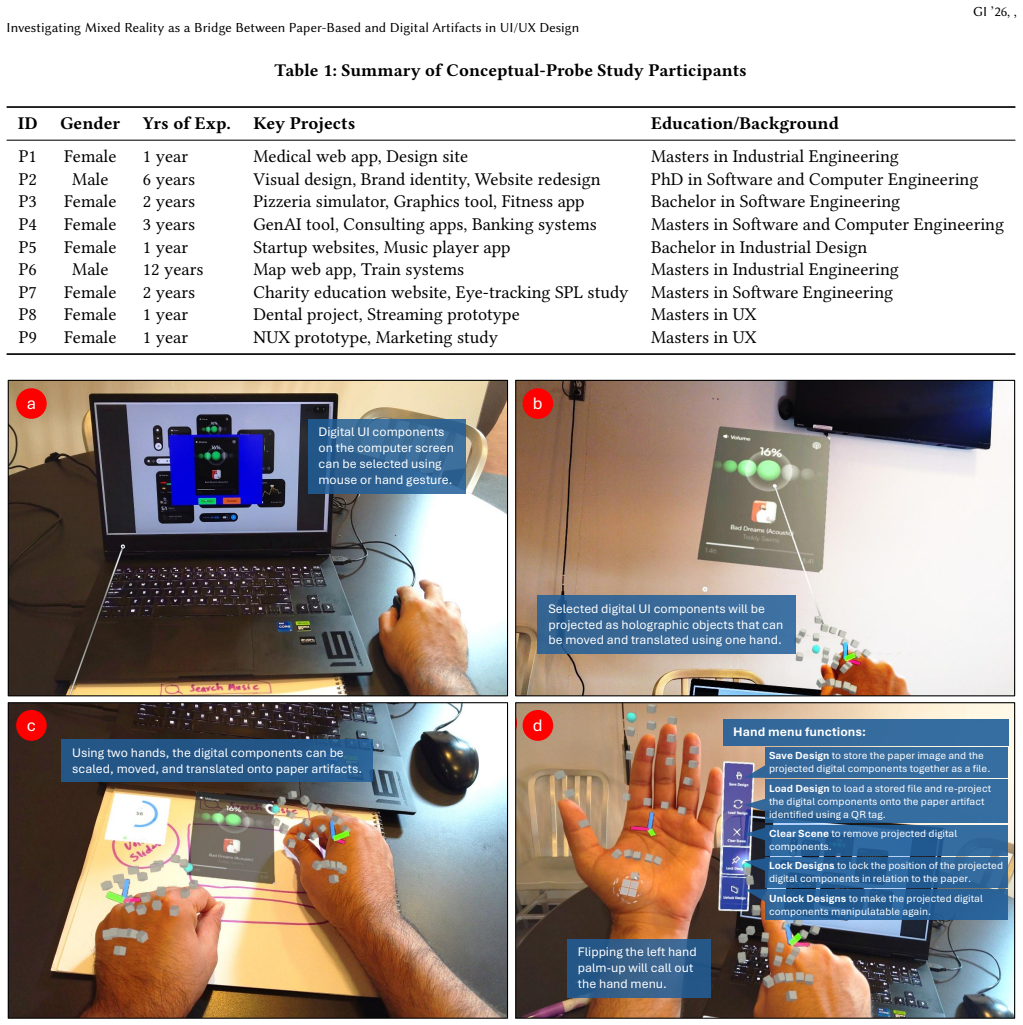
UI/UX designers work with both paper-based and digital artifacts but lack tools that seamlessly integrate the two. Mixed Reality (MR) offers under-explored opportunities to combine the strengths of both design environments. To examine these opportunities, we first conducted interviews with 19 professional UI/UX designers to understand their current experiences using paper and digital artifacts. Motivated and informed by the interview insights, we organized nine conceptual-probe user study sessions in which designers engaged with a MR-probe that combined paper and digital prototyping processes and brainstormed MR's potential in UI/UX design. We found that participants valued MR for enabling continuous hybrid design workflows, reducing manual reconstruction, supporting spatially anchored workspaces, and facilitating real-time cross-medium collaboration. They also envisioned future MR tools with AI assistance, richer interactive and dynamic content, and the ability to manage diverse design artifacts within a unified environment. From these findings, we derive four design dimensions for future MR systems that could enable more fluid, creative, and collaborative design practices.
Editorial analysis
A structured set of objections, weighed in public.
Referee Report
Summary. The manuscript reports results from interviews with 19 professional UI/UX designers on their current use of paper-based and digital artifacts, followed by nine conceptual-probe sessions in which designers interacted with an MR-probe that combined paper and digital prototyping processes. Participants expressed value in MR for enabling continuous hybrid workflows, reducing manual reconstruction, supporting spatially anchored workspaces, and facilitating real-time cross-medium collaboration. They also described visions for future MR tools incorporating AI assistance, richer interactive content, and unified management of diverse artifacts. From these data the authors derive four design dimensions intended to guide development of MR systems for more fluid, creative, and collaborative design practices.
Significance. If the empirical findings are robust, the work contributes exploratory HCI insights into an under-explored application area—using mixed reality to bridge longstanding paper-digital divides in UI/UX practice. The conceptual-probe method is well-suited to early-stage ideation, and the derivation of four design dimensions supplies concrete, falsifiable guidance for subsequent tool-building efforts. The study is appropriately scoped to participant reactions to the probe rather than claims about production-grade systems.
major comments (2)
- [Methods] Methods section: the manuscript supplies no information on participant recruitment criteria, interview protocol structure, data analysis procedure (e.g., coding scheme or inter-rater reliability), or the technical and interaction details of the MR-probe itself. These omissions are load-bearing because the central claims consist of participant valuations and derived design dimensions that cannot be evaluated for rigor, bias, or transferability without them.
- [Results/Discussion] Results and Discussion: the four design dimensions are presented as direct outputs of the probe sessions, yet the manuscript does not report how many participants contributed to each dimension or whether any dimensions emerged from only a minority of sessions. This weakens the claim that the dimensions represent broadly shared participant visions.
minor comments (1)
- [Abstract] Abstract: the phrase 'conceptual-probe user study sessions' is used without a brief parenthetical gloss on what a conceptual probe entails, which may confuse readers unfamiliar with the method.
Simulated Author's Rebuttal
We thank the referee for their constructive comments, which identify key areas where additional detail will strengthen the manuscript's transparency and evaluability. We respond to each major comment below.
read point-by-point responses
-
Referee: [Methods] Methods section: the manuscript supplies no information on participant recruitment criteria, interview protocol structure, data analysis procedure (e.g., coding scheme or inter-rater reliability), or the technical and interaction details of the MR-probe itself. These omissions are load-bearing because the central claims consist of participant valuations and derived design dimensions that cannot be evaluated for rigor, bias, or transferability without them.
Authors: We agree that the current Methods section is insufficiently detailed for assessing rigor and transferability. In the revised manuscript we will add: (1) recruitment criteria and channels for the 19 interviewees and nine probe-session participants; (2) the full structure of the semi-structured interview protocol; (3) the thematic-analysis procedure, including the coding scheme, number of coders, and steps taken to establish consistency; and (4) the technical implementation, hardware, software, and interaction mechanics of the MR-probe. These additions will directly address the load-bearing concerns. revision: yes
-
Referee: [Results/Discussion] Results and Discussion: the four design dimensions are presented as direct outputs of the probe sessions, yet the manuscript does not report how many participants contributed to each dimension or whether any dimensions emerged from only a minority of sessions. This weakens the claim that the dimensions represent broadly shared participant visions.
Authors: The dimensions were synthesized from recurring themes across the nine probe sessions. We acknowledge that the original manuscript does not quantify participant or session contributions per dimension. In revision we will add a table or textual breakdown indicating the number of sessions and participants that informed each dimension, while clarifying that the dimensions are exploratory, generative insights rather than claims of universal consensus. This will allow readers to judge the breadth of support for each dimension. revision: yes
Circularity Check
No significant circularity: empirical qualitative study grounded in participant data
full rationale
The paper reports an interview study (N=19) followed by nine conceptual-probe sessions whose outputs are summarized and used to derive four design dimensions. All load-bearing claims are explicitly tied to participant statements and probe interactions rather than any equation, fitted parameter, or self-citation chain. No mathematical derivation, uniqueness theorem, or ansatz is invoked. The central result is therefore a direct reporting and thematic synthesis of external data, not a reduction to the authors' own prior inputs.
Axiom & Free-Parameter Ledger
Reference graph
Works this paper leans on
-
[1]
Judith Amores, Xavier Benavides, and Pattie Maes. 2015. ShowMe: A Remote Collaboration System that Supports Immersive Gestural Communication. In Proceedings of the 33rd Annual ACM Conference Extended Abstracts on Human Factors in Computing Systems(Seoul Republic of Korea). ACM, New York, NY, USA, 1343–1348. doi:10.1145/2702613.2732927
-
[2]
Jodi Aronson. 1993. A Pragmatic View of Thematic Analysis.The Qualitative Report2, 1 (1993), 1–3. doi:10.46743/2160-3715/1995.2069
-
[3]
Narges Ashtari, Andrea Bunt, Joanna McGrenere, Michael Nebeling, and Parmit K. Chilana. 2020. Creating Augmented and Virtual Reality Applications: Current Practices, Challenges, and Opportunities. InProceedings of the 2020 CHI Conference on Human Factors in Computing Systems(2020-04-21). ACM, Honolulu HI USA, 1–13. doi:10.1145/3313831.3376722
-
[4]
Jonas Auda, Roman Heger, Uwe Gruenefeld, and Stefan Schneegass. 2021. VRS- ketch: Investigating 2D Sketching in Virtual Reality with Different Levels of Hand and Pen Transparency. InHuman-Computer Interaction – INTERACT 2021, Carmelo Ardito, Rosa Lanzilotti, Alessio Malizia, Helen Petrie, Antonio Piccinno, Giuseppe Desolda, and Kori Inkpen (Eds.). Vol. 12...
-
[5]
Julian Baader, Mats Ole Ellenberg, and Marc Satkowski. 2025. The Invisible Hand of the Context: Authoring of Context-Aware Mixed Reality Labels. InProceedings of the Mensch Und Computer 2025 (MuC ’25). ACM, New York, NY, USA, 738–743. doi:10.1145/3743049.3748552
-
[6]
Radka Bauerová, Michal Halaška, and Veronika Kopřivová. 2025. User Experience with Virtual Reality in Team-Based Prototyping and Brainstorming.International Journal of Human–Computer Interaction0, 0 (2025), 1–19. doi:10.1080/10447318. 2025.2474462
-
[7]
Christensen, Kim Halskov, and Clemens N
Bo T. Christensen, Kim Halskov, and Clemens N. Klokmose. 2020. Chapter 1 - The properties of sticky notes for collaborative creativity: An introduction. In Sticky Creativity, Bo T. Christensen, Kim Halskov, and Clemens N. Klokmose (Eds.). Academic Press, 1–16. doi:10.1016/B978-0-12-816566-9.00001-X
-
[8]
Tim Coughlan and Peter Johnson. 2008. Idea management in creative lives. InCHI ’08 Extended Abstracts on Human Factors in Computing Systems(Florence, Italy) (CHI EA ’08). ACM, New York, NY, USA, 3081–3086. doi:10.1145/1358628.1358811
-
[9]
Davis, T
Richard C. Davis, T. Scott Saponas, Michael Shilman, and James A. Landay
-
[10]
SketchWizard: Wizard of Oz prototyping of pen-based user interfaces. In Proceedings of the 20th Annual ACM Symposium on User Interface Software and Technology(Newport, Rhode Island, USA)(UIST ’07). ACM, New York, NY, USA, 119–128. doi:10.1145/1294211.1294233
-
[11]
Tobias Drey, Jan Gugenheimer, Julian Karlbauer, Maximilian Milo, and Enrico Rukzio. 2020. VRSketchIn: Exploring the Design Space of Pen and Tablet Interac- tion for 3D Sketching in Virtual Reality. InProceedings of the 2020 CHI Conference on Human Factors in Computing Systems(Honolulu HI USA, 2020-04-21). ACM, New York, NY, USA, 1–14. doi:10.1145/3313831.3376628
-
[12]
Hatana El-Jarn and Glen Southern. 2020. Can co-creation in extended reality technologies facilitate the design process?Journal of Work-Applied Management 12, 2 (2020), 191–205. doi:10.1108/JWAM-04-2020-0022
-
[13]
K. J. Kevin Feng, Tony W Li, and Amy X. Zhang. 2023. Understanding Collabo- rative Practices and Tools of Professional UX Practitioners in Software Organi- zations. InProceedings of the 2023 CHI Conference on Human Factors in Comput- ing Systems(Hamburg Germany, 2023-04-19). ACM, New York, NY, USA, 1–20. doi:10.1145/3544548.3581273
-
[14]
Mafalda Gamboa. 2022. Conversations with Myself: Sketching Workshop Ex- periences in Design Epistemology. InCreativity and Cognition(Venice Italy, 2022-06-20). ACM, New York, NY, USA, 71–82. doi:10.1145/3527927.3531450
-
[15]
Florian Geyer, Jochen Budzinski, and Harald Reiterer. 2012. IdeaVis: a hybrid workspace and interactive visualization for paper-based collaborative sketching sessions. InProceedings of the 7th Nordic Conference on Human-Computer Inter- action: Making Sense Through Design(Copenhagen Denmark). ACM, New York, NY, USA, 331–340. doi:10.1145/2399016.2399069
-
[16]
Jens Emil Sloth Grønbæk, Juan Sánchez Esquivel, Germán Leiva, Eduardo Velloso, Hans Gellersen, and Ken Pfeuffer. 2024. Blended Whiteboard: Physicality and Reconfigurability in Remote Mixed Reality Collaboration. InProceedings of the 2024 CHI Conference on Human Factors in Computing Systems(Honolulu)(CHI ’24). ACM, New York, USA, Article 798, 16 pages. doi...
-
[17]
Klemmer, Michael Bernstein, Leith Abdulla, Bran- don Burr, Avi Robinson-Mosher, and Jennifer Gee
Björn Hartmann, Scott R. Klemmer, Michael Bernstein, Leith Abdulla, Bran- don Burr, Avi Robinson-Mosher, and Jennifer Gee. 2006. Reflective physical prototyping through integrated design, test, and analysis. InProceedings of the 19th annual ACM symposium on User interface software and technology. ACM, Montreux Switzerland, 299–308. doi:10.1145/1166253.1166300
-
[18]
Mads Møller Jensen, Sarah-Kristin Thiel, Eve Hoggan, and Susanne Bødker. 2018. Physical Versus Digital Sticky Notes in Collaborative Ideation.Comput. Supported Coop. Work27, 3 (2018), 609–645. doi:10.1007/s10606-018-9325-1
-
[19]
Matthew G. Jervis and Masood Masoodian. 2010. SOPHYA: a system for digital management of ordered physical document collections. InProceedings of the Fourth International Conference on Tangible, Embedded, and Embodied Interaction (Cambridge, Massachusetts, USA)(TEI ’10). ACM, New York, NY, USA, 33–40. doi:10.1145/1709886.1709894
-
[20]
Ben Jonson. 2005. Design ideation: the conceptual sketch in the digital age. Design Studies26, 6 (2005), 613–624. doi:10.1016/j.destud.2005.03.001
-
[21]
Lee Kent, Chris Snider, James Gopsill, and Ben Hicks. 2021. Mixed reality in design prototyping: A systematic review.Design Studies77 (2021), 101046. doi:10. 1016/j.destud.2021.101046
arXiv 2021
-
[22]
Scott R. Klemmer, Katherine M. Everitt, and James A. Landay. 2008. Integrating Physical and Digital Interactions on Walls for Fluid Design Collaboration.Hu- man–Computer Interaction23, 2 (2008), 138–213. doi:10.1080/07370020802016399
-
[23]
Scott R. Klemmer, Mark W. Newman, Ryan Farrell, Mark Bilezikjian, and James A. Landay. 2001. The designers’ outpost: a tangible interface for collaborative web site. InProceedings of the 14th annual ACM symposium on User interface software and technology. ACM, Orlando Florida, 1–10. doi:10.1145/502348.502350
-
[24]
Zhen Li, Michelle Annett, Ken Hinckley, Karan Singh, and Daniel Wigdor. 2019. HoloDoc: Enabling Mixed Reality Workspaces that Harness Physical and Digital Content. InProceedings of the 2019 CHI Conference on Human Factors in Computing Systems(Glasgow, Scotland Uk)(CHI ’19). Association for Computing Machinery, New York, NY, USA, 1–14. doi:10.1145/3290605.3300917
-
[25]
Zhipeng Li, Christoph Gebhardt, Yves Inglin, Nicolas Steck, Paul Streli, and Christian Holz. 2024. SituationAdapt: Contextual UI Optimization in Mixed Reality with Situation Awareness via LLM Reasoning. InProceedings of the 37th Annual ACM Symposium on User Interface Software and Technology(Pittsburgh) (UIST ’24). ACM, New York, Article 43, 13 pages. doi:...
-
[26]
Youn-Kyung Lim, Erik Stolterman, and Josh Tenenberg. 2008. The anatomy of prototypes: Prototypes as filters, prototypes as manifestations of design ideas. ACM Trans. Comput.-Hum. Interact.15, 2, Article 7 (July 2008), 27 pages. doi:10. 1145/1375761.1375762
arXiv 2008
-
[27]
James Lin, Mark W. Newman, Jason I. Hong, and James A. Landay. 2000. DENIM: finding a tighter fit between tools and practice for Web site design. InProceedings of the SIGCHI Conference on Human Factors in Computing Systems(The Hague, The Netherlands)(CHI ’00). ACM, New York, NY, USA, 510–517. doi:10.1145/ 332040.332486
arXiv 2000
-
[28]
Michael McCurdy, Christopher Connors, Guy Pyrzak, Bob Kanefsky, and Alonso Vera. 2006. Breaking the fidelity barrier: an examination of our current charac- terization of prototypes and an example of a mixed-fidelity success. InPro- ceedings of the SIGCHI Conference on Human Factors in Computing Systems (Montréal, Québec, Canada)(CHI ’06). ACM, New York, N...
-
[29]
Inoussa Ouedraogo, Huyen Nguyen, and Patrick Bourdot. 2024. Where to Draw the Line: Physical Space Partitioning and View Privacy in AR-based Co-located Collaboration for Immersive Analytics. InProceedings of the 2024 ACM Symposium on Spatial User Interaction(Trier, Germany)(SUI ’24). ACM, New York, NY, USA, Article 20, 12 pages. doi:10.1145/3677386.3682085
-
[30]
Shwetha Rajaram and Michael Nebeling. 2022. Paper Trail: An Immersive Author- ing System for Augmented Reality Instructional Experiences. InCHI Conference on Human Factors in Computing Systems(2022-04-29). ACM, New Orleans LA USA, 1–16. doi:10.1145/3491102.3517486
-
[31]
Reinhard Sefelin, Manfred Tscheligi, and Verena Giller. 2003. Paper prototyping - what is it good for? a comparison of paper- and computer-based low-fidelity prototyping. InCHI ’03 Extended Abstracts on Human Factors in Computing Systems(Ft. Lauderdale, Florida, USA)(CHI EA ’03). ACM, New York, NY, USA, 778–779. doi:10.1145/765891.765986
-
[32]
Maximilian Speicher, Brian D. Hall, and Michael Nebeling. 2019. What is Mixed Reality?. InProceedings of the 2019 CHI Conference on Human Factors in Computing Systems. ACM, New York, NY, USA, 1–15. doi:10.1145/3290605.3300767
-
[33]
Mojtaba Vaismoradi, Hannele Turunen, and Terese Bondas. 2013. Content analy- sis and thematic analysis: Implications for conducting a qualitative descriptive study.Nursing & Health Sciences15, 3 (2013), 398–405. doi:10.1111/nhs.12048 Investigating Mixed Reality as a Bridge Between Paper-Based and Digital Artifacts in UI/UX Design GI ’26, ,
-
[34]
Remko van der Lugt. 2002. Functions of sketching in design idea generation meet- ings. InProceedings of the 4th Conference on Creativity & Cognition(Loughborough, UK)(C&C ’02). ACM, New York, NY, USA, 72–79. doi:10.1145/581710.581723
-
[35]
Hongbo Zhang, Pei Chen, Xuelong Xie, Zhaoqu Jiang, Zihong Zhou, and Lingyun Sun. 2024. A Hybrid Prototype Method Combining Physical Models and Genera- tive Artificial Intelligence to Support Creativity in Conceptual Design.ACM Trans. Comput.-Hum. Interact.31, 5, Article 65 (Nov. 2024), 34 pages. doi:10.1145/3689433
-
[36]
Shih, Ellen Yi-Luen Do, Malte F Jung, Wendy Ju, and Daniel Leithinger
Yuzhen Zhang, Ruixiang Han, Ran Zhou, Peter Gyory, Clement Zheng, Patrick C. Shih, Ellen Yi-Luen Do, Malte F Jung, Wendy Ju, and Daniel Leithinger. 2024. Wizard of Props: Mixed Reality Prototyping with Physical Props to Design Re- sponsive Environments. InProceedings of the Eighteenth International Conference on Tangible, Embedded, and Embodied Interactio...
discussion (0)
Sign in with ORCID, Apple, or X to comment. Anyone can read and Pith papers without signing in.