Deep Image Prototype Learning with Geometric Heat-Kernel Priors
Pith reviewed 2026-06-30 10:21 UTC · model grok-4.3
The pith
A geometry-aware EM step selects heat-kernel graph medoids to keep variational image prototypes on the data manifold.
A machine-rendered reading of the paper's core claim, the machinery that carries it, and where it could break.
Core claim
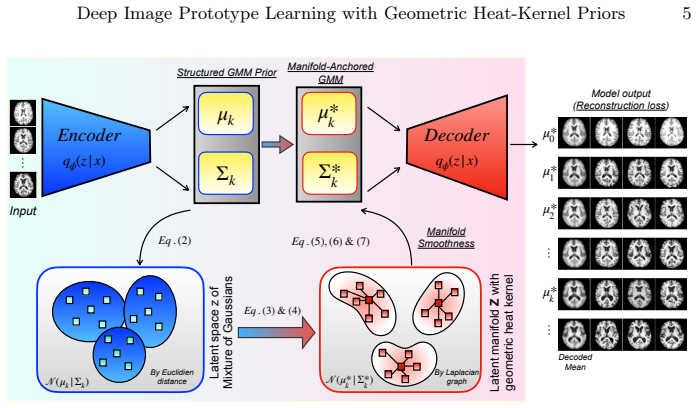
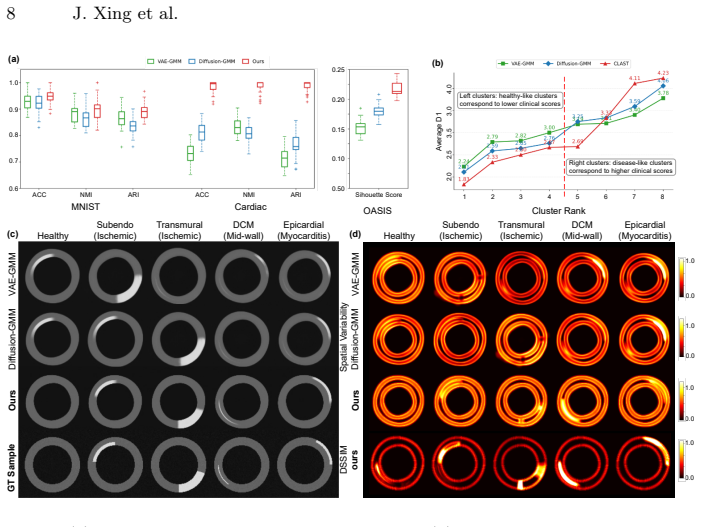
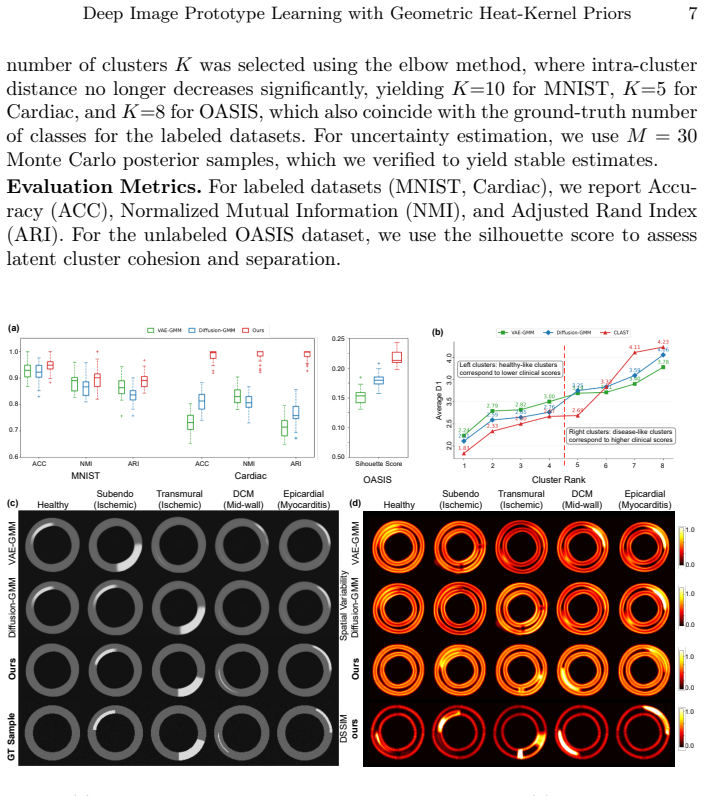
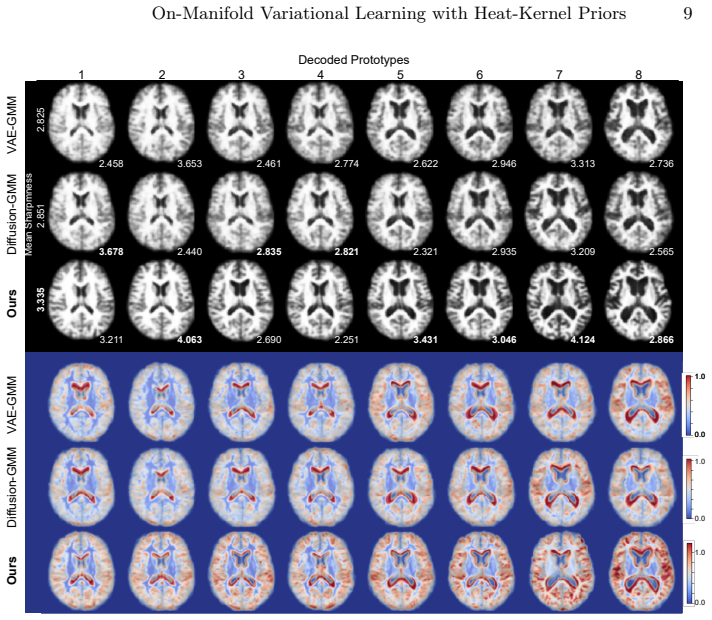
The central claim is that a manifold-anchored variational framework built on a geometry-aware Expectation-Maximization algorithm, whose M-step selects each sub-population prototype as the graph medoid with the highest diffusion centrality on a heat-kernel-weighted latent graph, ensures that every prototype remains on-manifold, yielding higher accuracy, sharper prototypes, and stability at large sub-population counts on cardiac scar and brain MRI data.
What carries the argument
The manifold-anchored EM algorithm that replaces Euclidean prototype averaging with selection of the highest-diffusion-centrality medoid on a heat-kernel-weighted latent graph.
If this is right
- Every prototype is guaranteed to lie on the data manifold rather than drifting into off-manifold regions.
- The framework remains accurate and produces sharp prototypes at high sub-population counts where Gaussian mixture baselines degenerate.
- A Dirichlet energy regularizer enforces geometric smoothness throughout the latent space.
- A per-sub-population uncertainty score supplies label-free quality assessment without expert annotations.
- The same manifold-anchored EM step can be applied as a general geometric tool to other latent-variable models.
Where Pith is reading between the lines
- The heat-kernel construction may allow the method to handle noisy or incomplete medical labels more gracefully than Euclidean priors.
- The uncertainty scores could be repurposed for active learning or for identifying atypical scans in a clinical cohort.
- Because the EM step is presented as model-agnostic, it could be inserted into other variational autoencoders that currently rely on isotropic Gaussian mixtures.
- Extending the same diffusion-centrality selection to non-image modalities such as time-series or point clouds would test whether the manifold-anchoring benefit generalizes.
Load-bearing premise
That selecting the graph medoid with highest diffusion centrality on the heat-kernel-weighted latent graph is sufficient to keep every prototype on the true data manifold.
What would settle it
Showing that the selected medoids produce higher reconstruction error or lie farther from the data support (by geodesic distance) than Euclidean means, or that accuracy collapses at large sub-population counts on the cardiac and brain MRI benchmarks, would falsify the on-manifold guarantee.
Figures
read the original abstract
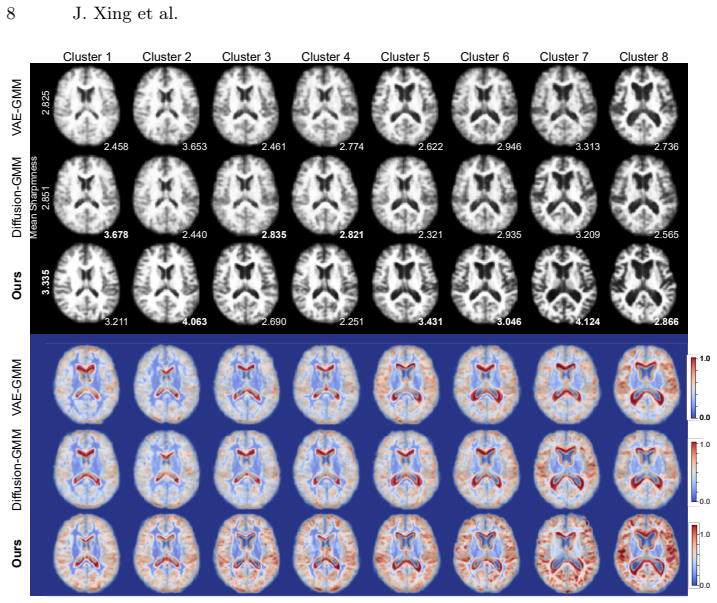
Learning unsupervised representations of medical imaging cohorts can reveal anatomically meaningful prototypes without expert labels, which are often noisy and fail to capture true pathological heterogeneity. However, existing deep latent-variable models estimate Gaussian mixture priors via Euclidean averaging, producing prototypes that drift off the curved data manifold and degenerate as the number of sub-populations grows. We propose a manifold-anchored variational framework built on a geometry-aware Expectation-Maximization (EM) algorithm, whose M-step selects each sub-population prototype as the graph medoid with the highest diffusion centrality on a heat-kernel-weighted latent graph, ensuring that every prototype remains on-manifold. A Dirichlet energy regularizer enforces geometric smoothness of the latent space, and a per-sub-population uncertainty score enables label-free quality assessment. The manifold-anchored EM is a general-purpose geometric tool that extends standard EM and applies readily to other latent-variable models beyond this setting. On cardiac scar and brain MRI benchmarks, our framework attains the highest accuracy among all compared methods, produces the sharpest prototypes reported to date, and remains stable at large sub-population counts where all baselines degenerate. Code and implementation details are available at https://github.com/jr-xing/On-Manifold-Variational-Learning-with-Heat-Kernel-Priors.
Editorial analysis
A structured set of objections, weighed in public.
Referee Report
Summary. The paper proposes a manifold-anchored variational framework for unsupervised prototype learning in medical imaging cohorts. It replaces Euclidean averaging in standard EM with a geometry-aware M-step that selects each prototype as the graph medoid of highest diffusion centrality on a heat-kernel-weighted latent graph, thereby keeping prototypes on the observed data manifold by construction. A Dirichlet energy regularizer promotes latent-space smoothness and a per-subpopulation uncertainty score supports label-free assessment. The method is presented as a general-purpose extension of EM. On cardiac scar and brain MRI benchmarks the framework reports the highest accuracy, sharpest prototypes, and stability at large subpopulation counts where baselines degenerate. Code is released.
Significance. If the empirical claims hold, the work supplies a practical geometric fix for manifold drift in deep mixture models, a recurring issue in medical imaging where Euclidean prototypes lose anatomical fidelity. The explicit construction that every prototype is an observed data point, the release of code, and the framing as a reusable EM extension are concrete strengths. The approach could improve interpretability of learned subpopulations without requiring additional supervision.
major comments (1)
- [Abstract, §3] Abstract and §3 (M-step description): the stability claim at large subpopulation counts is load-bearing for the central contribution, yet the provided text gives no quantitative definition of 'large' (e.g., K=20, K=50) nor reports the precise metric values and variance across runs that would demonstrate non-degeneration relative to the baselines.
minor comments (2)
- [Abstract] The abstract states that the method 'attains the highest accuracy among all compared methods' but does not name the exact datasets (e.g., specific cardiac scar or brain MRI cohorts) or the accuracy metric (Dice, Hausdorff, etc.).
- [§3] Notation for the heat-kernel-weighted latent graph and diffusion centrality is introduced without an explicit equation reference in the visible text; a numbered definition would aid reproducibility.
Simulated Author's Rebuttal
We thank the referee for the positive assessment and the recommendation of minor revision. The single major comment identifies a genuine gap in the presentation of the stability claim; we address it directly below and will revise accordingly.
read point-by-point responses
-
Referee: [Abstract, §3] Abstract and §3 (M-step description): the stability claim at large subpopulation counts is load-bearing for the central contribution, yet the provided text gives no quantitative definition of 'large' (e.g., K=20, K=50) nor reports the precise metric values and variance across runs that would demonstrate non-degeneration relative to the baselines.
Authors: We agree that the abstract and §3 would be strengthened by an explicit quantitative definition of 'large' and by the corresponding metric values with variance. In the revised manuscript we will (i) update the abstract to state that stability holds for subpopulation counts up to K=50, (ii) add a short clarifying sentence in §3 that defines 'large' as K ≥ 30, and (iii) insert a new table (or extended figure) in the experiments section that reports, for K = 10, 20, 30, 50 on both cardiac and brain MRI benchmarks, the mean and standard deviation (over 5 independent runs) of accuracy, prototype sharpness, and a stability metric (e.g., average pairwise prototype distance or clustering purity). These numbers will be contrasted directly with the Euclidean GMM baselines to demonstrate non-degeneration. revision: yes
Circularity Check
No significant circularity
full rationale
The paper describes a geometry-aware EM algorithm whose M-step explicitly selects each prototype as the graph medoid of highest diffusion centrality on a heat-kernel-weighted latent graph. This is an algorithmic design choice that keeps prototypes on the observed data manifold by selecting existing points rather than performing Euclidean averaging. No equations, self-citations, or fitted parameters are presented that reduce the manifold-anchoring property, the Dirichlet regularizer, or the reported empirical performance gains to inputs defined by the same data. The framework is positioned as a general-purpose extension of standard EM, with performance claims resting on benchmark comparisons and released code rather than any self-referential derivation.
Axiom & Free-Parameter Ledger
axioms (1)
- domain assumption Medical imaging cohorts lie on a curved data manifold that Euclidean averaging violates
invented entities (1)
-
heat-kernel-weighted latent graph
no independent evidence
Reference graph
Works this paper leans on
-
[1]
In: Proceedings of the Computer Vision and Pattern Recognition Conference
Abulnaga, S.M., Hoopes, A., Dey, N., Hoffmann, M., Fischl, B., Guttag, J., Dalca, A.: Multimorph: On-demand atlas construction. In: Proceedings of the Computer Vision and Pattern Recognition Conference. pp. 30906–30917 (2025)
2025
-
[2]
In: International Conference on Learning Representations (ICLR) (2018)
Arvanitidis,G.,Hansen,L.K.,Hauberg,S.:Latentspaceoddity:onthecurvatureof deep generative models. In: International Conference on Learning Representations (ICLR) (2018)
2018
-
[3]
In: International Conference on Artificial Intelligence and Statistics (AISTATS)
Arvanitidis, G., Hauberg, S., Schölkopf, B.: Geometrically enriched latent spaces. In: International Conference on Artificial Intelligence and Statistics (AISTATS). pp. 631–639. PMLR (2021)
2021
-
[4]
Nature Biomedical Engineering7(6), 756–779 (2023)
Azizi, S., Mustafa, B., Ryan, F., Beaver, Z., Freyberg, J., Deaton, J., Loh, A., Karthikesalingam, A., Kornblith, S., Chen, T., Natarajan, V., Norouzi, M.: Robust and data-efficient generalization of self-supervised machine learning for diagnostic imaging. Nature Biomedical Engineering7(6), 756–779 (2023)
2023
-
[5]
Journal of Neuropathology & Experimental Neurology71(4), 266–273 (2012)
Beach, T.G., Monsell, S.E., Phillips, L.E., Kukull, W.: Accuracy of the clinical diagnosis of Alzheimer disease at National Institute on Aging Alzheimer Disease Centers, 2005–2010. Journal of Neuropathology & Experimental Neurology71(4), 266–273 (2012)
2005
-
[6]
In: International Conference on Machine Learning (ICML)
Chen, T., Kornblith, S., Norbert, M., Hinton, G.: A simple framework for con- trastive learning of visual representations. In: International Conference on Machine Learning (ICML). pp. 1597–1607. PMLR (2020)
2020
-
[7]
Advances in Neural Information Processing Systems32(2019)
Dalca, A.V., Rakic, M., Guttag, J., Sabuncu, M.R.: Learning conditional de- formable templates with convolutional networks. Advances in Neural Information Processing Systems32(2019)
2019
-
[8]
Deep Unsupervised Clustering with Gaussian Mixture Variational Autoencoders
Dilokthanakul, N., Mediano, P.A.M., Garnelo, M., Lee, M.C.H., Salimbeni, H., Arulkumaran, K., Shanahan, M.: Deep unsupervised clustering with Gaussian mix- ture variational autoencoders. arXiv preprint arXiv:1611.02648 (2016) 10 J. Xing et al
work page internal anchor Pith review Pith/arXiv arXiv 2016
-
[9]
Nature 542(7639), 115–118 (2017)
Esteva, A., Kuprel, B., Novoa, R.A., Ko, J., Swetter, S.M., Blau, H.M., Thrun, S.: Dermatologist-level classification of skin cancer with deep neural networks. Nature 542(7639), 115–118 (2017)
2017
-
[10]
JAMA316(22), 2402–2410 (2016)
Gulshan, V., Peng, L., Coram, M., Stumpe, M.C., Wu, D., Narayanaswamy, A., Venugopalan, S., Widner, K., Madams, T., Cuadros, J., et al.: Development and validation of a deep learning algorithm for detection of diabetic retinopathy in retinal fundus photographs. JAMA316(22), 2402–2410 (2016)
2016
-
[11]
In: Proceedings of the IEEE/CVF Conference on Computer Vision and Pattern Recognition (CVPR)
He, K., Fan, H., Wu, Y., Xie, S., Girshick, R.: Momentum contrast for unsupervised visual representation learning. In: Proceedings of the IEEE/CVF Conference on Computer Vision and Pattern Recognition (CVPR). pp. 9729–9738 (2020)
2020
-
[12]
In: Advances inNeuralInformationProcessingSystems(NeurIPS).vol.33,pp.6840–6851(2020)
Ho, J., Jain, A., Abbeel, P.: Denoising diffusion probabilistic models. In: Advances inNeuralInformationProcessingSystems(NeurIPS).vol.33,pp.6840–6851(2020)
2020
-
[13]
Nature (2025)
Iglesias, J.E., et al.: A probabilistic histological atlas of the human brain for MRI segmentation. Nature (2025)
2025
-
[14]
Journal of Magnetic Res- onance Imaging27(4), 685–691 (2008)
Jack, C.R., Bernstein, M.A., Fox, N.C., Thompson, P., Alexander, G., Harvey, D., Borowski, B., Britson, P.J., Whitwell, J.L., Ward, C., et al.: The Alzheimer’s Disease Neuroimaging Initiative (ADNI): MRI methods. Journal of Magnetic Res- onance Imaging27(4), 685–691 (2008)
2008
-
[15]
The Lancet Neurology12(2), 207–216 (2013)
Jack, C.R., Knopman, D.S., Jagust, W.J., Petersen, R.C., Weiner, M.W., Aisen, P.S., Shaw, L.M., Vemuri, P., Wiste, H.J., Weigand, S.D., et al.: Tracking patho- physiological processes in Alzheimer’s disease: an updated hypothetical model of dynamic biomarkers. The Lancet Neurology12(2), 207–216 (2013)
2013
-
[16]
In: International Joint Conference on Artificial Intelligence (IJCAI)
Jiang, Z., Zheng, Y., Tan, H., Tang, B., Zhou, H.: Variational deep embedding: an unsupervised and generative approach to clustering. In: International Joint Conference on Artificial Intelligence (IJCAI). pp. 1965–1972 (2017)
1965
-
[17]
Medical Image Analysis88, 102846 (2023)
Kazerouni, A., Aghdam, E.K., Heidari, M., Azad, R., Fayyaz, M., Hacihaliloglu, I., Merhof, D.: Diffusion models in medical imaging: a comprehensive survey. Medical Image Analysis88, 102846 (2023)
2023
-
[18]
In: International Conference on Learning Representations (ICLR) (2014)
Kingma, D.P., Welling, M.: Auto-encoding variational Bayes. In: International Conference on Learning Representations (ICLR) (2014)
2014
-
[19]
Frontiers in Physiology12, 709230 (2022)
Li, L., Wu, F., Yang, G., Xu, L., Wong, T., Mohiaddin, R., Firmin, D., Keegan, J., Zhuang, X.: Recent advances in fibrosis and scar segmentation from cardiac MRI: a state-of-the-art review and future perspectives. Frontiers in Physiology12, 709230 (2022)
2022
-
[20]
Neuro-Oncology 23(8), 1231–1251 (2021)
Louis, D.N., Perry, A., Wesseling, P., Brat, D.J., Cree, I.A., Figarella-Branger, D., Hawkins, C., Ng, H.K., Pfister, S.M., Reifenberger, G., et al.: The 2021 WHO classification of tumors of the central nervous system: a summary. Neuro-Oncology 23(8), 1231–1251 (2021)
2021
-
[21]
Marcus, D.S., Wang, T.H., Parker, J., Csernansky, J.G., Morris, J.C., Buckner, R.L.: Open access series of imaging studies (OASIS): cross-sectional MRI data in young,middleaged,nondemented,anddementedolderadults.JournalofCognitive Neuroscience19(9), 1498–1507 (2007)
2007
-
[22]
Biological Psychiatry80(7), 552–561 (2016)
Marquand, A.F., Rezek, I., Buitelaar, J., Beckmann, C.F.: Understanding hetero- geneity in clinical cohorts using normative models: beyond case-control studies. Biological Psychiatry80(7), 552–561 (2016)
2016
-
[23]
IEEE Access6, 39501–39514 (2018)
Min, E., Guo, X., Liu, Q., Zhang, G., Cui, J., Long, J.: A survey of clustering with deep learning: from the perspective of network architecture. IEEE Access6, 39501–39514 (2018)
2018
-
[24]
In: Advances in Neural Information Processing Systems (NeurIPS)
Ng, A.Y., Jordan, M.I., Weiss, Y.: On spectral clustering: analysis and an algo- rithm. In: Advances in Neural Information Processing Systems (NeurIPS). vol. 14 (2001) Deep Image Prototype Learning with Geometric Heat-Kernel Priors 11
2001
-
[25]
In: Medical Image Computing and Computer Assisted Intervention (MICCAI)
Ou, Z., Jiang, C., Liu, Y., Zhang, Y., Cui, Z., Shen, D.: A graph-embedded la- tent space learning and clustering framework for incomplete multimodal multi- class Alzheimer’s disease diagnosis. In: Medical Image Computing and Computer Assisted Intervention (MICCAI). pp. 45–55. Springer (2024)
2024
-
[26]
In: Medical Image Computing and Computer Assisted Intervention (MICCAI)
Peng, W., Adeli, E., Zhao, Q., Pohl, K.M.: Generating realistic 3D brain MRIs using a conditional diffusion probabilistic model. In: Medical Image Computing and Computer Assisted Intervention (MICCAI). pp. 14–24. Springer (2023)
2023
-
[27]
Neurology74(3), 201–209 (2010)
Petersen, R.C., Aisen, P.S., Beckett, L.A., Donohue, M.C., Gamst, A.C., Harvey, D.J.,Jack,C.R.,Jagust,W.J.,Shaw,L.M.,Toga,A.W.,Trojanowski,J.Q.,Weiner, M.W.: Alzheimer’s Disease Neuroimaging Initiative (ADNI): clinical characteriza- tion and 12-month follow-up. Neurology74(3), 201–209 (2010)
2010
-
[28]
In: Proceedings of the IEEE/CVF Conference on Computer Vision and Pattern Recognition (CVPR)
Rombach, R., Blattmann, A., Lorenz, D., Esser, P., Ommer, B.: High-resolution image synthesis with latent diffusion models. In: Proceedings of the IEEE/CVF Conference on Computer Vision and Pattern Recognition (CVPR). pp. 10684– 10695 (2022)
2022
-
[29]
Wang, P., Zhang, H., Zhang, Z., Chen, S., Ma, Y., Qu, Q.: Diffusion mod- els learn low-dimensional distributions via subspace clustering. arXiv preprint arXiv:2409.02426 (2024)
work page internal anchor Pith review Pith/arXiv arXiv 2024
-
[30]
In: International Conference on Machine Learning (ICML)
Xie, J., Girshick, R., Farhadi, A.: Unsupervised deep embedding for clustering analysis. In: International Conference on Machine Learning (ICML). pp. 478–487. PMLR (2016)
2016
discussion (0)
Sign in with ORCID, Apple, or X to comment. Anyone can read and Pith papers without signing in.