Thermodynamics of photonic nonlinear Aharonov-Bohm cages
Pith reviewed 2026-06-26 19:19 UTC · model grok-4.3
The pith
In photonic diamond lattices with Kerr nonlinearity, tuning synthetic magnetic flux to the Aharonov-Bohm caging condition turns the system from conductor to insulator at weak nonlinearity.
A machine-rendered reading of the paper's core claim, the machinery that carries it, and where it could break.
Core claim
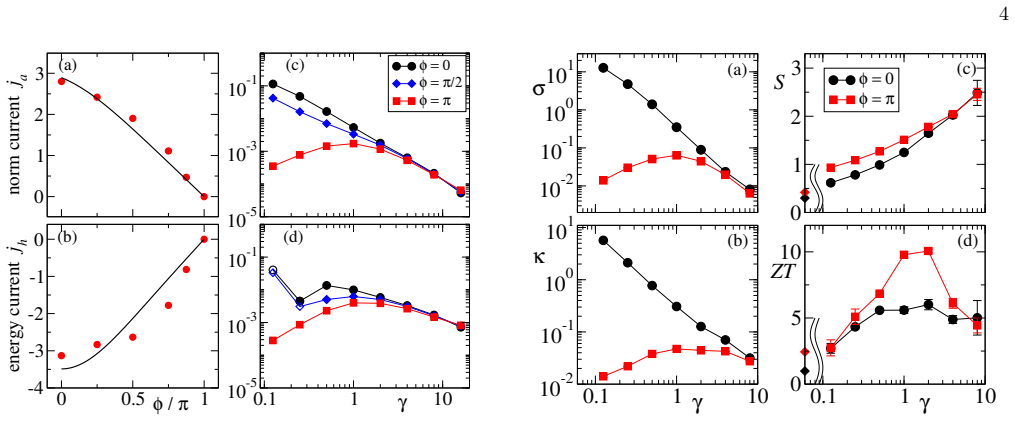
The equilibrium phase diagram of the photonic diamond lattice is obtained as a function of the synthetic magnetic flux. In the linear regime the flux induces Aharonov-Bohm caging, flattening all Bloch bands and suppressing currents. Nonlinearity enables currents inside the caging regime. With imposed temperature and chemical-potential imbalances at the boundaries, weak nonlinearity plus flux tuned to the caging condition converts the system from conductor to insulator. At intermediate nonlinearity the system conducts for all fluxes, yet the caging condition enhances the Seebeck coefficient and thermoelectric figure of merit, offering a route to optimize coupled transport devices by controlli
What carries the argument
Aharonov-Bohm caging induced by synthetic magnetic flux per plaquette, which flattens Bloch bands and blocks currents in the linear regime and is modified by Kerr nonlinearity to control transport.
If this is right
- At weak nonlinearity, fine tuning the flux at the Aharonov-Bohm caging condition transforms the system from a conductor to an insulator.
- At intermediate nonlinear strength the system remains conducting for all magnetic fluxes, yet the caging condition significantly enhances the Seebeck coefficient and thermoelectric figure of merit.
- Control of linear versus nonlinear conduction channels via synthetic magnetic flux provides a route toward optimization of coupled transport devices.
Where Pith is reading between the lines
- The same flux-tuning mechanism could be tested in other nonlinear flat-band lattices to see whether thermoelectric enhancement appears generically at the caging point.
- Realization in optical waveguide arrays would allow direct observation of the predicted conductor-insulator transition as a function of nonlinearity strength.
- The enhancement of thermoelectric performance at the caging condition may suggest design principles for flux-controlled photonic heat engines.
Load-bearing premise
The linear regime of the photonic diamond lattice exhibits complete Aharonov-Bohm caging that flattens all Bloch bands and suppresses currents.
What would settle it
Direct measurement of whether particle or energy current drops to zero precisely when flux is set to the caging value at weak nonlinearity, while remaining finite at other flux values or at stronger nonlinearity.
Figures



read the original abstract
We investigate equilibrium and non-equilibrium thermodynamics of one-dimensional photonic diamond lattices with Kerr nonlinearity. The equilibrium phase diagram is obtained as a function of the synthetic magnetic flux acting on each plaquette. In the linear regime, the magnetic flux can induce Aharonov-Bohm caging, flattening all Bloch bands and suppressing particle and energy currents. In this caging regime, non-vanishing currents are enabled by nonlinearity. By imposing stationary temperature- and chemical potential- imbalances at the system boundaries, we show that at weak nonlinearity fine tuning the flux at the Aharonov-Bohm caging transforms the system from a conductor to an insulator. For intermediate nonlinear strength, the system remains conducting for all magnetic fluxes; however, the caging condition significantly enhances the Seebeck coefficient and thermoelectric figure of merit, improving the thermoelectric features of the system. Our results give evidence of a novel route towards optimization of coupled transport devices, based on the control of linear versus nonlinear conduction channels via a synthetic magnetic flux.
Editorial analysis
A structured set of objections, weighed in public.
Referee Report
Summary. The manuscript examines equilibrium and non-equilibrium thermodynamics in one-dimensional photonic diamond lattices subject to Kerr nonlinearity and synthetic magnetic flux per plaquette. In the linear limit the flux induces Aharonov-Bohm caging that flattens all Bloch bands and suppresses both particle and energy currents; finite nonlinearity restores non-zero currents inside the caging regime. The central claims are that, at weak nonlinearity, fine-tuning the flux exactly to the caging condition drives a conductor-to-insulator transition, while at intermediate nonlinearity the system remains conducting for all fluxes yet the caging condition markedly increases the Seebeck coefficient and the thermoelectric figure of merit.
Significance. If the reported conductor-insulator transition and the flux-enhanced thermoelectric performance are quantitatively confirmed, the work supplies a concrete, flux-tunable mechanism for separating linear and nonlinear transport channels in photonic lattices. This route to thermoelectric optimization is distinct from conventional band-engineering approaches and could be relevant for synthetic-gauge-field platforms.
major comments (2)
- [§3] §3 (or the section presenting the non-equilibrium steady-state calculation): the conductor-to-insulator transition at weak nonlinearity is asserted to occur precisely at the linear caging flux, yet no explicit expression for the nonlinear current or the critical nonlinearity strength is given; the transition appears to rest on a numerical observation whose convergence with system size and boundary conditions is not quantified.
- The definition of the Seebeck coefficient and figure of merit (presumably in the transport-coefficient section) is not shown; it is unclear whether these quantities are extracted from the full nonlinear steady-state solution or from a linearized response around the caging point, which would affect the claimed enhancement.
minor comments (2)
- The abstract states that 'all Bloch bands' are flattened, but the diamond lattice dispersion is only sketched; an explicit band-structure plot or analytic expression for the linear spectrum would clarify the caging condition.
- Notation for the Kerr coefficient and the flux per plaquette is introduced without a dedicated table of symbols; consistency with standard photonic-lattice conventions should be checked.
Simulated Author's Rebuttal
We thank the referee for the careful reading and constructive comments. Below we respond point-by-point to the major remarks and indicate the revisions that will be incorporated.
read point-by-point responses
-
Referee: [§3] §3 (or the section presenting the non-equilibrium steady-state calculation): the conductor-to-insulator transition at weak nonlinearity is asserted to occur precisely at the linear caging flux, yet no explicit expression for the nonlinear current or the critical nonlinearity strength is given; the transition appears to rest on a numerical observation whose convergence with system size and boundary conditions is not quantified.
Authors: We agree that the presentation of the conductor-to-insulator transition can be strengthened. The nonlinear current is obtained by solving the steady-state Lindblad master equation for the open system (Sec. III); an analytic closed-form expression for the critical nonlinearity strength is not available because of the many-body character of the Kerr interaction. In the revised manuscript we will (i) write the explicit expression for the steady-state particle current in terms of the density-matrix elements and (ii) add a paragraph plus supplementary data quantifying finite-size convergence (N = 4, 6, 8) and the effect of different boundary reservoirs. revision: yes
-
Referee: The definition of the Seebeck coefficient and figure of merit (presumably in the transport-coefficient section) is not shown; it is unclear whether these quantities are extracted from the full nonlinear steady-state solution or from a linearized response around the caging point, which would affect the claimed enhancement.
Authors: The Seebeck coefficient is defined as S = Δμ/ΔT evaluated at vanishing particle current J = 0 and is obtained directly from the full nonlinear steady-state solution by imposing a temperature bias and adjusting the chemical-potential bias until J vanishes. The figure of merit ZT is then constructed from this S together with the nonlinear electrical and thermal conductances computed in the same steady state. We will add the explicit definitions and a sentence clarifying that all quantities are extracted from the nonlinear solution, not from linear-response theory around the caging point. revision: yes
Circularity Check
No significant circularity detected
full rationale
The abstract and available summary describe a standard linear Aharonov-Bohm caging reference (flat bands, suppressed currents) perturbed by Kerr nonlinearity, with transport coefficients extracted from boundary imbalances. No equations, self-citations, fitted parameters renamed as predictions, or ansatzes are presented that reduce the central claims (conductor-insulator transition or Seebeck enhancement) to inputs by construction. The linear reference is invoked as an external benchmark rather than defined circularly from the nonlinear results, and the derivation chain appears self-contained against external physical assumptions.
Axiom & Free-Parameter Ledger
Reference graph
Works this paper leans on
-
[1]
Leykam, A
D. Leykam, A. Andreanov, and S. Flach, Artificial flat band systems: from lattice models to experiments, Adv. Phys.: X3, 1473052 (2018)
2018
-
[2]
Rhim and B.-J
J.-W. Rhim and B.-J. Yang, Singular flat bands, Ad- vances in Physics: X6, 1901606 (2021)
2021
-
[3]
Danieli and S
C. Danieli and S. Flach, Progress on artificial flat band systems: classifying, perturbing, applying, Advances in Physics0, 1 (2026)
2026
-
[4]
Leykam and S
D. Leykam and S. Flach, Perspective: Photonic flat- bands, APL Photonics3, 070901 (2018)
2018
-
[5]
Vicencio, Photonic flat band dynamics, Advances in Physics: X6, 1878057 (2021)
R. Vicencio, Photonic flat band dynamics, Advances in Physics: X6, 1878057 (2021)
2021
-
[6]
Danieli, A
C. Danieli, A. Andreanov, D. Leykam, and S. Flach, Flat band fine-tuning and its photonic applications, Nanopho- tonics13, 3925 (2024)
2024
-
[7]
R. A. Vicencio, C. Cantillano, L. Morales-Inostroza, B. Real, C. Mej´ ıa-Cort´ es, S. Weimann, A. Szameit, and M. I. Molina, Observation of localized states in Lieb pho- tonic lattices, Phys. Rev. Lett.114, 245503 (2015)
2015
-
[8]
Mukherjee, A
S. Mukherjee, A. Spracklen, D. Choudhury, N. Goldman, P. ¨Ohberg, E. Andersson, and R. R. Thomson, Obser- vation of a localized flat-band state in a photonic Lieb lattice, Phys. Rev. Lett.114, 245504 (2015)
2015
-
[9]
S. Xia, Y. Hu, D. Song, Y. Zong, L. Tang, and Z. Chen, Demonstration of flat-band image transmission in opti- cally induced lieb photonic lattices, Opt. Lett.41, 1435 (2016)
2016
-
[10]
Brosco, L
V. Brosco, L. Pilozzi, R. Fazio, and C. Conti, Non-abelian thouless pumping in a photonic lattice, Phys. Rev. A103, 063518 (2021)
2021
-
[11]
Danieli, L
C. Danieli, L. Pilozzi, C. Conti, and V. Brosco, Thouless quantum walks in topological flat bands, Light: Science & Applications15, 244 (2026)
2026
-
[12]
Mukherjee and R
S. Mukherjee and R. R. Thomson, Observation of robust flat-band localization in driven photonic rhombic lattices, Opt. Lett.42, 2243 (2017)
2017
-
[13]
Sun, X.-L
Y.-K. Sun, X.-L. Zhang, F. Yu, Z.-N. Tian, Q.-D. Chen, and H.-B. Sun, Non-abelian thouless pumping in pho- tonic waveguides, Nature Physics18, 1080 (2022)
2022
-
[14]
R. A. Vicencio and M. Johansson, Discrete flat-band soli- tons in the kagome lattice, Phys. Rev. A87, 061803 (2013)
2013
-
[15]
Johansson, U
M. Johansson, U. Naether, and R. A. Vicencio, Compact- ification tuning for nonlinear localized modes in sawtooth lattices, Phys. Rev. E92, 032912 (2015)
2015
-
[16]
Danieli, A
C. Danieli, A. Maluckov, and S. Flach, Compact discrete breathers on flat-band networks, Low Temp. Phys.44, 678 (2018)
2018
-
[17]
Vidal, R
J. Vidal, R. Mosseri, and B. Doucot, Aharonov-Bohm cages in two-dimensional structures, Phys. Rev. Lett.81, 5888 (1998)
1998
-
[18]
Creutz, End states, ladder compounds, and domain- wall fermions, Phys
M. Creutz, End states, ladder compounds, and domain- wall fermions, Phys. Rev. Lett.83, 2636 (1999)
1999
-
[19]
Vidal, B
J. Vidal, B. Dou¸ cot, R. Mosseri, and P. Butaud, Interac- tion induced delocalization for two particles in a periodic 6 potential, Phys. Rev. Lett.85, 3906 (2000)
2000
-
[20]
Brosco, L
V. Brosco, L. Pilozzi, and C. Conti, Two-flux tunable aharonov-bohm effect in a photonic lattice, Phys. Rev. B 104, 024306 (2021)
2021
-
[21]
Mukherjee, M
S. Mukherjee, M. Di Liberto, P. ¨Ohberg, R. R. Thomson, and N. Goldman, Experimental observation of Aharonov- Bohm cages in photonic lattices, Phys. Rev. Lett.121, 075502 (2018)
2018
-
[22]
C´ aceres-Aravena, D
G. C´ aceres-Aravena, D. Guzm´ an-Silva, I. Salinas, and R. A. Vicencio, Controlled transport based on multior- bital aharonov-bohm photonic caging, Phys. Rev. Lett. 128, 256602 (2022)
2022
-
[23]
R. A. Vicencio, Multi-orbital photonic lattices, APL Pho- tonics10, 071101 (2025)
2025
-
[24]
N. K. Efremidis, S. Sears, D. N. Christodoulides, J. W. Fleischer, and M. Segev, Discrete solitons in photorefrac- tive optically induced photonic lattices, Phys. Rev. E66, 046602 (2002)
2002
-
[25]
Heinrich, R
M. Heinrich, R. Keil, F. Dreisow, A. Tunnermann, A. Szameit, and S. Nolte, Nonlinear discrete optics in femtosecond laser-written photonic lattices, Applied Physics B104, 469 (2011)
2011
-
[26]
Gligoric, P
G. Gligoric, P. P. Beliˇ cev, D. Leykam, and A. Maluckov, Nonlinear symmetry breaking of Aharonov-Bohm cages, Phys. Rev. A99, 013826 (2019)
2019
-
[27]
Di Liberto, S
M. Di Liberto, S. Mukherjee, and N. Goldman, Nonlinear dynamics of Aharonov-Bohm cages, Phys. Rev. A100, 043829 (2019)
2019
-
[28]
Danieli, A
C. Danieli, A. Andreanov, T. Mithun, and S. Flach, Non- linear caging in all-bands-flat lattices, Phys. Rev. B104, 085131 (2021)
2021
-
[29]
Chang, S
N. Chang, S. Gundogdu, D. Leykam, D. G. Angelakis, S. Kou, S. Flach, and A. Maluckov, Nonlinear Bloch wave dynamics in photonic Aharonov–Bohm cages, APL Pho- tonics6, 030801 (2021)
2021
-
[30]
Y. Kim, O. I. Utesov, A. Andreanov, M. V. Fistul, and S. Flach, Nematic phase transitions and density mod- ulations in 1d flat band condensates, arXiv:2604.05258 (2026)
work page internal anchor Pith review Pith/arXiv arXiv 2026
-
[31]
L. G. Wright, F. O. Wu, D. N. Christodoulides, and F. W. Wise, Physics of highly multimode nonlinear optical sys- tems, Nature Physics18, 1018 (2022)
2022
-
[32]
Y. Sun, P. Parra-Rivas, G. P. Agrawal, T. Hansson, C. Antonelli, A. Mecozzi, F. Mangini, and S. Wabnitz, Multimode solitons in optical fibers: a review, Photon. Res.12, 2581 (2024)
2024
-
[33]
A. E. Kraych, D. Agafontsev, S. Randoux, and P. Suret, Statistical properties of the nonlinear stage of modulation instability in fiber optics, Phys. Rev. Lett.123, 093902 (2019)
2019
-
[34]
Krupa, A
K. Krupa, A. Tonello, A. Barth´ el´ emy, V. Couderc, B. M. Shalaby, A. Bendahmane, G. Millot, and S. Wabnitz, Observation of geometric parametric instability induced by the periodic spatial self-imaging of multimode waves, Phys. Rev. Lett.116, 183901 (2016)
2016
-
[35]
Mangini, M
F. Mangini, M. Gervaziev, M. Ferraro, D. S. Kharenko, M. Zitelli, Y. Sun, V. Couderc, E. V. Podivilov, S. A. Babin, and S. Wabnitz, Statistical mechanics of beam self-cleaning in grin multimode optical fibers, Opt. Ex- press30, 10850 (2022)
2022
-
[36]
Ferraro, F
M. Ferraro, F. Mangini, M. Zitelli, and S. Wabnitz, On spatial beam self-cleaning from the perspective of optical wave thermalization in multimode graded-index fibers, Advances in Physics: X8, 2228018 (2023)
2023
-
[37]
L. G. Wright, D. N. Christodoulides, and F. W. Wise, Spatiotemporal mode-locking in multimode fiber lasers, Science358, 94 (2017)
2017
-
[38]
Ferraro, K
M. Ferraro, K. Baudin, M. Gervaziev, A. Fusaro, A. Pi- cozzi, J. Garnier, G. Millot, D. Kharenko, E. Podivilov, S. Babin, F. Mangini, and S. Wabnitz, Wave turbulence, thermalization and multimode locking in optical fibers, Physica D: Nonlinear Phenomena481, 134758 (2025)
2025
-
[39]
F. O. Wu, A. U. Hassan, and D. N. Christodoulides, Thermodynamic theory of highly multimoded nonlinear optical systems, Nature Photonics13, 776 (2019)
2019
-
[40]
K. G. Makris, F. O. Wu, P. S. Jung, and D. N. Christodoulides, Statistical mechanics of weakly nonlin- ear optical multimode gases, Opt. Lett.45, 1651 (2020)
2020
-
[41]
M. A. Selim, F. O. Wu, H. Ren, M. Khajavikhan, and D. Christodoulides, Thermodynamic description of the near- and far-field intensity patterns emerging from mul- timode nonlinear waveguide arrays, Phys. Rev. A105, 013514 (2022)
2022
-
[42]
Pourbeyram, P
H. Pourbeyram, P. Sidorenko, F. O. Wu, N. Bender, L. Wright, D. N. Christodoulides, and F. Wise, Direct observations of thermalization to a rayleigh–jeans distri- bution in multimode optical fibres, Nature Physics18, 685 (2022)
2022
-
[43]
H. M. Dinani, G. G. Pyrialakos, A. M. Berman Bradley, M. Monika, H. Ren, M. A. Selim, U. Peschel, D. N. Christodoulides, and M. Khajavikhan, Universal routing of light via optical thermodynamics, Nature Photonics 19, 1116 (2025)
2025
-
[44]
Kurnosov, L
A. Kurnosov, L. J. Fern´ andez-Alc´ azar, A. Ramos, B. Shapiro, and T. Kottos, Optical kinetic theory of non- linear multimode photonic networks, Phys. Rev. Lett. 132, 193802 (2024)
2024
-
[45]
Optical Thermodynamics Beyond the Weak Nonlinearity Limit
E. Kabat, S. Mohapatra, P. Kevrekidis, and T. Kottos, Optical thermodynamics beyond the weak nonlinearity limit, arXiv:2602.13161 (2026)
work page internal anchor Pith review Pith/arXiv arXiv 2026
-
[46]
Wen, H.-Y
K. Wen, H.-Y. Xie, A. Auerbach, and B. Uchoa, Thermal and thermoelectric transport in flat bands with nontrivial quantum geometry, Phys. Rev. B111, 205140 (2025)
2025
-
[47]
T. F. O. Lara, E. B. Barros, M. Godoy, R. N. Costa Filho, T. A. S. Pereira, and D. R. da Costa, Interconvertibility in the thermodynamic properties of lieb-kagome lattices, Phys. Rev. B113, 045413 (2026)
2026
-
[48]
F. J. Pena, R. Garcia-Zamora, G. De Chiara, J. Flores, S. Henriquez, F. Barra, and P. Vargas, Bosonic work- ing media in a frustrated rhombi chain: Otto and stir- ling cycles from flat bands, caging, and flux control, arXiv:2604.13185 (2026)
work page internal anchor Pith review Pith/arXiv arXiv 2026
-
[49]
Mishra, R
S. Mishra, R. Das, and C. Benjamin, Majorana ther- moelectrics and refrigeration, Journal of Applied Physics 136, 234401 (2024)
2024
-
[50]
Garcia, S
D. Garcia, S. Arias, and R. Lopez, High-efficiency thermoelectric transport in aharonov-bohm-casher rings, Phys. Rev. Res.8, 023020 (2026)
2026
-
[51]
Ramachandran, A
A. Ramachandran, A. Andreanov, and S. Flach, Chiral flat bands: Existence, engineering, and stability, Phys. Rev. B96, 161104(R) (2017)
2017
-
[52]
See Supplemental Material at [URL will be inserted by publisher] for additional information
-
[53]
(6) reduce toi˙p n = 0,i ˙fn = 0, andi˙c n = 0 – hence, the 7 solution of each of the three complex fields is constant at zero
If trimer is initially empty,p n(0) = 0,c n(0) = 0, and fn−1(0) = 0, the nonlinear equations of motion Eq. (6) reduce toi˙p n = 0,i ˙fn = 0, andi˙c n = 0 – hence, the 7 solution of each of the three complex fields is constant at zero
-
[54]
K. O. Rasmussen, T. Cretegny, P. G. Kevrekidis, and N. Grønbech-Jensen, Statistical mechanics of a discrete nonlinear system, Phys. Rev. Lett.84, 3740 (2000)
2000
-
[55]
Gradenigo, S
G. Gradenigo, S. Iubini, R. Livi, and S. N. Majum- dar, Localization transition in the discrete nonlinear schr¨ odinger equation: ensembles inequivalence and nega- tive temperatures, Journal of Statistical Mechanics: The- ory and Experiment2021, 023201 (2021)
2021
-
[56]
Iubini and A
S. Iubini and A. Politi, Effective grand canonical descrip- tion of condensation in negative-temperature regimes, Phys. Rev. Lett.134, 097102 (2025)
2025
-
[57]
Szavits-Nossan, M
J. Szavits-Nossan, M. R. Evans, and S. N. Majumdar, Constraint-driven condensation in large fluctuations of linear statistics, Phys. Rev. Lett.112, 020602 (2014)
2014
-
[58]
Sheng, Introduction to wave scattering, localization, and mesoscopic phenomena, Vol
P. Sheng, Introduction to wave scattering, localization, and mesoscopic phenomena, Vol. 88 (Springer-Verlag, Berlin, 1996)
1996
-
[59]
R. S. MacKay and S. Aubry, Proof of existence of breathers for time-reversible or hamiltonian networks of weakly coupled oscillators, Nonlinearity7, 1623 (1994)
1994
-
[60]
Lepri, R
S. Lepri, R. Livi, and A. Politi, Thermal conduction in classical low-dimensional lattices, Physics Reports377, 1 (2003)
2003
-
[61]
Iubini, S
S. Iubini, S. Lepri, and A. Politi, Nonequilibrium discrete nonlinear schr¨ odinger equation, Phys. Rev. E86, 011108 (2012)
2012
-
[62]
Iubini, A
S. Iubini, A. Politi, and P. Politi, Onsager coefficients in a coupled-transport model displaying a condensation transition, New Journal of Physics25, 063020 (2023)
2023
-
[63]
Lepri, Thermal transport in low dimensions: from sta- tistical physics to nanoscale heat transfer, Springer New York921(2016)
S. Lepri, Thermal transport in low dimensions: from sta- tistical physics to nanoscale heat transfer, Springer New York921(2016)
2016
-
[64]
A. F. Ioffe, L. S. Stil’bans, E. K. Iordanishvili, T. S. Stavitskaya, A. Gelbtuch, and G. H. Vineyard, Semi- conductor thermoelements and thermoelectric cooling (1957)
1957
-
[65]
(9,10) in vector form read j=Lf, where the 2×2 matrixL= −Laa Lah −Lha Lhh en- capsulates the Onsager coefficients, whilej= (j a, jh)t andf= (m y, βy)t
Onsager relations in Eqs. (9,10) in vector form read j=Lf, where the 2×2 matrixL= −Laa Lah −Lha Lhh en- capsulates the Onsager coefficients, whilej= (j a, jh)t andf= (m y, βy)t
-
[66]
G. D. Mahan and J. O. Sofo, The best thermoelectric., Proceedings of the National Academy of Sciences93, 7436 (1996)
1996
-
[67]
Shakouri, Thermoelectric, thermionic and thermopho- tovoltaic energy conversion, ICT 2005
A. Shakouri, Thermoelectric, thermionic and thermopho- tovoltaic energy conversion, ICT 2005. 24th International Conference on Thermoelectrics , 507 (2005)
2005
-
[68]
Benenti and G
G. Benenti and G. Casati, Increasing thermoelectric ef- ficiency: dynamical models unveil microscopic mecha- nisms, Philosophical Transactions of the Royal Society A: Mathematical, Physical and Engineering Sciences369, 466 (2011)
2011
-
[69]
Gayner and Y
C. Gayner and Y. Amouyal, Energy filtering of charge carriers: Current trends, challenges, and prospects for thermoelectric materials, Advanced Functional Materials 30, 1901789 (2020)
2020
-
[70]
Masci, E
A. Masci, E. Dimaggio, N. Neophytou, D. Narducci, and G. Pennelli, Large increase of the thermoelectric power factor in multi-barrier nanodevices, Nano Energy132, 110391 (2024)
2024
-
[71]
Ishibe, T
T. Ishibe, T. Hinakawa, S. Sakane, S. Ishigaki, K. Suzuki, K. Sato, T. Fujita, Y. Yamashita, E. Kobayashi, and Y. Nakamura, Robust thermoelectric power factor en- hanced by energy filtering effect in b20-type cosi films, Phys. Rev. Mater.9, 075402 (2025)
2025
-
[72]
Garmroudi, S
F. Garmroudi, S. D. Cataldo, M. Parzer, J. Coul- ter, Y. Iwasaki, M. Grasser, S. Stockinger, S. P´ azm´ an, S. Witzmann, A. Riss, H. Michor, R. Podloucky, S. Khmelevskyi, A. Georges, K. Held, T. Mori, E. Bauer, and A. Pustogow, Energy filtering–induced ultrahigh thermoelectric power factors in Ni3Ge, Science Advances 11, eadv7113 (2025)
2025
-
[73]
J. Zhou, R. Yang, G. Chen, and M. S. Dresselhaus, Opti- mal bandwidth for high efficiency thermoelectrics, Phys. Rev. Lett.107, 226601 (2011)
2011
-
[74]
R. Luo, G. Benenti, G. Casati, and J. Wang, Onsager reciprocal relations with broken time-reversal symmetry, Phys. Rev. Res.2, 022009(R) (2020)
2020
-
[75]
Iubini, L
S. Iubini, L. Chirondojan, G.-L. Oppo, A. Politi, and P. Politi, Dynamical freezing of relaxation to equilibrium, Phys. Rev. Lett.122, 084102 (2019)
2019
-
[76]
Campbell, I
S. Campbell, I. D’Amico, M. A. Ciampini, J. Anders, N. Ares, S. Artini, A. Auff` eves, L. Bassman Oftelie, L. P. Bettmann, M. V. S. Bonan¸ ca, T. Busch, M. Campisi, M. F. Cavalcante, L. A. Correa, E. Cuestas, C. B. Dag, S. Dago, S. Deffner, A. Del Campo, A. Deutschmann- Olek, S. Donadi, E. Doucet, C. Elouard, K. Ensslin, P. Erker, N. Fabbri, F. Fedele, G....
2026
-
[77]
W. H. Press, S. A. Teukolsky, W. T. Vetterling, and B. P. Flannery, Numerical recipes 3rd edition (Cambridge uni- versity press, New York, 2007). 8 SUPPLEMENT AL MA TERIAL ROT A TING THE HAMIL TONIAN Let us recall the unitary transformation recapped pn = an+bn√ 2 fn = an−bn√ 2 cn =c n ⇔ an = pn+fn√ 2 bn = pn−fn√ 2 cn =c n (11) In the new c...
2007
discussion (0)
Sign in with ORCID, Apple, or X to comment. Anyone can read and Pith papers without signing in.