Where Did the Variability Go? From Vibe Coding to Product Lines by Regeneration
Pith reviewed 2026-06-26 20:04 UTC · model grok-4.3
The pith
Variability in LLM-generated programs is resolved entirely at generation time rather than left in the compiled code.
A machine-rendered reading of the paper's core claim, the machinery that carries it, and where it could break.
Core claim
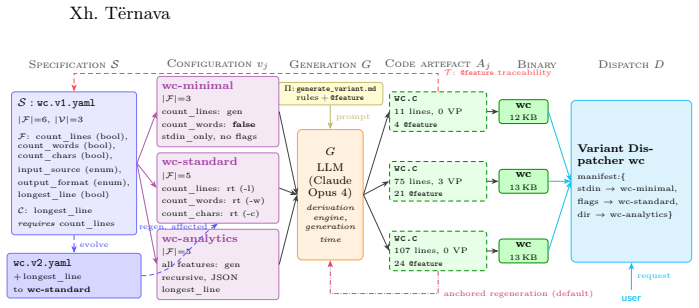
In vibe coding, an exploratory study of 10 projects reveals near-zero in-artifact variability. All variability decisions are bound at generation time when the LLM produces the source code. Variability by Regeneration treats the LLM as a derivation engine that produces a dedicated binary for each variant from a declarative specification, with a variant dispatcher handling routing, offering an alternative to classical software product line derivation.
What carries the argument
Variability by Regeneration (VbR), where the LLM serves as the derivation engine that generates a purpose-built binary for each variant from a declarative specification.
Load-bearing premise
The near-zero in-artifact variability observed in the ten projects is caused by the generation-time binding rather than by project selection or prompt style.
What would settle it
Observing substantial compile-time conditionals or runtime variability mechanisms in a larger or differently sampled collection of vibe-coded projects would falsify the central claim.
Figures
read the original abstract
In vibe coding, an emerging AI-driven paradigm, an LLM generates an entire program from a natural language prompt, but what happens to the variability that traditional software engineering carefully builds into code? To answer this question, we conducted an exploratory analysis on 10 vibe coded C/C++ projects, which suggests that there is near-zero in-artifact variability, i.e., at compile and runtime. All variability decisions are resolved at a single new binding time, generation time, the moment the LLM produces the source code. Rather than treating this as a defect to fix, we propose Variability by Regeneration (VbR), to our knowledge the first product-line approach in which the LLM acts as the derivation engine, generating a purpose-built, free of dead code binary for each variant from a declarative specification, while a variant dispatcher transparently routes user requests to the matching binary. We formalise VbR, contrast it with classical SPL derivation, and demonstrate its full pipeline on a wc product family. For SPL engineering, variability in AI-generated software belongs in the specification, not in the code.
Editorial analysis
A structured set of objections, weighed in public.
Referee Report
Summary. The paper claims that in 'vibe coding' (LLM generation of entire programs from natural-language prompts), near-zero in-artifact variability is observed at compile and runtime because all variability decisions are resolved at a new 'generation time' binding point. This is supported by an exploratory analysis of 10 C/C++ projects. The authors propose Variability by Regeneration (VbR), a product-line approach in which the LLM serves as the derivation engine to produce purpose-built, dead-code-free binaries from a declarative specification, routed by a variant dispatcher; they formalize VbR, contrast it with classical SPL derivation, and demonstrate the full pipeline on a wc product family, concluding that variability belongs in the specification rather than the generated code.
Significance. If the core observation generalizes and VbR proves practical, the work could reframe SPL engineering for AI-generated software by relocating variability decisions to the prompt/specification layer and leveraging regeneration for derivation. The wc demonstration and formal contrast with classical approaches provide a concrete starting point and credit the conceptual novelty of treating the LLM itself as the derivation mechanism.
major comments (3)
- [Exploratory analysis section] Exploratory analysis of 10 projects: the reported near-zero in-artifact variability lacks any stated project selection criteria, quantitative metrics (e.g., variability measures, error rates), or contrast conditions (different prompt styles or traditional implementations), so the attribution of the outcome specifically to generation-time binding rather than selection or prompting effects remains unisolated and correlational. This observation is load-bearing for the motivation and central claim of VbR.
- [VbR formalization] VbR formalization and contrast with classical SPL: the proposal that the LLM acts as derivation engine is presented without addressing how the variant dispatcher is itself implemented or whether it introduces new sources of variability or runtime overhead; this is load-bearing for the claim that VbR yields 'free of dead code' binaries in a practical product-line setting.
- [wc demonstration] wc product-family demonstration: the pipeline is shown for a single example but provides no details on declarative-specification construction, prompt templates for regeneration, or quantitative comparison of generated variants against a baseline SPL, limiting assessment of whether the approach scales beyond the illustrative case.
minor comments (2)
- [Abstract] The abstract's phrasing 'to our knowledge the first product-line approach' would benefit from a brief literature positioning statement to avoid appearing as an unsubstantiated novelty claim.
- [Introduction or formalization section] Notation for binding times (generation time vs. compile/runtime) is introduced informally; a small table contrasting the three would improve clarity for readers unfamiliar with SPL terminology.
Simulated Author's Rebuttal
We thank the referee for the constructive feedback on our exploratory study and VbR proposal. We address each major comment point-by-point below.
read point-by-point responses
-
Referee: [Exploratory analysis section] Exploratory analysis of 10 projects: the reported near-zero in-artifact variability lacks any stated project selection criteria, quantitative metrics (e.g., variability measures, error rates), or contrast conditions (different prompt styles or traditional implementations), so the attribution of the outcome specifically to generation-time binding rather than selection or prompting effects remains unisolated and correlational. This observation is load-bearing for the motivation and central claim of VbR.
Authors: The analysis is explicitly exploratory, intended to surface the phenomenon rather than provide causal proof. Project selection was based on availability of vibe-coded C/C++ projects in public repositories; we will document the specific repositories and selection process in the revision. We will also incorporate basic quantitative metrics, such as the number of conditional compilation directives and runtime configuration options observed in the artifacts. However, as the study does not include contrast conditions, we will emphasize the correlational nature and the need for future controlled studies. This constitutes a partial revision focused on transparency rather than altering the core claim. revision: partial
-
Referee: [VbR formalization] VbR formalization and contrast with classical SPL: the proposal that the LLM acts as derivation engine is presented without addressing how the variant dispatcher is itself implemented or whether it introduces new sources of variability or runtime overhead; this is load-bearing for the claim that VbR yields 'free of dead code' binaries in a practical product-line setting.
Authors: We will revise the formalization section to specify that the variant dispatcher is a lightweight, non-variable component (e.g., a thin wrapper using command-line arguments or environment variables to select the appropriate pre-generated binary). This implementation does not embed feature variability or dead code, as each binary is specialized at generation time. Regarding overhead, we will note that any routing cost is minimal and constant, independent of the number of variants, unlike traditional SPLs with runtime variability. This addresses the practicality concern without changing the central idea. revision: yes
-
Referee: [wc demonstration] wc product-family demonstration: the pipeline is shown for a single example but provides no details on declarative-specification construction, prompt templates for regeneration, or quantitative comparison of generated variants against a baseline SPL, limiting assessment of whether the approach scales beyond the illustrative case.
Authors: We agree that additional details are required. In the revision, we will provide the full declarative specification for the wc product family, sample prompt templates used for regeneration, and a quantitative comparison including metrics such as binary size reduction and feature inclusion rates compared to a baseline using traditional preprocessor-based variability. This will better illustrate the pipeline and support claims of practicality. revision: yes
Circularity Check
No circularity; observational interpretation and proposal remain independent of inputs
full rationale
The paper reports an exploratory analysis of 10 projects that observed near-zero in-artifact variability and interprets the pattern as decisions being resolved at generation time. It then proposes and formalizes Variability by Regeneration as a new product-line approach. No equations, fitted parameters, or self-citations appear in the provided text as load-bearing steps that reduce the central claim to its own definitions or prior outputs. The attribution is presented as a data-driven suggestion rather than a derivation that loops back by construction, and the VbR proposal is a distinct conceptual contribution.
Axiom & Free-Parameter Ledger
Reference graph
Works this paper leans on
-
[1]
Acher, M., Duarte, J.A.G., Jézéquel, J.: On programming variability with large language model-based assistant. In: Proc. SPLC. pp. 8–14. ACM (2023).https: //doi.org/10.1145/3579027.3608972
-
[2]
Acher, M., Martinez, J.: Generative AI for reengineering variants into software product lines: An experience report. In: Proc. SPLC. pp. 57–66. ACM (2023). https://doi.org/10.1145/3579028.3609016
-
[3]
Claude Code Documentation (2025),https://code.claude.com/docs/en/memory
Anthropic: How Claude remembers your project: CLAUDE.md files. Claude Code Documentation (2025),https://code.claude.com/docs/en/memory
2025
-
[4]
Springer (2013).https://doi.org/10.100 7/978-3-642-37521-7
Apel, S., Batory, D., Kästner, C., Saake, G.: Feature-Oriented Software Product Lines: Concepts and Implementation. Springer (2013).https://doi.org/10.100 7/978-3-642-37521-7
2013
-
[5]
Berger, T., Nair, D., Rublack, R., Atlee, J.M., Czarnecki, K., Wąsowski, A.: Three cases of feature-based variability modeling in industry. pp. 302–319. Springer (2014).https://doi.org/https://doi.org/10.1007/978-3-319-11653-2_19
-
[6]
Online software (2024),https://busybox.net/
BusyBox: BusyBox: The Swiss army knife of embedded Linux. Online software (2024),https://busybox.net/
2024
-
[7]
In: Capilla, R., Bosch, J., Kang, K.C
Capilla, R., Bosch, J.: Binding time and evolution. In: Capilla, R., Bosch, J., Kang, K.C. (eds.) Systems and Software Variability Management: Concepts, Tools and Experiences, pp. 57–73. Springer (2013).https://doi.org/10.1007/978-3-642 -36583-6_4
-
[8]
Chen, M., Tworek, J., Jun, H., Yuan, Q., de Oliveira Pinto, H.P., Kaplan, J., Ed- wards, H., Burda, Y., Joseph, N., Brockman, G., et al.: Evaluating large language models trained on code (2021).https://doi.org/10.48550/arXiv.2107.03374
work page internal anchor Pith review Pith/arXiv arXiv doi:10.48550/arxiv.2107.03374 2021
-
[9]
Chou, Y., Jiang, B., Chen, Y.W., Weng, M., Jackson, V., Zimmermann, T., Jones, J.A.: Building software by rolling the dice: A qualitative study of vibe coding. In: Proc. ESEC/FSE (2026).https://doi.org/10.48550/arXiv.2512.22418
-
[10]
Addison-Wesley (2001)
Clements, P., Northrop, L.: Software Product Lines: Practices and Patterns. Addison-Wesley (2001)
2001
-
[11]
AI-generated code: A large-scale study of defects, vulnerabilities, and complexity
Cotroneo, D., Improta, C., Liguori, P.: Human-written vs. AI-generated code: A large-scale study of defects, vulnerabilities, and complexity. In: Proc. ISSRE. pp. 252–263. IEEE (2025).https://doi.org/10.1109/ISSRE66568.2025.00035
-
[12]
Cursor Documentation (2025),https://cursor.com/docs/rules
Cursor Inc.: Rules: system-level instructions for Agent. Cursor Documentation (2025),https://cursor.com/docs/rules
2025
-
[13]
Addison-Wesley (2000)
Czarnecki, K., Eisenecker, U.W.: Generative Programming: Methods, Tools, and Applications. Addison-Wesley (2000)
2000
-
[14]
Czarnecki, K., Grünbacher, P., Rabiser, R., Schmid, K., Wąsowski, A.: Cool fea- tures and tough decisions: A comparison of variability modeling approaches. In: Proc. 6th International Workshop on Variability Modelling of Software-Intensive Systems (VaMoS). pp. 173–182. ACM (2012).https://doi.org/10.1145/211014 7.2110167
-
[15]
Fawzy, A., Tahir, A., Blincoe, K.: Vibe coding in practice: Motivations, challenges, and a future outlook–a grey literature review (2025).https://doi.org/10.48550 /arXiv.2510.00328
arXiv 2025
-
[16]
FreeSoftwareFoundation:GNUCoreutils:CoreGNUutilities.FreeSoftwareFoun- dation (2026),https://www.gnu.org/software/coreutils/, version 9.10
2026
-
[17]
September 2024–August 2025 data Xh
GitHub: Octoverse: A new developer joins GitHub every second as AI leads Type- Scrip to#1 (2025),https://github.blog/news-insights/octoverse/octovers e-a-new-developer-joins-github-every-second-as-ai-leads-typescript-t o-1/, accessed: 2025-12-11. September 2024–August 2025 data Xh. Tërnava
2025
-
[18]
Greiner, S., Schmid, K., Berger, T., Krieter, S., Meixner, K.: Generative AI and software variability–A research vision. In: Proc. VaMoS. pp. 71–76. ACM (2024). https://doi.org/10.1145/3634713.3634722
-
[20]
In: IEEE/ACM 20th Interna- tional Conference on Mining Software Repositories (MSR)
Jesse, K., Ahmed, T., Devanbu, P.T., Morgan, E.: Large language models and simple, stupid bugs. In: Proc. MSR. pp. 563–575. IEEE (2023).https://doi.or g/10.1109/MSR59073.2023.00082
-
[21]
Ji, W., Berger, T., Antkiewicz, M., Czarnecki, K.: Maintaining feature traceability with embedded annotations. In: Proc. SPLC. pp. 61–70. ACM (2015).https: //doi.org/10.1145/2791060.2791107
-
[22]
Kang,K.C.,Cohen,S.G.,Hess,J.A.,Novak,W.E.,Peterson,A.S.:Feature-oriented domain analysis (FODA) feasibility study. Tech. Rep. CMU/SEI-90-TR-021, Soft- ware Engineering Institute (1990).https://doi.org/10.21236/ADA235785
-
[23]
X (Twitter) (Feb 2025),https://x.com/karpathy/s tatus/1886192184808149383
Karpathy, A.: Vibe coding. X (Twitter) (Feb 2025),https://x.com/karpathy/s tatus/1886192184808149383
arXiv 2025
-
[24]
Lesoil, L., Acher, M., Blouin, A., Jézéquel, J.: The interaction between in- puts and configurations fed to software systems: An empirical study. CoRR abs/2112.07279(2021).https://doi.org/10.48550/arXiv.2112.07279, jour- nal reference: Journal of Systems and Software, 2023
-
[25]
Liebig, J., Apel, S., Lengauer, C., Kästner, C., Schulze, M.: An analysis of the variability in forty preprocessor-based software product lines. In: Proc. ICSE. pp. 105–114 (2010).https://doi.org/10.1145/1806799.1806819
-
[26]
Luu, D.: The growth of command line options, 1979–present.https://danluu.c om/cli-complexity/(2020)
1979
-
[27]
Online software (2006),https://code.videolan.org/videolan/x264
Merritt, L., Vanam, R.: x264: A high performance H.264/AVC encoder. Online software (2006),https://code.videolan.org/videolan/x264
2006
-
[28]
IEEE Access13, 213242–213259 (2025)
Meske, C., Hermanns, T., von der Weiden, E., Loser, K., Berger, T.: Vibe cod- ing as a reconfiguration of intent mediation in software development: Defini- tion, implications, and research agenda. IEEE Access13, 213242–213259 (2025). https://doi.org/10.1109/ACCESS.2025.3645466
-
[29]
Mikkonen, T., Taivalsaari, A.: Software reuse in the generative AI era: From cargo cult towards systematic practices. In: Proc. Internetware. pp. 541–544. ACM (2025).https://doi.org/10.1145/3755881.3755981
-
[30]
SAILFISH: Vetting Smart Contract State-Inconsistency Bugs in Seconds,
Pearce, H., Ahmad, B., Tan, B., Dolan-Gavitt, B., Karri, R.: Asleep at the key- board? Assessing the security of GitHub Copilot’s code contributions. In: Proc. IEEE Symposium on Security and Privacy (SP). pp. 754–768. IEEE (2022). https://doi.org/10.1109/SP46214.2022.9833571
-
[31]
Pimenova, V., Fakhoury, S., Bird, C., Storey, M., Endres, M.: Good vibrations? A qualitative study of co-creation, communication, flow, and trust in vibe coding (2025).https://doi.org/10.48550/arXiv.2509.12491
-
[32]
Springer (2005).https://doi.org/10.1 007/3-540-28901-1
Pohl, K., Böckle, G., van der Linden, F.J.: Software Product Line Engineering: Foundations, Principles, and Techniques. Springer (2005).https://doi.org/10.1 007/3-540-28901-1
2005
-
[33]
Computers14(3), 94 (2025).https: //doi.org/10.3390/computers14030094
Sonkin, V., Tudose, C.: Beyond snippet assistance: A workflow-centric framework for end-to-end AI-driven code generation. Computers14(3), 94 (2025).https: //doi.org/10.3390/computers14030094
-
[34]
Online (2025),https://su rvey.stackoverflow.co/2025/, 49,000+ responses from 177 countries Where Did the Variability Go?
Stack Overflow: Stack overflow developer survey 2025. Online (2025),https://su rvey.stackoverflow.co/2025/, 49,000+ responses from 177 countries Where Did the Variability Go?
2025
-
[35]
Stümpfle, C., Atray, S., Jazdi, N., Weyrich, M.: Large language model assisted transformation of software variants into a software product line. In: Proc. ICSR. pp. 12–20. IEEE (2025).https://doi.org/10.1109/ICSR66718.2025.00008
-
[36]
https://superwhisper.com/(2025)
Superultra Inc.: Superwhisper: AI voice-to-text for macOS, Windows, and iOS. https://superwhisper.com/(2025)
2025
-
[37]
Software—Practice and Experience35(8), 705–754 (2005).https: //doi.org/10.1002/spe.652
Svahnberg, M., van Gurp, J., Bosch, J.: A taxonomy of variability realization techniques. Software—Practice and Experience35(8), 705–754 (2005).https: //doi.org/10.1002/spe.652
-
[38]
In: SAC SE Symposium (2023), hAL Id: hal-03916459
Tërnava, X., Acher, M., Combemale, B.: Specialization of run-time configuration space at compile-time: An exploratory study. In: SAC SE Symposium (2023), hAL Id: hal-03916459
2023
-
[39]
Tërnava, X., Collet, P.: On the diversity of capturing variability at the imple- mentation level. In: Proc. SPLC (Volume B). pp. 81–88. ACM (2017).https: //doi.org/10.1145/3109729.3109733
-
[40]
Tërnava, X., Collet, P.: Tracing imperfectly modular variability in software product line implementation. In: Proc. ICSR. pp. 112–120. Springer (2017).https://doi. org/10.1007/978-3-319-56856-0_8
-
[41]
HAL preprint (2025),https://hal.scienc e/hal-05097580, HAL Id: hal-05097580
Tërnava, X., Randrianaina, G.A., Lesoil, L., Acher, M.: Small yet configurable: Unveiling null variability in software. HAL preprint (2025),https://hal.scienc e/hal-05097580, HAL Id: hal-05097580
2025
-
[42]
Watanabe, K., Shirai, T., Kashiwa, Y., Iida, H.: What to cut? Predicting unnec- essary methods in agentic code generation (2026).https://doi.org/10.48550/a rXiv.2602.17091
work page doi:10.48550/a 2026
-
[43]
X (Twitter) (Mar 2025),https://x.com/petergyang/status/18967931 72489155048
Yang, P.: Vibe coding a zombie survival FPS with Cursor + Sonnet 3.7 + Super- whisper. X (Twitter) (Mar 2025),https://x.com/petergyang/status/18967931 72489155048
arXiv 2025
-
[44]
Zine,M.,Quinton,C.,Rouvoy,R.:LLM-basedco-evolutionofconfigurablesoftware systems. In: Proc. SPLC. pp. 27–38. ACM (2025).https://doi.org/10.1145/37 44915.3748460
work page doi:10.1145/37 2025
discussion (0)
Sign in with ORCID, Apple, or X to comment. Anyone can read and Pith papers without signing in.