Resolving the Hubble Tension in the Early Dark Energy Framework with JWST and DESI Data
Pith reviewed 2026-06-26 19:46 UTC · model grok-4.3
The pith
Early dark energy model with CMB, DESI, and JWST data raises the Hubble constant to 71.58 km s^{-1} Mpc^{-1} and reduces tension to 1.0 sigma.
A machine-rendered reading of the paper's core claim, the machinery that carries it, and where it could break.
Core claim
Within the canonical axion EDE framework, the CMB+DESI+JWST data significantly increase the H0 value to 71.58±1.05 km s^{-1} Mpc^{-1}, alleviating the H0 tension to the 1.0σ level. Simultaneously, this model improves the fit to the JWST data and exhibits statistical performance significantly better than the Λ CDM model, with Δχ²_tot = -18.26 and ΔDIC = -11.89.
What carries the argument
The canonical axion early dark energy (EDE) framework, which adds a transient dark energy component active before recombination to shift the sound horizon and allow a higher present-day expansion rate.
If this is right
- The combined dataset favors a Hubble constant of 71.58±1.05 km s^{-1} Mpc^{-1}.
- The EDE model reduces the Hubble tension from its usual level down to 1.0 sigma.
- The EDE model yields Δχ²_tot = -18.26 and ΔDIC = -11.89 relative to ΛCDM, indicating a better global fit.
- JWST high-redshift galaxy counts provide complementary constraints that improve the EDE fit beyond what CMB and BAO alone achieve.
Where Pith is reading between the lines
- High-redshift galaxy abundance data can serve as an independent early-universe probe that complements acoustic-scale measurements.
- If the EDE improvement holds, next-generation surveys could further tighten the allowed range of the EDE decay timescale.
- The result suggests that any resolution of the Hubble tension may need to modify expansion history before recombination rather than only late-time physics.
Load-bearing premise
The JWST ultraviolet luminosity function observations at high redshift are assumed to be free of large systematic uncertainties or selection effects that would alter the inferred galaxy number densities used to constrain the EDE parameters.
What would settle it
A future measurement of the Hubble constant below 70.5 km s^{-1} Mpc^{-1} at high significance, or a demonstration that JWST high-redshift galaxy counts are overestimated by more than the current error bars, would remove the reported improvement.
Figures

read the original abstract
In the JWST and DESI era, the JWST high-redshift galaxy observations and DESI baryon acoustic oscillation (BAO) measurements severely challenge the standard $\Lambda$CDM model, while the $H_0$ tension becomes increasingly prominent. In this work, we investigate the capability of the early dark energy (EDE) model to alleviate the $H_0$ tension utilizing cosmic microwave background data from Planck, ACT, and SPT, BAO data from DESI, and ultraviolet luminosity function observations from the JWST. Within the canonical axion EDE framework, the CMB+DESI+JWST data significantly increase the $H_0$ value to $71.58\pm1.05\,\mathrm{km\,s^{-1}\,Mpc^{-1}}$, alleviating the $H_0$ tension to the $1.0\sigma$ level. Simultaneously, this model improves the fit to the JWST data and exhibits statistical performance significantly better than the $\Lambda$CDM model, with $\Delta\chi^2_{\mathrm{tot}} = -18.26$ and $\Delta\mathrm{DIC} = -11.89$. Our results highlight the complementary advantages of JWST high-redshift galaxy data alongside early- and late-time observations in testing EDE and alleviating the $H_0$ tension.
Editorial analysis
A structured set of objections, weighed in public.
Referee Report
Summary. The manuscript claims that fitting the canonical axion early dark energy (EDE) model to CMB data (Planck, ACT, SPT), DESI BAO, and JWST ultraviolet luminosity function (UVLF) observations raises H0 to 71.58±1.05 km s^{-1} Mpc^{-1}, reducing the Hubble tension to 1.0σ while yielding a better global fit than ΛCDM (Δχ²_tot = −18.26, ΔDIC = −11.89).
Significance. If the JWST UVLF likelihood is shown to correctly capture EDE-induced changes to the halo mass function and star-formation efficiency, the result would demonstrate that high-redshift galaxy counts can tighten EDE parameters and help resolve the H0 tension in a manner complementary to CMB and BAO data.
major comments (2)
- [JWST UVLF modeling (results section)] JWST UVLF modeling (results section): the reported Δχ² improvement and H0 shift rest on the assumption that the UVLF likelihood maps observed number densities to the EDE-altered sound horizon and growth history; the manuscript provides no explicit statement or test that the halo mass function and star-formation efficiency have been re-derived under EDE rather than taken from ΛCDM-calibrated abundance matching. This mapping is load-bearing for the central claim.
- [Parameter fitting and data selection (methods and results)] Parameter fitting and data selection (methods and results): the abstract and results give no information on whether the JWST data selection cuts were defined before fitting, nor on covariance handling or robustness tests (e.g., data splits or prior variations); without these, it is unclear whether the quoted χ² improvement is robust or could arise from post-hoc choices.
minor comments (1)
- [Abstract] The abstract states the EDE parameters but does not list the priors or the exact number of free parameters; adding this would improve clarity for readers unfamiliar with the canonical axion EDE implementation.
Simulated Author's Rebuttal
We thank the referee for their careful and constructive comments, which help strengthen the presentation of our results. We address each major comment below and will revise the manuscript to improve clarity on the modeling and analysis choices.
read point-by-point responses
-
Referee: [JWST UVLF modeling (results section)] JWST UVLF modeling (results section): the reported Δχ² improvement and H0 shift rest on the assumption that the UVLF likelihood maps observed number densities to the EDE-altered sound horizon and growth history; the manuscript provides no explicit statement or test that the halo mass function and star-formation efficiency have been re-derived under EDE rather than taken from ΛCDM-calibrated abundance matching. This mapping is load-bearing for the central claim.
Authors: We agree that an explicit description of the UVLF modeling procedure is essential. The likelihood employs the EDE cosmology to recompute the linear growth factor and halo mass function via the modified power spectrum before performing abundance matching; the star-formation efficiency is then adjusted to reproduce the observed UVLF at the EDE parameters. This was implemented in the analysis pipeline but not stated in detail. We will add a dedicated paragraph in the methods section describing the EDE-specific re-derivation, including the relevant equations and a brief comparison to the ΛCDM case. revision: yes
-
Referee: [Parameter fitting and data selection (methods and results)] Parameter fitting and data selection (methods and results): the abstract and results give no information on whether the JWST data selection cuts were defined before fitting, nor on covariance handling or robustness tests (e.g., data splits or prior variations); without these, it is unclear whether the quoted χ² improvement is robust or could arise from post-hoc choices.
Authors: The referee is correct that these details are missing from the current text. The JWST UVLF sample cuts follow the published observational selections and were fixed prior to any cosmological fitting; covariances are taken directly from the JWST data release. We will expand the methods section with a new subsection that (i) states the pre-defined nature of the cuts, (ii) describes the covariance treatment, and (iii) reports results from robustness checks (prior variations and data splits) that confirm the stability of the Δχ² and H0 values. revision: yes
Circularity Check
No circularity: standard parameter estimation from combined datasets
full rationale
The paper reports posterior constraints on EDE parameters (f_EDE, z_c, etc.) and derived H0 from a joint likelihood using Planck+ACT+SPT CMB, DESI BAO, and JWST UVLF data. The quoted H0 = 71.58 ± 1.05 km s^{-1} Mpc^{-1}, Δχ²_tot = −18.26, and tension reduction to 1.0σ are direct outputs of this fit, not presented as independent predictions or first-principles derivations. No self-definitional equations, fitted inputs relabeled as predictions, load-bearing self-citations, or ansatz smuggling appear in the abstract or described methodology. The analysis is a conventional MCMC constraint exercise whose central claims remain independent of the input data by construction of the likelihood.
Axiom & Free-Parameter Ledger
free parameters (1)
- EDE fraction f_EDE and critical redshift z_c (and related axion parameters)
axioms (2)
- domain assumption The axion EDE model evolves according to the standard Klein-Gordon equation with the usual potential form used in prior EDE literature.
- domain assumption JWST UV luminosity function measurements can be directly translated into constraints on the expansion history without additional high-redshift systematics.
Reference graph
Works this paper leans on
-
[1]
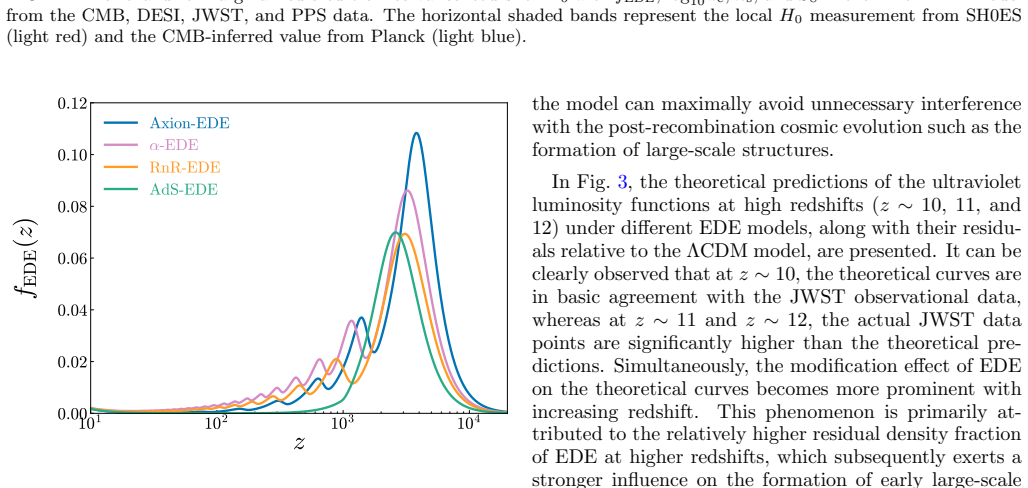
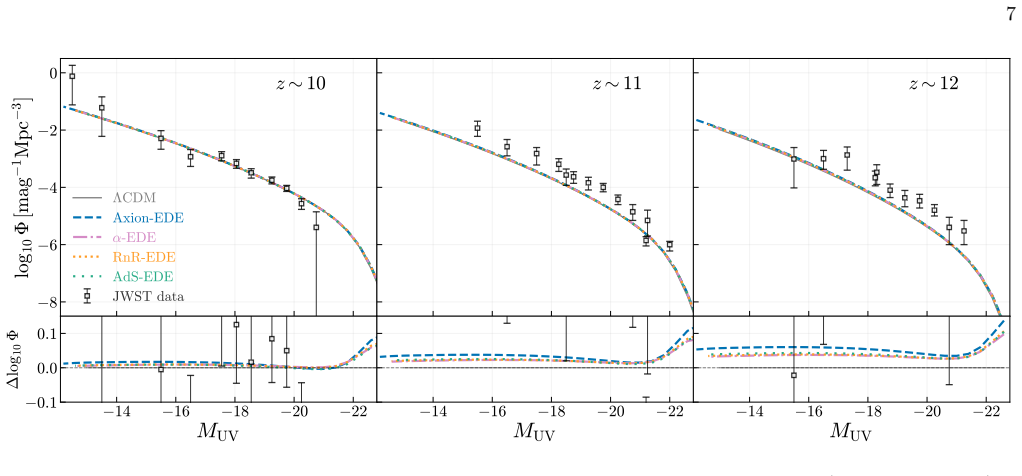
under different EDE models, along with their residu- als relative to the ΛCDM model, are presented. It can be clearly observed that atz∼10, the theoretical curves are in basic agreement with the JWST observational data, whereas atz∼11 andz∼12, the actual JWST data points are significantly higher than the theoretical pre- dictions. Simultaneously, the modi...
2025
-
[2]
N. Aghanimet al.(Planck), Astron. Astrophys.641, A6 (2020), [Erratum: Astron.Astrophys. 652, C4 (2021)], arXiv:1807.06209 [astro-ph.CO]
Pith/arXiv arXiv 2020
-
[3]
A. G. Riesset al., Astrophys. J. Lett.934, L7 (2022), arXiv:2112.04510 [astro-ph.CO]
Pith/arXiv arXiv 2022
-
[4]
M.-M. Zhao, D.-Z. He, J.-F. Zhang, and X. Zhang, Phys. Rev. D96, 043520 (2017), arXiv:1703.08456 [astro-ph.CO]
Pith/arXiv arXiv 2017
-
[5]
L. Verde, T. Treu, and A. G. Riess, Nature Astron.3, 891 (2019), arXiv:1907.10625 [astro-ph.CO]
Pith/arXiv arXiv 2019
-
[6]
R.-Y. Guo, J.-F. Zhang, and X. Zhang, JCAP02, 054 (2019), arXiv:1809.02340 [astro-ph.CO]
Pith/arXiv arXiv 2019
-
[7]
S. Vagnozzi, Phys. Rev. D102, 023518 (2020), arXiv:1907.07569 [astro-ph.CO]
arXiv 2020
-
[8]
E. Di Valentinoet al., Astropart. Phys.131, 102605 (2021), arXiv:2008.11284 [astro-ph.CO]
arXiv 2021
-
[9]
E. Di Valentino, O. Mena, S. Pan, L. Visinelli, W. Yang, A. Melchiorri, D. F. Mota, A. G. Riess, and J. Silk, Class. Quant. Grav.38, 153001 (2021), arXiv:2103.01183 [astro-ph.CO]
Pith/arXiv arXiv 2021
-
[10]
P. Shah, P. Lemos, and O. Lahav, Astron. Astrophys. Rev.29, 9 (2021), arXiv:2109.01161 [astro-ph.CO]
arXiv 2021
-
[11]
S. Vagnozzi, Phys. Rev. D104, 063524 (2021), arXiv:2105.10425 [astro-ph.CO]
arXiv 2021
- [12]
-
[13]
L. Perivolaropoulos and F. Skara, New Astron. Rev.95, 101659 (2022), arXiv:2105.05208 [astro-ph.CO]
Pith/arXiv arXiv 2022
-
[14]
N. Sch¨ oneberg, G. Franco Abell´ an, A. P´ erez S´ anchez, S. J. Witte, V. Poulin, and J. Lesgourgues, Phys. Rept. 984, 1 (2022), arXiv:2107.10291 [astro-ph.CO]
arXiv 2022
-
[15]
Abdallaet al., JHEAp34, 49 (2022), arXiv:2203.06142 [astro-ph.CO]
E. Abdallaet al., JHEAp34, 49 (2022), arXiv:2203.06142 [astro-ph.CO]
Pith/arXiv arXiv 2022
-
[16]
Di Valentino, Universe8, 399 (2022)
E. Di Valentino, Universe8, 399 (2022)
2022
-
[17]
M. Kamionkowski and A. G. Riess, Ann. Rev. Nucl. Part. Sci.73, 153 (2023), arXiv:2211.04492 [astro- ph.CO]
Pith/arXiv arXiv 2023
-
[18]
Giar` e, (2023), 10.1007/978-981-99-0177-7 36, arXiv:2305.16919 [astro-ph.CO]
W. Giar` e, (2023), 10.1007/978-981-99-0177-7 36, arXiv:2305.16919 [astro-ph.CO]
-
[19]
J.-P. Hu and F.-Y. Wang, Universe9, 94 (2023), arXiv:2302.05709 [astro-ph.CO]
arXiv 2023
-
[20]
Vagnozzi, Universe9, 393 (2023), arXiv:2308.16628 [astro-ph.CO]
S. Vagnozzi, Universe9, 393 (2023), arXiv:2308.16628 [astro-ph.CO]
arXiv 2023
- [21]
- [22]
- [23]
- [24]
-
[25]
J.-Q. Jiang and Y.-S. Piao, Phys. Rev. D111, 103505 (2025), arXiv:2501.16883 [astro-ph.CO]
arXiv 2025
-
[26]
D. Pedrotti, J.-Q. Jiang, L. A. Escamilla, S. S. da Costa, and S. Vagnozzi, Phys. Rev. D111, 023506 (2025), arXiv:2408.04530 [astro-ph.CO]
arXiv 2025
-
[27]
D. Pedrotti, L. A. Escamilla, V. Marra, L. Perivolaropoulos, and S. Vagnozzi, Phys. Rev. D113, 043507 (2026), arXiv:2510.01974 [astro-ph.CO]
Pith/arXiv arXiv 2026
-
[28]
Pedrotti, (2026), arXiv:2604.25813 [astro-ph.CO]
D. Pedrotti, (2026), arXiv:2604.25813 [astro-ph.CO]
Pith/arXiv arXiv 2026
-
[29]
A. G. Riess, G. S. Anand, W. Yuan, S. Casertano, A. Dolphin, L. M. Macri, L. Breuval, D. Scolnic, M. Per- rin, and I. R. Anderson, Astrophys. J. Lett.962, L17 (2024), arXiv:2401.04773 [astro-ph.CO]
arXiv 2024
-
[30]
B. Boisseau, G. Esposito-Farese, D. Polarski, and A. A. Starobinsky, Phys. Rev. Lett.85, 2236 (2000), arXiv:gr- qc/0001066
arXiv 2000
-
[31]
M. Chevallier and D. Polarski, Int. J. Mod. Phys. D10, 213 (2001), arXiv:gr-qc/0009008
Pith/arXiv arXiv 2001
- [32]
-
[33]
Q.-G. Huang and Y.-G. Gong, JCAP08, 006 (2004), arXiv:astro-ph/0403590
Pith/arXiv arXiv 2004
-
[34]
X. Zhang and F.-Q. Wu, Phys. Rev. D72, 043524 (2005), arXiv:astro-ph/0506310
Pith/arXiv arXiv 2005
-
[35]
X. Zhang, Int. J. Mod. Phys. D14, 1597 (2005), arXiv:astro-ph/0504586
Pith/arXiv arXiv 2005
-
[36]
X. Zhang and F.-Q. Wu, Phys. Rev. D76, 023502 (2007), arXiv:astro-ph/0701405
Pith/arXiv arXiv 2007
-
[37]
X. Zhang, Phys. Rev. D79, 103509 (2009), arXiv:0901.2262 [astro-ph.CO]
Pith/arXiv arXiv 2009
-
[38]
J.-F. Zhang, Y.-H. Li, and X. Zhang, Eur. Phys. J. C 74, 2954 (2014), arXiv:1404.3598 [astro-ph.CO]
Pith/arXiv arXiv 2014
-
[39]
J.-F. Zhang, M.-M. Zhao, Y.-H. Li, and X. Zhang, JCAP04, 038 (2015), arXiv:1502.04028 [astro-ph.CO]
Pith/arXiv arXiv 2015
-
[40]
Y.-F. Cai, S. Capozziello, M. De Laurentis, and E. N. Saridakis, Rept. Prog. Phys.79, 106901 (2016), arXiv:1511.07586 [gr-qc]
Pith/arXiv arXiv 2016
-
[41]
B. Wang, E. Abdalla, F. Atrio-Barandela, and D. Pavon, Rept. Prog. Phys.79, 096901 (2016), arXiv:1603.08299 [astro-ph.CO]
Pith/arXiv arXiv 2016
-
[42]
L. Feng and X. Zhang, JCAP08, 072 (2016), arXiv:1607.05567 [astro-ph.CO]
Pith/arXiv arXiv 2016
-
[43]
R.-Y. Guo and X. Zhang, Eur. Phys. J. C76, 163 (2016), arXiv:1512.07703 [astro-ph.CO]
Pith/arXiv arXiv 2016
-
[44]
S. Nojiri, S. D. Odintsov, and V. K. Oikonomou, Phys. Rept.692, 1 (2017), arXiv:1705.11098 [gr-qc]
Pith/arXiv arXiv 2017
-
[45]
R.-Y. Guo, J.-F. Zhang, and X. Zhang, Chin. Phys. C 42, 095103 (2018), arXiv:1803.06910 [astro-ph.CO]
Pith/arXiv arXiv 2018
-
[46]
L. Feng, D.-Z. He, H.-L. Li, J.-F. Zhang, and X. Zhang, Sci. China Phys. Mech. Astron.63, 290404 (2020), 9 arXiv:1910.03872 [astro-ph.CO]
arXiv 2020
-
[47]
L. Yin, J. Kochappan, T. Ghosh, and B.-H. Lee, JCAP 10, 007 (2023), arXiv:2305.07937 [astro-ph.CO]
arXiv 2023
- [48]
-
[49]
Y.-H. Yao and X.-H. Meng, Commun. Theor. Phys.76, 075401 (2024), arXiv:2312.04007 [astro-ph.CO]
arXiv 2024
-
[50]
J.-Y. Song, L.-F. Wang, Y. Li, Z.-W. Zhao, J.-F. Zhang, W. Zhao, and X. Zhang, Sci. China Phys. Mech. Astron. 67, 230411 (2024), arXiv:2212.00531 [astro-ph.CO]
arXiv 2024
-
[51]
B. Wang, E. Abdalla, F. Atrio-Barandela, and D. Pav´ on, Rept. Prog. Phys.87, 036901 (2024), arXiv:2402.00819 [astro-ph.CO]
arXiv 2024
-
[52]
W. Giar` e, M. A. Sabogal, R. C. Nunes, and E. Di Valentino, Phys. Rev. Lett.133, 251003 (2024), arXiv:2404.15232 [astro-ph.CO]
arXiv 2024
-
[53]
Di Valentinoet al.(CosmoVerse Network), Phys
E. Di Valentinoet al.(CosmoVerse Network), Phys. Dark Univ.49, 101965 (2025), arXiv:2504.01669 [astro- ph.CO]
Pith/arXiv arXiv 2025
-
[54]
J. Kochappan, L. Yin, B.-H. Lee, and T. Ghosh, Phys. Rev. D112, 063562 (2025), arXiv:2408.09521 [astro- ph.CO]
arXiv 2025
-
[55]
L. Knox and M. Millea, Phys. Rev. D101, 043533 (2020), arXiv:1908.03663 [astro-ph.CO]
arXiv 2020
-
[56]
V. Poulin, T. L. Smith, T. Karwal, and M. Kamionkowski, Phys. Rev. Lett.122, 221301 (2019), arXiv:1811.04083 [astro-ph.CO]
Pith/arXiv arXiv 2019
-
[57]
M.-X. Lin, G. Benevento, W. Hu, and M. Raveri, Phys. Rev. D100, 063542 (2019), arXiv:1905.12618 [astro- ph.CO]
arXiv 2019
-
[58]
G. Ye and Y.-S. Piao, Phys. Rev. D101, 083507 (2020), arXiv:2001.02451 [astro-ph.CO]
arXiv 2020
-
[59]
G. Ye and Y.-S. Piao, Phys. Rev. D102, 083523 (2020), arXiv:2008.10832 [astro-ph.CO]
arXiv 2020
-
[60]
M. Braglia, W. T. Emond, F. Finelli, A. E. Gum- rukcuoglu, and K. Koyama, Phys. Rev. D102, 083513 (2020), arXiv:2005.14053 [astro-ph.CO]
arXiv 2020
-
[61]
P. Agrawal, F.-Y. Cyr-Racine, D. Pinner, and L. Randall, Phys. Dark Univ.42, 101347 (2023), arXiv:1904.01016 [astro-ph.CO]
arXiv 2023
- [62]
-
[63]
M. Bella, V. Poulin, S. Vagnozzi, and L. Knox, (2026), arXiv:2604.13535 [astro-ph.CO]
Pith/arXiv arXiv 2026
- [64]
-
[65]
J. C. Hill, E. McDonough, M. W. Toomey, and S. Alexander, Phys. Rev. D102, 043507 (2020), arXiv:2003.07355 [astro-ph.CO]
arXiv 2020
-
[66]
M. M. Ivanov, E. McDonough, J. C. Hill, M. Simonovi´ c, M. W. Toomey, S. Alexander, and M. Zaldarriaga, Phys. Rev. D102, 103502 (2020), arXiv:2006.11235 [astro-ph.CO]
arXiv 2020
-
[67]
T. L. Smith, V. Poulin, and M. A. Amin, Phys. Rev. D101, 063523 (2020), arXiv:1908.06995 [astro-ph.CO]
arXiv 2020
-
[68]
M. Abdul Karimet al.(DESI), Phys. Rev. D112, 083515 (2025), arXiv:2503.14738 [astro-ph.CO]
Pith/arXiv arXiv 2025
-
[69]
W. Giar` e, M. Najafi, S. Pan, E. Di Valentino, and J. T. Firouzjaee, JCAP10, 035 (2024), arXiv:2407.16689 [astro-ph.CO]
arXiv 2024
-
[70]
Y. Yang, X. Ren, Q. Wang, Z. Lu, D. Zhang, Y.-F. Cai, and E. N. Saridakis, Sci. Bull.69, 2698 (2024), arXiv:2404.19437 [astro-ph.CO]
arXiv 2024
- [71]
-
[72]
G. Ye, M. Martinelli, B. Hu, and A. Silvestri, Phys. Rev. Lett.134, 181002 (2025), arXiv:2407.15832 [astro- ph.CO]
arXiv 2025
-
[73]
J. Rebou¸ cas, D. H. F. de Souza, K. Zhong, V. Mi- randa, and R. Rosenfeld, JCAP02, 024 (2025), arXiv:2408.14628 [astro-ph.CO]
arXiv 2025
-
[74]
C.-G. Park, J. de Cruz P´ erez, and B. Ratra, Int. J. Mod. Phys. D34, 2550058 (2025), arXiv:2410.13627 [astro- ph.CO]
arXiv 2025
- [75]
-
[76]
W. J. Wolf, C. Garc´ ıa-Garc´ ıa, T. Anton, and P. G. Ferreira, Phys. Rev. Lett.135, 081001 (2025), arXiv:2504.07679 [astro-ph.CO]
arXiv 2025
-
[77]
A. J. Shajib and J. A. Frieman, Phys. Rev. D112, 063508 (2025), arXiv:2502.06929 [astro-ph.CO]
arXiv 2025
-
[78]
W. Giar` e, T. Mahassen, E. Di Valentino, and S. Pan, Phys. Dark Univ.48, 101906 (2025), arXiv:2502.10264 [astro-ph.CO]
arXiv 2025
-
[79]
E. Chaussidonet al., Phys. Rev. D112, 063548 (2025), arXiv:2503.24343 [astro-ph.CO]
arXiv 2025
-
[80]
Y.-H. Pang, X. Zhang, and Q.-G. Huang, Sci. China Phys. Mech. Astron.68, 280410 (2025), arXiv:2503.21600 [astro-ph.CO]
arXiv 2025
discussion (0)
Sign in with ORCID, Apple, or X to comment. Anyone can read and Pith papers without signing in.