Equivariant Graph Neural Networks Improve Optical Spectra Prediction for Materials Screening
Pith reviewed 2026-06-26 19:58 UTC · model grok-4.3
The pith
Equivariant graph neural networks outperform prior models when predicting optical spectra of materials.
A machine-rendered reading of the paper's core claim, the machinery that carries it, and where it could break.
Core claim
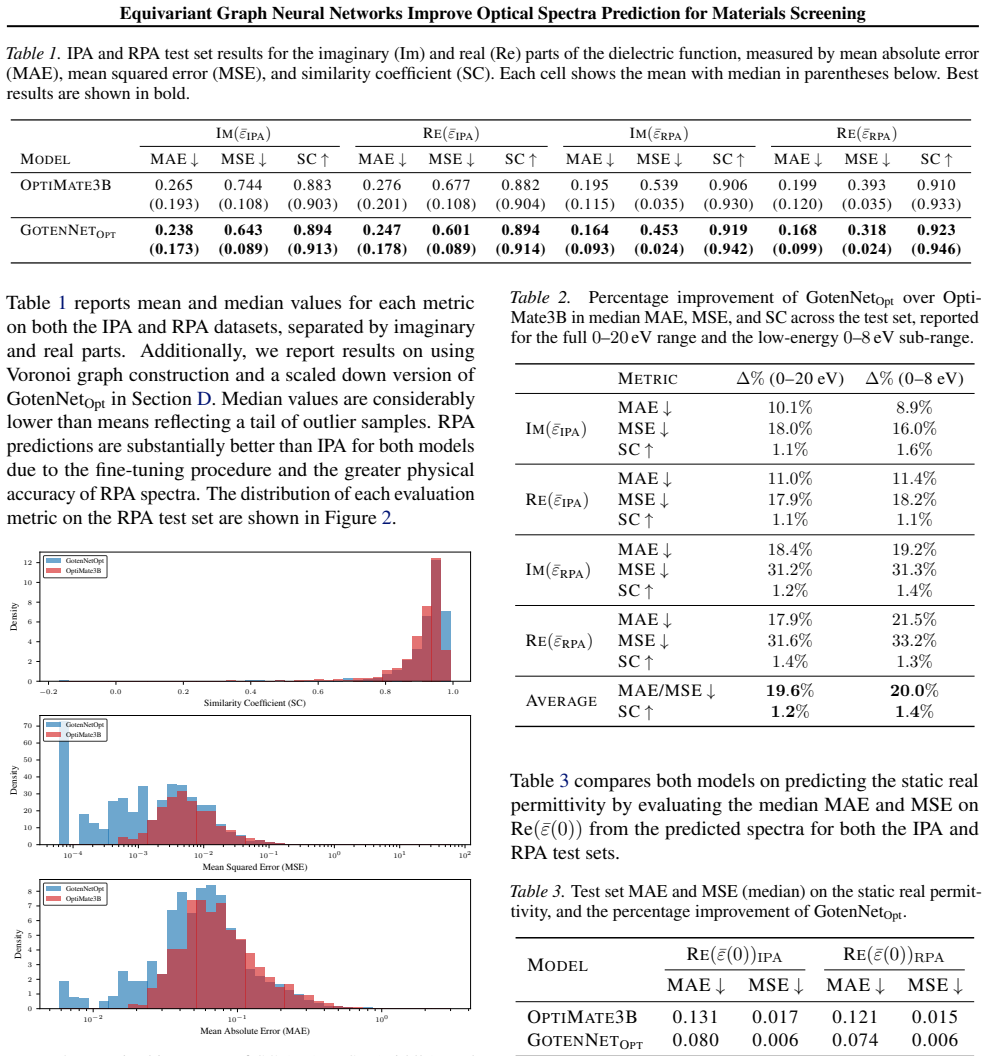
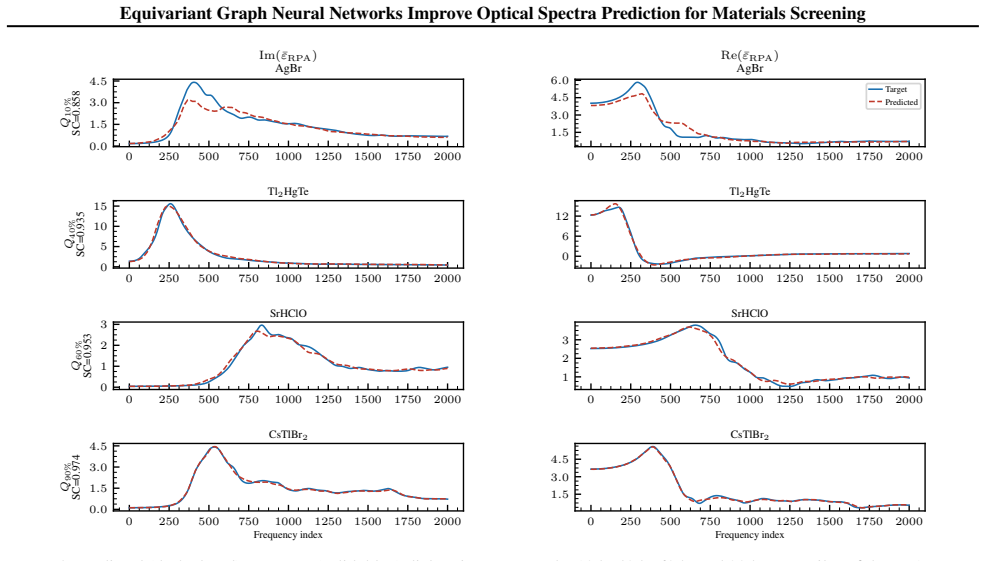
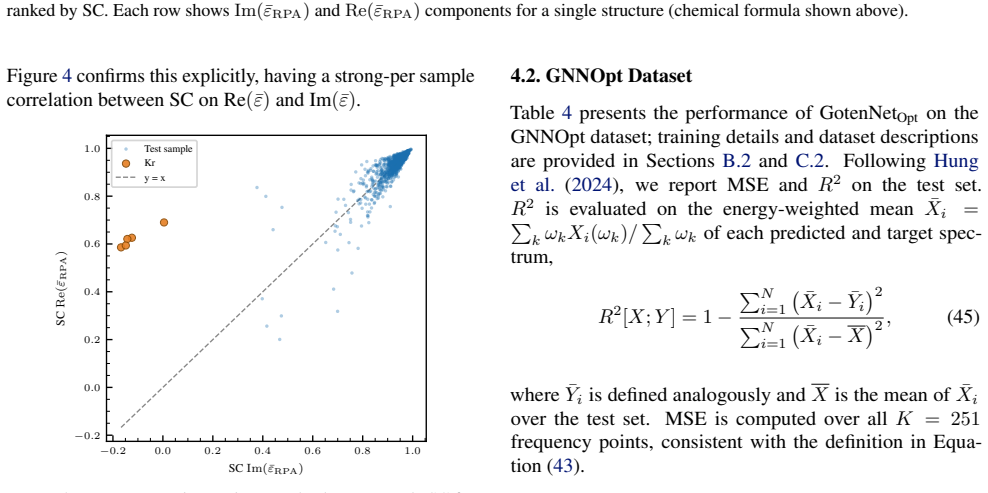
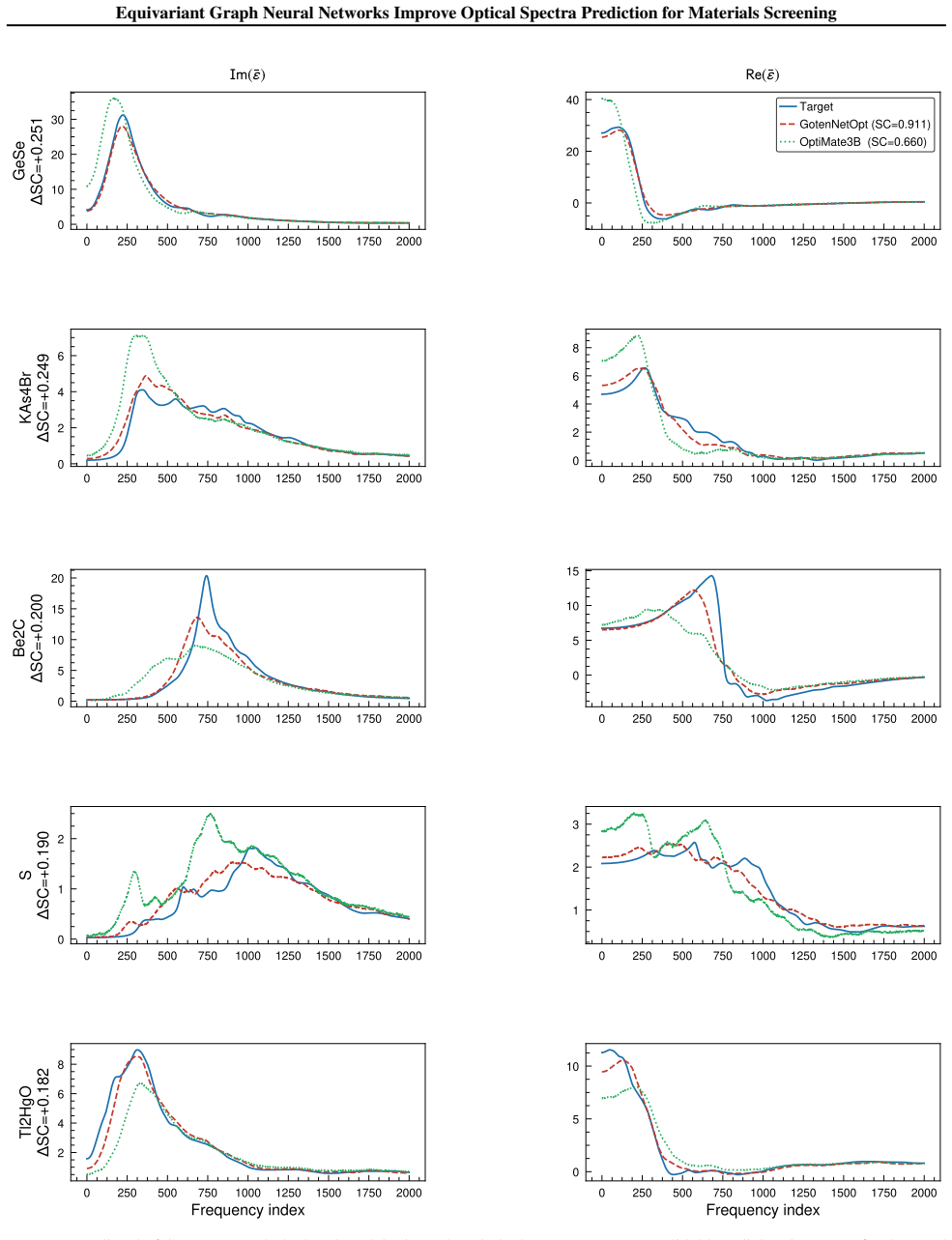
The paper claims that an equivariant graph neural network adapted from GotenNet outperforms the current state of the art on optical spectra prediction tasks. Performance advantages are reported on several datasets, including a collection of 10,533 structures with random phase approximation spectra, and are largest in the 0-8 eV interval and for the static real permittivity.
What carries the argument
Equivariant graph neural network (adapted GotenNet) that encodes material structures while respecting rotational symmetries to predict full optical spectra.
If this is right
- More reliable high-throughput screening becomes feasible for optoelectronic materials such as solar-cell candidates.
- Predictions improve most where they matter for thin-film device design, namely low-energy spectra and static permittivity.
- Rotationally aware models can replace scalar-feature surrogates without loss of scalability.
- Screening pipelines can incorporate these predictions directly into property filters for experimental follow-up.
Where Pith is reading between the lines
- The same architecture may transfer to other geometry-dependent tensor properties such as elastic or piezoelectric responses.
- Combining the model with active learning on experimental spectra could close the gap between theory and measurement.
- Equivariant training might reduce data requirements when generalizing across crystal families.
- The approach suggests a route to parameter-free surrogate models for spectra that respect physical symmetries by construction.
Load-bearing premise
Performance differences arise mainly from the equivariant architecture rather than from dataset tuning, training details, or target choices.
What would settle it
An ablation that removes equivariance while keeping all other model and training elements fixed and shows no accuracy change on the same RPA dataset.
Figures





read the original abstract
Scalable prediction of optical spectra is a critical component of high-throughput materials screening for optoelectronic applications such as solar cells. Existing surrogate models are trained on spectra computed from lower levels of theory or rely on rotation-invariant scalar features, limiting their geometric expressiveness. We explore the use of equivariant graph neural networks for optical spectra prediction, adapting GotenNet to this task and evaluating it on multiple datasets including a recently published collection of 10,533 structures with spectra computed at the level of the random phase approximation (RPA). The proposed model outperforms the current state of the art, with the largest gains in the 0-8 eV range and on predicting the static real permittivity, both of particular relevance for thin-film optics.
Editorial analysis
A structured set of objections, weighed in public.
Referee Report
Summary. The manuscript adapts the equivariant graph neural network GotenNet for predicting optical spectra of materials computed at the random phase approximation (RPA) level. It evaluates the model on multiple datasets, including a collection of 10,533 structures, and reports that the proposed model outperforms prior state-of-the-art approaches, with the largest gains in the 0-8 eV range and for the static real permittivity.
Significance. If the reported performance gains hold under the provided dataset splits, training protocols, and baseline comparisons, the work would be significant for high-throughput materials screening in optoelectronics. The manuscript supplies the necessary dataset descriptions, model architecture details, training protocol, and quantitative comparisons, addressing the initial concern that the abstract alone was insufficient to assess the central claim.
minor comments (1)
- [Abstract] Abstract: the claim of outperformance would be more immediately verifiable if the abstract briefly named the primary baselines and reported a key metric (e.g., MAE on the 0-8 eV window) rather than leaving all quantitative detail to the main text.
Simulated Author's Rebuttal
We thank the referee for the positive assessment of our manuscript and the recommendation for minor revision. The report raises no major comments requiring point-by-point rebuttal.
Circularity Check
No significant circularity
full rationale
The paper is a standard supervised ML benchmarking study that trains an adapted equivariant GNN on external RPA-computed spectra datasets and reports test-set performance gains versus published baselines. No derivation chain exists; claims rest on empirical comparisons with independent data splits and external references rather than any self-definitional mapping, fitted parameter renamed as prediction, or load-bearing self-citation. The architecture, training protocol, and metrics are fully specified without reducing to their own inputs by construction.
Axiom & Free-Parameter Ledger
Reference graph
Works this paper leans on
-
[1]
Applied Physics Letters , volume =
Grunert, Malte and Großmann, Max and Runge, Erich , title =. Applied Physics Letters , volume =. 2026 , month =. doi:10.1063/5.0305586 , url =
-
[2]
ChemRxiv , volume =
Anthony Wang and Steven Kauwe and Ryan Murdock and Taylor Sparks , title =. ChemRxiv , volume =. 2021 , doi =
2021
-
[3]
The Thirteenth International Conference on Learning Representations , year =
GotenNet: Rethinking Efficient 3D Equivariant Graph Neural Networks , author =. The Thirteenth International Conference on Learning Representations , year =
-
[4]
2024 , eprint =
Ensemble-Embedding Graph Neural Network for Direct Prediction of Optical Spectra from Crystal Structure , author =. 2024 , eprint =
2024
-
[5]
2025 , eprint =
Accelerated prediction of dielectric functions in solar cell materials with graph neural networks , author =. 2025 , eprint =
2025
-
[6]
2024 , eprint =
Prediction of Frequency-Dependent Optical Spectrum for Solid Materials: A Multi-Output & Multi-Fidelity Machine Learning Approach , author =. 2024 , eprint =
2024
-
[7]
Computational Materials Science , volume =
Python Materials Genomics (pymatgen): A Robust, Open-Source Python Library for Materials Analysis , author =. Computational Materials Science , volume =. 2013 , doi =
2013
-
[8]
Justin Gilmer and Samuel S. Schoenholz and Patrick F. Riley and Oriol Vinyals and George E. Dahl , title =. CoRR , volume =. 2017 , url =. 1704.01212 , timestamp =
Pith/arXiv arXiv 2017
-
[9]
Inhomogeneous Electron Gas , author =. Phys. Rev. , volume =. 1964 , month =. doi:10.1103/PhysRev.136.B864 , url =
-
[10]
Electronic excitations: density-functional versus many-body Green's-function approaches , author =. Rev. Mod. Phys. , volume =. 2002 , month =. doi:10.1103/RevModPhys.74.601 , url =
-
[11]
2019 , eprint =
Molecular Property Prediction: A Multilevel Quantum Interactions Modeling Perspective , author =. 2019 , eprint =
2019
-
[12]
2017 , eprint =
SchNet: A continuous-filter convolutional neural network for modeling quantum interactions , author =. 2017 , eprint =
2017
-
[13]
Johannes Klicpera and Shankari Giri and Johannes T. Margraf and Stephan G. Fast and Uncertainty-Aware Directional Message Passing for Non-Equilibrium Molecules , journal =. 2020 , url =. 2011.14115 , timestamp =
arXiv 2020
-
[14]
Yi Liu and Limei Wang and Meng Liu and Xuan Zhang and Bora Oztekin and Shuiwang Ji , title =. CoRR , volume =. 2021 , url =. 2102.05013 , timestamp =
arXiv 2021
-
[15]
Victor Garcia Satorras and Emiel Hoogeboom and Max Welling , title =. CoRR , volume =. 2021 , url =. 2102.09844 , timestamp =
arXiv 2021
-
[16]
Kristof T. Sch. Equivariant message passing for the prediction of tensorial properties and molecular spectra , journal =. 2021 , url =. 2102.03150 , timestamp =
arXiv 2021
-
[17]
2019 , eprint =
Cormorant: Covariant Molecular Neural Networks , author =. 2019 , eprint =
2019
-
[18]
Bekkers and Max Welling , title =
Johannes Brandstetter and Rob Hesselink and Elise van der Pol and Erik J. Bekkers and Max Welling , title =. CoRR , volume =. 2021 , url =. 2110.02905 , timestamp =
arXiv 2021
-
[19]
2020 , eprint =
Generalizing Convolutional Neural Networks for Equivariance to Lie Groups on Arbitrary Continuous Data , author =. 2020 , eprint =
2020
-
[20]
2023 , eprint =
MACE: Higher Order Equivariant Message Passing Neural Networks for Fast and Accurate Force Fields , author =. 2023 , eprint =
2023
-
[21]
2022 , eprint =
Equivariant Graph Attention Networks for Molecular Property Prediction , author =. 2022 , eprint =
2022
-
[22]
TorchMD-NET: Equivariant Transformers for Neural Network based Molecular Potentials , journal =
Philipp Th. TorchMD-NET: Equivariant Transformers for Neural Network based Molecular Potentials , journal =. 2022 , url =. 2202.02541 , timestamp =
arXiv 2022
-
[23]
2023 , eprint =
TensorNet: Cartesian Tensor Representations for Efficient Learning of Molecular Potentials , author =. 2023 , eprint =
2023
-
[24]
2022 , eprint =
Learning Local Equivariant Representations for Large-Scale Atomistic Dynamics , author =. 2022 , eprint =
2022
-
[25]
2023 , eprint =
Equiformer: Equivariant Graph Attention Transformer for 3D Atomistic Graphs , author =. 2023 , eprint =
2023
-
[26]
The Thirteenth International Conference on Learning Representations , journal =
Liao, Yi-Lun and Wood, Brandon and Das, Abhishek and Smidt, Tess , title =. The Thirteenth International Conference on Learning Representations , journal =. 2024 , doi =
2024
-
[27]
Physical review , volume =
Self-consistent equations including exchange and correlation effects , author =. Physical review , volume =. 1965 , publisher =
1965
-
[28]
Physical review , volume =
Causality and the dispersion relation: logical foundations , author =. Physical review , volume =. 1956 , publisher =
1956
-
[29]
Data for evaluating OptiMate3B
Malte Grunert and Max Großmann and Erich Runge. Data for evaluating OptiMate3B. 2026. doi:10.6084/m9.figshare.30257551.v1
-
[30]
Malte Grunert and Max Großmann and Erich Runge. Dielectric Function of Semiconductors and Insulators under the Independent Particle Approximation and the Random Phase Approximation. 2026. doi:10.6084/m9.figshare.30257689.v1
-
[31]
2022 , eprint=
High-throughput optical absorption spectra for inorganic semiconductors , author=. 2022 , eprint=
2022
-
[32]
Jain, Anubhav and Ong, Shyue Ping and Hautier, Geoffroy and Chen, Wei and Richards, William Davidson and Dacek, Stephen and Cholia, Shreyas and Gunter, Dan and Skinner, David and Ceder, Gerbrand and Persson, Kristin A. , title =. APL Materials , volume =. 2013 , month =. doi:10.1063/1.4812323 , url =
discussion (0)
Sign in with ORCID, Apple, or X to comment. Anyone can read and Pith papers without signing in.