OrthoReg: Orthogonal Regularization for Hybrid Symbolic-Neural Dynamical Systems
Pith reviewed 2026-06-26 20:57 UTC · model grok-4.3
The pith
OrthoReg penalizes overlap between symbolic and neural parts to force complementary decomposition in hybrid dynamical models.
A machine-rendered reading of the paper's core claim, the machinery that carries it, and where it could break.
Core claim
OrthoReg introduces an orthogonal regularization term that directly penalizes overlap between the symbolic and neural components. When the symbolic part is obtained through sparse discovery, this penalty prevents the neural augmentation from absorbing symbolic structure, producing a complementary decomposition in which each component handles distinct aspects of the dynamics.
What carries the argument
The OrthoReg orthogonal penalty term added to the training loss, which enforces non-overlap between symbolic and neural predictions.
If this is right
- Symbolic recovery improves on systems where the library only partially matches the true dynamics.
- Hybrid models generalize better outside the training distribution.
- The neural residual captures only the remainder after the symbolic library has been fully exploited.
- Redundancy between components is reduced even when the symbolic part is learned rather than prescribed.
Where Pith is reading between the lines
- The same orthogonal penalty could be tested in hybrid models for tasks other than dynamical systems, such as time-series forecasting or control.
- If the library is completely mismatched, the method may force the neural component to carry almost everything, which could be checked on synthetic cases.
- Pairing OrthoReg with post-hoc inspection of the learned neural residual might reveal new physical terms not in the original library.
Load-bearing premise
Penalizing overlap with the orthogonal term produces a stable, useful decomposition without new instabilities or degraded predictive performance.
What would settle it
On the same benchmark systems, OrthoReg produces higher measured overlap between symbolic and neural components or lower out-of-distribution accuracy than the L2 baseline.
Figures


read the original abstract
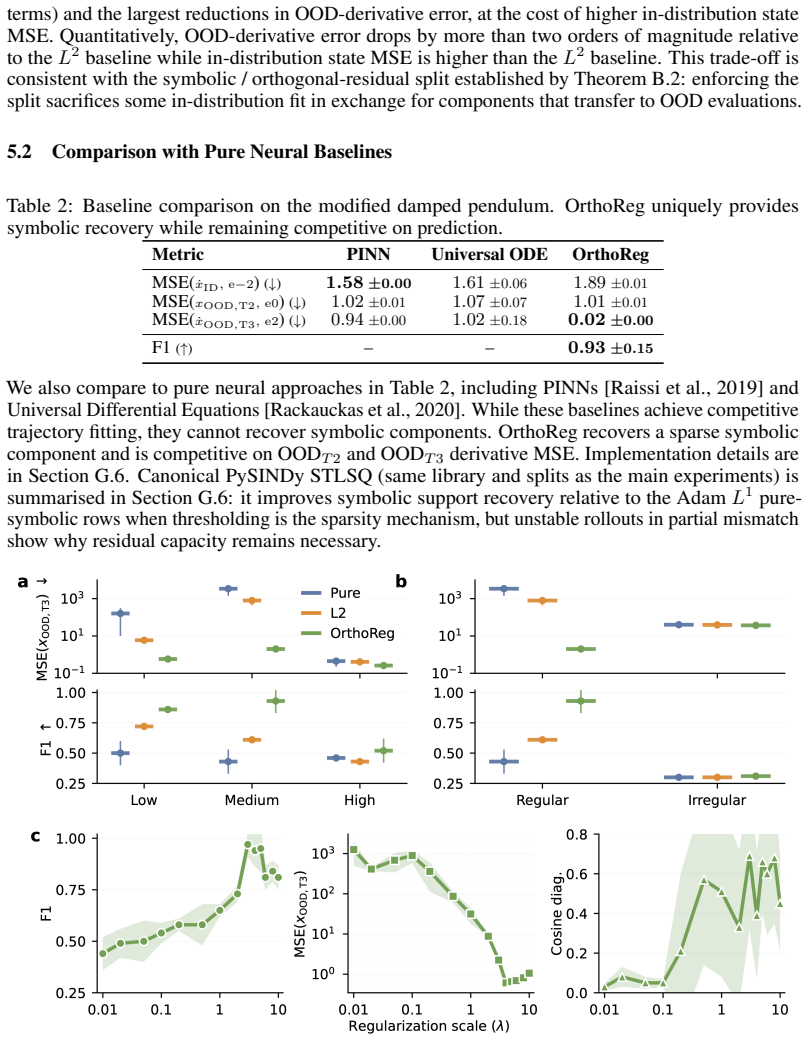
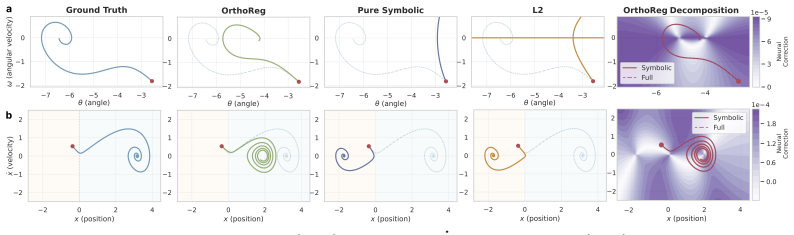
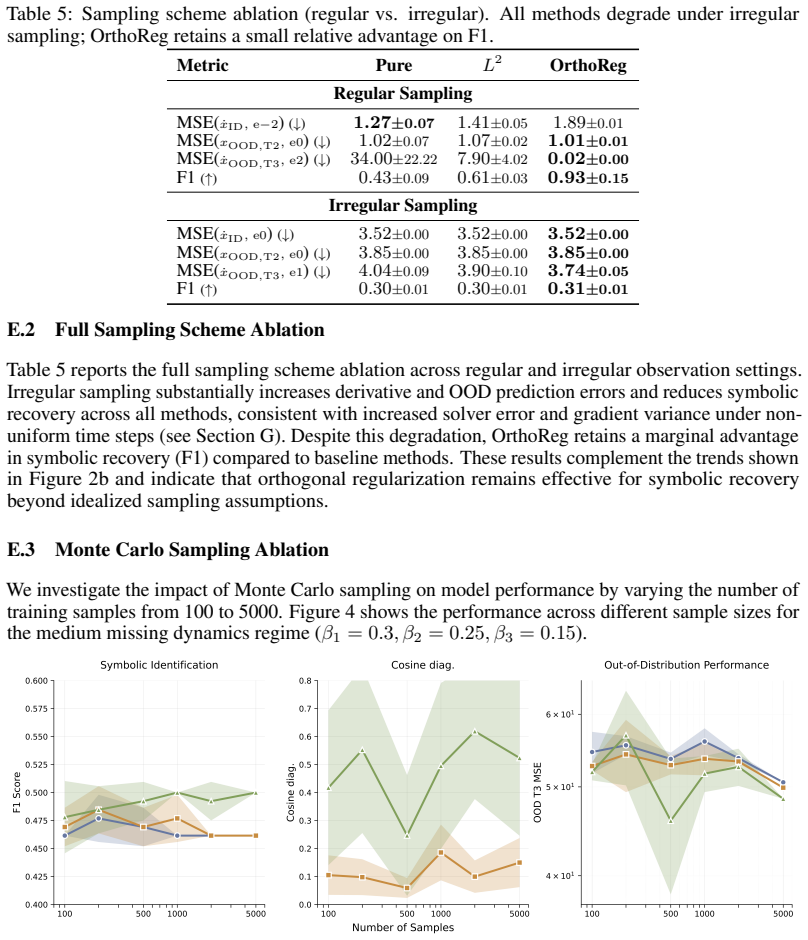
Dynamical systems are fundamental to modeling the natural world, yet modeling them involves a persistent trade-off: manually prescribed mechanistic models are interpretable by design but often overly simplistic and misspecified; in contrast, flexible data-driven neural methods lack physical insight. Hybrid modeling aims for the best of both worlds by combining a prescribed or symbolic, physics-based component with a flexible neural network. A critical challenge, however, is that the neural component may relearn mechanistic parts, yielding redundant and uninterpretable models, especially when the symbolic structure itself is discovered from data. Existing methods based on standard $L^2$ regularization rely on a projection argument that breaks when the symbolic component is learned through sparse discovery, allowing the neural augmentation to overlap with symbolic structure. We introduce \textbf{OrthoReg} (Orthogonal Regularization), which directly penalizes overlap between the symbolic and neural components, preventing symbolic structure from being absorbed by the neural residual. This yields a complementary decomposition: the symbolic part captures what the library can express, and the neural part captures what remains. On benchmark dynamical systems with partial library mismatch, OrthoReg improves symbolic recovery and out-of-distribution behavior.
Editorial analysis
A structured set of objections, weighed in public.
Referee Report
Summary. The manuscript proposes OrthoReg, an orthogonal regularization term for hybrid symbolic-neural dynamical system models. It argues that standard L2 regularization fails to prevent overlap when the symbolic component is obtained via sparse discovery (as the projection argument no longer holds), and introduces a direct penalty on overlap between the symbolic and neural parts to enforce a complementary decomposition. Experiments on benchmark systems with partial library mismatch report improved symbolic recovery and out-of-distribution generalization.
Significance. If the central claim holds, the work would address a recognized practical failure mode in hybrid modeling of dynamical systems, where neural residuals can absorb mechanistic structure discovered from data. The explicit targeting of the sparse-discovery case distinguishes it from prior regularization approaches and could improve both interpretability and robustness in scientific machine learning applications.
major comments (2)
- [§3] §3 (OrthoReg formulation): the claim that the orthogonal penalty yields a stable complementary decomposition is load-bearing, yet the construction applies the penalty against a moving symbolic support that is itself selected by the joint sparsity-inducing optimizer. No argument is given showing why the sparsity regularizer cannot simply select terms already partially captured by the neural component (or vice versa), which would undermine the 'complementary' guarantee.
- [§4.1] §4.1 (theoretical motivation): the text correctly notes that standard L2 projection arguments break under sparse discovery, but the new orthogonal term appears to inherit an analogous dependence on the instantaneous active library; a concrete counter-example or stability analysis under joint optimization is needed to establish that the penalty still forces the intended separation.
minor comments (2)
- Notation for the orthogonal penalty (likely Eq. (X)) should be defined before its first use in the method section to improve readability.
- [§5] The benchmark descriptions in §5 would benefit from explicit statement of the library mismatch percentage and the exact sparsity hyper-parameters used in each experiment.
Simulated Author's Rebuttal
We thank the referee for the detailed and constructive comments on the theoretical foundations of OrthoReg. We address each major comment below, indicating where revisions will be made to strengthen the presentation.
read point-by-point responses
-
Referee: [§3] §3 (OrthoReg formulation): the claim that the orthogonal penalty yields a stable complementary decomposition is load-bearing, yet the construction applies the penalty against a moving symbolic support that is itself selected by the joint sparsity-inducing optimizer. No argument is given showing why the sparsity regularizer cannot simply select terms already partially captured by the neural component (or vice versa), which would undermine the 'complementary' guarantee.
Authors: The referee correctly notes that the active symbolic support changes during joint optimization. The orthogonal penalty is applied at each step to the current support, creating a dynamic incentive: the sparsity term will prefer to assign a library term to the symbolic component (avoiding the overlap penalty on the neural residual) rather than allowing partial capture by the neural part. This interaction is implicit in the joint objective but was not explicitly discussed. We will revise §3 to include a paragraph explaining this feedback mechanism between the sparsity and orthogonal terms, along with a brief 1D toy example illustrating the separation under simultaneous updates. revision: partial
-
Referee: [§4.1] §4.1 (theoretical motivation): the text correctly notes that standard L2 projection arguments break under sparse discovery, but the new orthogonal term appears to inherit an analogous dependence on the instantaneous active library; a concrete counter-example or stability analysis under joint optimization is needed to establish that the penalty still forces the intended separation.
Authors: We agree that the orthogonal term is evaluated on the current active set and that a formal stability analysis of the joint optimizer is absent from the manuscript. The key distinction from the L2 projection case is that the penalty directly regularizes the inner product (or overlap) rather than relying on a fixed orthogonal complement; this still discourages alignment even as the support evolves. To address the request, we will add to §4.1 both a short stability discussion (based on the alternating nature of the updates) and a concrete low-dimensional counter-example showing overlap without the penalty versus enforced separation with it. revision: yes
Circularity Check
No significant circularity: OrthoReg is a proposed regularization term whose claimed effect follows from its definition rather than reducing to inputs by construction.
full rationale
The paper introduces OrthoReg as an explicit penalty term that directly penalizes overlap between the symbolic and neural components. The abstract states that this yields a complementary decomposition without any equations or citations showing that the claimed benefit is presupposed in the inputs, fitted parameters renamed as predictions, or load-bearing self-citations. The method is presented as a direct construction to address the breakdown of L2 projection under sparse discovery; the central claim does not reduce to a self-definition or prior result by the authors. This is a standard case of a self-contained proposal of a new technique.
Axiom & Free-Parameter Ledger
axioms (1)
- domain assumption The projection argument underlying standard L2 regularization breaks when the symbolic component is learned through sparse discovery.
Reference graph
Works this paper leans on
-
[1]
Proceedings of the national academy of sciences , volume=
Discovering governing equations from data by sparse identification of nonlinear dynamical systems , author=. Proceedings of the national academy of sciences , volume=. 2016 , publisher=
2016
-
[2]
Proceedings of the National Academy of Sciences , volume=
Data-driven discovery of coordinates and governing equations , author=. Proceedings of the National Academy of Sciences , volume=. 2019 , publisher=
2019
-
[3]
Optimization letters , volume=
Proximality and Chebyshev sets , author=. Optimization letters , volume=. 2007 , publisher=
2007
-
[4]
Journal of Statistical Mechanics: Theory and Experiment , volume=
Augmenting physical models with deep networks for complex dynamics forecasting , author=. Journal of Statistical Mechanics: Theory and Experiment , volume=. 2021 , publisher=
2021
-
[5]
Chen, Ricky T. Q. and Rubanova, Yulia and Bettencourt, Jesse and Duvenaud, David K , booktitle =. Neural Ordinary Differential Equations , volume =
-
[6]
Journal of Computational physics , volume=
Physics-informed neural networks: A deep learning framework for solving forward and inverse problems involving nonlinear partial differential equations , author=. Journal of Computational physics , volume=. 2019 , publisher=
2019
-
[7]
Universal Differential Equations for Scientific Machine Learning
Universal differential equations for scientific machine learning , author=. arXiv preprint arXiv:2001.04385 , year=
work page internal anchor Pith review Pith/arXiv arXiv 2001
-
[8]
Metaphysica: Improving
Mouli, S Chandra and Alam, Muhammad and Ribeiro, Bruno , booktitle=. Metaphysica: Improving
-
[9]
Data analysis, classification, and related methods , pages=
Regression analysis for interval-valued data , author=. Data analysis, classification, and related methods , pages=. 2000 , publisher=
2000
-
[10]
Statistics and computing , volume=
Genetic programming as a means for programming computers by natural selection , author=. Statistics and computing , volume=. 1994 , publisher=
1994
-
[11]
International Conference on Learning Representations , volume=
d'Ascoli, St. International Conference on Learning Representations , volume=
-
[12]
International conference on machine learning , pages=
Predicting ordinary differential equations with transformers , author=. International conference on machine learning , pages=. 2023 , organization=
2023
-
[13]
International Conference on Machine Learning , pages=
Sparse nonlinear regression: Parameter estimation under nonconvexity , author=. International Conference on Machine Learning , pages=. 2016 , organization=
2016
-
[14]
Advances in Neural Information Processing Systems , volume=
Sparsity in continuous-depth neural networks , author=. Advances in Neural Information Processing Systems , volume=
-
[15]
science , volume=
Distilling free-form natural laws from experimental data , author=. science , volume=. 2009 , publisher=
2009
-
[16]
1987 , publisher=
Real and complex analysis , author=. 1987 , publisher=
1987
-
[17]
Exact solutions to the nonlinear dynamics of learning in deep linear neural networks
Exact solutions to the nonlinear dynamics of learning in deep linear neural networks , author=. arXiv preprint arXiv:1312.6120 , year=
work page internal anchor Pith review Pith/arXiv arXiv
-
[18]
Advances in Neural Information Processing Systems , volume=
Can we gain more from orthogonality regularizations in training deep networks? , author=. Advances in Neural Information Processing Systems , volume=
-
[19]
Proceedings of the IEEE/CVF conference on computer vision and pattern recognition , pages=
Controllable orthogonalization in training dnns , author=. Proceedings of the IEEE/CVF conference on computer vision and pattern recognition , pages=
-
[20]
2008 , publisher=
Optimization algorithms on matrix manifolds , author=. 2008 , publisher=
2008
-
[21]
Computer Methods in Applied Mechanics and Engineering , volume=
A framework based on symbolic regression coupled with extended physics-informed neural networks for gray-box learning of equations of motion from data , author=. Computer Methods in Applied Mechanics and Engineering , volume=. 2023 , publisher=
2023
-
[22]
The Astrophysical Journal , volume=
Deep symbolic regression for physics guided by units constraints: toward the automated discovery of physical laws , author=. The Astrophysical Journal , volume=. 2023 , publisher=
2023
-
[23]
Nature communications , volume=
Physics-informed learning of governing equations from scarce data , author=. Nature communications , volume=. 2021 , publisher=
2021
-
[24]
Science advances , volume=
Data-driven discovery of partial differential equations , author=. Science advances , volume=. 2017 , publisher=
2017
-
[25]
arXiv preprint arXiv:2211.08064 , year=
Physics-informed machine learning: A survey on problems, methods and applications , author=. arXiv preprint arXiv:2211.08064 , year=
-
[26]
Journal of Scientific Computing , volume=
Scientific machine learning through physics--informed neural networks: Where we are and what’s next , author=. Journal of Scientific Computing , volume=. 2022 , publisher=
2022
-
[27]
International Conference on Learning Representations , volume=
Multi-task reinforcement learning with mixture of orthogonal experts , author=. International Conference on Learning Representations , volume=
-
[28]
SciPost Physics , volume=
Back to the formula-LHC edition , author=. SciPost Physics , volume=
-
[29]
International Conference on Learning Representations , year=
Deep symbolic regression: Recovering mathematical expressions from data via risk-seeking policy gradients , author=. International Conference on Learning Representations , year=
-
[30]
International Conference on Machine Learning , pages=
Discovering symbolic policies with deep reinforcement learning , author=. International Conference on Machine Learning , pages=. 2021 , organization=
2021
-
[31]
arXiv preprint arXiv:1910.05117 , year=
Data-driven discovery of free-form governing differential equations , author=. arXiv preprint arXiv:1910.05117 , year=
-
[32]
ACM Computing Surveys (CSUR) , volume=
Tackling climate change with machine learning , author=. ACM Computing Surveys (CSUR) , volume=. 2022 , publisher=
2022
-
[33]
Advances in neural information processing systems , volume=
Retain: An interpretable predictive model for healthcare using reverse time attention mechanism , author=. Advances in neural information processing systems , volume=
-
[34]
International Conference on Learning Representations , volume=
Bayesian neural controlled differential equations for treatment effect estimation , author=. International Conference on Learning Representations , volume=
-
[35]
Proceedings of the 39th International Conference on Machine Learning , pages =
Continuous-Time Modeling of Counterfactual Outcomes Using Neural Controlled Differential Equations , author =. Proceedings of the 39th International Conference on Machine Learning , pages =. 2022 , editor =
2022
-
[36]
IEEE Transactions on Power Systems , volume=
Deep learning-based multivariate probabilistic forecasting for short-term scheduling in power markets , author=. IEEE Transactions on Power Systems , volume=. 2018 , publisher=
2018
-
[37]
2014 , publisher=
Functional analysis , author=. 2014 , publisher=
2014
-
[38]
SIAM Journal on Control and Optimization , volume=
On penalty and multiplier methods for constrained minimization , author=. SIAM Journal on Control and Optimization , volume=. 1976 , publisher=
1976
-
[39]
Journal of the Operational Research Society , volume=
Nonlinear programming , author=. Journal of the Operational Research Society , volume=. 1997 , publisher=
1997
-
[40]
SIAM journal on optimization , volume=
Stochastic first-and zeroth-order methods for nonconvex stochastic programming , author=. SIAM journal on optimization , volume=. 2013 , publisher=
2013
-
[41]
Journal of the American statistical association , volume=
Probability inequalities for sums of bounded random variables , author=. Journal of the American statistical association , volume=. 1963 , publisher=
1963
-
[42]
European Journal of Physics , volume=
Resonance oscillation of a damped driven simple pendulum , author=. European Journal of Physics , volume=. 2018 , publisher=
2018
-
[43]
Nature , volume=
Complex dynamics and phase synchronization in spatially extended ecological systems , author=. Nature , volume=. 1999 , publisher=
1999
-
[44]
SIAM review , volume=
The mathematics of infectious diseases , author=. SIAM review , volume=. 2000 , publisher=
2000
-
[45]
The lancet infectious diseases , volume=
Early dynamics of transmission and control of COVID-19: a mathematical modelling study , author=. The lancet infectious diseases , volume=. 2020 , publisher=
2020
-
[46]
Nature Climate Change , volume=
Pushing the frontiers in climate modelling and analysis with machine learning , author=. Nature Climate Change , volume=. 2024 , publisher=
2024
-
[47]
Zaharieva and Ramesh Johari and Emily Fox , booktitle=
Bob Junyi Zou and Matthew E Levine and Dessi P. Zaharieva and Ramesh Johari and Emily Fox , booktitle=. Hybrid\
-
[48]
International conference on machine learning , pages=
Universal physics-informed neural networks: symbolic differential operator discovery with sparse data , author=. International conference on machine learning , pages=. 2023 , organization=
2023
-
[49]
Advances in Neural Information Processing Systems , volume=
Stabilized neural differential equations for learning dynamics with explicit constraints , author=. Advances in Neural Information Processing Systems , volume=
-
[50]
Advances in neural information processing systems , volume=
Hamiltonian neural networks , author=. Advances in neural information processing systems , volume=
-
[51]
Takashi Matsubara and Takaharu Yaguchi , year=
-
[52]
Symbolic Physics Learner: Discovering governing equations via
Fangzheng Sun and Yang Liu and Jian-Xun Wang and Hao Sun , booktitle=. Symbolic Physics Learner: Discovering governing equations via
-
[53]
Transactions on Machine Learning Research , year=
Robust symbolic regression for dynamical system identification , author=. Transactions on Machine Learning Research , year=
-
[54]
Journal of Machine Learning Research , volume=
Finite expression method for solving high-dimensional partial differential equations , author=. Journal of Machine Learning Research , volume=
-
[55]
International Conference on Learning Representations , year=
D-code: Discovering closed-form odes from observed trajectories , author=. International Conference on Learning Representations , year=
-
[56]
Forty-first International Conference on Machine Learning , year=
Out-of-Domain Generalization in Dynamical Systems Reconstruction , author=. Forty-first International Conference on Machine Learning , year=
-
[57]
Science advances , volume=
AI Feynman: A physics-inspired method for symbolic regression , author=. Science advances , volume=. 2020 , publisher=
2020
-
[58]
International Conference on Learning Representations , year=
Deep Learning For Symbolic Mathematics , author=. International Conference on Learning Representations , year=
-
[59]
International Conference on Learning Representations , year=
Teaching Temporal Logics to Neural Networks , author=. International Conference on Learning Representations , year=
-
[60]
Generative Language Modeling for Automated Theorem Proving
Generative language modeling for automated theorem proving , author=. arXiv preprint arXiv:2009.03393 , year=
work page internal anchor Pith review Pith/arXiv arXiv 2009
-
[61]
International conference on machine learning , pages=
Neural symbolic regression that scales , author=. International conference on machine learning , pages=. 2021 , organization=
2021
-
[62]
Valipour, Mojtaba and You, Bowen and Panju, Maysum and Ghodsi, Ali , journal=
-
[63]
Advances in Neural Information Processing Systems , volume=
End-to-end symbolic regression with transformers , author=. Advances in Neural Information Processing Systems , volume=
-
[64]
IEEE Access , volume=
Symformer: End-to-end symbolic regression using transformer-based architecture , author=. IEEE Access , volume=. 2024 , publisher=
2024
-
[65]
Nature Communications , volume=
Interactive symbolic regression with co-design mechanism through offline reinforcement learning , author=. Nature Communications , volume=. 2025 , publisher=
2025
-
[66]
Nature Communications , volume=
Learning interpretable network dynamics via universal neural symbolic regression , author=. Nature Communications , volume=. 2025 , publisher=
2025
-
[67]
Orthogonal Deep Neural Networks (
Chenhan Xiao and Yang Weng , year=. Orthogonal Deep Neural Networks (
-
[68]
Journal of the Royal Society Interface , volume=
A hybrid neural ordinary differential equation model of the cardiovascular system , author=. Journal of the Royal Society Interface , volume=. 2024 , publisher=
2024
-
[69]
Computers in Biology and Medicine , volume=
Representation meets optimization: Training PINNs and PIKANs for gray-box discovery in systems pharmacology , author=. Computers in Biology and Medicine , volume=. 2026 , publisher=
2026
-
[70]
Advances in Neural Information Processing Systems , volume=
Common task framework for a critical evaluation of scientific machine learning algorithms , author=. Advances in Neural Information Processing Systems , volume=
-
[71]
Communications Biology , year=
Generative models of cell dynamics: from Neural ODEs to flow matching , author=. Communications Biology , year=
discussion (0)
Sign in with ORCID, Apple, or X to comment. Anyone can read and Pith papers without signing in.