X-Shooter survey of disk accretion in Upper Scorpius II. A lack of correlation between accretion rates and disk properties
Pith reviewed 2026-06-26 19:06 UTC · model grok-4.3
The pith
Accretion rates in Upper Scorpius show only weak correlation with stellar mass and none with disk dust mass or radius.
A machine-rendered reading of the paper's core claim, the machinery that carries it, and where it could break.
Core claim
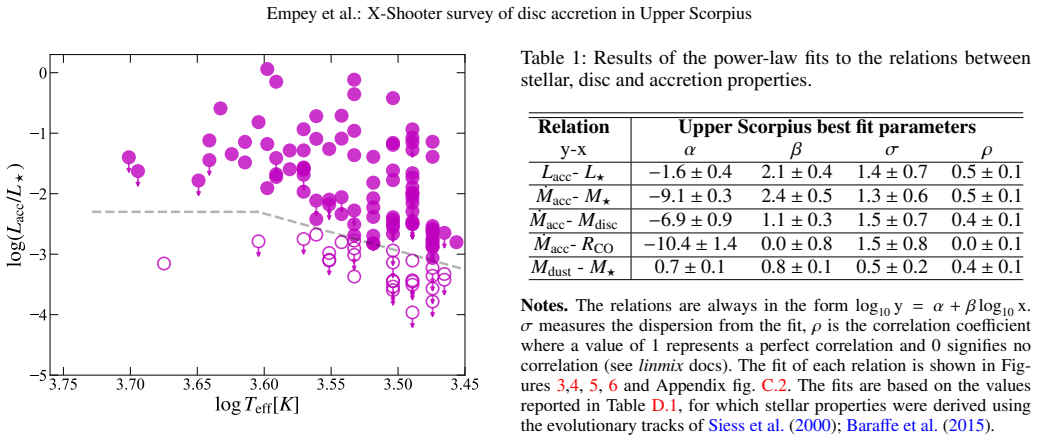
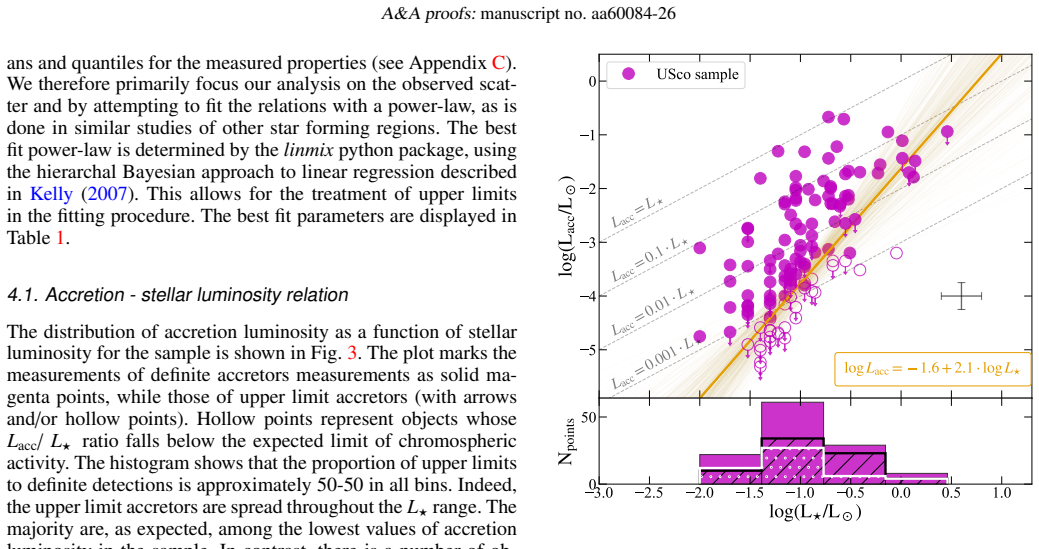
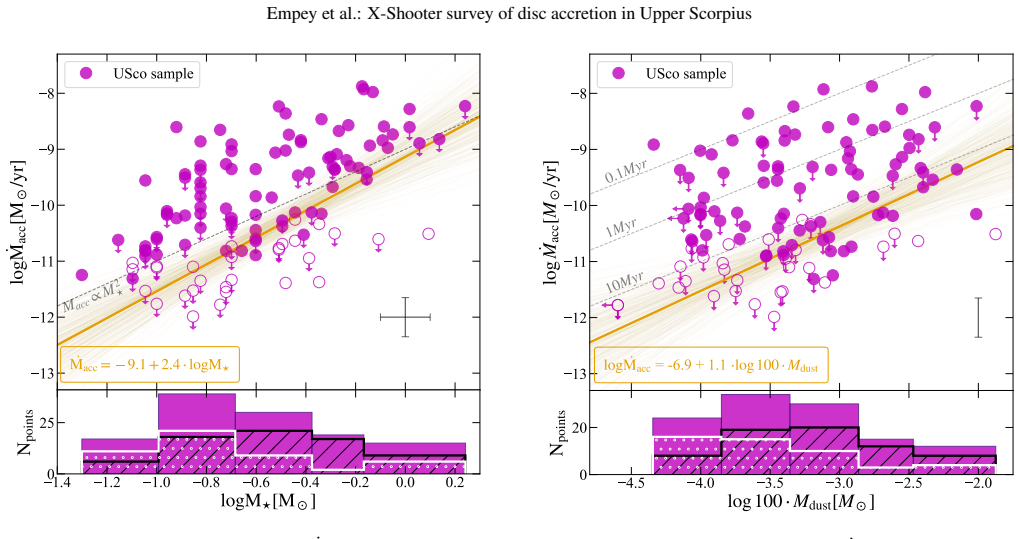
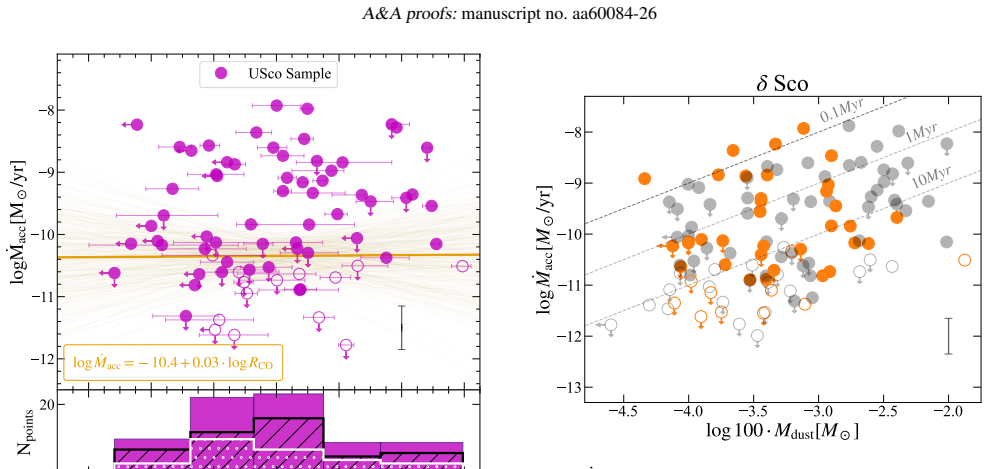
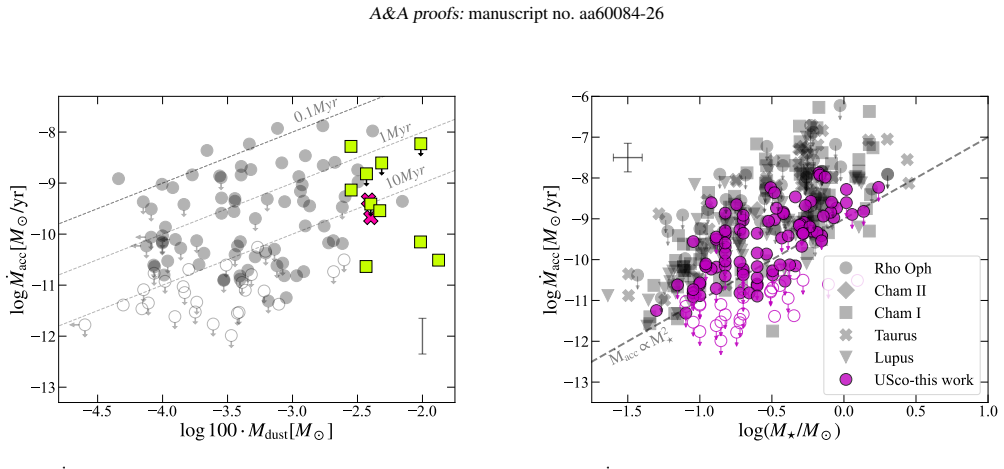
Measurements of accretion luminosity in Upper Scorpius stars with disks reveal only a weak dependence on stellar mass and no dependence on disk dust mass or gas radius. The dispersion around these relations exceeds that seen in younger star-forming regions, and upper limits on accretion for half the sample support the view that inner-disk accretion has become decoupled from outer-disk properties by this age. Sub-group membership and the presence of binaries or transition disks do not explain the observed scatter.
What carries the argument
FRAPPE method to derive accretion luminosity from UV continuum excess relative to photospheric and chromospheric emission, applied self-consistently with spectral type, extinction, and luminosity, together with a procedure for setting upper limits when the excess falls below the chromospheric floor.
If this is right
- Evolutionary models must accommodate the loss of accretion-disk correlations and increased dispersion by the age of Upper Scorpius.
- Inner and outer disk regions operate independently at this stage of evolution.
- The dispersion is intrinsic and not produced by sub-group membership, binaries, or transition disks.
- Accretion properties vary more widely than disk structural parameters at this age.
Where Pith is reading between the lines
- Planet-formation models may need to treat gas accretion in the inner disk as independent of outer-disk dust mass after a few million years.
- Surveys of other associations at similar ages could test whether decoupling of inner and outer disks is a general evolutionary feature.
- The larger dispersion could revise estimates of how long individual disks sustain accretion before dispersal.
Load-bearing premise
The upper limits on accretion luminosity for half the sample are unbiased and the FRAPPE separation of accretion excess from chromospheric activity holds across the full range of spectral types and extinctions present.
What would settle it
A re-analysis of the sample with deeper spectra that converts a substantial fraction of the upper limits into detections and recovers a statistically significant correlation between accretion rate and disk dust mass would falsify the reported lack of correlation.
Figures



read the original abstract
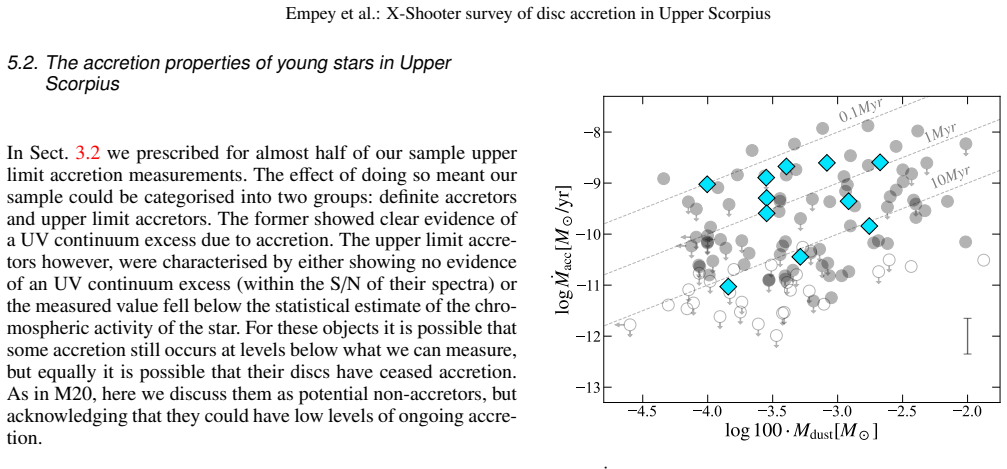
The evolution of protoplanetary discs is intertwined with the process of planet formation, growth and migration. Studies of nearby star forming regions of different ages and properties provide the necessary information needed to understand the processes dictating their evolution. This paper presents the results of a spectroscopic study of the stellar and accretion properties of a large sample of 127 stars with protoplanetary discs in the Upper Scorpius region with disc dust masses inferred from ALMA continuum measurements. The accretion luminosity is derived from the excess UV continuum emission with respect to the photospheric and chromospheric one self-consistently with the stellar spectral types, extinction and luminosity, using FRAPPE. We apply a new method to evaluate upper limits to the accretion luminosity. In ~50% of cases we evaluate upper limits on the accretion luminosity, either because the S/N of the data is insufficient or because the measured value of the accretion luminosity is below the estimate of the emission due to chromospheric activity. The results show that the mass accretion rate has a weak correlation with the stellar mass, while no correlation is observed with disc properties such as dust mass or gas disc radius. The dispersion is larger than what is found in younger star forming regions such as Lupus and Cham. I, and suggests a fading of the correlations with age. We find no evidence that membership to Upper Scorpius sub-groups, nor the properties of known binary or transition discs can explain the origin of this dispersion. The lack of correlation and large dispersion of accretion rates challenge the current expectations of evolutionary models. The observed properties point to a decoupling of the inner and outer disc by the age of Upper Scorpius and a fading of the relations observed in younger star forming regions.
Editorial analysis
A structured set of objections, weighed in public.
Referee Report
Summary. This paper reports results from an X-Shooter survey of 127 disk-bearing stars in Upper Scorpius with ALMA-derived disk properties. Accretion luminosities (or upper limits) are derived self-consistently via FRAPPE, including a new method for upper limits applied to ~50% of the sample where measured L_acc falls below the chromospheric floor or S/N is insufficient. The central claims are a weak Ṁ_acc–M_* correlation, no correlation with M_dust or R_gas, larger dispersion than in Lupus or Chamaeleon I, and no explanatory power from sub-group membership, binaries, or transition disks, implying inner–outer disk decoupling and fading of relations by the age of Upper Sco.
Significance. If the upper limits prove robust, the result would be significant for disk-evolution studies: a large, homogeneous sample with ancillary ALMA data shows the disappearance of correlations seen at younger ages, directly challenging model expectations of persistent Ṁ_acc–disk links. The new upper-limit method and direct inter-region comparison are strengths that could be cited if validated.
major comments (1)
- [Abstract] Abstract and methods (FRAPPE upper-limit procedure): The no-correlation and increased-dispersion claims are load-bearing on the ~50% upper limits being free of systematic bias. The text states that upper limits are evaluated when L_acc is below the chromospheric estimate or S/N is low, but provides no quantitative validation, error budget, or tests of the FRAPPE separation across the sample’s spectral-type and extinction range; this directly affects whether the reported dispersion is physical or methodological.
Simulated Author's Rebuttal
We thank the referee for their thorough review and valuable feedback on our manuscript. We address the major comment regarding the validation of the FRAPPE upper-limit procedure below.
read point-by-point responses
-
Referee: [Abstract] Abstract and methods (FRAPPE upper-limit procedure): The no-correlation and increased-dispersion claims are load-bearing on the ~50% upper limits being free of systematic bias. The text states that upper limits are evaluated when L_acc is below the chromospheric estimate or S/N is low, but provides no quantitative validation, error budget, or tests of the FRAPPE separation across the sample’s spectral-type and extinction range; this directly affects whether the reported dispersion is physical or methodological.
Authors: We acknowledge that the current manuscript lacks a detailed quantitative validation, error budget, and tests of the FRAPPE method across the spectral type and extinction range of the sample. This is a valid point, as such information would strengthen the robustness of our conclusions on the dispersion and lack of correlations. In the revised version, we will add an appendix or subsection in the methods describing quantitative tests (e.g., recovery tests on simulated spectra and comparisons with literature values for similar objects), an error budget for the upper limits, and verification that the method performs consistently across the parameter space. We believe this will confirm that the increased dispersion is physical rather than methodological. revision: yes
Circularity Check
No significant circularity: purely observational data analysis
full rationale
The paper reports direct measurements of accretion luminosities (and upper limits) via the FRAPPE method on X-Shooter spectra for 127 Upper Sco stars, combined with ALMA-derived disk dust masses and radii. Correlations (or lack thereof) with stellar mass, M_dust, and R_gas are computed from these independent observables. No equations derive a 'prediction' that reduces by construction to fitted parameters or self-cited ansatzes; the dispersion and decoupling claims follow from the data distribution itself. FRAPPE and the new upper-limit method are external tools applied to the sample, not self-referential definitions. Self-citations (e.g., to prior X-Shooter surveys) are not load-bearing for the central negative result. This matches the default expectation for an observational survey.
Axiom & Free-Parameter Ledger
Reference graph
Works this paper leans on
-
[1]
X-shooter survey of disk accretion in Upper Scorpius. I. Very high accretion rates at age > 5 Myr. , keywords =. doi:10.1051/0004-6361/202037949 , archivePrefix =. 2004.14232 , primaryClass =
-
[2]
ALMA Observations of Circumstellar Disks in the Upper Scorpius OB Association
ALMA Observations of Circumstellar Disks in the Upper Scorpius OB Association. , keywords =. doi:10.3847/0004-637X/827/2/142 , archivePrefix =. 1605.05772 , primaryClass =
work page internal anchor Pith review Pith/arXiv arXiv doi:10.3847/0004-637x/827/2/142
-
[3]
Refining the Census of the Upper Scorpius Association with Gaia. , keywords =. doi:10.3847/1538-3881/ab9599 , archivePrefix =. 2005.10128 , primaryClass =
-
[4]
Extending the ALMA Census of Circumstellar Disks in the Upper Scorpius OB Association. , keywords =. doi:10.3847/1538-4357/ad8ebc , archivePrefix =. 2410.21598 , primaryClass =
-
[5]
Summary of the content and survey properties
Gaia Data Release 3. Summary of the content and survey properties. Astronomy & Astrophysics , volume =. 2023 , doi =
2023
-
[6]
The Gaia mission. , keywords =. doi:10.1051/0004-6361/201629272 , archivePrefix =. 1609.04153 , primaryClass =
work page internal anchor Pith review Pith/arXiv arXiv doi:10.1051/0004-6361/201629272
-
[7]
X-shooter, the new wide band intermediate resolution spectrograph at the ESO Very Large Telescope
X-shooter, the new wide band intermediate resolution spectrograph at the ESO Very Large Telescope. , keywords =. doi:10.1051/0004-6361/201117752 , archivePrefix =. 1110.1944 , primaryClass =
work page internal anchor Pith review Pith/arXiv arXiv doi:10.1051/0004-6361/201117752 1944
-
[8]
Observatory Operations: Strategies, Processes, and Systems III , year = 2010, editor =
The X-shooter pipeline. Observatory Operations: Strategies, Processes, and Systems III , year = 2010, editor =. doi:10.1117/12.857211 , adsurl =
-
[9]
Molecfit: A general tool for telluric absorption correction. I. Method and application to ESO instruments. , keywords =. doi:10.1051/0004-6361/201423932 , archivePrefix =. 1501.07239 , primaryClass =
work page internal anchor Pith review Pith/arXiv arXiv doi:10.1051/0004-6361/201423932
-
[10]
Molecfit: A general tool for telluric absorption correction. II. Quantitative evaluation on ESO-VLT/X-Shooterspectra. , keywords =. doi:10.1051/0004-6361/201423909 , archivePrefix =. 1501.07265 , primaryClass =
work page internal anchor Pith review Pith/arXiv arXiv doi:10.1051/0004-6361/201423909
-
[11]
X-shooter spectroscopy of young stellar objects in Lupus - Accretion properties of class II and transitional objects⋆ , DOI= "10.1051/0004-6361/201629929", url= "https://doi.org/10.1051/0004-6361/201629929", journal =
-
[12]
Protoplanetary Disks in $\rho$ Ophiuchus as Seen From ALMA
Protoplanetary Disks in Ophiuchus as Seen from ALMA. , keywords =. doi:10.3847/1538-4357/aa97e2 , archivePrefix =. 1711.03974 , primaryClass =
work page internal anchor Pith review Pith/arXiv arXiv doi:10.3847/1538-4357/aa97e2
-
[13]
A proof of concept in Lupus and Upper Sco
Testing protoplanetary disc evolution with CO fluxes. A proof of concept in Lupus and Upper Sco. , keywords =. doi:10.1051/0004-6361/202346164 , archivePrefix =. 2304.01760 , primaryClass =
-
[14]
1986, in Society of Photo-Optical Instrumentation Engineers (SPIE) Conference Series, Vol
The IRAF Data Reduction and Analysis System. Instrumentation in astronomy VI , year = 1986, editor =. doi:10.1117/12.968154 , adsurl =
-
[15]
Astronomical Data Analysis Software and Systems II , year = 1993, editor =
IRAF in the Nineties. Astronomical Data Analysis Software and Systems II , year = 1993, editor =
1993
-
[16]
Astronomical Data Analysis Software and Systems XXXIII , year = 2025, editor =
Modernizing IRAF to Support Gemini Data Reduction. Astronomical Data Analysis Software and Systems XXXIII , year = 2025, editor =. doi:10.26624/CETF5821 , archivePrefix =. 2401.01982 , primaryClass =
-
[17]
Timescale of Mass Accretion in Pre-Main-Sequence Stars
Timescale of mass accretion in pre-main-sequence stars. , keywords =. doi:10.1051/0004-6361/200912810 , archivePrefix =. 0911.3320 , primaryClass =
work page internal anchor Pith review Pith/arXiv arXiv doi:10.1051/0004-6361/200912810
-
[18]
X-shooter study of accretion in Chamaeleon I. II. A steeper increase of accretion with stellar mass for very low-mass stars?. , keywords =. doi:10.1051/0004-6361/201630147 , archivePrefix =. 1704.02842 , primaryClass =
work page internal anchor Pith review Pith/arXiv arXiv doi:10.1051/0004-6361/201630147
-
[19]
FitteR for Accretion ProPErties of T Tauri stars (FRAPPE): A new approach to use class III spectra to derive stellar and accretion properties. , keywords =. doi:10.1051/0004-6361/202450885 , archivePrefix =. 2407.11866 , primaryClass =
-
[20]
X-shooter spectroscopy of young stellar objects. II. Impact of chromospheric emission on accretion rate estimates. , keywords =. doi:10.1051/0004-6361/201220921 , archivePrefix =. 1301.3058 , primaryClass =
work page internal anchor Pith review Pith/arXiv arXiv doi:10.1051/0004-6361/201220921
-
[21]
Externally irradiated young stars in NGC 3603: A JWST NIRSpec catalogue of pre-main-sequence stars in a massive star formation region. , keywords =. doi:10.1051/0004-6361/202453358 , archivePrefix =. 2412.05650 , primaryClass =
-
[22]
The evolution of accretion in young stellar objects: Strong accretors at 3 - 10 Myr
The Evolution of Accretion in Young Stellar Objects: Strong Accretors at 3-10 Myr. , keywords =. doi:10.1088/0004-637X/790/1/47 , archivePrefix =. 1406.0722 , primaryClass =
work page internal anchor Pith review Pith/arXiv arXiv doi:10.1088/0004-637x/790/1/47
-
[23]
Accurate determination of accretion and photospheric parameters in young stellar objects: The case of two candidate old disks in the Orion Nebula Cluster. , keywords =. doi:10.1051/0004-6361/201321866 , archivePrefix =. 1307.8118 , primaryClass =
work page internal anchor Pith review Pith/arXiv arXiv doi:10.1051/0004-6361/201321866
-
[24]
The physics of the accretion process in the formation and evolution of Young Stellar Objects
-
[25]
Demographics of Transition Discs in Ophiuchus and Taurus
Demographics of transition discs in Ophiuchus and Taurus. , keywords =. doi:10.1093/mnras/stv839 , archivePrefix =. 1504.05198 , primaryClass =
work page internal anchor Pith review Pith/arXiv arXiv doi:10.1093/mnras/stv839
-
[26]
Demographics of transition objects. , keywords =. doi:10.1111/j.1365-2966.2007.11793.x , archivePrefix =. 0704.1681 , primaryClass =
-
[27]
The Relationship between Infrared, Optical, and Ultraviolet Extinction. , keywords =. doi:10.1086/167900 , adsurl =
-
[28]
X-shooter spectroscopy of young stellar objects - I. Mass accretion rates of low-mass T Tauri stars in σ Orionis⋆ , DOI= "10.1051/0004-6361/201219832", url= "https://doi.org/10.1051/0004-6361/201219832", journal =
-
[29]
A Census of the Young Cluster IC 348
A Census of the Young Cluster IC 348. , keywords =. doi:10.1086/376594 , archivePrefix =. astro-ph/0304409 , primaryClass =
work page internal anchor Pith review Pith/arXiv arXiv doi:10.1086/376594
-
[30]
New evolutionary models for pre-main sequence and main sequence low-mass stars down to the hydrogen-burning limit. , keywords =. doi:10.1051/0004-6361/201425481 , archivePrefix =. 1503.04107 , primaryClass =
work page internal anchor Pith review Pith/arXiv arXiv doi:10.1051/0004-6361/201425481
-
[31]
An internet server for update pre-main sequence tracks of low- and intermediate-mass stars
An internet server for pre-main sequence tracks of low- and intermediate-mass stars. , keywords =. doi:10.48550/arXiv.astro-ph/0003477 , archivePrefix =. astro-ph/0003477 , primaryClass =
work page internal anchor Pith review Pith/arXiv arXiv doi:10.48550/arxiv.astro-ph/0003477
-
[32]
Estimating Distances from Parallaxes. V. Geometric and Photogeometric Distances to 1.47 Billion Stars in Gaia Early Data Release 3. , keywords =. doi:10.3847/1538-3881/abd806 , archivePrefix =. 2012.05220 , primaryClass =
work page internal anchor Pith review Pith/arXiv arXiv doi:10.3847/1538-3881/abd806 2012
-
[33]
The Many-faceted Light Curves of Young Disk-bearing Stars in Upper Sco -- Oph Observed by K2 Campaign 2. , keywords =. doi:10.3847/1538-3881/aacead , archivePrefix =. 1802.06409 , primaryClass =
work page internal anchor Pith review Pith/arXiv arXiv doi:10.3847/1538-3881/aacead
-
[34]
Some Aspects of Measurement Error in Linear Regression of Astronomical Data
Some Aspects of Measurement Error in Linear Regression of Astronomical Data. , keywords =. doi:10.1086/519947 , archivePrefix =. 0705.2774 , primaryClass =
work page internal anchor Pith review Pith/arXiv arXiv doi:10.1086/519947
-
[35]
Constraining disk evolution prescriptions of planet population synthesis models with observed disk masses and accretion rates. , keywords =. doi:10.1051/0004-6361/201936488 , archivePrefix =. 1909.08485 , primaryClass =
-
[36]
Challenges in Planet Formation
Challenges in planet formation. Journal of Geophysical Research (Planets) , keywords =. doi:10.1002/2016JE005088 , archivePrefix =. 1610.07202 , primaryClass =
work page internal anchor Pith review Pith/arXiv arXiv doi:10.1002/2016je005088
-
[37]
, year = 1974, month = sep, volume =
The evolution of viscous discs and the origin of the nebular variables. , year = 1974, month = sep, volume =. doi:10.1093/mnras/168.3.603 , adsurl =
-
[38]
Accretion and the Evolution of T Tauri Disks. , keywords =. doi:10.1086/305277 , adsurl =
-
[39]
, year = 2016, month = sep, volume =
Accretion onto Pre-Main-Sequence Stars. , year = 2016, month = sep, volume =. doi:10.1146/annurev-astro-081915-023347 , adsurl =
-
[40]
Observing and data analysis systems, discovery and timing of 100 pulsars
The dispersal of circumstellar discs: the role of the ultraviolet switch. , keywords =. doi:10.1046/j.1365-8711.2001.04891.x , adsurl =
-
[41]
A Powerful Local Shear Instability in Weakly Magnetized Disks. I. Linear Analysis. , keywords =. doi:10.1086/170270 , adsurl =
-
[42]
Linear and nonlinear evolution of the vertical shear instability in accretion discs
Linear and non-linear evolution of the vertical shear instability in accretion discs. , keywords =. doi:10.1093/mnras/stt1475 , archivePrefix =. 1209.2753 , primaryClass =
work page internal anchor Pith review Pith/arXiv arXiv doi:10.1093/mnras/stt1475
-
[43]
Testing the locality of transport in self-gravitating accretion discs. , keywords =. doi:10.1111/j.1365-2966.2004.07811.x , archivePrefix =. astro-ph/0403185 , primaryClass =
-
[44]
Investigating fragmentation conditions in self-gravitating accretion discs. , keywords =. doi:10.1111/j.1745-3933.2005.00105.x , archivePrefix =. astro-ph/0509413 , primaryClass =
-
[45]
Observational appearance
Black holes in binary systems. Observational appearance. , year = 1973, month = jan, volume =
1973
-
[46]
Protoplanetary disc `isochrones' and the evolution of discs in the $\dot{M}-M_{\rm d}$ plane
Protoplanetary disc `isochrones' and the evolution of discs in the M˙-M _ d plane. , keywords =. doi:10.1093/mnras/stx2273 , archivePrefix =. 1708.09467 , primaryClass =
work page internal anchor Pith review Pith/arXiv arXiv doi:10.1093/mnras/stx2273
-
[47]
Hydromagnetic flows from accretion disks and the production of radio jets. , keywords =. doi:10.1093/mnras/199.4.883 , adsurl =
-
[48]
MHD disc winds can reproduce fast disc dispersal and the correlation between accretion rate and disc mass in Lupus. , keywords =. doi:10.1093/mnrasl/slab124 , archivePrefix =. 2111.14473 , primaryClass =
-
[49]
Wind-driven Accretion in Protoplanetary Disks. I. Suppression of the Magnetorotational Instability and Launching of the Magnetocentrifugal Wind. , keywords =. doi:10.1088/0004-637X/769/1/76 , archivePrefix =. 1301.0318 , primaryClass =
work page internal anchor Pith review Pith/arXiv arXiv doi:10.1088/0004-637x/769/1/76
-
[50]
Towards a Global Evolutionary Model of Protoplanetary Disks
Towards a Global Evolutionary Model of Protoplanetary Disks. , keywords =. doi:10.3847/0004-637X/821/2/80 , archivePrefix =. 1603.00484 , primaryClass =
work page internal anchor Pith review Pith/arXiv arXiv doi:10.3847/0004-637x/821/2/80
-
[51]
Journal of Plasma Physics , keywords =
Magnetohydrodynamics of protoplanetary discs. Journal of Plasma Physics , keywords =. doi:10.1017/S0022377820001002 , archivePrefix =. 2007.15967 , primaryClass =
-
[52]
Clarke, C. J. and Pringle, J. E. , title =. Monthly Notices of the Royal Astronomical Society , volume =. 1993 , month =. doi:10.1093/mnras/261.1.190 , url =
-
[53]
Parameter Study of Star-Discs Encounters
Parameter study of star-disc encounters. , keywords =. doi:10.1051/0004-6361:20042467 , archivePrefix =. astro-ph/0504288 , primaryClass =
work page internal anchor Pith review Pith/arXiv arXiv doi:10.1051/0004-6361:20042467
-
[54]
The photoevaporation of discs around young stars in massive clusters. , keywords =. doi:10.1111/j.1365-2966.2007.11547.x , archivePrefix =. astro-ph/0702112 , primaryClass =
-
[55]
Anderson, Kassandra R. and Adams, Fred C. and Calvet, Nuria , title =. 2013 , month =. doi:10.1088/0004-637X/774/1/9 , url =
-
[56]
External photoevaporation of protoplanetary discs in sparse stellar groups: the impact of dust growth. , keywords =. doi:10.1093/mnras/stw240 , archivePrefix =. 1601.07562 , primaryClass =
work page internal anchor Pith review Pith/arXiv arXiv doi:10.1093/mnras/stw240
-
[57]
X-Shooter study of accretion in Chamaeleon I
X-Shooter study of accretion in Chamaeleon I. , keywords =. doi:10.1051/0004-6361/201527224 , archivePrefix =. 1510.08255 , primaryClass =
work page internal anchor Pith review Pith/arXiv arXiv doi:10.1051/0004-6361/201527224
-
[58]
Accretion in protoplanetary disks: the imprint of core properties
Accretion in Protoplanetary Disks: The Imprint of Core Properties. , keywords =. doi:10.1086/505744 , archivePrefix =. astro-ph/0605336 , primaryClass =
work page internal anchor Pith review Pith/arXiv arXiv doi:10.1086/505744
-
[59]
Constraining protoplanetary disc evolution using accretion rate and disc mass measurements: the usefulness of the dimensionless accretion parameter. , keywords =. doi:10.1093/mnras/stx595 , archivePrefix =. 1703.02974 , primaryClass =
work page internal anchor Pith review Pith/arXiv arXiv doi:10.1093/mnras/stx595
-
[60]
ALMA Survey of Lupus Protoplanetary Disks. I. Dust and Gas Masses. , keywords =. doi:10.3847/0004-637X/828/1/46 , archivePrefix =. 1604.05719 , primaryClass =
work page internal anchor Pith review Pith/arXiv arXiv doi:10.3847/0004-637x/828/1/46
-
[61]
An ALMA Survey of Protoplanetary Disks in the $\sigma$ Orionis Cluster
An ALMA Survey of Protoplanetary Disks in the Orionis Cluster. , keywords =. doi:10.3847/1538-3881/aa69c0 , archivePrefix =. 1703.08546 , primaryClass =
work page internal anchor Pith review Pith/arXiv arXiv doi:10.3847/1538-3881/aa69c0
-
[62]
A Steeper than Linear Disk Mass-Stellar Mass Scaling Relation
A Steeper than Linear Disk Mass-Stellar Mass Scaling Relation. , keywords =. doi:10.3847/0004-637X/831/2/125 , archivePrefix =. 1608.03621 , primaryClass =
work page internal anchor Pith review Pith/arXiv arXiv doi:10.3847/0004-637x/831/2/125
-
[63]
Constraints from Dust Mass and Mass Accretion Rate Measurements on Angular Momentum Transport in Protoplanetary Disks. , keywords =. doi:10.3847/1538-4357/aa8906 , archivePrefix =. 1708.09464 , primaryClass =
work page internal anchor Pith review Pith/arXiv arXiv doi:10.3847/1538-4357/aa8906
-
[64]
ALMA Survey of Lupus Protoplanetary Disks. II. Gas Disk Radii. , keywords =. doi:10.3847/1538-4357/aab890 , archivePrefix =. 1803.05923 , primaryClass =
work page internal anchor Pith review Pith/arXiv arXiv doi:10.3847/1538-4357/aab890
-
[65]
Demographics of disks around young very low-mass stars and brown dwarfs in Lupus. , keywords =. doi:10.1051/0004-6361/201936913 , archivePrefix =. 1911.06005 , primaryClass =
-
[66]
X-shooter spectroscopy of young stellar objects. IV. Accretion in low-mass stars and substellar objects in Lupus. , keywords =. doi:10.1051/0004-6361/201322254 , archivePrefix =. 1310.2069 , primaryClass =
work page internal anchor Pith review Pith/arXiv arXiv doi:10.1051/0004-6361/201322254 2069
-
[67]
ALMA survey of Class II protoplanetary disks in Corona Australis: a young region with low disk masses★ , DOI= "10.1051/0004-6361/201935273", url= "https://doi.org/10.1051/0004-6361/201935273", journal =
-
[68]
Akeson, Rachel L. and Jensen, Eric L. N. and Carpenter, John and Ricci, Luca and Laos, Emily and Nogueira, Natasha F. and Suen-Lewis, Emma M. , title =. 2019 , month =. doi:10.3847/1538-4357/aaff6a , url =
-
[69]
The protoplanetary disk population in the -Ophiuchi region L1688 and the time evolution of Class II YSOs. , keywords =. doi:10.1051/0004-6361/202141380 , archivePrefix =. 2201.04079 , primaryClass =
-
[70]
Luhman, K. L. , title =. 2020 , month =. doi:10.3847/1538-3881/abb12f , url =
-
[71]
The 12CO Gas Structures of Protoplanetary Disks in the Upper Scorpius Region
The ^ 12 CO gas structures of protoplanetary disks in the Upper Scorpius region. , keywords =. doi:10.1051/0004-6361/202557366 , archivePrefix =. 2511.16734 , primaryClass =
work page internal anchor Pith review Pith/arXiv arXiv doi:10.1051/0004-6361/202557366
-
[72]
A High-resolution Optical Survey of Upper Sco: Evidence for Coevolution of Accretion and Disk Winds. , keywords =. doi:10.3847/1538-4357/acb2c9 , archivePrefix =. 2301.09240 , primaryClass =
-
[73]
Protostars and Planets VII , year = 2023, editor =
Demographics of Young Stars and their Protoplanetary Disks: Lessons Learned on Disk Evolution and its Connection to Planet Formation. Protostars and Planets VII , year = 2023, editor =. doi:10.48550/arXiv.2203.09930 , archivePrefix =. 2203.09930 , primaryClass =
-
[74]
Protostars and Planets VII , year = 2023, editor =
Planet Formation Theory in the Era of ALMA and Kepler: from Pebbles to Exoplanets. Protostars and Planets VII , year = 2023, editor =. doi:10.48550/arXiv.2203.09759 , archivePrefix =. 2203.09759 , primaryClass =
-
[75]
Protostars and Planets VII , year = 2023, editor =
The Role of Disk Winds in the Evolution and Dispersal of Protoplanetary Disks. Protostars and Planets VII , year = 2023, editor =. doi:10.48550/arXiv.2203.10068 , archivePrefix =. 2203.10068 , primaryClass =
-
[76]
The Dispersal of Protoplanetary Disks
The Dispersal of Protoplanetary Disks. Protostars and Planets VI , year = 2014, editor =. doi:10.2458/azu_uapress_9780816531240-ch021 , archivePrefix =. 1311.1819 , primaryClass =
work page internal anchor Pith review Pith/arXiv arXiv doi:10.2458/azu_uapress_9780816531240-ch021 2014
-
[77]
Spatially correlated stellar accretion in the Lupus star-forming region: Evidence for ongoing infall from the interstellar medium. , keywords =. doi:10.1051/0004-6361/202452120 , archivePrefix =. 2409.17220 , primaryClass =
-
[78]
A systematic search for late-stage infall of material onto Class II disks
Reflections on nebulae around young stars. A systematic search for late-stage infall of material onto Class II disks. , keywords =. doi:10.1051/0004-6361/202245254 , archivePrefix =. 2301.02994 , primaryClass =
-
[79]
Testing external photoevaporation in the -Orionis cluster with spectroscopy and disk mass measurements. , keywords =. doi:10.1051/0004-6361/202347627 , archivePrefix =. 2309.05651 , primaryClass =
-
[80]
Protostars and Planets VII , year = 2023, editor =
Setting the Stage for Planet Formation: Measurements and Implications of the Fundamental Disk Properties. Protostars and Planets VII , year = 2023, editor =. doi:10.48550/arXiv.2203.09818 , archivePrefix =. 2203.09818 , primaryClass =
discussion (0)
Sign in with ORCID, Apple, or X to comment. Anyone can read and Pith papers without signing in.