Quadratic Forms for Measuring Geometric Trees in 3-dimensional Space
Pith reviewed 2026-06-26 15:07 UTC · model grok-4.3
The pith
Quadratic forms measure the directional spread of tree-like structures modeled as geometric graphs in 3D space.
A machine-rendered reading of the paper's core claim, the machinery that carries it, and where it could break.
Core claim
By thinking of tree-like structures as geometric graphs in R^3, quadratic forms measure their directional spread, while the hexplot model equipped with a metric derived from the Fisher metric on the standard triangle supports visualization, measurement, and statistics collection.
What carries the argument
The hexplot model with its metric derived from the Fisher metric on the standard triangle, used in tandem with quadratic forms to capture directional spread of geometric graphs.
If this is right
- Geometric graphs gain a concrete way to quantify directional spread via quadratic forms.
- The hexplot model supplies a standardized visualization and metric space for comparing multiple trees.
- Statistics on directional properties become directly computable from the embedded graphs.
- Computational geometry tools become applicable to the study of scientific tree-like structures.
Where Pith is reading between the lines
- The same quadratic-form approach might extend to graphs that are not strictly trees but retain similar directional structure.
- The Fisher-derived metric on the hexplot could support clustering or classification tasks across large collections of trees.
- If the directional measure proves stable under small perturbations of the embedding, it could serve as a shape descriptor in applied settings.
Load-bearing premise
Modeling tree-like structures as geometric graphs in R^3 preserves the directional properties that quadratic forms are intended to capture without extra topological or embedding assumptions.
What would settle it
A set of test trees whose known directional spreads are not correctly ordered or distinguished by the quadratic form values computed from their hexplot representations.
Figures


read the original abstract
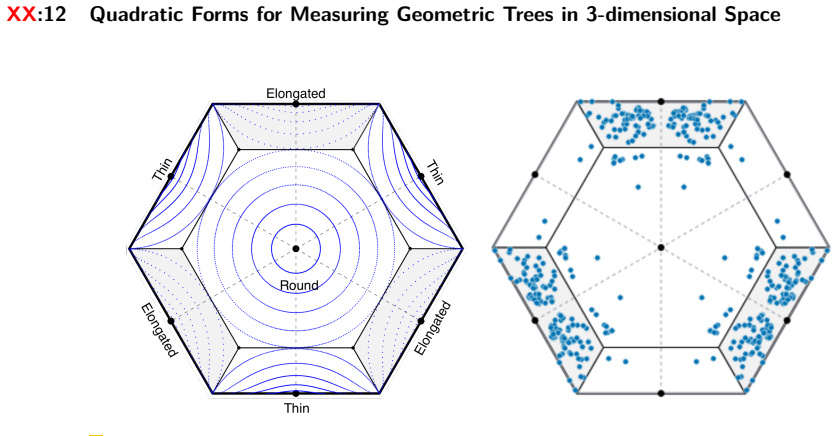
Tree-like structures appear in many areas of science, and their shapes can help understand the underlying processes they drive or that give rise to them. By thinking of these structures as geometric graphs in $\mathbb{R}^3$, we gain access to tools from computational geometry and topology to study them. In this paper, we adopt the theory of quadratic forms to measure the directional spread of geometric graphs, and we introduce the hexplot model -- equipped with a metric derived from the Fisher metric on the standard triangle -- to visualize, measure, and collect statistics.
Editorial analysis
A structured set of objections, weighed in public.
Referee Report
Summary. The paper claims that tree-like structures can be studied as geometric graphs in R^3 using tools from computational geometry and topology. It adopts the theory of quadratic forms to measure the directional spread of these graphs and introduces the hexplot model equipped with a metric derived from the Fisher metric on the standard triangle to visualize, measure, and collect statistics.
Significance. If the central construction is sound, this work could offer a new quantitative framework for analyzing the shapes of tree-like structures in three dimensions, with applications across scientific disciplines. The combination of quadratic forms and the Fisher metric represents a potentially useful methodological contribution if the mapping from embeddings to forms is canonical and the metric preserves relevant directional information.
major comments (2)
- [Abstract] The abstract announces the adoption of quadratic forms for measuring directional spread but provides no explicit definition or construction for associating a quadratic form with a given geometric tree in R^3. This omission is load-bearing because without it, the claim that eigenvalues or eigenspaces quantify directional spread cannot be evaluated, consistent with the stress-test concern that the map from embedded tree to quadratic form is unspecified.
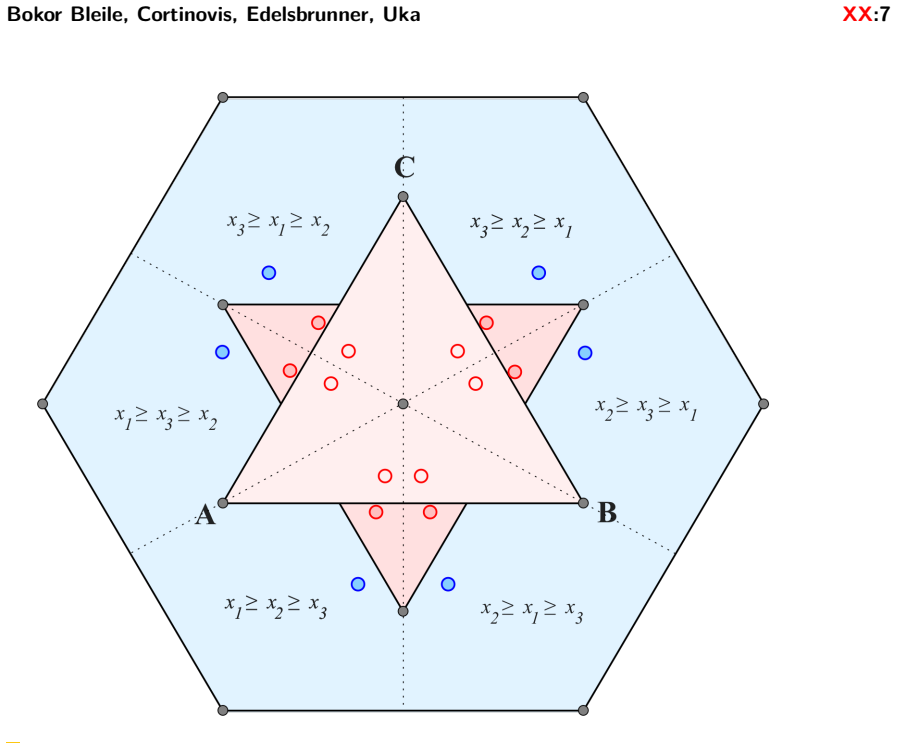
- [Hexplot model] The description of the hexplot model and its Fisher-derived metric on the standard triangle does not explain how the 3D directional properties of the tree are projected or reduced to the 2-simplex, nor does it address whether the acyclic nature of the tree or the embedding in R^3 requires additional topological assumptions to preserve the intended measurements.
minor comments (1)
- The manuscript would benefit from including at least one concrete example of a geometric tree, the associated quadratic form, and the resulting hexplot to illustrate the method.
Simulated Author's Rebuttal
We thank the referee for the careful reading and constructive feedback. We address each major comment below, providing clarifications from the manuscript and indicating revisions made to improve explicitness.
read point-by-point responses
-
Referee: [Abstract] The abstract announces the adoption of quadratic forms for measuring directional spread but provides no explicit definition or construction for associating a quadratic form with a given geometric tree in R^3. This omission is load-bearing because without it, the claim that eigenvalues or eigenspaces quantify directional spread cannot be evaluated, consistent with the stress-test concern that the map from embedded tree to quadratic form is unspecified.
Authors: The abstract is a high-level summary, but the explicit construction is given in Section 2 of the manuscript: for a geometric tree T embedded in R^3, the associated quadratic form is defined by Q_T(v) = sum over edges e of length(e) * (unit direction vector of e dot v)^2. The eigenvalues and eigenspaces of the matrix representing Q_T then quantify directional spread. We agree the abstract should reference this map more directly and have revised it to include a concise statement of the construction. revision: yes
-
Referee: [Hexplot model] The description of the hexplot model and its Fisher-derived metric on the standard triangle does not explain how the 3D directional properties of the tree are projected or reduced to the 2-simplex, nor does it address whether the acyclic nature of the tree or the embedding in R^3 requires additional topological assumptions to preserve the intended measurements.
Authors: Section 4 details the reduction: edge directions from the R^3 embedding are normalized to the unit sphere and then mapped to the standard 2-simplex via the Fisher metric (which is the unique invariant metric on the simplex). The acyclic property of the tree ensures the induced direction measure has no cyclic dependencies, and the embedding in R^3 is used directly with no further topological assumptions required. We have expanded the exposition in the revised manuscript to make the projection step and compatibility explicit. revision: yes
Circularity Check
No circularity; standard quadratic forms and Fisher metric imported without self-referential reduction
full rationale
The provided abstract and context contain no equations, fitted parameters, or self-citations. The paper states it 'adopt[s] the theory of quadratic forms' and introduces a hexplot model 'equipped with a metric derived from the Fisher metric on the standard triangle,' which are external mathematical objects rather than quantities defined in terms of the target directional spread. No load-bearing step reduces a prediction or claim to its own inputs by construction. The derivation is self-contained via imported tools.
Axiom & Free-Parameter Ledger
axioms (1)
- domain assumption Quadratic forms are suitable for capturing directional spread of points in R^3
invented entities (1)
-
hexplot model
no independent evidence
Reference graph
Works this paper leans on
-
[1]
Methods of Information Geometry
S.\ Amari and H.\ Nagaoka. Methods of Information Geometry. Amer.\ Math.\ Soc., Providence, Rhoode Island, 2000
2000
-
[2]
The geometry of random drift i-vi
P.L.\ Antonelli et al. The geometry of random drift i-vi. Adv.\ Appl.\ Probab. 9-12 (1977-80)
1977
-
[3]
NeuroMorpho.Org: a central resource for neuronal morphologies
G.A.\ Ascoli, D.E.\ Donohue and N.M.\ Halavi. NeuroMorpho.Org: a central resource for neuronal morphologies. J.\ Neurosci. 27 (2007), 9247--9251
2007
-
[4]
Differential structure of hippocampal CA1 pyramidal neurons in the human and mouse
R.\ Benavides-Piccione et al. Differential structure of hippocampal CA1 pyramidal neurons in the human and mouse. Cerebral Cortex 30 (2020), 730--752
2020
-
[5]
Y.\ Bokor Bleile and E.\ Cortinovis. Quadrix . Inst.\ Sci.\ Techn.\ Austria, Klosterneuburg, Austria, 2026. DOI: 10.15479/AT-ISTA-21971
-
[6]
Curves and Singularities: a Geometrical Introduction to Singularity Theory
J.W.\ Bruce and P.J.\ Giblin. Curves and Singularities: a Geometrical Introduction to Singularity Theory. Second edition, Cambridge Univ.\ Press, Cambridge, England, 1992
1992
-
[7]
The Sensual (quadratic) Form
J.H.\ Conway. The Sensual (quadratic) Form. The Carus Mathematical Monographs 26 , MAA Press, Amer.\ Math.\ Soc., Providence, Rhode Island, 1997
1997
-
[8]
Geometry and the Imagination
D.\ Hilbert and S.\ Cohn-Vossen. Geometry and the Imagination. Translated by P.\ Nemenyi, AMS Chelsea Publ., Providence, Rhode Island, 1952
1952
-
[9]
Matrix Analysis
R.A.\ Horn and C.R.\ Johnson. Matrix Analysis. Second edition, Cambridge Univ.\ Press, Cambridge, England, 2013
2013
-
[10]
Perturbation Theory for Linear Operators
T.\ Kato. Perturbation Theory for Linear Operators. Second edition, Springer-Verlag, New York, New York, 1976
1976
-
[11]
On information and sufficiency
S.\ Kullback and R.A.\ Leibler. On information and sufficiency. Ann.\ Math.\ Stat. 22 (1951). 79--86
1951
-
[12]
Introduction to Smooth Manifolds
J.M.\ Lee. Introduction to Smooth Manifolds. Graduate Texts in Mathematics 218 , Springer, New York, New York, 2003
2003
-
[13]
Dendritic and axonal architecture of individual pyramidal neurons across layers of adult human neocortex
H.\ Mohan et al. Dendritic and axonal architecture of individual pyramidal neurons across layers of adult human neocortex. Cerebral Cortex 25 (2015), 4839--4853
2015
-
[14]
Lognormal distributions and geometric averages of symmetric positive definite matrices
A.\ Schwartzman. Lognormal distributions and geometric averages of symmetric positive definite matrices. Int.\ Stat.\ Rev. 84 (2016), 456--486
2016
-
[15]
False discovery rate analysis of brain diffusion direction maps
A.\ Schwartzman, R.F.\ Dougherty and J.E.\ Taylor. False discovery rate analysis of brain diffusion direction maps. Ann.\ Appl.\ Stat. 2 (2008), 153--175
2008
-
[16]
Wellesley-Cambridge, Wellesley, Massachusetts, 1993
Introduction to Linear Algebra. Wellesley-Cambridge, Wellesley, Massachusetts, 1993
1993
-
[17]
Human hippocampal CA3 uses specific functional connectivity rules for efficient associative memory
J.F.\ Watson et al. Human hippocampal CA3 uses specific functional connectivity rules for efficient associative memory. Cell 188 (2024), 501--514
2024
discussion (0)
Sign in with ORCID, Apple, or X to comment. Anyone can read and Pith papers without signing in.