A merger shock traced by radio arcs and ultra-long radio tails in galaxy cluster A2142
Pith reviewed 2026-06-26 16:38 UTC · model grok-4.3
The pith
The merger shock in galaxy cluster A2142 produces radio arcs as vortex rings from radio galaxy cocoons and elongates the radio tails.
A machine-rendered reading of the paper's core claim, the machinery that carries it, and where it could break.
Core claim
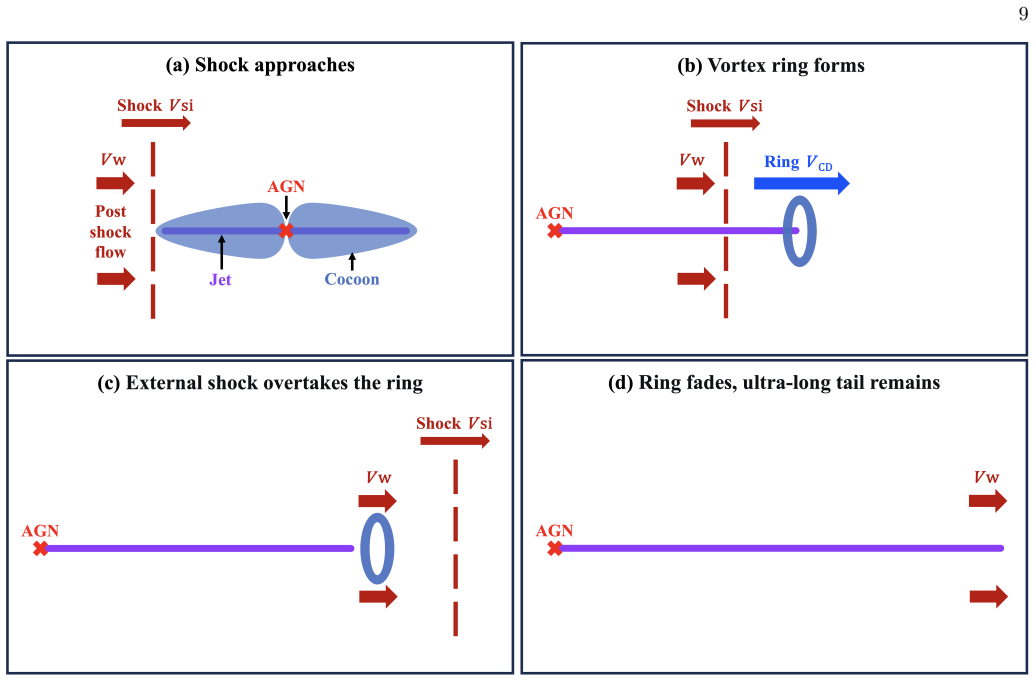
We detect a merger shock with Mach number around 1.3 whose front is spatially coincident with arc-shaped radio filaments. These arcs are partial vortex ring structures formed by the shock stripping and rolling the jet cocoons of radio galaxies into toroidal vortices. The post-shock wind re-accelerates aged relativistic electrons and stretches the tail plasma, which accounts for the ultra-long radio tails seen in this and other merging clusters.
What carries the argument
Partial vortex ring structures formed when the merger shock interacts with the low-density cocoons of radio galaxies
If this is right
- Radio arcs and ultra-long tails function as independent tracers of merger shocks.
- Merger shocks reshape both thermal gas and non-thermal relativistic electrons in clusters.
- Tailed radio galaxies act as sensitive probes of intracluster medium flows and weather.
- Off-axis mergers with large impact parameters can generate both the observed shock and cold-front sloshing.
Where Pith is reading between the lines
- Comparable radio arcs may appear in other merging clusters and could be used to map shocks where X-ray coverage is incomplete.
- The cocoon-rolling process may redistribute magnetic fields and cosmic-ray electrons on large scales inside clusters.
- Numerical merger simulations that embed radio sources would predict the frequency and geometry of such vortex features.
Load-bearing premise
Magnetohydrodynamic simulations accurately describe how a merger shock will strip and roll radio galaxy cocoons into partial vortex rings in this specific system.
What would settle it
Radio spectral maps that show no flattening or re-acceleration signature across the arcs and tails would contradict the proposed vortex and elongation mechanisms.
Figures

read the original abstract
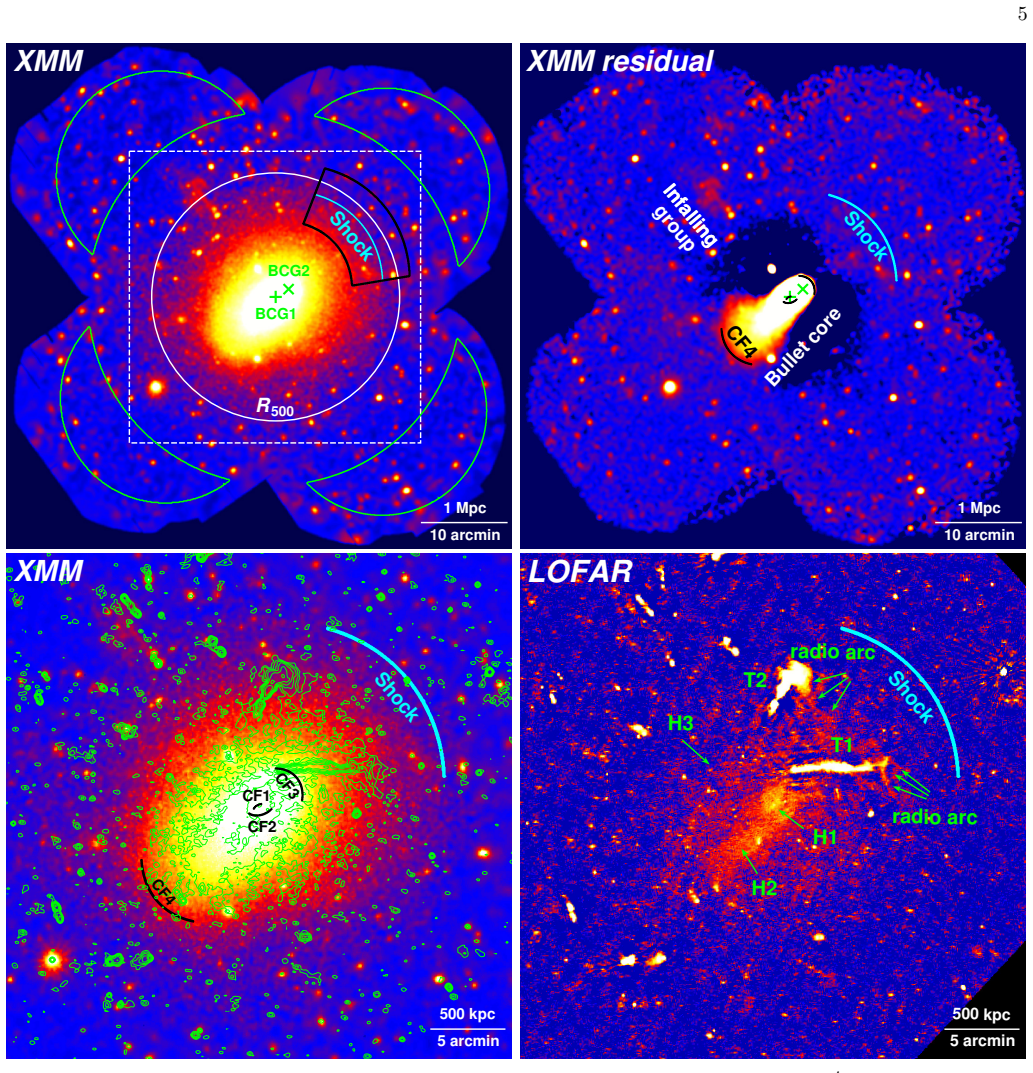
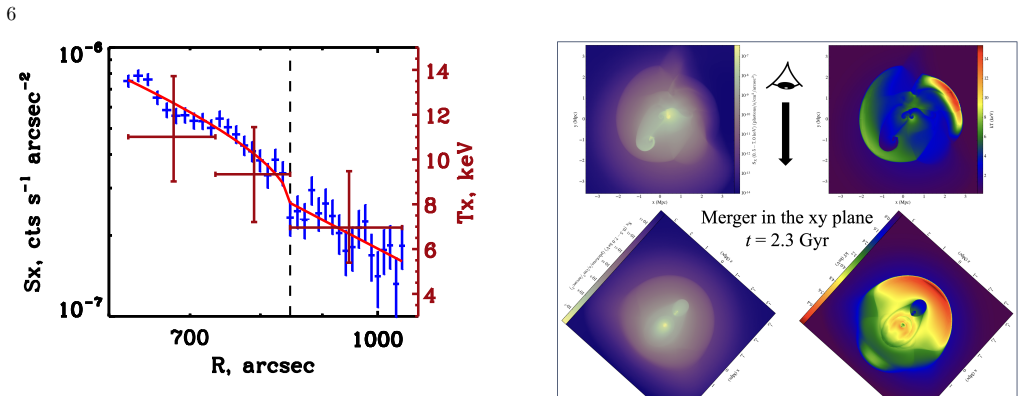
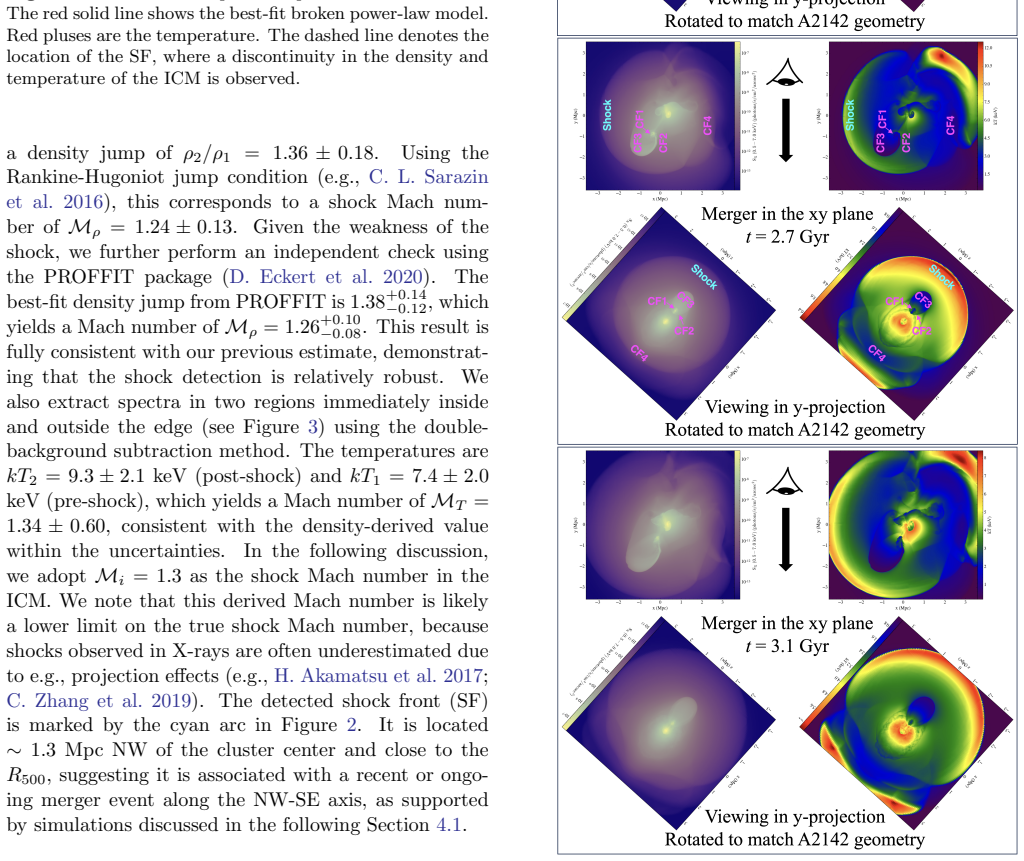
Abell 2142 (A2142) is a massive, nearby galaxy cluster undergoing a complex merger. It exhibits an elongated X-ray morphology along the northwest-southeast axis and hosts four known cold fronts. Using XMM-Newton observations, we detect a merger shock on the northwest side of the cluster with a Mach number of $M \sim 1.3$. The observed shock front and four cold fronts can be reproduced by numerical simulations of an off-axis merger with a large impact parameter, which imparts significant angular momentum to induce the sloshing of the subcluster core and large-scale ambient gas. In projection, the shock front is spatially coincident with arc-shaped radio filaments observed behind the prominent head-tail radio galaxies T1 and T2. We interpret these radio arcs as partial vortex ring structures (resembling ``smoke rings'') produced by the interaction of the merger shock with the low-density cocoons of radio galaxies. The shock strips and rolls the jet cocoon into a toroidal vortex, as predicted by recent magnetohydrodynamic simulations. We further demonstrate that the merger shock can significantly elongate the radio tails by re-accelerating aged relativistic electrons and stretching the tail plasma via the post-shock wind. This process provides a natural explanation for the $>$500 kpc tail observed in this and other merging clusters. Our findings establish radio arcs and ultra-long radio tails as independent, complementary tracers of merger shocks in galaxy clusters. Our results demonstrate that merger shocks can reshape both the thermal and non-thermal components of galaxy clusters, and that tailed radio galaxies serve as sensitive probes of intracluster medium weather.
Editorial analysis
A structured set of objections, weighed in public.
Referee Report
Summary. The paper reports XMM-Newton detection of a merger shock (M~1.3) in A2142, reproduced by off-axis merger simulations that also match the four cold fronts. Radio arcs behind head-tail galaxies T1/T2 are interpreted as partial vortex rings formed when the shock strips and rolls radio-galaxy cocoons, citing recent MHD simulations; the same shock is claimed to re-accelerate electrons and stretch plasma to produce >500 kpc tails.
Significance. If the dynamical origin of the arcs and tails is established, the work would supply independent radio tracers of weak merger shocks and demonstrate how shocks reshape non-thermal plasma on large scales, complementing X-ray data in merging clusters.
major comments (2)
- [Abstract] Abstract (radio-interpretation paragraph): the claim that the observed arcs are partial vortex rings produced by shock-cocoon interaction rests on visual spatial coincidence and reference to external MHD simulations, without any quantitative comparison (arc radius, thickness, curvature, or surface-brightness profile) between the A2142 data and simulated structures at M~1.3, the relevant density contrast, or the observed magnetic geometry.
- [Abstract] Abstract (Mach-number statement): the reported M~1.3 is presented without accompanying density-jump measurement, temperature jump, or error analysis; the central claim that the shock is responsible for both the arcs and the ultra-long tails therefore lacks the quantitative verification needed to rule out projection or alternative origins.
minor comments (2)
- Notation for the four cold fronts and the two radio galaxies (T1, T2) should be defined at first use with explicit coordinate references.
- [Abstract] The phrase "as predicted by recent magnetohydrodynamic simulations" requires a specific citation and a brief statement of the simulation parameters (Mach number, density contrast) that match A2142.
Simulated Author's Rebuttal
We thank the referee for the constructive comments on the abstract. We agree that strengthening the quantitative support for both the Mach number and the radio arc interpretation will improve the manuscript. We respond to each point below and will revise accordingly.
read point-by-point responses
-
Referee: [Abstract] Abstract (radio-interpretation paragraph): the claim that the observed arcs are partial vortex rings produced by shock-cocoon interaction rests on visual spatial coincidence and reference to external MHD simulations, without any quantitative comparison (arc radius, thickness, curvature, or surface-brightness profile) between the A2142 data and simulated structures at M~1.3, the relevant density contrast, or the observed magnetic geometry.
Authors: We acknowledge that the vortex-ring interpretation currently rests on spatial coincidence with the detected shock and the predictions of the cited MHD simulations. The manuscript does not yet provide direct quantitative metrics such as arc radius, thickness or curvature extracted from the radio data and compared to the simulations at the observed Mach number and density contrast. In revision we will add these measurements (arc radius ~50 kpc, thickness and curvature) together with a brief comparison to the simulated vortex structures, and will note the limitations on surface-brightness profile comparison imposed by current resolution. The revised abstract and discussion will reflect this addition. revision: yes
-
Referee: [Abstract] Abstract (Mach-number statement): the reported M~1.3 is presented without accompanying density-jump measurement, temperature jump, or error analysis; the central claim that the shock is responsible for both the arcs and the ultra-long tails therefore lacks the quantitative verification needed to rule out projection or alternative origins.
Authors: The Mach number is obtained from the density jump measured across the northwest X-ray surface-brightness discontinuity in the XMM-Newton data; the full text reports the jump value (~1.4), associated temperature information, uncertainties, and the supporting off-axis merger simulation that simultaneously reproduces the shock and the four cold fronts, thereby reducing the likelihood of pure projection. The abstract itself is a summary and therefore omits these details. We will insert a concise statement of the measured density jump and its uncertainty into the abstract to make the quantitative basis explicit while retaining brevity. revision: partial
Circularity Check
No significant circularity; claims rest on external data and cited simulations
full rationale
The paper derives the merger shock Mach number M~1.3 directly from XMM-Newton X-ray observations and reproduces the shock plus cold fronts via independent numerical simulations of an off-axis merger. The radio-arc interpretation as partial vortex rings is presented as an inference from spatial coincidence plus reference to external MHD simulations, without any equations, fitted parameters, or self-citations that reduce the claim to its own inputs by construction. No self-definitional loops, fitted-input predictions, or load-bearing self-citation chains appear in the provided text.
Axiom & Free-Parameter Ledger
Reference graph
Works this paper leans on
-
[1]
2017, A&A, 600, A100, doi: 10.1051/0004-6361/201628400
Akamatsu, H., Mizuno, M., Ota, N., et al. 2017, A&A, 600, A100, doi: 10.1051/0004-6361/201628400
-
[2]
Jacques and Scott, Pat , year = 2009, month = sep, journal =
Asplund, M., Grevesse, N., Sauval, A. J., & Scott, P. 2009, ARA&A, 47, 481, doi: 10.1146/annurev.astro.46.060407.145222 12
-
[3]
Bliton, M., Rizza, E., Burns, J. O., Owen, F. N., & Ledlow, M. J. 1998, MNRAS, 301, 609, doi: 10.1046/j.1365-8711.1998.01973.x
-
[4]
2023, A&A, 678, A133, doi: 10.1051/0004-6361/202347245
Bruno, L., Botteon, A., Shimwell, T., et al. 2023, A&A, 678, A133, doi: 10.1051/0004-6361/202347245
-
[5]
Bruno, L., Venturi, T., Dallacasa, D., et al. 2024, A&A, 690, A329, doi: 10.1051/0004-6361/202451515
-
[6]
Burns, J. O. 1998, Science, 280, 400, doi: 10.1126/science.280.5362.400
-
[7]
1976, A&A, 500, 95
Cavaliere, A., & Fusco-Femiano, R. 1976, A&A, 500, 95
1976
-
[8]
and Lang, Dustin and Blum, Robert and Burleigh, Kaylan and Fan, Xiaohui and Findlay, Joseph R
Dey, A., Schlegel, D. J., Lang, D., et al. 2019, AJ, 157, 168, doi: 10.3847/1538-3881/ab089d
-
[9]
2020, The Open Journal of Astrophysics, 3, 12, doi: 10.21105/astro.2009.13944
Eckert, D., Finoguenov, A., Ghirardini, V., et al. 2020, The Open Journal of Astrophysics, 3, 12, doi: 10.21105/astro.2009.13944
-
[10]
2014, A&A, 570, A119, doi: 10.1051/0004-6361/201424259
Eckert, D., Molendi, S., Owers, M., et al. 2014, A&A, 570, A119, doi: 10.1051/0004-6361/201424259
-
[11]
2015, A&A, 580, A69, doi: 10.1051/0004-6361/201526399 Enßlin, T
Einasto, M., Gramann, M., Saar, E., et al. 2015, A&A, 580, A69, doi: 10.1051/0004-6361/201526399 Enßlin, T. A., & Br¨ uggen, M. 2002, MNRAS, 331, 1011, doi: 10.1046/j.1365-8711.2002.05261.x
-
[12]
Ge, C., Sun, M., Ramatsoku, M., Nolting, C., & Koribalski, B. S. 2026, ApJ, 1000, 67, doi: 10.3847/1538-4357/ae4226
-
[13]
2019, MNRAS, 484, 1946, doi: 10.1093/mnras/stz088
Ge, C., Sun, M., Rozo, E., et al. 2019, MNRAS, 484, 1946, doi: 10.1093/mnras/stz088
-
[14]
Ge, C., Wang, Q. D., Tripp, T. M., et al. 2016, MNRAS, 459, 366, doi: 10.1093/mnras/stw599
-
[15]
2020, MNRAS, 497, 4704, doi: 10.1093/mnras/staa2320
Ge, C., Liu, R.-Y., Sun, M., et al. 2020, MNRAS, 497, 4704, doi: 10.1093/mnras/staa2320
-
[16]
2021, MNRAS, 508, L69, doi: 10.1093/mnrasl/slab108
Ge, C., Sun, M., Yagi, M., et al. 2021, MNRAS, 508, L69, doi: 10.1093/mnrasl/slab108
-
[17]
Henry, J. P., & Briel, U. G. 1996, ApJ, 472, 137, doi: 10.1086/178049
-
[18]
Jones, T. W., Nolting, C., O’Neill, B. J., & Mendygral, P. J. 2017, Physics of Plasmas, 24, 041402, doi: 10.1063/1.4978620
-
[19]
Koester, B. P., McKay, T. A., Annis, J., et al. 2007, ApJ, 660, 239, doi: 10.1086/509599
-
[20]
Koribalski, B. S., Duchesne, S. W., Lenc, E., et al. 2024, MNRAS, 533, 608, doi: 10.1093/mnras/stae1838
-
[21]
2018, ApJ, 863, 102, doi: 10.3847/1538-4357/aad090
Liu, A., Yu, H., Diaferio, A., et al. 2018, ApJ, 863, 102, doi: 10.3847/1538-4357/aad090
-
[22]
2007, PhR, 443, 1, doi: 10.1016/j.physrep.2007.01.001
Markevitch, M., & Vikhlinin, A. 2007, PhR, 443, 1, doi: 10.1016/j.physrep.2007.01.001
-
[23]
Markevitch, M., Ponman, T. J., Nulsen, P. E. J., et al. 2000, ApJ, 541, 542, doi: 10.1086/309470
-
[24]
Munari, E., Biviano, A., & Mamon, G. A. 2014, A&A, 566, A68, doi: 10.1051/0004-6361/201322450
-
[25]
Nolting, C., Jones, T. W., O’Neill, B. J., & Mendygral, P. J. 2019a, ApJ, 876, 154, doi: 10.3847/1538-4357/ab16d6
-
[26]
Nolting, C., Jones, T. W., O’Neill, B. J., & Mendygral, P. J. 2019b, ApJ, 885, 80, doi: 10.3847/1538-4357/ab4650
-
[27]
2008, PASJ, 60, 345, doi: 10.1093/pasj/60.2.345 O’Neill, B
Okabe, N., & Umetsu, K. 2008, PASJ, 60, 345, doi: 10.1093/pasj/60.2.345 O’Neill, B. J., Jones, T. W., Nolting, C., & Mendygral, P. J. 2019a, ApJ, 884, 12, doi: 10.3847/1538-4357/ab40b1 O’Neill, B. J., Jones, T. W., Nolting, C., & Mendygral, P. J. 2019b, ApJ, 887, 26, doi: 10.3847/1538-4357/ab4efa
-
[28]
Osinga, E., van Weeren, R. J., Brunetti, G., et al. 2024, A&A, 688, A175, doi: 10.1051/0004-6361/202348002
-
[29]
Owers, M. S., Couch, W. J., Nulsen, P. E. J., & Randall, S. W. 2012, ApJL, 750, L23, doi: 10.1088/2041-8205/750/1/L23
-
[30]
Owers, M. S., Nulsen, P. E. J., & Couch, W. J. 2011, ApJ, 741, 122, doi: 10.1088/0004-637X/741/2/122
-
[31]
2009, ApJ, 704, 1349, doi: 10.1088/0004-637X/704/2/1349
Markevitch, M. 2009, ApJ, 704, 1349, doi: 10.1088/0004-637X/704/2/1349
-
[32]
Pfrommer, C., & Jones, T. W. 2011, ApJ, 730, 22, doi: 10.1088/0004-637X/730/1/22 Planck Collaboration, Ade, P. A. R., Aghanim, N., et al. 2016, A&A, 594, A27, doi: 10.1051/0004-6361/201525823
-
[33]
J., Bonafede, A., Bruno, L., et al
Riseley, C. J., Bonafede, A., Bruno, L., et al. 2024, A&A, 686, A44, doi: 10.1051/0004-6361/202348944
-
[34]
2014, MNRAS, 443, L114, doi: 10.1093/mnrasl/slu087
Sun, M. 2014, MNRAS, 443, L114, doi: 10.1093/mnrasl/slu087
-
[35]
2013, A&A, 556, A44, doi: 10.1051/0004-6361/201321319
Rossetti, M., Eckert, D., De Grandi, S., et al. 2013, A&A, 556, A44, doi: 10.1051/0004-6361/201321319
-
[36]
Deep XMM-Newton Observations of the NW Radio Relic Region of Abell 3667
Sarazin, C. L., Finoguenov, A., Wik, D. R., & Clarke, T. E. 2016, arXiv e-prints, arXiv:1606.07433, doi: 10.48550/arXiv.1606.07433
work page internal anchor Pith review Pith/arXiv arXiv doi:10.48550/arxiv.1606.07433 2016
-
[37]
Shimwell, T. W., Hardcastle, M. J., Tasse, C., et al. 2026, A&A, 707, A198, doi: 10.1051/0004-6361/202557749
-
[38]
Sobral, D., Stroe, A., Dawson, W. A., et al. 2015, MNRAS, 450, 630, doi: 10.1093/mnras/stv521
-
[39]
Sun, M., Voit, G. M., Donahue, M., et al. 2009, ApJ, 693, 1142, doi: 10.1088/0004-637X/693/2/1142
-
[40]
2016, A&A, 595, A42, doi: 10.1051/0004-6361/201628183
Tchernin, C., Eckert, D., Ettori, S., et al. 2016, A&A, 595, A42, doi: 10.1051/0004-6361/201628183
-
[41]
2009, ApJ, 694, 1643, doi: 10.1088/0004-637X/694/2/1643 van Weeren, R
Umetsu, K., Birkinshaw, M., Liu, G.-C., et al. 2009, ApJ, 694, 1643, doi: 10.1088/0004-637X/694/2/1643 van Weeren, R. J., de Gasperin, F., Akamatsu, H., et al. 2019, SSRv, 215, 16, doi: 10.1007/s11214-019-0584-z
-
[42]
2017, A&A, 603, A125, doi: 10.1051/0004-6361/201630014
Venturi, T., Rossetti, M., Brunetti, G., et al. 2017, A&A, 603, A125, doi: 10.1051/0004-6361/201630014
-
[43]
Wang, Q. H. S., & Markevitch, M. 2018, ApJ, 868, 45, doi: 10.3847/1538-4357/aae921 13
-
[44]
Willingale, R., Starling, R. L. C., Beardmore, A. P., Tanvir, N. R., & O’Brien, P. T. 2013, MNRAS, 431, 394, doi: 10.1093/mnras/stt175
-
[45]
Zhang, C., Churazov, E., Forman, W. R., & Jones, C. 2019, MNRAS, 482, 20, doi: 10.1093/mnras/sty2501
-
[46]
ZuHone, J. A. 2011, ApJ, 728, 54, doi: 10.1088/0004-637X/728/1/54
discussion (0)
Sign in with ORCID, Apple, or X to comment. Anyone can read and Pith papers without signing in.