AInterviewer: A Platform for Designing and Conducting AI-led Qualitative Interviews
Pith reviewed 2026-06-30 19:35 UTC · model grok-4.3
The pith
AInterviewer is an open-source multi-agent platform that blends survey-style question control with LLM flexibility for qualitative interviews.
A machine-rendered reading of the paper's core claim, the machinery that carries it, and where it could break.
Core claim
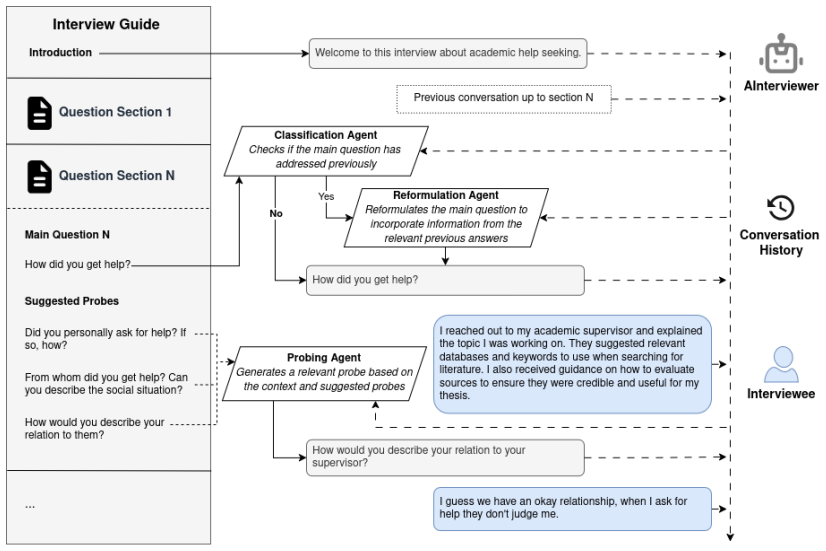
AInterviewer is an opensource solution based on a multi-agent pipeline that combines controlled question administration of survey software with the flexibility of LLMs and can run with locally hosted models to ensure security, transparency, and reproducibility.
What carries the argument
The multi-agent pipeline, which integrates controlled question administration from survey software with LLM flexibility for handling interview tasks.
If this is right
- The platform supports the full interview process through a web-based GUI, including guide design, pilot testing, distribution, and monitoring.
- Local model hosting allows data collection without sending sensitive information to external providers.
- It applies social science standards for qualitative interviewing to an automated system.
- Question wording and order remain standardized even as LLMs handle conversational elements.
Where Pith is reading between the lines
- The system could be adapted for hybrid data collection that mixes structured survey items with open qualitative probes.
- Real-world deployment in social science projects would test whether it maintains interview quality at scale.
- Similar multi-agent designs might apply to other research tasks like automated coding of responses.
Load-bearing premise
That a multi-agent pipeline can simultaneously enforce standardization and best practices from qualitative interviewing while retaining LLM flexibility without introducing new biases or losing natural conversation flow.
What would settle it
A controlled study measuring response consistency, adherence to the interview guide, and participant engagement in interviews run by AInterviewer versus human interviewers or single-LLM systems.
Figures

read the original abstract
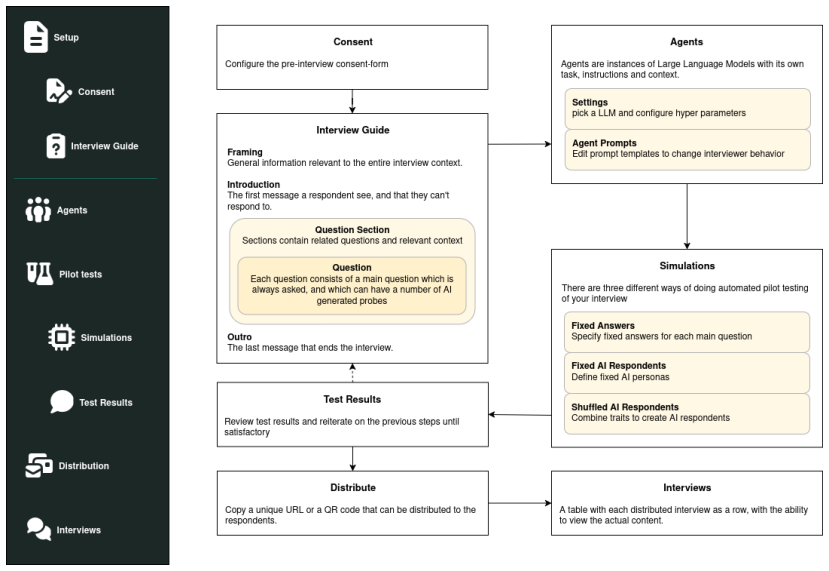
There are now multiple proposals for systems based on Large Language Models (LLMs) to conduct automated qualitative interviews, but most of the current solutions rely on proprietary LLMs, which compromises reproducibility and data security. They also rely on LLMs for all interview tasks, which limits standardisation of question wording as well as control over question order. To address these issues, we introduce the AInterviewer platform, an opensource solution based on a multi-agent pipeline that combines controlled question administration of survey software with the flexibility of LLMs. AInterviewer is an interdisciplinary effort designed to implement best practices of qualitative interviewing in social science, and it can run with locally hosted models to ensure security, transparency, and reproducibility. Our platform provides a web-based GUI supporting each phase of data collection: from interview guide design and pilot testing to interview distribution and data collection monitoring.
Editorial analysis
A structured set of objections, weighed in public.
Referee Report
Summary. The manuscript introduces AInterviewer, an open-source web-based platform for AI-led qualitative interviews. It describes a multi-agent pipeline that integrates controlled question administration from survey software with LLM adaptability, supports local model hosting for security/transparency/reproducibility, implements social-science best practices for interviewing, and provides a GUI covering interview guide design, pilot testing, distribution, and monitoring.
Significance. If the platform's claims hold, it would offer a reproducible, secure alternative to proprietary LLM interview systems and could support more standardized qualitative data collection in HCI and social sciences. The emphasis on open-source code, local models, and interdisciplinary best practices is a strength. However, the complete absence of any empirical validation, pilot data, or comparisons means the practical significance remains potential rather than demonstrated.
major comments (2)
- [Abstract] Abstract: The central claim that the multi-agent pipeline 'combines controlled question administration of survey software with the flexibility of LLMs' while implementing best practices is load-bearing for the contribution, yet the manuscript supplies only architectural descriptions and GUI screenshots with no pilot data, inter-rater reliability metrics, ablation studies on agent roles, or comparisons to human interviewers or single-agent baselines.
- [Platform architecture description] Platform architecture description: The assertion that the system enforces standardization of question wording and order while retaining natural conversation flow without introducing new biases is presented without any implementation details on agent coordination, error handling, or flow-control mechanisms, leaving the technical feasibility of the claimed balance unexamined.
minor comments (2)
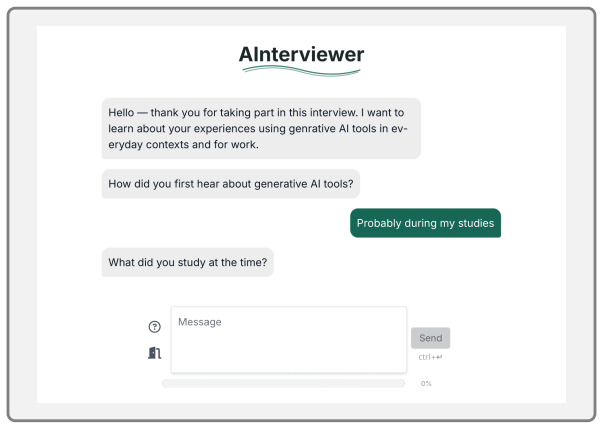
- [GUI screenshots] Figure captions for GUI screenshots could include annotations or callouts to highlight specific interface elements referenced in the text.
- [Conclusion] The manuscript would benefit from a dedicated limitations or future-work subsection that explicitly addresses the current lack of empirical evaluation.
Simulated Author's Rebuttal
We thank the referee for the constructive review and for highlighting both the platform's potential strengths and the need for greater clarity on its claims. We respond to each major comment below.
read point-by-point responses
-
Referee: [Abstract] Abstract: The central claim that the multi-agent pipeline 'combines controlled question administration of survey software with the flexibility of LLMs' while implementing best practices is load-bearing for the contribution, yet the manuscript supplies only architectural descriptions and GUI screenshots with no pilot data, inter-rater reliability metrics, ablation studies on agent roles, or comparisons to human interviewers or single-agent baselines.
Authors: We agree that the manuscript contains no empirical validation, pilot data, or comparative metrics. The work is framed as a systems paper whose primary contribution is the open-source platform design, architecture, and GUI that integrates survey-style control with LLM flexibility while supporting local models. We will revise the abstract, introduction, and add an explicit limitations and future-work section to state the scope more precisely and note that empirical evaluations (including reliability metrics and baselines) are planned separately. revision: partial
-
Referee: [Platform architecture description] Platform architecture description: The assertion that the system enforces standardization of question wording and order while retaining natural conversation flow without introducing new biases is presented without any implementation details on agent coordination, error handling, or flow-control mechanisms, leaving the technical feasibility of the claimed balance unexamined.
Authors: We will expand the platform architecture section with concrete implementation details on the multi-agent pipeline, including agent coordination logic, error-handling routines, and flow-control mechanisms that maintain question order and wording while allowing natural follow-up. These additions will make the technical feasibility of the claimed balance explicit. revision: yes
Circularity Check
No circularity: platform description with no derivations or fitted claims
full rationale
The paper is a system description of an open-source interview platform. It contains no equations, no fitted parameters, no predictions of quantities, and no derivation chain. Claims about the multi-agent pipeline combining survey control with LLM flexibility are presented as design choices and implementation goals, not as results derived from prior fitted data or self-citations that reduce to the inputs. No load-bearing self-citation, uniqueness theorem, or ansatz smuggling is present. This is the expected non-finding for a software platform paper.
Axiom & Free-Parameter Ledger
Reference graph
Works this paper leans on
-
[1]
, month = nov, year =
Salganik, Matthew J. , month = nov, year =. Bit by
-
[2]
Thinking through methods:
Martin, John Levi , year =. Thinking through methods:
-
[3]
2011 , pages =
The Public Opinion Quarterly , author =. 2011 , pages =
2011
-
[4]
2023 , eprint=
Mistral 7B , author=. 2023 , eprint=
2023
-
[5]
PloS one , author =
Wiki surveys:. PloS one , author =. 2015 , note =
2015
-
[6]
Method and meaning in polls and surveys , url =
Schuman, Howard , year =. Method and meaning in polls and surveys , url =
-
[7]
Social Science Computer Review , author =
A. Social Science Computer Review , author =. 2021 , note =. doi:10.1177/0894439319885317 , abstract =
-
[8]
Proceedings of the 17th international web for all conference , pages=
Accessible conversational user interfaces: considerations for design , author=. Proceedings of the 17th international web for all conference , pages=
-
[9]
Competitive Social Science Research Journal , author=
Development of Qualitative Semi-Structured Interview Guide for Case Study Research , volume=. Competitive Social Science Research Journal , author=. 2022 , month=
2022
-
[10]
The SAGE handbook of qualitative methods in health research , volume=
Qualitative interviewing techniques and styles , author=. The SAGE handbook of qualitative methods in health research , volume=. 2010 , publisher=
2010
-
[11]
Journal of advanced nursing , volume=
Systematic methodological review: developing a framework for a qualitative semi-structured interview guide , author=. Journal of advanced nursing , volume=. 2016 , publisher=
2016
-
[12]
arXiv preprint arXiv:2503.16789 , year=
Conversational user-ai intervention: A study on prompt rewriting for improved llm response generation , author=. arXiv preprint arXiv:2503.16789 , year=
-
[13]
Proceedings of the Extended Abstracts of the CHI Conference on Human Factors in Computing Systems , pages=
Privacy Meets Explainability: Managing Confidential Data and Transparency Policies in LLM-Empowered Science , author=. Proceedings of the Extended Abstracts of the CHI Conference on Human Factors in Computing Systems , pages=
-
[14]
Proceedings of the Fortieth Conference on Uncertainty in Artificial Intelligence , articleno =
Herlihy, Christine and Neville, Jennifer and Schnabel, Tobias and Swaminathan, Adith , title =. Proceedings of the Fortieth Conference on Uncertainty in Artificial Intelligence , articleno =. 2024 , publisher =
2024
-
[15]
Staudinger, Moritz and Kusa, Wojciech and Piroi, Florina and Lipani, Aldo and Hanbury, Allan , title =. Proceedings of the 2024 Annual International ACM SIGIR Conference on Research and Development in Information Retrieval in the Asia Pacific Region , pages =. 2024 , isbn =. doi:10.1145/3673791.3698432 , abstract =
-
[16]
Whispers in the Machine: Confidentiality in Agentic Systems
Whispers in the machine: Confidentiality in llm-integrated systems , author=. arXiv preprint arXiv:2402.06922 , year=
work page internal anchor Pith review Pith/arXiv arXiv
-
[17]
arXiv preprint arXiv:2601.05918 , year=
Agentic LLMs as Powerful Deanonymizers: Re-identification of Participants in the Anthropic Interviewer Dataset , author=. arXiv preprint arXiv:2601.05918 , year=
-
[18]
arXiv preprint arXiv:2406.12934 , year=
Current state of LLM Risks and AI Guardrails , author=. arXiv preprint arXiv:2406.12934 , year=
-
[19]
Proceedings of the 31st International Conference on Computational Linguistics , pages=
The only way is ethics: A guide to ethical research with large language models , author=. Proceedings of the 31st International Conference on Computational Linguistics , pages=
-
[20]
Minimalist style of UI interface design in the age of self-media , author=. Proc. Of International Conference on Information and Social Science , pages=
-
[21]
ti 5.0: A comparative review of two popular qualitative data-analysis programs , author=
NVivo 2.0 and ATLAS. ti 5.0: A comparative review of two popular qualitative data-analysis programs , author=. Field methods , volume=. 2004 , publisher=
2004
-
[22]
Journal of the Medical Library Association: JMLA , volume=
NVivo , author=. Journal of the Medical Library Association: JMLA , volume=
-
[23]
Conducting Research in Conservation , pages=
Qualitative interviews and focus groups , author=. Conducting Research in Conservation , pages=. 2010 , publisher=
2010
-
[24]
Journal of official statistics , author =
The status of computer-assisted telephone interviewing:. Journal of official statistics , author =. 1986 , note =
1986
-
[25]
Social Science Computer Review , author =
New. Social Science Computer Review , author =. 1992 , note =. doi:10.1177/089443939201000202 , abstract =
-
[26]
Sociological Methods & Research , author =
Computational. Sociological Methods & Research , author =. 2017 , pages =. doi:10.1177/0049124117729703 , abstract =
-
[27]
Big Data & Society , author =
Computational grounded theory revisited:. Big Data & Society , author =. 2022 , note =
2022
-
[28]
Quality & Quantity , author =
Quantitative narrative analysis software options compared:. Quality & Quantity , author =. 2013 , note =
2013
-
[29]
The international encyclopedia of communication research methods , author =
Qualitative analysis software (. The international encyclopedia of communication research methods , author =. 2017 , note =
2017
-
[30]
Qualitative sociology , author =
The. Qualitative sociology , author =. 1991 , note =
1991
-
[31]
Sociological Research Online , author =
Choosing. Sociological Research Online , author =. 1998 , pages =. doi:10.5153/sro.178 , abstract =
-
[32]
Qualitative and
Salmona, Michelle and Lieber, Eli and Kaczynski, Dan , month = aug, year =. Qualitative and
-
[33]
Synthetic. Political Analysis , author =. 2024 , keywords =. doi:10.1017/pan.2024.5 , abstract =
-
[34]
Sociological Methods & Research , author =
Generative. Sociological Methods & Research , author =. 2025 , note =. doi:10.1177/00491241251327130 , abstract =
-
[35]
Social Science Computer Review , author =
The. Social Science Computer Review , author =. 2025 , note =. doi:10.1177/08944393251334977 , abstract =
-
[36]
Social Science Computer Review , author =
Navigating the. Social Science Computer Review , author =. 2025 , note =. doi:10.1177/08944393251366243 , abstract =
-
[37]
Social Science Computer Review , author =
Prompting the. Social Science Computer Review , author =. 2025 , note =. doi:10.1177/08944393251344865 , abstract =
-
[38]
Social Science Computer Review , author =
Dialogues. Social Science Computer Review , author =. 2025 , note =. doi:10.1177/08944393251370354 , abstract =
-
[39]
Proceedings of the National Academy of Sciences , author =
Can. Proceedings of the National Academy of Sciences , author =. 2024 , pages =. doi:10.1073/pnas.2314021121 , abstract =
-
[40]
International Journal of Social Research Methodology , author =
Clarifying question meaning in standardized interviews can improve data quality even though wording may change: a review of the evidence , volume =. International Journal of Social Research Methodology , author =. 2021 , note =. doi:10.1080/13645579.2020.1824627 , abstract =
-
[41]
Precision and. PLOS ONE , author =. 2015 , note =. doi:10.1371/journal.pone.0128337 , abstract =
-
[42]
Topics in Cognitive Science , author =
When. Topics in Cognitive Science , author =. 2018 , note =. doi:10.1111/tops.12330 , abstract =
-
[43]
Public opinion quarterly , author =
Does conversational interviewing reduce survey measurement error? , url =. Public opinion quarterly , author =. 1997 , note =
1997
-
[44]
Applied Cognitive Psychology , author =
Bringing features of human dialogue to web surveys , volume =. Applied Cognitive Psychology , author =. 2007 , note =. doi:10.1002/acp.1335 , abstract =
-
[45]
Journal of Official Statistics , author =
Promoting uniform question understanding in today's and tomorrow's surveys , volume =. Journal of Official Statistics , author =. 2005 , note =
2005
-
[46]
Journal of official statistics , author =
New strategies for pretesting survey questions , volume =. Journal of official statistics , author =. 1991 , note =
1991
-
[47]
Public Opinion Quarterly , author =
Interviewer. Public Opinion Quarterly , author =. 2010 , pages =. doi:10.1093/poq/nfp089 , abstract =
-
[48]
Public Opinion Quarterly , author =
Questions for. Public Opinion Quarterly , author =. 2011 , pages =. doi:10.1093/poq/nfr048 , abstract =
-
[49]
Public Opinion Quarterly , author =
Clarifying. Public Opinion Quarterly , author =. 2000 , pages =. doi:10.1086/316757 , abstract =
-
[50]
Narayanan, Arvind and Kapoor, Sayash , month = dec, year =
-
[51]
, month = jul, year =
Briggs, Charles L. , month = jul, year =. Learning
-
[52]
Strangers in their own land:
Hochschild, Arlie Russell , year =. Strangers in their own land:
-
[53]
Interviews:
Kvale, Steinar and Brinkmann, Svend , year =. Interviews:
-
[54]
A. Sociological Focus , author =. 2019 , pages =. doi:10.1080/00380237.2018.1544514 , language =
-
[55]
Qualitative Research , author =
‘. Qualitative Research , author =. 2013 , note =. doi:10.1177/1468794112446106 , abstract =
-
[56]
Comparing
Guven, Semra Yuksel and G. Comparing. 2025 , note =
2025
-
[57]
Soudani, Heydar and Petcu, Roxana and Kanoulas, Evangelos and Hasibi, Faegheh , month = may, year =. A. doi:10.48550/arXiv.2405.13003 , abstract =
work page internal anchor Pith review Pith/arXiv arXiv doi:10.48550/arxiv.2405.13003
-
[58]
Balloccu, Simone and Schmidtová, Patrícia and Lango, Mateusz and Dušek, Ondřej , year =. Leak,
-
[59]
Conversations at
Geiecke, Friedrich and Jaravel, Xavier , year =. Conversations at
-
[60]
Conducting
Chopra, Felix and Haaland, Ingar , year =. Conducting
-
[61]
and Würschinger, Quirin and Kreuter, Frauke , year =
Wuttke, Alexander and Aßenmacher, Matthias and Klamm, Christopher and Lang, Max M. and Würschinger, Quirin and Kreuter, Frauke , year =
-
[62]
, year =
Weiss, Robert S. , year =. Learning from
-
[63]
Sociological Methods & Research , author =
Sources of. Sociological Methods & Research , author =. 2019 , pages =. doi:10.1177/0049124117729698 , number =
-
[64]
Sociological Methods & Research , author =
Deceptively. Sociological Methods & Research , author =. 2023 , pages =. doi:10.1177/00491241221140431 , number =
-
[65]
Why. Nature , author =. 2023 , pages =. doi:10.1038/d41586-023-01295-4 , number =
-
[66]
Nature Computational Science , author =
Using. Nature Computational Science , author =. 2024 , pages =. doi:10.1038/s43588-023-00585-1 , number =
-
[67]
Interpretive. Ethnography , author =. 2017 , pages =. doi:10.1177/1466138115592418 , number =
-
[68]
AI-interview , url=
Carlsen, Hjalmar B , year=. AI-interview , url=
-
[69]
Krippendorff, Klaus , year =. Content
-
[70]
ACM Transactions on Interactive Intelligent Systems (TiiS) , volume=
Bridging the gap between ethics and practice: guidelines for reliable, safe, and trustworthy human-centered AI systems , author=. ACM Transactions on Interactive Intelligent Systems (TiiS) , volume=. 2020 , publisher=
2020
-
[71]
and Wang, Haohan , booktitle =
Jin, Haibo and Zhou, Andy and Menke, Joe D. and Wang, Haohan , booktitle =. Jailbreaking Large Language Models Against Moderation Guardrails via Cipher Characters , url =. doi:10.52202/079017-1896 , editor =
-
[72]
An Audit on the Perspectives and Challenges of Hallucinations in NLP
Narayanan Venkit, Pranav and Chakravorti, Tatiana and Gupta, Vipul and Biggs, Heidi and Srinath, Mukund and Goswami, Koustava and Rajtmajer, Sarah and Wilson, Shomir. An Audit on the Perspectives and Challenges of Hallucinations in NLP. Proceedings of the 2024 Conference on Empirical Methods in Natural Language Processing. 2024. doi:10.18653/v1/2024.emnlp...
-
[73]
ACM Transactions on Information Systems , volume=
A survey on hallucination in large language models: Principles, taxonomy, challenges, and open questions , author=. ACM Transactions on Information Systems , volume=. 2025 , publisher=
2025
-
[74]
Qualitative Health Research , author =
Protecting. Qualitative Health Research , author =. 2009 , pages =. doi:10.1177/1049732309350879 , number =
-
[75]
Comparing Text and Voice Answers to Open Questions on Sensitive Topics in Smartphone Surveys , author =
Typing or. Comparing Text and Voice Answers to Open Questions on Sensitive Topics in Smartphone Surveys , author =
-
[76]
‘. Ethnography , author =. 2009 , pages =. doi:10.1177/1466138108099586 , number =
-
[77]
Sociological Methods & Research , author =
Gender. Sociological Methods & Research , author =. 1985 , pages =. doi:10.1177/0049124185014001002 , number =
-
[78]
, year =
Goldthorpe, John H. , year =. On
-
[79]
Gerson, Kathleen and Damaske, Sarah , year =. The
-
[80]
Survey. Field Methods , author =. 2005 , pages =. doi:10.1177/1525822X04269550 , number =
discussion (0)
Sign in with ORCID, Apple, or X to comment. Anyone can read and Pith papers without signing in.