NeuroShield: A Device-Agnostic Foundation Model for EEG Authentication
Pith reviewed 2026-06-27 04:28 UTC · model grok-4.3
The pith
NeuroShield pretrains a dual-stage transformer on 15,762 subjects to produce EEG identity embeddings that transfer across unseen headsets after fine-tuning.
A machine-rendered reading of the paper's core claim, the machinery that carries it, and where it could break.
Core claim
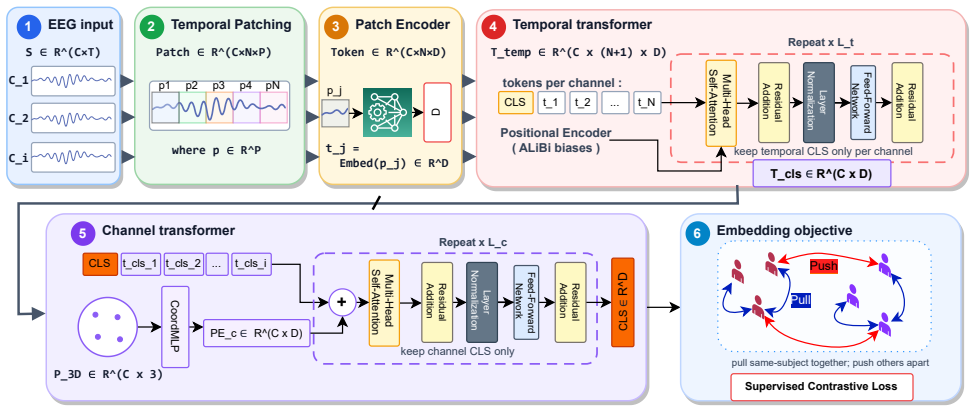
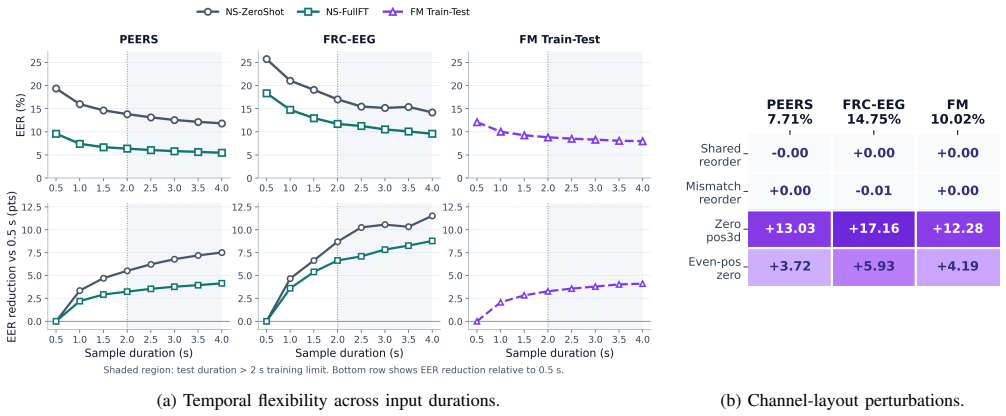
NeuroShield is a reusable foundation model for EEG authentication that learns identity-discriminative embeddings from variable-channel and variable-length recordings through a dual-stage transformer architecture. It is pretrained on three public datasets comprising 15,762 subjects and 28,116 sessions, then fine-tuned and evaluated on two previously unseen downstream datasets, where it reduces equal error rate by 0.44–8.06 percentage points relative to the state of the art while also generalizing to longer segments and novel channel layouts.
What carries the argument
Dual-stage transformer architecture that ingests variable-channel and variable-length EEG to produce identity-discriminative embeddings.
If this is right
- After fine-tuning, equal error rate drops 0.44–8.06 percentage points on two unseen downstream datasets.
- The model processes EEG segments longer than any length seen during pretraining.
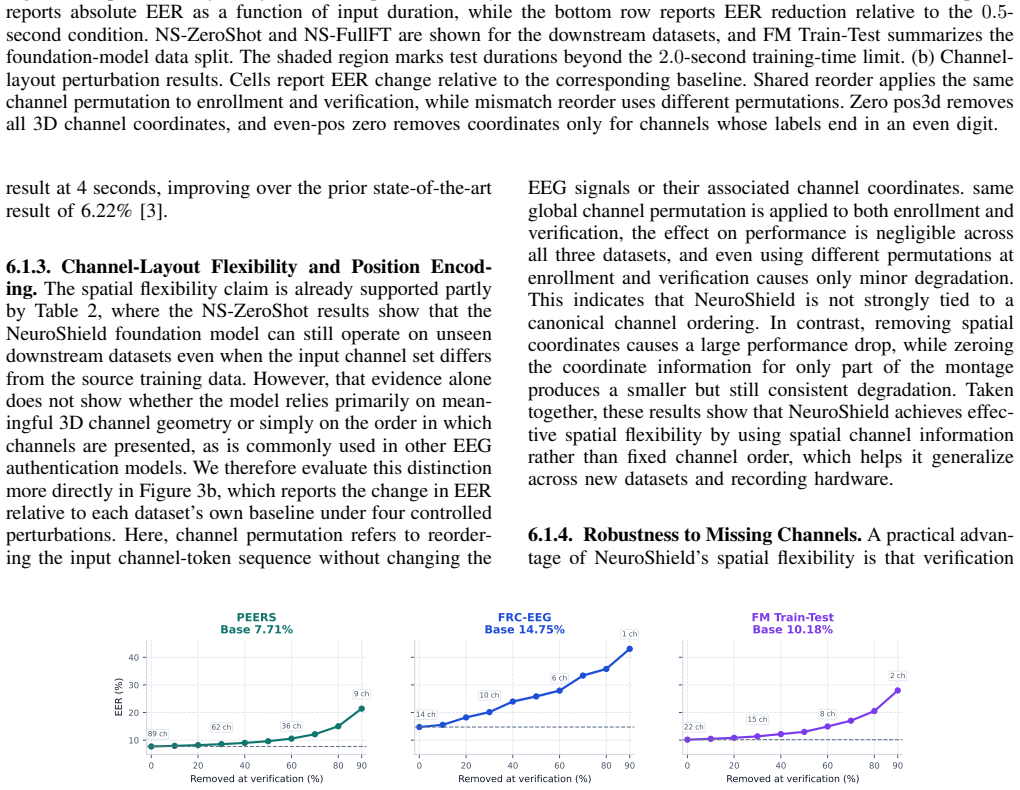
- It produces usable embeddings for channel layouts absent from the pretraining data.
- One pretrained encoder can be reused across heterogeneous recording settings instead of training a separate model for each headset.
- The model is released as open source to enable community reuse.
Where Pith is reading between the lines
- The same pretraining approach could reduce the data-collection burden for deploying EEG biometrics on consumer wearables that use non-standard electrode placements.
- If the embeddings remain stable across longer recordings, real-time continuous authentication becomes feasible without retraining on full-session lengths.
- Open release of the weights may allow researchers to test whether the same architecture transfers to other biosignal tasks such as ECG or fNIRS authentication.
- The performance gain on unseen datasets suggests that multi-dataset pretraining could become a standard first step for any new EEG biometric study rather than an exception.
Load-bearing premise
The three public pretraining datasets already contain enough diversity in hardware, channel layouts, and subject populations for the learned embeddings to transfer to arbitrary new headsets with only fine-tuning.
What would settle it
A new EEG dataset recorded on an unseen headset brand with a channel layout outside the pretraining distribution, where fine-tuned NeuroShield fails to reduce equal error rate below the best existing per-device model, would falsify the transfer claim.
Figures



read the original abstract
A central challenge in EEG authentication is that models are typically tied to the acquisition settings in which they are trained. In particular, variations in headset hardware, channel layout, and signal duration create heterogeneous recordings that existing models are not designed to handle, causing each new headset or dataset to be treated as a separate model-development problem. This fragmentation limits multi-dataset learning, hinders knowledge transfer, and reduces model reusability. To address this limitation, we present NeuroShield, a reusable foundation model for EEG authentication that learns identity-discriminative embeddings from variable-channel and variable-length EEG recordings through a dual-stage transformer architecture. We pretrain NeuroShield on three public EEG datasets comprising 15{,}762 subjects and 28{,}116 sessions, and evaluate transfer on two unseen downstream datasets. Our evaluations show that, after fine-tuning, NeuroShield reduces equal error rate by 0.44--8.06 percentage points relative to the state of the art. NeuroShield further generalizes to segments longer than those seen during training and operates across channel layouts not encountered during pretraining. These results establish NeuroShield as a reusable and adaptable EEG identity encoder across heterogeneous recording settings. We release NeuroShield as open source to support reproducibility and community adoption.
Editorial analysis
A structured set of objections, weighed in public.
Referee Report
Summary. The paper presents NeuroShield, a dual-stage transformer foundation model for EEG authentication that learns identity-discriminative embeddings from variable-channel and variable-length recordings. Pretrained on three public datasets (15,762 subjects, 28,116 sessions), it is evaluated on two unseen downstream datasets, claiming EER reductions of 0.44--8.06 percentage points after fine-tuning relative to the state of the art, plus generalization to longer segments and unseen channel layouts. The model is released open source.
Significance. If the generalization claims hold after verification, the work would be significant for EEG biometrics by enabling a reusable, device-agnostic encoder that reduces per-headset model development. The open-source release and multi-dataset pretraining are strengths that support reproducibility and community use.
major comments (3)
- [Abstract] Abstract: the reported EER reductions of 0.44--8.06 percentage points are stated without reference to statistical tests, error bars, confidence intervals, or ablation controls on the fine-tuning procedure, making it impossible to determine whether the gains are robust or affected by post-hoc dataset or hyperparameter choices.
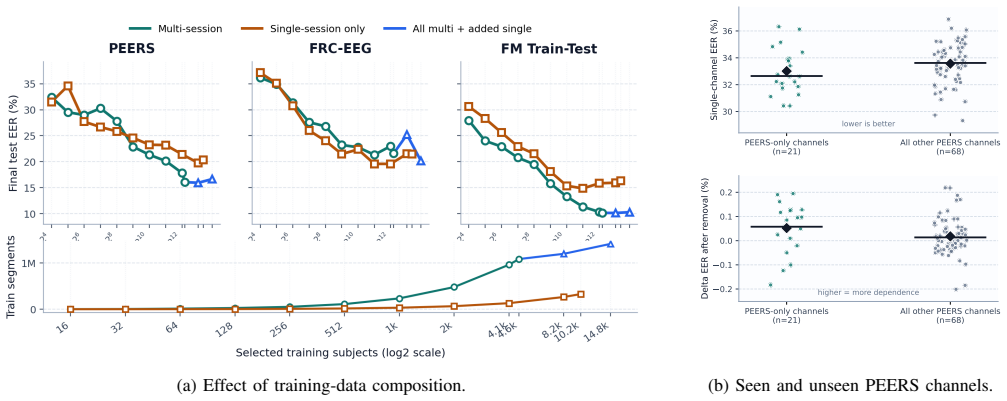
- [Abstract] Abstract and §3 (model description): the device-agnostic claim requires that the three pretraining datasets already span relevant hardware, montage, and population variations for transfer to arbitrary unseen headsets; no characterization or quantitative analysis of this diversity (e.g., channel layout overlap statistics or hardware metadata) is supplied, so the downstream EER gains could reflect dataset overlap rather than true generalization.
- [Abstract] Abstract: the dual-stage transformer is asserted to handle variable channels and lengths, yet no explicit mechanism (learned channel embeddings, permutation-invariant pooling, or layout-agnostic positional encoding) is described whose correctness can be verified independently of the particular pretraining datasets.
minor comments (1)
- [Abstract] The abstract would benefit from a brief sentence on the exact fine-tuning protocol and the two downstream datasets (subject counts, channel counts, session lengths) to allow immediate assessment of the transfer setting.
Simulated Author's Rebuttal
We thank the referee for the constructive comments. We address each major comment below and will revise the manuscript accordingly to improve clarity and rigor.
read point-by-point responses
-
Referee: [Abstract] Abstract: the reported EER reductions of 0.44--8.06 percentage points are stated without reference to statistical tests, error bars, confidence intervals, or ablation controls on the fine-tuning procedure, making it impossible to determine whether the gains are robust or affected by post-hoc dataset or hyperparameter choices.
Authors: We agree that the abstract lacks these details. We will revise the abstract and results section to reference statistical tests, error bars from multiple fine-tuning runs, confidence intervals, and ablation controls on the fine-tuning procedure. revision: yes
-
Referee: [Abstract] Abstract and §3 (model description): the device-agnostic claim requires that the three pretraining datasets already span relevant hardware, montage, and population variations for transfer to arbitrary unseen headsets; no characterization or quantitative analysis of this diversity (e.g., channel layout overlap statistics or hardware metadata) is supplied, so the downstream EER gains could reflect dataset overlap rather than true generalization.
Authors: We agree that a quantitative characterization is missing. We will add an analysis of pretraining dataset diversity, including channel layout overlap statistics and hardware metadata, to §2 to substantiate the generalization claims. revision: yes
-
Referee: [Abstract] Abstract: the dual-stage transformer is asserted to handle variable channels and lengths, yet no explicit mechanism (learned channel embeddings, permutation-invariant pooling, or layout-agnostic positional encoding) is described whose correctness can be verified independently of the particular pretraining datasets.
Authors: We agree the abstract does not explicitly describe the mechanisms. We will revise §3 to explicitly detail the mechanisms (e.g., learned channel embeddings) for handling variable channels and lengths, enabling independent verification. revision: yes
Circularity Check
No circularity in derivation chain
full rationale
The paper is an empirical ML study: it pretrains a dual-stage transformer on three public datasets (15,762 subjects) and reports EER reductions after fine-tuning on two explicitly unseen downstream datasets. No equations, fitted parameters, or self-citations are invoked to derive the performance numbers; the gains are measured on held-out data. The device-agnostic claim is an empirical generalization hypothesis resting on dataset diversity rather than any self-definitional loop, fitted-input prediction, or load-bearing self-citation. No patterns from the enumerated circularity kinds are present.
Axiom & Free-Parameter Ledger
Reference graph
Works this paper leans on
-
[1]
A review of eeg-based user authentication: trends and future research directions,
C. A. Fidas and D. Lyras, “A review of eeg-based user authentication: trends and future research directions,”IEEE Access, vol. 11, pp. 22 917–22 934, 2023
2023
-
[2]
Challenges and future perspectives on electroencephalogram-based biometrics in person recognition,
H.-L. Chan, P.-C. Kuo, C.-Y . Cheng, and Y .-S. Chen, “Challenges and future perspectives on electroencephalogram-based biometrics in person recognition,”Frontiers in neuroinformatics, vol. 12, p. 66, 2018
2018
-
[3]
Advancing brainwave- based biometrics: a large-scale, multi-session evaluation,
M. Fallahi, P. Arias-Cabarcos, and T. Strufe, “Advancing brainwave- based biometrics: a large-scale, multi-session evaluation,”IEEE Transactions on Biometrics, Behavior, and Identity Science, vol. 8, no. 3, pp. 445–460, 2026
2026
-
[4]
Neuroidbench: An open-source benchmark framework for the standardization of methodology in brainwave-based authentication research,
A. K. Chaurasia, M. Fallahi, T. Strufe, P. Terh ¨orst, and P. A. Cabar- cos, “Neuroidbench: An open-source benchmark framework for the standardization of methodology in brainwave-based authentication research,”Journal of Information Security and Applications, vol. 85, p. 103832, 2024
2024
-
[5]
Eeg authentication system based on one-and multi-class machine learning classifiers,
L. Hern ´andez- ´Alvarez, E. Barbierato, S. Caputo, L. Mucchi, and L. Hern´andez Encinas, “Eeg authentication system based on one-and multi-class machine learning classifiers,”Sensors, vol. 23, no. 1, p. 186, 2022
2022
-
[6]
Eeg-based authentication across various event-related potentials (erps),
A. Al-Nafjan, L. Alahaideb, M. Aldayel, and H. Aljumah, “Eeg-based authentication across various event-related potentials (erps),”Sensors, vol. 25, no. 16, p. 4962, 2025
2025
-
[7]
Brainnet: Improving brainwave-based biometric recognition with siamese networks,
M. Fallahi, T. Strufe, and P. Arias-Cabarcos, “Brainnet: Improving brainwave-based biometric recognition with siamese networks,” in 2023 IEEE International Conference on Pervasive Computing and Communications (PerCom). IEEE, 2023, pp. 53–60
2023
-
[8]
Session invariant eeg signatures using elicitation protocol fusion and convolutional neural network,
E. Debie, N. Moustafa, and A. Vasilakos, “Session invariant eeg signatures using elicitation protocol fusion and convolutional neural network,”IEEE Transactions on Dependable and Secure Computing, vol. 19, no. 4, pp. 2488–2500, 2021
2021
-
[9]
An introduction to biometric recognition,
A. K. Jain, A. Ross, and S. Prabhakar, “An introduction to biometric recognition,”IEEE Trans. Circuits Syst. Video Technol., vol. 14, no. 1, pp. 4–20, 2004. [Online]. Available: https://doi.org/10.1109/TCSVT.2003.818349
-
[10]
Aitst— affective eeg-based person identification via interrelated temporal– spatial transformer,
H. Cai, J. Jin, H. Wang, L. Li, Y . Huang, and J. Pan, “Aitst— affective eeg-based person identification via interrelated temporal– spatial transformer,”Pattern Recognition Letters, vol. 174, pp. 32–38, 2023
2023
-
[11]
Performance and usability evaluation of brainwave authentication techniques with consumer devices,
P. Arias-Cabarcos, M. Fallahi, T. Habrich, K. Schulze, C. Becker, and T. Strufe, “Performance and usability evaluation of brainwave authentication techniques with consumer devices,”ACM Transactions on Privacy and Security, vol. 26, no. 3, pp. 26:1–26:36, 2023
2023
-
[12]
Beyond gaze points: augmenting eye movement with brainwave data for multimodal user authentication in extended reality,
M. Fallahi, P. Arias-Cabarcos, and T. Strufe, “Beyond gaze points: augmenting eye movement with brainwave data for multimodal user authentication in extended reality,”Complex & Intelligent Systems, vol. 12, no. 1, p. 39, 2026
2026
-
[13]
Hans berger and 100 years of the electroencephalogram: Insights into his life and his research on the “electrencephalogram
J. R. Lemke, G. Kluger, and G. Kr ¨amer, “Hans berger and 100 years of the electroencephalogram: Insights into his life and his research on the “electrencephalogram”,”Clinical Epileptology, vol. 37, no. Suppl 3, pp. 112–119, 2024
2024
-
[14]
Consumer grade eeg measuring sensors as research tools: A review,
P. Sawangjai, S. Hompoonsup, P. Leelaarporn, S. Kongwudhiku- nakorn, and T. Wilaiprasitporn, “Consumer grade eeg measuring sensors as research tools: A review,”IEEE Sensors Journal, vol. 20, no. 8, pp. 3996–4024, 2020
2020
-
[15]
A survey on methods and challenges in eeg based authentication,
A. J. Bidgoly, H. J. Bidgoly, and Z. Arezoumand, “A survey on methods and challenges in eeg based authentication,”Computers & Security, vol. 93, p. 101788, 2020
2020
-
[16]
Pattern Recognition Letters123, 1–8 (2019)
E. Maiorana, “Learning deep features for task-independent eeg- based biometric verification,”Pattern Recognit. Lett., vol. 143, pp. 122–129, 2021. [Online]. Available: https://doi.org/10.1016/j.patrec. 2021.01.004
-
[17]
Attention is all you need,
A. Vaswani, N. Shazeer, N. Parmar, J. Uszkoreit, L. Jones, A. N. Gomez, Ł. Kaiser, and I. Polosukhin, “Attention is all you need,” in Advances in Neural Information Processing Systems, vol. 30, 2017
2017
-
[18]
Train short, test long: Attention with linear biases enables input length extrapolation,
O. Press, N. A. Smith, and M. Lewis, “Train short, test long: Attention with linear biases enables input length extrapolation,” in The Tenth International Conference on Learning Representations, ICLR 2022, Virtual Event, April 25-29, 2022. OpenReview.net, 2022. [Online]. Available: https://openreview.net/forum?id=R8sQPpGCv0
2022
-
[19]
A transformer-based framework for multivariate time series represen- tation learning,
G. Zerveas, S. Jayaraman, D. Patel, A. Bhamidipaty, and C. Eickhoff, “A transformer-based framework for multivariate time series represen- tation learning,” inProceedings of the 27th ACM SIGKDD Conference on Knowledge Discovery & Data Mining, 2021, pp. 2114–2124
2021
-
[20]
Informer: Beyond efficient transformer for long sequence time-series forecasting,
H. Zhou, S. Zhang, J. Peng, S. Zhang, J. Li, H. Xiong, and W. Zhang, “Informer: Beyond efficient transformer for long sequence time-series forecasting,” inProceedings of the AAAI Conference on Artificial Intelligence, vol. 35, no. 12, 2021, pp. 11 106–11 115
2021
-
[21]
Digital identity guidelines: Authentication and authenticator management,
National Institute of Standards and Technology, “Digital identity guidelines: Authentication and authenticator management,” National Institute of Standards and Technology, Tech. Rep., 2025. [Online]. Available: https://pages.nist.gov/800-63-4/sp800-63b.html
2025
-
[22]
Iso/iec 30107-1:2023 information technology — biometric presentation attack detection — part 1: Framework,
International Organization for Standardization, “Iso/iec 30107-1:2023 information technology — biometric presentation attack detection — part 1: Framework,” 2023, international Standard. [Online]. Available: https://www.iso.org/standard/83828.html
2023
-
[23]
Person authentication using brain- waves (eeg) and maximum a posteriori model adaptation,
S. Marcel and J. del R. Mill ´an, “Person authentication using brain- waves (eeg) and maximum a posteriori model adaptation,”IEEE Transactions on Pattern Analysis and Machine Intelligence, vol. 29, no. 4, pp. 743–752, 2007
2007
-
[24]
A survey on brain biometrics,
Q. Gui, M. V . Ruiz-Blondet, S. Laszlo, and Z. Jin, “A survey on brain biometrics,”ACM Comput. Surv., vol. 51, no. 6, pp. 112:1–112:38,
-
[25]
Available: https://doi.org/10.1145/3230632
[Online]. Available: https://doi.org/10.1145/3230632
-
[26]
Towards a univer- sal and privacy preserving eeg-based authentication system,
A. J. Bidgoly, H. J. Bidgoly, and Z. Arezoumand, “Towards a univer- sal and privacy preserving eeg-based authentication system,”Scientific Reports, vol. 12, no. 1, p. 2531, 2022
2022
-
[27]
A brainwave verification system integrating passwords with eeg templates for online identification and authentication,
H. Zhao, Y . Wang, and X. Gao, “A brainwave verification system integrating passwords with eeg templates for online identification and authentication,”Pattern Recognition, vol. 169, p. 112009, 2026
2026
-
[28]
10/20, 10/10, and 10/5 systems revisited: Their validity as relative head-surface-based positioning systems,
V . Jurcak, D. Tsuzuki, and I. Dan, “10/20, 10/10, and 10/5 systems revisited: Their validity as relative head-surface-based positioning systems,”NeuroImage, vol. 34, no. 4, pp. 1600–1611, 2007
2007
-
[29]
Eeg temporal–spatial transformer for person identification,
Y . Du, Y . Xu, X. Wang, L. Liu, and P. Ma, “Eeg temporal–spatial transformer for person identification,”Scientific Reports, vol. 12, p. 14378, 2022
2022
-
[30]
An interpretable contrastive learning transformer for eeg-based person identification,
X. Shao, C. Chang, J. Q. Gan, and H. Wang, “An interpretable contrastive learning transformer for eeg-based person identification,” IEEE Transactions on Information Forensics and Security, vol. 20, pp. 5069–5082, 2025
2025
-
[31]
Enhancing eeg-based authentication with transformer in internet of things,
C. Li, W. Meng, and W. Li, “Enhancing eeg-based authentication with transformer in internet of things,”IEEE Transactions on Information Forensics and Security, vol. 20, pp. 7197–7210, 2025
2025
-
[32]
A time series is worth 64 words: Long-term forecasting with transformers,
Y . Nie, N. H. Nguyen, P. Sinthong, and J. Kalagnanam, “A time series is worth 64 words: Long-term forecasting with transformers,” in The Eleventh International Conference on Learning Representations, ICLR 2023, Kigali, Rwanda, May 1-5, 2023. OpenReview.net, 2023. [Online]. Available: https://openreview.net/forum?id=Jbdc0vTOcol
2023
-
[33]
Medformer: A multi-granularity patching transformer for medical time-series classification,
Y . Wang, N. Huang, T. Li, Y . Yan, and X. Zhang, “Medformer: A multi-granularity patching transformer for medical time-series classification,”Advances in Neural Information Processing Systems, vol. 37, pp. 36 314–36 341, 2024
2024
-
[34]
Supervised contrastive learning,
P. Khosla, P. Teterwak, C. Wang, A. Sarna, Y . Tian, P. Isola, A. Maschinot, C. Liu, and D. Krishnan, “Supervised contrastive learning,” inAdvances in Neural Information Processing Systems 33: Annual Conference on Neural Information Processing Systems 2020, NeurIPS 2020, December 6-12, 2020, virtual, H. Larochelle, M. Ranzato, R. Hadsell, M. Balcan, and H...
2020
-
[35]
Multi- similarity loss with general pair weighting for deep metric learning,
X. Wang, X. Han, W. Huang, D. Dong, and M. R. Scott, “Multi- similarity loss with general pair weighting for deep metric learning,” inProceedings of the IEEE/CVF Conference on Computer Vision and Pattern Recognition, 2019, pp. 5022–5030
2019
-
[36]
The tuh eeg corpus: A big data resource for automated eeg interpretation,
A. Harati, S. Lopez, I. Obeid, J. Picone, M. Jacobson, and S. To- bochnik, “The tuh eeg corpus: A big data resource for automated eeg interpretation,” in2014 IEEE signal processing in medicine and biology symposium (SPMB). IEEE, 2014, pp. 1–5
2014
-
[37]
Resting- state eeg data before and after cognitive activity across the adult lifespan and a 5-year follow-up,
E. Wascher, D. Schneider, P. D. Gajewski, and S. Getzmann, “Resting- state eeg data before and after cognitive activity across the adult lifespan and a 5-year follow-up,” OpenNeuro dataset, 2025. [Online]. Available: https://openneuro.org/datasets/ds005385/versions/1.0.3
2025
-
[38]
Resting- state eeg data before and after cognitive activity across the adult lifespan and a 5-year follow-up,
S. Getzmann, P. D. Gajewski, D. Schneider, and E. Wascher, “Resting- state eeg data before and after cognitive activity across the adult lifespan and a 5-year follow-up,”Scientific Data, vol. 11, no. 1, p. 988, 2024
2024
-
[39]
Predict,
N. S. Chowdhury, C. Bi, A. J. Furman, A. K. Chiang, P. Skippen, E. Si, S. K. Millard, S. M. Margerison, D. Spies, M. L. Keaser, J. T. D. Silva, S. Chen, S. M. Schabrun, and D. A. Seminowicz, “Predict,” OpenNeuro dataset, 2025. [Online]. Available: https://openneuro.org/datasets/ds005486/versions/1.0.1
2025
-
[40]
A novel cortical biomarker signature for predicting pain sensitivity: protocol for the predict longitudinal analytical validation study,
D. A. Seminowicz, K. Bilska, N. S. Chowdhury, P. Skippen, S. K. Millard, A. K. Chiang, S. Chen, A. J. Furman, and S. M. Schabrun, “A novel cortical biomarker signature for predicting pain sensitivity: protocol for the predict longitudinal analytical validation study,”Pain Reports, vol. 5, no. 4, p. e833, 2020
2020
-
[41]
Predicting individual pain sensitivity using a novel cortical biomarker signature,
N. S. Chowdhury, C. Bi, A. J. Furman, A. K. Chiang, P. Skippen, E. Si, S. K. Millard, S. M. Margerison, D. Spies, M. L. Keaser et al., “Predicting individual pain sensitivity using a novel cortical biomarker signature,”JAMA neurology, vol. 82, no. 3, pp. 237–246, 2025
2025
-
[42]
Penn electrophysiology of encoding and retrieval study (peers),
M. J. Kahana, J. H. Rudoler, L. J. Lohnas, K. Healey, A. Aka, A. Broitman, E. Crutchley, P. Crutchley, K. H. Alm, B. S. Katerman, N. E. Miller, J. R. Kuhn, Y . Li, N. M. Long, J. Miller, M. D. Paron, J. K. Pazdera, I. Pedisich, and C. T. Weidemann, “Penn electrophysiology of encoding and retrieval study (peers),” OpenNeuro dataset, 2023. [Online]. Availab...
2023
-
[43]
The penn electrophysiology of encoding and retrieval study
M. J. Kahana, L. J. Lohnas, M. K. Healey, A. Aka, A. W. Broitman, P. Crutchley, E. Crutchley, K. H. Alm, B. S. Katerman, N. E. Milleret al., “The penn electrophysiology of encoding and retrieval study.”Journal of Experimental Psychology: Learning, Memory, and Cognition, 2024
2024
-
[44]
Eeg dataset of fusion relaxation and concentration moods,
A. Albasri, “Eeg dataset of fusion relaxation and concentration moods,”Mendeley Data, v1, 2019. [Online]. Available: https: //data.mendeley.com/datasets/8c26dn6c7w/1
2019
-
[45]
Permutation methods: A basis for exact inference,
M. D. Ernst, “Permutation methods: A basis for exact inference,” Statistical Science, vol. 19, pp. 676–685, 2004. [Online]. Available: https://api.semanticscholar.org/CorpusID:16746275
2004
-
[46]
Ped-anova: Efficiently quan- tifying hyperparameter importance in arbitrary subspaces,
S. Watanabe, A. Bansal, and F. Hutter, “Ped-anova: Efficiently quan- tifying hyperparameter importance in arbitrary subspaces,”arXiv preprint arXiv:2304.10255, 2023
Pith/arXiv arXiv 2023
-
[47]
Subsequent memory effect in intracranial and scalp eeg,
N. M. Long, J. F. Burke, and M. J. Kahana, “Subsequent memory effect in intracranial and scalp eeg,”NeuroImage, vol. 84, pp. 488– 494, 2014
2014
-
[48]
Posterior eeg alpha at rest and during task performance: Comparison of current source density and field potential measures,
C. E. Tenke, J. Kayser, K. Abraham, J. E. Alvarenga, and G. E. Bruder, “Posterior eeg alpha at rest and during task performance: Comparison of current source density and field potential measures,” International Journal of Psychophysiology, vol. 97, no. 3, pp. 299– 309, 2015
2015
-
[49]
Large brain model for learning generic representations with tremendous EEG data in BCI,
W. Jiang, L. Zhao, and B. Lu, “Large brain model for learning generic representations with tremendous EEG data in BCI,” inThe Twelfth International Conference on Learning Representations, ICLR 2024, Vienna, Austria, May 7-11, 2024. OpenReview.net, 2024. [Online]. Available: https://openreview.net/forum?id=QzTpTRVtrP
2024
-
[50]
Review of the BCI competition IV,
M. Tangermann, K.-R. M ¨uller, A. Aertsen, N. Birbaumer, C. Braun, C. Brunner, R. Leeb, C. Mehring, K. J. Miller, G. Mueller-Putz, G. Nolte, G. Pfurtscheller, H. Preissl, G. Schalk, A. Schl ¨ogl, C. Vi- daurre, S. Waldert, and B. Blankertz, “Review of the BCI competition IV,”Frontiers in Neuroscience, vol. 6, p. 55, 2012
2012
-
[51]
BCI2000: A general-purpose brain-computer inter- face (BCI) system,
G. Schalk, D. J. McFarland, T. Hinterberger, N. Birbaumer, and J. R. Wolpaw, “BCI2000: A general-purpose brain-computer inter- face (BCI) system,”IEEE Transactions on Biomedical Engineering, vol. 51, no. 6, pp. 1034–1043, 2004
2004
-
[52]
Neuralbench: A unifying framework to benchmark neuroai models,
H. J. Banville, S. d’Ascoli, S. Dahan, J. Rapin, M. Careil, Y . Benchetrit, J. L ´evy, S. Panchavati, A. Ratouchniak, M. Zhang, E. Cascardi, K. Begany, T. Brooks, and J. King, “Neuralbench: A unifying framework to benchmark neuroai models,”CoRR, vol. abs/2605.08495, 2026. [Online]. Available: https://doi.org/10.48550/ arXiv.2605.08495
Pith/arXiv arXiv 2026
-
[53]
Y . E. Ouahidi, J. Lys, P. Th ¨olke, N. Farrugia, B. Pasdeloup, V . Gripon, K. Jerbi, and G. Lioi, “REVE: A foundation model for EEG - adapting to any setup with large-scale pretraining on 25,000 subjects,”CoRR, vol. abs/2510.21585, 2025. [Online]. Available: https://doi.org/10.48550/arXiv.2510.21585
-
[54]
How eeg preprocessing shapes decoding performance,
R. Kessler, A. Enge, and M. A. Skeide, “How eeg preprocessing shapes decoding performance,”Communications Biology, vol. 8, p. 1039, 2025
2025
-
[55]
The prep pipeline: standardized preprocessing for large- scale eeg analysis,
N. Bigdely-Shamlo, T. Mullen, C. Kothe, K.-M. Su, and K. A. Robbins, “The prep pipeline: standardized preprocessing for large- scale eeg analysis,”Frontiers in Neuroinformatics, vol. 9, p. 16, 2015
2015
-
[56]
A personalized user authentication system based on eeg signals,
C. Stergiadis, V .-D. Kostaridou, S. Veloudis, D. Kazis, and M. A. Klados, “A personalized user authentication system based on eeg signals,”Sensors, vol. 22, no. 18, p. 6929, 2022. Appendix A. Preprocessing Details Following common EEG preprocessing practice, we ap- ply a unified preprocessing pipeline across all datasets to harmonize recordings collected...
2022
discussion (0)
Sign in with ORCID, Apple, or X to comment. Anyone can read and Pith papers without signing in.