Gas-induced perturbations on the gravitational wave in-spiral of live post-Newtonian LISA massive black hole binaries: 0.1 disk aspect ratio
Pith reviewed 2026-06-26 16:35 UTC · model grok-4.3
The pith
Gas torques from a 0.1-aspect-ratio circumbinary disk shift the orbital phase of a 10^6 solar-mass black hole binary by 0.12 radians over 600 cycles.
A machine-rendered reading of the paper's core claim, the machinery that carries it, and where it could break.
Core claim
The simulation tracks an equal-mass 10^6 solar-mass MBHB embedded in a locally isothermal circumbinary disk of aspect ratio 0.1. Gravitational and accretion torques are measured both with and without concurrent gravitational-wave emission. The gas-induced orbital phase shift accumulated over 600 orbital cycles equals 0.12 rad, which LISA should detect at z approximately 1. The accretion time series morphology changes only modestly once gravitational-wave emission becomes the dominant driver.
What carries the argument
Coupled 3D hydrodynamics evolution of the circumbinary disk with live 2.5 post-Newtonian binary dynamics that includes both gas torques and gravitational-wave emission.
If this is right
- LISA detection of the phase shift together with LSST or Roman detection of accretion-rate modulation would jointly constrain the circumbinary-disk environment.
- The reported torques and phase shift apply specifically to the 0.1 aspect-ratio, locally isothermal, equal-mass quasi-circular case.
- The accretion time series shows modest morphological change once gravitational-wave emission dominates the evolution.
- The binary is followed only from 55 to 46 Schwarzschild radii, the early part of its LISA-band inspiral.
Where Pith is reading between the lines
- If the measured phase shift is confirmed, LISA waveform templates may need environmental corrections to avoid systematic errors in inferred masses or distances.
- Varying the disk aspect ratio or thermodynamics in follow-up runs would show how sensitive the phase shift is to those parameters.
- Growth of binary eccentricity beyond the quasi-circular assumption would likely change the accumulated phase shift and therefore the LISA signal.
Load-bearing premise
The disk stays locally isothermal with a fixed 0.1 aspect ratio while the binary remains equal-mass and quasi-circular throughout the run.
What would settle it
LISA measurement of the accumulated orbital phase shift for a z=1, 10^6 solar-mass binary at the frequencies corresponding to 55-46 Schwarzschild radii radii would be either consistent or inconsistent with the reported 0.12 rad value.
Figures

read the original abstract
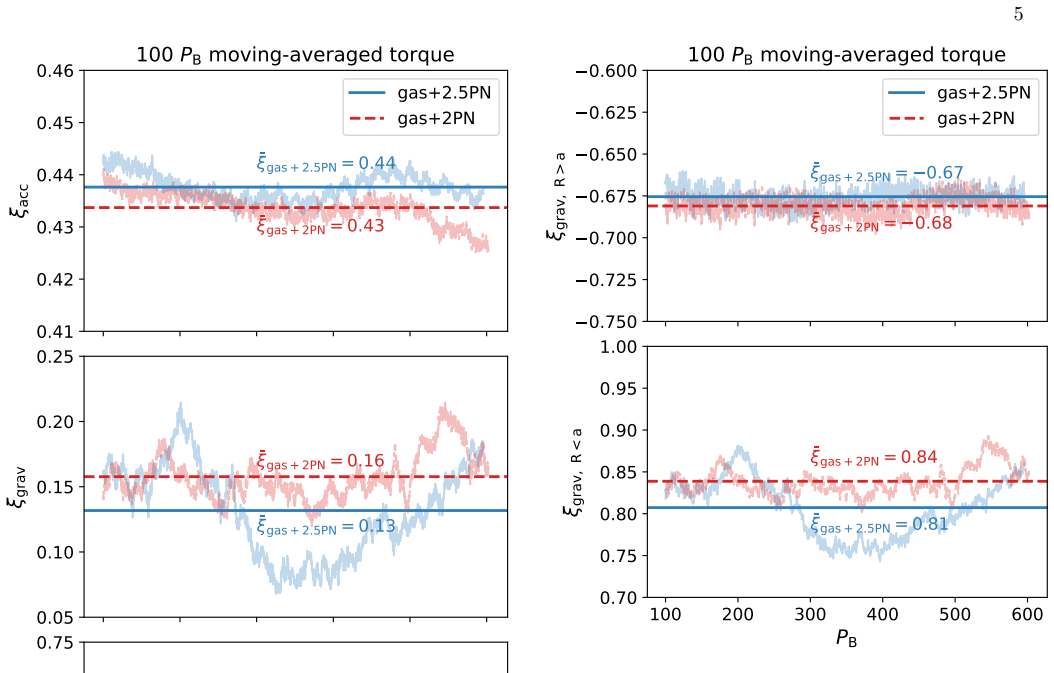
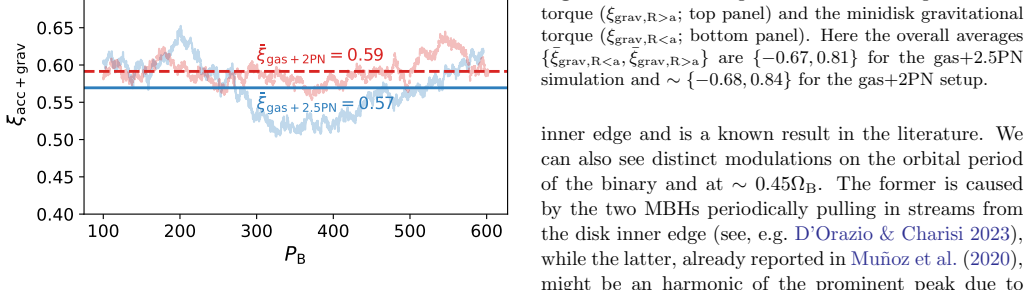
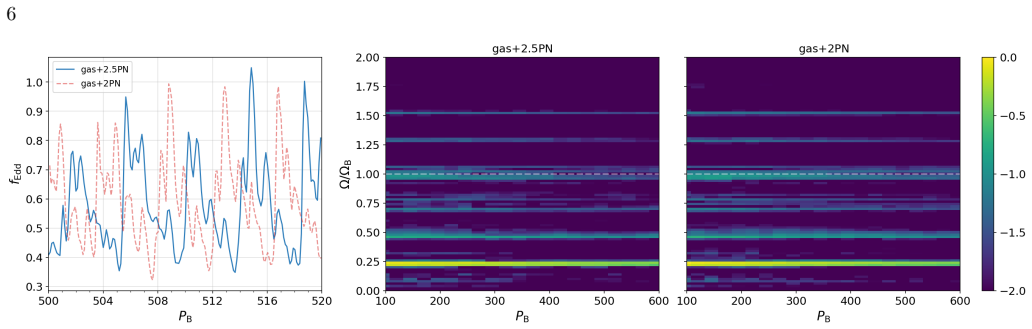
We perform 3D hydrodynamics simulations of an equal-mass quasi-circular live $10^6~{\rm M}_\odot$ massive black hole binary (MBHB) embedded in a prograde, locally isothermal circumbinary disk (CBD) with $0.1$ aspect ratio. The binary evolution is driven by the gaseous torques and its dynamics is described with $2.5$ post-Newtonian corrections. This approach allows us to track the influence of the CBD on a gravitational-wave (GW) driven MBHB inspiral from $55$ to $46$ Schwarzschild radii, i.e., at its early evolution in the LISA band at redshift $z\sim1$. For the first time for the $0.1$ aspect ratio disk, we report the measurement of gravitational and accretion torques with and without concurrent GW emission. We also report how the morphology of the accretion time series onto the MBHB modestly alters when GW emission is the dominant binary evolutionary mechanism. Lastly, we find that the gas-induced orbital phase-shift is $0.12$ rad over $600$ orbital cycles, which LISA should detect at $z=1$. Our results have implications for multi-messenger astronomy, since observation of accretion rate modulation by LSST/Roman surveys and phase-shift by LISA will provide crucial information on the complex environment surrounding MBHBs.
Editorial analysis
A structured set of objections, weighed in public.
Referee Report
Summary. The paper reports 3D hydrodynamical simulations of an equal-mass, quasi-circular 10^6 M_⊙ MBHB embedded in a prograde, locally isothermal circumbinary disk with fixed aspect ratio h=0.1. Using 2.5PN corrections, the authors evolve the binary from 55 to 46 Schwarzschild radii while tracking gaseous torques, accretion, and the resulting orbital phase accumulation. They measure a gas-induced orbital phase shift of 0.12 rad over 600 cycles and conclude that this shift is detectable by LISA at z≈1, with additional implications for multi-messenger observations via accretion modulation.
Significance. If the reported 0.12 rad phase shift is robust, the work provides a concrete, numerically derived prediction for an environmental effect on GW inspiral in the early LISA band. The combination of live 3D hydrodynamics with post-Newtonian binary evolution and the explicit torque measurements (with and without GW emission) strengthens the case for multi-messenger constraints on circumbinary disks. The result is novel for the h=0.1 regime.
major comments (2)
- [Abstract] Abstract: the central claim that LISA can detect the 0.12 rad gas-induced phase shift at z=1 rests on a single simulation with fixed h=0.1, locally isothermal thermodynamics, and the assumption that the binary remains equal-mass and quasi-circular. No tests of alternative thermodynamics, cavity-induced eccentricity growth, or torque sensitivity to these choices are reported, so the numerical value does not automatically generalize.
- [Abstract] Abstract: the 0.12 rad phase shift is stated without accompanying error bars, resolution study, or torque-convergence diagnostics. Because this number is the load-bearing quantitative result for the detectability conclusion, its numerical reliability cannot be assessed from the given information.
minor comments (1)
- [Abstract] Abstract: the phrase 'for the first time for the 0.1 aspect ratio disk' would benefit from a brief comparison sentence to prior work at other aspect ratios to clarify the incremental advance.
Simulated Author's Rebuttal
We thank the referee for the constructive report. Below we address the two major comments point by point. We agree that the reported phase shift is specific to the chosen parameters and that additional numerical diagnostics would strengthen the result. We propose targeted revisions to the abstract and methods to clarify these points without altering the core findings of the single simulation presented.
read point-by-point responses
-
Referee: [Abstract] Abstract: the central claim that LISA can detect the 0.12 rad gas-induced phase shift at z=1 rests on a single simulation with fixed h=0.1, locally isothermal thermodynamics, and the assumption that the binary remains equal-mass and quasi-circular. No tests of alternative thermodynamics, cavity-induced eccentricity growth, or torque sensitivity to these choices are reported, so the numerical value does not automatically generalize.
Authors: The study is deliberately scoped to an equal-mass, quasi-circular binary in a locally isothermal disk with fixed h=0.1, as this regime had not previously been explored with live 3D hydrodynamics coupled to 2.5PN evolution. The 0.12 rad phase shift is therefore reported specifically for these choices. We agree that the numerical value does not automatically generalize to different thermodynamics or to cases with eccentricity growth. In revision we will modify the abstract to state explicitly that the result applies to the simulated setup and to note the limitations for broader application, while retaining the detectability statement for the reported case. revision: yes
-
Referee: [Abstract] Abstract: the 0.12 rad phase shift is stated without accompanying error bars, resolution study, or torque-convergence diagnostics. Because this number is the load-bearing quantitative result for the detectability conclusion, its numerical reliability cannot be assessed from the given information.
Authors: The 0.12 rad value is obtained by direct time integration of the measured gaseous torques (with and without GW emission) over the 600 orbital cycles. No formal resolution study or error bars appear in the current manuscript. We acknowledge that this limits independent assessment of numerical reliability. Performing additional resolution runs is computationally expensive, but we can add a paragraph in the methods section describing the grid resolution, softening lengths, and any internal torque-convergence checks already performed during the production run. We will also qualify the abstract statement to indicate that the quoted phase shift is the measured value from the reported simulation. revision: partial
Circularity Check
No circularity: phase shift is direct numerical output from hydro+PN simulation
full rationale
The central result (0.12 rad gas-induced phase shift over 600 cycles) is reported as a direct measurement from 3D hydrodynamics simulations of an equal-mass quasi-circular MBHB with 2.5PN corrections in a fixed locally isothermal CBD. No equations, fitted parameters, or self-citations are invoked in the provided text to derive this value; it is presented as simulation output. No self-definitional loops, fitted inputs renamed as predictions, or load-bearing self-citations appear in the derivation chain. The result is therefore self-contained against external benchmarks and receives the default non-circularity finding.
Axiom & Free-Parameter Ledger
free parameters (1)
- disk aspect ratio 0.1
axioms (1)
- domain assumption locally isothermal equation of state
Reference graph
Works this paper leans on
-
[1]
2023b, Living Reviews in Relativity, 26, 2, doi: 10.1007/s41114-022-00041-y
Amaro-Seoane, P., Andrews, J., Arca Sedda, M., et al. 2023, Living Reviews in Relativity, 26, 2, doi: 10.1007/s41114-022-00041-y
-
[2]
Armitage, P. J., & Natarajan, P. 2002, ApJL, 567, L9, doi: 10.1086/339770
-
[3]
G., Belgacem, E., Benkel, R., et al
Arun, K. G., Belgacem, E., Benkel, R., et al. 2022, Living Reviews in Relativity, 25, 4, doi: 10.1007/s41114-022-00036-9
-
[4]
2023, Living Reviews in Relativity, 26, 5, doi: 10.1007/s41114-023-00045-2
Auclair, P., Bacon, D., Baker, T., et al. 2023, Living Reviews in Relativity, 26, 5, doi: 10.1007/s41114-023-00045-2
-
[5]
Avara, M. J., Krolik, J. H., Campanelli, M., et al. 2024, ApJ, 974, 242, doi: 10.3847/1538-4357/ad5bda
-
[6]
Barausse, E., Cardoso, V., & Pani, P. 2014, PhRvD, 89, 104059, doi: 10.1103/PhysRevD.89.104059
-
[7]
Bate, M. R., Bonnell, I. A., & Price, N. M. 1995, MNRAS, 277, 362, doi: 10.1093/mnras/277.2.362
-
[8]
Begelman, M. C., Blandford, R. D., & Rees, M. J. 1980, Nature, 287, 307, doi: 10.1038/287307a0
-
[9]
2014, Living Reviews in Relativity, 17, 2, doi: 10.12942/lrr-2014-2
Blanchet, L. 2014, Living Reviews in Relativity, 17, 2, doi: 10.12942/lrr-2014-2
-
[10]
1942, Principles of stellar dynamics (University of Chicago Press)
Chandrasekhar, S. 1942, Principles of stellar dynamics (University of Chicago Press)
1942
-
[11]
Colpi, M., Danzmann, K., Hewitson, M., et al. 2024, arXiv e-prints, arXiv:2402.07571, doi: 10.48550/arXiv.2402.07571
work page internal anchor Pith review Pith/arXiv arXiv doi:10.48550/arxiv.2402.07571 2024
-
[12]
2021, MNRAS, 501, 3540, doi: 10.1093/mnras/staa3976
MacFadyen, A. 2021, MNRAS, 501, 3540, doi: 10.1093/mnras/staa3976
-
[13]
Dittmann, A. J., & Ryan, G. 2022, MNRAS, 513, 6158, doi: 10.1093/mnras/stac935
-
[14]
Dittmann, A. J., Ryan, G., & Miller, M. C. 2023, ApJL, 949, L30, doi: 10.3847/2041-8213/acd183 D’Orazio, D. J., & Charisi, M. 2023, arXiv e-prints, arXiv:2310.16896, doi: 10.48550/arXiv.2310.16896 D’Orazio, D. J., & Duffell, P. C. 2021, ApJL, 914, L21, doi: 10.3847/2041-8213/ac0621 D’Orazio, D. J., Duffell, P. C., & Tiede, C. 2024, ApJ, 977, 244, doi: 10....
-
[15]
Duffell, P. C., Dittmann, A. J., D’Orazio, D. J., et al. 2024, ApJ, 970, 156, doi: 10.3847/1538-4357/ad5a7e
-
[16]
2025, PhRvD, 111, 084006, doi: 10.1103/PhysRevD.111.084006
Duque, F., Kejriwal, S., Sberna, L., Speri, L., & Gair, J. 2025, PhRvD, 111, 084006, doi: 10.1103/PhysRevD.111.084006
-
[17]
Escala, A., Larson, R. B., Coppi, P. S., & Mardones, D. 2004, ApJ, 607, 765, doi: 10.1086/386278
-
[18]
, archivePrefix = "arXiv", eprint =
Farris, B. D., Duffell, P., MacFadyen, A. I., & Haiman, Z. 2014, ApJ, 783, 134, doi: 10.1088/0004-637X/783/2/134 9
-
[19]
2024, A&A, 686, A288, doi: 10.1051/0004-6361/202449206
Franchini, A., Bonetti, M., Lupi, A., & Sesana, A. 2024, A&A, 686, A288, doi: 10.1051/0004-6361/202449206
-
[20]
Franchini, A., Lupi, A., & Sesana, A. 2022, ApJL, 929, L13, doi: 10.3847/2041-8213/ac63a2
-
[21]
Franchini, A., Sesana, A., & Dotti, M. 2021, MNRAS, 507, 1458, doi: 10.1093/mnras/stab2234
-
[22]
2024a, MNRAS, 532, 4060, doi: 10.1093/mnras/stae1764
Garg, M., Derdzinski, A., Tiwari, S., Gair, J., & Mayer, L. 2024a, MNRAS, 532, 4060, doi: 10.1093/mnras/stae1764
-
[23]
Mayer, L. 2022, MNRAS, 517, 1339, doi: 10.1093/mnras/stac2711
-
[24]
2025, ApJ, 993, 145, doi: 10.3847/1538-4357/ae10b4
Garg, M., Franchini, A., Lupi, A., Bonetti, M., & Mayer, L. 2025, ApJ, 993, 145, doi: 10.3847/1538-4357/ae10b4
-
[25]
Garg, M., Mayer, L., Wu, Y., Ali-Ha¨ ımoud, Y., & Lin, D. N. C. 2026, arXiv e-prints, arXiv:2604.20971, doi: 10.48550/arXiv.2604.20971
work page internal anchor Pith review Pith/arXiv arXiv doi:10.48550/arxiv.2604.20971 2026
-
[26]
2024b, MNRAS, 535, 3283, doi: 10.1093/mnras/stae2605
Garg, M., Sberna, L., Speri, L., Duque, F., & Gair, J. 2024b, MNRAS, 535, 3283, doi: 10.1093/mnras/stae2605
-
[27]
Garg, M., Tiede, C., & D’Orazio, D. J. 2024c, MNRAS, 534, 3705, doi: 10.1093/mnras/stae2357
-
[28]
Gong, X., Xu, S., Gui, S., Huang, S., & Lau, Y.-K. 2021, in Handbook of Gravitational Wave Astronomy (Springer Singapore), 24, doi: 10.1007/978-981-15-4702-7 24-1
-
[29]
, archivePrefix = "arXiv", eprint =
Haiman, Z., Kocsis, B., & Menou, K. 2009, ApJ, 700, 1952, doi: 10.1088/0004-637X/700/2/1952
-
[30]
2023, arXiv e-prints, arXiv:2306.14990, doi: 10.48550/arXiv.2306.14990
Haiman, Z., Xin, C., Bogdanovi´ c, T., et al. 2023, arXiv e-prints, arXiv:2306.14990, doi: 10.48550/arXiv.2306.14990
-
[31]
Harris, C. R., Millman, K. J., van der Walt, S. J., et al. 2020, Nature, 585, 357, doi: 10.1038/s41586-020-2649-2
-
[32]
Hopkins, P. F. 2015, MNRAS, 450, 53, doi: 10.1093/mnras/stv195
-
[33]
Hunter, J. D. 2007, Computing in Science & Engineering, 9, 90, doi: 10.1109/MCSE.2007.55 Ivezi´ c,ˇZ., Kahn, S. M., Tyson, J. A., et al. 2019, ApJ, 873, 111, doi: 10.3847/1538-4357/ab042c
-
[34]
2025, ApJ, 988, 43, doi: 10.3847/1538-4357/addecb
Jiang, Y.-F., Blaes, O., Kaul, I., & Zhang, L. 2025, ApJ, 988, 43, doi: 10.3847/1538-4357/addecb
-
[35]
The Astrophysical Journal , author =
Khan, F. M., Just, A., & Merritt, D. 2011, ApJ, 732, 89, doi: 10.1088/0004-637X/732/2/89
-
[36]
Kormendy, J., & Ho, L. C. 2013, ARA&A, 51, 511, doi: 10.1146/annurev-astro-082708-101811
work page internal anchor Pith review doi:10.1146/annurev-astro-082708-101811 2013
-
[37]
2025, Reports on Progress in Physics, 88, 056901, doi: 10.1088/1361-6633/adc9be
Li, E.-K., Liu, S., Torres-Orjuela, A., et al. 2025, Reports on Progress in Physics, 88, 056901, doi: 10.1088/1361-6633/adc9be
-
[38]
Lovelace, R. V. E., & Romanova, M. M. 2014, Fluid Dynamics Research, 46, 041401, doi: 10.1088/0169-5983/46/4/041401
-
[39]
MacFadyen, A. I., & Milosavljevi´ c, M. 2008, ApJ, 672, 83, doi: 10.1086/523869
-
[40]
Classical and Quantum Gravity , archivePrefix = "arXiv", eprint =
Mayer, L. 2013, Classical and Quantum Gravity, 30, 244008, doi: 10.1088/0264-9381/30/24/244008
-
[41]
Milosavljevic, M., & Merritt, D. 2003, AIP Conf. Proc., 686, 201, doi: 10.1063/1.1629432 Mu˜ noz, D. J., Lai, D., Kratter, K., & Miranda, R. 2020, ApJ, 889, 114, doi: 10.3847/1538-4357/ab5d33
-
[42]
Murphy, G. C., & Pessah, M. E. 2015, ApJ, 802, 139, doi: 10.1088/0004-637X/802/2/139 O’Neill, D., Tiede, C., D’Orazio, D. J., Haiman, Z., &
-
[43]
MacFadyen, A. 2025, ApJ, 993, 206, doi: 10.3847/1538-4357/ae0ca8 pandas development team, T. 2020, pandas-dev/pandas:
-
[44]
Pandas, Zenodo, doi: 10.5281/zenodo.3509134
-
[45]
Peters, P. C. 1964, PhD thesis, California Institute of Technology
1964
-
[46]
2011, ApJL, 732, L26, doi: 10.1088/2041-8205/732/2/L26
Preto, M., Berentzen, I., Berczik, P., & Spurzem, R. 2011, ApJL, 732, L26, doi: 10.1088/2041-8205/732/2/L26
-
[47]
Price, D. J., Wurster, J., Tricco, T. S., et al. 2018, PASA, 35, e031, doi: 10.1017/pasa.2018.25
-
[48]
Ragusa, E., Lodato, G., & Price, D. J. 2016, MNRAS, 460, 1243, doi: 10.1093/mnras/stw1081
-
[49]
M., Combi, L., Ripperda, B., & Li, X
Ressler, S. M., Combi, L., Ripperda, B., & Li, X. 2025, ApJL, 993, L22, doi: 10.3847/2041-8213/ae11ab
-
[50]
I., & Sunyaev, R
Shakura, N. I., & Sunyaev, R. A. 1973, A&A, 24, 337
1973
-
[51]
Siwek, M., Ho, M., & Bellinger, E. 2026, arXiv e-prints, arXiv:2605.23006, doi: 10.48550/arXiv.2605.23006
work page internal anchor Pith review Pith/arXiv arXiv doi:10.48550/arxiv.2605.23006 2026
-
[52]
Orbital evolution of binaries in circumbinary discs , volume=
Siwek, M., Weinberger, R., & Hernquist, L. 2023, MNRAS, 522, 2707, doi: 10.1093/mnras/stad1131
-
[53]
Speri, L., Antonelli, A., Sberna, L., et al. 2023, Physical Review X, 13, 021035, doi: 10.1103/PhysRevX.13.021035
-
[54]
Tiede, C., & D’Orazio, D. J. 2024, MNRAS, 527, 6021, doi: 10.1093/mnras/stad3551
-
[55]
Tiede, C., Zrake, J., MacFadyen, A., & Haiman, Z. 2020, ApJ, 900, 43, doi: 10.3847/1538-4357/aba432
-
[56]
2015, , 810, 49, 10.1088/0004-637X/810/1/49
Vasiliev, E., Antonini, F., & Merritt, D. 2015, ApJ, 810, 49, doi: 10.1088/0004-637X/810/1/49
-
[57]
Virtanen, P., Gommers, R., Oliphant, T. E., et al. 2020, Nature Methods, 17, 261, doi: 10.1038/s41592-019-0686-2
-
[58]
2024, MNRAS, 533, 3164, doi: 10.1093/mnras/stae2009
Xin, C., & Haiman, Z. 2024, MNRAS, 533, 3164, doi: 10.1093/mnras/stae2009
-
[59]
Equilibrium Eccentricity of Accreting Binaries , volume=
Zrake, J., Tiede, C., MacFadyen, A., & Haiman, Z. 2021, ApJL, 909, L13, doi: 10.3847/2041-8213/abdd1c
-
[60]
Mayer, L. 2022, MNRAS, 511, 6143, doi: 10.1093/mnras/stac299
-
[61]
Zwick, L., Tiede, C., Trani, A. A., et al. 2024, PhRvD, 110, 103005, doi: 10.1103/PhysRevD.110.103005
-
[62]
Zwick, L., Hendriks, K., O’Neill, D., et al. 2025, PhRvD, 112, 063005, doi: 10.1103/lz7k-bvjf 10 log10Σ[g/cm2] 3 1 2 LR MR HR Figure A1.Same as Fig. 1 but comparing column densities ata= 54.5r s for the gas+2.5PN setup at different resolutions: LR (left panel), MR (middle panel), and HR (right panel). APPENDIX A.RESOLUTION STUDY In this section, we perfor...
discussion (0)
Sign in with ORCID, Apple, or X to comment. Anyone can read and Pith papers without signing in.